Summarize this article with AI
In Brief
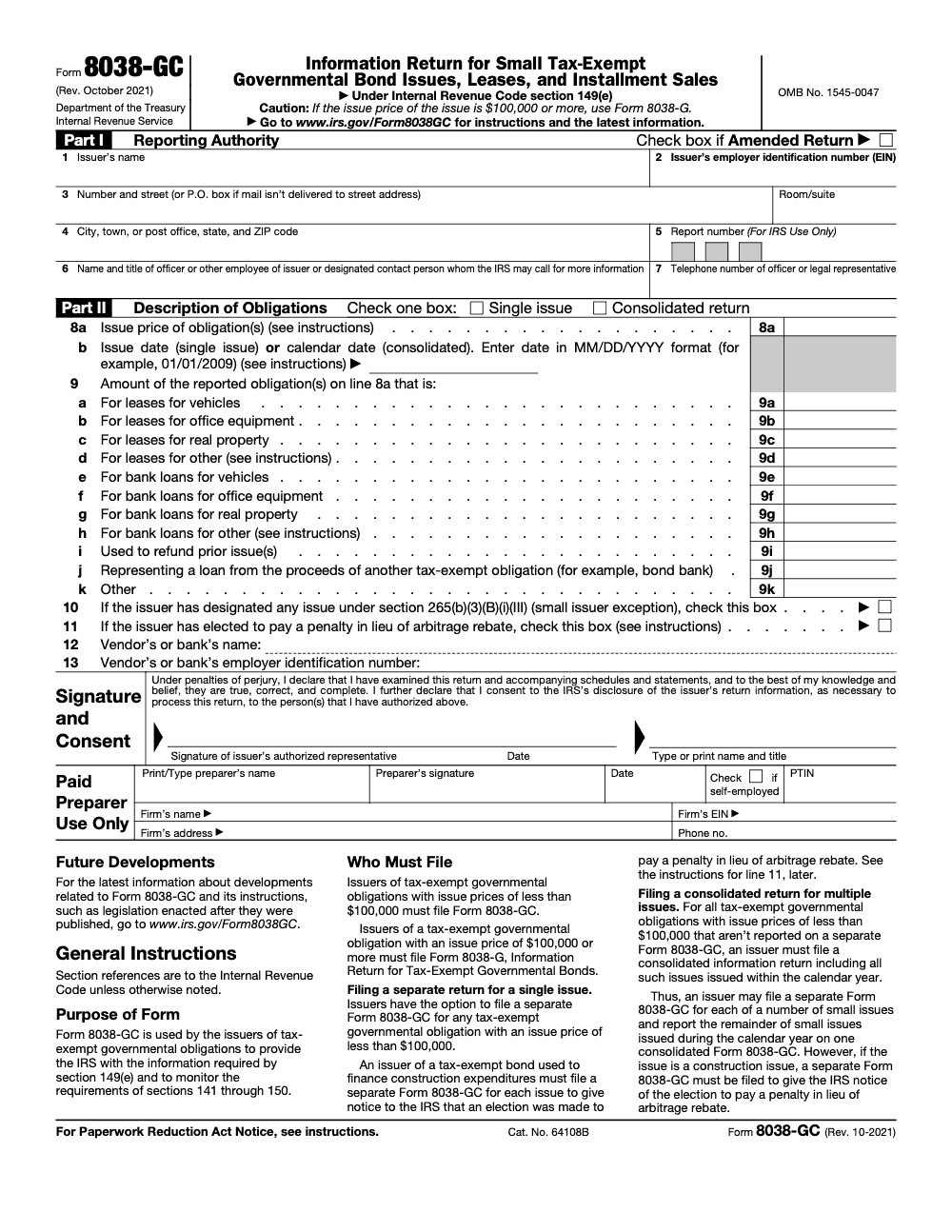
Form 8038-GC is the IRS information return for small tax-exempt governmental obligations with an issue price of less than $100,000 (per IRC §149(e) and the Instructions for Form 8038-GC, Rev. October 2021). Single-issue returns are due by the 15th day of the 2nd calendar month after the close of the calendar quarter in which the obligation was issued; consolidated returns covering all qualifying small issues from the prior calendar year are due February 15. Obligations with an issue price of $100,000 or more report on Form 8038-G instead, and private activity bonds report on Form 8038.
A small governmental issuer borrows a modest amount, signs a municipal lease for a couple of buses or a fire truck, and files nothing because nobody thinks of a lease as a bond. That is exactly where Form 8038-GC trips people up. The form is the information return for small tax-exempt governmental obligations with an issue price under $100,000, and the obligation to file rides on the calendar quarter the debt was issued, not the budget cycle the issuer is watching.
Get the threshold or the timing wrong and the return either goes on the wrong form or goes in late. Cross $100,000 and you owe Form 8038-G instead. Miss the deadline and you are writing a reasonable-cause statement under Rev. Proc. 2002-48. There is no e-file option here, so the return gets mailed to Ogden, UT 84201, and the calendar has to account for paper processing.


Key Takeaways
- Use Form 8038‑GC when each tax‑exempt governmental obligation has an issue price under $100,000. If the issue price is $100,000 or more, use Form 8038‑G, not 8038‑GC.
- You can file per issue or as a consolidated annual return. Per‑issue filings are due on the 15th day of the second month after the close of the quarter of issuance. A consolidated annual 8038‑GC, covering all small obligations you did not file separately, is due by February 15 of the following year.
- Mail the return to the IRS in Ogden, UT 84201. The IRS lists the current “where to file” address for 8038‑GC on its site.
- Late filing relief is available in limited cases. If you miss the deadline, you may request relief under Rev. Proc. 2002‑48 by attaching a reasonable‑cause statement as directed in IRS instructions.
- Electronic filing is not offered for 8038‑GC. The IRS currently accepts e‑filing for 8038‑CP through MeF providers, but 8038‑GC is mailed. Plan your calendar around paper processing.
What Form 8038‑GC actually does
Form 8038‑GC is the IRS information return for small tax‑exempt governmental obligations. Think police cars financed through a bank loan, a short equipment lease, or a small installment sale, each with an issue price under $100,000. The IRS uses the filing to monitor compliance with sections 141 through 150 of the Internal Revenue Code and to keep issuer records current.
Here is the part that trips people up. The 8038‑GC return often sits next to “small issuer” concepts in your head. The form does include a checkbox related to the small‑issuer designation under section 265(b)(3), which deals with bank‑qualified “qualified tax‑exempt obligations.” That designation hinges on a separate rule about your expected total tax‑exempt obligations for the year, generally 10 million or less, and it is not the rule that decides whether you should use 8038‑GC or 8038‑G. Use 8038‑GC because each obligation is under 100,000. Consider the 265(b)(3) designation separately if you qualify.
If you expect to issue 10 million or less in tax‑exempt obligations this calendar year, you may be a “qualified small issuer” for 265(b)(3) purposes, which is relevant to bank‑qualified treatment, not to the 8038‑GC vs 8038‑G form choice.
8038‑G vs 8038‑GC at a glance
Which form do you file?
| Item | 8038‑G | 8038‑GC |
| When to use | Any governmental bond issue with issue price 100,000 or more | Small governmental obligations with issue price under 100,000 |
| Deadline, single issue | 15th day of the second month after quarter of issuance | 15th day of the second month after quarter of issuance |
| Consolidated option | Not applicable | Allowed, due February 15 of the following year |
| Where to file | IRS, Ogden, UT 84201 | IRS, Ogden, UT 84201 |
| E‑file | Not offered | Not offered |
Sources: IRS instructions and IRM.
I like to frame the choice this way for teams. First, look at the issue price. Under 100,000, you are squarely in 8038‑GC. At or above 100,000, move to 8038‑G. Then decide whether to file each small obligation separately by quarter or to bundle the remainder into a clean consolidated 8038‑GC by February 15 of the next year. That single calendar choice keeps filing work lighter without sacrificing control.
How to file Form 8038‑GC, step by step
Here is the fast path you can follow, whether you are the controller, clerk, or the firm reviewer who meets the final deadline.
Pre‑checks before you start
- Confirm each obligation you plan to report on 8038‑GC has an issue price under $100,000.
- Decide filing mode. Will you file a single‑issue 8038‑GC for something issued this past quarter, or will you wait and include it on a consolidated 8038‑GC by February 15 after year end, as permitted by the instructions.
- Calendar the correct due date based on that choice.
Fill out the header and Part I, Reporting Authority
- Issuer name and EIN. Use the governmental issuer’s legal name and EIN. If it is a lease or installment sale, the issuer is the lessee or purchaser. If you do not yet have an EIN, apply, but do not miss your filing window.
- Address and contact. List a contact person whom the IRS may call. This is where IRS notices will go, so be precise.
- Amended return. If you must correct a prior filing, check the box, repeat all of the original return information plus the corrections (the IRS requires the complete original data, not only the changed fields), and attach a brief explanation labeled “Amended Return Explanation.”
Part II, Description of Obligations
- Choose single issue or consolidated return. For a single issue, you will enter the issue date. For a consolidated return, enter January 1 of the calendar year in the date field.
- Line 8a, issue price. Use the rules in section 1.148‑1 to calculate issue price, whether issued for cash or property – do not just enter the face or par amount, which can differ. For cash issues, the issue price is the price at which a substantial amount of the obligations is sold to the public; for property, look to IRC sections 1273 and 1274.
- Lines 9a–9k, categorize the obligation. Indicate if the obligation is a lease for vehicles or equipment, a bank loan, a real property lease, a refunding, or a loan from another tax‑exempt obligation, and provide “other” descriptions where needed.
- Two judgment calls on lines 9a–9k: complete lines 9a–9d only when property other than cash is exchanged for the obligation (a true municipal lease) – if proceeds came in as cash, skip 9a–9d even when the deal is titled a lease. And the 9a–9k buckets are not mutually exclusive; the same dollars can land on more than one line (for example, refunding loans from another tax‑exempt obligation belong on both 9i and 9j).
- Line 10, small issuer designation. Check this box if you designated an issue under section 265(b)(3). Remember, that designation hinges on the 10 million qualified small issuer rule in the Code.
- Line 11, penalty election for construction issues. If applicable, indicate the election to pay a penalty in lieu of arbitrage rebate for a construction issue, an election described in section 148(f)(4)(C) and referenced by the form (the election must have been made irrevocably on or before the bond issuance date; any construction issue with this election must be filed on its own separate Form 8038‑GC and cannot be rolled into a consolidated year-end return; and the penalty payments themselves are remitted every six months on Form 8038‑T, never with Form 8038‑GC).
- Lines 12–13, vendor or bank information. Provide the name and EIN of the vendor or bank that is a party to the lease, installment purchase, or loan. If more than one vendor or bank is involved, attach a schedule listing all of them rather than naming just one on lines 12 or 13.
Sign and mail
- Signature. An authorized officer must sign, and by signing the return that officer also consents to IRS disclosure of return information to any third-party contact listed on line 6. Paid preparer rules apply only when a paid third-party preparer completes the return; full-time employees of the issuer (clerks, secretaries) and unpaid preparers must not sign the Paid Preparer block, and paid preparers must use a PTIN rather than a Social Security number.
- Where to file. Mail Form 8038‑GC to the IRS in Ogden, UT 84201. Keep proof of mailing.
- Acknowledgement. Expect a CP152 notice as the official confirmation that the IRS received your Form 8038 series return.
Filing deadlines you can post on your wall
| Filing type | Covers | Due date |
| Single‑issue 8038‑GC | One obligation under 100,000 | 15th day of the second month after the close of the quarter in which it was issued |
| Consolidated 8038‑GC | All small obligations under 100,000 not separately filed for that calendar year | February 15 of the following calendar year |
Authority: IRS IRM and the 8038‑GC instructions.
Pro move: If you like clean quarters, file per issue. If you prefer one tidy package, plan your year and use the February 15 consolidated option. Both paths are valid.
A quick word on e‑file expectations. As of now, only Form 8038‑CP is set up for electronic filing through authorized MeF providers, and many issuers are required to e‑file that form if they meet the 10‑return threshold. 8038‑GC is still a mailed paper return. This matters for planning, because mailroom delays can affect acknowledgement timing.
Compliance, records, and the mistakes that trigger IRS questions
You do not file 8038‑GC in a vacuum. You file it to support tax‑exempt status and to keep a clear trail for future audits or refundings. Here is how to stay audit‑ready without drowning in paperwork.
Recordkeeping that stands up in a review
- Keep a copy of each filed 8038‑GC, your calculation of issue price, the financing agreement or lease, and any bank term sheets. Tie these to a central index by report number and calendar year so anyone on your team can find them fast.
- Maintain spending logs that show dates, payees, and amounts, especially if you made a construction‑issue penalty election in lieu of rebate. Track investment earnings and note any timing that could affect arbitrage.
- Store vendor or bank EIN support because it flows onto lines 12 and 13, and it is a common follow‑up item in correspondence.
- Save your CP152 acknowledgement with the return workpapers so you can answer processing questions in minutes.
The four errors I see most, and how to avoid them
- Using the wrong form. Filing 8038‑GC for an obligation with a 100,000 or higher issue price will invite a correction. If you cross that threshold, use 8038‑G.
- Missing the right deadline. Teams remember the quarterly due date but forget the consolidated February 15 option, or vice versa. Put both on your calendar.
- Confusing “small issuer” with “small obligation.” The 265(b)(3) small issuer rule is about your total expected tax‑exempt obligations for the calendar year, generally 10 million or less, and it affects bank‑qualified designation. It does not decide whether you use 8038‑GC.
- Mailing to an old address or assuming e‑file is available. Use the current Ogden address from the IRS site and plan for paper processing.
Late filing and how to fix it
If something slips, the IRS provides a path. You can request relief for a late 8038‑GC if the failure to file timely was not due to willful neglect. Print at the top “Request for Relief under section 3 of Rev. Proc. 2002‑48,” attach a short letter that explains reasonable cause, indicate whether the obligation is currently under IRS examination, and mail to the listed Ogden address. Do not attach copies of the bond, lease, or installment-sale documents; the IRS instructions specifically tell filers not to submit those with the relief request. Keep a copy with your records.
Practical tip: If you missed a single‑issue filing, consider whether a consolidated filing will cover it by February 15. If not, do not wait. File the single‑issue return with your relief request now.
Why discipline pays off for firms
When your firm builds a standard checklist for small obligations, you reduce review time and avoid the “where is the EIN” scramble. In our experience working with accounting teams, the firms that number their reports consistently and attach the CP152 notice to their digital workpaper set close their quarter faster and respond to IRS notices with less stress. If you support multiple local governments or special districts, consistency is your edge.
For firms that are scaling municipal work and feel stretched during filing windows, a structured offshore delivery partner can keep workpapers clean and deadlines predictable without losing control of the process. Accountably integrates trained staff into your flow, with SOPs, layered review, and Ogden‑ready filing packages when you need capacity without chaos. Use this only if it fits your practice and the security standards you require.
Common Mistakes We See Every Season
Across calendar quarters and year-end consolidated runs, the same handful of mistakes show up on Form 8038-GC. They cost reviewer time during the filing window and surface as IRS follow-up months after the bonds close.
Reusable Checklists
Drop these into your firm's bond compliance binder or copy them straight into the engagement workpapers. Each list maps to a real decision point on Form 8038-GC.
Pre-filing review (single-issue return)
- Confirm the issue price is less than $100,000 under Treasury Reg §1.148-1(b) or IRC §§1273-1274.
- Verify the issuer on line 1 is the governmental entity (lessee or purchaser in a lease or installment sale), not the bank or vendor.
- Enter the actual issue date on line 8b in MM/DD/YYYY format.
- Walk the issue through every line 9 category; overlapping categories repeat the same dollar amount.
- Leave line 5 (Report number) blank; the IRS fills it in.
- If proceeds qualify under IRC §265(b)(3)(B)(i)(III), check line 10.
- For multiple vendors or banks, attach a schedule and reference it from lines 12 and 13.
- Confirm the authorized representative signing line 6 has authority to consent to IRS disclosure for any designated contact.
- Mail to Department of the Treasury, Internal Revenue Service Center, Ogden, UT 84201 by the 15th day of the 2nd month after the close of the calendar quarter.
Consolidated year-end return (due February 15)
- Pull every tax-exempt governmental obligation issued in the prior calendar year with an issue price below $100,000.
- Exclude any issue where line 11 (penalty in lieu of arbitrage rebate) is elected; each of those files on its own Form 8038-GC.
- Use good-faith estimates where readily available year-end information is incomplete; the instructions permit this for consolidated returns.
- Enter 01/01 of the reporting calendar year on line 8b (for example 01/01/2025 for the 2025 return).
- Sum line 8a issue prices with cents included; round only the total.
- Map aggregate amounts across lines 9a-9k; remaining amounts fall to 9k as the residual.
- Confirm address changes since the last filing were communicated on Form 8822.
- Mail to the Ogden, UT service center by February 15.
Late-filing relief packet under Rev. Proc. 2002-48
- Write "Request for Relief under section 3 of Rev. Proc. 2002-48" across the top of Form 8038-GC.
- Complete the form with all required information as if it were timely.
- Attach a brief letter stating why the form was not submitted on time.
- State explicitly whether the obligation is under IRS examination.
- Do not attach bond, lease, or installment-sale documents; the instructions prohibit this.
- Confirm the failure to file was not due to willful neglect before requesting relief.
- Retain a copy with the workpapers in case the IRS requests follow-up.
Keep 8038-GC Season From Stalling
Small-issuer bond compliance is one of the easier files to under-staff. Form 8038-GC has a quarterly cadence for single issues (the 15th day of the 2nd calendar month after the close of the calendar quarter) and an annual consolidated cadence (February 15 of the following year). Per the Instructions for Form 8038-GC (Rev. October 2021), each construction issue with a line 11 penalty election also has to file on its own paper, which means one client with four small leases and one penalty election can produce five separate returns in a year.
The fix is not more hours. It is a stable workflow that catches the threshold, the dates, and the line 9 categories before the return leaves the firm. The recurring failure points are predictable; treating them as a checklist instead of judgment calls is what keeps the cadence steady.
- Confirm the $100,000 issue price threshold every time. Anything at or above moves to Form 8038-G; private activity bonds move to Form 8038.
- Pull each line 11 construction-penalty issue onto its own return; the consolidated return is for non-election small issues only.
- Pin line 8b dates by filing type: the actual issue date for single-issue returns, 01/01 of the calendar year for consolidated returns.
- Walk every issue through lines 9a-9k; treat them as overlapping categories rather than mutually exclusive picks, with 9k holding the residual.
- Track line 12-13 vendor and bank attachments so multi-party financings get a complete schedule instead of a single named party.
Accountably builds these review gates directly into the engagement so the same return goes out the same way every quarter. Our tax outsourcing teams work the 8038-GC cadence as a standing workflow, with the threshold check, the line 9 walk, and the Ogden mailing documented in the SOP.
FAQs
It is the information return issuers file for small tax‑exempt governmental obligations with an issue price under $100,000. The IRS uses it to monitor compliance under sections 141–150 of the Code.
File by the 15th day of the second month after the close of the calendar quarter in which the obligation was issued. For example, an obligation issued on October 20 is due by February 15.
Yes. You can file a consolidated annual 8038‑GC that includes all small obligations not reported on separate returns. The consolidated filing is due by February 15 of the following year.
Mail to the IRS in Ogden, UT 84201. Check the IRS “where to file” page before you send, since addresses can update.
No. The IRS currently offers electronic filing for Form 8038‑CP through approved MeF providers, but not for 8038‑GC. Plan for paper mailing and keep proof of timely submission.
A CUSIP is not a field on 8038‑GC. You report the issue price and categorize the obligation on lines 9a–9k. Follow the form’s categories for leases, loans, refundings, and related items.
That box relates to the section 265(b)(3) designation for “qualified tax‑exempt obligations,” commonly called bank‑qualified. It depends on whether you reasonably expect to issue 10 million or less in tax‑exempt obligations in the calendar year, with certain aggregation rules. It does not control whether you use 8038‑GC.
The IRS sends a CP152 series notice acknowledging receipt of the Form 8038 series return. Keep it with your workpapers in case you need to contact Customer Accounts Services.
Yes. You can request relief under Rev. Proc. 2002‑48 with a brief reasonable‑cause statement attached to the late 8038‑GC. Follow the language in the instructions and mail to Ogden.
Other forms this guide names
- Form 8038-G: Filing Guide, Due Dates, and Instructions
- Form 8038‑T: Complete Filing Checklist for Rebate and Penalties
Summarize this article with AI
About this guide
Accountably helps US CPA, EA, and accounting firms hire trained accountants and tax preparers in India.
About us Reviewed byJugal Thacker, CPAFounder and CEO at Accountably
A Washington-licensed CPA with 7+ years inside US firms – PwC, a real-estate tax practice, then a full-service firm, rising from reviewer to manager to advisory. This article was reviewed against current IRS guidance for the 2025 tax year and updated for filers preparing late returns, amendments, and 2026 estimates.
View profile →How we research, review, and update this guide
Every Accountably guide is researched against primary IRS sources, reviewed by a U.S. CPA, and refreshed as guidance evolves. Read our Editorial Guidelines to see how we source, fact-check, and update our content.