Summarize this article with AI
In Brief
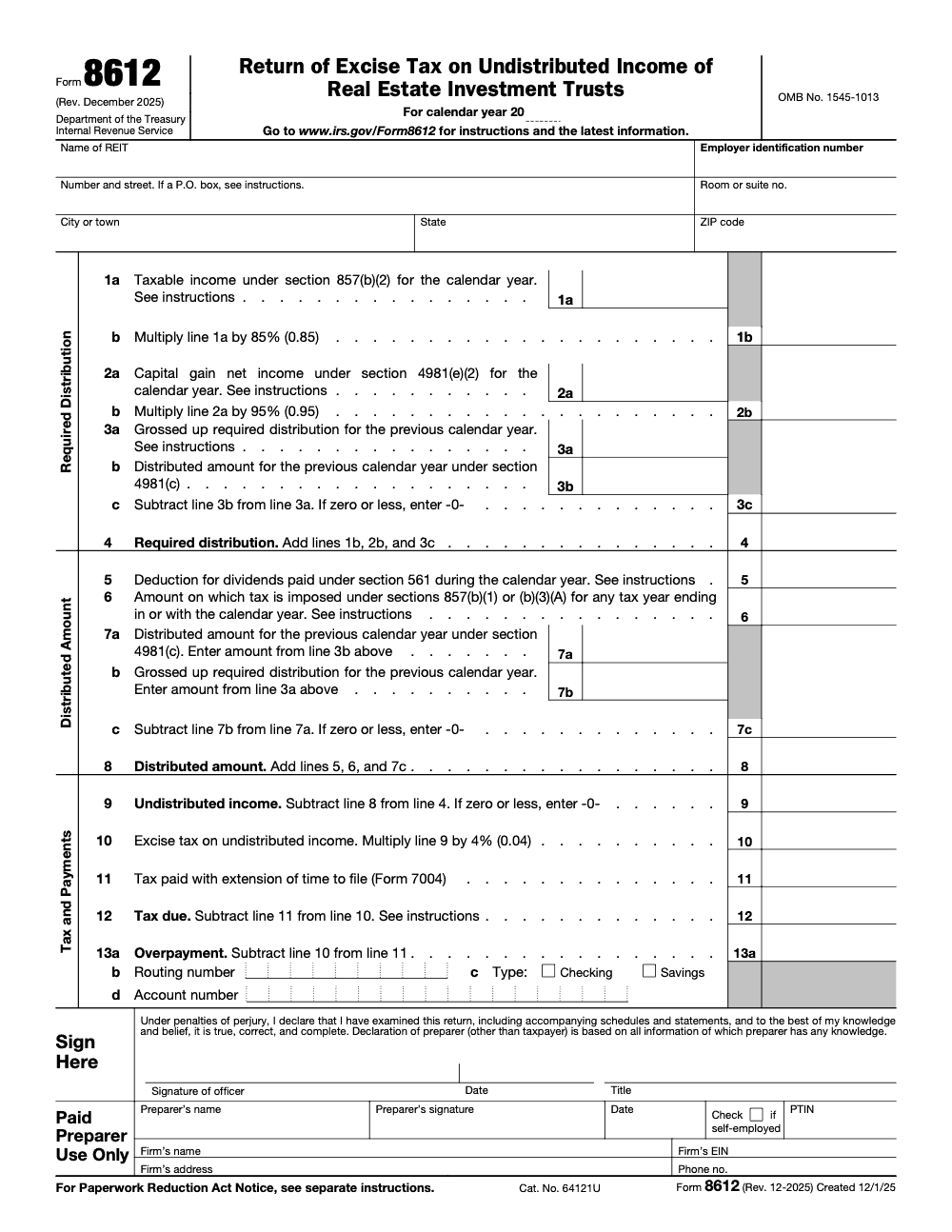
Form 8612 is the REIT's annual excise tax return for undistributed income under IRC §4981 – the 4% rate applies to line 9 (the gap between line 4 required distribution and line 8 distributed amount), where required distribution equals 85% of ordinary taxable income plus 95% of capital gain net income (per Form 8612 instructions, Rev. December 2025). Calendar-year 2025 returns are due March 16, 2026 (March 15 falls on a Sunday); Form 7004 grants a 6-month filing extension to September 15, 2026 but does NOT extend time to pay.
A REIT controller called the second week of March because her §4981 excise calculation was off by a wide margin. Her team had counted §858 throwback dividends in the distributed amount, the way they would for the qualification distribution test. The statute tells you to determine the distributed amount without regard to §858, so those dollars never belonged on Form 8612 in the first place.
Form 8612 reports the 4% excise tax on a REIT's undistributed income, measured as the gap between line 4 required distribution and line 8 distributed amount. Required distribution generally runs 85% of ordinary taxable income plus 95% of capital gain net income, and calendar-year 2025 returns are due March 16, 2026 because March 15 falls on a Sunday. A Form 7004 extension moves the filing date but not the payment date.
Key Takeaways
- The Form 8612 excise tax equals 4 percent of the excess of the year’s required distribution over the year’s distributed amount. Required distribution generally means 85 percent of ordinary income plus 95 percent of capital gain net income, with a prior‑year shortfall adjustment.
- For the distributed amount, count the actual dividends paid during the calendar year using the dividends paid deduction rules, but ignore the throwback provisions of section 858. Dividends declared in October, November, or December and paid in January can still be treated as paid on December 31 for dividends paid purposes.
- Form 8612 is a separate excise return. The tax for calendar year 2025 is due March 16, 2026 (March 15 falls on a Sunday), and you can request a filing extension on Form 7004, although the extension does not extend time to pay.
- Keep evidence for every adjustment, from capital gains designations to reconciliation of dividends paid with Forms 1099‑DIV. Your documentation should tie to Form 1120‑REIT schedules and board actions.
What Form 8612 Actually Does
Form 8612 is the REIT’s return to compute and pay the calendar‑year excise tax on undistributed income under section 4981. The math is straightforward, but the inputs are not. The form compares the required distribution, which is set by statute, to what you actually distributed for that same calendar year, then applies the 4 percent rate to any shortfall. You pay this excise by March 15 of the following year (March 16, 2026 for calendar year 2025, since March 15 falls on a Sunday).
- Required distribution is a combined target. It equals 85 percent of ordinary income plus 95 percent of capital gain net income, each computed on a calendar‑year basis, and it is increased by any prior‑year shortfall under the gross‑up rules.
- Distributed amount is the sum of the REIT’s dividends paid deduction amounts for that calendar year, adjusted as section 4981 requires, plus certain amounts already taxed at the REIT level for a taxable year that ends in the calendar year. The statute then adds an overdistribution carryforward from the prior year.
Here is the nuance that catches people. For excise purposes, the statute tells you to determine dividends paid during the calendar year without using section 858. That means the familiar throwback election that helps you meet the 90 percent qualification test does not help you reduce the excise, because the excise ignores those post‑year distributions treated as prior‑year under section 858. However, dividends declared in October, November, or December and paid in January can still count as paid on December 31 under section 857(b)(9) for dividends paid deduction purposes, and therefore can flow into the distributed amount calculation. Timing, wording on the board resolution, and the shareholder record date matter.
Who Should Care, And Why
- If you are a REIT CFO, controller, tax director, or outside firm preparing the return, Form 8612 is your calendar‑year stress test. It measures whether cash left the door soon enough to meet a statutory distribution target.
- If you are planning cash conservatively, the excise tax can be a sensible price for liquidity. If you are surprised by it, you probably missed a sequencing rule, a December declaration opportunity, or a booking error that reduced your dividends paid deduction.
In my experience, the fastest way to derail a clean 8612 is to assume that every post‑year dividend counts. It does not. Get the definitions right, then build your calendar around them. For the 2025 calendar year, that means your payment deadline is March 16, 2026 (March 15 falls on a Sunday), and your internal checkpoint for December‑declared dividends is the board meeting window in the last quarter.
How To Compute Form 8612, Step By Step
Step 1, Pin Down Ordinary Income And Capital Gain Net Income
- Compute REIT ordinary income from section 857(b)(2) for the calendar year, then take 85 percent.
- Compute capital gain net income for the calendar year under section 4981(e)(2) (do not just lift the §1222 net capital gain figure from Form 1120‑REIT, which can differ), then take 95 percent, after any reduction for net ordinary loss.
- Add the prior‑year shortfall adjustment, which compares last year’s grossed‑up required distribution to last year’s distributed amount.
Shortcut you can trust, required distribution is 85 percent of ordinary income plus 95 percent of capital gain net income, with the required prior‑year adjustment layered in.
Step 2, Determine The Distributed Amount
- Start with the dividends paid deduction actually available for the calendar year under section 561.
- Include December‑declared, January‑paid dividends, because section 857(b)(9) treats them as paid on December 31 for dividends paid purposes.
- Do not include section 858 throwback dividends, because section 4981 tells you to calculate dividends paid without regard to section 858.
- Add any amounts taxed at the REIT level for a taxable year that ends in the calendar year, and add the overdistribution carryforward.
Step 3, Apply The 4 Percent Rate
If required distribution exceeds the distributed amount, multiply the difference by 4 percent. Book it as a nondeductible excise. Pay by March 15 of the following year (March 16, 2026 for calendar year 2025, since March 15 falls on a Sunday).
A Simple Illustration
- Ordinary income, 120, capital gain net income, 40.
- Required distribution, 0.85 × 120 = 102, plus 0.95 × 40 = 38, total 140.
- Dividends paid during the calendar year, 135, including a dividend declared December 15 and paid January 10 that is treated as paid December 31.
- Excise base, 140 minus 135 = 5.
- Excise tax, 4 percent × 5 = 0.2. Pay 0.2 by March 15.
Timing Rules That Prevent Headaches
What Counts For Excise, January Payments And The “December Declaration” Rule
- January payments of dividends declared in October, November, or December count as paid on December 31 for dividends paid purposes, so they can reduce the excise base. Your board minutes and shareholder record date need to reflect this.
- Section 858 throwback dividends, where you declare by the return due date and pay later in the next 12 months, can help you meet the 90 percent REIT qualification distribution requirement, but they do not reduce the Form 8612 excise calculation. That distinction is exactly what section 4981(c)(3) imposes.
Filing And Paying
- Due date, March 15 following the calendar year. For calendar year 2025, pay by March 16, 2026 (March 15 falls on a Sunday). The §4981 excise is a single annual liability – there is no quarterly estimated deposit regime like corporate income tax.
- Form 8612 is processed as its own return in IRS systems. You can request an extension to file on Form 7004, but you still must pay by March 15 – failure‑to‑pay penalty and §6621 interest both keep accruing from the original March 15 due date on any unpaid tax, even with a timely Form 7004. Keep your EFTPS confirmation.
Documentation, Controls, And What To Retain
You want an audit‑ready trail from your GL to Form 8612. That includes:
- A reconciliation from taxable income to ordinary income and capital gain net income on a calendar‑year basis.
- A dividends paid rollforward that ties to board approvals, record dates, pay dates, cash proof, and shareholder counts.
- A schedule linking dividends paid to Forms 1099‑DIV and any capital gain designations, plus any Form 2439 if you retained long‑term gains.
- Evidence for December declaration minutes and January payments, plus any deficiency dividends and related interest if used.
Quick Comparison Table
| Item | Counts in distributed amount for Form 8612? | Why |
| Dividends paid March 1 to December 31 | Yes | Paid in the calendar year, included in dividends paid deduction. |
| Dividends declared in Dec, paid in January | Yes | Treated as paid on December 31 under section 857(b)(9). |
| Section 858 throwback dividends paid later in the next year | No | Excise ignores section 858 for dividends paid. |
| Amounts taxed at the REIT level for a taxable year ending in the calendar year | Yes | Included by statute in distributed amount. |
| Deficiency dividends under section 860 | Count when paid | Excise takes deficiency dividends into account when paid. |
Where Operations Can Save Your Tax Day
If your internal team or external firm struggles with uneven workpapers, missing approvals, or unclear review notes, the excise math can be right while the evidence is not. That is where disciplined delivery helps. At Accountably, we integrate trained offshore teams into your workflow in a way that protects review time, file naming, and version control, so your December‑to‑January dividend actions are documented and traceable. We mention this because clean delivery lowers your risk, not because outsourcing is a shortcut. Use it only if it truly improves your control.
Common Pitfalls And How To Avoid Them
Misreading What “Distributed Amount” Means
Treating every post‑year distribution as if it counts for excise is the classic miss. Remember, the excise calculation ignores section 858 throwbacks. Align your plan with section 857(b)(9) and your board calendar. A simple December board meeting can move a January payment into the prior year’s distributed amount.
Waiting On Cash Until After Year End
Some REITs accept the excise as a liquidity tool, which is fine if it is intentional. If not, model the 4 percent cost against the borrowing you would need to pay in December. Put the choice in front of the board with clear numbers, then minute the decision.
Disconnects Between Tax And Investor Reporting
Your Form 8612 schedule should tie cleanly to Form 1120‑REIT’s dividends paid deduction and to shareholder tax reporting. If you retain long‑term capital gains, make sure Form 2439 and basis adjustments are reflected in your investor communications and your workpapers. The story must be consistent across tax, finance, and IR.
Your Year‑End Checklist
- Lock the calendar. Confirm the last board meeting in December, the shareholder record dates, and the earliest practical January pay date if needed.
- Update the cash plan. Decide whether to pull forward a payment or accept the excise, with the cost quantified.
- Refresh the dividend rollforward. Tie every dividend to minutes, notices, pay files, and bank proof.
- Reconcile income. Build the calendar‑year ordinary income and capital gain net income schedules that support the required distribution.
- Prepare Form 8612 early. Draft the form, compute the liability, and line up the March 15 payment process and backup approver.
Final Word, And A Helpful Partner If You Need One
Form 8612 is short, but the definitions behind it are not. If you treat it as a calendar exercise and not a documentation exercise, you will eventually pay an excise you did not plan. Build a tight calendar, declare in December when needed, and prove every figure from the GL to the shareholder notices. If you want extra hands that work inside your systems and keep the paper trail clean without slowing your team, our crew at Accountably can help you operationalize the workpapers, review layers, and December board cadence that make this form uneventful.
Common Mistakes We See Every Season
Every REIT excise engagement we touch surfaces the same handful of mistakes – they cluster in the dividends-paid math, the calendar-year frame, and the Form 7004 extension confusion. Here are the six we catch most often, with the SOP-style fix.
Reusable Checklists
These three checklists slot straight into a firm SOP – we use the same skeleton on every REIT engagement. Copy them, rename them for the client, and check them off as the workpaper takes shape.
Calendar-year close packet (lines 1a-4)
- Pull §857(b)(2) ordinary income on a strict calendar-year basis for line 1a.
- Pull §4981(e)(2) capital gain net income for the calendar year (not the §1222 figure from Form 1120-REIT) for line 2a.
- Compute 85 percent of line 1a for line 1b and 95 percent of line 2a for line 2b.
- Confirm the grossed-up prior-year required distribution on line 3a (prior-year required distribution increased by prior-year excise tax paid).
- Pull the prior-year distributed amount under §4981(c) for line 3b.
- Net lines 3a and 3b for line 3c (enter -0- if line 3b is greater than or equal to line 3a).
- Sum lines 1b, 2b, and 3c for line 4, the required distribution.
§561 dividends-paid roll-forward (lines 5-8)
- List every cash distribution paid during the calendar year by pay date.
- Add consent dividends with shareholder consents on file.
- Add dividends declared in October, November, or December and paid the following January (the spillover rule).
- Exclude every §858 throwback dividend – these do not count for line 5.
- Total to line 5 and reconcile against the dividends-paid deduction on Form 1120-REIT (the two can differ).
- Add line 6 for amounts taxed at the REIT level under §857(b)(1) or §857(b)(3)(A) for a tax year ending in the calendar year.
- Pull line 7c from the prior-year carryforward worksheet (positive only if the prior year over-distributed).
- Sum lines 5, 6, and 7c for line 8, the distributed amount.
March 15 payment and extension review (lines 9-13)
- Subtract line 8 from line 4 for line 9 undistributed income (enter -0- if zero or less).
- Multiply line 9 by 4 percent (0.04) for line 10 excise tax.
- If the REIT cannot file by the calendar-year 2025 due date of March 16, 2026 (March 15 falls on a Sunday), file Form 7004 by the original due date.
- Pay any estimated excise with the Form 7004 to stop the 0.5 percent failure-to-pay penalty and §6621 interest – the extension covers filing only, not payment.
- Post the estimated payment to line 11 and compute tax due on line 12 (or overpayment on line 13a) when the final return is filed.
- For direct deposit of an overpayment, complete line 13b routing number, line 13c account type, and line 13d account number.
- File the final Form 8612 by the extended due date (September 15, 2026 for the calendar-year 2025 return) if Form 7004 was filed.
- Confirm the minimum failure-to-file penalty exposure ($510 for returns due in 2026) is logged in the engagement file if the return slips past the extended date.
Keep 8612 Season From Stalling
Form 8612 sits in a quiet corner of REIT compliance until the calendar flips to March. The §4981 excise is calendar-year only, even for fiscal-year REITs filing Form 1120-REIT, and the math depends on prior-year close figures the income-tax team may not have locked yet (per Form 8612 instructions, Rev. December 2025). Layer on a Sunday-shift due date for calendar-year 2025 (March 16, 2026) and a $510 minimum failure-to-file penalty under IRC §6651(a), and a routine excise check turns into a fire drill.
The fix is not more hours in March – it is a documented prior-year close, a clean §561 ledger, and a workpaper that mirrors lines 3 and 7 of the form so reviewers can see the shortfall or over-distribution at a glance.
- Lock the §4981(e)(2) calendar-year capital gain net income separately from the §1222 net capital gain that lands on Form 1120-REIT – the two figures can differ, and pulling the wrong one is one of the most common line 2a errors.
- Build a §561 dividends-paid roll-forward that captures cash distributions, consent dividends, and §858 spillover dividends declared in October, November, or December and paid in January – line 5 understatement is the most common cause of an inflated line 9.
- Use a single carryforward worksheet for lines 3a, 3b, 3c, 7a, 7b, and 7c so that only one of line 3c or line 7c is positive in a given year – never both, since the form uses them in mirror fashion.
- Pay any estimated excise with Form 7004 and post it to line 11 to stop the failure-to-pay penalty and §6621 interest from the original March 15 due date – the 6-month extension covers filing only.
- Confirm the grossed-up required distribution on lines 3a and 7b reflects the prior-year required distribution increased by prior-year excise tax paid, not the raw prior-year distribution figure.
That is the operating shape Accountably's tax delivery brings to REIT engagements – a documented close, a standardized §4981 workpaper, and a reviewer ready when the year-end ledger lands, not after the deadline.
FAQs
No. For REITs, the distributed amount is based on dividends paid during the calendar year, and the statute specifically tells you to ignore section 858 for this purpose. December‑declared, January‑paid dividends can still be treated as paid on December 31 under section 857(b)(9), which is why board timing matters.
The excise for a calendar year is due by March 15 of the following year (March 16, 2026 for calendar year 2025, since March 15 falls on a Sunday). Form 8612 is a separate excise return in IRS processing, and you may request a filing extension on Form 7004, but the extension does not extend time to pay.
Required distribution equals 85 percent of REIT ordinary income plus 95 percent of capital gain net income for the calendar year, and it is increased by the prior‑year shortfall under the gross‑up rule.
Yes, but only when paid. Deficiency dividends are taken into account for the excise in the year they are actually paid, even though they may relate to a prior period for other purposes.
No. Section 4981 requires that dividends paid for excise be determined without regard to section 858. Use the December declaration rule where appropriate, and plan ahead if you need liquidity flexibility.
Other forms this guide names
- Form 7004: Business Tax Extension Guide, Deadlines & E‑File
- Form 1099-DIV: guide, boxes and deadlines
- Form 2439: Report Undistributed Capital Gains, Claim the Credit
About this guide
Accountably helps US CPA, EA, and accounting firms hire trained accountants and tax preparers in India.
About us Reviewed byJugal Thacker, CPAFounder and CEO at Accountably
A Washington-licensed CPA with 7+ years inside US firms – PwC, a real-estate tax practice, then a full-service firm, rising from reviewer to manager to advisory. This article was reviewed against current IRS guidance for the 2025 tax year and updated for filers preparing late returns, amendments, and 2026 estimates.
View profile →How we research, review, and update this guide
Every Accountably guide is researched against primary IRS sources, reviewed by a U.S. CPA, and refreshed as guidance evolves. Read our Editorial Guidelines to see how we source, fact-check, and update our content.