Summarize this article with AI
In Brief
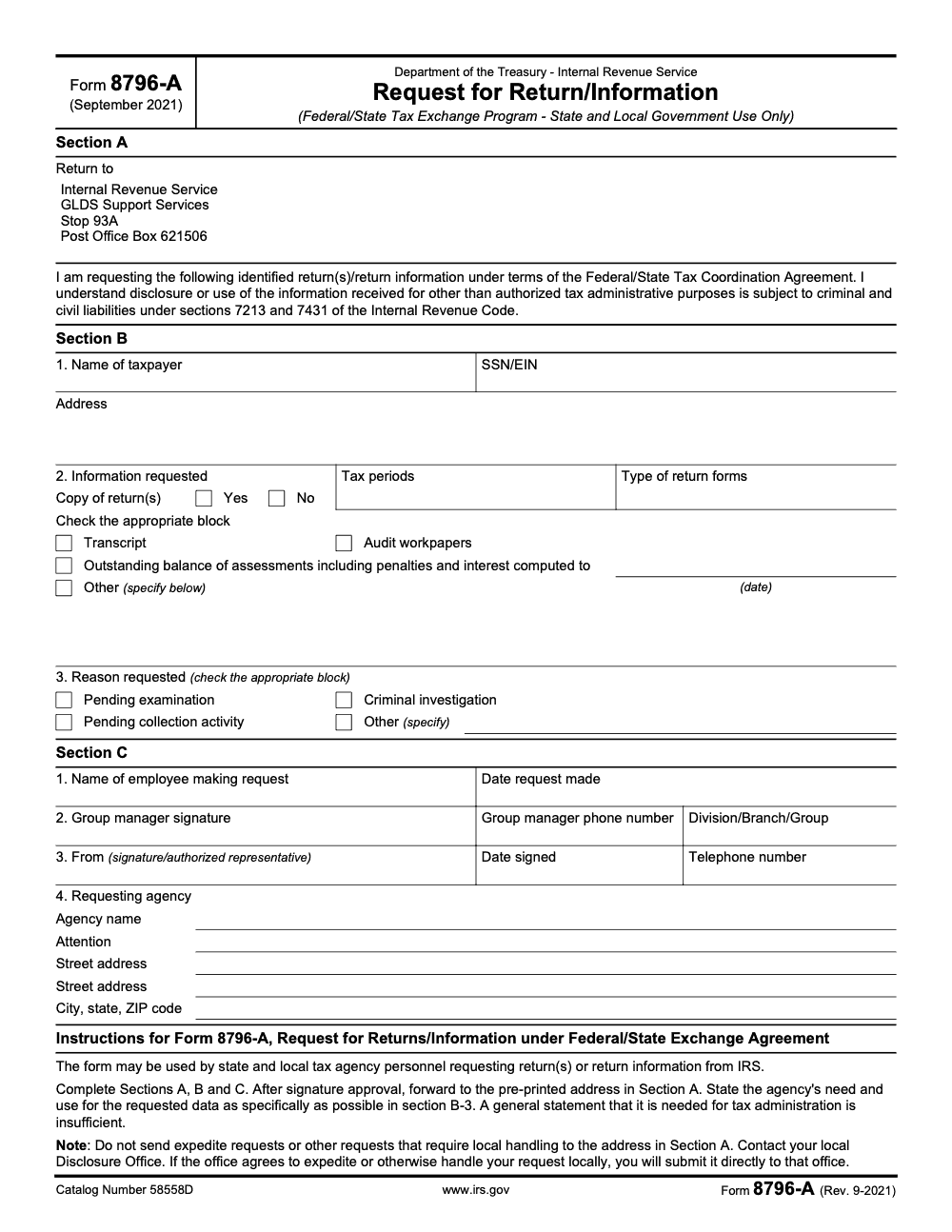
Form 8796-A is the request that state and local tax agencies use to obtain federal returns or return information from the IRS, authorized under IRC §6103(d) through the Federal/State Tax Exchange Program (per the Form 8796-A instructions, Rev. 9-2021). Practitioners and taxpayers do not file it. Taxpayers who need their own records use Form 4506-T for a transcript or Form 4506 for a full return copy, while firms fielding a state inquiry tied to federal data can lean on structured tax support to reconcile positions and assemble clean workpapers.
Most practitioners never file Form 8796-A, and that is the first thing to get straight. It is the request that state and local tax agencies use to obtain federal returns or return information from the IRS under IRC §6103(d), through the Federal/State Tax Exchange Program. Taxpayers and the firms representing them do not submit it.
Where it shows up in practice is a state inquiry that references a federal information exchange. Taxpayers who need their own records reach for Form 4506-T for a transcript or Form 4506 for a full copy, and a firm fielding the state question has to respond in line with IRC §6103 controls and its client authorization framework. We cover how to recognize 8796-A in the file and how to build a clean response around it.
Key Takeaways
- Form 8796‑A is used by state and local tax agencies to request federal returns or return information from the IRS under IRC 6103(d). It is not a taxpayer or practitioner submission form (taxpayers requesting their own returns or transcripts use Form 4506 for a full return copy or Form 4506-T for a transcript, never Form 8796-A). The IRS lists the form in its publishing catalog with a September 2021 revision, which stays current for 2025 returns because the revision date is fixed until the IRS publishes a new version, not updated on an annual cycle.
- For firms, 8796‑A matters when a state inquiry references a federal information exchange. Your response plan should align with IRC 6103 controls, Disclosure Office procedures, and your client authorization framework.
- Accountably builds SOP‑driven offshore delivery, structured workpapers, and multi‑layer reviews that cut revision cycles and protect partner review time across tax compliance, advisory deliverables, and audit support.
- Our teams work inside your systems with SOC 2 aligned safeguards, role‑based access, encrypted exchange, and zero local storage policies to protect U.S. client data.
- You keep strategy and client trust. We handle the standardized execution, visibility, and turnaround SLAs.
What Form 8796‑A Is, and Who Actually Uses It
Form 8796‑A, Request for Return or Information, is the vehicle state and local tax agencies use to ask the IRS for federal returns or return information under the Federal or State Tax Exchange Program. The IRS indicates the form exists for state and local government use only, and the current catalog lists the revision as September 2021. Practitioners and taxpayers do not file this form.
Where 8796‑A Sits in the Law and the IRS Process
The authority flows from IRC 6103(d), which permits disclosures to state tax agencies for tax administration, subject to agreements, designated requesters, and strict accounting for disclosures. Note that the federal data the state receives may be used only for the specific tax administration purpose that justified the request, not redirected to other state government functions. IRS Internal Revenue Manual sections 11.3.32 and 11.3.41 describe how state agencies may request information, how the IRS accounts for those disclosures, and where Form 8796‑A fits into that workflow.
- 6103(d) disclosures require a valid purpose and a specifically identified taxpayer.
- State requesters must be designated by name and submit proper written requests.
- The IRS Disclosure office controls processing, timeliness, and recordkeeping.
For comparison, IRS employees who seek state data use Form 8796, a different form. Form 8796‑A flows in the opposite direction, that is, states requesting federal data from the IRS.
Why 8796‑A Matters in Practice
You might never complete Form 8796‑A yourself, yet the downstream impact hits your firm. When a state inquiry rides on a federal disclosure, your team must reconcile federal filings, transcripts, and workpapers quickly. Review notes need to be clear, client authorizations must be in place, and your response package must reflect consistent documentation logic. That is where a trained team working to a fixed SOP, not ad hoc effort, makes the difference.
Accountably brings a controlled operating layer to these moments. We standardize workpapers, index support to the return, and align each response with your reviewers’ preferences. You keep control of strategy and risk decisions, while we maintain the engine that moves the file forward at pace. We build this once, then make it repeatable across every state cycle and every tax type.
How Accountably Helps, From Disclosures to Daily Production
We integrate offshore teams into your firm to stabilize capacity and protect quality. Our lead managers are U.S.‑led, our operators are trained on U.S. GAAP, IRS procedure, and state tax workflows, and our delivery structure is built to remove friction in review.
Our Delivery Architecture
- SOP‑driven execution, we turn your process into clear, stepwise checklists across bookkeeping, month‑end, tax prep, tax review, advisory schedules, and audit support.
- Structured workpapers, consistent naming, indexed exhibits, source links, and version control so reviews are faster and comments map to the right place.
- Multi‑layer review, preparer to senior to quality to final, with checklist gates that prevent rework and reduce partner time stuck in loops.
- Turnaround SLAs, predictable windows by engagement type, so you can plan capacity and set client expectations with confidence.
- Live workflow visibility, progress tracking, blockers flagged early, and escalation paths that protect deadlines.
This model matches the core challenge we see in firms, capacity is the ceiling when the work is unstructured and trust has not been earned. We remove that ceiling, which lets your partners reclaim time for advisory and relationship work, while keeping margin discipline.
Security, Compliance, and Work Integrity
Your clients’ data demands a security posture you can trust. We align controls to SOC 2 principles, apply role‑based access, run secure VPN, enforce zero local storage, and keep audit logs and activity records. Files move through encrypted channels with permissions and expirations. We also screen staff, verify backgrounds, and confine work to approved systems, including QuickBooks, Xero, CCH Axcess, UltraTax, ProConnect, Lacerte, Drake, Thomson Reuters, Karbon, TaxDome, Suralink, Jetpack, and more.
Compliance is not a layer we add later, it is built into how we operate, from checklists and sign‑offs to secure data transfer and documented review trails.
8796‑A in Practice, What Your Team Will See
Here is how 8796‑A appears in real life. A state requests information from the IRS. The IRS Disclosure office validates the request, then returns approved federal data to the state. The state follows up with your client, and your firm must reconcile positions, provide state‑level support, and sometimes coordinate transcripts or copies of federal filings for context. IRM sections 11.3.32 and 11.3.41 outline these interactions and the accounting required for each disclosure.
Where your team acts directly is everything around the disclosure. That includes transcripts through Form 4506‑C or 4506‑T, authorizations through Form 8821 or 2848, and clean workpapers tied to federal and state positions. The IRS catalog confirms 8796‑A’s role and revision date, while IRM guidance explains the controls behind it. Your file has to match that standard.
Common Scenarios We Support
- A state SALT inquiry references federal items, we assemble a reconciled package, map state adjustments to federal lines, and prepare exhibits that mirror the transcript or return copy.
- A compliance season surge triggers backlog risk, we deploy dedicated tax teams to keep 1040, 1065, 1120, and 1120‑S moving, while seniors clear review notes daily.
- A multi‑state client faces payroll or sales tax issues, we document the position, align return data, and prepare a clean handoff for the responding manager.
Our value is predictable turnaround, tight documentation, and fewer review iterations. Your value is strategic guidance that grows the client relationship.
Step‑By‑Step, Responding When a State Inquiry Ties to Federal Disclosures
- Intake and triage, we log the notice, identify the federal items in question, confirm periods, and capture deadlines and contact details.
- Authorizations and access, we verify 8821 or 2848 on file and secure transcripts if needed through 4506‑C or 4506‑T. We track acknowledgments and retain confirmations.
- Reconcile and prepare, we align workpapers to return lines, cross‑reference schedules, and draft a response outline with exhibits and citations.
- Internal review, seniors check completeness, quality reviews test math, ties, and naming, and we stage the file for partner sign‑off.
- Delivery and follow‑up, we transmit per your protocol, log delivery, set reminders for agency follow‑ups, and update your client communication plan.
Related IRS Forms, What They Do, and When to Use Them
| Form | Who uses it | Purpose | When firms touch it |
| 8796‑A | State and local tax agencies | Request federal returns or return information from IRS under IRC 6103(d) | Indirect impact, know it, plan documentation and response around state inquiries tied to federal data. |
| 8796 | IRS employees | Request state tax information from state agencies | Context only for two‑way exchanges under agreements. |
| 4506‑C or 4506‑T | Taxpayers or authorized representatives | Request transcripts of returns or account data | Firms secure transcripts to reconcile positions and validate facts. |
| 8821 | Taxpayers | Authorize disclosure of tax information to designees | Firms obtain information access without representation before the IRS. |
| 2848 | Taxpayers | Power of Attorney to represent before IRS | Use when advocacy or representation is required. |
Advisory and Audit‑Support Delivery That Complements Tax
Capacity only helps if it protects quality. We staff dedicated teams for your advisory and audit‑support needs too, so nothing gets stuck while tax season peaks.
- Advisory support, cash flow models, KPI packs, controller support, and board‑ready reporting that match your templates.
- Audit support, PBC lists, tie‑outs, fixed asset roll‑forwards, and documentation that survives sampling and partner review.
- Tax advisory, federal to state ripple analysis, opportunity zone considerations for clients with QOF exposure, and partnership push‑outs where Form 8986 is involved.
Special Topics Your Reviewers Ask About
- Qualified Opportunity Funds, entities certify and report compliance on Form 8996 with their timely filed partnership or corporate return, and they must meet a 90 percent investment standard or compute penalties. We keep the files, schedules, and testing support organized.
- Partnership “push out” mechanics, Form 8986 supports pushing out imputed underpayments or flowing AAR changes to reviewed‑year partners. We prepare supporting schedules so your reviewer can sign off without a second pass.
Engagement Models That Scale With Your Firm
- Dedicated offshore talent, full‑time accountants and tax staff who operate in your workflow, trained on your templates, and aligned to your calendar.
- White‑label delivery teams, end‑to‑end teams with a manager and reviewers for seasonal surges or compliance waves.
- Build, operate, transfer, your own offshore unit under our guidance, with exclusive team and management when you want long‑term control.
No band‑aids and no resume farming. You get a trained team and multi‑layer review, not a list of names. Start with one to three people and scale as trust builds. Not a fit in the first 45 days? We replace them free.
Security, Compliance, and U.S. Standards
We protect confidentiality with SOC 2 aligned controls, NDA‑backed commitments, role‑based data access, secure VPN, audit logs, zero local storage, and encrypted exchange. We operate to U.S. GAAP and IRS standards, support multi‑state payroll and sales tax workflows, and maintain documentation that stands up to audit or regulatory inquiry. This is offshore delivery designed for firms that cannot risk compliance exposure.
Work We Support, Built for U.S. Firms
- Accounting execution, month‑end close, reconciliations, AP and AR, reporting packages, consolidations, fixed assets and depreciation, GL reviews, adjustment entries, and controller support.
- Tax execution, 1040, 1120, 1120‑S, 1065, 990, SALT, cleanup and review support, and smart workpapers that cut review time.
- CAS and payroll, monthly financial packages, payroll review, T and E allocations, client onboarding and cleanup, and year‑end processing.
- Audit support, PBC packs, sampling support, revenue testing prep, tie‑outs, and schedule integrity that speeds external reviews.
Why Our Structure Improves Review Time
- SOPs reduce rework and make handoffs clean between preparers, seniors, and reviewers.
- Standard naming and file logic means comments land in the right place, then get cleared fast.
- SLAs and real‑time tracking remove the guesswork from capacity planning.
The result is production stability, delivery efficiency, and review protection that gives partners time for advisory and growth.
What‑How‑Wow, The Short Version
- What, an offshore accounting and tax staffing company built for CPA, EA, and accounting firms, built for on‑time, at‑quality execution across tax, advisory, and audit support.
- How, SOPs, structured workpapers, multi‑layer reviews, SLAs, and security controls that meet U.S. standards.
- Wow, fewer review loops, fewer deadline scrambles, and a calm capacity plan, even when state inquiries and federal disclosures collide.
Make Proof the Advantage
You do not need more resumes. You need a trained team you can trust before your name is on the return. Accountably places offshore accountants and tax preparers inside your workflow, with multi‑layer review and documented SOPs that keep your promises to clients. If your firm is serious about scale, we are ready to operate inside your systems and standards, then prove it with predictable turnaround and cleaner reviews. Don't trust us. Test us.
- Book a working session, scope your workload and deadlines.
- Choose the model, dedicated talent, white‑label teams, or build, operate, transfer.
- Start with a pilot, measure revision cuts, turnaround, and partner time saved.
We will meet you where your capacity breaks today and build a calm, repeatable way forward. Form 8796‑A, state exchanges, federal transcripts, advisory, audit support, we run the engine so you can run the firm.
Common Mistakes We See Every Season
Form 8796-A trips firms up in a specific way. It is not a form your team files, so the errors cluster around misreading what it is and mishandling the state inquiry that follows it. Here are the ones we correct most often.
Reusable Checklists
These checklists are copy-paste ready for your firm SOPs, aligned to the Form 8796-A instructions and IRC 6103(d) controls. Drop them into your engagement workflow the moment a state inquiry ties back to a federal disclosure.
State Inquiry Intake Packet
- Log the state notice, the tax periods in question, and every stated deadline.
- Identify which federal returns or items the inquiry references.
- Capture the responding agency contact and any case or reference number.
- Confirm the specific reason cited, whether examination, collection, or investigation.
- Note whether the request reads as scoped to one tax matter or reaches wider.
- Open a tracked file and assign a preparer and a reviewer.
Federal Transcript and Authorization Pull
- Verify a current Form 8821 or Form 2848 is on file for the client.
- Request the needed transcripts through Form 4506-C or Form 4506-T.
- Match transcript years and return types to the periods the state named.
- Retain acknowledgments and delivery confirmations in the file.
- Flag any gap between the federal account data and the client's own records.
Disclosure Reconciliation Review
- Tie each state adjustment back to the federal return line it references.
- Index exhibits to the transcript or return copy that supports each position.
- Apply consistent workpaper naming so review comments land in the right place.
- Run a senior check for completeness, then a quality check on math and ties.
- Limit the response package to the specific purpose the state stated.
- Stage the file for partner sign-off before transmittal.
Keep 8796-A Season From Stalling
Form 8796-A does not arrive on a schedule. A state agency requests federal data from the IRS under IRC 6103(d), per the Form 8796-A instructions, and weeks later your client forwards a state notice that leans on it. Those inquiries rarely land in a quiet stretch, they stack on top of compliance deadlines, and each one needs a reconciled federal-to-state package quickly.
The work stalls when the response is built from scratch every time. Transcripts get requested late, authorizations are not on file, and workpapers do not tie cleanly to the federal return. A repeatable system turns each inquiry into a known sequence instead of a fire drill.
- Standing authorization check, confirm Form 8821 or Form 2848 is current before any transcript request goes out.
- Transcript playbook, pull federal account and return data through Form 4506-C or Form 4506-T and match years to the periods the state named.
- Scope discipline, tie the response only to the purpose stated in the request, since 6103(d) data is limited to that tax administration use.
- Reconciliation index, map each state adjustment to its federal return line with exhibits a reviewer can clear in one pass.
- Escalation clock, log the state deadline and stage the file for partner review with buffer, not on the due date.
That structure is what we install. Accountably runs the intake, transcript pulls, reconciliation, and multi-layer review as one documented workflow inside your systems, so a state inquiry tied to a federal disclosure moves on a predictable timeline. See how our tax support delivery keeps these responses off your partners' critical path.
FAQs
Form 8796‑A is used by state and local tax agencies to request federal return information from the IRS under IRC 6103(d). Practitioners and taxpayers do not file it. Your firm interacts with the effects of those disclosures, not the form itself.
Verify authorizations, pull needed transcripts with 4506‑C or 4506‑T, and assemble a reconciled workpaper set that ties to the federal return and relevant schedules. Follow your escalation plan and response timeline, then document every step for auditability.
Other forms this guide names
- Form 4506‑T: Request IRS Transcripts Fast
- Form 2848: Guide to Line 3, Filing, and Rules
- Form 4506-C: Guide to IRS Transcripts, IVES, and SBA
- Form 8821: Tax Information Authorization
- Form 1040: Filing Guide for 2025 Returns (AGI, Deductions, Deadlines)
- Form 1065: Guide, Deadlines, K‑1, K‑2/K‑3, E‑File
About this guide
Accountably helps US CPA, EA, and accounting firms hire trained accountants and tax preparers in India.
About us Reviewed byJugal Thacker, CPAFounder and CEO at Accountably
A Washington-licensed CPA with 7+ years inside US firms – PwC, a real-estate tax practice, then a full-service firm, rising from reviewer to manager to advisory. This article was reviewed against current IRS guidance for the 2025 tax year and updated for filers preparing late returns, amendments, and 2026 estimates.
View profile →How we research, review, and update this guide
Every Accountably guide is researched against primary IRS sources, reviewed by a U.S. CPA, and refreshed as guidance evolves. Read our Editorial Guidelines to see how we source, fact-check, and update our content.