Summarize this article with AI
In Brief
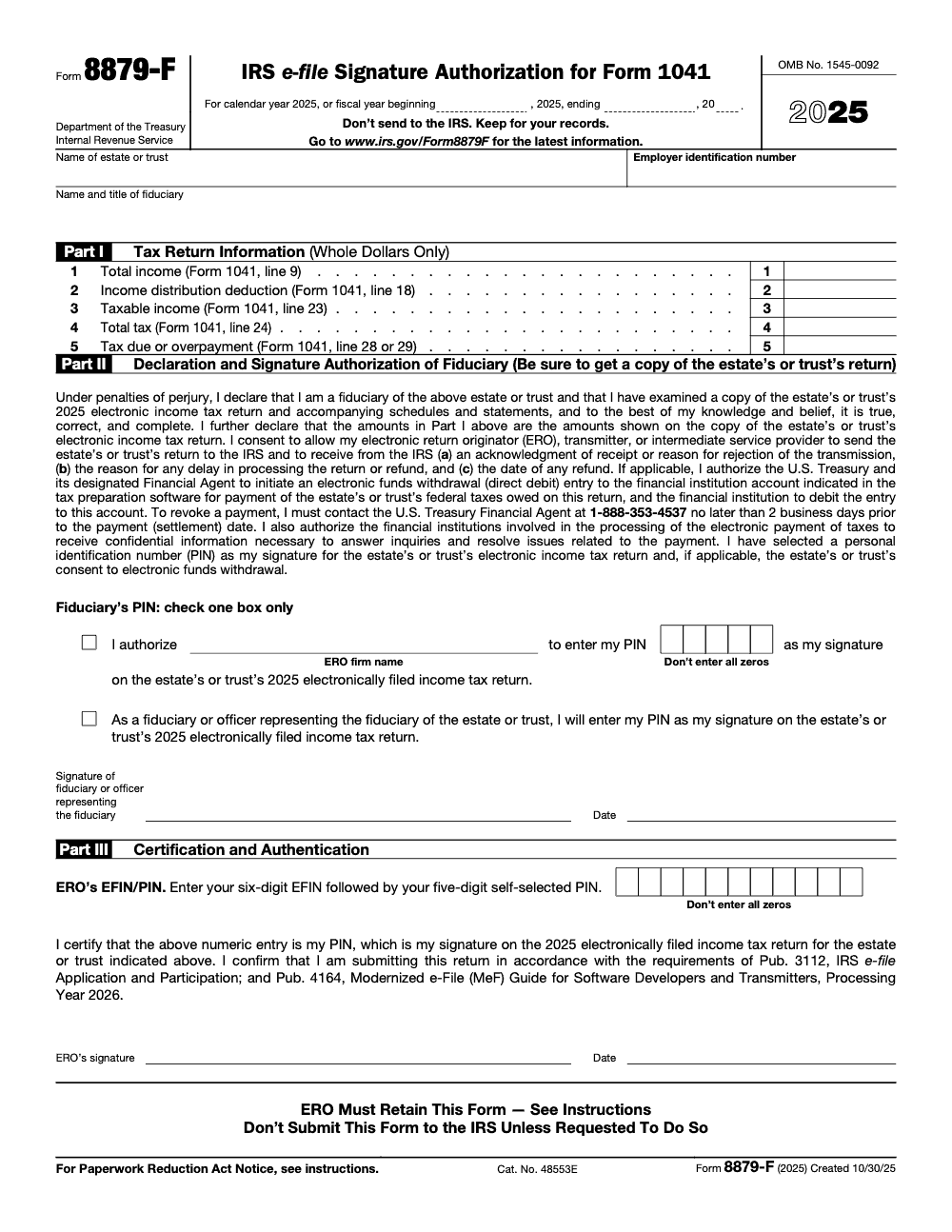
Form 8879-F is the IRS e-file signature authorization for Form 1041, the U.S. income tax return for estates and trusts. According to the Form 8879-F (2025) instructions, the ERO completes the three parts (Part I Tax Return Information in whole dollars, Part II the fiduciary declaration and PIN, and Part III certification with the ERO 6-digit EFIN plus 5-digit PIN), and the fiduciary signs with a 5-digit PIN that cannot be all zeros.
There is one sentence in the instructions that decides whether an estate or trust return goes out on time: the ERO must have the signed Form 8879-F in hand before the Form 1041 is transmitted. Together, the ERO's EFIN and PIN in Part III run eleven digits.
One authorization ties to exactly one Form 1041, so each estate or trust needs its own. You never file this form with the return. The ERO retains it for three years from the later of the return due date or IRS received date, and a fiduciary who skips the PIN method uses Form 8453-FE instead and can still e-file.
A trustee signs Form 8879-F, then asks for a change to a distribution before the Form 1041 goes out. The ERO has to provide a corrected copy of Form 8879-F, because the fiduciary declares that the amounts in Part I match the amounts shown on the electronic return.
Form 8879-F is the e-file signature authorization for Form 1041. The fiduciary signs Part II with a 5-digit PIN that cannot be all zeros, the ERO signs Part III with a 6-digit EFIN plus a 5-digit PIN, and the ERO must receive the signed form before the Form 1041 is transmitted. Do not send it to the IRS: the ERO keeps it for 3 years from the return due date or IRS received date, whichever is later, and one Form 8879-F can be associated with only a single Form 1041.
Key Takeaways
- Form 8879-F is the IRS e-file signature authorization for Form 1041, the U.S. income tax return for estates and trusts. It has three parts: Part I Tax Return Information, Part II the fiduciary declaration and PIN, and Part III the ERO certification.
- The fiduciary signs with a 5-digit PIN that cannot be all zeros. The ERO signs Part III with a 6-digit EFIN followed by a 5-digit self-selected PIN, for 11 digits total.
- The ERO must receive the signed Form 8879-F before the Form 1041 is transmitted. The return is not transmitted until that signed form is in hand.
- Do not send Form 8879-F to the IRS. The ERO retains it for 3 years from the return due date or IRS received date, whichever is later, and electronic retention is allowed under Rev. Proc. 97-22.
- One Form 8879-F can be associated with only a single Form 1041. A separate authorization is required for each estate or trust return.
- A fiduciary who does not use a PIN signature uses Form 8453-FE instead, and the return can still be e-filed.
What Form 8879-F Is and Why It Matters
Form 8879-F is the IRS e-file Signature Authorization for Form 1041. A fiduciary and an Electronic Return Originator, the ERO, use it when the fiduciary wants to use a personal identification number, a PIN, to electronically sign an estate's or trust's Form 1041 and, if applicable, consent to an electronic funds withdrawal. The 2025 revision was created 10/30/25, carries OMB No. 1545-0092, and is issued by the Department of the Treasury, Internal Revenue Service.
It is a small form that carries an outsized rule. The signed authorization is what lets the ERO put the fiduciary's PIN on the electronic return, and the estate's or trust's return will not be transmitted to the IRS until the ERO has that signed form in hand. Get the sequence wrong and a finished return sits in queue.
The form has three parts. Part I, Tax Return Information, carries five amounts from the Form 1041 in whole dollars only. Part II is the fiduciary's declaration and PIN authorization. Part III is the ERO's certification and authentication. The ERO completes all three parts; the fiduciary verifies the return and signs Part II.
One more boundary worth setting early: Form 8879-F can only be associated with a single Form 1041. There is no batching here. Each estate or trust return you e-file gets its own authorization, so the relationship is strictly one Form 8879-F to one Form 1041.
Who Signs Form 8879-F and When
Two parties touch the form. The fiduciary of the estate or trust, the trustee or executor responsible for the return, signs Part II. The ERO, the firm that originates the electronic submission, completes Part I and Part III and signs Part III. The ERO also enters the name and employer identification number of the estate or trust at the top of the form.
The fiduciary's job is to verify the accuracy of the estate's or trust's prepared income tax return, check the appropriate box in Part II to either authorize the ERO to enter the PIN or enter it in person, indicate or verify a 5-digit PIN that is not all zeros, and sign and date Part II. The fiduciary should be sure to get a copy of the estate's or trust's return as part of executing Part II.
The ERO's job is to complete Part I from the estate's or trust's 2025 income tax return, give the fiduciary the form for completion and review, enter the fiduciary's PIN on the input screen only if authorized to do so, and complete Part III with a signature and date. When the ERO is authorized to enter the fiduciary's PIN, the Part II authorization line carries the ERO firm name, not the name of the individual preparing the return.
The "when" is the part people miss. You receive the signed Form 8879-F first, then you transmit the Form 1041. Never the other way around.
Sequencing: Sign Before You Transmit
The single most important rule on Form 8879-F is an ordering rule, not a calendar deadline. You must receive the completed and signed Form 8879-F from the fiduciary before the electronic return is transmitted or released for transmission. The estate's or trust's return will not be transmitted to the IRS until the ERO receives the fiduciary's signed form.
Read together, those two instructions create a clean handoff. The ERO prepares the return and Form 8879-F, sends the form to the fiduciary, waits for the signed form to come back, and only then releases the Form 1041. Skipping ahead is not a shortcut, it is a compliance gap.
Signed Form 8879-F in hand, then transmit. Build the status check into the workflow so no Form 1041 leaves your system while its authorization is still out for signature.
The handoff in five steps
- 1. ERO completes the form
- Enter the estate's or trust's name and EIN at the top, complete Part I in whole dollars from the 2025 Form 1041, and set up Part II for the fiduciary's signature.
- 2. ERO gives the form to the fiduciary
- Deliver Form 8879-F for completion and review using any acceptable delivery method.
- 3. Fiduciary reviews and signs
- The fiduciary verifies the accuracy of the prepared return, checks the appropriate Part II box, indicates or verifies a 5-digit PIN that is not all zeros, then signs and dates Part II.
- 4. ERO receives the signed form
- The signed Form 8879-F must be back with the ERO before transmission. Log the received date.
- 5. ERO completes Part III and transmits
- Complete Part III with the ERO PIN, signature, and date, then transmit the Form 1041.
Transmitting first and collecting the signed Form 8879-F afterward is not allowed. The IRS instructions require the signed form to be on file before the electronic return is released for transmission.
Part I: Tax Return Information from Form 1041
Part I, Tax Return Information, carries five amounts straight off the estate's or trust's 2025 Form 1041. The ERO completes it, and all amounts go in whole dollars only. Zero may be entered when appropriate. These five lines exist so the fiduciary can confirm that what was authorized matches what was filed.
| Form 8879-F line | Description | Source on Form 1041 |
|---|---|---|
| 1 | Total income | Form 1041, line 9 |
| 2 | Income distribution deduction | Form 1041, line 18 |
| 3 | Taxable income | Form 1041, line 23 |
| 4 | Total tax | Form 1041, line 24 |
| 5 | Tax due or overpayment | Form 1041, line 28 or 29 |
Use these 2025 line numbers as printed on the form. Line 28 is the tax due figure and line 29 is the overpayment figure, so line 5 reflects whichever applies. Do not pull Part I values from memory of prior-year layouts, line numbers shift between revisions.
Part I is labeled Whole Dollars Only. Entering dollars and cents is a smell that signals the form was filled from the wrong template. Round to whole dollars and confirm each line matches the filed Form 1041.
Part II: Fiduciary Declaration and PIN
Part II, the Declaration and Signature Authorization of Fiduciary, is where the fiduciary takes ownership of the return. By signing, the fiduciary declares under penalties of perjury that they are a fiduciary of the estate or trust, that they have examined a copy of the 2025 electronic income tax return and accompanying schedules and statements, and that to the best of their knowledge and belief it is true, correct, and complete.
The fiduciary also declares that the amounts in Part I match the amounts shown on the copy of the estate's or trust's electronic income tax return. That is why Part I and the filed Form 1041 must reconcile before the form goes out for signature.
- Check the PIN box
- The fiduciary checks the appropriate box to either authorize the ERO to enter the fiduciary's PIN or to enter it in person.
- Indicate or verify the PIN
- When authorizing the ERO to enter it, the fiduciary indicates or verifies a 5-digit PIN that cannot be all zeros.
- Authorization line
- If the ERO is authorized to enter the PIN, the authorization line carries the ERO firm name, not the individual preparer's name.
- Sign, date, and return
- The fiduciary signs and dates Part II and returns the form to the ERO. The return will not be transmitted until the ERO has it.
Two consents ride along in Part II. The fiduciary consents to allow the ERO, transmitter, or intermediate service provider to send the return to the IRS and to receive back an acknowledgment of receipt or reason for rejection, the reason for any delay, and the date of any refund. The fiduciary may also sign using a scanned signature, so wet ink is not required.
Part III: ERO Certification and Authentication
Part III, Certification and Authentication, is the ERO's signature on the electronic return. The ERO enters a 6-digit EFIN followed by a 5-digit self-selected PIN, 11 digits total, and that numeric entry serves as the ERO's signature on the 2025 electronically filed income tax return for the estate or trust. Like the fiduciary PIN, the ERO PIN cannot be all zeros.
In Part III the ERO also confirms it is submitting the return in accordance with the requirements of Pub. 3112, IRS e-file Application and Participation, and Pub. 4164, Modernized e-File (MeF) Guide for Software Developers and Transmitters, Processing Year 2026. Processing Year 2026 is the IRS processing year for tax year 2025 returns.
The ERO completes Part III, including a signature and date, and may sign using a scanned signature. Once Part III is done and the signed fiduciary authorization is on file, the Form 1041 is ready to transmit.
PIN Rules for Fiduciary and ERO
Two PINs live on Form 8879-F, and they have different shapes. Get them straight and the authentication just works; get them wrong and the e-file gets rejected or the authorization is invalid.
- Fiduciary PIN. Five numbers, and it cannot be all zeros. The fiduciary indicates or verifies it in Part II when authorizing the ERO to enter it, or enters it in person.
- ERO PIN. In Part III the ERO enters a 6-digit EFIN followed by a 5-digit self-selected PIN, 11 digits in all. That combined entry is the ERO's signature on the electronically filed return, and the PIN portion cannot be all zeros either.
Both PIN blocks carry the explicit warning not to enter all zeros. A PIN of 00000 is invalid for the fiduciary and for the ERO. Any other 5-digit combination is acceptable.
One practical guardrail: the ERO enters the fiduciary's PIN on the input screen only if the fiduciary has authorized it. If the box in Part II says the fiduciary will enter the PIN in person, that is what happens, the ERO does not key it for them.
Electronic Funds Withdrawal Consent
If the estate or trust owes a balance and is paying by direct debit, Part II also carries an electronic funds withdrawal, EFW, authorization. By signing, the fiduciary authorizes the U.S. Treasury and its designated Financial Agent to initiate a direct debit from the account indicated in the tax preparation software for the federal taxes owed on the return, and authorizes the financial institution to debit the account.
The fiduciary also authorizes the financial institutions involved in processing the payment to receive confidential information necessary to answer inquiries and resolve issues related to the payment. EFW only applies when there is a balance being paid this way, it is not part of a refund return.
To revoke an EFW payment, the fiduciary must contact the U.S. Treasury Financial Agent at 1-888-353-4537 no later than 2 business days prior to the payment settlement date. Count business days only, weekends and holidays do not count.
Retention and Recordkeeping
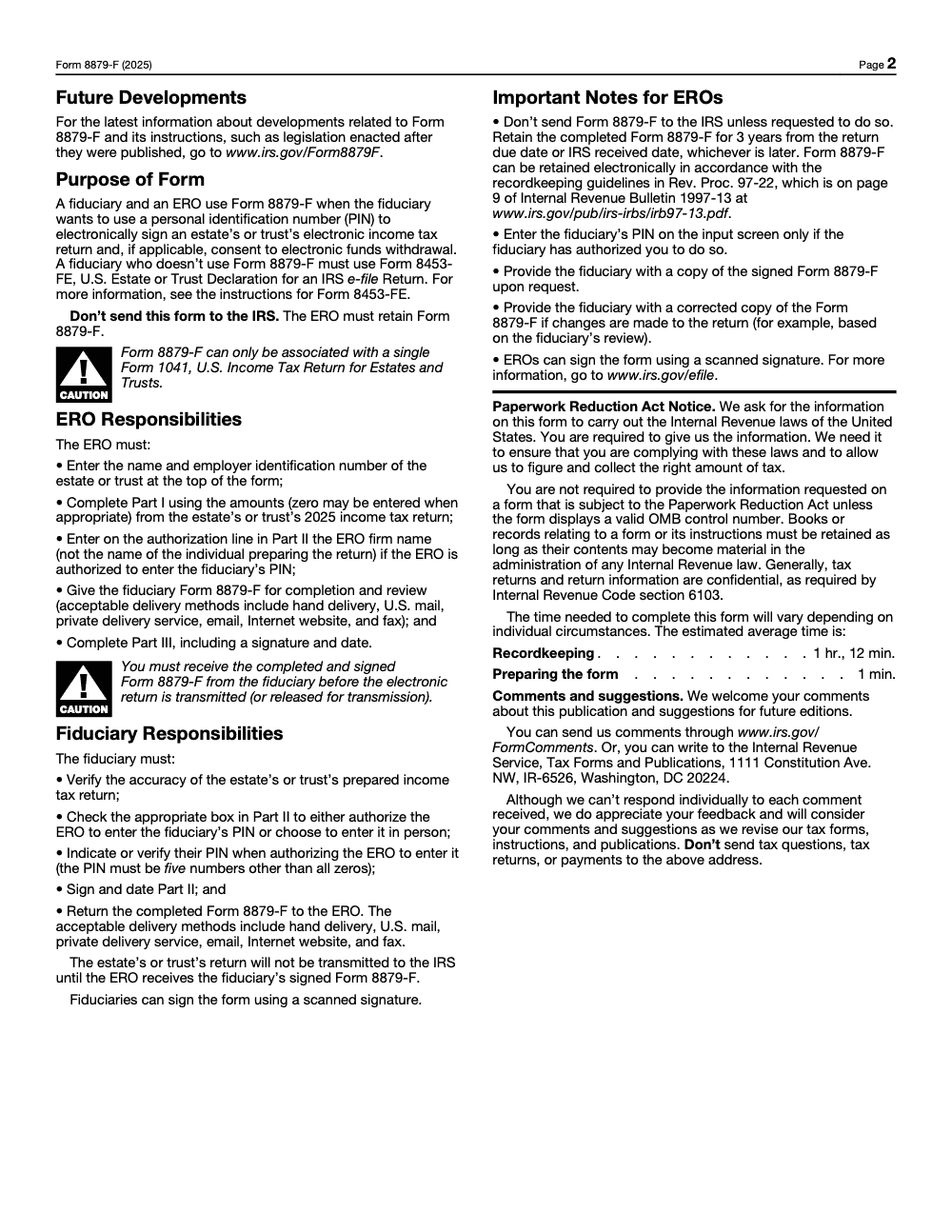
Form 8879-F is never mailed in with the Form 1041. The instructions are blunt: do not send this form to the IRS. The ERO retains Form 8879-F and only produces it if the IRS specifically requests it.
The retention clock runs 3 years from the return due date or IRS received date, whichever is later. That "whichever is later" matters, measuring from the filing date alone or the due date alone can leave you short. Log both dates and start the clock from the later one.
- Where it lives
- In the ERO's files, not with the IRS. The IRS receives the e-filed Form 1041; the signed authorization stays behind.
- How long
- 3 years from the return due date or IRS received date, whichever is later.
- Electronic retention
- Form 8879-F can be retained electronically in accordance with the recordkeeping guidelines in Rev. Proc. 97-22, found on page 9 of Internal Revenue Bulletin 1997-13.
- Broader records rule
- Books or records relating to the form must be kept as long as their contents may become material in the administration of any Internal Revenue law.
The IRS Paperwork Reduction Act Notice estimates recordkeeping at 1 hr., 12 min. and preparation at 1 min. per form. Budget the time for filing and storing the authorization, not just keying it.
Delivery, Copies, and Corrected Forms
You do not have to hand the form across a desk. The ERO gives the fiduciary Form 8879-F for completion and review using any of six acceptable delivery methods: hand delivery, U.S. mail, private delivery service, email, Internet website, and fax. That flexibility is built into the instructions, so do not restrict it to in-person or mail only.
Two copy obligations follow. The ERO must provide the fiduciary with a copy of the signed Form 8879-F upon request. And if changes are made to the return, for example based on the fiduciary's review, the ERO must provide a corrected copy of Form 8879-F.
Tax returns and return information are generally confidential, as required by Internal Revenue Code section 6103. Treat the authorization and the return data it carries with the same care you give any client tax file.
Form 8879-F vs Form 8453-FE
Form 8879-F is the PIN route to signing an e-filed Form 1041. It is not the only route. A fiduciary who does not use Form 8879-F must use Form 8453-FE, U.S. Estate or Trust Declaration for an IRS e-file Return. The return is still e-filed, only the signature mechanism changes. Use the quick decider below if you are unsure which path fits, then read the comparison table for context.
The decider above covers the common cases. If the engagement involves an electronic funds withdrawal for a balance due, remember the EFW revocation window: contact the U.S. Treasury Financial Agent at 1-888-353-4537 no later than 2 business days before the settlement date.
| Form | Who uses it | Notes |
|---|---|---|
| Form 8879-F | Fiduciary signing Form 1041 with a PIN | PIN-based e-file signature authorization. ERO completes Parts I to III, retains the signed form, does not mail it to the IRS. |
| Form 8453-FE | Fiduciary who does not use a PIN signature | U.S. Estate or Trust Declaration for an IRS e-file Return. The alternative path when Form 8879-F is not used. |
| Form 1041 | Estates and trusts | The underlying U.S. income tax return that Form 8879-F authorizes. One Form 8879-F per Form 1041. |
How Form 8879-F Connects to Form 1041
Form 8879-F does not stand alone. It exists to authorize the e-filing of a specific Form 1041, and the two documents have to agree. Part I carries five figures straight from the Form 1041, and the fiduciary declares that those amounts match the filed return.
That tight coupling drives the workflow. Finish the Form 1041 first, reconcile Part I to it, then send Form 8879-F for signature. If anything on the Form 1041 changes after the fiduciary signs, you owe a corrected Form 8879-F before transmitting.
- Line 1, total income, comes from Form 1041 line 9.
- Line 2, income distribution deduction, comes from Form 1041 line 18.
- Line 3, taxable income, comes from Form 1041 line 23.
- Line 4, total tax, comes from Form 1041 line 24.
- Line 5, tax due or overpayment, comes from Form 1041 line 28 or 29.
Keep one Form 8879-F per Form 1041. If a discrepancy creeps in between Part I and the filed return, the signature authorization can be void, so reconcile before you send it out, not after.
Common Mistakes We See Every Season
From my side of the desk, our team sees the same five mistakes every year. Small errors create big cleanup. Catch them in workpaper review before they reach the partner or the IRS.
Reusable Checklists
Print these or paste them into your workpaper template. We wrote them so you can copy them verbatim into a firm-wide SOP. Click any item to tick it off – your progress is saved automatically.
ERO pre-transmit checklist (every Form 8879-F)
0 of 10 done- Estate or trust name and EIN entered at the top of the form.
- Part I completed in whole dollars from the 2025 Form 1041 (lines 9, 18, 23, 24, 28 or 29).
- Part I amounts reconciled to the filed Form 1041.
- Correct Part II box checked (ERO enters PIN, or fiduciary enters in person).
- ERO firm name (not the individual preparer's name) on the Part II authorization line.
- Fiduciary 5-digit PIN confirmed, not all zeros.
- Signed Form 8879-F received from the fiduciary before transmission.
- Part III completed: 6-digit EFIN + 5-digit ERO PIN (not all zeros), signature, and date.
- Form 1041 transmitted only after the signed form is in hand.
- Signed-form received date logged for the 3-year retention clock.
Fiduciary review checklist
0 of 7 done- Obtain and keep a copy of the estate's or trust's return.
- Verify the accuracy of the prepared Form 1041.
- Confirm Part I amounts match the return.
- Check the appropriate Part II box for how the PIN will be entered.
- Choose a 5-digit PIN that is not all zeros.
- If a balance is owed by direct debit, review the EFW authorization.
- Sign and date Part II, then return the form to the ERO.
Retention and delivery checklist
0 of 7 done- Form delivered to the fiduciary using an acceptable method (hand delivery, U.S. mail, private delivery service, email, Internet website, or fax).
- Do not send Form 8879-F to the IRS; ERO retains it.
- Retention clock set to 3 years from the return due date or IRS received date, whichever is later.
- Electronic retention, if used, follows Rev. Proc. 97-22.
- Copy of the signed form provided to the fiduciary on request.
- Corrected Form 8879-F issued if the return changed after signing.
- One Form 8879-F retained per Form 1041.
Real-World Examples
Five situations our team sees every season, with the part, line, or rule each one touches. Use them as a quick rule you can copy into your SOP.
- Trustee signs, then asks to change a distribution. The fiduciary signs Part II, then wants the income distribution deduction adjusted before transmission. Because the fiduciary declared that Part I matches the return, you redo Part I (line 2 ties to Form 1041 line 18), reissue a corrected Form 8879-F, and collect a fresh signature before you transmit.
- Estate with a balance due paying by direct debit. The estate owes tax, so the fiduciary uses the Part II electronic funds withdrawal authorization. If the payment needs to be revoked, the fiduciary contacts the U.S. Treasury Financial Agent at 1-888-353-4537 no later than 2 business days before the settlement date.
- Fiduciary who will not use a PIN. An out-of-state executor declines the PIN process. Switch the engagement to Form 8453-FE, U.S. Estate or Trust Declaration for an IRS e-file Return. The Form 1041 still e-files, only the signature method changes.
- Two related trusts under one preparer. A firm prepares Form 1041 for two related trusts. Because Form 8879-F can only be associated with a single Form 1041, you prepare and collect a separate signed Form 8879-F for each, never one form for both.
- Remote signing across time zones. The fiduciary is traveling. The ERO delivers Form 8879-F by email, the fiduciary signs with a scanned signature, and the ERO confirms the signed form is received before transmitting. Both fiduciary and ERO may use scanned signatures, so this is fully compliant.
Tip for checklists, log the dates next to each step in your folder: sent to fiduciary, signed and received, and transmitted. It keeps the sequencing rule visible and starts the retention clock cleanly.
Keep 8879-F Season From Stalling
Form 8879-F is a small form that creates a hard sequencing rule for every estate and trust return you e-file. The Form 8879-F (2025) instructions are explicit that the signed authorization must be in the ERO's hands before the Form 1041 is transmitted, and the IRS Paperwork Reduction Act Notice on the form pegs recordkeeping alone at 1 hr., 12 min. per form. When estate and trust returns stack up near deadlines, that collection-then-transmit handoff is exactly where queues stall: a return is finished, but it cannot go out because the fiduciary's signed PIN authorization is still in transit.
The fix is to treat the signature authorization as a tracked workflow step, not an afterthought. One fiduciary, one Form 8879-F, one Form 1041, every time, with a clear status from "sent to fiduciary" to "signed and received" to "transmitted." That turns a bottleneck into a predictable checkpoint.
- Reconcile Part I to the filed Form 1041 before sending: line 1 (total income, Form 1041 line 9), line 3 (taxable income, line 23), line 4 (total tax, line 24), and line 5 (tax due or overpayment, line 28 or 29), in whole dollars only.
- Confirm the fiduciary's 5-digit PIN is not all zeros, and that the correct Part II box is checked before the return is queued.
- On the Part II authorization line enter the ERO firm name, not the individual preparer's name, and complete Part III with the ERO's 6-digit EFIN plus 5-digit self-selected PIN.
- Log the signed-form received date and start the 3-year retention clock from the return due date or IRS received date, whichever is later.
- Where a fiduciary will not use a PIN, switch the engagement to Form 8453-FE rather than holding the return.
This is the kind of repeatable, deadline-bound execution we build SOPs around. Our tax preparation services embed trained offshore teams into your workflow with documented signature-collection steps and review tiers, so finished returns move out the door instead of waiting on paperwork.
FAQs
Form 8879-F is the IRS e-file signature authorization for Form 1041, the U.S. income tax return for estates and trusts. A fiduciary and an ERO use it when the fiduciary wants to use a 5-digit PIN to electronically sign the estate's or trust's return and, if applicable, consent to an electronic funds withdrawal.
No. The Form 8879-F (2025) instructions state to not send the form to the IRS. The ERO retains the signed Form 8879-F and only provides it to the IRS if specifically requested. The form is kept for 3 years from the return due date or IRS received date, whichever is later.
The fiduciary of the estate or trust signs Part II using a 5-digit PIN that cannot be all zeros, and the ERO completes and signs Part III using a 6-digit EFIN followed by a 5-digit self-selected PIN. Both the fiduciary and the ERO may sign using a scanned signature.
No. Form 8879-F can only be associated with a single Form 1041. A separate Form 8879-F is required for each estate or trust return you e-file, so the relationship is strictly one Form 8879-F to one Form 1041.
A fiduciary who does not use Form 8879-F must use Form 8453-FE, U.S. Estate or Trust Declaration for an IRS e-file Return, instead. The Form 1041 can still be e-filed; only the signature method changes.
The ERO must receive the completed and signed Form 8879-F from the fiduciary before the electronic Form 1041 is transmitted or released for transmission. The return will not be transmitted to the IRS until the ERO has the fiduciary's signed form on file.
Other forms this guide names
- Form 1041: Guide for Estates & Trusts, Deadlines & K-1s
- Form 8453-FE: Guide to E-filing 1041 Signatures
Summarize this article with AI
About this guide
Accountably helps US CPA, EA, and accounting firms hire trained accountants and tax preparers in India.
About us Reviewed byJugal Thacker, CPAFounder and CEO at Accountably
A Washington-licensed CPA with 7+ years inside US firms – PwC, a real-estate tax practice, then a full-service firm, rising from reviewer to manager to advisory. This article was reviewed against current IRS guidance for the 2025 tax year and updated for filers preparing late returns, amendments, and 2026 estimates.
View profile →How we research, review, and update this guide
Every Accountably guide is researched against primary IRS sources, reviewed by a U.S. CPA, and refreshed as guidance evolves. Read our Editorial Guidelines to see how we source, fact-check, and update our content.