Summarize this article with AI
In Brief
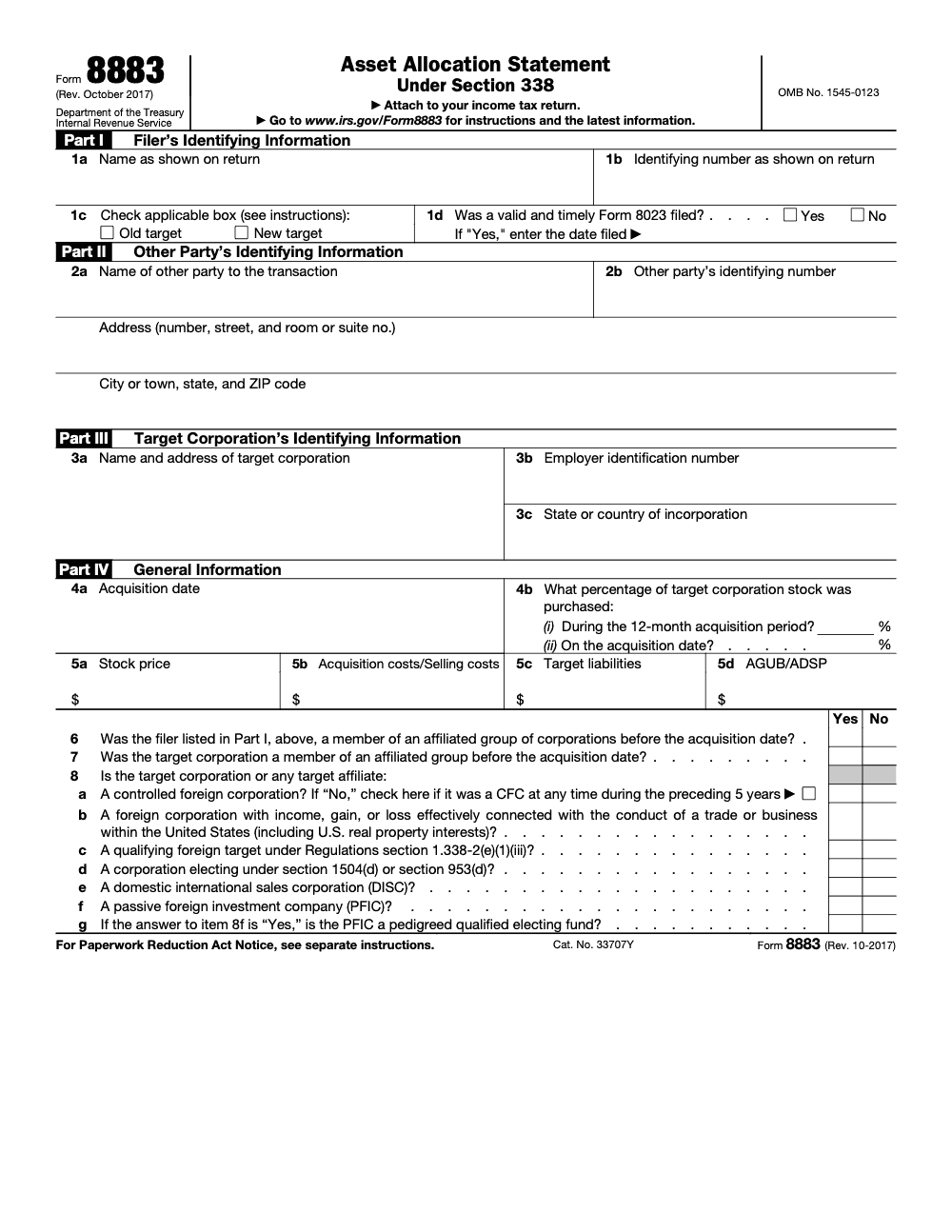
Form 8883, the Asset Allocation Statement Under Section 338 (Rev. October 2017), turns a Section 338 election into tax basis by allocating consideration across seven asset classes under the residual method, with goodwill and going concern value as the Class VII residual (per the Form 8883 instructions and Treas. Reg. §1.338-6). Both the old target, reporting ADSP, and the new target, reporting AGUB, attach it to the return that reports the deemed sale or deemed purchase rather than filing it on its own – our tax services team prepares both sides.
The Form 8883 that lands in trouble is rarely the one with a hard valuation question. It is the one where the buyer prepared a clean allocation, the seller prepared a different one, and neither side knew the other had filed. Picture the new target dropping a customer list into Class VII goodwill while the old target left it in Class VI, same deal, two stories, and a consistency problem waiting to surface.
This Asset Allocation Statement turns a Section 338 election into actual tax basis by spreading consideration across seven asset classes under the residual method, with goodwill as the Class VII residual. So the order of operations matters: confirm the election was made on Form 8023, get ADSP and AGUB to reconcile, then allocate across the classes before anyone builds a depreciation schedule. You attach it to the return that reports the deemed sale or purchase rather than filing it on its own.
Key Takeaways
- Form 8883 reports the asset allocation for a stock deal treated as an asset purchase under a Section 338 election. It converts the election into basis, depreciation, and amortization for tax.
- Both the old target and the new target generally have a filing role. You attach Form 8883 to the return that reports the deemed sale or the deemed purchase, not as a standalone filing.
- For foreign targets, attach copies of Form 8883 to the last Form 5471 for the old target and the first Form 5471 for the new target, as the instructions specify.
- File the election on Form 8023 by the 15th day of the ninth month after the acquisition date. Then attach Form 8883 to the relevant return for the year that includes the deemed asset transaction.
- Corporate return timing still matters. Most C corporations file by the 15th day of the fourth month after year end, with six months available on a timely Form 7004 extension. Special June 30 year end rules apply through 2026.
Form 8883 in Plain English
Form 8883 is the Asset Allocation Statement under Section 338. It is where you assign fair market value to asset classes and lock in tax basis after a qualified stock purchase that you treat as a deemed asset acquisition. Without it, your election is theory. With it, your depreciation and amortization schedules have legs. You do not mail Form 8883 to a separate address. You attach it to the return that reports the deemed sale or the deemed purchase, as the IRS instructions direct.
Here is the practical rhythm. You make a timely Section 338 election on Form 8023. Then, in the tax year that includes the acquisition date, you complete Form 8883 and attach it with the relevant filer’s return. In some cross border cases you attach copies to Form 5471 as well, so the IRS can track the allocation alongside the election.
Form 8883 is where your Section 338 election becomes basis, depreciation, amortization, and gain or loss you can defend.
Section 338 Elections and How Form 8883 Fits
A Section 338 election lets you treat a qualified stock purchase as a deemed asset deal. There are two flavors. The purchaser makes a 338(g) election. The purchaser and sellers make a joint 338(h)(10) election in qualifying scenarios, which exist only when the target is an S corporation or a subsidiary that was a member of a U.S. consolidated group, never a stand-alone C corporation or a foreign target. Either way, Form 8883 is required to allocate consideration across assets using the residual method, which drives both the seller’s deemed sale results and the buyer’s basis.
The instructions are explicit about roles. Both the old target and the new target have Form 8883 responsibilities. You attach the form to the return that captures the deemed sale or the first return that captures the deemed purchase. When a foreign target is involved, copies ride with Form 5471, last for the old target and first for the new target.
The IRS Is Watching Consistency
LB&I has used matching to connect Form 8023 and Form 8883, especially where foreign purchasers and U.S. shareholders are involved. Incomplete shareholder details on Form 8023 can trigger follow up letters, short response windows, and questions about the validity of the election. Keep the details complete, respond quickly, and maintain proof. The IRS has also flagged taxable asset transactions under sections 1060 and 338(h)(10) for buyer and seller consistency checks.
Who Must File, and When You Do Not
If you make a Section 338 election and the transaction is a qualified stock purchase, you are in Form 8883 territory. The old target and the new target must each file Form 8883 with the appropriate return that reflects the deemed transaction. This is not a standalone submission.
You generally do not file Form 8883 for a straight asset purchase; that is Form 8594 territory under Section 1060, and the two forms are not interchangeable. You also skip it if there is no valid Section 338 election, for example, if the stock acquisition does not reach 80 percent of vote and value, so it is not a qualified stock purchase. The filing flows from the election, not from the legal form of the deal.
Quick check, no election, no Form 8883. Election made, allocation required.
Deadlines, Extensions, and Where to Attach
Timing has two tracks. First, the election. File Form 8023 by the 15th day of the ninth month after the acquisition date. If you miss it, consult counsel about whether relief under Treas. Reg. 301.9100 is even possible. Relief requires a private letter ruling and a showing of reasonable action and no government prejudice. It is not automatic.
Second, the returns. Attach Form 8883 to the return that reports the deemed sale or the first return that reports the deemed purchase for the tax year that includes the acquisition date. Do not send Form 8883 on its own. The corporate return deadline is generally the 15th day of the fourth month after year end, with a six month extension available via Form 7004 if you file on time. Special due date and seven month extension rules apply to certain June 30 year ends through 2026.
Cross Border Attachments
If the target is foreign and a 338(g) election applies, attach a copy of Form 8883 to the last Form 5471 for the old foreign target and a copy to the first Form 5471 for the new foreign target. If U.S. shareholders file the election on behalf of a controlled foreign purchasing corporation, the 8023 copy rides with the purchasing corporation’s Form 5471 as well. Align these attachments so LB&I can match the election and the allocation.
Filing Rhythm At A Glance
| Situation | What you file | When it is due | Where it goes |
| Section 338 election | Form 8023 | 15th day of the ninth month after the acquisition date | Fax or mail per instructions, Ogden address listed in the instructions |
| Deemed sale year return, old target | Form 8883 attached | Due date of the old target’s return for the year including the acquisition date, extensions allowed | With that return, not separately |
| First return, new target | Form 8883 attached | Due date of the return for the day after acquisition date begins the new target’s year | With that return, not separately |
| Foreign target, 338(g) | Copies of Form 8883 attached to Form 5471 filings | Due dates that apply to the relevant Form 5471 filings | With the Form 5471 packages |
Sources for the table items appear in the IRS instructions cited in this section.
Completing Form 8883, the Practical Walkthrough
You will move through the form in order. Start with exact legal names, EINs, addresses, and acquisition date. Check the correct election type on the return that fits your role, old target or new target. Small identity gaps create big matching headaches.
- Part I and II, Filer and Other Party. Enter complete identifiers for the filer and the other party responsible for reporting the other side of the deemed transaction. If the other party is a consolidated group, use the common parent. If a CFC is involved and it does not file a U.S. return, identify the relevant U.S. shareholder.
- Part IV, General Information. This is where ADSP and AGUB appear. You will compute liabilities, selling costs, and acquisition costs precisely as the instructions describe.
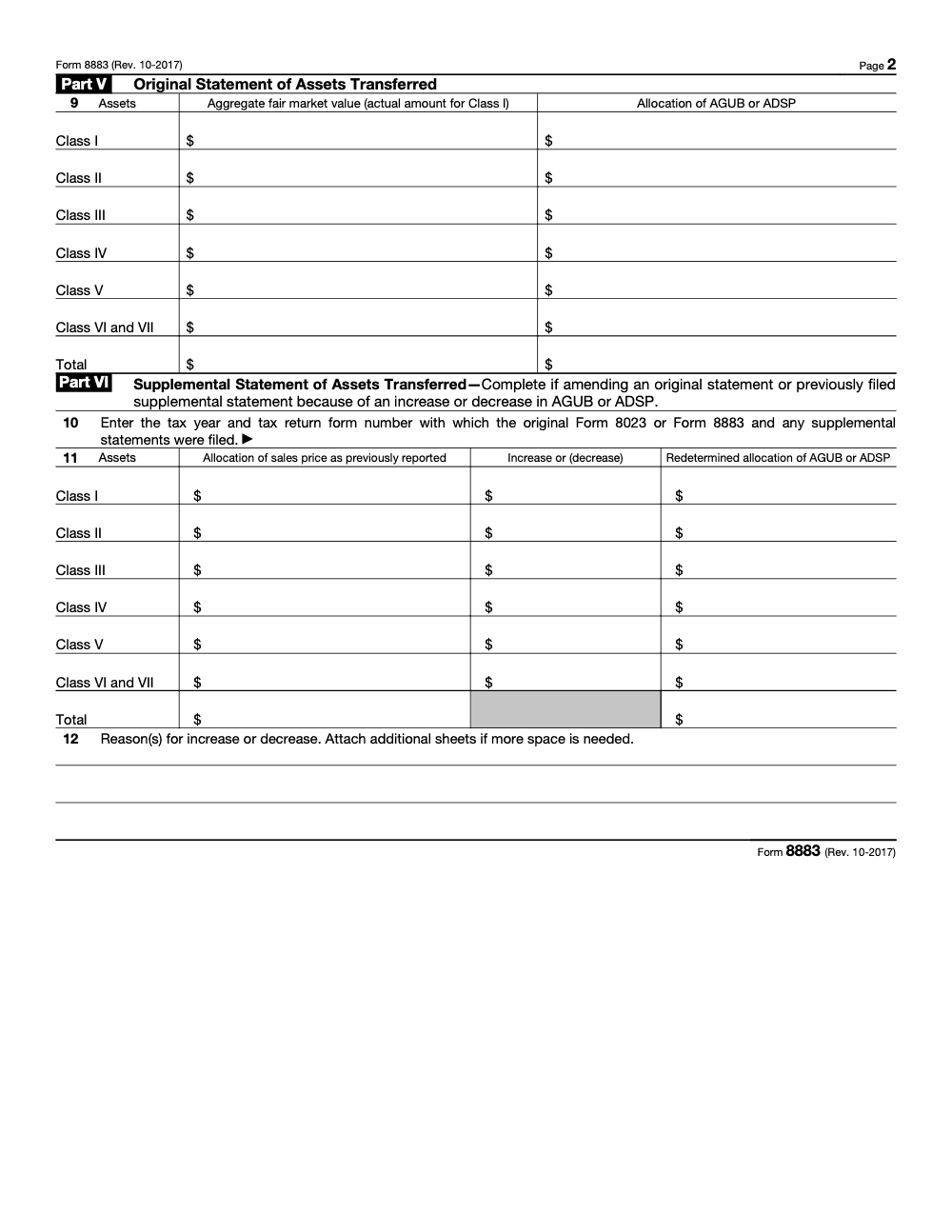
- Part V, Original Statement of Assets Transferred. Allocate consideration across Classes I through VII using the residual method, with the fair market value cap for all but Class VII. Keep schedules tight for multiple properties or numerous intangibles.
- Part VI, Supplemental Statement. If consideration changes later, reallocate in the tax year the change occurs, following the increase and decrease ordering rules. Part VI is triggered only by an increase or decrease in AGUB or ADSP, not by a simple classification correction that leaves the total unchanged.
Build your backup as you build the form, not after. Appraisals, memos on methods, and proof of attachment are what save time in exam.
What Form 8883 Reports, Asset Classes and Values
You are assigning fair market value to the IRS classes, then flowing the residual to goodwill and going concern, which live in Class VII. Tangible property generally sits in Class V. Section 197 intangibles like workforce, customer lists, and noncompetes sit in Class VI, and for tax they amortize ratably over a fixed 15-year period from the month of acquisition, regardless of any shorter book or contractual life. The instructions spell out the classes and set the order of operations for increases and decreases later.
- Class V often includes buildings, land improvements, and equipment.
- Class VI includes most section 197 intangibles except goodwill and going concern.
- Class VII is goodwill and going concern.
Your total allocations must reconcile to ADSP for the seller and AGUB for the buyer, and you cannot allocate above fair market value for any class other than VII.
Fair Market Valuation That Holds Up
Use contemporaneous evidence. For tangible assets, rely on recent appraisals and invoices. For intangibles, your valuation team will often use discounted cash flow, multi period excess earnings, or relief from royalty where it fits. Keep assumptions documented. Your fair market value package is part of your Form 8883 defense file.
Match the numbers to the method. If the customer list value is large, ensure churn, margin, and cost to serve are explained. If goodwill is oversized, show that Class V and VI values were not capped too low. Then tie your depreciation and amortization schedules back to the allocation so the return tells one story.
ADSP, AGUB, and Why They Matter
- ADSP, aggregate deemed sales price, is the seller side amount. It equals the grossed up amount realized plus liabilities.
- AGUB, adjusted grossed up basis, is the buyer side amount. It equals the grossed up basis in recently purchased stock, plus basis in nonrecently purchased stock, plus liabilities.
The instructions walk through these computations and the line references. Keep the workpapers with your form.
One tight reconciliation between ADSP, AGUB, and your asset classes prevents most exam questions before they start.
Common Allocation Pitfalls We See
- Lumping customer lists into goodwill, which weakens amortization support.
- Ignoring contingent consideration that closes later, then missing the Part VI reallocation in the year the change occurs.
- Misclassifying land and buildings without FMV support.
- Overlooking leasehold improvements or right of use asset impacts on classes.
- Forgetting to update depreciation and amortization schedules to match the final allocation.
Deadlines, Extensions, and Late Relief, A Closer Look
Calendar year C corporations generally file by April 15. A timely Form 7004 buys six months, usually to October 15. Fiscal year and June 30 year end rules can alter those dates, so check the Form 1120 instructions and the current tax calendar. These rules are current as of January 22, 2026.
When the election deadline is the issue, the 8023 due date is fixed at the 15th day of the ninth month after the acquisition date. If you missed it, limited late election relief exists under Treas. Reg. 301.9100, but only through a private letter ruling process that requires proof of reasonable action and no prejudice to the government. This is costly, slow, and discretionary, so calendar discipline beats cleanup every time.
IRS Matching, What To Expect
LB&I has used programs that match Form 8023 and Form 8883, especially where a foreign purchasing corporation and U.S. shareholders are involved. If U.S. shareholder details are missing on Form 8023, the service may send a letter with a short response window and warn that the election could be invalid without a signed shareholder statement. Keep those details complete at filing. The IRS has also highlighted taxable asset transactions for buyer and seller consistency under sections 1060 and 338(h)(10).
Records To Keep and How To Amend
Keep a full copy of the filed Form 8883, the return it rode with, and proof of e‑file or mailing. Retain all valuation support, purchase agreements, closing statements, and internal memos that explain your method and assumptions. If facts change, file a supplemental Form 8883 in the later year and amend returns where required. The ordering rules for increases and decreases in consideration live in the instructions, so follow them precisely and keep the narrative tight.
File clean, file complete, save the proof. That is the entire amendment playbook in one line.
A Quick Word On Delivery
Most firms do not stumble for lack of technical knowledge. They stumble when busy season pressure breaks the process, reviews pile up, and deadlines slip. If your team is drowning in production, a disciplined workflow with SOPs, standardized workpapers, and layered review keeps Form 8883 allocations consistent and auditable. Accountably works with firms that need offshore production without losing control, which can help you keep allocations, schedules, and attachments moving on time, especially during peak months. Mentioning this here only because delivery failure is the root cause of many filing issues we see.
Step‑By‑Step Checklist You Can Use Today
- Confirm the qualified stock purchase and election strategy, 338(g) or 338(h)(10).
- Calendar the Form 8023 due date, 15th day of the ninth month after the acquisition date. Prepare foreign purchasing corporation shareholder statements if applicable.
- Gather identifiers, purchase documents, debt schedules, and a draft valuation plan.
- Compute ADSP and AGUB, pull liabilities, costs, and stock percentages from the instructions.
- Build the allocation schedules by class, attach support, and tie to depreciation and amortization.
- Complete Parts I through V, plus Part VI if consideration may change.
- Attach Form 8883 to the correct return, or to Form 5471 copies when a foreign target is involved. Keep proof of attachment.
- Revisit in later years if contingent amounts adjust consideration, then file the supplemental Form 8883 and amend returns if needed.
Final Checks Before You File
- Reconcile totals, ADSP and AGUB, to the penny.
- Confirm class assignments and FMVs, then lock the schedules.
- Verify the correct attachment points, old target, new target, or Form 5471 copies.
- Export depreciation and amortization schedules that tie to the final allocation.
- Save e‑file acknowledgments or mailing proof with your workpapers.
Clean workpapers, consistent attachments, and saved proof are what protect you if LB&I knocks.
Conclusion
You now have a practical playbook for Form 8883 that fits busy season reality. Section 338 elections open the door. Form 8883 is how you walk through it, with defendable basis and deductions. Keep the election on time, give yourself valuation evidence that stands up, attach the form correctly, and respond quickly if the IRS asks who filed what and where. That is the formula for peace of mind when the review queue gets loud.
Common Mistakes We See Every Season
Form 8883 errors cluster in predictable places, and most trace back to treating the form as a formality rather than the statement that sets basis for years of returns. Here are the ones my team flags every season.
Reusable Checklists
These checklists are built to paste straight into a firm SOP. Work them top to bottom on any Section 338 deal and you will have a defensible Form 8883 file before the return goes out.
Election and intake setup
- Confirm the purchase clears 80 percent of vote and value within the 12-month acquisition period, so it is a qualified stock purchase.
- Confirm the election type fits the target: 338(g) for any qualified stock purchase, 338(h)(10) only for an S corporation or a consolidated-group subsidiary.
- Calendar the Form 8023 due date, the 15th day of the 9th month beginning after the month of the acquisition date.
- Collect exact legal names, EINs, addresses, and the acquisition date for the filer and the other party.
- For a foreign target, plan the Form 5471 attachments and any U.S. shareholder statements.
Allocation build and reconciliation
- Compute ADSP for the seller and AGUB for the buyer, pulling liabilities and costs as the instructions describe.
- Report Class I at actual cash and deposit balances, not fair market value.
- Allocate Classes II through VI at FMV in order, with appraisal or method support for each.
- Let the residual fall to Class VII goodwill and going concern value.
- Reconcile the buyer and seller allocations by asset class to the penny.
Attach, file, and retain
- Attach Form 8883 to the return that reports the deemed sale for the old target and to the first return for the new target.
- For foreign targets, attach copies to the last Form 5471 for the old target and the first Form 5471 for the new target.
- Tie depreciation and amortization schedules to the final allocation, with §197 intangibles on the 15-year life.
- Save e-file acknowledgments or mailing proof, appraisals, and the purchase agreement with the workpapers.
- Diary a Part VI supplemental review for any contingent consideration that can still adjust the price.
Keep 8883 Season From Stalling
Section 338 work does not arrive on a tidy seasonal calendar. It lands the moment a deal closes, and then two clocks start at once: the Form 8023 election deadline at the 15th day of the 9th month beginning after the month of the acquisition date, and the income tax return that Form 8883 has to ride with. Miss the first and the election is gone; rush the second and the allocation across seven asset classes (per Treas. Reg. §1.338-6), including the 15-year life on §197 intangibles (per IRC §197), gets sloppy.
The fix is not more technical knowledge. It is a delivery process that treats each deal as a tracked workstream with named owners, hard due dates, and a single source of truth for the numbers, so the buyer and seller allocations never drift apart.
- A shared allocation workpaper that reconciles ADSP and AGUB by class before either Form 8883 is filed.
- A standing calendar for the 8023 deadline, each affected return, and Form 5471 attachment dates on cross-border deals.
- A class-by-class review that keeps receivables in Class III, inventory in Class IV, and the residual in Class VII goodwill.
- A locked 180-month amortization life on every §197 intangible, tied back to the depreciation schedules.
- A Part VI diary for contingent consideration that can adjust AGUB or ADSP in a later year.
That is the structured execution we build for clients who need M&A and corporate tax work delivered on time without losing control of review. Our tax services team runs the workpapers, reconciliations, and attachments so your Section 338 allocations stay consistent and defensible through the busiest stretch of the year.
FAQs
Yes. For 338(g) and 338(h)(10) elections, both the old target and the new target have filing responsibilities. Attach Form 8883 to the return that reports the deemed sale or the first return that reports the deemed purchase.
ADSP, aggregate deemed sales price, is the seller side number used to compute gain or loss. AGUB, adjusted grossed up basis, is the buyer side number used to set basis. The instructions describe how to compute each and how they flow into the residual allocation.
Attach a copy of Form 8883 to the last Form 5471 for the old foreign target and a copy to the first Form 5471 for the new foreign target, as directed by the instructions. If U.S. shareholders file the election for a controlled foreign purchasing corporation, attach the Form 8023 copy to the purchasing corporation’s Form 5471.
Sometimes, but it is not automatic. Relief under Treas. Reg. 301.9100 requires a private letter ruling, proof that you acted reasonably and in good faith, and that granting relief would not prejudice the government. Build calendars to avoid needing this.
No. The instructions say to attach Form 8883 to the relevant return. Do not mail it separately to the address used for comments, and do not send it to the Ogden address that appears in the 8023 instructions.
Yes, the service has used programs that match elections and allocations, and it has highlighted taxable asset transactions for buyer and seller consistency. Keep shareholder details complete on Form 8023 and keep allocations consistent with the other party’s reporting.
Other forms this guide names
About this guide
Accountably helps US CPA, EA, and accounting firms hire trained accountants and tax preparers in India.
About us Reviewed byJugal Thacker, CPAFounder and CEO at Accountably
A Washington-licensed CPA with 7+ years inside US firms – PwC, a real-estate tax practice, then a full-service firm, rising from reviewer to manager to advisory. This article was reviewed against current IRS guidance for the 2025 tax year and updated for filers preparing late returns, amendments, and 2026 estimates.
View profile →How we research, review, and update this guide
Every Accountably guide is researched against primary IRS sources, reviewed by a U.S. CPA, and refreshed as guidance evolves. Read our Editorial Guidelines to see how we source, fact-check, and update our content.