Summarize this article with AI
In Brief
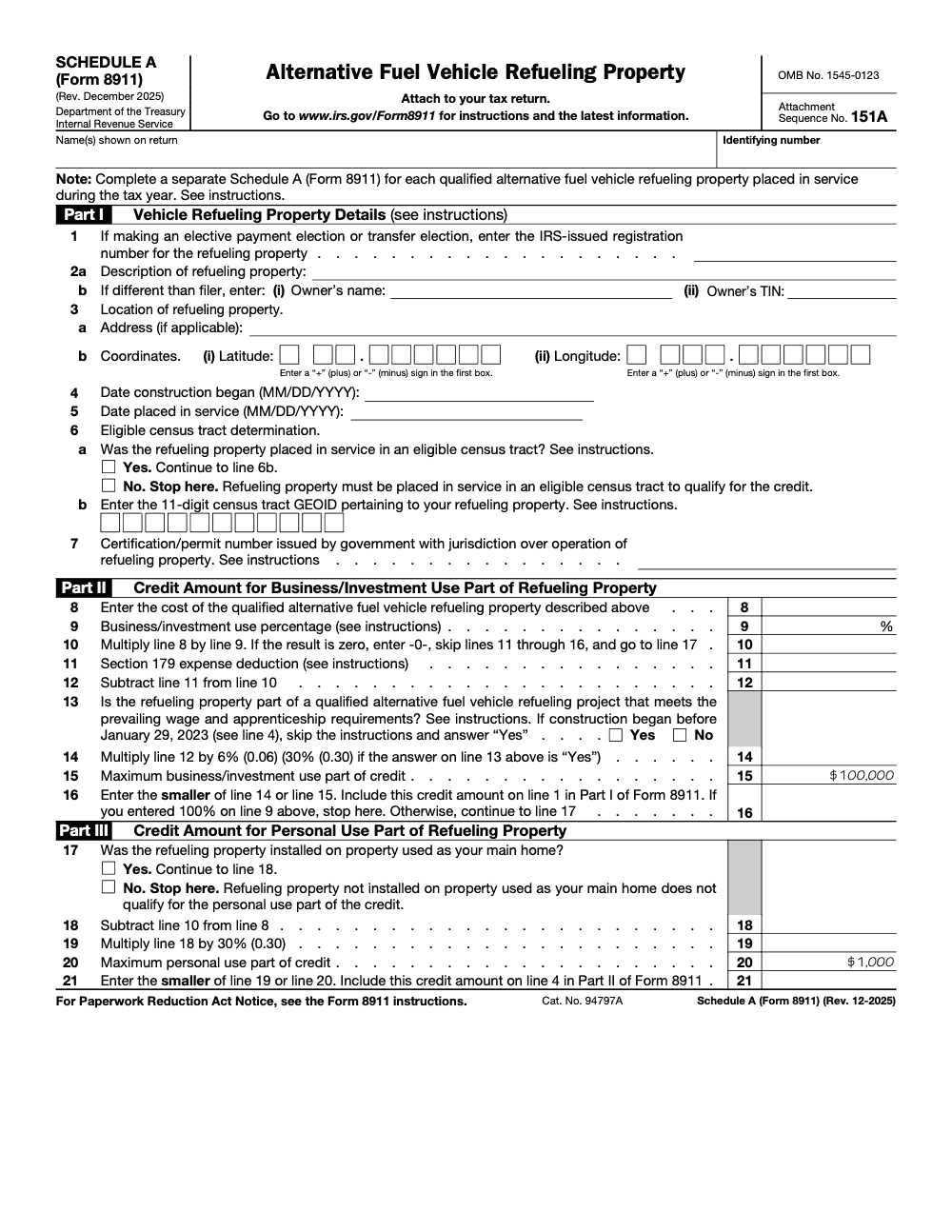
Schedule A (Form 8911) is the per-item worksheet for the Section 30C alternative fuel vehicle refueling property credit – you file one Schedule A for each charger or dispenser placed in service after December 31, 2022. Line 6b carries the 11-digit census tract GEOID, the business credit on line 14 runs 6% (or 30% with prevailing wage and apprenticeship) and is capped at $100,000 per item on line 15, while the personal-use credit is a flat 30% capped at $1,000 per item (according to the Instructions for Form 8911). Calendar-year 2025 returns were due April 15, 2026, with an extension to October 15, 2026.
Last season a client installed several chargers at a single site and handed over one summary invoice, expecting one credit. Schedule A (Form 8911) is the per-item worksheet for the Section 30C refueling property credit, so the costs had to be split by unit, with one Schedule A for each charger or dispenser placed in service after December 31, 2022, and the results carried to Form 8911.
Post 2022, location is part of eligibility, so line 6b carries the 11-digit census tract GEOID, which has to appear on the correct appendix for that year. On the business side, line 14 runs 6% of cost, or 30% with prevailing wage and apprenticeship, capped at $100,000 per item on line 15, while personal property at a main home gets 30% up to $1,000 per item.
Key Takeaways
- You must complete one Schedule A per refueling property unit, then carry results to Form 8911.
- Post 2022, location is part of eligibility. Enter the 11 digit census tract GEOID and confirm the tract appears on the correct appendix for that year.
- For business property placed in service after 2022, the credit is 6% of cost, or 30% with prevailing wage and apprenticeship, capped at $100,000 per single item, after any Section 179.
- For personal property at your main home, the credit is 30% up to $1,000 per item.
- Schedule A drives basis reduction, recapture tracking, elective payment or transfer details, and business versus personal routing.
Why Teams Struggle With Form 8911
Most firms do not stall because they lack clients. They stall because delivery is messy during peak season. Reviewers get stuck in loops, GEOIDs are missing, workpapers are inconsistent, and capacity swings cause shortcuts. That is a delivery system problem, not a sales problem.
- Capacity spikes hide small misses, like an incorrect GEOID or a missing PWA proof.
- Partner time gets trapped in reviews instead of client strategy.
- Inconsistent workpapers create rework and missed deadlines.
Fix the system and the credit stops being a bottleneck. That means SOPs, standardized workpapers, clear naming, and a one to one link between each unit and its Schedule A. If you truly need more hands, pair capacity with structure. That is where a disciplined offshore extension can help, but only if it plugs into your templates, your software, and your review rules.
What Schedule A Actually Does
Think of Schedule A as the unit level dossier for the alternative fuel refueling property credit. It captures the details that determine eligibility and rate, then feeds the math into Form 8911.
- Identifies each item of qualified refueling property, what it is, and when it was placed in service.
- Confirms the exact location using the 11 digit census tract GEOID and the correct appendix.
- Locks in the business rate, 6% base or 30% with prevailing wage and apprenticeship, or the personal rate, 30% up to 1,000.
- Records elective payment or transfer registration numbers when used.
- Feeds basis reduction and recapture tracking into your fixed asset and return workflow.
Who Qualifies For The Credit
You qualify if you place new qualified refueling property in service during the tax year and you meet the rules for original use, U.S. use, and, post 2022, eligible location. Two major paths exist.
Individuals Installing Home Chargers
- Install a new EV charger at your main home, original use starts with you, and the charger is in the United States.
- For placed in service after 2022, your home must sit in an eligible census tract. Confirm and record the 11 digit GEOID.
- The credit equals 30% of cost up to $1,000 per item. The personal credit is nonrefundable, so it is limited to your tax liability for the year, and any unused personal credit does not carry forward.
- You must file Form 8911 and, if your software requires, attach Schedule A for each unit.
Businesses Adding Dispensing Equipment
- Install new qualified refueling property, for example EVSE, bidirectional chargers, tanks, storage, or dispensers for CNG, LNG, hydrogen, propane, E85, or biodiesel blends.
- For property placed in service after 2022, it must be in an eligible census tract.
- Your business credit is 6% of cost, or 30% if prevailing wage and apprenticeship are met, capped at $100,000 per single item, after Section 179.
- Partnerships and S corporations claim on the entity return, then pass through on Schedule K 1. Business credits flow to Form 3800.
Tip, document what the “single item” is, then list the associated property you include in the calculation. Reviewers can tie costs quickly and move on.
What Counts As Qualified Refueling Property
The clean way to frame it is simple. Does the equipment deliver alternative fuel at the point of use, or does it recharge a vehicle, and does original use start with you this year in the United States. If yes, you are in range. For post 2022, add the location check.
- Electric, EV charging supply equipment, including Level 2, DC fast charging, bidirectional or V2G, and chargers for certain two and three wheeled public road vehicles.
- Non electric, equipment that stores or dispenses CNG, LNG, propane, hydrogen, E85, fuel that is at least 85% natural gas, and diesel or biodiesel blends with at least 20% biodiesel.
Exclusions still apply. Buildings and structural components do not qualify. Original use must begin with you. Property must be used mainly in the United States.
The “Single Item” And Associated Property
For a home charger, the single item is usually the charging port. Associated property can include a dedicated connector, wall mount, new panel, and wiring, if directly attributable and traceable to the charger.
- For personal use, apply 30% to the combined eligible costs, then apply the $1,000 per item cap.
- For business use, reduce cost by any Section 179, then apply 6% or 30% with PWA, subject to the $100,000 per item cap.
Original Use, In Service, And Timing
Original use must start with you. The property must be placed in service during the tax year, which means the date it is ready and available for use, generally when installation is complete and the unit is operational, not the purchase or order date. For certain projects that began construction before January 29, 2023, continuity rules may allow the enhanced rate without PWA. Beginning of construction is determined by the physical work of a significant nature test, or the 5% safe harbor when you have paid or incurred at least 5% of the total cost, not the purchase or delivery date. Keep dated contracts, permits, commissioning reports, and site photos. When in doubt, add a brief memo to your workpapers explaining timing.
Post 2022 Credit Rules And Limits
From 2023 forward, two big shifts apply. Location is now part of eligibility, and the business cap is per item, not per location.
- Business property, 6% of cost, or 30% with prevailing wage and apprenticeship, capped at $100,000 per single item. Reduce basis by the credit.
- Personal property at your main home, 30% of cost up to $1,000 per item. Reduce basis by the credit, even for personal property.
Checklist for teams:
- Verify tract eligibility before committing capital.
- Document PWA to secure 30%.
- Track beginning of construction to use conversion relief if it applies.
Pre 2023 Credit Rules And Limits
If you are amending older years, apply the legacy framework.
- Business, 30% up to 30,000 per location.
- Personal, 30% up to 1,000 per location.
- No location rule applied, but original use and placed in service did.
Side By Side Comparison
| Item | Pre 2023 | Post 2022 |
| Business rate and cap | 30% up to 30,000 per location | 6% or 30% with PWA, up to 100,000 per single item |
| Personal rate and cap | 30% up to 1,000 per location | 30% up to 1,000 per single item |
| Location requirement | Not required | Must be in eligible census tract |
| Basis reduction | Yes | Yes |
| Elective pay or transfer | Not available | Available for eligible taxpayers with registration |
Planning note, the switch from per location to per item gives you more control when modeling multi port projects. Keep invoices and asset tags clean so each item ties to its own Schedule A.
Location Eligibility And The 11 Digit GEOID
This is where most returns stumble. For property placed in service after 2022, you must confirm that the unit sits in an eligible census tract, then enter the exact 11 digit census tract GEOID on Schedule A. The catch is that the IRS uses different census boundary years in different periods, so you must match the correct list.
Which List To Use
- For property placed in service during 2023 or 2024, use the 2015 Census Tract Identifier, then confirm eligibility against Appendix A.
- For property placed in service during 2025 and later years still covered, use the 2020 Census Tract Identifier, then confirm eligibility against Appendix B.
You only need one category to qualify, either a low income community tract or a qualifying non urban tract.
Four Step GEOID Packet
- Capture the precise site location, address and, if helpful, GPS coordinates.
- Pull the 11 digit GEOID using the correct Census tool for the placed in service year.
- Highlight the entry in the applicable appendix and save a screenshot.
- Save both screenshots in your workpapers using a consistent naming scheme.
Name them like this:
- 01 GEOID 2015 tool, 02 Appendix A highlight, 03 GEOID 2020 tool, 04 Appendix B highlight.
Field note, the same coordinates can produce different GEOIDs in the 2015 and 2020 tools. That is expected. Match your placed in service year to the right tool and appendix, and you will be fine.
Prevailing Wage And Apprenticeship, How To Lock The 30% Rate
For business property placed in service after 2022, you get 30% only if you satisfy prevailing wage and apprenticeship, unless you qualify under the beginning of construction rule with continuity. Build a simple PWA packet.
- Wage determinations for the county and trades you used, with a short note showing how you applied them.
- Certified payrolls or payroll extracts, with hours by classification.
- Apprenticeship paperwork, ratios, and proof that when four or more workers were on site, at least one qualified apprentice was employed.
- A one page attestation signed by the project lead.
If you cannot support PWA during review, your rate drops to 6%, and you may need to adjust prior claims.
Business Versus Personal Use Treatment
Form 8911 splits the credit between business or investment property and personal property, and the math flows to different places on the return.
- Business or investment property routes to Form 3800 as part of the general business credit. Apply Section 179 before the credit, then reduce basis by the allowed credit.
- Personal property at your main home routes to Schedule 3. The unused personal portion does not carry forward. Reduce basis by the allowed credit.
Pro tip, post the basis reduction in your fixed asset or home charger file as soon as you finalize the amount. This avoids depreciation mismatches or gain calculation errors later.
Basis Reduction, Depreciation, And Recapture
Claiming the Form 8911 credit reduces your basis in each item of qualified refueling property by the amount of the allowed credit. For depreciable assets, you start depreciation from the reduced basis. Keep this simple and visible.
- Fixed asset memo, original cost, Section 179, credit amount, reduced basis, recovery method, and life.
- If recapture applies later, document the event and the year, add the recapture amount to income, and increase basis by the same amount from that year forward.
When can recapture apply
- If the property stops being qualified within the recapture window, for example it is modified so it no longer qualifies.
- For depreciable property, if business use drops below 50%.
- Disposal events can also trigger adjustments, so record dates cleanly.
Clean Example
You installed a DC fast charger in 2025 and claimed a 30% business credit. In 2027, you modified the unit in a way that makes it ineligible. You include a recapture amount in 2027 income and increase the asset’s basis by that recapture amount beginning in 2027. Keep a one page memo with dates, the calculation, and the updated depreciation schedule.
Elective Payment, Transfers, And Registration
If you will use elective payment or transfer the credit, complete the IRS pre filing registration and include the registration number on Schedule A. Keep in mind that elective payment under Section 6417, direct pay, is limited to applicable entities such as tax exempt organizations, state and local governments, and Indian tribal governments. Other taxpayers who want to monetize the credit use the Section 6418 transfer election instead. Keep the confirmation with your workpapers. If you are not using these options, skip the registration.
Quick Checklist
- Complete the pre filing registration for each property or project.
- Enter the registration number on Schedule A.
- Retain the confirmation and reference it in your reviewer notes.
How To Complete Schedule A And Form 8911
Use this sequence so your reviewers never hunt for basic facts.
- Create one Schedule A for each single item placed in service.
- If using elective payment or transfer, collect the registration number and enter it on Schedule A.
- Record beginning of construction if relevant, and the placed in service date with support.
- Pull the 11 digit GEOID using the correct Census tool, then test it against the right appendix, and save screenshots.
- Enter costs, reduce by Section 179 for business assets, apply 6% or 30% with PWA, and enforce the $100,000 per item cap.
- For personal property, compute 30% up to $1,000 per item.
- Reduce basis by the allowed credit and route amounts, Form 3800 for business, Schedule 3 for personal.
- Attach all Schedules A to Form 8911 and the return.
Reviewer relief, label each Schedule A with a short code, site short name plus port number. Keep the same code in your workpapers and your tax software. That simple match cuts review time dramatically.
Software Workflow And Data Entry Tips
Your software is only as good as your inputs. The goal is one to one mapping, one unit to one Schedule A, and workpapers that mirror software entries exactly.
- Create a unique identifier for each unit and use it everywhere, workpapers, Schedule A title, and internal notes.
- Build a location packet per unit, 2015 tool GEOID and Appendix A screenshot if 2023 or 2024, 2020 tool GEOID and Appendix B screenshot if 2025 or later.
- Add a PWA packet for business items targeting 30%, wage determinations, payroll extracts, apprentice ratios, and a signed summary page.
- Reconcile Section 179 before you compute the credit. Then post the basis reduction back to fixed assets or your home charger file.
- For pass through entities, tie the entity credit to owner K 1s and owners’ Form 3800 entries. Include a crosswalk in your file.
Naming Conventions That Keep Review Clean
- 01 GEOID 2015 tool
- 02 Appendix A highlight
- 03 GEOID 2020 tool
- 04 Appendix B highlight
- 05 PWA packet
- 06 Cost map and basis reduction
- 07 Registration confirmation, if applicable
Common Pitfalls To Avoid
- Forgetting to check the correct appendix for the year, which breaks eligibility.
- Computing the credit, then applying Section 179, which inflates the credit.
- Claiming 30% on business property without PWA proof in the file.
- Missing basis reduction entries, which cause depreciation issues and messy gain calculations.
Coordinating Federal And State Incentives
Federal and state programs often collide in small ways, basis adjustments, timing, and documentation. Keep a one page reconciliation for every project.
- Show the federal credit amount and the exact basis reduction you posted.
- Note any state add back or state specific limits.
- If you use elective payment or transfer, confirm how the state treats that election.
A simple reconciliation page clears up most questions, both with clients and with examiners, because it shows your math and your intent in one spot.
Delivery Discipline For Busy Firms
If your firm lives in review loops, you do not have a people problem, you have a process problem. The fix is structure.
- SOP driven execution, so every Schedule A file looks the same.
- Structured workpapers, so reviewers always know where to look.
- Multi layer review, preparer, senior, quality, then final sign off.
If your in house team is at capacity during deadlines, you can add help without losing control. Accountably can operate as a U.S. led offshore extension that works inside your systems, your templates, and your cadence. The goal is predictable delivery, not resumes, and fewer review notes, not more work.
Conclusion
Treat Schedule A like a control center, not a form to rush through. When you complete one Schedule A per unit, confirm the 11 digit GEOID against the correct appendix, and make your PWA story obvious, Form 8911 turns into clean data flow rather than detective work. Your reviewers spend less time chasing fixes, your clients get their credits on time, and your team avoids the weekend scramble.
If you need help standardizing files or adding disciplined capacity without giving up control, Accountably can plug in, work inside your systems and templates, and keep your delivery stable. Either way, use this guide as your checklist. Precision wins here. One correct GEOID, one tight packet, one smooth review at a time.
Disclaimer, this article is general information, not tax advice. Confirm current IRS instructions, notices, and FAQs for your filing year, and consult a tax advisor for your facts.
Common Mistakes We See Every Season
The same handful of errors shows up on Schedule A every season, and each one is avoidable once you know where to look. Here are the ones that cost filers the most.
Reusable Checklists
These checklists are copy-paste ready for your firm SOP. Drop them into your workpaper template and run them top to bottom for each refueling property.
Eligibility and location packet
- Confirm original use begins with the taxpayer and the property is in the United States.
- Verify the line 5 placed-in-service date falls after December 31, 2022 and before January 1, 2033.
- Pull the 11-digit census tract GEOID and confirm the tract is eligible on line 6a, then enter it on line 6b.
- Match the GEOID to the correct IRS appendix for the placed-in-service year.
- Record the certification or permit number for line 7.
- Screenshot the IRS Section 30C census tract tool result into the file.
Per-unit Schedule A computation
- Open one Schedule A per single item of refueling property.
- Enter total cost on line 8 and the business-use percentage on line 9.
- Subtract any Section 179 amount on line 11 to set the credit base on line 12.
- Apply 6% on line 14, or 30% only when PWA is documented on line 13.
- Cap the business credit at $100,000 per item on line 15 and carry the smaller figure to line 16.
- For main-home personal use, apply 30% on line 19 and cap at $1,000 on line 20.
- Route line 16 to Form 8911 Part I and line 21 to Form 8911 Part II.
PWA substantiation file
- Confirm whether construction began before January 29, 2023, which grandfathers the property into PWA.
- Set the line 4 construction-begin date under the physical-work or 5% safe-harbor test.
- Collect wage records supporting prevailing wage for the installation labor.
- Document apprenticeship participation and labor-hour records that support the bonus rate.
- Answer Yes to PWA on line 13 only when the packet is complete.
Keep Schedule A (Form 8911) Season From Stalling
Schedule A does not run on a single deadline so much as a documentation window that opens the moment a charger is energized and closes when the return is filed. The work clusters in the same spring crunch as every other return, and the per-item structure multiplies it. The Inflation Reduction Act of 2022 replaced the old $30,000 per-location cap with a $100,000 per-item cap, so a site with six chargers becomes six Schedule A files, six GEOID checks, and six PWA decisions instead of one.
The teams that stay calm in April do the slow work in advance. They treat each unit as its own dossier from the day it is placed in service, so nothing has to be reconstructed under deadline pressure. That front-loading is what keeps a clean credit from turning into a week of detective work.
- Capture the line 5 placed-in-service date and the line 6b GEOID for every unit at install time, not at filing time.
- Decide the line 13 PWA answer early so you know whether a unit runs at 6% or 30% before the return is in motion.
- Track the line 15 $100,000 and line 20 $1,000 caps per item, so multi-unit sites do not silently lose credit.
- Log the basis reduction and any recapture trigger the moment you post the credit, since both follow the asset for years.
When the volume outgrows your bench, the answer is structure, not a scramble. Accountably can extend your team with U.S.-led offshore capacity that works inside your software, your templates, and your review cadence, so every Schedule A is built the same way each time. See how our tax services keep credit work moving without adding headcount.
FAQs
Yes. File one Schedule A per single item of qualified refueling property. This is how you document eligibility, location, dates, and caps before you complete Form 8911.
Use the Census Tract Identifier tool that matches your placed in service year. For 2023 or 2024, use the 2015 tool and Appendix A. For 2025 and later years covered, use the 2020 tool and Appendix B. Save screenshots in your file.
The single item is the unit that dispenses fuel or charges the vehicle, for example the charger. Associated property includes directly attributable items like a dedicated connector, wall mount, new panel, and wiring. Keep a simple cost map that ties every line to the single item.
You can still claim the business credit at 6%. If you cannot substantiate PWA on review, do not use 30%. Build a PWA packet before filing whenever you plan to claim 30%.
Yes. For property placed in service after 2022, both business and personal property must be in an eligible census tract.
Recapture can apply if the property ceases to qualify within the recapture window, for example it is modified so it no longer qualifies, or, for depreciable property, business use drops below 50%. Document the event date and follow the basis increase rule in the recapture year.
Other forms this guide names
Summarize this article with AI
About this guide
Accountably helps US CPA, EA, and accounting firms hire trained accountants and tax preparers in India.
About us Reviewed byJugal Thacker, CPAFounder and CEO at Accountably
A Washington-licensed CPA with 7+ years inside US firms – PwC, a real-estate tax practice, then a full-service firm, rising from reviewer to manager to advisory. This article was reviewed against current IRS guidance for the 2025 tax year and updated for filers preparing late returns, amendments, and 2026 estimates.
View profile →How we research, review, and update this guide
Every Accountably guide is researched against primary IRS sources, reviewed by a U.S. CPA, and refreshed as guidance evolves. Read our Editorial Guidelines to see how we source, fact-check, and update our content.