Summarize this article with AI
In Brief
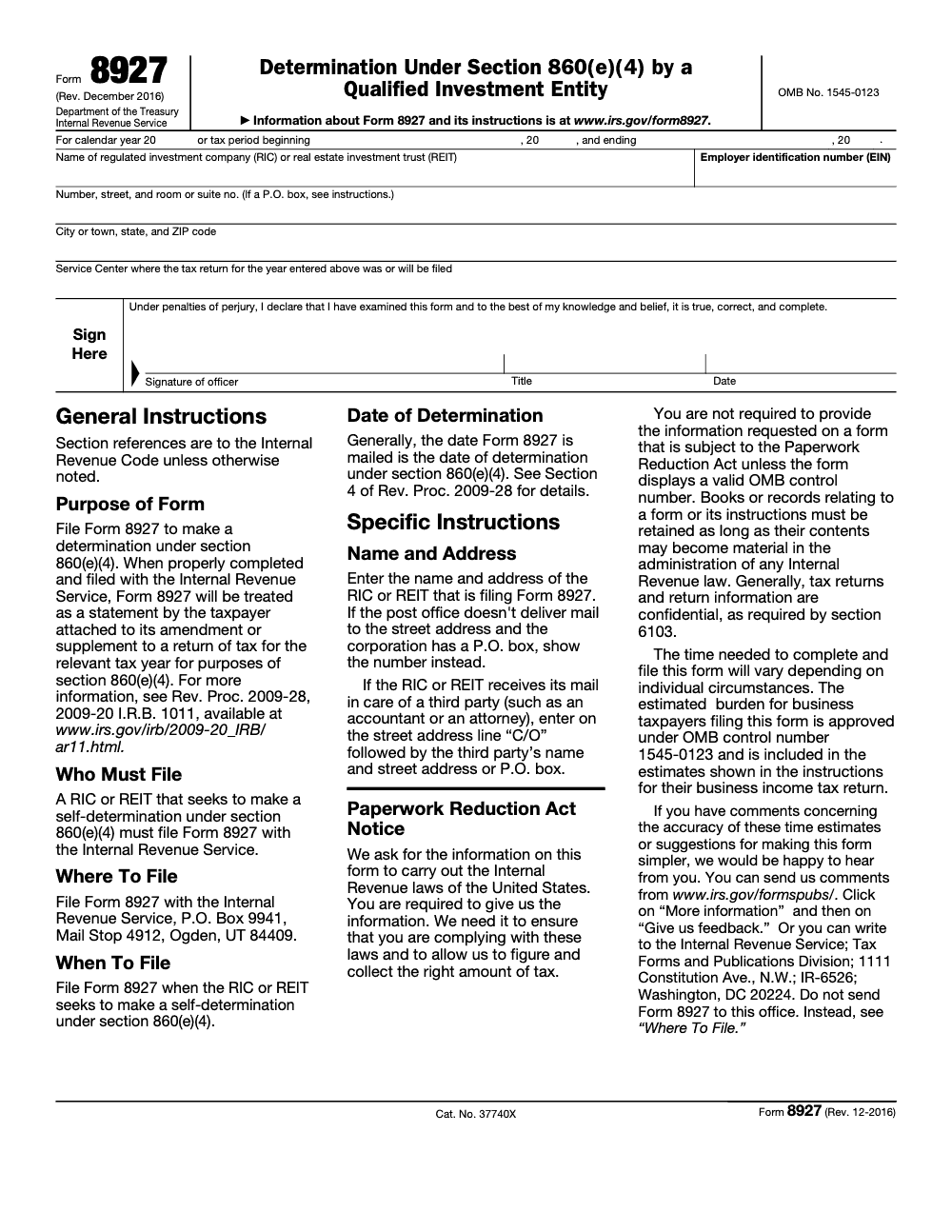
Form 8927 is filed by a regulated investment company (RIC) or real estate investment trust (REIT) to make a self-determination under IRC 860(e)(4) so the entity can use the deficiency dividend procedures in section 860 (per the December 2016 IRS revision of the form, still current for 2025). Mail the signed form to Internal Revenue Service, P.O. Box 9941, Mail Stop 4912, Ogden, UT 84409 – per Section 4 of Rev. Proc. 2009-28, the mailing date generally sets the determination clock for the 90-day distribution and 120-day Form 976 claim windows.
The first Form 8927 a team handles, the calendar trips them up before the technical part ever does. A REIT controller calls late in the 90-day clock asking whether a wire that hits the transfer agent the next day still meets the deficiency dividend deadline. The mechanics are short; the timing is where the risk lives.
Form 8927 is filed by a RIC or REIT to self-determine under IRC 860(e)(4) so the entity can use the deficiency dividend procedures in section 860. The signed form mails to Ogden, Utah, and the mailing date generally sets the determination clock, after which deficiency dividends go out within 90 days and the claim, usually Form 976, is filed within 120 days.
Key Takeaways
- Form 8927 is filed by a qualified investment entity, specifically a RIC or a REIT, to make a determination under IRC 860(e)(4). This enables use of the deficiency dividend rules in IRC 860.
- The form is mailed to the IRS in Ogden, Utah. Mailing the form generally sets the determination date for the 90‑day and 120‑day clocks in the deficiency dividend procedures.
- After the determination, deficiency dividends must be distributed within 90 days and the claim, typically Form 976, must be filed within 120 days.
- Form 8927 is not a REMIC or qualified mortgage pool filing and it is not tied to Form 1066. It is a RIC or REIT tool tied to deficiency dividends.
- As of August 2, 2025, the IRS shows no recent developments for Form 8927, and the current revision remains the December 2016 PDF. Verify addresses before mailing.
What Form 8927 Actually Does
Form 8927 is a simple trigger. When you complete and mail it, the IRS treats it as the taxpayer’s statement that satisfies IRC 860(e)(4). That statement is one of four ways to get a “determination” under section 860, which is needed before you can pay deficiency dividends that relate back to the affected year for RIC or REIT distribution requirements. Put differently, you use Form 8927 to start the legal stopwatch that allows you to clean up a distribution shortfall the right way.
Once you have a valid determination, the deficiency dividend must be paid on or within 90 days after that date, and before you file the deduction claim. The claim is typically made on Form 976. The claim must be filed within 120 days after the determination. Interest consequences follow IRC 860(c)(1), so getting dates right matters.
Who Must File Form 8927
Only qualified investment entities file this form, and that term is defined narrowly. It means a regulated investment company or a real estate investment trust. If you are not a RIC or a REIT, Form 8927 is not for you. The IRS’s one‑page PDF says exactly that, and the Internal Revenue Manual backs it up.
In practice, we see Form 8927 used when a RIC or REIT identifies an adjustment that creates a distribution shortfall, then chooses to self‑determine under 860(e)(4) so it can use the deficiency dividend rules.
Common Confusion, Cleared Up
You might have heard references to REMICs, qualified mortgage pools, or Form 1066 alongside Form 8927. That is a mix‑up. REMIC concepts live under sections 860A through 860G, and Form 1066 belongs to REMICs. Form 8927 is tied to section 860 deficiency dividends for RICs and REITs. These are different parts of the Code with different forms and timelines. If you are managing a REIT, you may work around mortgage‑related vehicles, but the Form 8927 determination is not a REMIC filing.
Why This Matters Operationally
The 90‑day and 120‑day windows are short. You need clean records, a clear board process, and a production plan that can push a dividend and a claim through without scrambling. If your internal capacity is tight during peak cycles, build a repeatable checklist for 8927 and 976 events. On Accountably.com we focus on delivery discipline, not just filling seats, so I will share the exact timelines and checklists we use in the next section. This is about reliability and proof, not heroics.
The 8927 Timeline, From Determination To Claim
The determination date drives everything. For a self‑determination under 860(e)(4), the IRS guidance treats the date you mail Form 8927 as the determination date, not the date the IRS receives or processes it. From that date, your 90‑day and 120‑day clocks start.
The Three Critical Dates You Must Lock
- Determination date, generally the date you mail Form 8927.
- Distribution deadline, deficiency dividends must be paid on or within 90 days after the determination, and before the claim is filed.
- Claim deadline, the claim for the deficiency dividend deduction, typically Form 976, must be filed within 120 days after the determination.
Sample Calendar Walkthrough
- You mail Form 8927 on April 1, 2026. That sets the determination date at April 1, 2026.
- You must declare and pay the deficiency dividend by June 30, 2026, which is within 90 days of April 1.
- You must file Form 976 by July 30, 2026, which is within 120 days of April 1.
Tip, build internal buffers of 10 to 15 days on both the 90‑ and 120‑day dates. Interest under 860(c)(1) still applies, so precision and speed both matter.
Where and How to File Form 8927
- Filing method, mail only. There is no e‑file option for Form 8927. Sign the form as an authorized officer. Keep proof of mailing.
- Address, send Form 8927 to Internal Revenue Service, P.O. Box 9941, Mail Stop 4912, Ogden, UT 84409, regardless of which service center the entity's underlying tax return goes to. This is the same address used for Form 976 when the determination is made under 860(e)(4). Always confirm the address on the day you mail.
- Copies and controls, assemble a packet that includes your form, officer signature, board resolution or officer certification authorizing the dividend plan, and a cover memo tying dates to IRC 860 requirements. Retain full copies and mailing receipts.
As of August 2, 2025, the IRS page for Form 8927 lists no recent developments. The governing PDF is still the December 2016 revision. Verify addresses and any procedural updates before you drop it in the mail.
The Process Flow, Step By Step
- Confirm you are a RIC or REIT and that an adjustment exists or is expected for the affected year. Tie the adjustment to sections 860(d)(1) or (2).
- Prepare Form 8927. This is the 860(e)(4) self‑determination. Get the officer signature.
- Mail Form 8927 to Ogden. The mailing date generally sets the determination date. Start the 90‑ and 120‑day clocks.
- Declare and pay the deficiency dividend within 90 days after determination, and before filing the claim. Keep board minutes and payment proofs.
- File Form 976 within 120 days after determination. Include required attachments that substantiate the adjustment and the dividend.
- Track interest under 860(c)(1). Expect IRS correspondence about interest on the deduction you claimed on Form 976.
A Quick Comparison Table
| Item | Form 8927 | Form 976 | Primary purpose |
| Who files | RIC or REIT | PHC, RIC, REIT | Make 860(e)(4) determination vs. claim deficiency dividend deduction |
| When | When you choose to self‑determine | Within 120 days after determination | Start the legal clock vs. claim the deduction |
| Where | IRS, P.O. Box 9941, MS 4912, Ogden, UT 84409 | Same address when 860(e)(4) determination is used | Ogden processing for these cases |
| Attachments | Minimal, signed by officer | Substantiation of adjustment and dividend | Prove the amount, the timing, and eligibility |
Citations, Form 8927 PDF and IRM show the address and timing rules, and the Form 976 page ties the claim to the same Ogden address when the determination comes from 860(e)(4).
Completing Form 8927, Line By Line
Form 8927 is short, but do it carefully. Small errors here can ripple through the 90‑ and 120‑day clocks.
Header, Name, EIN, Period
- Entity name, use the legal name of the RIC or REIT exactly as it appears on your return. Use the correct EIN.
- Period, enter the calendar year or the tax period that ties to the affected year. Keep this consistent with your 1120‑RIC or 1120‑REIT.
- Service center, list where the underlying return was or will be filed (this is the service center for the entity's tax return, not the Ogden address used to file Form 8927 itself). This helps the IRS route the case correctly.
Signature Block
An authorized officer signs under penalties of perjury. Do not delegate this to an external preparer without confirming authority. Include title and date. Keep the wet‑ink original in your records and a high‑resolution scan in your document system.
What To Attach
The 8927 PDF does not mandate supporting schedules, but in practice you should attach a short statement that identifies the affected year, briefly describes the adjustment that gave rise to the need for a determination, and states that you are making a determination under 860(e)(4). This helps align the later Form 976 claim with the determination. See the regulations under 860 and Rev. Proc. 2009‑28 for the framework the IRS applies.
Recordkeeping That Survives Exam
- Keep the mailed 8927 package, certified mail or courier proof, and a control log that records the determination date.
- Preserve board resolutions, dividend declarations, payment confirmations, and shareholder notices for the deficiency dividend. Tie each to dates and amounts.
- Retain the Form 976 claim, all attachments, and any IRS interest computations. Note that interest is addressed under 860(c)(1).
If you ever need to prove timeliness, your best friend is a clean packet, a precise timeline, and a tracking receipt that shows when the IRS received your mailing.
A Simple Example
- Situation, a calendar‑year REIT receives a state audit report in February 2026 that increases taxable income for 2025.
- Action, on April 1, 2026 the REIT mails Form 8927 to make a 860(e)(4) determination. The mailing date is the determination date.
- Dividend, the REIT declares and pays a deficiency dividend on June 20, 2026. This falls within 90 days.
- Claim, the REIT files Form 976 on July 15, 2026, which is within 120 days. The claim includes schedules that show the adjustment and the dividend computation.
This sequence preserves the REIT’s distribution requirement position while accepting the interest consequence under section 860.
Coordinating With Your Corporate Return
There is no e‑file for Form 8927, and it is not attached to your 1120‑RIC or 1120‑REIT. It is a separate mailed filing, but you should still keep the names, EINs, and periods in lockstep with the tax return. If you file 1120‑RIC or 1120‑REIT on a fiscal year, be extra careful that the 8927 period reflects the affected year correctly. Cross‑check your return instructions to be sure your filing center and addresses are up to date.
Common Errors And How To Avoid Them
- Treating Form 8927 as a REMIC filing. It is not. This form is for RICs and REITs using the deficiency dividend procedures.
- Missing the 90‑day distribution window or the 120‑day claim window. Build buffers, set multiple reminders, and get board time on the calendar early.
- Wrong address or missing officer signature. Use the Ogden P.O. Box and Mail Stop listed on the PDF and sign as an authorized officer.
- Incomplete substantiation for Form 976. The claim needs to tie the amount and timing of the dividend to the adjustment. Keep schedules clean and labeled.
- Assuming e‑file exists. Mail it, track it, and keep the receipt.
How We Operationalize The 90/120‑Day Workflow
Here is the internal playbook we use with finance teams so the legal steps translate into a predictable timeline.
Day 0 To Day 7, Determination And Controls
- Draft and sign Form 8927.
- Mail it certified with return receipt and capture the tracking number in your timeline.
- Start a single source timeline that shows Day 0 as the mailing date.
Day 8 To Day 60, Dividend Mechanics
- Draft board materials for a deficiency dividend.
- Confirm earnings and profits computations and capital gain dividend limits, since the dividend can be ordinary or capital, subject to limitations.
- Stage transfer agent instructions and shareholder communications.
Day 61 To Day 90, Payment And Proof
- Declare and pay the dividend no later than Day 90.
- Archive payment proofs and notices by CUSIP or account, then tie totals back to the board resolution and the adjustment workpapers.
Day 91 To Day 120, File The Claim
- Prepare Form 976 with line‑by‑line support.
- Mail Form 976 to Ogden, the same address used when the determination was made under 860(e)(4). Track the filing and add the receipt to the packet.
Amending Or Correcting
If you discover an error in your Form 8927 package, prepare a corrected Form 8927 marked Amended, explain the change in a short attachment, and remail to the Ogden address. Then check whether the dividend or the Form 976 claim also needs correction and, if so, repeat the mailing and documentation steps. Keep each version and receipt. The IRM explains how timeliness affects allowability, so move quickly and document every date.
Where Accountably Fits
When deadlines are tight, the bottleneck is usually not the tax rule, it is the workflow. If you need disciplined production, standardized workpapers, and predictable turnarounds for tasks like dividend schedules, board packets, and filing packets, a structured delivery partner can help you avoid last‑minute scrambles. At Accountably, we integrate offshore teams under U.S. leadership, align to your systems, and build SOP‑driven workflows that make the 90‑ and 120‑day steps repeatable. Use us only where you truly need capacity with control.
Final Checklist You Can Reuse
- Confirm you are a RIC or REIT and that an 860(d) adjustment exists.
- Prepare and sign Form 8927. Mail it and log the determination date.
- Plan the deficiency dividend. Keep board approvals, payment proofs, and notices.
- File Form 976 within 120 days, with clean schedules that tie amounts and dates to the adjustment and the dividend.
- Track interest under 860(c)(1) and keep all IRS correspondence with your packet.
Common Mistakes We See Every Season
The recurring trap with Form 8927 is mixing it up with adjacent forms and addresses. Six errors come up over and over – here is how to spot them in your file before mailing.
Reusable Checklists
These checklists are formatted for copy-paste into your firm's SOP library. Use them as the working spine of an 8927 and 976 engagement, then adjust the dates against your own calendar.
Pre-Mailing Packet for Form 8927
- Confirm the entity is a regulated investment company (RIC) or real estate investment trust (REIT) for the affected tax year.
- Identify the specific section 860(d) adjustment that drives the determination.
- Enter the entity's legal name and EIN exactly as shown on the 1120-RIC or 1120-REIT return.
- Enter the affected tax period in the calendar-year or fiscal-period block and cross-check against the underlying return.
- Enter the Service Center where the entity's underlying return was or will be filed (not Ogden).
- Obtain an authorized officer's wet-ink signature, title, and date under penalties of perjury.
- Verify the Ogden address (P.O. Box 9941, Mail Stop 4912, Ogden, UT 84409) against the current IRS Form 8927 PDF.
- Mail by certified mail or a trackable courier and log the postmark as the determination date.
90-Day Deficiency Dividend Distribution Control
- Set Day 0 equal to the postmark date of Form 8927 and calculate Day 90 in your compliance calendar.
- Build a 10 to 15 day internal buffer ahead of Day 90.
- Draft the board resolution authorizing the deficiency dividend amount and record date.
- Reconcile earnings and profits and confirm capital gain dividend limits under IRC 860.
- Coordinate with the transfer agent on payment date and shareholder notices.
- Pay the deficiency dividend on or before Day 90 and before filing the claim.
- Archive payment proofs, transfer-agent confirmations, and shareholder notices to the engagement file.
120-Day Form 976 Claim File
- Set Day 120 in the compliance calendar from the same postmark date used for the 90-day clock.
- Prepare Form 976 with schedules tying the adjustment, dividend amount, and dividend date together.
- Cross-reference the Form 8927 determination date and packet on the Form 976 cover memo.
- Mail Form 976 to the same Ogden address used for Form 8927 when the determination is made under 860(e)(4).
- Track interest exposure under IRC 860(c)(1) and stage a response packet for IRS correspondence.
- Retain the full 8927 and 976 file on a materiality-based retention flag, not the standard three-year clock.
Keep 8927 Season From Stalling
Form 8927 work does not arrive on a predictable quarterly cadence. It lands when a RIC or REIT discovers an 860(d) adjustment, and from that moment the 90-day distribution clock and the 120-day Form 976 claim clock both start running. According to Section 4 of Rev. Proc. 2009-28, the mailing date of Form 8927 is generally the date of determination, so the calendar is unforgiving from the moment the envelope leaves the office. For firms serving RIC or REIT entities, the bottleneck is rarely the IRC 860 analysis. It is the production capacity to pull a board resolution, a transfer-agent instruction, a wire confirmation, and a Form 976 schedule package together inside roughly four months.
The way to keep that cycle from stalling is to treat the 8927 and 976 event as a defined workflow with named owners and pre-built artifacts, not as an ad-hoc fire drill. Each handoff should be documented before Day 0, so when a determination is triggered the team is executing a known sequence rather than designing one under pressure.
- Pre-stage the 8927 packet template with the Ogden address (P.O. Box 9941, Mail Stop 4912, Ogden, UT 84409), the officer signature block, and the affected-period header so only the variable fields need a touch.
- Lock the Service Center field convention in your SOP. It shows where the underlying 1120-RIC or 1120-REIT return is filed, not Ogden, and getting this wrong creates routing delays.
- Stand up a single source-of-truth timeline (one workpaper, one row per event) that captures the postmark, Day 90, and Day 120 against named owners for board action, transfer-agent coordination, and Form 976 preparation.
- Build the Form 976 schedule shell at the same time you draft Form 8927, so the 120-day claim is not a separate project that starts at Day 91.
- Run a Day 60 and a Day 100 internal review against IRC 860(c)(1) interest exposure. A documented two-stage review prevents last-minute escalations.
At Accountably we build this pre-staged 8927 and 976 workflow into the engagement so the determination, distribution, and claim sequences run as one production line rather than three. The structured offshore delivery we provide for U.S. tax execution is designed for exactly this kind of event-driven compliance work, where the legal rule is short but the operational tempo decides whether the file holds up.
FAQs
No. Form 8927 makes the determination under 860(e)(4). The deduction for the deficiency dividend is claimed on Form 976, and it has its own timing and documentation rules.
For a self‑determination under 860(e)(4), yes, the IRS generally treats the mailing date as the determination date. Keep proof of mailing.
Within 90 days after the determination date, and before filing the claim. Then file the Form 976 claim within 120 days after the determination date.
No. A qualified investment entity for this purpose is a RIC or a REIT.
No. REMICs file Form 1066 and operate under different parts of the Code. Form 8927 is for RICs and REITs using 860 deficiency dividend procedures.
Mail both to Internal Revenue Service, P.O. Box 9941, Mail Stop 4912, Ogden, UT 84409 when the determination is made under 860(e)(4). Confirm the address before you mail.
Other forms this guide names
- Form 976: PHC Deficiency Dividends Deduction Claim Guide
- Form 1120-RIC: Guide, Deadlines, Tests, Deductions
- Form 1066: REMIC Tax Return – Schedule Q Guide, Deadlines
About this guide
Accountably helps US CPA, EA, and accounting firms hire trained accountants and tax preparers in India.
About us Reviewed byJugal Thacker, CPAFounder and CEO at Accountably
A Washington-licensed CPA with 7+ years inside US firms – PwC, a real-estate tax practice, then a full-service firm, rising from reviewer to manager to advisory. This article was reviewed against current IRS guidance for the 2025 tax year and updated for filers preparing late returns, amendments, and 2026 estimates.
View profile →How we research, review, and update this guide
Every Accountably guide is researched against primary IRS sources, reviewed by a U.S. CPA, and refreshed as guidance evolves. Read our Editorial Guidelines to see how we source, fact-check, and update our content.