Summarize this article with AI
In Brief
Form 976 is the Claim for Deficiency Dividends Deductions – the post-determination remedy a personal holding company, regulated investment company, or real estate investment trust uses to claim a deduction for dividends paid under IRC §547 or §860 (per the IRS Form 976 instructions, Rev. November 2022). The dividend must be distributed within 90 days of the determination date and the form filed within 120 days, with a separate Form 976 for each tax year. To recover any resulting overpayment, file an amended return in addition to Form 976. For hands-on help, see our tax preparation support.
Form 976 is a remedy, not a planning tool, and that distinction is the whole point. A personal holding company, RIC, or REIT that has had a tax deficiency determined can still reduce or eliminate it by distributing dividends after the fact and claiming the deduction under IRC section 547 or section 860.
Two dates control everything. The deficiency dividend must be an actual cash or property distribution made within 90 days of the determination date, and Form 976 must be filed within 120 days, with a separate form for each tax year. That filing deadline cannot be extended, and missing it forfeits the deduction permanently. Consent dividends do not qualify here, and even a successful claim leaves the corporation owing interest and the additional charge under section 547. The current instructions are Rev. November 2022.
Key Takeaways
- Form 976 is filed by a personal holding company after a PHC tax deficiency has been determined by the IRS, to claim a deduction for dividends actually distributed after the determination as a way to reduce or eliminate the PHC tax liability.
- The deficiency dividend procedure under IRC §547 allows a PHC to reduce the amount of PHC tax owed by distributing dividends after the IRS has determined a deficiency – a post-assessment remedy that is not available for most other tax liabilities.
- The deficiency dividends must be actual cash or property distributions to shareholders – consent dividends (Forms 972/973) are not eligible for the deficiency dividend procedure; only distributions made within 90 days of the deficiency determination qualify, and the distribution must be completed before Form 976 is filed.
- Form 976 must be filed within 120 days of the PHC tax deficiency determination – this hard deadline cannot be extended, and missing it permanently forfeits the deficiency dividend deduction.
- Quick rule you can copy into your SOP: when a PHC tax deficiency notice arrives, immediately calendar the 90-day distribution window and the 120-day Form 976 filing deadline; these are the two critical dates that control the entire strategy.
- Even with a successful Form 976 claim, the corporation still owes interest and the “dividend amount” (a small additional charge under IRC §547(c)) on the PHC tax reduction – the deficiency dividend procedure reduces but does not eliminate all costs.
What Form 976 Is and When to Use It
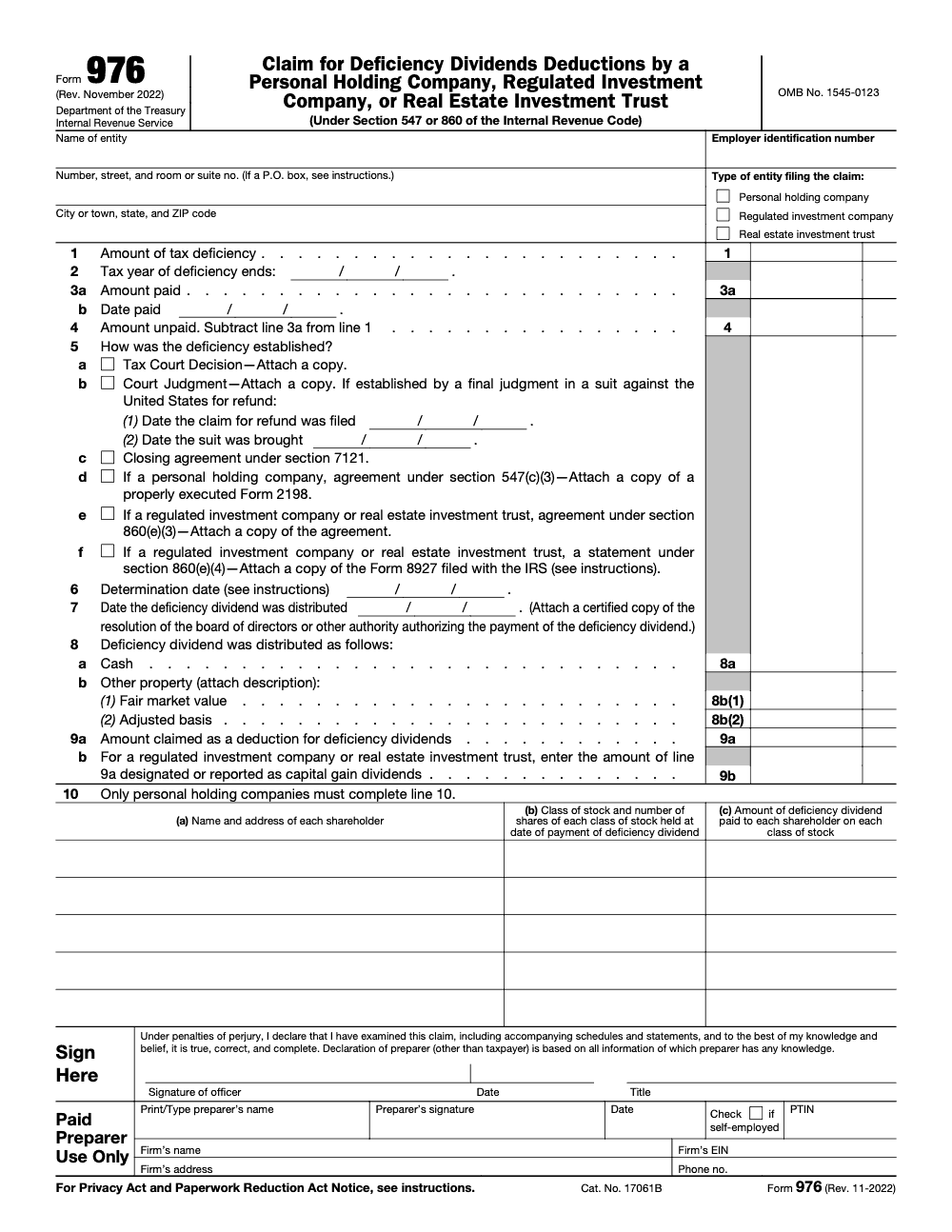
Form 976 – Claim for Deficiency Dividends Deductions by a Personal Holding Company – is the procedural vehicle for a PHC that has received a tax deficiency determination to reduce its PHC tax liability by distributing dividends after the fact. Under IRC §547, the deficiency dividend procedure creates a limited post-assessment opportunity that is unique to the PHC, regulated investment company (RIC), and real estate investment trust (REIT) contexts – it has no equivalent in the regular corporate income tax world.
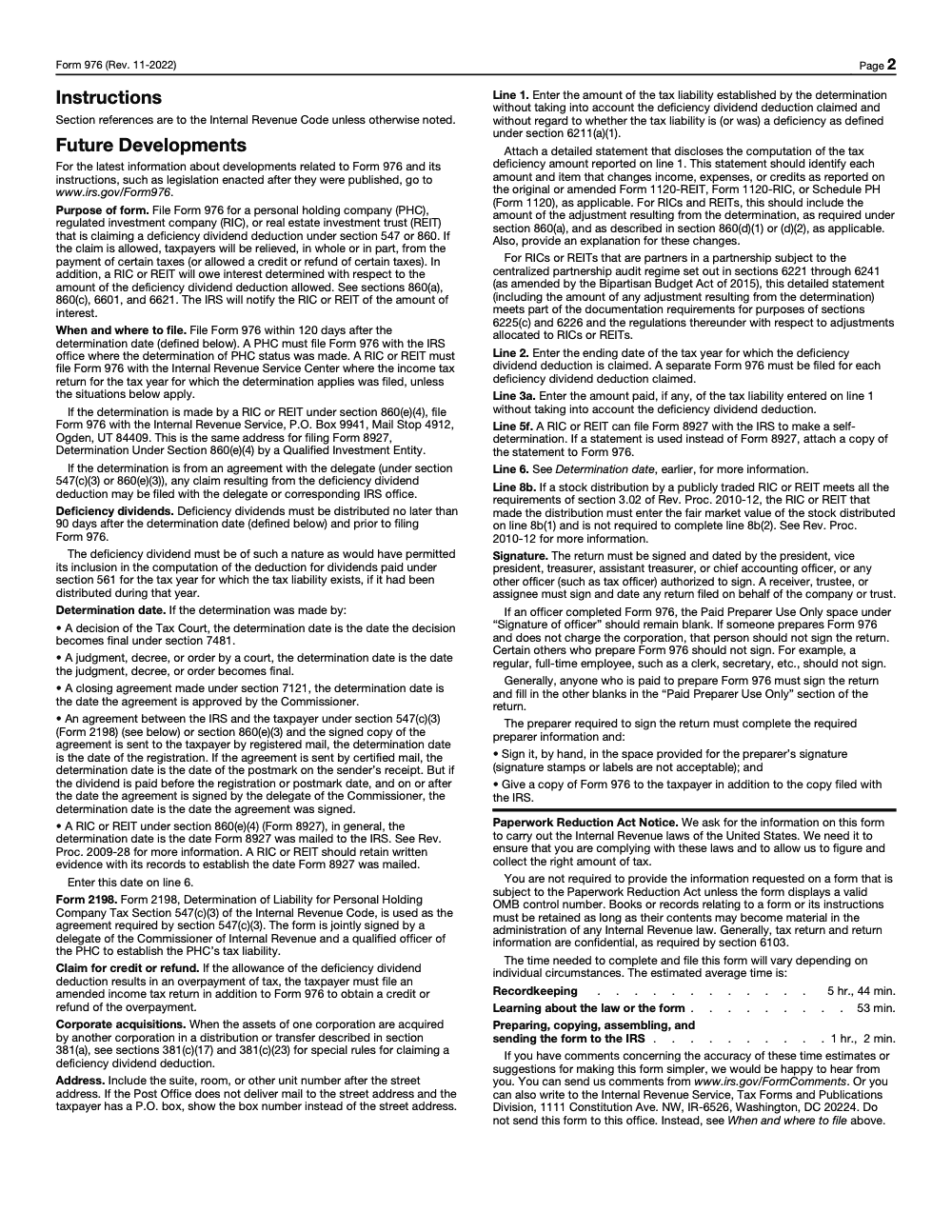
The deficiency dividend mechanism works as follows: when the IRS determines a PHC tax deficiency – through examination, decision by a court, or agreement by the corporation – the PHC has 90 days from that determination to distribute dividends to shareholders. If it does so, it can then file Form 976 within 120 days of the determination to claim a deduction for those deficiency dividends, reducing the PHC tax liability by the deductible amount.
This procedure is most valuable when a corporation discovers after the fact – often through an IRS examination or a return review by a new CPA firm – that it should have been classified as a PHC and that PHC tax is owed. Rather than simply paying the full PHC tax, the corporation can distribute cash to shareholders, claim the deficiency dividend deduction, and substantially reduce the tax liability. The tradeoff is that shareholders will have additional dividend income to report, and the corporation still owes interest and the IRC §547(c) charge on the reduced liability.
What Constitutes a “Determination” for Form 976 Purposes
Under IRC §547(c)(1), a “determination” includes a final court decision, a closing agreement, or a final disposition of a PHC tax claim by the IRS. The 90-day and 120-day windows begin to run from the date of this determination. It is critical to identify the precise determination date – an informal settlement discussion or proposed adjustment does not start the clock; only the final determination does. When the determination is a Tax Court decision, the determination date is the date the decision becomes final under IRC §7481, which can be substantially later than the date the decision is rendered. Work with tax counsel to confirm the determination date before taking any distribution actions.
Who Qualifies to Use Form 976
Form 976 is available only to personal holding companies (as defined under IRC §542), regulated investment companies (RICs), and real estate investment trusts (REITs) that have received a deficiency determination. It is not available to corporations that simply failed to file Schedule PH or that later discover they may have had PHC income – a formal deficiency determination must exist. If your client has not yet received a formal determination, the pre-assessment planning strategies using Forms 972 and 973 are the appropriate tools.
How to Complete Form 976
Form 976 requires precise documentation of the deficiency determination, the distributions made, and the calculated deduction amount. Every field is important – errors in the determination date or distribution amounts can invalidate the claim.
| Field / Section | What to Provide | Practitioner Tip |
|---|---|---|
| Corporation Name and EIN | Legal name and EIN of the personal holding company | Must match exactly to the Form 1120 and Schedule PH for the year in question |
| Tax Year of PHC Deficiency | The specific year for which the PHC tax deficiency was determined | Confirm the tax year from the deficiency notice or court decision – the deduction applies only to that specific year’s PHC tax liability, and a separate Form 976 must be filed for each tax year’s deficiency dividend deduction (multiple years cannot be combined on one form) |
| Date of Determination | The exact date on which the PHC tax deficiency was finally determined | This is the date from which the 90-day distribution window and 120-day filing deadline are calculated – confirm with legal counsel |
| Deficiency Dividends Paid | Amounts, dates, and recipient information for each distribution made within 90 days of the determination | Only distributions within the 90-day window qualify; distributions outside this window do not count as deficiency dividends regardless of intent |
| Deduction Amount Claimed | The amount of the dividends-paid deduction attributable to the deficiency dividends | The deduction reduces the PHC tax liability; calculate carefully to confirm the maximum available deduction |
| Authorized Signature | Corporate officer signature under penalties of perjury | The same officer who signs the Form 1120 should sign Form 976 for consistency |
The “Dividend Amount” Under IRC §547(c)
Even when Form 976 is successfully filed and the PHC tax deduction is allowed, the corporation must pay an additional amount called the “dividend amount” under IRC §547(c). This is a modest additional charge designed to compensate the government for the delayed payment – it does not eliminate the benefit of the deficiency dividend strategy, but practitioners should explain it to clients so they are not surprised by the residual liability after Form 976 is processed.
Deadlines, Penalties, and Filing Requirements
The deficiency dividend procedure operates on two strict deadlines that cannot be extended. Missing either one forfeits the right to the deduction permanently.
| Action Required | Deadline | Consequence of Missing |
|---|---|---|
| Distribute deficiency dividends to shareholders | Within 90 days of the PHC tax deficiency determination | Distributions made after 90 days do not qualify as deficiency dividends; no deduction available for late distributions |
| File Form 976 with the IRS | Within 120 days of the PHC tax deficiency determination | Missing the 120-day deadline permanently forfeits the deficiency dividend deduction; no extensions available |
| Shareholders report dividend income | On the shareholder’s individual or corporate return for the year the deficiency dividend is received | Shareholders must report dividends received as income; failure to do so creates separate shareholder-level compliance issues |
Interest Still Accrues
The deficiency dividend procedure does not eliminate interest on the PHC tax. Interest continues to accrue from the original due date of the tax through the date of payment, regardless of whether a valid Form 976 claim is filed. Clients should understand that the Form 976 strategy reduces the principal PHC tax liability but does not provide relief from the associated interest.
Deficiency Dividends Strategy – Calculating the Optimal Distribution Amount
Before distributing deficiency dividends, calculate the exact amount needed to eliminate (or reduce to an acceptable level) the PHC tax liability. Over-distributing creates unnecessary dividend income for shareholders; under-distributing leaves residual PHC tax exposure.
Calculating the Required Deficiency Dividend Amount
The deficiency dividend deduction reduces the undistributed PHC income – the base on which the 20% PHC tax is calculated. To eliminate the full PHC tax liability, the deficiency dividend must equal the undistributed PHC income for the year in question. If the corporation cannot distribute the full amount within 90 days, a partial deduction is available for whatever is distributed – this reduces the PHC tax proportionally rather than eliminating it entirely.
Shareholder Tax Impact of Deficiency Dividends
Deficiency dividends are taxable to the shareholders who receive them, in the year received. For individual shareholders, qualified dividend rates may apply if applicable. The shareholder’s taxable year in which the deficiency dividend falls may be different from the PHC tax year for which the deduction applies – this temporal mismatch can create complexity in shareholder planning, particularly if the distributions occur in a year with other significant income events.
PHC Tax Mitigation After Assessment – The Full Remediation Picture
Form 976 addresses one aspect of PHC tax remediation – the federal PHC tax deduction. But a comprehensive remediation strategy involves several coordinated steps that practitioners should walk through systematically.
Amended Returns and E&P Adjustments
After the deficiency dividend distribution and Form 976 filing, the corporation’s earnings and profits records must be updated to reflect the deficiency dividends paid. If amended returns are required for prior years – for example, to report corrected Schedule PH calculations – these should be coordinated with the Form 976 filing timeline. An incomplete or inconsistent set of amended filings can confuse the IRS processing of the Form 976 claim.
Avoiding Recurrence – Post-Remediation PHC Monitoring
Once a corporation has gone through the deficiency dividend process, preventing recurrence requires building PHC monitoring into the annual compliance workflow. This means: annual AOGI calculation to identify PHCI components, automatic year-end check on the 50% ownership and 60% PHCI thresholds, and a standing policy of distributing sufficient dividends (or executing consent dividends via Forms 972 and 973) before the corporate return is filed. Small errors create big cleanup – an ongoing monitoring process is far less costly than another deficiency dividend exercise.
Common Mistakes That Slow Things Down
Most Form 976 problems are not about the math – they are about the calendar and the attachments. Here are the errors my team sees most often when a deficiency dividend claim crosses our desk.
Practical Checklists You Can Reuse
These checklists are copy-paste ready for your engagement SOPs – drop them into your workpaper template and work them in order the moment a determination arrives.
Determination-date verification
- Confirm the source of the determination: final court decision, closing agreement under section 7121, or a section 547(c)(3) agreement on Form 2198.
- For a Tax Court decision, fix the determination date as the date it becomes final under IRC section 7481, not the date rendered.
- For a closing agreement, use the date the agreement is approved by the Commissioner.
- Calendar day 90 (distribution deadline) and day 120 (Form 976 filing deadline) from the confirmed determination date.
- Document the determination date and its basis in the workpaper file.
Deficiency dividend distribution packet
- Calculate the distribution needed to meet the dividends-paid deduction standard of IRC section 561 for the deficiency year.
- Obtain and certify the board resolution authorizing the deficiency dividend (required attachment for line 7).
- Distribute the dividend within 90 days of the determination date and before Form 976 is filed.
- Record the cash portion on line 8a and the fair market value and adjusted basis of any property on lines 8b(1) and 8b(2).
- Retain canceled checks, wire records, and distribution dates as payment evidence.
Form 976 filing packet
- Enter the gross tax liability on line 1, disregarding the deficiency dividend deduction, and attach the detailed statement computing it.
- Report the tax year end on line 2, and file a separate Form 976 for each year of deficiency.
- Enter the deduction claimed on line 9a; PHCs also complete the line 10 shareholder schedule, while RICs and REITs leave line 10 blank.
- Have an authorized officer sign by hand; a paid preparer must also sign by hand, since stamps and labels are not accepted.
- File within 120 days of the determination and file the matching amended return (Form 1120 with Schedule PH, Form 1120-RIC, or Form 1120-REIT) to claim any refund.
Keep 976 Season From Stalling
Form 976 does not arrive on a calendar – it lands the moment a personal holding company, regulated investment company, or real estate investment trust receives a deficiency determination, and from that instant a 90-day distribution clock and a 120-day filing clock run in parallel. The IRS estimates the form alone takes about 5 hours and 44 minutes of recordkeeping plus nearly two more hours to learn about and prepare it (per the IRS Form 976 instructions, Rev. November 2022), and that is before counting the amended returns and board resolution the claim depends on.
When that window opens during an already busy stretch, the work stalls not because the rules are unclear but because the steps are not standardized. A documented intake-to-filing sequence keeps the determination date, the distribution, and the filing from slipping past their statutory limits.
- Lock the determination date first – confirm finality under IRC section 7481 for a Tax Court decision before the 90-day and 120-day clocks are calendared.
- Standardize the line 1 detailed statement so the gross liability and its computation are documented the same way on every engagement.
- Template the certified board resolution required for line 7 so it is ready before the distribution rather than scrambled for afterward.
- Pair each Form 976 with its matching amended return (Form 1120 with Schedule PH, Form 1120-RIC, or Form 1120-REIT) so the refund claim is filed in one motion.
This is exactly the kind of deadline-driven, multi-attachment work where structured delivery pays off. Our tax preparation support handles the workpaper assembly, statement computation, and review layers so the 90-day and 120-day windows are met without a fire drill.
FAQs
No. Form 976 is exclusively a post-assessment remedy – it can only be used after a PHC tax deficiency has been formally determined. Before a deficiency determination, the appropriate tools are year-end tax planning using actual distributions or the consent dividend procedure (Forms 972 and 973). If PHC status is identified before the return is filed, pre-return planning is far less costly than the deficiency dividend procedure.
The deficiency dividend deduction under IRC §547 reduces the undistributed PHC income – the base on which the 20% PHC tax is calculated. For example, if undistributed PHC income was $400,000 and a deficiency dividend of $400,000 is distributed and claimed on Form 976, the PHC tax on the $400,000 base is eliminated. The corporation still owes interest on the original deficiency and the IRC §547(c) dividend amount, but the core 20% PHC tax on the distributed amount is removed.
Form 976 should be accompanied by documentation of the deficiency determination (copy of the IRS notice or court decision), a certified copy of the board resolution (or other authority) authorizing payment of the deficiency dividend (a required attachment), records of each deficiency dividend distribution (canceled checks, wire transfer records, or other payment evidence), and a schedule showing how the deduction amount was calculated. The IRS may request additional documentation during processing; maintain complete records in the engagement file.
No. The 120-day deadline under IRC §547(e) is statutory and cannot be extended. There is no provision for reasonable cause relief or equitable tolling. This makes immediate action upon receiving a PHC tax deficiency determination critical – delay in acting on the deficiency dividend opportunity can result in its complete forfeiture.
Other forms this guide names
- Form 1120: Corporation Tax Return Guide
- Form 972: Shareholder Consent to Include Dividends in Income
- Form 973: Corporation Consent Dividends Deduction Guide
- Form 1120-RIC: Guide, Deadlines, Tests, Deductions
About this guide
Accountably helps US CPA, EA, and accounting firms hire trained accountants and tax preparers in India.
About us Reviewed byJugal Thacker, CPAFounder and CEO at Accountably
A Washington-licensed CPA with 7+ years inside US firms – PwC, a real-estate tax practice, then a full-service firm, rising from reviewer to manager to advisory. This article was reviewed against current IRS guidance for the 2025 tax year and updated for filers preparing late returns, amendments, and 2026 estimates.
View profile →How we research, review, and update this guide
Every Accountably guide is researched against primary IRS sources, reviewed by a U.S. CPA, and refreshed as guidance evolves. Read our Editorial Guidelines to see how we source, fact-check, and update our content.