Summarize this article with AI
In Brief
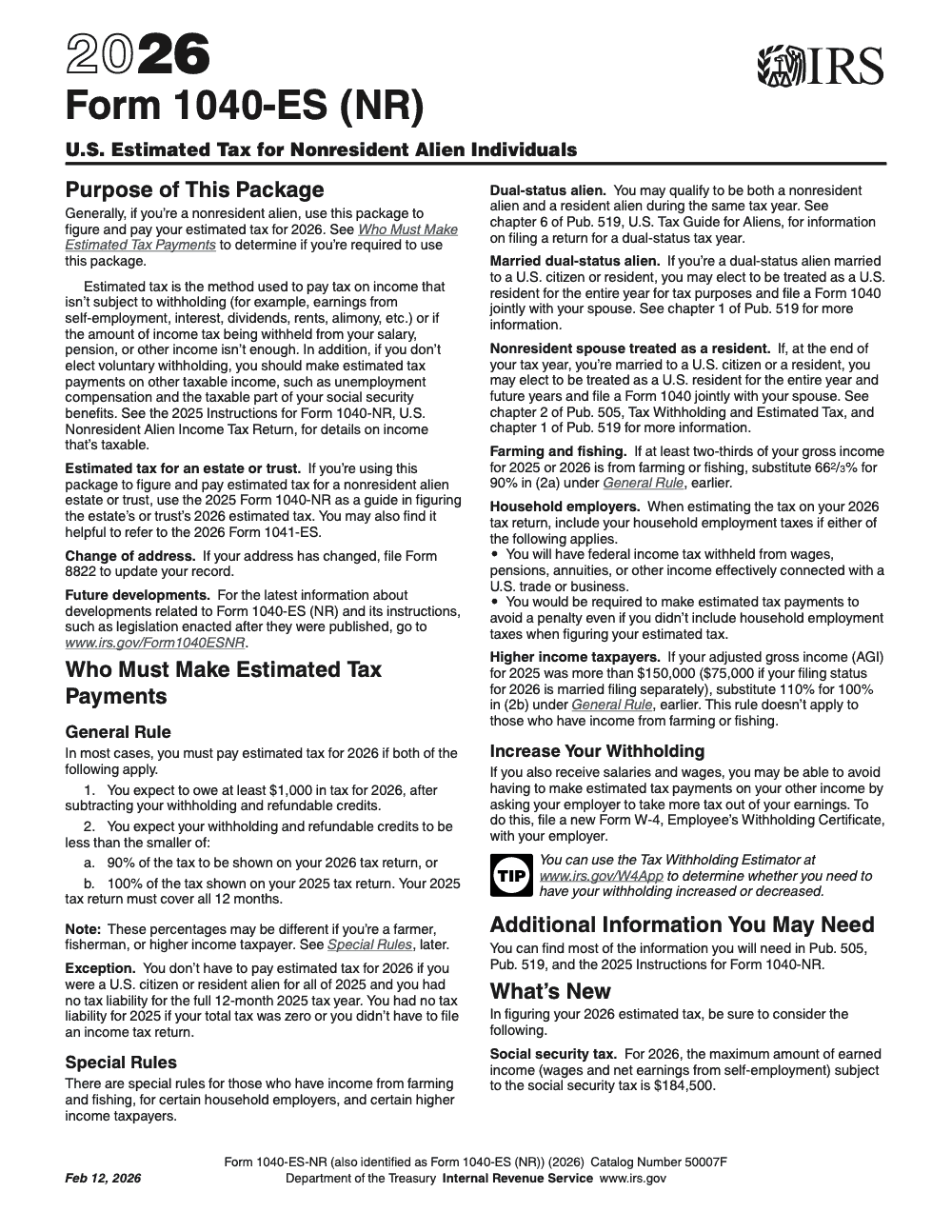
Form 1040-ES (NR) is the U.S. estimated tax form for nonresident alien individuals who expect to owe at least $1,000 in tax after withholding and refundable credits (according to IRS Publication 505). Calendar-year filers pay in installments due April 15, June 16, and September 15, 2025, and January 15, 2026, and avoid the IRC §6654 underpayment penalty by covering the smaller of 90% of current-year tax or 100% of prior-year tax shown on a full-year 1040-NR.
A common assumption is that a nonresident alien can just run the regular Form 1040-ES worksheet and pay the same way a U.S. filer would. That worksheet gives the wrong number. Nonresidents generally cannot claim the standard deduction, so the 1040-ES (NR) worksheet exists specifically to reflect that difference.
The trigger is the same in shape, estimated payments once you expect to owe at least $1,000 after withholding and credits, but the timing traps are particular to this group. The penalty is figured separately for each quarter, so a generous later payment does not cure a missed first quarter, and a client who first receives income mid-year, such as an F-1 student moving to H-1B and picking up consulting work, can shift onto a different installment schedule.


Key Takeaways
- Form 1040-ES (NR) is the nonresident alien equivalent of Form 1040-ES – it provides the worksheet and payment vouchers for quarterly estimated tax payments on income not subject to withholding.
- You must make estimated tax payments if you expect to owe at least $1,000 in tax after withholding and credits, and your withholding and credits will cover less than the smaller of 90% of current-year tax or 100% of prior-year tax on a full-year return.
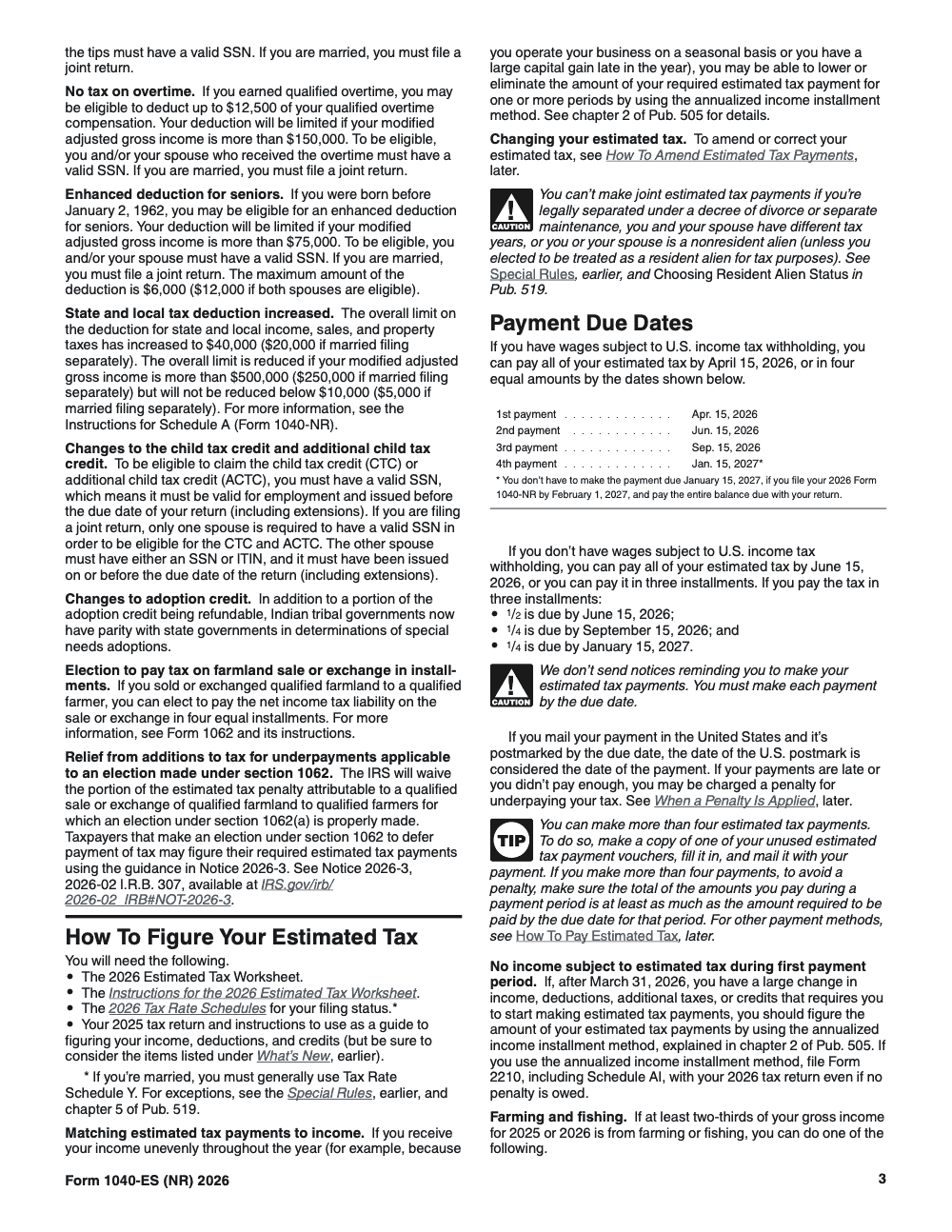
- The four payment due dates for calendar-year nonresident aliens are April 15, June 15, September 15, and January 15 of the following year – but nonresidents who first receive income after May 31 or August 31 may enter the system with later first-payment dates.
- Nonresident aliens must use the 1040-ES (NR) worksheet, not the standard 1040-ES worksheet, because the NR version reflects the different standard deduction rules (nonresidents generally cannot claim the standard deduction) and treaty positions.
- Underpayment penalties are computed using the IRS short-term applicable federal rate plus 3 percentage points – the penalty is calculated separately for each quarter, so a late first-quarter payment is not cured by an overpayment in the third quarter.
- Quick SOP tip: flag every client with U.S.-source self-employment income, freelance income, or investment income not subject to Chapter 3 withholding for an estimated tax review at the start of their engagement.
What Form 1040-ES (NR) Is and When to Use It
The U.S. tax system is pay-as-you-go. For most employees, employers withhold income tax from each paycheck and remit it to the IRS on a regular schedule. But nonresident alien individuals who receive income not subject to that mandatory employer withholding – consulting fees, self-employment income, U.S.-source rental income, or investment distributions from pass-through entities – must make their own periodic payments. Form 1040-ES (NR) is the vehicle for those payments.
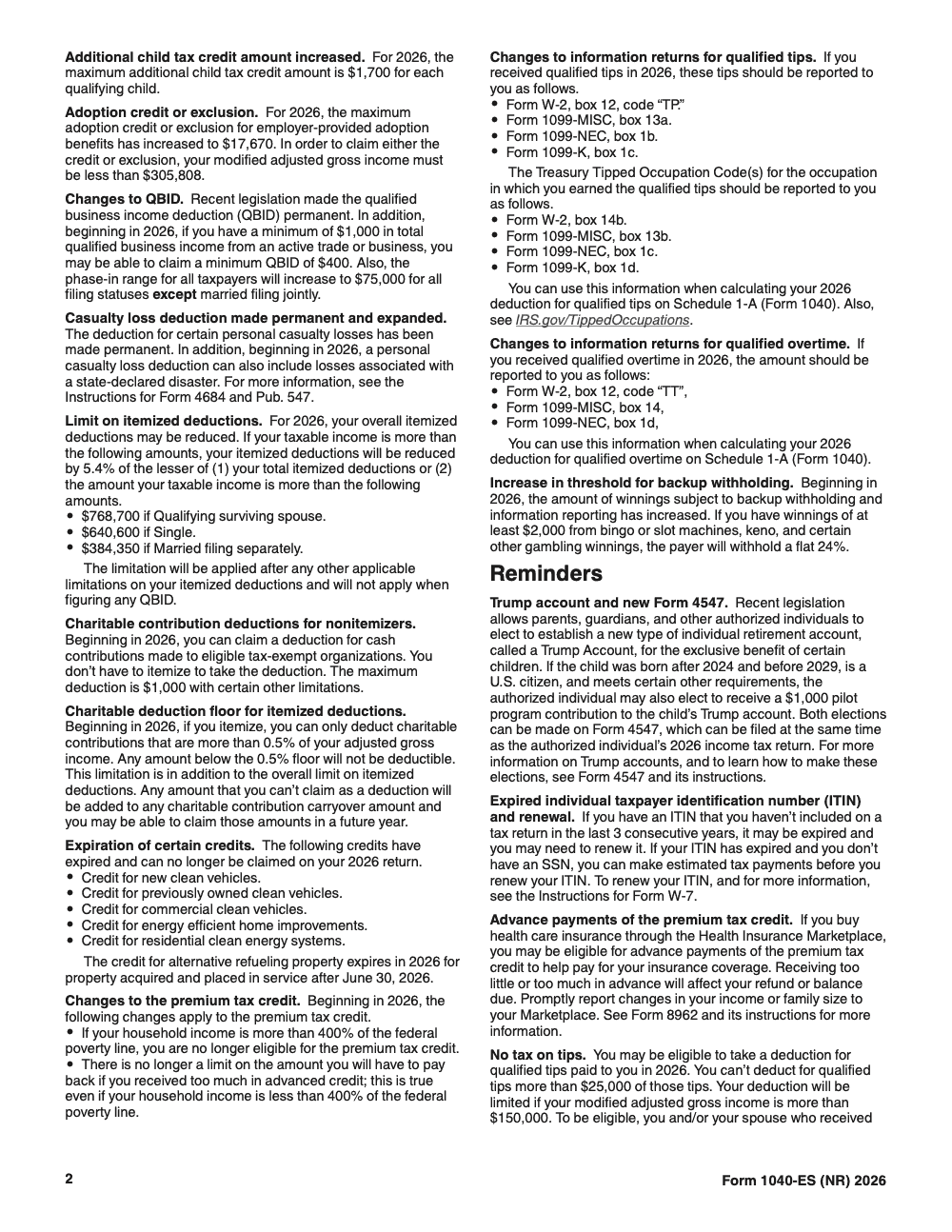
The “NR” designation matters. The standard Form 1040-ES is designed for U.S. citizens and resident aliens who may claim the full standard deduction, all personal exemptions, and certain credits unavailable to nonresidents. Nonresident aliens are subject to a different set of rules: they generally cannot claim the standard deduction (except for students and business apprentices from India, who qualify under Article 21(2) of the U.S.-India income tax treaty), they are taxed only on U.S.-source income (and effectively connected income), and they compute their alternative minimum tax exposure differently. The 1040-ES (NR) worksheet accounts for these distinctions.
A nonresident alien is generally required to make estimated tax payments when two conditions are both met: (1) the taxpayer expects to owe at least $1,000 in total tax after subtracting withholding and refundable credits, and (2) withholding plus credits will cover less than the smaller of 90% of the current year’s tax liability or 100% of the prior year’s total tax (shown on a full-year 1040-NR). If the prior-year return showed zero tax liability and was a full twelve-month return, the prior-year safe harbor provides complete protection – but this no-liability exception only helps a taxpayer who was a U.S. citizen or resident alien for that entire prior year, a status most nonresident aliens did not hold. If no prior-year return was filed as a nonresident, only the 90%-of-current-year test is available.
Common triggering situations I see on my side of the desk: H-1B visa holders who moonlight as consultants, treaty country nationals with U.S. rental property, F-1 Optional Practical Training workers who exceed their withholding gap, partnership K-1 income from a U.S. entity, and nonresident alien sole proprietors with U.S.-based clients. Each of these requires a timely estimated payment conversation early in the relationship – not at extension time.
Resident Alien vs. Nonresident Alien – Why the Form Matters
The determining factor is residency status for tax purposes, not immigration status. Resident aliens – those who hold a green card or meet the substantial presence test – use Form 1040-ES and follow the same estimated tax rules as U.S. citizens. Nonresident aliens – those who fail both the green card test and the substantial presence test – use Form 1040-ES (NR). Dual-status aliens (those who change status during the year) must carefully split their treatment: the resident period uses 1040 rules and the nonresident period uses 1040-NR rules, which affects which estimated payment form governs each quarter.
Income Types That Trigger the Obligation
Not all U.S.-source income creates an estimated tax obligation. Income subject to Chapter 3 withholding at the statutory 30% rate – such as dividends from U.S. corporations paid to a nonresident with a valid W-8BEN on file – satisfies the pay-as-you-go requirement through that withholding. What is left unaddressed are: effectively connected income (ECI) from a U.S. trade or business not covered by employer withholding, pass-through income from a U.S. partnership that does not withhold adequately at the entity level, rental income from U.S. real property where the client has made the net election under Reg. §1.871-10, and self-employment income earned by nonresidents permitted to work in the U.S.
How to Complete Form 1040-ES (NR)
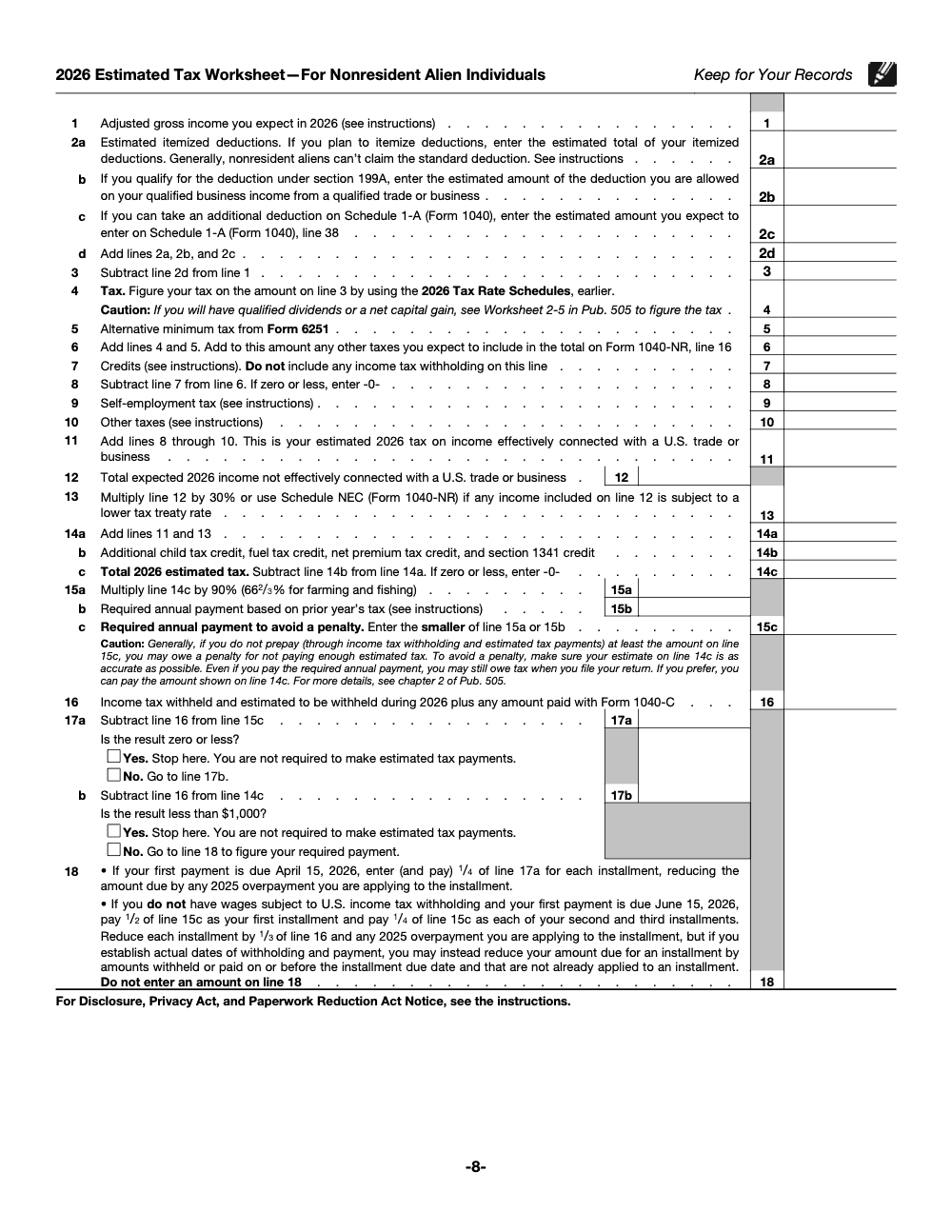
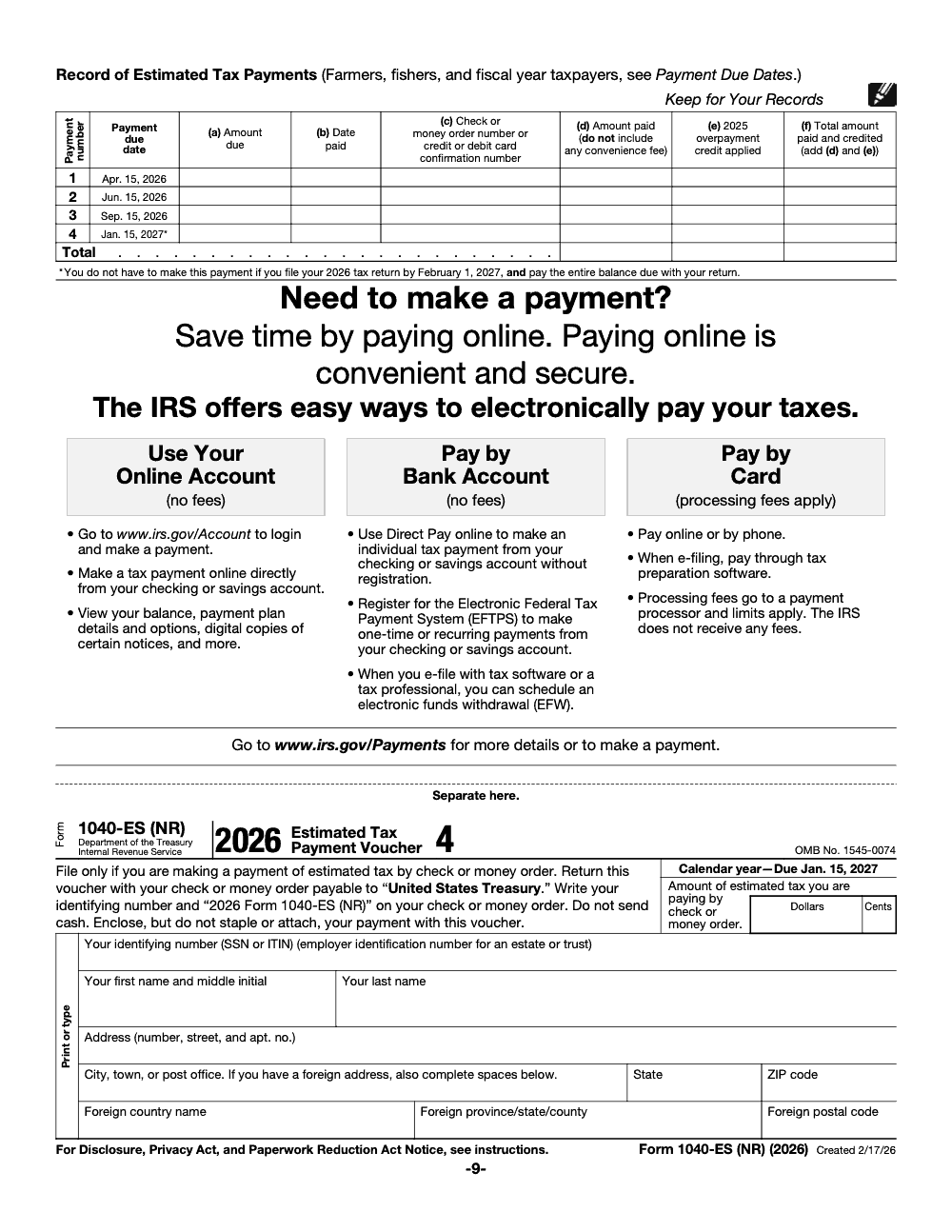
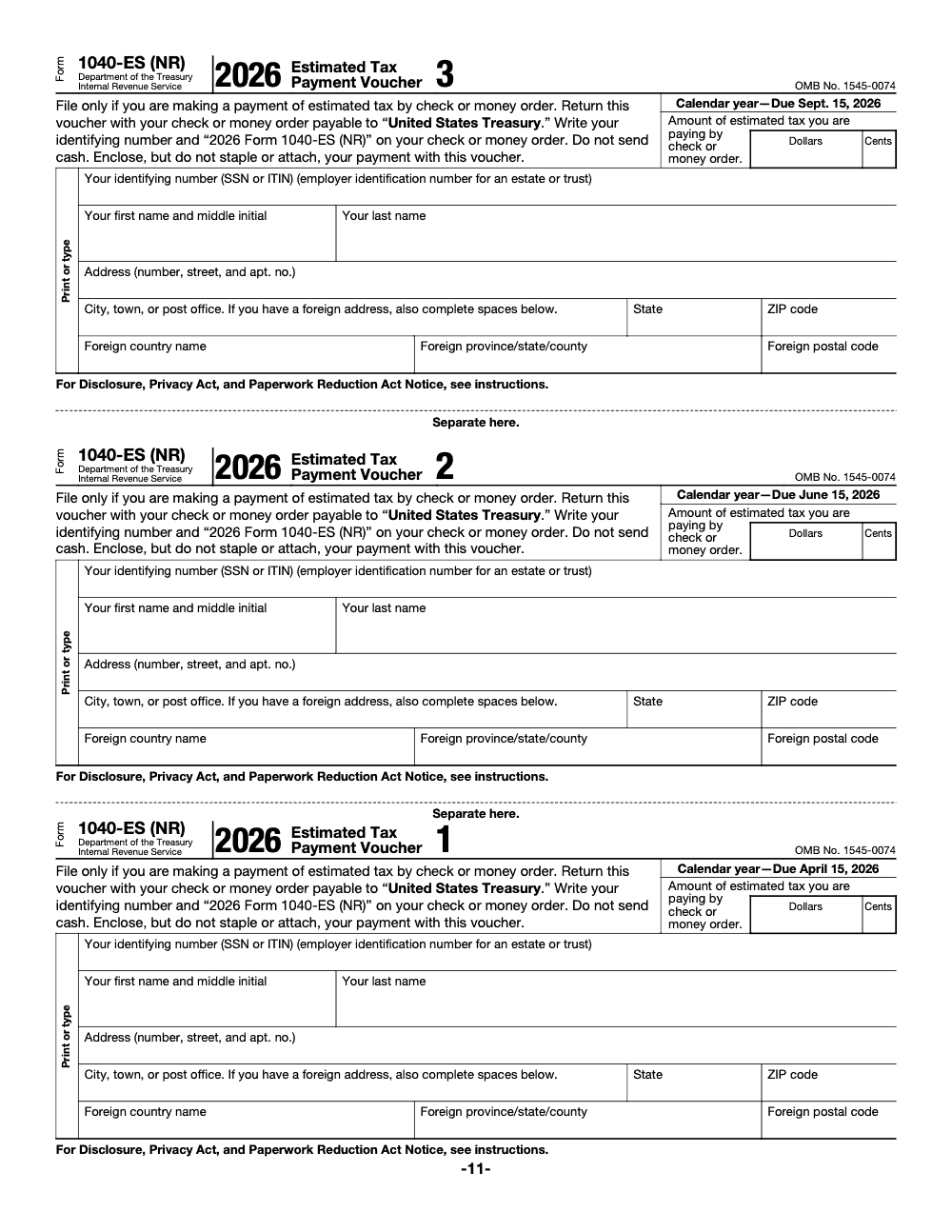
The form itself contains two components: the Estimated Tax Worksheet and four quarterly payment vouchers. Unlike many IRS forms, you do not mail the worksheet – only the voucher (or make an electronic payment) goes to the IRS. The worksheet stays in your file as support for the payment amount.
Estimated Tax Worksheet – Section by Section
| Line | Description | Practitioner Note |
|---|---|---|
| 1 | Adjusted gross income you expect in 2025 – U.S.-source ECI only | Exclude foreign-source income; nonresidents taxed only on U.S.-source income and ECI |
| 2 | Estimated itemized deductions (nonresidents generally cannot use standard deduction) | Most nonresidents are limited to state and local income taxes plus charitable contributions to U.S. charities; certain Indian treaty nationals – specifically students and business apprentices – may claim the standard deduction |
| 3 | Subtract line 2 from line 1; result is estimated taxable income | Verify the treaty claim first; overstating deductions here creates underpayment risk |
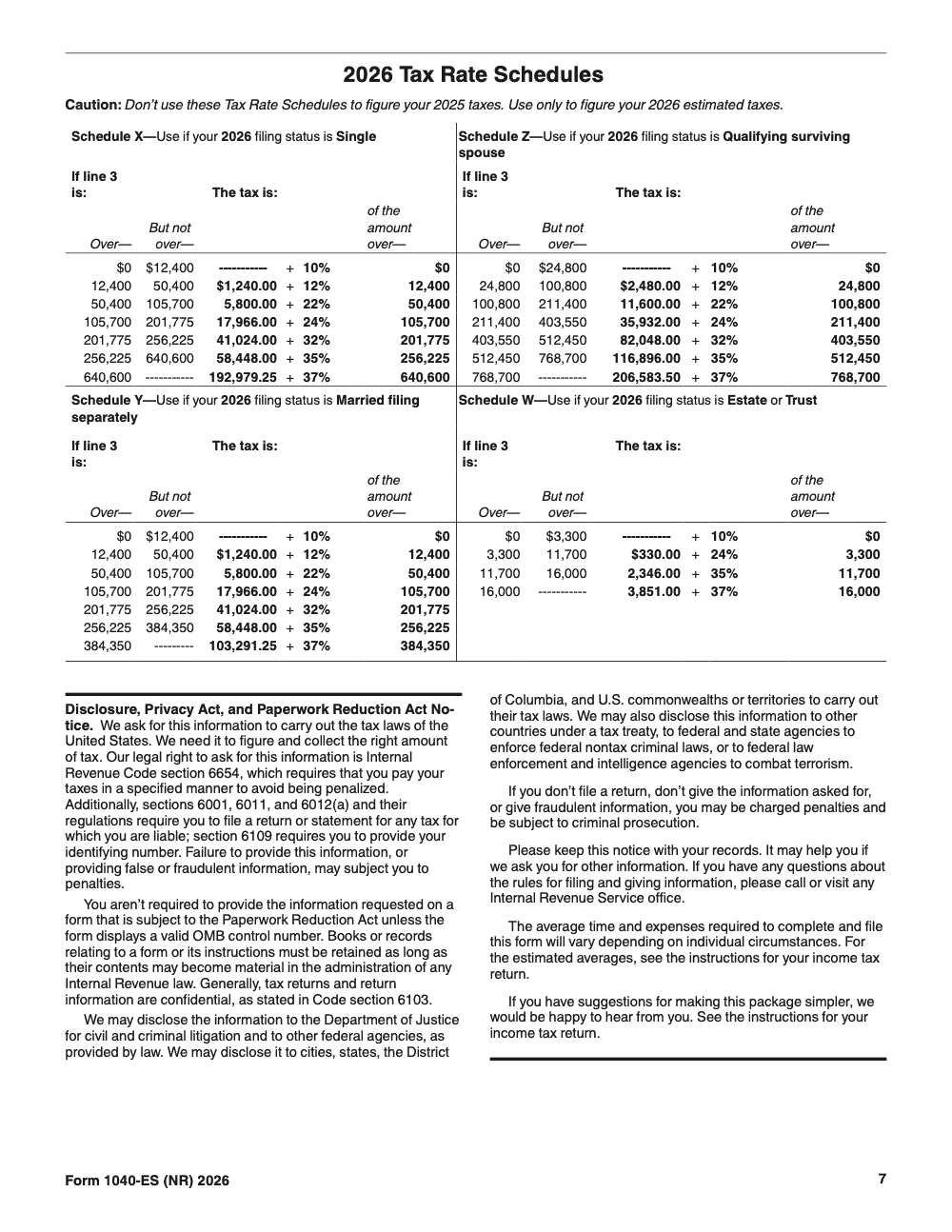
| 4 | Tax on line 3 amount using the 2025 Tax Rate Schedules | Effectively connected income is taxed at the same graduated rates that apply to U.S. citizens and residents – there is no separate NR rate schedule |
| 5 | Alternative minimum tax | Nonresidents compute AMT on ECI only; foreign-source income is excluded from AMTI |
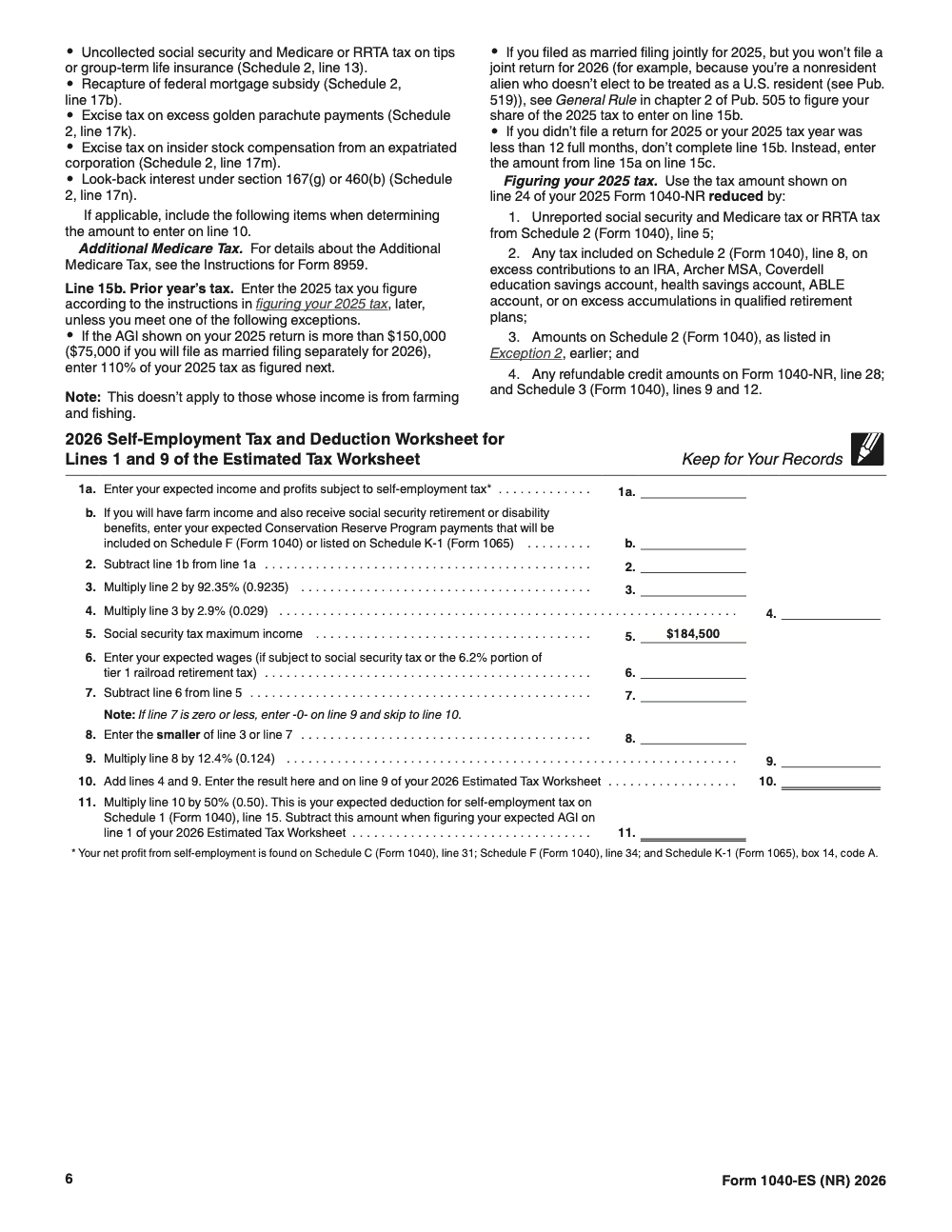
| 6 | Self-employment tax (Schedule SE amount) | Nonresident aliens are generally exempt from SE tax under IRC §1402(b), so this line (Line 9 on the official Form 1040-ES (NR) worksheet) is usually zero; only residents of Puerto Rico, the U.S. Virgin Islands, Guam, the CNMI, and American Samoa owe it, and they file the regular Form 1040-ES |
| 7 | Other taxes (net investment income tax, recapture taxes) | Nonresident aliens are statutorily exempt from NIIT under IRC §1411(e), so this is typically zero; it applies only if the client elects to be treated as a U.S. resident under IRC §6013(g) or (h) |
| 8 | Total estimated tax (sum of lines 4–7) | This is your gross liability before credits and withholding |
| 9 | Estimated credits (education credit, child and dependent care, etc.) | Nonresidents are ineligible for most personal credits; earned income credit is never available to nonresidents |
| 10 | Subtract line 9 from line 8 | Rarely differs from line 8 for most NR clients unless they have treaty-based credit positions |
| 11 | Federal income tax withheld (Line 13 on the official Form 1040-ES (NR) worksheet) | Include Chapter 3 withholding from W-2s, 1042-S forms, and backup withholding |
| 12 | Subtract line 11 from line 10; if less than $1,000, no estimated tax required | This is the gateway test; document your conclusion either way in the file |
| 13 | Safe harbor calculation: 90% of line 10 vs. 100% of prior-year tax (smaller of the two) | No prior year filed? Only 90% test is available; prior year must have been a full 12-month return |
| 14 | Required annual estimated tax payment (line 12 vs. line 13 – larger amount drives payment) | Divide by the number of remaining quarters; use Schedule AI if income is uneven across quarters |
Quarterly Payment Vouchers
Each voucher requires the taxpayer’s name, address, Social Security Number or ITIN (required – no EIN), and the payment amount. The four vouchers are labeled 1 through 4 and correspond to the four quarterly due dates. You do not have to pay exactly one-fourth of the annual liability each quarter – the IRS computes the penalty quarter by quarter, so you can annualize income if the client earns income unevenly (using the annualized income installment method documented in Schedule AI of Form 2210, which nonresidents reference for penalty computation).
Electronic Payment Options
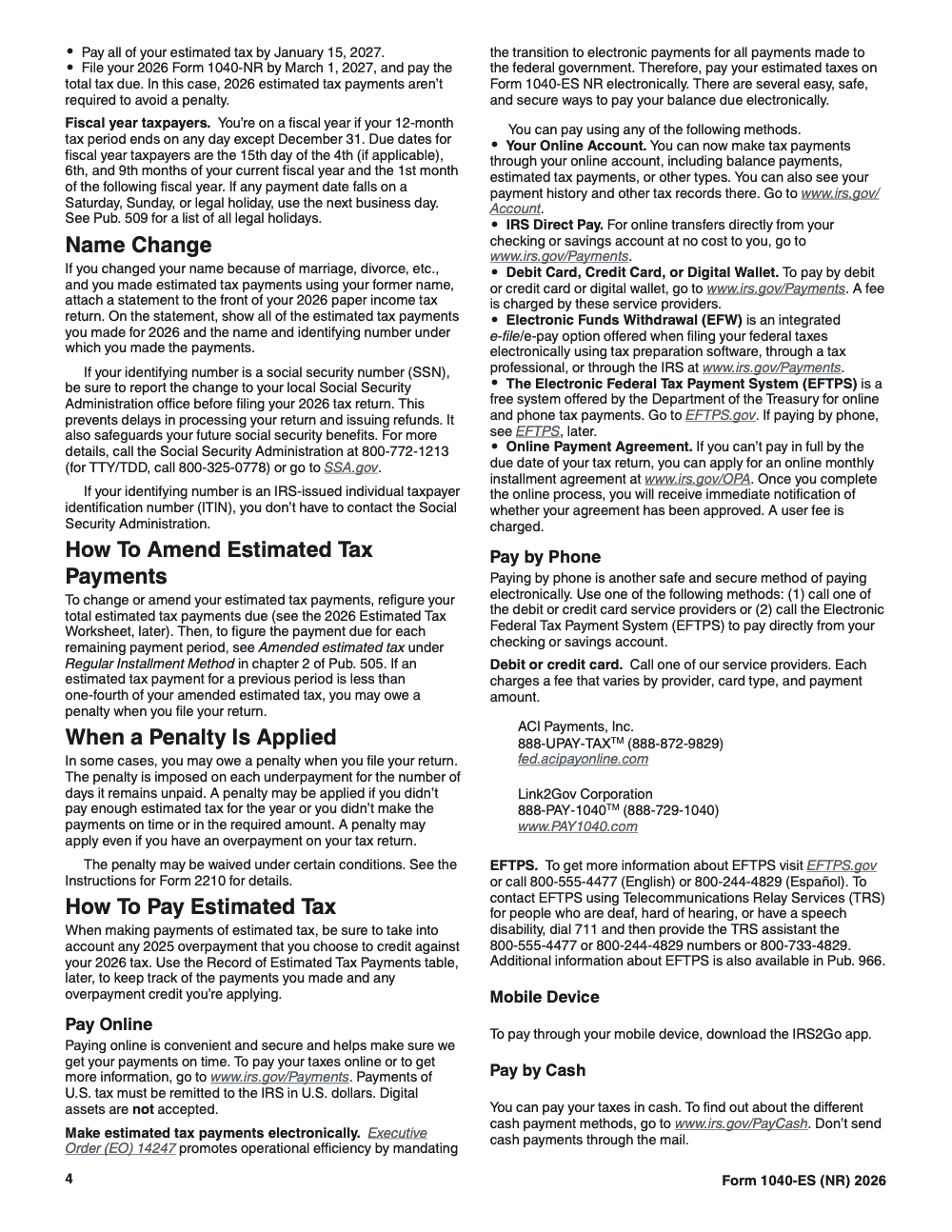
Nonresident aliens can pay estimated taxes electronically through IRS Direct Pay (using a U.S. bank account), EFTPS (Electronic Federal Tax Payment System), or by debit/credit card through one of the IRS-authorized processors. I strongly recommend EFTPS for any client making regular quarterly payments – the confirmation number is immediate and provides audit-ready proof of timely payment. Paper vouchers mailed with a check require the client to retain the certified mail receipt as evidence of timely filing.
Deadlines, Penalties, and Filing Requirements
The standard four-quarter calendar applies to nonresident aliens on the same dates as resident taxpayers, with one important structural difference: the first payment period covers January 1 through March 31, but nonresident aliens who first receive income subject to estimated tax after May 31 or after August 31 of the year enter the system with a reduced number of required installments.
2025 Estimated Tax Due Dates – Calendar-Year Nonresident Alien
| Payment | Period Covered | Due Date | If First Income After |
|---|---|---|---|
| 1st installment | Jan 1 – Mar 31 | April 15, 2025 | N/A |
| 2nd installment | Apr 1 – May 31 | June 16, 2025 | First income after Mar 31 – pay 50% on June 16 |
| 3rd installment | Jun 1 – Aug 31 | September 15, 2025 | First income after May 31 – pay 75% on Sept 15 |
| 4th installment | Sep 1 – Dec 31 | January 15, 2026 | First income after Aug 31 – pay 100% on Jan 15 |
When a due date falls on a Saturday, Sunday, or legal holiday, it shifts to the next business day. Clients who file their 1040-NR return by February 1, 2026 and pay the full balance due do not need to make the January 15 fourth-quarter payment.
Underpayment Penalty – How It Works
The underpayment penalty under IRC §6654 is not a flat fee – it is an interest-rate-based charge computed on the underpaid amount for each day it remains unpaid during the quarter. The rate is the federal short-term rate plus 3 percentage points, reset quarterly. For 2024, that rate hovered around 8%. The penalty is computed on Form 2210 (not a separate NR form) using the same mechanics, but nonresidents reference their 1040-NR total tax as the base.
The penalty applies separately to each quarter. A taxpayer who underpays Q1 by $2,000 and overpays Q3 by $2,000 still owes a Q1 penalty – the overpayment does not retroactively cure the Q1 shortfall. This is one of the most commonly misunderstood aspects I encounter when reviewing prior-year filings for new nonresident alien clients.
Waiver of Penalty
The IRS will waive the underpayment penalty on request if: (1) the underpayment was due to casualty, disaster, or other unusual circumstances and imposing the penalty would be inequitable; or (2) the taxpayer retired after reaching age 62 or became disabled during the tax year or the immediately preceding year and the underpayment was due to reasonable cause rather than willful neglect. Request the waiver on Form 2210, Part II. Document the circumstances thoroughly – the IRS does not grant these automatically.
Treaty Benefits and Estimated Tax Calculations
One of the most nuanced issues in computing estimated payments for nonresident alien clients is accounting for treaty benefits correctly. The U.S. has income tax treaties with more than 60 countries, and many of those treaties reduce or eliminate U.S. tax on specific income categories – reduced withholding rates on dividends, exemptions on certain compensation, and in some cases exemption of all compensation for students, researchers, or trainees for a limited number of years.
When computing the estimated tax worksheet, income that is fully exempt from U.S. tax under a treaty is excluded from line 1. Income taxed at a reduced treaty rate is included at that reduced rate, not the statutory rate. The problem I see repeatedly: practitioners include the full amount of income on line 1 and then forget to adjust the tax rate on line 4. Or, less commonly, they exclude treaty-exempt income but then still include the full withholding from line 11, which double-counts the benefit.
ITIN Requirement for Estimated Payments
A nonresident alien who does not have a Social Security Number must obtain an Individual Taxpayer Identification Number (ITIN) before making estimated tax payments. Without an SSN or ITIN, the IRS cannot post the payment to the correct account. The ITIN application (Form W-7) must be submitted with original identification documents or certified copies. Processing currently takes seven to eleven weeks, which means a client who first triggers an estimated payment obligation in March may not have an ITIN in hand before the April 15 due date – a situation that requires a documented reasonable cause explanation if the payment is late.
Totalization Agreements and Self-Employment Tax
Nonresident aliens are generally not subject to U.S. self-employment tax under IRC §1402(b) on net SE income, unlike resident aliens and U.S. citizens; the narrow exception is bona fide residents of Puerto Rico, the U.S. Virgin Islands, Guam, the CNMI, and American Samoa, who use the regular Form 1040-ES rather than the NR version. However, the U.S. has totalization agreements with 30+ countries that coordinate social security coverage and can eliminate the U.S. SE tax obligation for workers covered by a foreign social security system. If a client is a citizen of a totalization-agreement country and is covered by their home country’s social security system, they need a Certificate of Coverage from their home country to exclude SE income from U.S. self-employment tax. Line 6 of the estimated tax worksheet becomes zero in that scenario. Always verify the certificate is current before computing estimated payments.
Annualizing Income – When Even Installments Don’t Make Sense
The standard approach to estimated tax payments assumes income is earned evenly throughout the year – 25% per quarter. For many nonresident alien clients, that assumption is wrong. A foreign national who receives a large consulting fee in October, or a nonresident real estate investor who collects rents in Q4 after a slow Q1, will significantly overpay in the early quarters if they use even installments based on an annualized projection.
The annualized income installment method allows the taxpayer to base each quarterly payment on actual income earned through that quarter, annualized and tax-effected, rather than on a pro rata share of the full-year estimate. The computation flows through Schedule AI of Form 2210 and requires maintaining quarterly income records. For clients with highly seasonal income patterns, the result is usually lower Q1 and Q2 payments and higher Q3 and Q4 payments – which is consistent with when the cash actually arrives.
When to Use the Annualized Method
From my side of the desk, the annualized method is worth the additional worksheet complexity when: (a) more than 40% of the client’s income is expected in Q3 or Q4, (b) the client has a significant one-time income event – a property sale, a large consulting engagement, or a K-1 allocation – in a specific quarter, or (c) the client is new to estimated payments mid-year and would otherwise owe a large catch-up payment in Q3. The burden is the quarterly recordkeeping – make sure the client knows they need to track income by quarter, not just annually.
Common Mistakes That Slow Things Down
The same handful of errors shows up every season when a nonresident alien client first lands on estimated payments, and most of them trace back to treating the NR return like a domestic 1040. Here are the ones my team flags most often.
Practical Checklists You Can Reuse
These checklists are built to drop straight into a firm SOP or a solo practitioner’s workflow. Copy them into your engagement template and work top to bottom for every nonresident alien estimated tax client.
Nonresident estimated tax intake
- Confirm tax residency under the green card and substantial presence tests, and document the conclusion in the file.
- Verify the client has an SSN or ITIN; if neither, start Form W-7 right away, since processing runs several weeks.
- List every U.S.-source income stream and flag which ones already carry Chapter 3 or backup withholding.
- Identify any income tax treaty position, including reduced rates and student or trainee exemptions, before projecting income.
- Check for a Certificate of Coverage if a totalization agreement may remove any U.S. self-employment tax exposure.
- Record the date the client first had U.S. income subject to estimated tax to set the installment count.
Safe-harbor and installment calculation
- Project current-year U.S.-source AGI and effectively connected income on the Estimated Tax Worksheet, line 1.
- Enter itemized deductions only, unless a documented India treaty position supports the standard deduction.
- Confirm Line 9 (self-employment tax) is zero unless the client is a resident of a listed U.S. territory.
- Apply the $1,000 threshold test after withholding and refundable credits.
- Run the smaller of 90% of current-year tax or 100% of prior-year tax, using 110% when prior-year AGI exceeded $150,000 ($75,000 MFS).
- Divide the required annual payment across the correct number of installments, or switch to the annualized method on Schedule AI for uneven income.
Quarterly payment and proof
- Calendar the 2025 due dates: April 15, June 16, September 15, and January 15, 2026, shifting any weekend or holiday date to the next business day.
- Pay in U.S. dollars through IRS Direct Pay or EFTPS and save the confirmation number to the file.
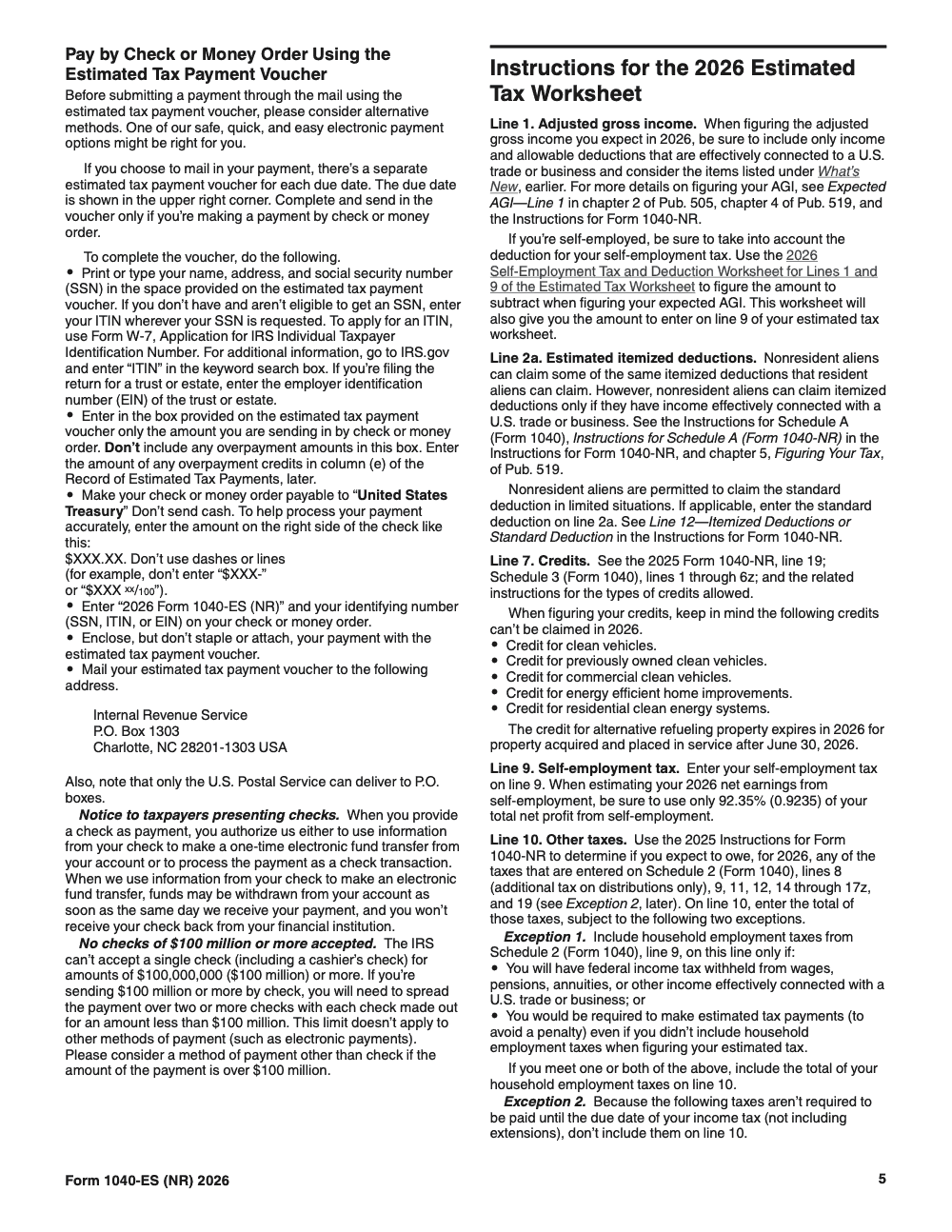
- For paper vouchers, mail to the Internal Revenue Service, P.O. Box 1303, Charlotte, NC 28201-1303, via USPS and keep the certified mail receipt.
- Make any check payable to “United States Treasury” and write the SSN or ITIN and “2025 Form 1040-ES (NR)” on it.
- If the client files the 2025 Form 1040-NR and pays the full balance by February 1, 2026, skip the January 15 installment.
- Re-run the worksheet mid-year whenever income changes, and adjust the remaining installments.
Keep 1040-ES (NR) Season From Stalling
Form 1040-ES (NR) does not have one filing day; it has a year-round cadence. A calendar-year nonresident faces installments on April 15, June 16, and September 15, 2025, and January 15, 2026, and a client whose U.S. income first arrives mid-year drops into a shorter installment schedule that has to be mapped by hand (per IRS Publication 505). Each quarter the underpayment penalty under IRC §6654 accrues separately, so a single missed installment cannot be patched by overpaying the next one.
The pressure is rarely the math on any one voucher; it is keeping every nonresident client’s residency status, treaty position, and payment proof current across four moving deadlines at once. That is a documentation problem, and documentation problems are solved with structure rather than with longer hours in April.
- Standardize the Estimated Tax Worksheet so line 1 captures only U.S.-source and effectively connected income, and Line 9 stays at zero unless a territory rule applies.
- Track each client’s first-income date so the installment count and due dates are set correctly instead of defaulted to four.
- Maintain a treaty and ITIN log so reduced rates, student exemptions, and Form W-7 timing never stall a payment.
- Calendar all four 2025 due dates alongside the February 1, 2026 final-balance shortcut, and store the EFTPS or Direct Pay confirmation against each one.
Structure like this is what keeps estimated tax cycles from turning into a Q4 scramble. Accountably builds SOP-driven worksheets, multi-layer review, and turnaround SLAs into U.S. tax preparation support so nonresident estimated payments stay on schedule without burning senior review time.
FAQs
Nonresident alien individuals who expect to owe at least $1,000 in U.S. income tax after withholding and credits, and whose withholding will not cover the smaller of 90% of their current-year liability or 100% of their prior-year tax (on a full twelve-month 1040-NR), are required to make estimated tax payments using Form 1040-ES (NR). Resident aliens and U.S. citizens use the standard Form 1040-ES instead.
Both forms accomplish the same function – calculating and paying quarterly estimated taxes – but they use different worksheets. The NR version excludes the standard deduction (which most nonresidents cannot claim), adjusts the credit eligibility section (most personal credits are unavailable to nonresidents), and references the 1040-NR tax tables rather than the standard 1040 tables. Using the wrong form typically results in an understated liability for nonresident alien clients.
The IRS imposes an underpayment penalty under IRC §6654 equal to the federal short-term rate plus 3 percentage points on the underpaid amount, computed from the due date of the installment through the earlier of the date the return is filed or April 15. The penalty is assessed separately for each quarter, so overpayment in a later quarter does not cancel a penalty on an earlier underpayment. Penalty waivers are available for unusual circumstances or retirement/disability but require a specific request.
An F-1 student whose only U.S. income is a university stipend subject to withholding typically does not need to make estimated payments because the withholding covers the liability. However, an F-1 student on Optional Practical Training with additional consulting or freelance income, or one receiving a fellowship stipend that is not withheld upon, may cross the $1,000 threshold and trigger the estimated payment requirement. Always run the worksheet when an F-1 student reports any income outside standard employment.
Yes. Nonresident aliens can pay through IRS Direct Pay (U.S. bank account required), EFTPS (Electronic Federal Tax Payment System, which requires prior enrollment), or via debit or credit card through one of the IRS-approved payment processors. Electronic payment is strongly preferred because it generates a real-time confirmation number that serves as proof of timely payment. Paper vouchers require the client to retain a certified mail receipt or proof of mailing to document timeliness.
A nonresident alien avoids the penalty if total estimated payments plus withholding equal at least the smaller of: (a) 90% of the current year’s total tax liability as shown on the 1040-NR, or (b) 100% of the prior year’s total tax as shown on a full-year 1040-NR (not a partial-year or first-year return). If no qualifying prior-year return exists, only the 90%-of-current-year test provides safe harbor protection. Note that for resident aliens with prior-year AGI over $150,000, the prior-year safe harbor rises to 110% – and this high-income rule applies to nonresident aliens just as it does to U.S. residents, so a high-income nonresident cannot assume 100% of prior-year tax is enough.
Other forms this guide names
- Form 1040-ES: How to Calculate and Pay Quarterly Taxes
- Form 1040‑NR: Filing 2025, Nonresident Taxes Made Simple
- Form 2210: Guide to the IRS Underpayment Penalty
- Form W-7: ITIN Application Guide, Requirements & Documents
- Form 1040: Filing Guide for 2025 Returns (AGI, Deductions, Deadlines)
Summarize this article with AI
About this guide
Accountably helps US CPA, EA, and accounting firms hire trained accountants and tax preparers in India.
About us Reviewed byJugal Thacker, CPAFounder and CEO at Accountably
A Washington-licensed CPA with 7+ years inside US firms – PwC, a real-estate tax practice, then a full-service firm, rising from reviewer to manager to advisory. This article was reviewed against current IRS guidance for the 2025 tax year and updated for filers preparing late returns, amendments, and 2026 estimates.
View profile →How we research, review, and update this guide
Every Accountably guide is researched against primary IRS sources, reviewed by a U.S. CPA, and refreshed as guidance evolves. Read our Editorial Guidelines to see how we source, fact-check, and update our content.