Summarize this article with AI
In Brief
Form 1099-LTC reports long-term care benefits and accelerated death benefits paid under long-term care insurance contracts (qualified or nonqualified) and life-insurance accelerated death benefit riders, with Box 1 showing gross benefits and Box 3 marking per diem versus reimbursement. For 2025, per diem payments are excludable up to $420 per day per insured under §7702B(d)(4) (per Rev. Proc. 2024-40); any excess is taxable on the policyholder's 1040 after running Form 8853, Section C, with Copy B due January 31, 2026 and Copy A due February 28, 2026 (paper) or March 31, 2026 (e-file).
A retired policyholder opens the envelope in February, sees a five-figure number in Box 1, and assumes the whole thing is taxable, which it usually is not. When you run the benefit through Form 8853, Section C, the taxable portion often lands at zero, because the gross figure in Box 1 is the starting point, not the answer.
The box that actually sets the path is Box 3, which marks whether benefits were paid per diem or as reimbursement, and the two follow different exclusion rules. For 2025, per diem payments are excludable up to $420 per day per insured under §7702B(d)(4), with anything above that potentially taxable unless actual qualified care costs absorb it. Whether you prepare these returns or you are the policyholder, the same worksheet applies.
Key Takeaways
- Form 1099‑LTC reports long term care and accelerated death benefits that were paid in the prior year. You use it to figure out what, if anything, is taxable.
- Box 3 matters. Per diem means a flat daily amount. Reimbursement means benefits tied to actual costs. These paths use different exclusion rules.
- For 2025, the per diem exclusion limit is $420 per day. Amounts above that can be taxable unless your actual qualified costs are high enough to offset them. You calculate it on Form 8853, Section C.
- If the policy is tax‑qualified, shown by Box 4, reimbursement benefits are generally excludable up to actual qualified long term care costs.
- Terminal illness accelerated death benefits are typically fully excludable with proper certification. Keep the certification date with your records.
What Form 1099‑LTC Is And Why You Received It
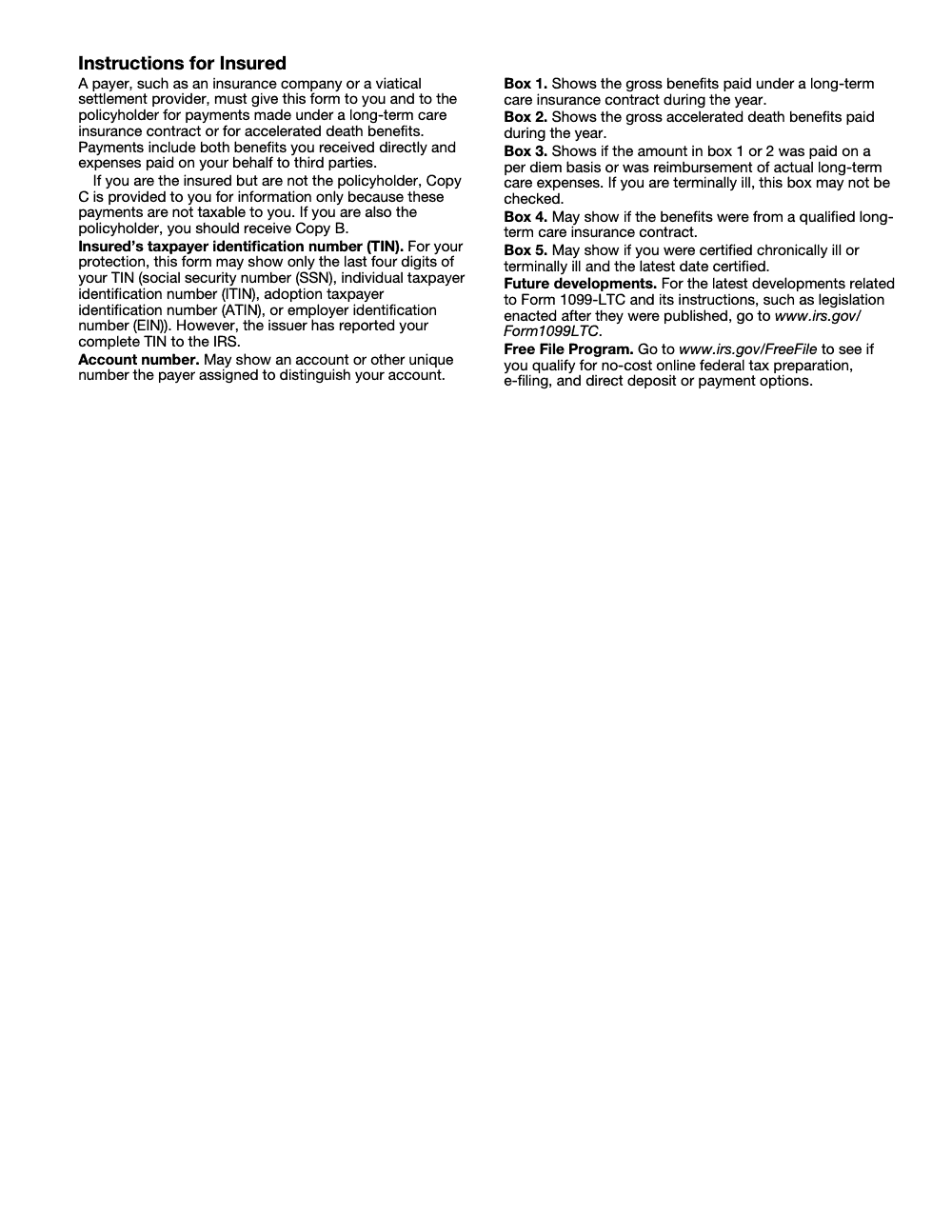
Form 1099‑LTC is an IRS information return titled Long‑Term Care and Accelerated Death Benefits. Insurers, some government payers, and licensed viatical settlement providers use it to report payments made under long term care insurance or accelerated death benefit riders. You get a copy, and the IRS gets a copy. That is why you cannot ignore it, even when nothing ends up taxable.
You will see two big buckets of amounts:
- Box 1, gross long term care benefits
- Box 2, gross accelerated death benefits
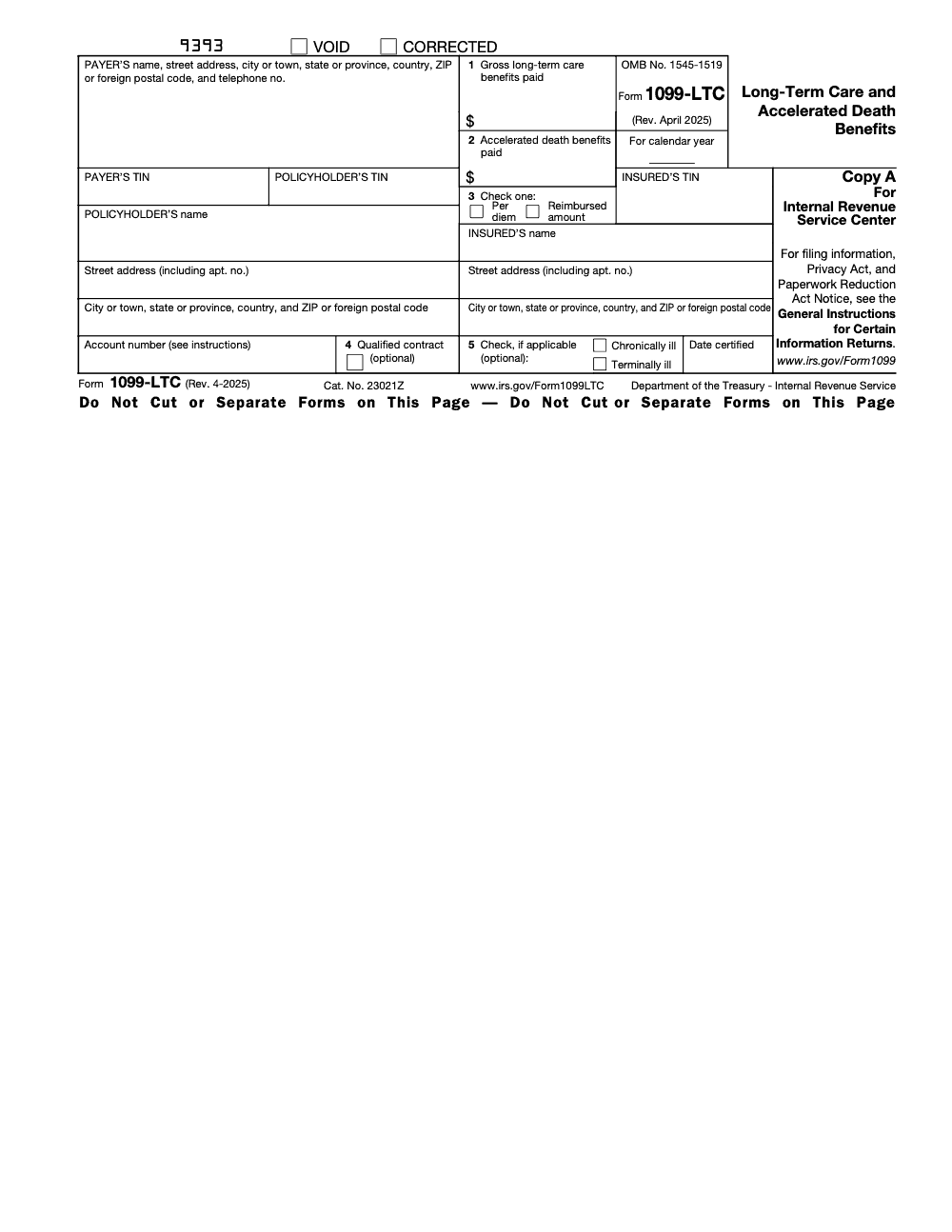
The form also shows whether payments were made as per diem or as reimbursements in Box 3, whether your contract is tax‑qualified in Box 4, and the certification that the insured is chronically ill or terminally ill with the certification date. These fields drive your tax math on Form 8853.
A quick word on 2025 limits
The 2025 per diem exclusion limit is $420 per day. This figure is indexed each year. If you are reading this for a future year, check the current IRS annual revenue procedure for the latest number. For reference, the IRS has already published a 2026 limit of $430 per day.
Who Receives Form 1099‑LTC
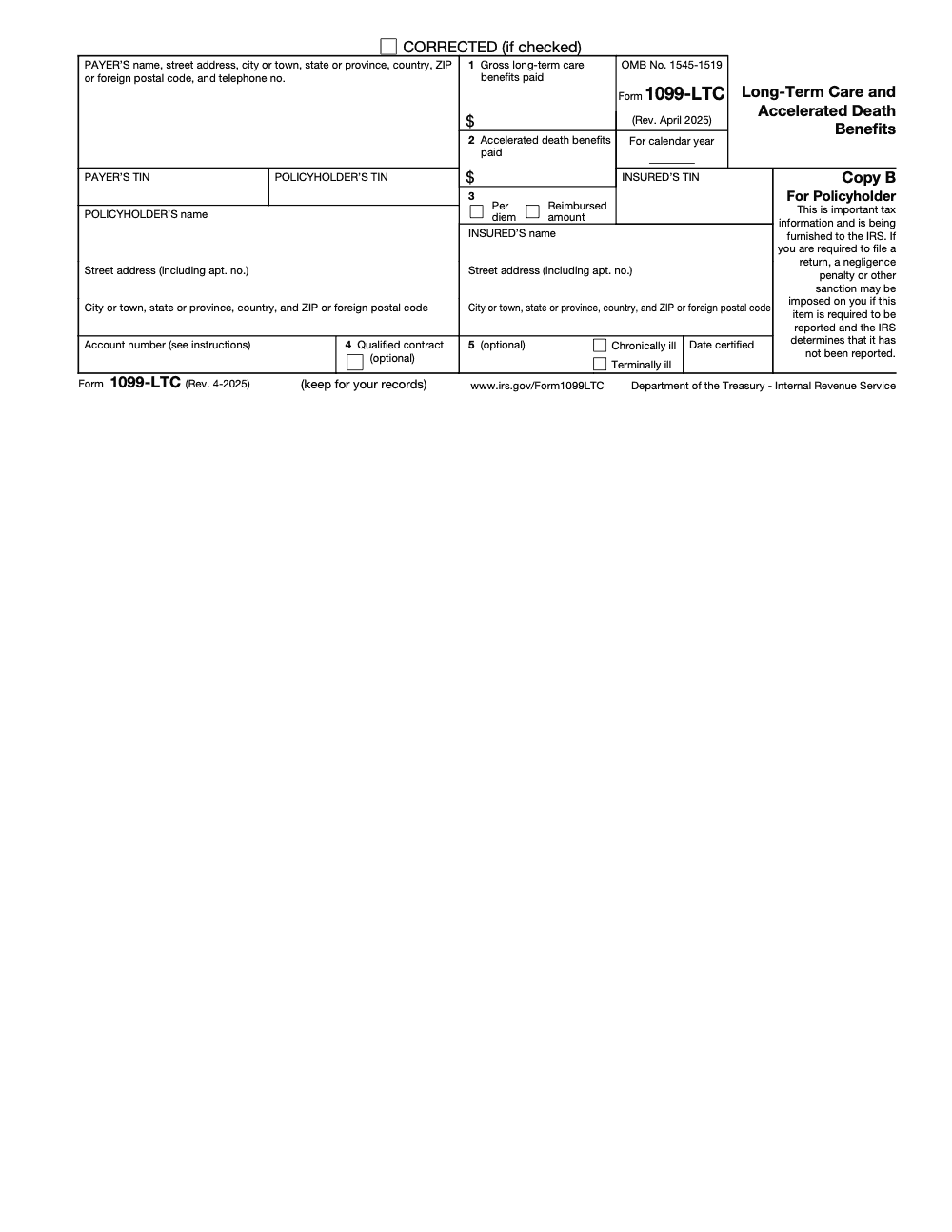
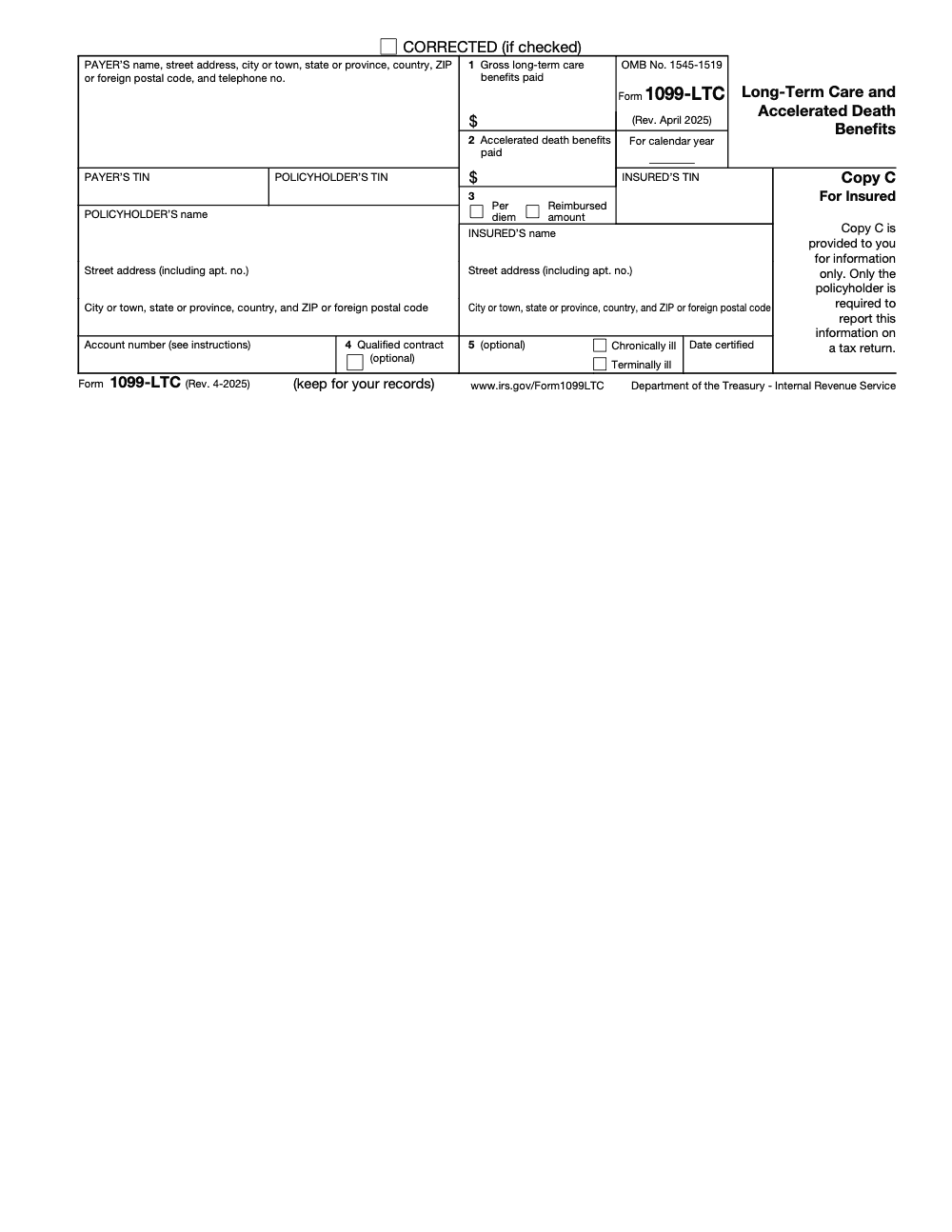
You may receive this form if you are the policyholder (Copy B) or the insured (Copy C). Form 1099-LTC has only three named copies – Copy A to the IRS, Copy B to the policyholder, and Copy C to the insured – so third-party care providers paid on the insured's behalf are not given a copy, even though those payments are still reportable in Box 1. The payer files Copy A with the IRS and sends you a copy in January for the prior calendar year. Always match the payer’s name and EIN, and your SSN or TIN, before you enter anything in your software. A mismatch can trigger notices.
Who sends it
Only certain entities issue Form 1099‑LTC, typically insurance companies, government agencies, and licensed viatical settlement providers that paid the benefits. They must file whether they paid you directly or paid a care provider for you.
How Per Diem And Reimbursement Payments Affect Tax
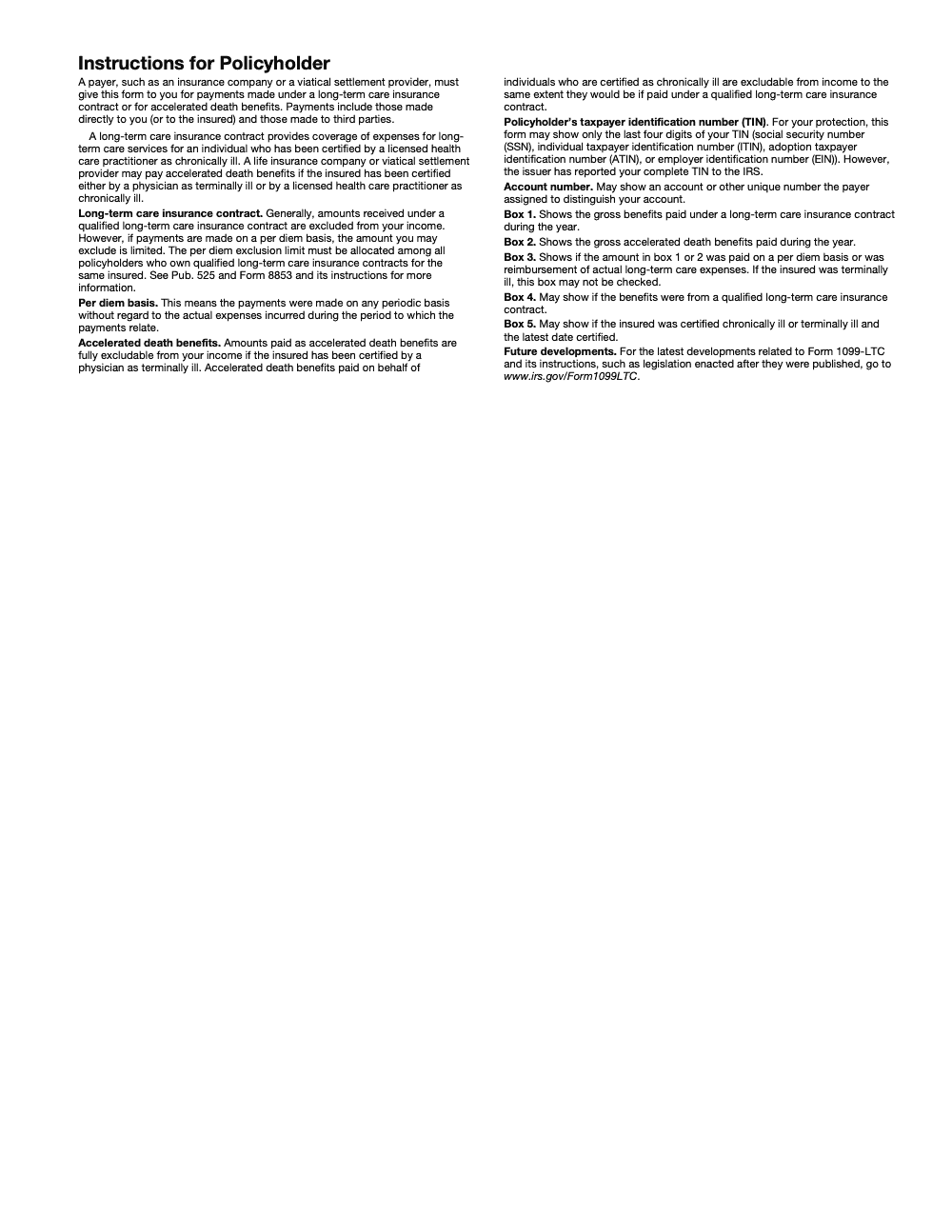
Think of per diem as a daily allowance and reimbursement as a refund of actual costs.
- Per diem, you can exclude up to the IRS daily cap, $420 per covered day in 2025. Above that, the excess can be taxable unless your facts fit special situations laid out in Form 8853.
- Reimbursement, if Box 4 shows a tax‑qualified contract, amounts that match qualified long term care services are generally excludable. Keep receipts and account statements, because your documentation is what supports the exclusion.
If benefits were paid as accelerated death benefits, terminal illness amounts are generally excludable in full with proper certification. Chronic illness benefits follow the per diem or reimbursement rules, including the per diem cap when paid as a per diem. You still do the math on Form 8853.
Read These Boxes First
Use this box‑by‑box checklist as you open the envelope.
| Box or Field | What to verify | Why it matters |
| Box 1 | Total LTC benefits | Drives per diem or reimbursement math for care benefits. |
| Box 2 | Accelerated death benefits | May be fully excludable for terminal illness with certification. |
| Box 3 | Per diem or reimbursement | Sets the exclusion method on Form 8853. |
| Box 4 | Tax‑qualified contract | Enables broader exclusions for reimbursements. |
| CI or TI plus Date | Certification type and date | Proves eligibility for exclusion and period covered. |
Tip, if Box 3 is blank or seems wrong, request a corrected form from the payer before you file – with one exception: a blank Box 3 paired with terminally ill certification in Box 5 is normal, because the per diem cap does not apply to terminally ill insureds and the payer may leave the box unchecked. The payment method controls the math on Form 8853.
A Short Story From The Review Desk
In our work supporting U.S. CPA firms, we often see rush season errors that create notices later. One common one, a per diem policy entered as reimbursement. The return looked fine, but the worksheet never applied the per diem cap, so the IRS read the e‑file and flagged a mismatch. A three minute box check up front would have prevented a letter and an hour of cleanup.
Note on scope, Accountably supports firms with standardized workpapers and Section C tie‑outs, which reduces review time and keeps Box 3 and Box 4 logic consistent. If you run a firm and want fewer review loops and a clean trail for Form 8853, build that discipline into your process, whether you do it in house or with a partner.
What, How, Wow, turning the form into a clean worksheet
- What, Form 1099‑LTC tells you the gross amounts and how they were paid.
- How, you move the numbers to Form 8853, Section C, apply the per diem limit or match reimbursements to qualified costs, then carry any taxable piece to Schedule 1.
- Wow, a few extra lines of documentation, certification date, LTC days, and receipts can turn a messy folder into an airtight file that survives a notice or an exam.
Definitions you will use while you work
- Policyholder, the person who owns the proceeds and reports the income, even if money was assigned to a facility or a family caregiver.
- Per diem payments, fixed amounts paid on a periodic basis without regard to actual costs.
- Qualified LTC insurance contract, generally a contract that meets section 7702B rules, which is often shown by Box 4 checked.
Eligibility And Certification Rules, the gate to exclusion
To exclude LTC or accelerated death benefits, the insured must meet medical criteria and you must have a current certification.
- Chronically ill, a licensed health care practitioner certifies the individual needs substantial assistance with at least two activities of daily living for at least 90 days, or needs substantial supervision due to severe cognitive impairment.
- Terminally ill, a physician certifies a condition that is reasonably expected to result in death within 24 months of the certification date under IRC §101(g)(4)(A) (not 6 months, despite common contract language). Terminal illness benefits are generally fully excludable when paid as accelerated death benefits.
Match the certification type and date on the form to the periods you claim on Form 8853. Keep copies of the certification with your tax file.
Per Diem Versus Reimbursement, which path are you on
Here is a quick comparison you can keep with your return.
| Feature | Per Diem payments | Reimbursement payments |
| What it is | Fixed daily benefit, not tied to bills | Payment that matches actual qualified costs |
| Where shown | Box 1 or 2, with Box 3 checked Per diem | Box 1 or 2, with Box 3 checked Reimbursed amount |
| 2025 exclusion rule | Exclude up to $420 per covered day, do the rest on Form 8853 | Generally excludable under a tax‑qualified contract up to actual qualified LTC costs |
| Documentation | Covered days, certification, and any proof of care | Receipts, statements, and proof of qualified services |
| Common pitfall | Forgetting to apply the per diem cap on Form 8853 | Forgetting that non‑qualified contracts can create taxable income |
What counts as qualified LTC services
Think of services that are necessary for a chronically ill individual, for example nursing care, personal care, and care in a qualified facility. This often overlaps with expenses discussed in IRS Publication 502, which explains medical and long term care costs in plain language. Keep receipts and statements that prove who was paid, for what service, and for which dates.
How To Read The Form, box by box
Start with the identifiers. Confirm the payer name and EIN match your policy. Confirm your SSN or TIN. Then walk the boxes.
- Box 1, total long term care benefits, tie to your explanation of per diem days or reimbursed costs.
- Box 2, accelerated death benefits, note whether the insured is terminally ill or chronically ill.
- Box 3, payment type, circle it on your copy to avoid data entry mistakes.
- Box 4, tax‑qualified contract, if checked, expect broader exclusions when benefits reimburse qualified services; note that Box 4 reporting is optional, so an unchecked Box 4 does not necessarily mean the contract is non-qualified, verify against the contract or the issuer.
- Chronic or terminal certification plus date, verify that the period covers the days or costs you are excluding.
Pro move, staple a one page summary to the front of your Form 1099‑LTC. List LTC days, the per diem limit used, total per diem received, total qualified costs, and a photo or scan of the certification. Future you will thank present you.
The Math You Need, Form 8853 Section C
Form 8853, Section C, is where you compute what is excludable and what is taxable. You enter gross benefits, indicate per diem or reimbursement, track LTC days, and list qualified costs. If multiple people received per diem payments for the same insured, you may need to attach an aggregate computation and allocate the per diem limitation across recipients, a rule that trips people up if family members split benefits.
Worked example, per diem in 2025
- Facts, you received a per diem LTC benefit of $460 per day for 120 covered days in 2025. The policy is tax‑qualified, Box 4 is checked.
- Step 1, compute the annual exclusion, 120 days times the 2025 per diem limit of $420 equals $50,400.
- Step 2, compute total per diem received, $460 times 120 equals $55,200.
- Step 3, taxable excess against the cap alone, $55,200 minus $50,400 equals $4,800. Caveat under §7702B(d)(4), the exclusion floor is the greater of the per diem ceiling ($50,400) or actual unreimbursed qualified LTC costs for those 120 days – if actual qualified costs exceed $50,400, the floor rises and the taxable excess shrinks or disappears.
- Step 4, report it, complete Form 8853, Section C, then carry $4,800 to Schedule 1, Other income, with a brief description, for example LTC. Keep your LTC day count and certification with your records.
Worked example, reimbursement in 2025
- Facts, the insurer paid $36,000 directly to a qualified facility, and you paid $4,000 out of pocket. Box 3 shows Reimbursed amount. Box 4 is checked.
- Result, reimbursement benefits under a tax‑qualified contract are generally excludable to the extent of qualified costs. With $40,000 of qualified costs and $36,000 reimbursed, there is no taxable income. Complete Form 8853, Section C, even when nothing is taxable; the IRS expects it whenever a 1099-LTC was issued, and skipping it can trigger a CP2000 matching notice.
Accelerated Death Benefits, special rules to know
If the insured was certified as terminally ill, accelerated death benefits are generally fully excludable. If the insured was certified as chronically ill, those benefits follow the same rules as LTC benefits, per diem limit if paid as per diem, reimbursement matching if paid as reimbursements. Form 8853 gives you the exact lines to use, and the instructions include special rules for multiple payees.
Reporting On Your Tax Return
Here is the clean path most filers use.
- Complete Form 8853, Section C, with gross amounts from Form 1099‑LTC and the details for per diem days or qualified costs.
- Review whether any portion is taxable, per diem above the daily limit or reimbursements that exceed qualified costs under a non‑qualified contract.
- Carry any taxable amount to Schedule 1, Other income, and keep your computation with your return.
Using tax software
Many consumer and professional platforms guide you to a 1099‑LTC entry screen that feeds Form 8853. Menu names differ, so search for 1099‑LTC or Form 8853 in your software’s help panel. TaxAct, for example, routes you through Federal, Other Adjustments, Archer MSAs and Long‑Term Care Insurance Contracts to Section C. Paths change, so always follow your software’s current instructions and compare the final Form 8853 to your paper form.
Keep a PDF of your completed Form 8853, the certification, and a day count or expense log in the same folder. If the IRS asks, you can answer in minutes instead of hours.
Resources
- IRS Instructions for Form 1099‑LTC, continuous use, updated April 2025. Keep these handy for payer rules, box definitions, and filing guidance.
- IRS Instructions for Form 8853. Section C walks you through definitions, day counts, reimbursement lines, and multiple payee rules.
- IRS Publication 502, Medical and Dental Expenses. Helpful for understanding which services qualify as medical and long term care.
- Annual IRS revenue procedure for inflation updates. For 2025 the per diem limit is $420 per day (Rev. Proc. 2024-40), and for 2026 it is $430 per day (Rev. Proc. 2025-32).
Practical Checklist Before You File
- Confirm payer and recipient IDs on the form.
- Circle Box 3, per diem or reimbursement, and Box 4, tax‑qualified status.
- Pull the certification and verify the date covers your LTC period.
- Count LTC days if per diem applies, then apply the $420 per day cap for 2025.
- Gather receipts and statements if reimbursement applies.
- Complete Form 8853, Section C, then carry any taxable amount to Schedule 1.
- Save your computation, certification, and receipts with your return.
Compliance note
This article is for educational purposes only. Tax situations vary. For personalized advice, talk with a qualified tax professional. Always confirm current year limits and instructions on IRS.gov before filing. The 2025 per diem limit used here comes from the IRS’s annual inflation update and the Form 8853 instructions.
Common Mistakes We See Every Season
Five or six mistakes drive most of the rework we see on 1099-LTC returns. Each one either costs the policyholder real tax dollars or invites an IRS matching notice the following year.
Reusable Checklists
Copy these into your firm SOP or a return workpaper. Each one mirrors what we run on a 1099-LTC engagement at the preparer and reviewer layers.
1099-LTC Intake Packet
- Confirm the POLICYHOLDER'S TIN matches the return-filer; if it does not, the insured does not report.
- Record Box 1 (gross LTC benefits) and Box 2 (accelerated death benefits) separately on the workpaper.
- Note Box 3 status: per diem or reimbursed. If Box 3 is blank with Box 5 marking terminally ill, that is normal.
- Check Box 4 for qualified contract status. If unchecked, request the contract documents from the issuer rather than assuming non-qualified.
- Capture Box 5 chronically ill or terminally ill flag and the certification date.
- Pull the latest physician certification letter and store it with the return file.
- Confirm the form is the April 2025 revision. If older, ask the payer for a corrected form.
Per Diem Exclusion Math (Form 8853, Section C)
- Count the LTC days covered by the certification period.
- Multiply LTC days by $420 (the 2025 cap under §7702B(d)(4)) to get the per diem ceiling.
- Total actual unreimbursed qualified LTC costs from receipts and facility statements.
- Take the greater of per diem ceiling or actual qualified costs as the exclusion floor.
- If multiple qualified policies cover the same insured, allocate the cap across all policyholders before computing any overage.
- Subtract the floor from Box 1 (and Box 2 for chronically ill ADBs); the remainder is taxable.
- Carry the taxable amount to Schedule 1 per the Form 8853 Section C instructions.
- Archive the day count, per diem math, and receipts with the return file.
Payer Issuance Packet (carriers and viatical providers)
- Furnish Copy B to the policyholder and Copy C to the insured by January 31, 2026.
- File Copy A with the IRS by February 28, 2026 on paper or March 31, 2026 electronically.
- If aggregate 1099/1098/W-2 filings hit 10 across the calendar year, e-file is mandatory under TD 9972.
- Order scannable red-ink Copy A from the IRS. Never mail the IRS.gov PDF print.
- Truncate the policyholder and insured TIN to the last four digits on Copy B and Copy C only; report the full TIN on Copy A.
- Use VOID for unfiled drafts and CORRECTED only for already-filed forms.
- Confirm third-party payments (to facilities or home-care agencies) on behalf of the insured are captured in Box 1.
Keep 1099-LTC Season From Stalling
1099-LTC season is short and back-loaded. Payers must furnish Copy B by January 31, 2026, the same week vendor 1099-NEC and 1099-MISC forms go out under the General Instructions for Certain Information Returns. The downstream effect on return preparers is a wave of policyholders calling in February with a form they have never seen before, half of them retirees, all of them wanting to know what they owe.
The fix is process, not faster typing. The 1099-LTC has only five numbered boxes, but the wrong read on Box 3 (per diem versus reimbursed) or a missed Box 5 certification flag can change the taxable answer by tens of thousands of dollars. A short pre-season standardization pass eliminates most of the rework before the volume hits.
- Build a one-page 1099-LTC intake sheet that captures the POLICYHOLDER'S TIN, Box 1 and Box 2 amounts, Box 3 path, Box 5 certification status, and the certification date in one place.
- Lock the 2025 per diem cap of $420 per day per insured into your Form 8853 worksheet template, and flag it as "per insured, not per policy" so multi-policy clients get the right allocation.
- Pre-stage the physician certification request letter so chronically ill files clear the 12-month re-certification before the return reaches review.
- Add a Schedule 1 cross-check to the reviewer SOP so the Form 8853 Section C output reconciles to the line it flows into.
- For carrier and viatical-provider clients filing as payers, calendar the January 31, February 28, and March 31 deadlines on the 1099 issuance board, not the return board, so the TD 9972 e-file threshold gets caught before paper is ordered.
This is the layer Accountably builds into client engagements. Trained U.S.-led offshore teams handle intake, per diem math, and Form 8853 Section C reconciliation inside structured tax preparation workflows, with senior review on every taxable computation so the policyholder gets one clean answer instead of three rounds of revisions.
FAQs
It is the IRS information return for long term care and accelerated death benefits. You use it to figure out what is excludable and what, if anything, is taxable, mostly using Form 8853, Section C.
Often no. Per diem benefits are excludable up to the daily cap, $420 per day for 2025. Reimbursements under a tax‑qualified contract are generally excludable up to qualified long term care costs. You do the computation on Form 8853.
Look for a 1099‑LTC or Form 8853 entry in the income section or in other adjustments. The exact menu labels vary. Always review the produced Form 8853 for accuracy against your paper form.
Enter the gross benefits and your qualified costs on Form 8853, Section C. Under a tax‑qualified contract, reimbursement benefits are generally excludable up to qualified costs. Any excess or non‑qualified contract amounts can become taxable and flow to Schedule 1.
When multiple people receive per diem payments for the same insured, you may need an aggregate computation and an allocation of the per diem limit across recipients. The instructions explain how to attach the statement and allocate the limit.
Other forms this guide names
Summarize this article with AI
About this guide
Accountably helps US CPA, EA, and accounting firms hire trained accountants and tax preparers in India.
About us Reviewed byJugal Thacker, CPAFounder and CEO at Accountably
A Washington-licensed CPA with 7+ years inside US firms – PwC, a real-estate tax practice, then a full-service firm, rising from reviewer to manager to advisory. This article was reviewed against current IRS guidance for the 2025 tax year and updated for filers preparing late returns, amendments, and 2026 estimates.
View profile →How we research, review, and update this guide
Every Accountably guide is researched against primary IRS sources, reviewed by a U.S. CPA, and refreshed as guidance evolves. Read our Editorial Guidelines to see how we source, fact-check, and update our content.