Summarize this article with AI
In Brief
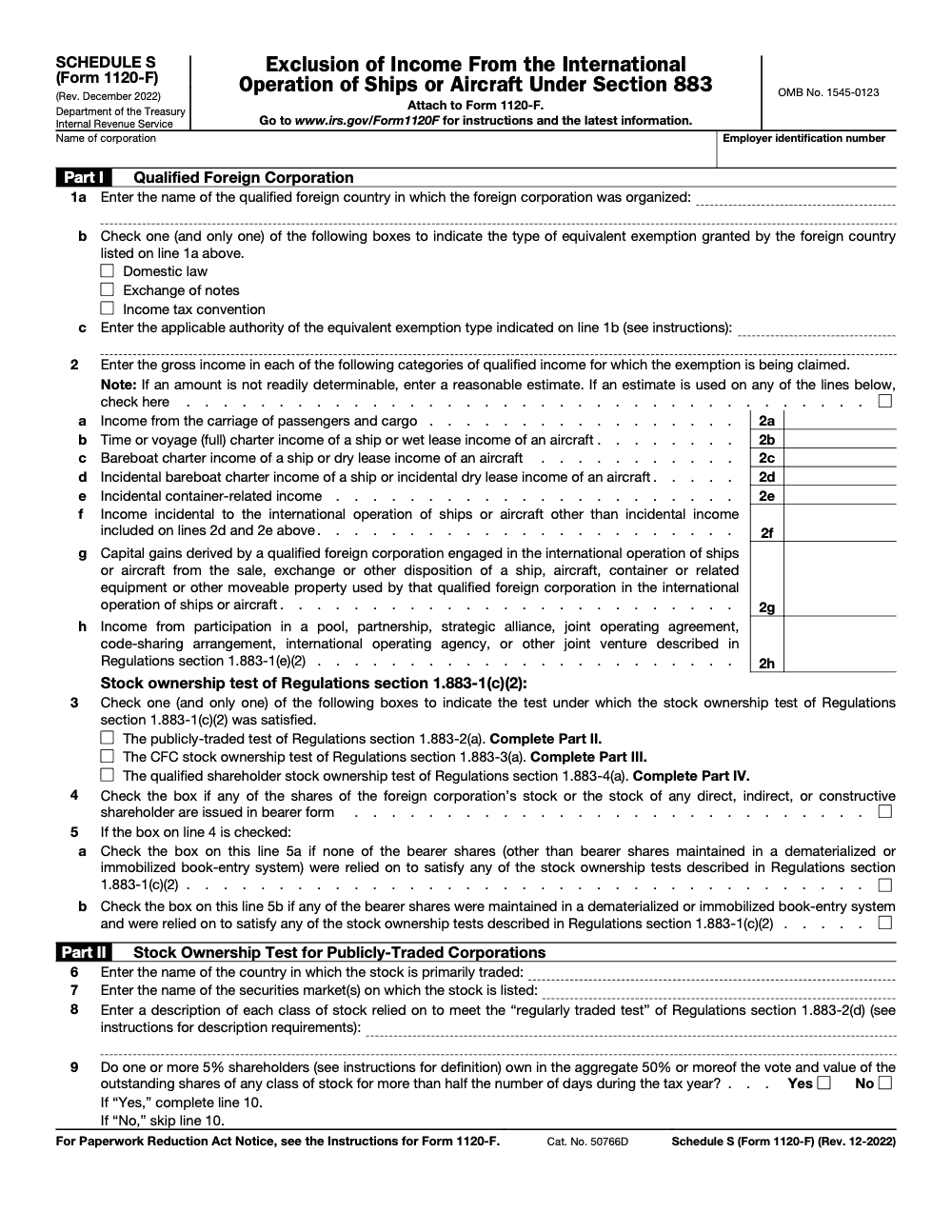
Schedule S is the attachment a foreign corporation files with Form 1120-F to claim the section 883 exclusion for income from the international operation of ships or aircraft (per the Schedule S instructions, IRS Rev. December 2022). Three mutually exclusive stock ownership tests sit on line 3 under Reg §1.883-1(c)(2): publicly-traded (Part II), CFC (Part III), or qualified shareholder (Part IV). Tax year 2025 Form 1120-F is due April 15, 2026 for foreign corporations with a U.S. office and June 15, 2026 for those without; a six-month extension is available via Form 7004.
Most people think of the section 883 exclusion as a one-time election: claim it once for international shipping or aircraft income, then leave it alone. The returns that land on review prove otherwise. A 5% shareholder block can quietly cross 50% of vote and value for more than half the year, and suddenly the publicly-traded test is back in play and the prior assumption is wrong.
Schedule S is where that exclusion gets proven, and it never travels alone. Excluded income has to reconcile to deduction allocations on Schedule H and interest allocation on Schedule I, or you double count. Protective filing relief generally runs within 18 months of the original due date, and a corporation filing 10 or more returns must e-file the package, attachments included.
Key Takeaways
- Schedule S is how you claim the section 883 exclusion for income from the international operation of ships or aircraft, and you must attach it to a timely filed Form 1120‑F.
- If you have U.S.‑source transportation income potentially subject to the 4% tax under section 887, attach Schedule V with vessel or aircraft details. Schedule S handles the exclusion, Schedule V supports the 4% regime.
- Link your excluded income on Schedule S to the deduction allocations on Schedule H and to interest allocation on Schedule I, or you risk double counting and audit adjustments.
- Protective filing relief depends on timeliness, generally within 18 months of the original due date. Late or incomplete filings can forfeit deductions and treaty claims.
- Most corporations that file 10 or more returns in a year must e‑file Form 1120‑F and transmit all required attachments, including Schedule S and Schedule V.
What Schedule S actually does
Schedule S, Exclusion of Income from the International Operation of Ships or Aircraft Under Section 883, is the mechanism a foreign corporation uses to state the legal basis for the exclusion, to quantify the excluded U.S.‑source gross income by category, and to show it satisfies section 883 and the related regulations. In plain terms, it tells the IRS what you are excluding, why you are allowed to exclude it, and how the total reconciles to your books. Attach Schedule S to Form 1120‑F for any year you claim the exclusion.
If section 883 is your shield, Schedule S is the evidence that the shield is valid. No Schedule S, no exclusion.
The IRS instructions are explicit. Even if a treaty or Code provision leaves you with no gross income for the year, you still file Form 1120‑F and, in the case of section 883, you attach Schedule S rather than a free‑form statement. That attachment is not optional, it is how you preserve the exclusion on a timely filed return.
Who must attach Schedule S to Form 1120‑F
If you are a foreign corporation with income from the international operation of ships or aircraft and you claim section 883, attach Schedule S to Form 1120‑F by the due date, including extensions. This applies whether you earn freight, charter, passenger, or related service income, and whether you operate or lease vessels or aircraft. The schedule documents your status as a qualified foreign corporation and the ownership tests required by the regulations.
Quick reference
| Filer | Trigger | Required attachment |
| Foreign corporation | Claiming section 883 on international shipping or air transport income | Schedule S with Form 1120‑F |
| Foreign corporation | U.S.‑source gross transportation income potentially subject to 4% tax | Schedule V listing each vessel or aircraft |
| Foreign corporation | Filing a protective 1120‑F where section 883 may apply | Complete Schedule S to preserve the claim |
The IRS maintains dedicated pages for both schedules and clearly separates their roles. Use Schedule S to claim section 883. Use Schedule V to list vessels or aircraft when section 887’s 4% U.S.‑source gross transportation income tax is in play. Many returns need both.
How Schedule S interacts with ECI on Form 1120‑F
Your Form 1120‑F analyzes two big buckets, effectively connected income, ECI, and other U.S.‑source items. Schedule S sits beside that computation and draws a bright line around shipping or air transport income that qualifies for the section 883 exclusion, so it does not drift into the ECI base. Done right, your 1120‑F shows taxable ECI after properly excluding section 883 items, and the tie‑out is visible in the attachments and workpapers.
Where interest expense is part of your story, Schedule I allocates interest to ECI under the exclusive rules in Regulations section 1.882‑5. That allocation must flow through your ECI computation and should not be used to net against income you have excluded on Schedule S. Keep the lines clean, reconcile totals, and attach the supporting calculations Schedule I requires.
Finally, keep an eye on branch profits tax. Excluded section 883 income does not enter ECI, which influences the dividend equivalent amount that drives the branch profits tax under section 884. You still compute that tax in Section III of Form 1120‑F at the applicable statutory or treaty rate, but the base is shaped by what you included in ECI after your Schedule S exclusion.
Reporting U.S.‑source gross income on Schedule S
Think of Schedule S as the story behind your exclusion. You show what you earned, where it came from, which vessels or aircraft produced it, and why section 883 applies.
When you complete Schedule S, list each category of U.S.‑source gross income tied to international shipping or air transport. Name the vessels or aircraft, the operators, and the exact periods. If you earned time charter income for two ships in March and April, do not lump the amounts into a single line. Break them out by hull or tail number and by period. That level of detail makes your review faster and your audit defense stronger.
Practical tips you can use today:
- Use a standard naming convention for every vessel or aircraft, for example, vessel name, IMO number, operator code, month, and year.
- Reconcile Schedule S totals to your ledger by route or voyage. Tie the supporting journal entries to a schedule that shows how you classified each income stream.
- Keep a short narrative for each line that explains the facts, for example, international operation, port calls, inbound or outbound legs, and any domestic segments that could raise source questions.
Staying consistent with section 883
Section 883 is not a general shipping carveout. It applies to income from the international operation of ships or aircraft when you meet the ownership and equivalent exemption requirements, and the exemption is evaluated category by category across lines 2a–2h – eligibility for one category of qualified income does not automatically extend to another. Keep the documentation close to the line items. Include:
- Ownership evidence that satisfies the tests for a qualified foreign corporation.
- Proof of international operation, for example, voyage logs, air waybills, tickets, or bills of lading that show cross‑border routes.
- Operator or charter agreements that confirm who controls the vessel or aircraft and the nature of services.
If you cannot locate a document quickly during review, treat that as a process problem, not a one‑off. Add the missing item to your workpaper index, then retrain the team on what belongs in the file before the next return cycle.
Allocating and apportioning deductions to ECI
Your goal is simple, even if the math is not. Only deductions that properly relate to ECI reduce ECI. That means you must keep expenses tied to excluded section 883 income out of the ECI bucket.
A clear, repeatable method
Use the section 861 regulations framework to allocate and apportion deductions:
- Directly trace expenses whenever you can, for example, port fees tied to a specific U.S. call that produced ECI.
- When direct tracing is not feasible, use reasonable allocation keys that you apply consistently, such as gross income, assets, or time on route.
- Document your approach in a one‑page method memo and use the same labels on Schedule H and the workpapers, so your reviewer is not translating terms mid‑stream.
Common allocation examples that work in practice:
- Crew and operations, time‑based or voyage‑day ratios.
- Insurance, asset‑based keys by vessel or fleet value.
- Management fees, revenue‑based apportionment, with a cross‑check against headcount or work orders.
Keep excluded operations out of ECI
Once you have the allocation keys, use them in two passes:
- Identify deductions that would otherwise be pulled into ECI.
- Remove the share that belongs to excluded section 883 income, so it does not net against ECI.
Make the removal visible. Add a short bridge that starts with total expense, subtracts the portion allocable to excluded income, and lands on the amount that appears on Schedule H. Label the bridge with the same keys you used in your computations. Your reviewer should be able to audit the trail in under five minutes.
Review checklist for allocation accuracy
- Do the allocation keys appear in both the workpapers and Schedule H, with the same labels.
- Are mixed‑use expenses, for example, management time or systems costs, prorated with stated numerators and denominators.
- Does the sum of exclusions removed from ECI equal the amounts shown as excluded on Schedule S.
- Are book‑to‑tax adjustments, for example, capitalization or timing, carried through to the ECI pool and the excluded pool consistently.
- Did you lock the workpaper version before filing, so the numbers do not drift after sign‑off.
Example, tying Schedule S to Schedule H in one page
Here is a simple one‑page structure you can adapt. Keep it in your recurring binder.
- Step 1, list U.S.‑source gross transportation income by vessel or aircraft, with dates and operators.
- Step 2, mark which lines qualify for section 883 and why, with a one‑sentence reference to the ownership and international operation proof.
- Step 3, total the excluded amounts by category. This ties to Schedule S, Column for excluded totals.
- Step 4, list deductions that would otherwise be in ECI. Show the allocation keys, the math, and the resulting amounts.
- Step 5, remove from ECI the share that relates to excluded section 883 income, then carry the remainder to Schedule H.
- Step 6, add a cross‑check that the sum of excluded deductions removed from ECI does not exceed the total deductions related to excluded income in your books.
If your firm struggles to keep these steps consistent across staff and seasons, standardize the workbook, name every tab the same way, and save it as a template. Consistency is half the battle, and it cuts partner review time sharply.
Claiming treaty‑based positions and Form 8833 disclosure
If you take a treaty position on your Form 1120‑F, do not bury it. Use Form 8833 to disclose the article, the facts, and the tax effect. The disclosure does two things. It shows the IRS you followed the rules, and it creates a clear record for your own files. Keep these pieces tight:
- Treaty article and paragraph.
- Short statement of facts, for example, carrier residency, routes, place of effective management, and permanent establishment analysis.
- How the treaty treatment differs from Code treatment and the dollar impact on gross income or tax.
If you file a protective return, say so in plain English. Explain what is uncertain, for example, whether you are engaged in a U.S. trade or business, and attach the disclosure that preserves deductions and credits if the IRS later finds ECI exists.
Protective filing, timing, and completeness
Protective filings are powerful when they are on time and complete. On a protective 1120‑F, still quantify the potential ECI, state the method you used to allocate deductions, and attach Schedule S for any section 883 exclusion you would claim if ECI is determined. Missing schedules can break the protection. Treat the protective return as if it will be the final answer, then store the proof of timely filing with the return copy.
Practical treaty tips you can apply this season
- Keep a one‑page treaty summary by country in your binder, listing articles relevant to shipping and air transport, branch profits tax rates, and disclosure thresholds.
- Save a PDF of the tax residency certificate alongside Form 8833 and your treaty memo.
- Cross‑reference the treaty claim on the face of the return to the exact attachment name and page count, so reviewers and examiners can find it fast.
Coordination with Schedule H for deduction allocation
You will avoid most review comments by aligning labels and math across schedules. Start with Schedule H because it is where ECI deductions live. Then mirror those same methods on Schedule S when you carve out deduction amounts related to excluded shipping or air transport income.
Linking ECI deductions without double using expenses
- Reconcile Schedule S excluded income with Schedule H. The deductions you remove from ECI should match the portion allocable to that excluded income.
- Segregate deductions allocable to section 883 operations, then remove them from the ECI pool before you finalize Schedule H.
- Tie interest allocation inputs from Schedule I to Schedule H outputs first, then finalize Schedule S. This keeps you from netting ECI interest against excluded income by mistake.
- Add a one‑line control total, for example, “Excluded‑related deductions removed from ECI, 2,450,” and tick it to the Schedule S bridge.
Keep methods identical across schedules
If Schedule H uses a gross receipts key for mixed costs, use the same key when you compute the share tied to excluded income. If you use asset‑based interest allocation or a functional category approach, mirror those categories when you remove expense from ECI for excluded operations. If you change a method year over year, document why and apply the change everywhere, not just on one schedule.
A simple worksheet you can copy
Create a single workbook with these tabs:
- S1 Summary, totals by vessel or aircraft, with tie‑outs to Schedule S and the return.
- H Alloc, allocation keys, math, and control totals for Schedule H.
- I Link, interest allocation summary that pulls the final amounts from your Schedule I calculations.
- Treaty, Form 8833 narrative, article citations, and residency proof.
- Refs, a cross‑reference page listing every attachment name, page count, and where it is cited on Form 1120‑F.
Set the workbook to read‑only before delivery. Store a signed PDF version in your permanent files so the numbers cannot drift after sign‑off.
Coordination with Schedule I for interest expense
Interest can swamp your ECI calculation if you treat it loosely. Schedule I allocates interest to ECI under a specific regulatory method. Do not reduce excluded section 883 income with any share of interest that Schedule I assigns to ECI. Keep these controls in place:
- Pull the Schedule I final ECI interest number into Schedule H first.
- Confirm that no share of that interest appears in the columnar detail that supports excluded income on Schedule S.
- If you have a section 882(c) limitation that disallows interest, keep it out of both ECI and excluded pools. Your workpapers should show the cap and the math.
Cross‑checks that catch most interest mistakes
- The total ECI interest on Schedule H equals the final Schedule I amount, no exceptions.
- Excluded income columns on Schedule S show zero for interest.
- Asset or liability balances used on Schedule I match the balances shown in your allocation memos and tie to the ledger.
Branch profits tax, how Schedule S affects the base
Schedule S does not compute branch profits tax, but it shapes it. When you exclude income under section 883, that income does not enter ECI (but any non‑§883 effectively connected income remains subject to the 30% branch profits tax under §884, subject to any applicable treaty rate reduction). Your ECI determines the dividend equivalent amount that drives the branch profits tax. Two practical points:
- Compute the branch profits tax after you finalize Schedules H, I, and S, so the base reflects the correct ECI.
- If you rely on a treaty rate for branch profits tax, include the disclosure with Form 8833 and show the math that leads to the treaty rate and the final tax.
Required attachments and supporting documentation
Audits turn on documents. Attach the schedules the return references, and keep supporting proof in the file.
Attachments to Form 1120‑F when section 883 is claimed
- Completed Schedule S, with line‑by‑line ties to vessels or aircraft.
- Schedule V when U.S.‑source gross transportation income and the 4% tax regime are relevant. List each vessel or aircraft precisely.
- Form 8833 for any treaty‑based position, plus a short memo.
- Schedule H and Schedule I when you allocate deductions and interest to ECI.
- Schedule M‑3 when required, with a short bridge that explains how book expenses map to ECI and excluded operations.
- Any related Forms 5472, 1118, and statement schedules that the return references.
Workpaper essentials for section 883
- Voyage or flight logs, dispatch records, and route maps to prove international operation.
- Charter agreements, invoices, tickets, and bills of lading.
- Ownership proofs and residency certificates.
- GL reconciliations, allocation keys, and method memos.
- Summary page listing the file names, locations, and page counts for each item.
A reviewer’s one‑minute scan path
Give your reviewer a clear path to a yes:
- Open the S1 Summary tab, confirm totals equal Schedule S.
- Open the H Alloc tab, confirm removed deductions equal the portion tied to excluded income.
- Open the I Link tab, confirm interest equals Schedule I and does not appear on Schedule S.
- Open Treaty tab, confirm Form 8833 facts and article citation.
- Open Attachments list, confirm every referenced schedule is present and named exactly as cited on the return.
If your team is short on time during peak season, templatize these tabs and add a two‑column control sheet with initials and dates. That small habit reduces late‑night questions and protects deadlines.
Protective filing considerations involving Schedule S
A protective Form 1120‑F is an insurance policy, and like any policy, it only works if you follow the terms. File on time, include all schedules, and quantify the items that could become ECI. On a protective return that touches shipping or air transport income:
- Attach a complete Schedule S that shows what would be excluded under section 883 if ECI exists.
- Include vessel or aircraft data, operators, and owners where relevant.
- Attach Form 8833 if you rely on a treaty claim, and label the return protective in the header or in a clear statement.
Keep proof of delivery and keep the working papers. If the IRS later finds a U.S. trade or business, your protective filing preserves deductions, credits, and refunds that would otherwise be lost.
Common errors that derail section 883 claims
You can avoid most issues with a short pre‑file checklist.
Frequent misses
- Omitting Schedule S while claiming section 883 on the face of the return.
- Leaving blanks for vessel or aircraft identifiers, for example, IMO or registration numbers.
- Mixing income that is not within the section 883 lane into the excluded totals.
- Failing to reconcile Schedule S excluded amounts to the ledger and to Schedule V where the 4% regime applies.
- Double using deductions by removing them from ECI on Schedule H, then netting them again against excluded income on Schedule S.
A 10‑minute pre‑file check
- Does the Schedule S total tie to S1 Summary, and do vessel or aircraft details match invoices and logs.
- Do the allocation keys used on Schedule H match those shown in the S1 Summary bridge.
- Do Schedule I interest totals match the I Link tab, with zero interest shown on Schedule S.
- Are all attachments present, named cleanly, and referenced on the face of Form 1120‑F.
- Is the return labeled protective when applicable, with Form 8833 attached and cross‑referenced.
Electronic filing and attachment requirements
If you must e‑file, treat the electronic return as the only return the IRS will see. That means every attachment has to transmit cleanly.
E‑file setup that avoids late‑night rejections
- Confirm your software supports Schedule S, Schedule V, Schedule H, Schedule I, and Schedule M‑3 in a single transmission.
- Convert statements and workpapers to IRS‑accepted print‑version PDFs with clear file names.
- Use a simple index at the front of the PDF package that lists every attachment and page count.
- If you qualify for a paper filing waiver, mail the full package and keep proof of timely mailing.
Common e‑file mistakes and how to avoid them
- Missing Schedule S or misnamed files that the IRS system does not recognize. Fix by naming files exactly as your software expects.
- Exceeding PDF size limits. Fix by splitting large PDFs at logical boundaries and updating the index.
- Forgetting to flag a protective return. Fix by setting the indicator in software and repeating the label in a statement.
Do a small test transmission a week before your first due date. A dry run exposes software quirks while you still have time to fix them.
Recent developments and what to watch
Keep an eye on three areas that affect Schedule S filers:
- Interest allocation reporting. Expect closer attention to how Schedule I flows into ECI and interacts with excluded transportation income. Tighten your bridges and labels.
- Attachment consistency. Examiners look for schedule mismatches and missing statements. Your best defense is a clean index and one‑page summaries that match the face of the return.
- Protective filings. When U.S. trade or business status is unclear, timely protective returns with complete schedules remain a smart move. Maintain calendar reminders and a short checklist for evidence you must collect before filing.
Recordkeeping and audit readiness for Schedule S
Audit‑ready means you can find the document in seconds, not hours. Build a file that tells the story without you in the room.
What to keep, and how long
- Voyage and flight logs, dispatch records, charter agreements, tickets, and bills of lading.
- Ownership proofs, tax residency certificates, and operator agreements.
- U.S.‑source gross income computations by vessel or aircraft, with reconciliations to the ledger.
- Allocation keys, method memos, and interest allocation summaries.
- Copies of every filed attachment, the e‑file acceptance, and mailing proofs.
Keep a central index that lists every document, its file name, and its location. Add a version number and lock the folder after filing.
Final word and next step
If you follow the steps in this guide, you will keep section 883 where it belongs, outside of U.S. tax, and you will make your reviews faster. If your firm wants more certainty during peak season, standardize the workbook, lock down naming conventions, and build a short index for every attachment. That is real control, not just more effort.
If your firm needs steady capacity for recurring U.S. returns like Form 1120‑F, Schedule S, Schedule H, Schedule I, and Schedule V, Accountably can place trained offshore preparers inside your process, on your systems and templates, with multi-layer review behind every return, and set up workpapers and review flows that cut partner time and reduce revision cycles. When you are ready, bring one engagement live, measure the turnaround, and then scale capacity with structure.
Common Mistakes We See Every Season
Six themes show up on Schedule S review more than anything else, and they share the same root: treating the §883 exclusion as a posture instead of an annual evidence file.
Reusable Checklists
The three checklists below cover Schedule S from engagement intake through pre-file review and are written for copy-paste into firm SOP libraries.
Schedule S engagement intake
- Confirm the foreign corporation's country of organization for line 1a.
- Identify the equivalent-exemption authority for line 1c and check the matching line 1b box: domestic law, exchange of notes, or income tax convention (only one applies).
- Determine whether the corporation maintains a U.S. office or place of business; this sets the April 15, 2026 or June 15, 2026 filing deadline.
- Pull the prior-year Schedule S to confirm which of the three stock ownership tests on line 3 was used and whether the same test still applies for the current year.
- Confirm Form 1120-F is on the engagement; the §883 exclusion is claimed on the return, not in lieu of filing it.
- Identify whether any direct, indirect, or constructive shareholder anywhere up the ownership chain holds bearer shares (drives lines 4, 5a, and 5b).
- Flag any of the eight line 2 income categories (2a through 2h) that will rely on estimates so the disclosure box at the top of line 2 can be checked.
- Pre-file Form 7004 if the return will not be on time; the 6-month extension runs to October 15 or December 15 depending on U.S. office status.
Stock ownership test selection (line 3)
- Lock the single test on line 3 under Reg §1.883-1(c)(2) before populating any of Parts II, III, or IV.
- Publicly-traded test (Part II): record country of primary trading on line 6, securities market(s) on line 7, and each class of stock on line 8.
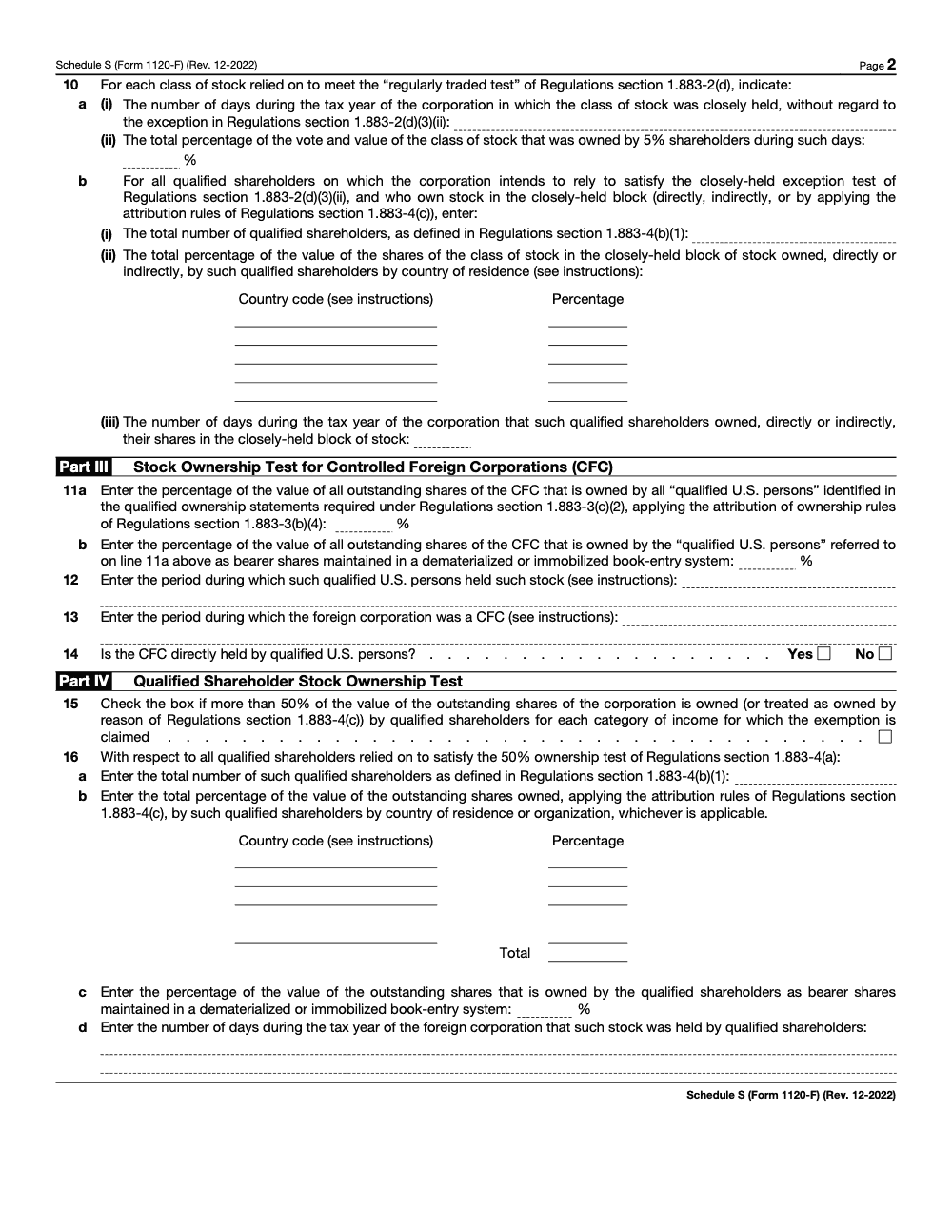
- Publicly-traded closely-held inquiry on line 9: if any 5% shareholder block aggregates to 50% or more of vote and value for more than half the tax year, mark Yes and complete line 10 invoking the Reg §1.883-2(d)(3)(ii) closely-held exception.
- CFC test (Part III): document qualified U.S. person ownership percentage on line 11a, bearer-share percentage on line 11b, and the two distinct periods on lines 12 (qualified U.S. person holding period) and 13 (CFC status period).
- Qualified shareholder test (Part IV): confirm strictly more than 50% of value owned by qualified shareholders for each category of exempt income on line 15, with country-of-residence breakdown on line 16b applying Reg §1.883-4(c) attribution.
- File the supporting ownership memo, including Reg §1.883-3(c)(2) qualified ownership statements where the CFC test is used.
Pre-file crosswalk and review
- Cross-walk every line 2 income category to the trial balance; separate incidental items on lines 2d, 2e, and 2f without double-counting on the residual line 2f.
- Capture line 2g capital gains for containers, related equipment, and other moveable property used in international operation, not just ship or aircraft sales.
- Include line 2h income from pools, partnerships, strategic alliances, code-sharing arrangements, and other joint ventures described in Reg §1.883-1(e)(2).
- Confirm any estimated line 2 amount has the disclosure box at the top of line 2 checked.
- Allocate deductions on Schedule H first, then strip the share tied to §883-excluded income before finalizing ECI on Schedule I.
- Confirm §883-excluded income is removed from the 30% branch profits tax base under IRC §884; only non-exempt effectively connected income remains in scope (treaty modifications applied where relevant).
- Confirm the engagement folder contains the equivalent-exemption cite (domestic statute, treaty article, or note exchange) supporting line 1c.
- If tax preparation is split between teams, sign off on the Schedule S to Schedule H to Schedule I crosswalk before final partner review.
Keep Schedule S Season From Stalling
Section 883 looks like a clean exclusion on paper until a preparer opens Schedule S for the first time. The qualified-foreign-corporation prong, the three mutually exclusive stock ownership tests under Reg §1.883-1(c)(2), and the line-2 category breakdown all have to line up for each tax year, and the exclusion is not perpetual once granted in a prior year (per the Schedule S instructions, IRS Rev. December 2022). Miss the April 15, 2026 deadline (or June 15, 2026 for filers without a U.S. office, per the Form 1120-F instructions) and the failure-to-file penalty under IRC §6651(a)(1) runs at 5% per month up to a 25% cap, with a $510 minimum once the return is more than 60 days late.
The fix is process, not effort. Most Schedule S errors trace back to documentation gaps that only surface at review, and the recurring ones are easy to script into a season-start standardization pass.
- Lock the stock ownership test on line 3 before touching Part II, III, or IV. Only one box may be checked under Reg §1.883-1(c)(2); flipping mid-season forces full rework of the supporting schedule.
- Build a country-code roster for qualified shareholders before drafting line 16b. Reg §1.883-4(c) attribution requires a country-by-country breakdown of value owned, not a single aggregated figure, and the threshold is strictly more than 50% of value.
- Tag line 2 income by category (lines 2a through 2h) at the journal-entry level, not at year-end. If any amount is a reasonable estimate, check the disclosure box at the top of line 2; estimates without disclosure are an unforced error.
- Cross-walk Schedule S excluded income to Schedule H deduction allocation and Schedule I interest expense before sign-off. Income excluded under §883 cannot absorb deductions and is not subject to the 30% branch profits tax under §884; missing the bridge double-reduces ECI.
- Capture the equivalent-exemption authority (domestic law, exchange of notes, or income tax convention) in the workpaper index for line 1c. Audit selections routinely pull on a missing or vague exemption cite.
Schedule S is a small attachment with a long tail of evidence behind it. If your team wants the ownership-test memos, line-2 category tagging, and Schedule H/I crosswalks built once and reused every cycle, our U.S. taxation outsourcing teams can integrate into your existing review flow and keep the documentation discipline in place across filing seasons.
FAQs
Schedule S is the attachment a foreign corporation uses to claim the section 883 exclusion for income from the international operation of ships or aircraft. It identifies each income category, the vessels or aircraft, and the basis for the exclusion, then ties those amounts back to your books.
A foreign corporation files Form 1120‑F when it has effectively connected income, certain U.S.‑source income, branch profits tax exposure, treaty positions to claim, or when filing thresholds require it. If section 883 applies, include Schedule S with the 1120‑F.
Schedule S claims the section 883 exclusion. Schedule V lists vessels and aircraft and supports reporting for the 4% U.S.‑source gross transportation income tax under section 887. Many filers include both, since shipping and air transport income can touch both rules.
Allocate deductions on Schedule H first, using clear keys, then remove the share tied to excluded section 883 income before you finalize ECI. Do not net interest against excluded income. Tie the totals to Schedule I and add a one‑page bridge.
Timeliness and completeness. File within the protective window, attach Schedule S and any Form 8833, quantify potential ECI and related deductions, and keep proof of filing with your working papers.
Other forms this guide names
- Form 1120‑F: Guide, Filing, Deadlines, Protective Return
- Form 1120-F: Schedule Q, QDD Filing Guide
- Form 8833: Filing Requirements, Exceptions, and Penalties
- Form 7004: Business Tax Extension Guide, Deadlines & E‑File
About this guide
Accountably helps US CPA, EA, and accounting firms hire trained accountants and tax preparers in India.
About us Reviewed byJugal Thacker, CPAFounder and CEO at Accountably
A Washington-licensed CPA with 7+ years inside US firms – PwC, a real-estate tax practice, then a full-service firm, rising from reviewer to manager to advisory. This article was reviewed against current IRS guidance for the 2025 tax year and updated for filers preparing late returns, amendments, and 2026 estimates.
View profile →How we research, review, and update this guide
Every Accountably guide is researched against primary IRS sources, reviewed by a U.S. CPA, and refreshed as guidance evolves. Read our Editorial Guidelines to see how we source, fact-check, and update our content.