Summarize this article with AI
In Brief
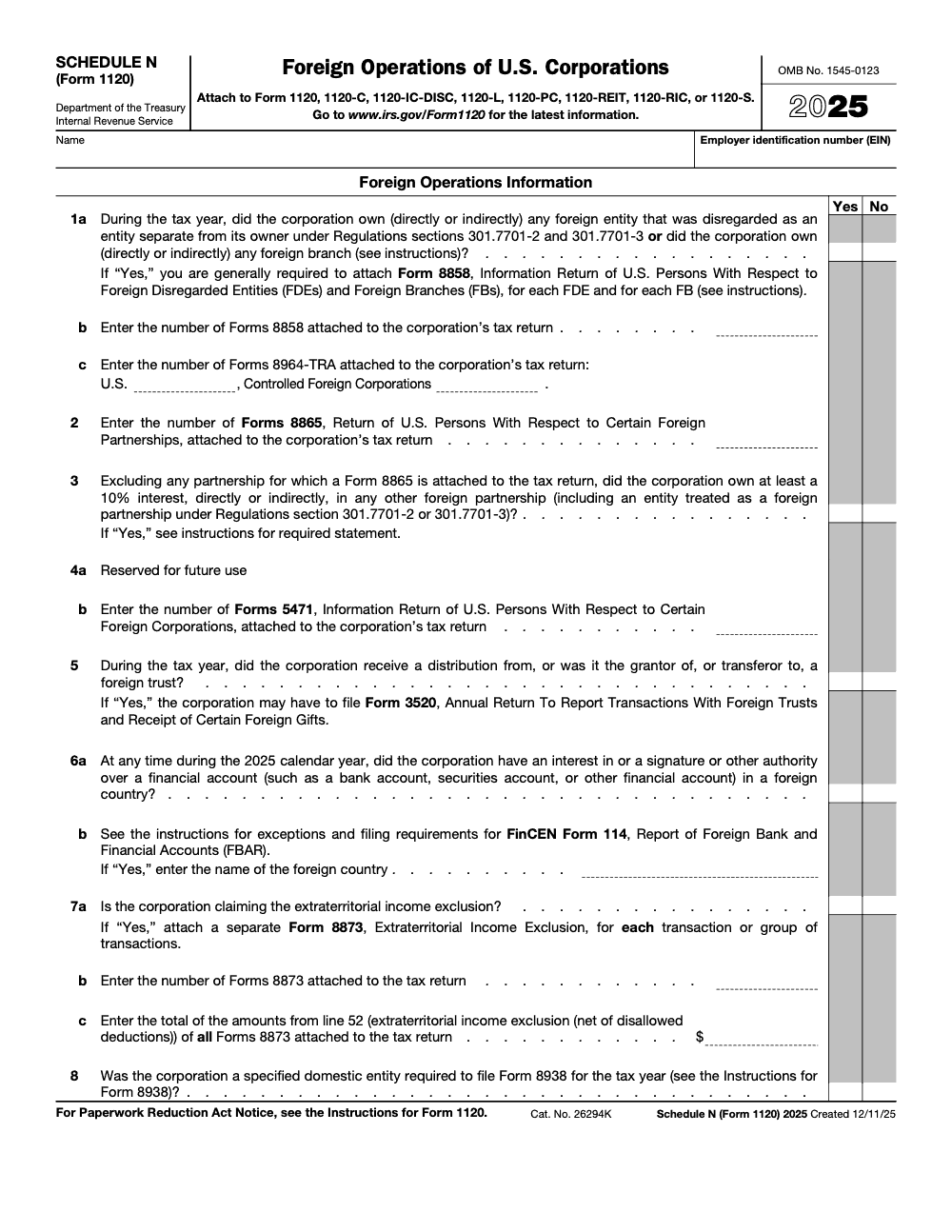
Schedule N is the foreign-activities attachment to the Form 1120 series – it captures FDE and foreign-branch ownership (Line 1a), 10% or greater foreign partnership interests (Line 3), foreign trust transfers and distributions (Line 5), FBAR-triggering foreign accounts when aggregate value exceeds $10,000 (Line 6a, per the Schedule N (Form 1120) instructions), and extraterritorial income exclusion claims (Line 7a). For calendar-year 2025 corporations the 1120 with Schedule N is due April 15, 2026; Form 7004 buys a six-month extension to file, not to pay.
Schedule N rarely surfaces from a CFO who already knows the corporation has foreign exposure. It comes from a controller who flagged a foreign bank account during a year-end reconciliation, or a partner who realized a small overseas joint venture quietly crossed the 10% ownership line. Once that signal hits, the question is no longer whether Schedule N is needed; it is which attachments are owed.
Schedule N is the foreign-activities attachment to the Form 1120 series, and each Yes answer triggers something else: Form 8858 for foreign disregarded entities and branches, Form 8865 for certain foreign partnerships, Form 5471 for certain foreign corporations. A foreign account whose aggregate value tops $10,000 brings an FBAR into play. For a calendar-year C corporation the return is generally due April 15, with a six-month extension on Form 7004.
Key Takeaways
- Schedule N is an attachment to Form 1120 that discloses a corporation’s foreign operations, assets, and related filing obligations, for example 8858, 8865, 5471, 3520, and 8938 where applicable.
- You are generally required to file Schedule N if you had assets in, or operated a business in, any foreign country or U.S. possession at any time in the year, or if any page‑1 question is Yes.
- For calendar‑year C corps, the Form 1120 due date is the 15th day of the 4th month, which is typically April 15, and you can request an automatic extension with Form 7004 for up to six months.
- If you own foreign disregarded entities or foreign branches, attach Form 8858. If you own certain foreign partnerships, attach Form 8865. If you own certain foreign corporations, attach Form 5471.
- If you will claim a corporate foreign tax credit, compute it on Form 1118 and include it with the return.
What Schedule N is and why it matters
Schedule N, Foreign Operations of U.S. Corporations, is the short, high‑impact form that consolidates the story of your corporation’s foreign footprint. It asks the big questions first, for example, do you own any foreign disregarded entities or branches, and then it prompts the right attachments. This single page reduces guesswork for both your reviewer and the IRS intake systems.
In practice, Schedule N prevents three common headaches:
- Missing international forms that would cause a reject or correspondence later.
- Mismatched disclosures, for example, a “Yes” to foreign branches but no 8858 in the package.
- Lack of clarity on FBAR and Form 8938 responsibilities when foreign accounts exist.
When Schedule N applies
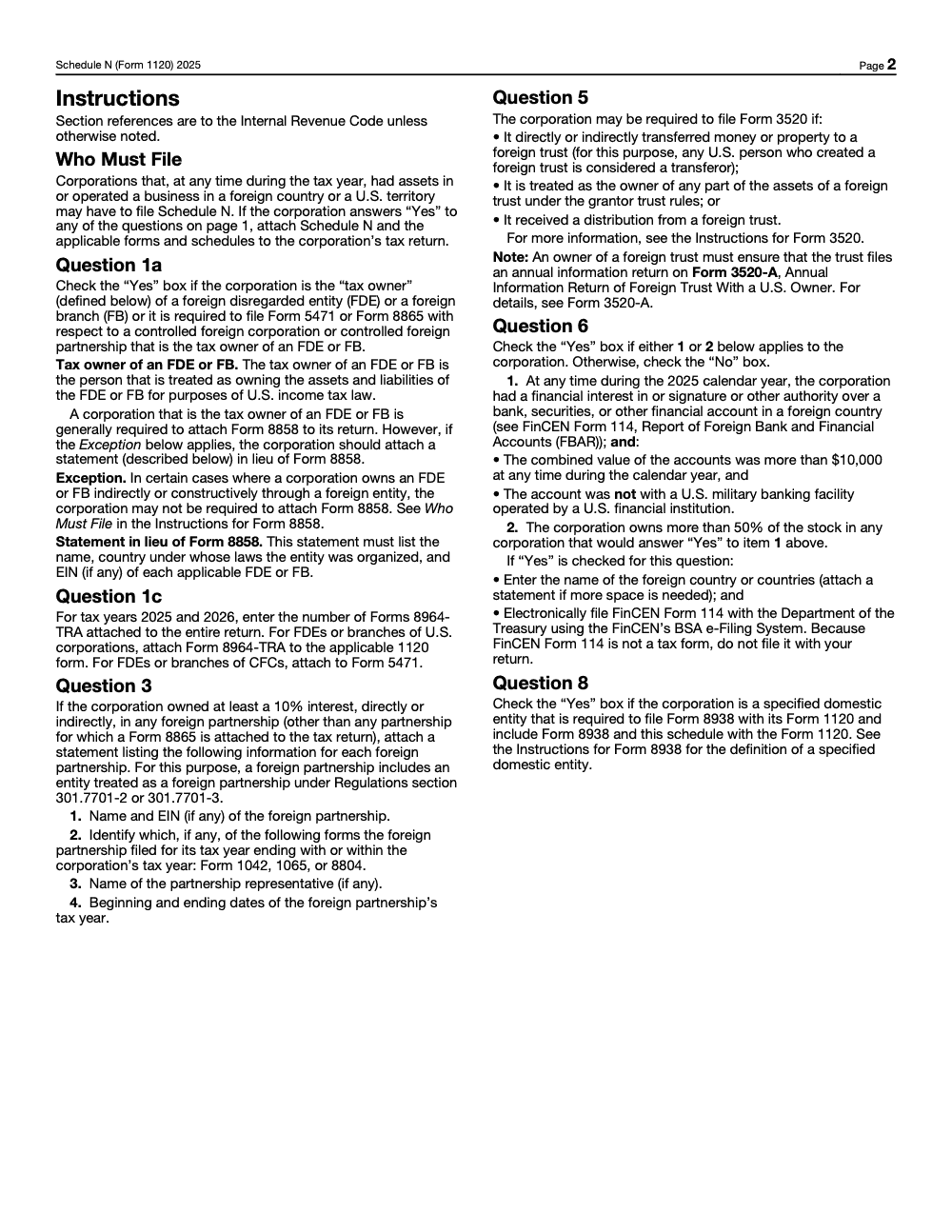
You should complete and attach Schedule N if at any time during the year your corporation had assets in, or operated a business in, a foreign country or U.S. possession. You must also attach it when any of the page‑1 questions is marked Yes, including questions tied to Forms 8858, 8865, 5471, 3520, and 8938.
Here are the common triggers you will see:
- Ownership of a foreign disregarded entity or foreign branch, generally requires Form 8858. This includes constructive or indirect ownership – if the corporation is required to file Form 5471 or Form 8865 for a CFC or controlled foreign partnership that is the tax owner of an FDE or FB, line 1a is still Yes even if the corporation does not directly own the entity.
- Ownership or transactions with certain foreign partnerships, you will attach Form 8865 and in some cases also list other foreign partnerships on a statement.
- Ownership of certain foreign corporations, you will attach Form 5471.
- Dealings with foreign trusts or distributions, you may need Form 3520 and ensure the trust files Form 3520‑A. Three separate triggers apply: transferring money or property to a foreign trust (including creating one), being treated as the owner of any part of a foreign trust under the grantor trust rules, or receiving a distribution from a foreign trust – not just distributions.
- Foreign financial accounts over the $10,000 aggregate threshold during the calendar year, you must file FinCEN Form 114 (FBAR) electronically with Treasury, not with the tax return, and disclose the country on Schedule N.
Due dates and extensions
- For a 2025 calendar‑year C corporation, the return is due April 15, 2026. If you extend with Form 7004 on or before the original due date, you typically receive a six‑month filing extension. The extension does not extend the time to pay.
Practical tip, put the Schedule N and all international attachments on your 1120 routing sheet and validate the e‑file schema before partner review. It saves a painful last‑day scramble.
A simple table of triggers, forms, and your action
| Trigger on Schedule N | What it means | Your action |
| “Yes” to foreign disregarded entity or foreign branch | You are the tax owner of an FDE or FB | Attach Form 8858 for each FDE and FB, or a statement if an exception applies, and enter the count on page 1, line 1b. |
| Foreign partnerships | Form 8865 required for certain controlled or reportable interests | Attach Form 8865 and enter the count on line 2. For other foreign partnerships where Form 8865 is not required, attach the statement Schedule N describes. |
| Foreign corporations | Form 5471 required for certain categories of U.S. persons | Attach Form 5471 and enter the count on line 4b. |
| Foreign trusts or distributions | 3520 reporting may apply | File Form 3520 as required and confirm 3520‑A compliance for owners. |
| Foreign accounts over $10,000 | FBAR required, not filed with IRS | File FinCEN Form 114 electronically and list country or countries on Schedule N. |
How to complete Schedule N, step by step
Follow an inverted pyramid, go from the broad Yes or No disclosures to the attachments and finally to your support workpapers.
Page 1 questions
- Read each question, then map it to the related form in your engagement binder. If the answer is Yes, confirm that the correct information return is prepared and counted on the line that asks for the number of forms attached.
- For Question 6 on foreign accounts, confirm the $10,000 aggregate threshold (combined value across all foreign accounts at any time during the calendar year, not per account), select the correct country codes for the disclosure on Schedule N, and make sure the FBAR was filed through FinCEN, not attached to the return. Question 6 is also Yes if the corporation owns more than 50% of the stock in any corporation that would itself answer Yes – constructive ownership counts even when the filing corporation has no direct foreign accounts of its own.
Statements Schedule N expects
- For certain 10 percent foreign partnership interests where Form 8865 is not attached, Schedule N asks for a statement with the partnership name, EIN if any, which returns it filed, the partnership representative, and the tax year dates. A foreign partnership for this purpose includes any entity treated as a foreign partnership under Treasury Regulations sections 301.7701-2 or 301.7701-3 (check-the-box) – U.S. tax classification controls, not local-law classification. Build a template for this statement in your binder so it is never missed.
Related forms you will often attach
- Form 8858 for foreign disregarded entities and foreign branches. The “Who Must File” section of the 8858 instructions describes exceptions and when a statement can be used instead, which Schedule N references.
- Form 8865 for controlled foreign partnerships and other reportable relationships under sections 6038, 6038B, and 6046A.
- Form 5471 for certain U.S. persons that are officers, directors, or shareholders in specified foreign corporations.
- Form 1118 if you claim the corporate foreign tax credit. Attach it to the 1120 and keep your country baskets and limitation calculations supportable.
Deadlines, extensions, and packaging
- Due date, the 15th day of the 4th month after year end for most C corps. Calendar year means April 15.
- Extension, file Form 7004 by the original due date to get six months. E‑file is available through MeF, and remember, an extension extends time to file, not to pay.
E‑file checklist that keeps reviews moving
- Confirm each “Yes” on Schedule N has a matching attachment in your software’s return tree.
- Validate country entries for the FBAR prompt and include the separate FinCEN filing confirmation in your workpapers.
- Run schema validation before partner review to avoid last‑minute rejects.
- If consolidating, ensure subsidiary counts on page 1 lines match the attached form counts.
Small habit, big payoff, add a final “International attachments” tick mark on your 1120 cover checklist that confirms Schedule N is present and the counts reconcile to the attached 8858, 8865, and 5471 forms.
Data readiness, workpapers, and review protection
If you want a calm review week, front‑load the materials your reviewers need.
Your source data checklist
- Organizational chart with ownership percentages and changes during the year.
- Trial balance by entity and branch, with functional currency notations.
- Foreign tax payment schedules with paid and accrued dates for potential Form 1118 work.
- Bank confirmations for foreign accounts to validate FBAR thresholds and country identifiers.
- Copies of local filings or returns for foreign partnerships and corporations if referenced in your statements or 5471 packages.
Workpaper standards that save hours
- Use a consistent file naming and version pattern for all international returns and statements, for example Entity_Year_FormNumber_v3.
- Keep a one‑page index that lists every Yes on Schedule N and the exact filename of the attachment that satisfies it.
- Tie the counts on lines 1b, 2, and 4b to that index. Reviewers will thank you.
Common mistakes to avoid
- Marking Yes to foreign branches but forgetting to attach Form 8858 or a qualifying statement.
- Reporting foreign accounts but failing to list the country on Schedule N or to file the FBAR.
- Claiming a foreign tax credit without including Form 1118 schedules.
Audit awareness and red flags
While Schedule N itself is short, it points to areas the IRS expects to see. Mismatches between a Yes and the missing form, large foreign tax credits without support, or inconsistent counts across consolidated groups can pull attention. Align the Schedule N answers with what is in the return and what is in your binder.
Who this helps most
- Corporate tax leads who own the 1120 and juggle multiple foreign entities.
- CPA firms that review client packages right before filing season deadlines.
- Finance leaders who want to reduce the risk of late notices for missing international forms.
Where offshore teams fit, carefully
If you use offshore capacity, make it support your control, not replace it. A disciplined offshore workflow can assemble 8858, 8865, and 5471 packages, maintain the Schedule N index, and pre‑validate FBAR disclosures, all inside your templates and systems. Accountably’s role is to build that controlled offshore delivery, so your team gets scale without losing review protection or security, used sparingly but exactly where production needs it. Keep the focus on SOPs, structured workpapers, and clear SLAs so that partner time is spent on judgment, not on chasing attachments.
If your bottleneck is production, not sales, tightening Schedule N processes is a fast win. The return files clean, reviewers spend less time in loops, and you protect the client relationship.
Real‑world workflow example
- Day 1 to 2, gather org charts, foreign TBs, and prior‑year international forms.
- Day 3, prepare Schedule N, answer page‑1 questions, and draft required statements.
- Day 4 to 5, build or update 8858, 8865, 5471, and 1118, then reconcile counts to Schedule N.
- Day 6, run e‑file validation, fix schema issues, and finalize.
- Day 7, partner review focused on judgments, not missing forms.
A short compliance checklist you can copy
- Confirm each Schedule N Yes has a matching form or statement attached.
- Verify FBAR thresholds, list countries on Schedule N, and file FinCEN Form 114.
- If claiming the foreign tax credit, include Form 1118.
- Run e‑file validation, then lock your PDF set for review.
- Calendar your due date and, if needed, file Form 7004 timely.
Conclusion
If you treat Schedule N as your foreign activity command center, you will file a cleaner return with fewer surprises. Answer the page‑1 questions carefully, attach the right forms, and keep a simple index that ties it all together. That is how you reduce audit risk, preserve your credits, and get your 1120 out the door on time.
If your internal bandwidth is tight during peak season, a structured offshore delivery model can handle the heavy lifting on international attachments inside your templates and systems, while you keep strategy and review. That way, you meet deadlines without burning out your team.
Note and sources, Always use the current IRS forms and instructions for your filing year. See Schedule N, 1120 instructions, Form 7004 guidance, and Form 1118 instructions for the most recent rules and dates. This article is educational, not tax advice.
Common Mistakes We See Every Season
The same Schedule N stumbles show up across firm reviews every March. Most come from misreading which trigger belongs to which attached form, or from packaging foreign filings the same way a domestic 1120 gets packaged.
Reusable Checklists
Copy these into your firm's international tax SOPs. Each item is the kind of step a preparer should actually tick during the workpaper build, not a placeholder.
Schedule N trigger scan
- Confirm whether the corporation held assets in or operated a business in a foreign country or U.S. territory at any time during the tax year.
- Identify every foreign disregarded entity and foreign branch the corporation owns directly.
- Identify every CFC or CFP requiring Form 5471 or Form 8865 that itself owns an FDE or foreign branch.
- List all foreign partnerships with 10 percent or greater direct or indirect ownership, including check-the-box partnerships under Treas. Reg. 301.7701-2 and 301.7701-3.
- Document every transfer to, grantor relationship with, or distribution from a foreign trust during the year.
- Aggregate the high-water-mark value of all foreign financial accounts across the 2025 calendar year and flag if the combined total exceeds $10,000 at any point.
- Confirm whether the corporation is a specified domestic entity required to file Form 8938 with the 1120.
- Confirm whether an extraterritorial income exclusion is being claimed and whether Form 8873 transactions need to be grouped.
Schedule N attachment packet
- One Form 8858 per FDE and per foreign branch; total count entered on Line 1b.
- Form 8964-TRA attached to the 1120 for U.S. corporate FDEs and branches (tax years 2025 and 2026).
- Form 8964-TRA attached to Form 5471 for CFC FDEs and branches (tax years 2025 and 2026).
- One Form 8865 per qualifying foreign partnership; total count on Line 2.
- Q3 statement for each 10 percent or greater foreign partnership not on Form 8865, with name, EIN, any Forms 1042 / 1065 / 8804 filed, partnership representative, and tax year dates.
- One Form 5471 per controlled foreign corporation; total count on Line 4b.
- Form 3520 filed separately by the corporation when Line 5 is Yes; confirmation that the foreign trust filed Form 3520-A.
- One Form 8873 per transaction or grouping; total count on Line 7b and Line 52 aggregate on Line 7c.
- Form 8938 included with the 1120 when the corporation is a specified domestic entity.
- Country names entered on Line 6b when Line 6a is Yes, with an attached statement if space runs short.
FBAR e-filing handoff
- Confirm any foreign financial account in which the corporation had financial interest or signature/other authority during the 2025 calendar year.
- Aggregate the high-water mark across all accounts; flag if combined value exceeded $10,000 at any time.
- Exclude accounts maintained with U.S. military banking facilities operated by U.S. financial institutions.
- Apply the 50 percent stock-ownership trigger: if the corporation owns more than 50 percent of any other corporation with foreign accounts, FBAR consideration still applies.
- File FinCEN Form 114 electronically through the BSA E-Filing System, separate from the 1120.
- Save the BSA e-filing confirmation number in the international workpaper packet for the corporate return reviewer.
- Reconcile the country list on Schedule N Line 6b against the FBAR account list before final signoff.
Keep Schedule N Season From Stalling
Schedule N season runs alongside the broader 1120 March-to-April crunch, but it carries a different load profile. Each Yes on the eight Schedule N questions triggers an attached form with its own data demands – Form 8858 per FDE, Form 8865 per qualifying foreign partnership, Form 5471 per CFC, Form 3520 for foreign trust activity, Form 8873 per extraterritorial transaction. According to the Schedule N (Form 1120) instructions, these attachments are not optional once a trigger is met, and the Q3 statement, FBAR country disclosure on Line 6b, and Form 8938 inclusion add layers a domestic-only 1120 does not face.
Teams that ship Schedule N filings on time treat the international packet as a parallel workstream that starts before the trial balance is final, not after. The data dependencies are deeper, the source documents sit in other accounting systems and sometimes other languages, and the review chain has to catch indirect ownership traps that the preparer may not see on the first pass.
- Build an entity-and-ownership map before the close: every CFC, CFP, FDE, foreign branch, and foreign partnership with at least a 10 percent interest, sourced from cap tables rather than from the prior-year return.
- Run a Line 1a indirect-ownership check the moment a Form 5471 or 8865 enters the workpaper packet – the FDE or foreign branch held downstream still flips Line 1a to Yes.
- Reconcile Line 1b, Line 2, and Line 4b counts against the attached form copies in the index; a mismatch here is the most common signoff blocker.
- Capture FBAR aggregate-value math on a calendar-year basis even when the corporation files on a fiscal year, and reconcile the country list on Line 6b to the FinCEN Form 114 e-filing.
- For Line 7a Yes returns, lock the per-transaction Form 8873 count and the Line 7c aggregate before review – this is the most rework-prone field on the schedule.
That is the production shape we build inside teams running Schedule N volume. When the bench is thin during peak season, a structured offshore delivery team can carry the preparer-level work on FDE inventories, Q3 statements, FBAR reconciliations, and Form 8858 attachments inside your templates and review chain. See /services/taxation/ for how the workflow plugs into your existing 1120 review structure.
FAQs
If you had assets in, or operated a business in, a foreign country or U.S. possession at any time during the year, or you answered Yes to any page‑1 question, you generally need to attach Schedule N and the indicated forms to your 1120.
You will usually need Form 8858 for each branch and each disregarded entity, and you should enter the total number attached on line 1b of Schedule N. If an exception applies because of indirect ownership through a foreign entity, Schedule N explains you can attach a statement instead of 8858.
FBAR is filed with Treasury on FinCEN Form 114, not with the IRS. Schedule N asks you to disclose the country or countries when you check Yes to the foreign accounts question. Track FBAR confirmations in your workpapers to avoid gaps.
For the 2025 calendar year, the due date is April 15, 2026. If you need more time, file Form 7004 by that date for a six‑month extension. Remember, the extension gives you more time to file, but not to pay.
Corporations compute the credit on Form 1118 and attach it to the 1120. Make sure your limitation calculations and baskets tie out and keep support for any paid or accrued foreign taxes.
Keep records as long as they are material to your return and potential adjustments. Many teams keep at least seven years of international workpapers as a practical policy, but your retention period should reflect your risk, audit posture, and legal requirements. Consult your advisor for a policy that fits your facts.
Other forms this guide names
- Form 1120: Corporation Tax Return Guide
- Form 8865: Filing Categories, K-2/K-3, Deadlines, Penalties
- Form 8858: U.S. Guide to FDE and Foreign Branch Reporting
- Form 5471: Filing Categories, Schedules, Penalties
- Form 5471: Schedule I‑1, GILTI, Tested Income and QBAI Guide
- Form 5471: Schedule R Reporting Foreign Distributions Guide
About this guide
Accountably helps US CPA, EA, and accounting firms hire trained accountants and tax preparers in India.
About us Reviewed byJugal Thacker, CPAFounder and CEO at Accountably
A Washington-licensed CPA with 7+ years inside US firms – PwC, a real-estate tax practice, then a full-service firm, rising from reviewer to manager to advisory. This article was reviewed against current IRS guidance for the 2025 tax year and updated for filers preparing late returns, amendments, and 2026 estimates.
View profile →How we research, review, and update this guide
Every Accountably guide is researched against primary IRS sources, reviewed by a U.S. CPA, and refreshed as guidance evolves. Read our Editorial Guidelines to see how we source, fact-check, and update our content.