Summarize this article with AI
In Brief
Form 1138 lets a corporation postpone paying prior-year corporate income tax when a current-year net operating loss carryback is expected to create an overpayment, capped at the Line 3 anticipated overpayment under IRC §6164. For tax years ending after December 31, 2017, carryback (and therefore Form 1138 utility) is generally limited to farming losses and non-life insurance company NOLs per P.L. 115-97, §13302; file Form 1139 before the 1138 window closes to keep the postponement running, and route the entire process through corporate tax preparation with disciplined Line 2 evidence and Line 3 schedules.
A controller looks at year-to-date numbers in the last week before a prior-year corporate installment is due, sees a real loss forming, and asks whether the next payment can wait. Form 1138 can be the answer: it postpones payment of prior-year corporate income tax when a current-year net operating loss carryback is expected to create an overpayment, capped at the Line 3 anticipated overpayment under section 6164.
Before any of that, two facts have to hold. For tax years ending after December 31, 2017, carryback is generally limited to farming losses and non-life insurance company net operating losses, so confirm the loss year is actually open for carryback. Then check that the Line 3 reduction in prior-year tax really covers the installment you want to defer. The postponement runs through the month the loss-year return is due, and filing Form 1139 before that window closes keeps it running. Interest on the postponed amount accrues at the section 6621 underpayment rate, so price it into the cash plan first.
Key Takeaways
- Form 1138 postpones payment of prior‑year corporate income tax when you expect a current‑year NOL carryback that creates an overpayment. You can defer only up to the anticipated overpayment, and only for payments due after you file. Interest still accrues.
- The postponement normally lasts through the month the NOL‑year return is due, including extensions. If you file Form 1139 for a tentative refund before that date, the postponement continues until the IRS allows or disallows the 1139 claim.
- Most corporations cannot carry back NOLs arising in tax years ending after December 31, 2017, with important exceptions for farming losses and non‑life insurance companies. Confirm you actually have carryback eligibility before relying on Form 1138.
- If you e‑file Form 7004, do not attach Form 1138. Send Form 1138 separately. Paper filings may be mailed together as the form instructions describe.
- Interest on any postponed amount runs at the IRC §6621 underpayment rate. For example, IRS rulings show a 7% underpayment rate and a 9% large corporate underpayment rate for the quarters ending December 31, 2025 and March 31, 2026.
What Form 1138 Actually Does
Form 1138 is an extension of time to pay, not an extension of time to file. If your corporation expects a current‑year net operating loss, and the carryback to the immediately preceding year will generate an overpayment, you can postpone paying prior‑year corporate income tax up to that expected overpayment. Payments already due before you file cannot be postponed; for tax you already paid and want refunded, use Form 1139 or Form 1120X instead. Think of 1138 as a short‑term cash flow valve that you open only after the loss year begins and only before the next targeted installment comes due.
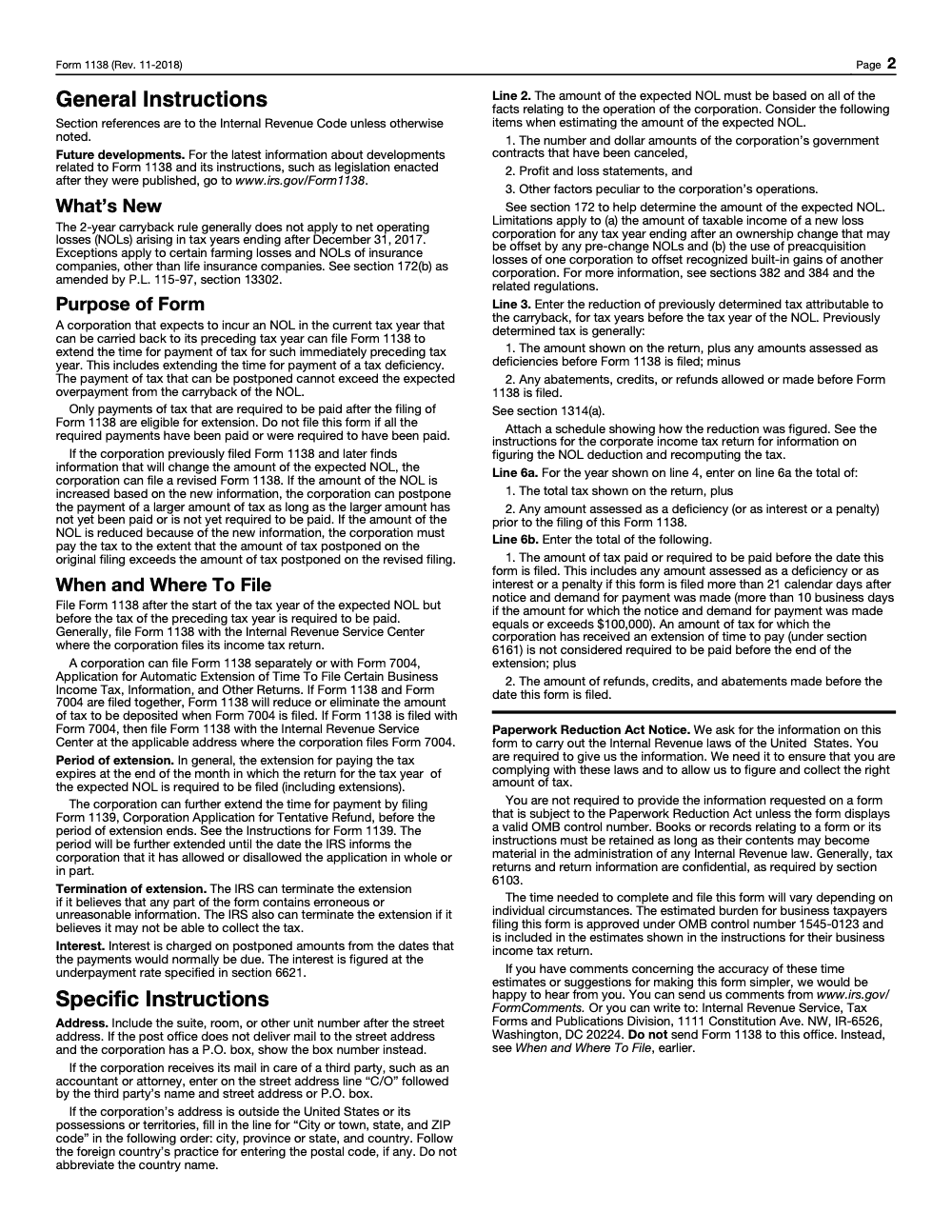
The legal backbone is IRC §6164 and the related Treasury regulations. Once filed, the postponement generally runs through the end of the month when the NOL‑year return is due, including any valid extension. If you also file a timely Form 1139 for a tentative carryback adjustment, your payment postponement continues until the IRS mails the allowance or disallowance notice for that 1139 claim.
First, Confirm You Can Carry Back An NOL In 2025
Here is the most common surprise we see. After the TCJA, most NOLs arising in tax years ending after December 31, 2017 cannot be carried back, and the temporary CARES Act relief that reopened carrybacks for 2018 to 2020 loss years no longer applies. Two important exceptions still matter in 2025:
- NOLs of non‑life insurance companies, generally with a 2‑year carryback.
- Farming losses, generally with a 2‑year carryback.
If you do not fall into an exception, you likely cannot carry back a 2025 NOL. No carryback means no 1138 postponement. Validate this at the planning stage so you do not build a cash plan on an assumption that current law does not support. The IRS Internal Revenue Manual summarizes these limits and notes that the CARES Act temporarily allowed carrybacks for 2018 to 2020 loss years, which no longer applies for new loss years in 2025.
Quick reference, who can carry back in 2025
| Taxpayer type | Carryback of 2025 NOL? | Notes |
| Most C corporations | Generally no | Post‑2020 loss years are carryforward only, subject to the 80% limit on use. |
| Non‑life insurance companies | Yes, 2 years | Special NOL rules apply. |
| Farming losses | Yes, 2 years | Farming loss exception continues. |
When The Postponement Ends
By statute and regulation, the 1138 postponement ends on the last day of the month in which your NOL‑year return is due, including any filing extension. If you submit Form 1139 before that date, the postponement stays alive until the IRS mails the notice that the 1139 claim is allowed or disallowed, in whole or in part.
That timing detail is not academic. If you are cutting it close, file the 1139 before the 1138 window expires, or the payment comes due immediately at that end‑of‑month mark.
Interest, Penalties, And A Helpful IRS Note
Interest never pauses. Postponed amounts accrue interest from the original payment due dates at the §6621 underpayment rate. For the fourth quarter of 2025, the IRS published a 7% underpayment rate and a 9% rate for large corporate underpayments. The Department of Labor maintains a convenient historical table that also shows 7% and 9% for the first quarter of 2026.
One small relief item, straight from the IRS IRM, is that the Failure to Pay penalty is not imposed on the portion of unpaid tax that gets satisfied by an NOL carryback when an accepted Form 1138 is on file. Interest still applies, and the IRS will reject 1138s that are incomplete, unsigned, already paid, or not tied to corporate income tax for the immediately preceding year.
Practical tip, file only when your loss expectation is real, your math is tied to evidence, and you have the carryback eligibility. Thin assertions invite termination of the extension and instant payment due.
Who Can Use Form 1138, And Who Usually Cannot
Form 1138 applies to corporations that have prior‑year corporate income tax due and a current‑year NOL that will be carried back to the immediately preceding year. In practice, this most often means C corporations. Individuals, estates, and trusts cannot use Form 1138 at all; individuals seeking a tentative refund from an NOL carryback use Form 1045 instead. S corporations generally do not pay corporate income tax at the entity level, so Form 1138 usually has no role for them unless they owe entity‑level tax for a specific reason. Always confirm the tax you are postponing is corporate income tax for the year immediately preceding the NOL year.
The regulations also make clear that the tax must be shown on the return or assessed within the loss year, and it cannot have been required to be paid before you file the 1138. In other words, file before the next payment is due, not after.
When And Where To File
- File after the start of the NOL year and before any installment you want to postpone is due. Payments due before you file cannot be postponed.
- File with the IRS Service Center where you normally file the corporate return (not the Tax Forms and Publications Division address shown in the Paperwork Reduction Act Notice – that address is for comments only, and 1138s sent there will not be processed). The regulations still refer to the district where the tax is payable, which corresponds to your Service Center filing.
Coordinating With Form 7004
You have two paths, and the right choice depends on how you file 7004.
- If you plan to e‑file Form 7004, the IRS states that applications with NOL carrybacks should not include Form 1138, so send Form 1138 separately.
- If you use a paper 7004, the Form 1138 instructions say you can file them together, and the 1138 amount can reduce or eliminate the 7004 payment. Mail both to the 7004 address shown in the instructions.
This split approach trips people up because the PDF still describes filing together, while the e‑file program guidance is explicit about separating 1138 from an electronic 7004. Use the rule that matches your filing method.
How Long The Extension Lasts, And How To Extend It
By default, your postponement expires at the end of the month that includes the due date for the NOL‑year return, including any extension you obtained. To keep the relief alive longer, file Form 1139 for a tentative carryback adjustment before that end‑of‑month deadline. If you do, the postponement continues until the IRS mails notice that the 1139 is allowed or disallowed, in whole or in part.
Why 1139 Timing Matters
The IRS aims to process tentative carryback applications within specific time frames and provides a 45‑day interest‑free processing window for carryback adjustments. You must file the loss‑year return on or before the date you file a tentative carryback application. These process rules do not replace interest rules on your postponed 1138 balance, but they are important for tracking cash in and out.
What To Attach So Your 1138 Survives Scrutiny
Think like a reviewer. You want to show that your expected NOL is real, that your carryback computation is correct, and that your deferral does not exceed the expected overpayment. Attach schedules that:
- Derive the expected NOL from year‑to‑date P&L, discrete loss events, or other drivers.
- Compute the carryback effect for the immediately preceding year, including any §382 or §384 limits and the recomputed tax.
- Tie to Line 3 on the form, the anticipated overpayment from the carryback.
- Reconcile Line 6a, 6b, and 6c so the extension amount never exceeds Line 3.
If your facts change, the regulations and form instructions expect a revised filing – the form is revisable in both directions. If the expected NOL goes up and the larger tax amount has not yet been paid or come due, you can postpone the additional amount. If the expected NOL goes down, pay the difference right away to cut additional interest.
A Simple Timeline You Can Reuse
- Early in the loss year, build a draft NOL model and confirm you qualify for a carryback in 2025 under current law.
- Before the next installment for the prior year is due, file Form 1138 with schedules.
- File the NOL‑year return. Then, before your 1138 window ends, file Form 1139 to keep the postponement running until the IRS allows or disallows the tentative refund.
At Accountably, we coach teams to assign one owner for the cash calendar. Someone must watch the 1138 end‑of‑month deadline and the 1139 clock, so the plan does not die quietly over a weekend.
Line‑By‑Line Highlights You Should Not Miss
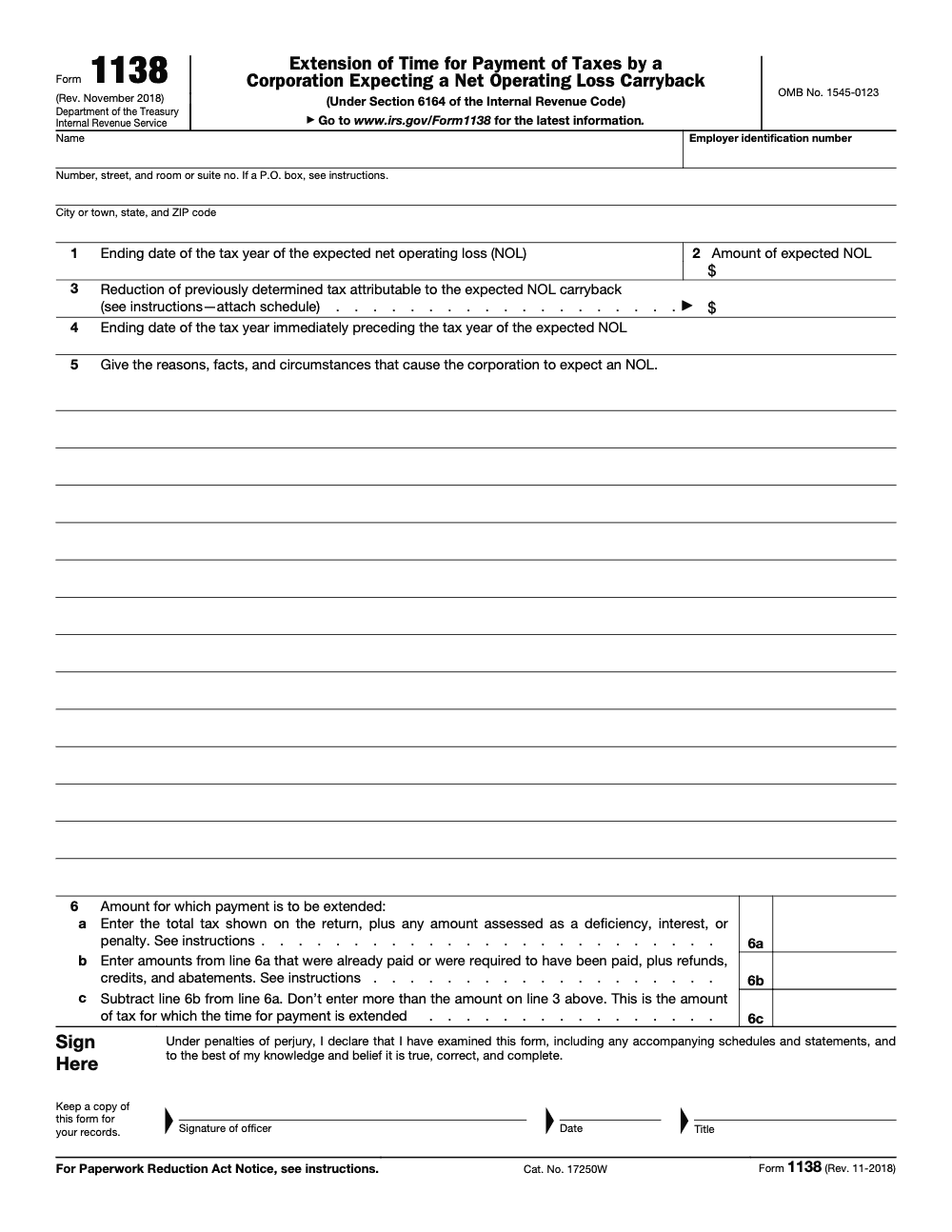
- Line 1, enter the ending date of the expected NOL year.
- Line 2, enter the estimated NOL, backed by real evidence, for example P&L, canceled contracts, extraordinary losses, and note any §382 ownership change limits.
- Line 3, enter the expected reduction of prior‑year tax from the carryback, and attach the computation.
- Line 4, enter the end date of the year immediately preceding the NOL year.
- Line 6a through 6c, compute the extension amount, never above Line 3, and include only amounts not required to be paid before filing (an assessed deficiency, interest, or penalty counts as required-to-be-paid only if Form 1138 is filed more than 21 calendar days after notice and demand – or more than 10 business days if the assessed amount equals or exceeds $100,000).
The IRS can terminate your extension if it finds erroneous or unreasonable information, or if collection looks at risk. Be ready to defend your schedules.
Interest Mechanics, Plainly Stated
- Interest runs from the original due date of each postponed installment, at the §6621 rate.
- For the quarter ending December 31, 2025, IRS guidance shows 7% underpayment and 9% large corporate underpayment. The same rates apply for the quarter ending March 31, 2026. Track the quarter in which your deferred amount sits, and expect rate changes over time.
A Helpful Penalty Note
The IRS IRM indicates the Failure to Pay penalty is not imposed on the portion of unpaid tax that is satisfied by an NOL carryback when there is an accepted Form 1138 on file. That does not cancel interest, but it is a meaningful difference in the cost of cash.
Using Form 1139 To Extend Time Further
File Form 1139 before your 1138 postponement ends. If you do, the postponement continues until the IRS mails notice that your tentative refund application is allowed or disallowed. This rule comes straight from §6164(d)(2) and its regulations. File with the same Service Center you used for Form 1138 or as directed in the 1139 instructions.
Include a clean set of computations that begin with the NOL year and step through the carryback, with before‑and‑after columns for the prior year so the IRS can see the impact. The 1139 instructions give detailed column guidance and what to attach, including how to handle net capital losses, unused general business credits, and foreign tax credit interactions.
Filing With Form 7004, The Right Way In 2025
A lot of firms still assume they should clip Form 1138 behind an e‑filed 7004. The IRS says otherwise. For electronic 7004 filings, send the 1138 separately. If you are on paper for 7004, the Form 1138 instructions say you may submit them together, and the 1138 amount can reduce or eliminate the 7004 payment. Match your process to your filing channel.
Where To Get The Current PDF
Always pull the current Form 1138 from the IRS site. The IRS “About Form 1138” page links to the latest PDF and shows the last reviewed date. As of February 19, 2025, the page reports no recent developments and links to the Rev. 11‑2018 form, which remains the operative version.
For your citations and cross‑checks, keep these handy:
- About Form 1138 page for the live PDF link.
- §6164 and 26 CFR 1.6164‑1 and 1.6164‑5 for the legal timing framework.
- About Form 1139 and its instructions for tentative refunds.
- IRS IRM carryback section for policy notes, timing, and penalty comments.
At Accountably, our review teams build 1138 and 1139 packets inside your workflow tools, QuickBooks or your GL for support, and we version the schedules so partner review is fast. We mention this only because speed and documentation discipline are what keep 1138s standing when the IRS looks closely.
Step‑By‑Step Checklist
- Confirm carryback eligibility for the loss year under current law, especially the farming and non‑life insurance company exceptions.
- Build the NOL estimate with supporting schedules, then compute the prior‑year tax reduction and cap the deferral at that amount.
- File Form 1138 after the NOL year starts and before the next installment you want to postpone is due.
- Calendar the end‑of‑month expiration tied to the NOL‑year return due date, including extensions.
- File Form 1139 before that date if you want the postponement to continue until the allowance or disallowance notice arrives.
- Track interest at the §6621 rate by quarter, and budget for it.
Sample Table, Interest Reference For Planning
| Period | Underpayment rate | Large corporate underpayment |
| Oct 1 to Dec 31, 2025 | 7% | 9% |
| Jan 1 to Mar 31, 2026 | 7% | 9% |
| Rates per IRS revenue rulings and the federal table of §6621 underpayment rates. Always check the current quarter. |
Download And Prepare
- Go to the IRS “About Form 1138” page and download the current fillable PDF. The page was last reviewed on February 19, 2025, and links to the operative Rev. 11‑2018 form and instructions.
- Pull the latest Form 1139 instructions for your tentative refund plan.
- If you extend the return, use Form 7004, and remember the e‑file separation rule for 1138.
Final Notes, Built For Busy Firms
If delivery is tight during peak season, put one person in charge of the 1138 calendar, the 1139 filing, and the §6621 interest model. A small amount of discipline saves partners from last‑minute scrambles and keeps client trust intact. If you want an extra set of hands, Accountably can help you standardize the schedules, file logic, and reviewer checklists inside your own systems so your team spends less time chasing files and more time advising clients.
Common Mistakes We See Every Season
The same 1138 errors repeat across firms every NOL season, and they share a pattern: the math is usually right, but a procedural miss kills the postponement before it earns its keep.
Reusable Checklists
These checklists are copy-paste ready for firm SOPs: the first verifies eligibility and evidence before the 1138 goes out, the second walks the form's active lines, and the third keeps the Form 1139 handoff alive so the postponement does not lapse at month-end.
Pre-file eligibility & evidence packet
- Confirm the NOL year has already started and the installment you want to postpone is not yet due (per the Form 1138 instructions, payments already required to be paid cannot be postponed).
- Confirm carryback eligibility under current law: post-2017 NOLs qualify only for farming losses or non-life insurance company NOLs under P.L. 115-97 §13302.
- Build the expected NOL on Line 2 from year-to-date P&L, canceled government contracts, and other operational factors named in the Form 1138 instructions.
- Apply IRC §382 and §384 ownership-change limits and reduce Line 2 to the truly usable NOL.
- Compute the Line 3 prior-year tax reduction at the 21% corporate rate and attach the calculation schedule.
- Verify Line 6c does not exceed Line 3 (Line 6c equals Line 6a minus Line 6b, capped at Line 3).
- Confirm signature by an officer of the corporation under penalties of perjury, with date and title; retain a signed copy in the engagement file.
Line-by-line filing
- Line 1: end date of the expected NOL year.
- Line 2: dollar amount of the expected NOL, after §382 and §384 limitations.
- Line 3: expected reduction of previously determined tax from the carryback, with the calculation schedule attached (mandatory).
- Line 4: end date of the year immediately preceding the NOL year.
- Line 5: narrative explanation of why an NOL is expected (canceled contracts, discrete loss events, year-to-date P&L trend).
- Line 6a: total tax on the preceding-year return plus any deficiency, interest, or penalty assessed before Form 1138 is filed.
- Line 6b: amounts from Line 6a already paid or required to be paid, plus refunds, credits, and abatements; treat an assessed deficiency as required-to-be-paid only if Form 1138 is filed more than 21 calendar days after notice and demand (or 10 business days when the amount equals or exceeds $100,000).
- Line 6c: Line 6a minus Line 6b, capped at Line 3.
- File at the IRS Service Center where the corporation files its income tax return (or, on a paper Form 7004, at the 7004 address); do not mail to the Tax Forms and Publications Division address.
Post-file 1139 handoff
- Calendar the 1138 expiration: the last day of the month in which the NOL-year return is due, including any Form 7004 filing extension.
- Pre-stage the Form 1139 packet during the loss year so it can leave the Service Center before the 1138 window closes.
- File the loss-year return on or before the date Form 1139 is filed (Form 1139 cannot be filed before the loss-year return).
- File Form 1139 within one year after the year the loss is sustained.
- Confirm Form 1139 was filed BEFORE the 1138 expiration so the postponement continues until the IRS mails the allow-or-disallow notice.
- If the one-year 1139 window closes, route the carryback claim through Form 1120X within three years of the loss-year return due date (including extensions).
- Track §6621 underpayment interest by quarter on every postponed dollar and reflect the running balance in the client's cash forecast.
Keep 1138 Season From Stalling
Form 1138 season collapses for the same reason every year. The postponement window expires at the end of the month the NOL-year return is due (including any Form 7004 filing extension), the next installment of prior-year corporate income tax is breathing down the production team's neck, and the §6621 underpayment rate (which adjusts quarterly under the statute) keeps running on every postponed dollar. Layer a Form 1139 deadline into the same calendar window and the cash plan starts to slip in the last week of the month.
What actually breaks delivery on a 1138 engagement is not the math, it is the absence of one named owner watching the 1138 expiration, the 1139 filing deadline, and the schedule reconciliation that ties Line 3 back to the carryback computation. The fixes below are mechanical, not heroic.
- File Form 1138 only after the NOL year begins and before the next installment you want to postpone is due, with a Line 2 schedule that derives the expected NOL from year-to-date P&L, canceled contracts, and other operational evidence (per the Form 1138 instructions on Line 2 estimation factors). Payments already due before you file cannot be postponed.
- Cap Line 6c at Line 3, never higher. Line 6c equals Line 6a minus Line 6b, but the extension cannot exceed the expected overpayment from the carryback. Attach the Line 3 computation schedule; filing without it is a routine reason the IRS rejects 1138s.
- Treat an assessed deficiency, interest, or penalty as required-to-be-paid for Line 6b only if Form 1138 is filed more than 21 calendar days after notice and demand, or more than 10 business days when the assessed amount equals or exceeds $100,000.
- Calendar the end-of-month expiration tied to the NOL-year return due date and file Form 1139 before that date to keep the postponement alive through the IRS allow-or-disallow notice. After that, Form 1120X remains an option within three years of the loss-year return due date.
- Apply §382 and §384 ownership-change limits before signing off on Line 2. Overstating the usable NOL is the fastest way to draw IRS termination of the extension on accuracy or collection-risk grounds.
If your team is juggling 1138 filings alongside multi-state corporate returns and 1120 production, the schedule and review discipline is what keeps the relief intact. Accountably's corporate tax preparation teams standardize the Line 2 evidence files, Line 3 reduction schedules, and the 1138/1139 calendar inside your existing review workflow so partners do not spend the last week of the month chasing missing attachments.
FAQs
It is a request to postpone payment of prior‑year corporate income tax when you reasonably expect a current‑year NOL carryback to create an overpayment, capped at the anticipated overpayment, with interest continuing at the §6621 rate.
Generally no, unless you are a non‑life insurance company or have a farming loss. The CARES Act’s broader carrybacks applied only to NOLs in tax years beginning in 2018 through 2020.
No. Interest accrues from the original due date at the §6621 underpayment rate. For late 2025 and early 2026, IRS guidance shows 7% underpayment and 9% large corporate underpayment.
File with the IRS Service Center where you file your corporate return. The regs describe filing where the tax is payable, which corresponds to your Service Center.
No. The IRS says applications with NOL carrybacks should not include Form 1138 when e‑filing 7004, so send 1138 separately. If you file 7004 on paper, the instructions allow filing together.
File Form 1139 before the 1138 window ends. Then the postponement continues until the IRS mails the allow or disallow notice for your tentative refund claim.
Other forms this guide names
Summarize this article with AI
About this guide
Accountably helps US CPA, EA, and accounting firms hire trained accountants and tax preparers in India.
About us Reviewed byJugal Thacker, CPAFounder and CEO at Accountably
A Washington-licensed CPA with 7+ years inside US firms – PwC, a real-estate tax practice, then a full-service firm, rising from reviewer to manager to advisory. This article was reviewed against current IRS guidance for the 2025 tax year and updated for filers preparing late returns, amendments, and 2026 estimates.
View profile →How we research, review, and update this guide
Every Accountably guide is researched against primary IRS sources, reviewed by a U.S. CPA, and refreshed as guidance evolves. Read our Editorial Guidelines to see how we source, fact-check, and update our content.