Summarize this article with AI
In Brief
Form 12009 is a one-page request for an informal conference with an IRS supervisor about a proposed IRS penalty (current revision December 2006, catalog 25631V, per IRS.gov). It is mailed to the specific IRS manager named on the proposed-penalty notice, filing does not extend any statutory deadline on the underlying notice, and escalation to the IRS Office of Appeals happens only at the taxpayer's request.
A proposed-penalty notice lands and the client wants it gone, but the route depends entirely on one word: proposed. While the penalty is still proposed, Form 12009 puts it in front of an IRS supervisor for an informal conference before it hardens into an assessment. Once it is assessed, you are on a different track. Reading that distinction wrong is where most of the friction starts, because people treat this like a general appeals form when it is a specific, supervisor-level review.
The form runs one page in its December 2006 revision and goes to the specific IRS manager named on your notice, not a general address. Filing it does not extend any statutory deadline on the underlying notice, and your letter often gives a tight clock, commonly 30 days, so the printed instructions on the notice control the timing. If the supervisor conference does not settle it, you can ask for the case to move to the Independent Office of Appeals, and depending on the situation Form 843 may be the better route for certain penalty relief.
Key Takeaways
- Form 12009 is used to request an informal conference with an IRS supervisor when you disagree with a proposed IRS penalty.
- Your notice often gives you a tight deadline, commonly 30 days, and you should follow the specific instructions printed on your letter.
- A strong submission is not “more words,” it’s clear facts plus labeled evidence (notice copy, timeline, receipts, filings, proof of mailing, and more).
- If the supervisor conference does not resolve it, you can request the case be sent to the IRS Independent Office of Appeals for an administrative appeal.
- If your goal is penalty relief (like First Time Abate or reasonable cause), you may also use other routes such as calling the number on the notice or using Form 843, depending on the situation.
What Is IRS Form 12009 (and What It’s Actually For)
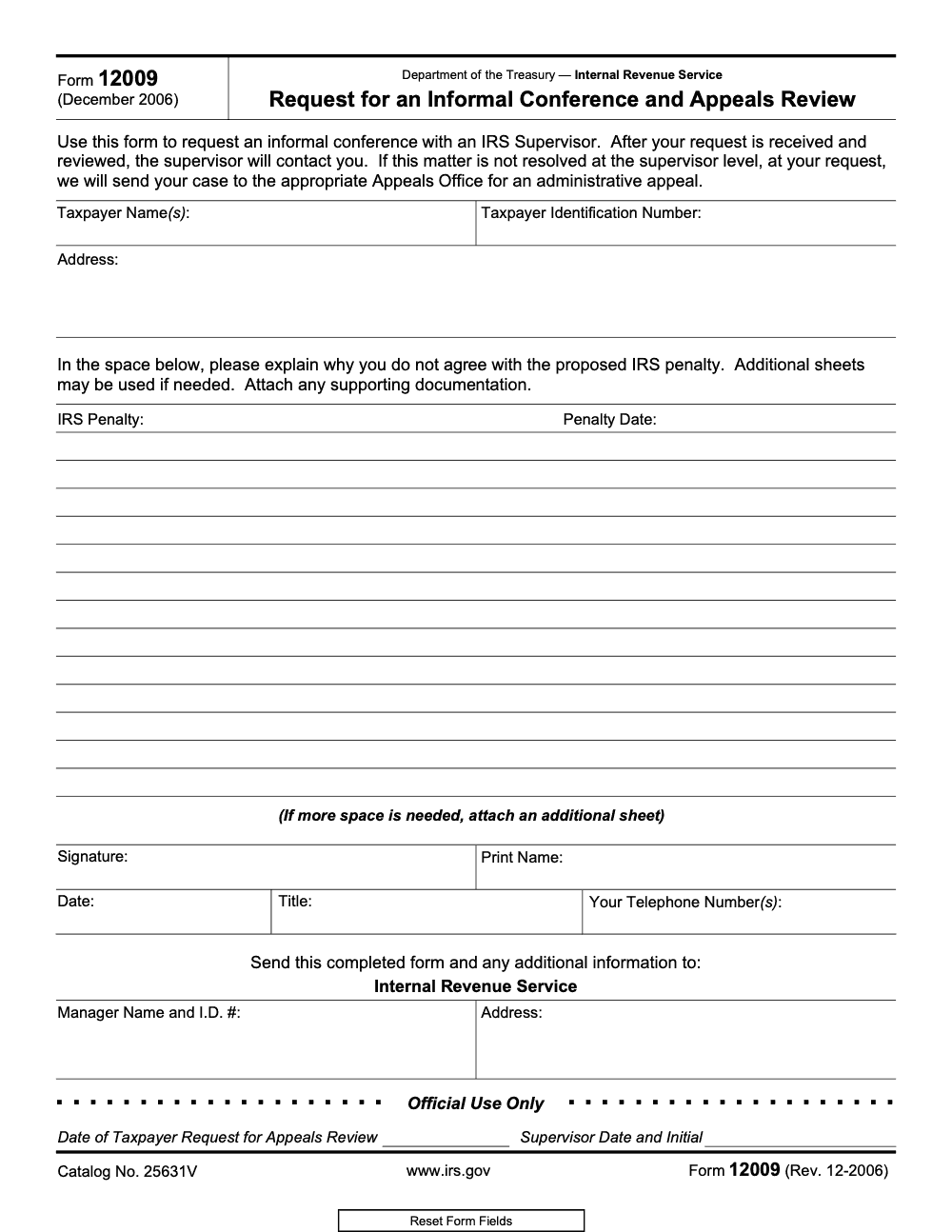
Form 12009 is officially titled “Request for an Informal Conference and Appeals Review.” It’s designed for one core job, requesting an informal conference with an IRS supervisor when you disagree with a proposed IRS penalty.
On the form itself, the IRS explains the flow in plain terms: you request the supervisor conference first, and if it’s not resolved at the supervisor level, the IRS can send the case to Appeals at your request.
What Form 12009 is not
This matters because a lot of people waste time filing the wrong thing.
Form 12009 is not:
- A way to dispute your entire tax return
- A general “IRS complaint form”
- A replacement for formal audit protest procedures
- A collection due process appeal (that’s a different process entirely)
If your notice is about penalty relief generally, the IRS may accept a phone request or a written statement, and in some cases you may use Form 843, Claim for Refund and Request for Abatement, instead.
Do You Need IRS Form 12009? A Fast “Yes or No” Checklist
You’re usually in Form 12009 territory when all of the following are true:
- You received a notice proposing an IRS penalty, and you disagree
- The issue is about the penalty, not a broader audit adjustment
- Your letter points you toward a supervisor review or informal conference
- You can explain your position clearly and back it up with documents
- You can respond within the deadline the letter gives you (often 30 days)
If you are unsure, start here: read the notice instructions first. The IRS’s own penalty relief guidance tells you to follow the instructions in the notice, and it notes that some requests can even be handled over the phone.
About that “30 days” deadline (important)
Many IRS penalty processes use a 30-day response window, but the safest rule is this:
- Use the deadline stated on your notice, and
- Mail early, because you do not want your rights to hinge on a late postmark.
For example, IRS procedures for certain proposed penalties state that the taxpayer must submit Form 12009 within 30 days of receipt of the proposed penalty package. Filing Form 12009 does not extend any other statutory deadline on the underlying notice (such as a formal written protest, CDP hearing, or Tax Court petition), so keep tracking those original dates separately.
What You Must Include With Form 12009 (So It Doesn’t Get Ignored)
Form 12009 is only one page, but the “make or break” part is what you attach and how you present it.
Here’s what the form itself asks you to include:
- Your taxpayer name(s), Taxpayer Identification Number, and address
- An explanation of why you don’t agree with the proposed penalty, you can use extra sheets
- The IRS penalty and penalty date
- Your signature, printed name, title (if relevant), phone number
- The packet goes to the manager name/ID and address shown on the form area, typically aligned with what your notice says
Required taxpayer details (don’t improvise these)
Accuracy starts with identification. Use the exact legal name format the IRS already has on file, and use the TIN shown on the notice.
Include:
- Full legal name (or business legal name)
- SSN, ITIN, or EIN
- Current mailing address
- Daytime phone number you will actually answer
If you’re a firm preparing this for a client, confirm the basics before you write a single sentence of the argument. Incorrect identifiers are one of the easiest ways to create delays you did not need.
How to Write a Clear Dispute Explanation (Without Turning It Into a Novel)
The explanation box on Form 12009 is small on purpose. The IRS is nudging you toward something short and reviewable, not a ten-page story.
A strong dispute explanation has three qualities:
- It ties directly to the notice and the penalty date
- It states exactly what you want (abatement, reduction, correction)
- It points to specific evidence, labeled and attached
A simple structure you can copy
Use this format on the form or on an attached page:
- Notice reference: Notice number and date (from your IRS letter)
- Penalty being disputed: Type of penalty, tax period, amount
- What you want: Full abatement or partial abatement
- Why: A short timeline with dates and facts
- Evidence: “See Exhibit A, Exhibit B…” style references
Here’s a clean “argument map” you can follow:
| Element | What to Provide |
| Notice linkage | IRS notice number and notice date |
| Disputed items | Tax period, penalty type, amount, and what relief you want |
| Facts | 5 to 10 bullet points with dates, names, and amounts |
| Evidence cross-reference | Exhibit labels that match your attachments |
Your goal is to make it easy for a supervisor to say, “Yes, I see it,” not to make them work to understand you.
Common “reasonable cause” themes that actually make sense
I’m not promising any outcome here, but in real-world penalty relief requests, these categories tend to show up:
- Serious illness, hospitalization, or death in the immediate family
- Natural disasters and major disruptions (with documentation)
- Records destroyed, theft, or inability to access critical records
- Reliance on incorrect written IRS advice (rare, but possible)
- Proof you filed or paid, and the IRS record is wrong
If you’re going for First Time Abate, that’s a different kind of argument. It’s less about a dramatic story and more about meeting eligibility criteria, like having a history of compliance for the prior three years and no qualifying penalties in that period.
Supporting Documentation Attachments (This Is Where Most People Win or Lose)
Form 12009 tells the IRS you disagree. Your attachments prove you should win.
At minimum, include:
- A copy of the penalty notice
- A short timeline of what happened
- Documents that support each timeline point
Evidence that tends to help (depending on the issue)
Pick what matches your situation:
- E-file acceptance confirmations
- Certified mail receipts, tracking, or proof of timely mailing
- Bank payment confirmations
- Copies of returns, amended returns, or corrected filings
- Receipts, invoices, and accounting records
- Prior IRS correspondence showing the history of the issue
- If professional reliance is relevant, engagement letters and documented advice
The IRS penalty relief guidance also notes that you should follow notice instructions, and that some requests may be accepted by phone, which means documentation still matters even when the request itself is simple.
Label your exhibits like you mean it
If you want your reviewer to stay with you, label everything.
A clean exhibit system looks like this:
- Exhibit A: IRS Notice (date, notice number)
- Exhibit B: Timeline statement (one page)
- Exhibit C: Filing proof
- Exhibit D: Payment proof
- Exhibit E: Supporting correspondence
Also, name your files the same way if you’re assembling digitally for your internal records, even if you’re mailing paper.
How to Fill Out Form 12009 Step by Step (Fast and Clean)
You don’t need fancy software for this. You need accuracy and a tight packet.
Step 1, Gather the details before you touch the form
Collect:
- Taxpayer name(s) and TIN exactly as shown on the notice
- Current address and daytime phone
- Penalty type and penalty date
- Notice number and tax period
- Your explanation draft
- Your exhibit stack
If you’re doing this for multiple clients (or you’re a firm managing a surge), this is where a checklist saves you. Most teams do not struggle with “knowing tax,” they struggle with delivery: missing documents, messy workpapers, and review loops that eat partner time. That same operational chaos shows up in notice response work too.
Step 2, Complete the form fields
On Form 12009 (Rev. December 2006), fill in:
- Taxpayer name(s)
- Taxpayer identification number
- Address
- Explanation of disagreement (or “See attached statement”)
- IRS penalty and penalty date
- Signature, printed name, title, phone number(s)
Step 3, Sign and date it
The form has a signature line, and you should treat it like any other IRS submission: sign and date it, and keep a copy of exactly what you sent.
Step 4, Mail it to the address provided
Form 12009 includes a “Send this completed form…” section with a manager name/ID and address area. In practice, you should mail it to the address specified by your notice or the manager listed (it does not go to a generic IRS service center or P.O. box – the form is routed to the specific manager identified on the proposed-penalty notice).
Deadlines and When You Don’t Need This Form
The hardest part of IRS deadlines is not the math. It’s the false confidence. People assume they have time, then a week disappears, then another, and now you’re mailing on Day 31 hoping the IRS “understands.”
Here’s the clean rule:
- Follow the deadline on your notice.
- If your letter references a supervisor conference and points you to Form 12009, treat it as urgent.
Some IRS procedures explicitly reference a 30-day submission window for Form 12009 in certain penalty contexts. The IRS’s broader penalty relief guidance also says to follow the instructions in the notice and notes that some requests can be accepted by phone or by written request, including Form 843 in some cases.
Situations where Form 12009 may not be the right tool
You may not need Form 12009 if:
- The notice tells you to call a number and resolve it directly (and the IRS accepts your request by phone)
- You’re filing a different type of request, such as Form 843 for abatement, depending on the penalty and stage
- You are dealing with a collections appeal process instead of a penalty proposal (different procedures)
If you’re not sure, do not guess. Use the notice instructions and, when appropriate, talk to a qualified tax professional.
Note: This article is for general information, not legal or tax advice. IRS facts can change by notice type, penalty type, and the stage of the case.
Where to Get Form 12009 (Official PDF)
The official IRS PDF is titled Form 12009 (Rev. 12-2006), and it’s a one-page form.
If you’re searching online, make sure you’re working from the real IRS form and not a third-party rewrite. The form itself tells you exactly what it’s for and what happens next, supervisor conference first, Appeals review if not resolved.
What Happens After You File, Supervisor Conference and Appeals
Once your Form 12009 request is received and reviewed, the IRS states that the supervisor will contact you (filing the form does not automatically schedule a conference – the supervisor initiates contact after reviewing what you submitted).
Think of the supervisor conference like a structured second look. It’s not a courtroom scene. It’s an administrative review where your clarity and documentation matter.
What to expect in the informal conference
You should be ready to:
- Restate the issue in 60 seconds
- Walk through your timeline
- Point to exhibits without shuffling papers
- Ask directly for the relief you want (full or partial)
If you’re working with a representative, keep your notes tight and consistent. Mixed messages are a common reason these conversations drag.
If you don’t agree with the supervisor’s outcome
Form 12009 explains that if the issue is not resolved at the supervisor level, at your request the IRS can send your case to the appropriate Appeals Office for an administrative appeal (Form 12009 supplements rather than replaces that formal process – once the case reaches Appeals, the standard written-protest or Small Case Request rules for the underlying dispute may still apply).
Appeals is designed to be a fresh review process. Timelines can vary widely depending on backlog, issue type, and what documentation you provide, so plan for it to take time.
A “Firm-Level” Note on Delivery (and Why It Matters Here)
If you’re a CPA firm, EA firm, or accounting practice handling penalty notices at scale, this kind of work can quietly wreck your week. It looks small, but it’s documentation-heavy, deadline-driven, and full of review traps.
This is exactly the kind of workflow where firms hit a ceiling: partner review loops, missing support, inconsistent naming, and last-minute scrambles. That’s not a tax knowledge problem, it’s a capacity and review problem – trained offshore preparers and layered review, placed inside your firm, clear it before your name is on the line.
At Accountably, we see the same pattern across bookkeeping, CAS, and tax compliance work. When your team has SOPs, clean workpapers, clear review steps, and tracking, you stop bleeding time and you stop missing deadlines. That operational discipline translates to notice response work too, even when the form is only one page.
Conclusion
Form 12009 is not complicated, but the situation around it usually is. You’re dealing with deadlines, stress, and paperwork that never shows up at a convenient time.
If you want the best shot at a clean review:
- Tie your request to the exact notice and penalty date
- Give a short timeline
- Attach labeled proof
- Mail early, keep copies, and track delivery
And if you’re a firm handling these requests alongside peak-season workload, treat notice response work like any other delivery system, checklists, naming standards, review steps, and clear ownership. That’s how you keep quality high without burning out your team.
Common Mistakes We See Every Season
We see the same pattern across penalty disputes every season. The form is one page, the rules sit on the page itself, and people still trip on details that decide whether a supervisor takes the request seriously.
Reusable Checklists
These are copy-paste ready for firm SOPs and personal filing folders. They follow the order we run inside our shop for a Form 12009 packet.
Form 12009 pre-mail packet
- Pull the proposed-penalty notice and save it to the engagement file.
- Copy the manager name, I.D. number, and address from the notice into the Form 12009 mailing block.
- Enter taxpayer name(s), Taxpayer Identification Number, and address verbatim from the notice.
- Identify the specific IRS penalty being contested and the penalty date in the labelled blocks.
- Draft the disagreement explanation in the form block; attach additional sheets if it does not fit.
- Attach the IRS notice, prior correspondence, and supporting records.
- Sign, print name, date, enter title, and add a working telephone number.
- Leave the Official Use Only footer blank – that section is reserved for IRS staff.
- Mail certified with return receipt and store the green card in the file.
Disagreement explanation quality check
- State the penalty type and the penalty date in the first sentence.
- Lead with the factual or legal basis for disagreement, not the emotional one.
- Reference reasonable-cause facts (illness, records destroyed, reliance on a professional) where they apply.
- Tie every assertion to a specific document in the attachment set.
- Keep it to one additional sheet where possible.
- Avoid arguments about underlying tax liability – this form is only for the proposed penalty.
- Close with the specific relief requested (full abatement, partial abatement, recalculation).
Post-mail monitoring
- Calendar the underlying notice's statutory deadlines (formal protest, CDP, Tax Court) on a separate diary from the Form 12009 file.
- Follow up with the named IRS manager 30 days after mailing if no contact has been received.
- Log every supervisor contact, including date and outcome, in the engagement file.
- If unresolved, prepare a written request to forward the case to the IRS Office of Appeals.
- If the proposed penalty is dropped, request written confirmation for the file.
Keep 12009 Season From Stalling
Penalty correspondence does not cluster on one date the way 1040 or 941 work does – it lands year-round and especially after CP notice cycles, which means a practice that runs cleanly through compliance season can still bottleneck on Form 12009 packets when notices stack up. The catch is the supervisor-level review window: the form is only useful while the penalty is still proposed, so a packet that sits in the queue past the underlying notice date loses its leverage.
The fix is treating penalty correspondence as its own workflow, not as overflow from compliance work. The form itself is one page (catalog 25631V per IRS.gov), but the supporting documentation packet is where engagement hours actually go.
- Triage every incoming IRS notice within 48 hours to confirm the penalty is proposed (Form 12009 territory) versus assessed (different track entirely).
- Standardize the copy of the manager name, I.D., and address from the notice into the form's mailing block – wrong address is the most common reason a packet stalls.
- Pre-build supporting-documentation templates by penalty type (failure to file, failure to deposit, accuracy-related) so the explanation block lines up with the evidence in the packet.
- Track the underlying notice's statutory deadlines on a separate calendar from the Form 12009 follow-up, because filing the form does not extend any of them.
- Log every supervisor contact and outcome in a single client file so that escalation to the IRS Office of Appeals, when the taxpayer requests it, starts from a complete record.
This is the kind of structured penalty workflow we package inside our offshore tax delivery service – packet preparation, manager-address routing, and follow-up diary handled inside your engagement system, with senior review before anything is mailed.
FAQs
Form 12009 is used to request an informal conference with an IRS supervisor when you disagree with a proposed IRS penalty. If the matter is not resolved at the supervisor level, the IRS can send the case to Appeals for an administrative appeal at your request.
Often, yes, but you should treat the notice instructions as the final word. Some IRS procedures require Form 12009 within 30 days in specific penalty situations, and the IRS also tells taxpayers to follow the instructions in the notice for penalty relief requests.
Sometimes. The IRS notes that certain penalty relief requests may be accepted over the phone, and if you do not call, you may send a written statement or use Form 843 depending on the situation.
The IRS recognizes multiple paths, but two common ones are First Time Abate (based on a history of compliance) and reasonable cause (based on facts and circumstances). The IRS spells out First Time Abate eligibility factors like filing compliance for the prior three years and no penalties in that period (with specific exceptions).
Keep it short and structured. Tie it to the notice, list the penalty and period, give a dated timeline, and cite labeled exhibits that prove your point. Form 12009 itself invites you to attach supporting documentation and add sheets if needed, so use that space wisely.
No. A Form W-9 is used to provide a taxpayer identification number to a payer, usually for reporting payments on a 1099. It’s unrelated to disputing an IRS penalty and it does not support a Form 12009 request.
Other forms this guide names
- Form W-9: Guide & Instructions
About this guide
Accountably helps US CPA, EA, and accounting firms hire trained accountants and tax preparers in India.
About us Reviewed byJugal Thacker, CPAFounder and CEO at Accountably
A Washington-licensed CPA with 7+ years inside US firms – PwC, a real-estate tax practice, then a full-service firm, rising from reviewer to manager to advisory. This article was reviewed against current IRS guidance for the 2025 tax year and updated for filers preparing late returns, amendments, and 2026 estimates.
View profile →How we research, review, and update this guide
Every Accountably guide is researched against primary IRS sources, reviewed by a U.S. CPA, and refreshed as guidance evolves. Read our Editorial Guidelines to see how we source, fact-check, and update our content.