Summarize this article with AI
In Brief
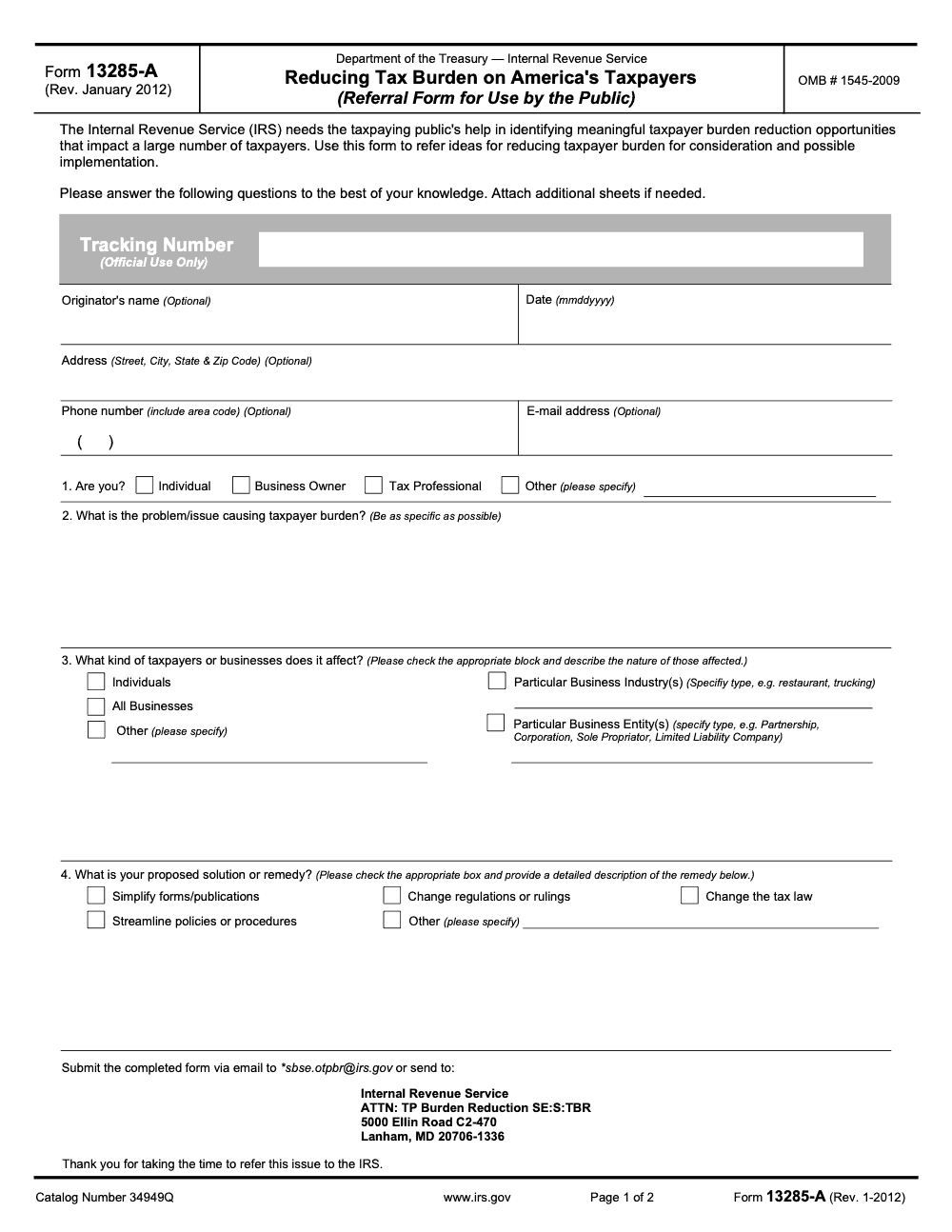
Form 13285-A is the IRS public referral form – titled Reducing Tax Burden on America's Taxpayers – used to propose changes that save time or money for a large group of filers. It is voluntary, carries no fee, has no filing deadline, takes about 15 minutes per the Paperwork Reduction Act notice on the form, and goes to *sbse.otpbr@irs.gov (Catalog Number 34949Q, OMB 1545-2009, per the official IRS PDF, Rev. January 2012).
Most filers never learn that the IRS keeps an open inbox for ideas that would make a form less painful to fill out. That inbox is Form 13285-A, titled Reducing Tax Burden on America's Taxpayers, and it costs nothing to use, carries no deadline, and runs about 15 minutes to complete per the notice printed on the form itself.
The catch is that a good idea written casually rarely survives the SB/SE triage desk. Reviewers want a specific change, an estimate of how many people it would help, and the right identifiers attached, which is why it helps to verify Catalog Number 34949Q and OMB Control No. 1545-2009 before you send anything internally.
Key Takeaways
- Use Form 13285-A to propose a specific change that reduces taxpayer compliance burden for a meaningful number of people, then email it to the IRS at the address shown on the form.
- The official PDF shows the identifiers you should check, including Catalog Number 34949Q and OMB Control No. 1545‑2009.
- The collection is active under the Paperwork Reduction Act. A 2022 OMB approval shows an expiration of September 30, 2025, and in September 2025 the IRS again sought an extension without change.
- Confidentiality follows 26 U.S.C. § 6103, a federal law that limits the disclosure of returns and return information.
- IRS guidance pages confirm what to include and where to send it, plus general instructions for each line.
What Form 13285-A is, and why you should care
Form 13285-A, Reducing Tax Burden on America’s Taxpayers, is a public referral form that lets you propose a change that saves time, money, or rework for a large population of taxpayers (it is not a tax return, a refund claim, a Taxpayer Advocate complaint, or a way to dispute an IRS notice). The IRS hosts the official PDF and gives plain‑English line guidance and the correct email submission address. If your idea only applies to a single notice or an isolated account issue, the IRS asks you to use the standard help lines instead (Form 13285-A is for systemic ideas affecting a large number of taxpayers – it is not a substitute for the Taxpayer Advocate Service Form 911 or for individual penalty-abatement requests).
Think of this form as your way to put a clean business case in front of the agency. You explain the problem, who it affects, and the fix that would remove steps, clarify instructions, or unify workflows. The IRS evaluates ideas based on reach, total time saved, feasibility, and alignment with agency goals.
Who should use it
Use Form 13285-A if you are a taxpayer, a practitioner, a software developer, or an industry group that can point to a measurable change and a clear savings across many filers. IRS pages explicitly invite the public to send ideas that help a significant number of taxpayers, and they explain where to email the completed form.
When this form is not the right route
- Individual notice or account questions, use IRS telephone assistance or the contact on your notice.
- Systemic advocacy issues that need the Taxpayer Advocate Service, consider Form 14411 instead, as noted in the Internal Revenue Manual.
Legal footing and privacy, in plain language
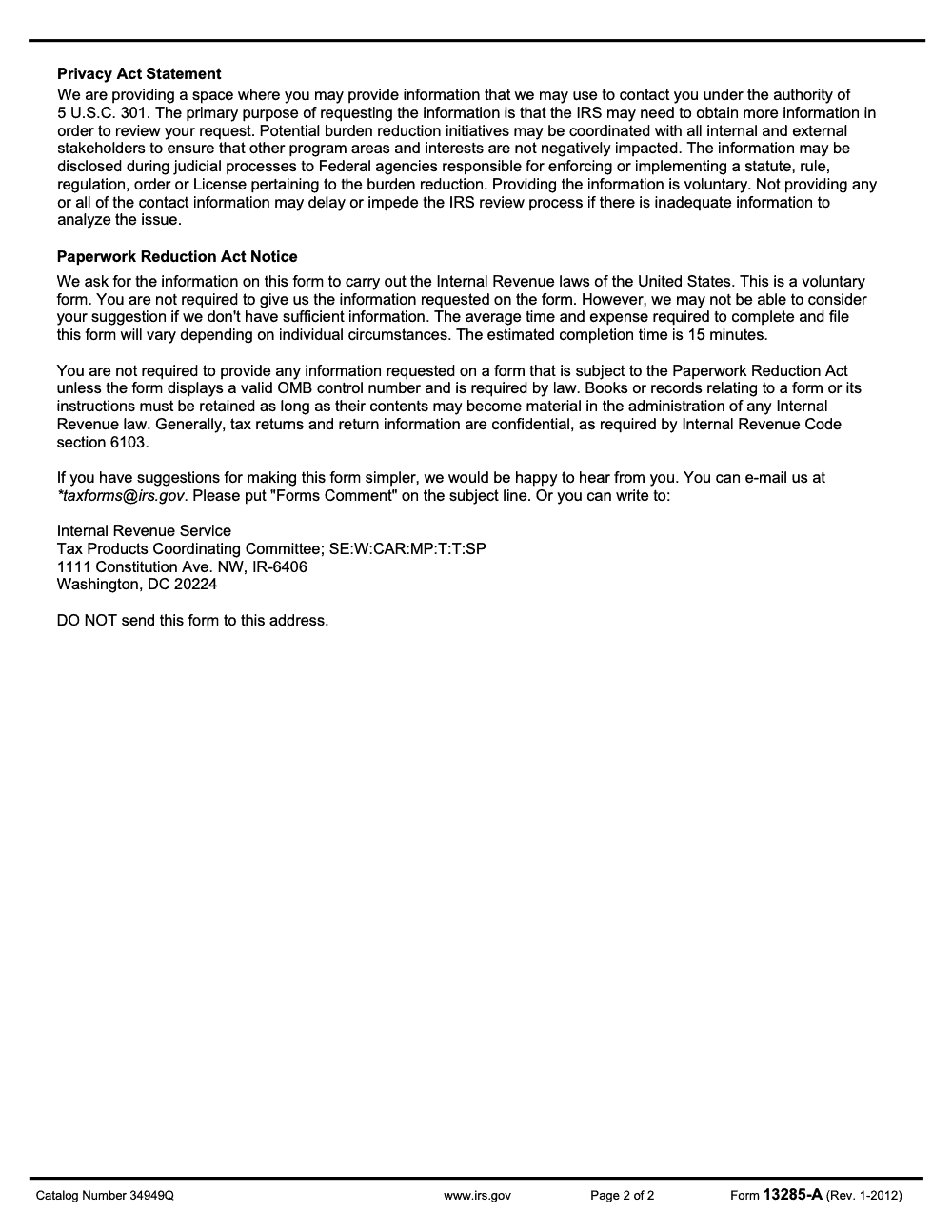
Your submission sits under two guardrails. First, the Paperwork Reduction Act, which requires the form to display a valid OMB control number. You will see OMB No. 1545‑2009 on the form itself. Second, 26 U.S.C. § 6103 governs confidentiality and disclosure of returns and return information. The IRS cites this rule on the form, and the statute limits how your information can be shared.
For extra assurance on status, the OMB docket shows an approval on September 19, 2022 with an expiration of September 30, 2025. In September 2025, Treasury again requested an extension without change for this very collection, titled Reducing Tax Burden on America’s Taxpayers.
Where to get the form and how to send it
- Download the official two‑page PDF, which includes the PRA notice and privacy statement, along with the correct government email and mailing address.
- The IRS help page provides concise line guidance and the same email destination. Keep your write‑up specific and quantify impact.
Quick reference, the essentials
| Item | What to check | Source |
| Official title | Form 13285-A, Reducing Tax Burden on America’s Taxpayers | |
| Catalog number | 34949Q | |
| OMB control number | 1545-2009, active under PRA | |
| Estimated completion time | 15 minutes | |
| Where to send | sbse.otpbr@irs.gov, per IRS page and form | |
| Privacy law | 26 U.S.C. § 6103 | ( |
Note, the Internal Revenue Manual identifies the program and references Form 13285‑A as the external route for taxpayers and stakeholders, which helps you confirm you are on the right path.
Why this matters for delivery, not just compliance
If you run a CPA or EA firm, you live the costs of unclear instructions and inconsistent workflows. A small form change or an explicit definition can save minutes per return, which adds up across a tax season. From a delivery perspective, this is how you unlock review time, reduce rework, and protect deadlines. That is the whole point of the IRS asking for ideas that reach a large audience.
Brief note, Accountably works with firms that want disciplined delivery. We care about this form because strong SOPs and clean workpapers make your proposals sharper and easier to evaluate. Use it when your team spots a recurring snag that a simple IRS fix could remove at scale.
How to fill IRS Form 13285-A, step by step
You only have four lines to make your case. Keep it tight, specific, and measurable.
- Line 1, who you are Check individual, business owner, tax professional, or other, and include contact info if you want a reply (every contact field is explicitly optional, so anonymous submission is permitted, though leaving them blank can delay follow-up if the IRS needs clarification).
- Line 2, the problem causing burden Write one to three sentences that describe the exact friction. Name the form, notice, instruction, or system screen, and the exact step that burns time or money. The IRS asks for specificity so they can scope the affected population.
- Line 3, who is affected Call out the taxpayer type and size. For example, all Schedule C filers with home office, or multi‑state S‑corps filing composite returns. The IRS examples show the level of detail they want.
- Line 4, the proposed solution Pick the right bucket, simplify instructions, change a regulation or ruling, change the tax law, streamline a policy or procedure, or other. Then write a clear remedy and estimate the time saved per taxpayer and in total. The form itself prompts these categories.
A simple structure you can copy
- Problem, name the form or process and the exact step.
- Scope, quantify who is affected and how often.
- Burden, estimate minutes, clicks, pages, or errors avoided.
- Fix, state the change in one sentence.
- Impact, show the time saved per filer and in total.
Aim for specific and measurable. The IRS page stresses being as specific as possible, because vague claims are hard to evaluate.
Example you can adapt
- Problem, Schedule K‑1 capital account formatting differs between e‑file and PDF outputs, reviewers need to chase missing fields, which adds three minutes per partner per return.
- Scope, impacts partnerships with more than five partners, roughly 600,000 filings.
- Burden, an estimated three minutes per partner, which compounds in review.
- Fix, unify the field order and naming between e‑file schema and PDF instructions, add one explicit example covering negative capital and prior‑year reclass.
- Impact, three minutes saved per partner per year, which could yield large system‑wide time savings.
What the IRS considers when they triage ideas
The IRS says it prioritizes by the number of taxpayers impacted, total time saved, feasibility, and how the idea aligns with its objectives (the agency commits to consider submissions and possibly implement them after stakeholder coordination, not to adopt or formally respond to every idea). That is why your counts and time estimates matter more than generic complaints.
How to quantify “time saved” credibly
- Use your firm’s stopwatch data or review logs.
- Multiply minutes by the number of affected returns your firm touched this season.
- Extrapolate cautiously to national counts, show your math so the IRS can refine it.
- Cite pain drivers like extra attachments, ambiguous definitions, duplicate entry, or missing cross‑references.
Submission and status checks
- Email the completed PDF to the address shown on the form. You can also mail it to the mailing address printed on page 1, though email is faster (do not send the completed form to the Tax Products Coordinating Committee address in Washington, DC that also appears on the form – that address is only for suggestions about simplifying the form itself).
- Keep a copy of your submission. The PDF includes the PRA notice and privacy statement, plus the estimated completion time of 15 minutes, which you may reference in your records.
- If you present at IRS education or outreach events, staff may collect these forms there, which is specifically contemplated by the program.
Compliance and identifiers to verify before you share the form internally
- OMB number, confirm the PDF shows OMB No. 1545‑2009. The PRA says collections need a valid OMB number to be used.
- Current approval, OIRA lists 1545‑2009 with an approval on September 19, 2022 and an expiration of September 30, 2025. In September 2025 the IRS sought an extension without change, which signals continuity.
- Privacy, confirm the form references 26 U.S.C. § 6103. That law restricts disclosure of return information and is enforced across IRS systems.
Quick field map
| Form section | What to write | Review tip |
| Line 1, Your role | Individual, business owner, tax pro, or other | Include email if you want follow up. |
| Line 2, Problem | Name the form, step, or instruction and the exact friction | Keep it to 1–3 sentences rooted in facts. |
| Line 3, Affected taxpayers | Describe the population in plain terms | Use counts or percentages if you have them. |
| Line 4, Solution | Pick a category and write the fix, then estimate time saved | Tie each fix to minutes saved and error reduction. |
Small note on program ownership. The Internal Revenue Manual section on Servicewide Burden Reduction confirms Form 13285‑A as the public channel and points employees to a separate internal form. This helps you steer your idea to the right place.
Disclosure, this article uses public IRS and OMB sources and is informational. It is not tax, legal, or compliance advice for your specific situation.
Common mistakes, and how to avoid them
Most botched 13285-A submissions are not wrong on the facts – they go to the wrong inbox, skip the math that makes the case, or describe a problem the form was never built to handle. The same pattern shows up every season.
A lightweight checklist you can paste into your SOP
- State the problem in one sentence, with the exact form, line, or instruction.
- Define who is affected and how often.
- Estimate minutes saved per return and in total.
- Choose the correct solution category on Line 4.
- Attach a one‑page appendix with examples or screenshots, if helpful.
- Send to the IRS email shown on the PDF and save a copy.
When to route ideas elsewhere
- Statutory changes – Form 13285-A's Line 4 includes a "Change the tax law" bucket, so a tax-law-change proposal is an appropriate use of this form. For direct legislative advocacy, also contact your congressional representatives, since only Congress can enact the statute.
- Advocacy issues, use the Taxpayer Advocate Service systemic submission, Form 14411.
How Accountably fits, only where it helps
You do not need a consultant to submit Form 13285‑A. That said, firms that already operate with disciplined SOPs and standardized workpapers write stronger, more credible proposals. Our team at Accountably helps firms build that discipline, which often reveals the exact burden drivers to include on the form, for example inconsistent naming, unclear review notes, or duplicate data entry. Use us when you want your internal documentation to double as evidence for reforms that save time across thousands of filings.
Reusable Checklists
These checklists are copy-paste ready for the firm SOP – use them before drafting a submission, while filling the form, and after the PDF goes out the door.
Pre-submission scoping checklist
- Confirm the burden is systemic, not a single notice or refund hold.
- Name the exact form, schedule, instruction page, or system screen creating the friction.
- Pull stopwatch or review-log data for minutes lost per return.
- Estimate the affected population (filings per season, taxpayer type, industry if relevant).
- Pick the right Line 4 bucket: simplify forms/publications, change regulations or rulings, change the tax law, streamline policies or procedures, or other.
- Check that the fix maps to one of the five Line 4 buckets the form actually lists, including "change the tax law" if the proposal requires statutory amendment.
- Decide whether contact info goes in (every originator field is optional per the form).
Form completion review checklist
- Line 1 (Are you?) checked: Individual, Business Owner, Tax Professional, or Other.
- Line 2 problem written in one to three plain sentences, naming the form and step.
- Line 3 affected-taxpayer category checked, with industry or entity examples noted if relevant.
- Line 4 solution category checked, with the proposed remedy in one sentence.
- Time-saved math attached: minutes per return, returns per season, hours saved annually.
- Tracking Number field left blank (it is Official Use Only).
- OMB No. 1545-2009 and Catalog Number 34949Q visible on the PDF being sent.
- Date field filled in mm/dd/yyyy format per the form instruction.
Post-submission firm log checklist
- Save a PDF copy of the completed form in the firm's internal log.
- Record the submission date and the destination used (*sbse.otpbr@irs.gov, or the Lanham, MD mailing address).
- Add a note that the IRS does not commit to a formal response per the form's stated process.
- Set a 12-month review reminder to check whether the named form or instruction has changed.
- If the same friction repeats next season, link the new submission back to the prior log entry.
- Share the writeup internally so staff reuse the time-saved math format on future submissions.
Keep 13285-A Season From Stalling
Form 13285-A has no statutory deadline, which is exactly why it gets buried. Firms see the friction during the March-April crush, promise to write it up afterward, and then April 16 hits and the reviewer notes never become a submission. The Paperwork Reduction Act notice on the form estimates about 15 minutes per response, but the real work is the firm-side discipline of capturing the burden as it happens, not from memory in July.
The fix is not effort, it is workflow. The submissions that get traction at the SB/SE Taxpayer Burden Reduction desk are the ones backed by clean stopwatch data, a named population count, and a one-sentence remedy mapped to a Line 4 category. None of that survives if it is reconstructed three months later, so the win is logging it the same week the reviewer flagged it.
- Add one line to the firm's review-note template: "Burden-reduction candidate? Y/N, with one sentence on the friction and minutes lost." Staff fills it during review, not after.
- Tag the candidate notes by Line 4 category (simplify forms/publications, change regulations or rulings, change the tax law, streamline policies or procedures, or other) so they map straight to the form's checkboxes when the writeup happens.
- Set one calendar block per quarter to convert tagged notes into a 13285-A submission, with an owner assigned. Quarterly cadence matches the IRS posture that the form is open year-round.
- Keep the population and time-saved math in the firm's KPI dashboard, not a stray Word doc. Numbers stale slowly, and that is what reviewers at the SB/SE desk read first.
- Save the submitted PDF with the OMB 1545-2009 stamp and submission date in the same folder as the source review notes, so future seasons build on the prior writeup instead of restarting it.
That is the kind of delivery discipline our team at Accountably builds into firm SOPs and workpaper templates – the same discipline that makes tax execution reproducible across seasons also turns offhand reviewer complaints into IRS-credible burden-reduction proposals.
FAQs
Yes. The OMB docket shows 1545‑2009 approved in 2022 with an expiration of September 30, 2025, and Treasury sought an extension without change in late September 2025. Always work from the official IRS PDF that displays OMB No. 1545‑2009 (still the January 2012 revision – the form has not been re-issued, so a 'Rev. 1-2012' footer is correct for 2025).
The form’s Paperwork Reduction Act notice estimates about 15 minutes per response, though your time will vary with the detail you provide.
Ideas should help a significant number of taxpayers. If impact is narrow, you can still submit, but show a clear case and consider whether another channel is better for niche fixes.
Email it to the address on the IRS page and the PDF. The same page includes general line instructions and notes for individual account issues.
Including contact details is optional. If the IRS needs more information to review your proposal, they may reach out using the details you provide. The privacy statement and § 6103 rules apply.
Yes. Employees use Form 13285 internally. Form 13285‑A is the public version for taxpayers and stakeholders.
Other forms this guide names
- Form 14411: Systemic Advocacy Issue Submission Guide 2026
About this guide
Accountably helps US CPA, EA, and accounting firms hire trained accountants and tax preparers in India.
About us Reviewed byJugal Thacker, CPAFounder and CEO at Accountably
A Washington-licensed CPA with 7+ years inside US firms – PwC, a real-estate tax practice, then a full-service firm, rising from reviewer to manager to advisory. This article was reviewed against current IRS guidance for the 2025 tax year and updated for filers preparing late returns, amendments, and 2026 estimates.
View profile →How we research, review, and update this guide
Every Accountably guide is researched against primary IRS sources, reviewed by a U.S. CPA, and refreshed as guidance evolves. Read our Editorial Guidelines to see how we source, fact-check, and update our content.