Summarize this article with AI
In Brief
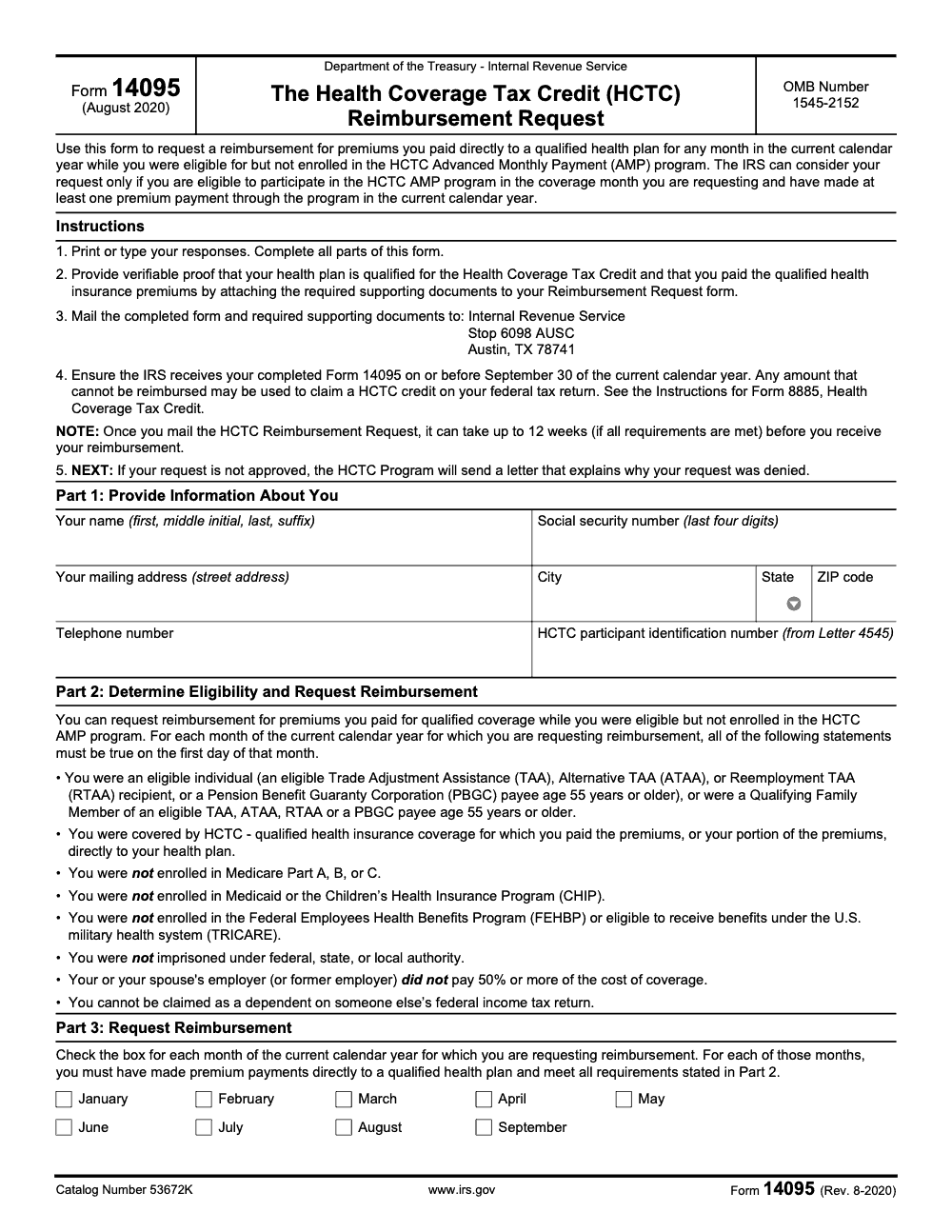
Form 14095 is the HCTC Reimbursement Request – the IRS uses it to refund 72.5% of qualified health insurance premiums paid directly to a qualified health plan by TAA, ATAA, and RTAA recipients and PBGC payees age 55 or older (per IRS Form 14095, Rev. August 2020). The underlying Health Coverage Tax Credit expired December 31, 2021 under the Taxpayer Certainty and Disaster Tax Relief Act of 2019, so for tax year 2025 no new HCTC reimbursement is payable; any remaining current-calendar-year request must reach the IRS HCTC unit at Stop 6098 AUSC, Austin, TX 78741 by September 30 (receipt date, not postmark), and prior-year amounts move to Form 8885 on the federal return for that year.
Almost every Form 14095 packet that still arrives is cleanup. A retiree on a PBGC-supervised pension paid health premiums directly while eligible for the Health Coverage Tax Credit, missed the advance monthly enrollment, and only later learned the IRS could have refunded part of those payments. The proof folder is half-built and the timing rules feel slower than they should.
The math itself is fixed: reimbursement runs at 72.5% of eligible, self-paid premiums, and every month you claim has to match insurance details and proof of payment. Just remember the program is closed. The credit expired December 31, 2021, so for 2022 and later there is no new HCTC claim to file and no HCTC entries to expect on today's Schedule 3.
Key Takeaways
- Form 14095 is the HCTC Reimbursement Request used to claim back a portion of qualified premiums you paid while you were eligible for, but not yet enrolled in, advance monthly HCTC. The latest IRS revision on file is August 2020, with OMB control number 1545‑2152.
- The form calculates reimbursement at 72.5% of your eligible, self‑paid premiums, and it requires proof of payment plus insurance details that match the months you claim.
- There was a program processing cutoff of September 30 each year for reimbursement requests, with some amounts otherwise handled on your return using Form 8885. For 2021 cleanup, review IRS instructions carefully.
- For 2022 and later, the HCTC has expired. Do not expect HCTC entries on today’s Schedule 3, and do not file new HCTC claims for post‑2021 months.
What Form 14095 Is, and When It Still Matters
Form 14095 is a two‑page IRS form titled “The Health Coverage Tax Credit Reimbursement Request.” You used it to get reimbursed for months when you were eligible for HCTC but had not yet started the advance monthly payment program. The IRS’s August 2020 revision remains the last posted version and shows the governing OMB control number 1545‑2152 on the face of the form.
Why it still matters in 2025. Although the HCTC ended after 2021, firms and taxpayers sometimes need to document old reimbursements, respond to correspondence, or reconstruct a file for a prior‑year claim. In those cases, you must mirror the official instructions, the documentation standards, and the math that appear on the form. You also need to recognize that the IRS has formally told filers that HCTC does not apply to tax years beginning after 2021. The agency even notes that Schedule 3 references to HCTC should be disregarded now.
How Reimbursement Worked, In Plain English
Here is the simple version of the process that applied while HCTC was active, and that still governs any historical cleanups for 2021:
- You checked boxes for each eligible month in the current calendar year while you waited for your advance payments to start.
- You added up only the qualified health premium amounts you actually paid, then multiplied the eligible portion by 72.5% to arrive at your reimbursement request.
- You attached two types of documents for each month you claimed, proof of coverage and proof of payment, and you made sure names, dates, and amounts matched the form exactly.
- You mailed the packet to the Austin, Texas address shown on the form, and you aimed to have it received by September 30 for that processing year. Any remaining credit could be handled on your federal return using Form 8885, subject to the year’s rules.
Pro tip, treat the form like a mini attestation. Every number and date must be traceable to a bill or bank record. Per IRS guidance, the signature certifies accuracy under penalties of perjury, so keep a full copy of what you submit.
Who Qualified Back Then
HCTC focused on a specific group. You or your qualifying family member generally needed to be a TAA, ATAA, or RTAA recipient, or a PBGC payee age 55 or older, and you needed qualified health coverage that you paid directly. The form also listed reasons you could not claim, such as Medicare enrollment, or a current or former employer (including a former employer providing COBRA subsidies) paying half or more of the premium. If you are rebuilding a 2021 file, verify these conditions month by month in your documentation.
A Quick Note On Today’s Reality
As of April 28, 2025, the IRS page about HCTC says the credit expired after 2021 and tells filers to ignore lingering references to it in other instructions. That is the current official position. If you see older tooltips or prefilled software entries, do not use them for 2022 and beyond.
In my experience, confusion usually comes from mixing rules across years. Anchor your work to concrete dates. If the month you are documenting falls in 2021 and you met eligibility, follow the August 2020 Form 14095 instructions and keep your proof tight. If the month is in 2022 or later, stop, because HCTC no longer applies.
Step‑By‑Step, How To Complete Form 14095 For A 2021 Cleanup
The IRS form is short, which tempts people to rush. Slow down and you will save weeks. Use this walk‑through while looking at the August 2020 PDF.
Part 1, Your Details
- Enter your legal name, mailing address, and a good phone number.
- Use the last four digits of your SSN where the form asks.
- Add your HCTC Participant Identification Number if you have Letter 4545 handy.
Accuracy matters here because the IRS matches your ID information to your HCTC record. Typos create avoidable letters and delays.
Part 2, Eligibility Statements
Read each rule as if you are the reviewer. Confirm that on the first day of each month claimed, you met the HCTC criteria in the form, for example you were a TAA or PBGC payee with qualified coverage, and you were not on Medicare. Make notes on a sticky if needed. Those notes will guide your exhibit list.
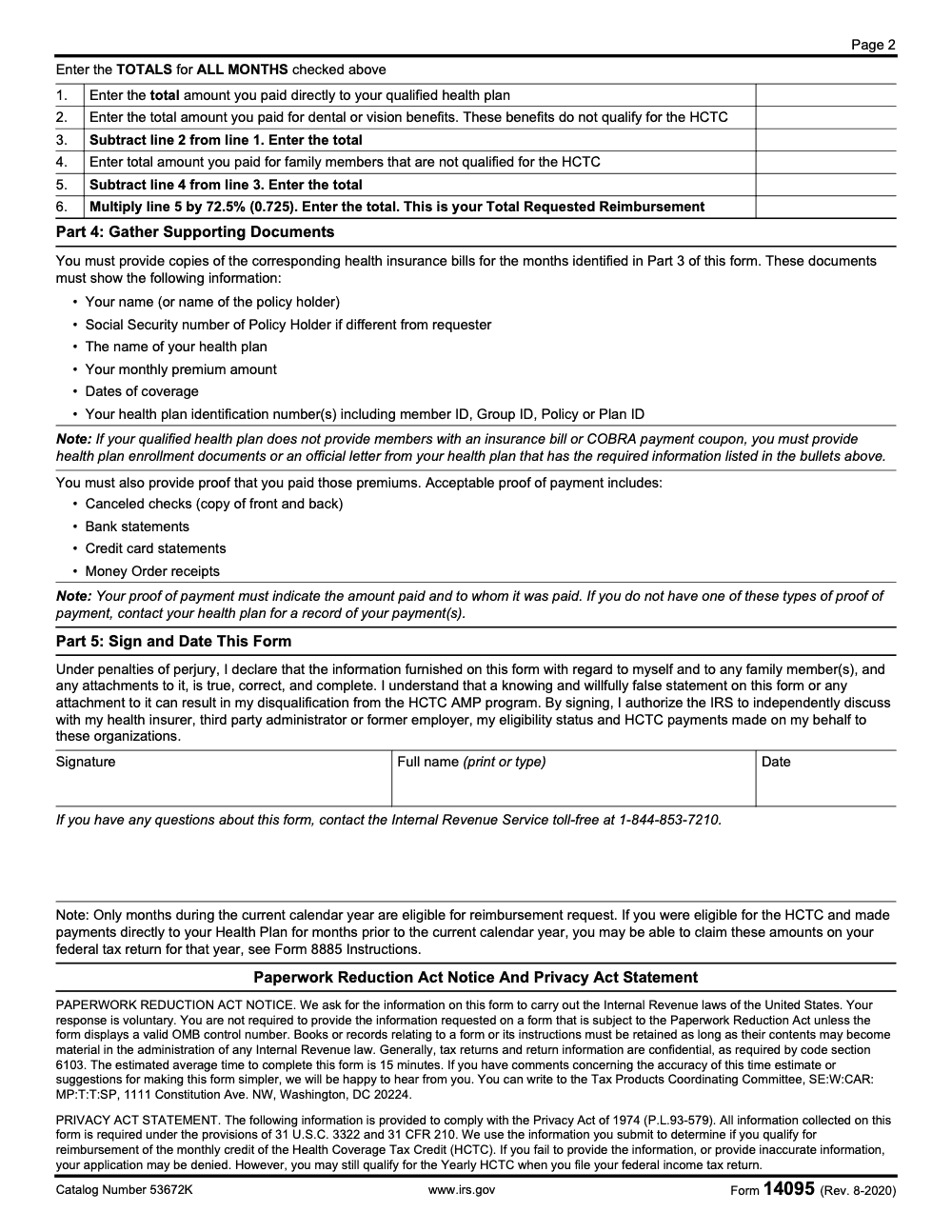
Part 3, The Math
- Check the boxes for each month you are requesting.
- Total only the qualified health plan premiums you paid for those months, then remove dental or vision amounts that are not eligible.
- Exclude any portion paid for family members who did not qualify.
- Multiply the final eligible number by 72.5% to calculate your requested reimbursement.
I like to staple a small calculator tape or a one‑line worksheet behind this page. Reviewers appreciate seeing how you got to the number.
Part 4, Supporting Documents
You must include both proof of coverage and proof of payment for every month you checked. Build a clean packet that layers these items month by month.
- Coverage proof, insurance bill or enrollment letter that shows your name, plan name, monthly premium, coverage dates, and plan ID.
- Payment proof, bank statements, canceled checks (front and back), credit card statements, or money order receipts that show the amount and payee. These are the only four acceptable types; cash receipts and self-prepared payment logs are not accepted, and if you do not have any of the four, request a payment record directly from your health plan.
Label each page with your name and the last four of your SSN. Keep the printouts legible. If a statement covers multiple months, highlight the exact transactions.
Documentation Checklist You Can Copy
| Item | Must Show | Common Misses |
| Insurance bill or enrollment letter | Name, plan name, monthly premium, coverage dates, plan ID | Missing coverage dates or plan ID |
| Proof of payment | Amount paid and to whom it was paid | Payee name cut off, amount not visible |
| Month labels | Each month requested clearly identified | Mixing months on one page with no highlights |
| ID matching | Name and last four SSN on every page | Pages missing ID label |
All four elements matter. The IRS uses them to tie the month, the plan, and the money together. If anything is unclear, expect a letter asking for more information, which slows everything down. The IRS IRM even includes letter templates for insufficient documentation and denials, so meet the bar up front.
Part 5, Signature
Sign and date under the penalties of perjury declaration. Use the same name as Part 1. If you are sending a scanned signature, make it dark and readable. Unsigned forms are routinely flagged and trigger a document request.
Where To Send It, And Timing
Mail the reimbursement request to the Austin, Texas address printed on the form (Form 14095 cannot be e-filed and is not attached to Form 1040; it must be paper-mailed separately). Historically, the IRS advised that the packet should be received by September 30 of the processing year. Plan around that date when reconstructing a 2021 claim. The form also noted that remaining credit could be reconciled on your return using Form 8885.
Keep a full copy of the entire packet, including envelopes and tracking. If a follow‑up letter arrives, you will be able to respond in minutes instead of days.
Avoidable Reasons For Delays Or Denials
From the IRS’s internal processing guidance, we know the common trip points that lead to letters or denials. Use this short list as a self‑audit before you mail anything.
- Missing signature or date on the form.
- No proof of payment for a month that is checked in Part 3.
- Coverage documents without coverage dates or monthly premium amounts.
- Totals that do not match bank records.
- Months in October through December handled incorrectly during the program’s active years, since those were often reconciled on the return.
When in doubt, attach the page that proves the number. Clean packets move faster than messy ones.
Documentation, Privacy, And Security You Should Not Skip
If you only remember one thing, remember this, the form is short, the exhibits do the heavy lifting. Treat your packet like a tiny case file.
- Put your name and the last four of your SSN on every page.
- Keep copies of everything, the form, proofs, cover letter, and mailing receipt.
- Store files in a secure folder with limited access.
- Do not email unredacted PII without encryption.
- If you share documents with a preparer, use a secure portal and require password protection on PDFs.
Handle personal data with care. Limit who can view it, use secure storage, and keep an audit trail of what was sent and when.
How To Label Your Packet So A Reviewer Smiles
- Page 1, a simple table of contents with page numbers.
- Page 2, your completed Form 14095.
- Pages 3 to X, repeat this for each month,
- a divider sheet that says “March 2021,”
- the insurance bill or enrollment letter for that month,
- a highlighted bank or card statement line that proves payment.
- Last page, a one‑line worksheet that shows the total eligible premiums and 72.5% calculation for your reimbursement request.
Small details reduce back‑and‑forth. If a bill shows multiple people, circle the qualifying individual. If a statement has many transactions, highlight the exact charge. If your name changed, include proof of the name change in that month’s section.
Versions And Availability, Without The Confusion
You will find multiple “fillable” PDFs floating around the web. Avoid grabbing random versions from third‑party sites if you can. Always compare the version you download with the current IRS posting for the last active year and make sure the layout, lines, and instructions match. If your software auto‑fills a different layout, print to PDF and mirror the IRS version so the reviewer is not guessing which line equals which request.
When you prepare historical files for 2021, keep that year’s instructions together with the packet. If you are a firm, add a sticky summary at the front, “Taxpayer eligible as PBGC payee, qualified coverage confirmed, months Jan–Sep, reimbursement at 72.5%, proofs attached.” Clear summaries speed triage on the IRS side and make your own QA checks easier.
Example, Building One Month’s Proof
Let’s say you are claiming May 2021.
- Coverage, include the May bill showing the plan name, policy number, coverage period, and the monthly premium.
- Payment, include the checking account statement with the May debit to the insurer, highlight the amount, and make sure the date sits inside May.
- Cross‑check, the bill’s premium must equal the amount you are treating as eligible. If the bill includes add‑ons like dental, subtract those before you calculate the 72.5%.
- Labeling, type “May 2021, John Q. Taxpayer, SSN XXX‑XX‑1234” in the footer of both pages.
- Tie‑out, on your one‑line worksheet, list “May 2021, eligible premium 400, reimbursement 290.”
Repeat that rhythm for every month you checked in Part 3. Consistency is what makes your packet easy to review.
Troubleshooting, If You Get An IRS Letter
It happens. Here is how to handle the most common letters without stress.
- “We need more information”, usually means a missing coverage date, unreadable amount, or no clear link between the bill and the payment. Send a neat reply that includes only the missing items and a one‑paragraph cover note that lists exactly what you enclosed.
- “We cannot verify eligibility”, often points to the first‑of‑month rule or a conflicting program. Re‑state your eligibility for each month, and include the eligibility proof you have, for example the PBGC award letter, with dates visible.
- “Math does not match”, attach your one‑line worksheet, circle the per‑month figures, and show the final 72.5% multiplication.
Respond by the deadline on the letter. Use certified mail or another trackable method and keep the proof of mailing with your packet copy.
Final Checklist
Use this quick pass right before you mail.
- All months in Part 3 match a complete set of exhibits.
- Every exhibit shows name and the last four of SSN.
- Coverage dates and monthly premium are visible and readable.
- Payment proof is highlighted and dates fall inside the month claimed.
- The 72.5% math ties out to your one‑line worksheet.
- Form is signed and dated, and a full copy is saved.
- Mailing method is trackable and the receipt is filed.
Common Mistakes We See Every Season
Same five or six errors send most Form 14095 packets back to the requester. They are mechanical, well-documented in the form's own instructions, and easy to design out of a firm SOP.
Reusable Checklists
These checklists are written so a senior reviewer can paste them straight into a firm SOP. Each item maps to a specific line, part, or rule on Form 14095 (Rev. August 2020).
Monthly eligibility verification (run for every month claimed)
- Confirm filer is a TAA, ATAA, or RTAA recipient, or a PBGC payee age 55 or older, or a qualifying family member of one (Part 2).
- Confirm filer was covered by a qualified health plan on the first day of the month and paid the premium directly to the plan.
- Confirm filer was not enrolled in Medicare Part A, B, or C on the first day of the month.
- Confirm filer was not enrolled in Medicaid or CHIP on the first day of the month.
- Confirm filer was not enrolled in FEHBP and was not eligible for TRICARE benefits on the first day of the month.
- Confirm filer was not imprisoned under federal, state, or local authority on the first day of the month.
- Confirm neither the filer's nor the spouse's current or former employer paid 50% or more of the cost of coverage that month.
- Confirm filer cannot be claimed as a dependent on anyone else's federal income tax return for the year.
Reimbursement proof packet (attach to Form 14095)
- Health insurance bill showing the policy holder's name.
- Health insurance bill showing the policy holder's SSN if different from the requester.
- Health insurance bill showing the health plan name and all plan identification numbers (member ID, Group ID, Policy or Plan ID).
- Health insurance bill showing the monthly premium amount and the dates of coverage.
- If no insurance bill or COBRA coupon is available, substitute health plan enrollment documents or an official health plan letter showing the same six data points.
- Proof of payment limited to one of: canceled check (front and back), bank statement, credit card statement, or money order receipt – each showing amount paid and payee.
- If none of the four proof-of-payment types exist, attach a payment record obtained directly from the health plan.
Mailing and follow-up handoff
- Verify all five parts of Form 14095 are completed; responses printed or typed (per Form 14095 instructions).
- Recalculate Line 6 = (Line 1 − Line 2 − Line 4) × 0.725, then double-check the multiplier is 72.5%, not 65% or 80%.
- Confirm Part 5 is signed under penalties of perjury.
- Mail to Internal Revenue Service, Stop 6098 AUSC, Austin, TX 78741 via tracked delivery so the IRS receives it on or before September 30 (receipt date, not postmark).
- Calendar a follow-up 12 weeks from the IRS receipt date; that is the maximum processing window stated on the form.
- Save the IRS HCTC contact line (1-844-853-7210) and the participant ID from Letter 4545 in the client file before mailing.
- If a denial letter arrives, log the stated reason and verify whether the underlying issue is eligibility, documentation, or math before resubmitting.
Keep 14095 Season From Stalling
Form 14095 does not have a high-volume filing cycle anymore. The Health Coverage Tax Credit expired after December 31, 2021 under the Taxpayer Certainty and Disaster Tax Relief Act of 2019, and the form has not been revised since August 2020 (per IRS Form 14095, Rev. August 2020). What does still arrive is cleanup work: late requests for current-calendar-year months that slipped through the AMP enrollment, denial letters from prior submissions, and questions from filers who confused Form 14095 with Form 8885. None of these are large engagements on their own, but each one is mail-only, has a hard September 30 receipt deadline, and can sit in IRS processing for up to 12 weeks before any answer comes back.
The fix is to treat every 14095 packet as a small but precise workflow rather than a one-off favor. The errors that stall packets are mechanical and the IRS HCTC unit publishes exactly what it expects, which means a short, repeatable SOP closes most of the risk.
- Cache the HCTC unit address (Internal Revenue Service, Stop 6098 AUSC, Austin, TX 78741) and the dedicated line (1-844-853-7210) inside the firm SOP, so no one searches for either on the day a packet is due.
- Standardize a one-page worksheet for Part 3 that locks Line 1 (total premium), Line 2 (dental and vision), Line 4 (non-qualified family members), and Line 6 (Line 5 × 72.5%) so the multiplier is never overstated.
- Test the eight Part 2 eligibility conditions month-by-month on the first day of each month claimed, not once for the year; eligibility is not annual.
- For any month outside the current calendar year, stop the 14095 workflow and route the analysis to Form 8885 on the federal return for that year.
- Mail with tracked delivery by early September so the IRS receives the packet before September 30; the deadline is receipt, not postmark, and a slow mail lane is the most common reason a packet gets timed out.
This is the kind of low-volume, high-precision filing that tends to fall between calendar quarters and stall when a firm is under load. Routing the cleanup queue through a structured offshore U.S. tax delivery workflow keeps the eligibility tests, math, and mailing logistics consistent across every packet, so a 12-week IRS turnaround is not extended by a redo on the firm's side.
FAQs
Not by itself. The reimbursement request is its own process. If you also claimed HCTC on a return for that year, that part flows through your filing. Keep the two workflows straight, your mailed packet for reimbursement and your filed return for tax reporting.
You can still claim your eligible portion. Include the full bill, identify the qualifying individual, and show how you removed non‑qualifying amounts like dental or non‑eligible dependents. Your payment proof should match the final eligible amount you used for the 72.5% calculation.
No. The credit ended for tax years beginning after 2021. For any month in 2022 or later, do not prepare a new HCTC reimbursement claim. If you paid premiums in those years, discuss other options with your tax professional.
Include a small note in the packet and a copy of the relevant document, for example a marriage certificate or court order. Make sure both names appear with the last four of your SSN on the exhibits for the month the change happened.
Other forms this guide names
- Form 8885: Health Coverage Tax Credit, 2021 Filing Guide
About this guide
Accountably helps US CPA, EA, and accounting firms hire trained accountants and tax preparers in India.
About us Reviewed byJugal Thacker, CPAFounder and CEO at Accountably
A Washington-licensed CPA with 7+ years inside US firms – PwC, a real-estate tax practice, then a full-service firm, rising from reviewer to manager to advisory. This article was reviewed against current IRS guidance for the 2025 tax year and updated for filers preparing late returns, amendments, and 2026 estimates.
View profile →How we research, review, and update this guide
Every Accountably guide is researched against primary IRS sources, reviewed by a U.S. CPA, and refreshed as guidance evolves. Read our Editorial Guidelines to see how we source, fact-check, and update our content.