Summarize this article with AI
In Brief
Form 14693 lets a whistleblower request a reduced withholding rate on a mandatory IRC §7623(b) award, which generally pays 15% to 30% of collected proceeds and is capped at 10% when the tip is based principally on publicly available information (per IRC §7623(b)). The signed application must be received by the IRS Whistleblower Office at 1111 Constitution Ave., NW, Washington, DC 20224, within 30 days of the date printed on the form, with an original (wet-ink) signature and only the last four digits of the claimant's TIN on line 1b (per Form 14693, Rev. Feb. 2017).
The Form 14693 clock starts the day the award letter arrives. A whistleblower opens it, sees a date printed at the top of a two-page form and a 30-day receipt window already shrinking against courier time and signature gathering, and the substantiation packet still has to be assembled. That window is the part people underestimate.
The form lets a whistleblower request a reduced withholding rate on a mandatory IRC §7623(b) award, the kind that generally pays 15% to 30% of collected proceeds. You earn the reduction by proving attorney fees and court costs tied to the award. IRS internal guidance notes withholding is generally 24% for U.S. citizens or resident aliens on awards over $10,000, and small details decide the outcome: only the last four digits of your TIN, an original wet-ink signature, and a Form 2848 if a representative is involved.
Key Takeaways
- Form 14693 is only for people who have been notified they are due to receive an IRS whistleblower award under IRC § 7623(b).
- Your request is time-sensitive. The Whistleblower Office needs to receive your application within 30 days of the date printed on the Form 14693 you were sent.
- You are asking for a reduced withholding rate by proving your attorney fees and court costs connected to the award.
- The IRS form specifically asks for only the last four digits of your TIN (SSN or ITIN).
- Whistleblower awards are generally taxable, and IRS internal guidance notes withholding is generally 24% for U.S. citizens or resident aliens on awards over $10,000, with different rules often applying to foreign persons.
What Is Form 14693?
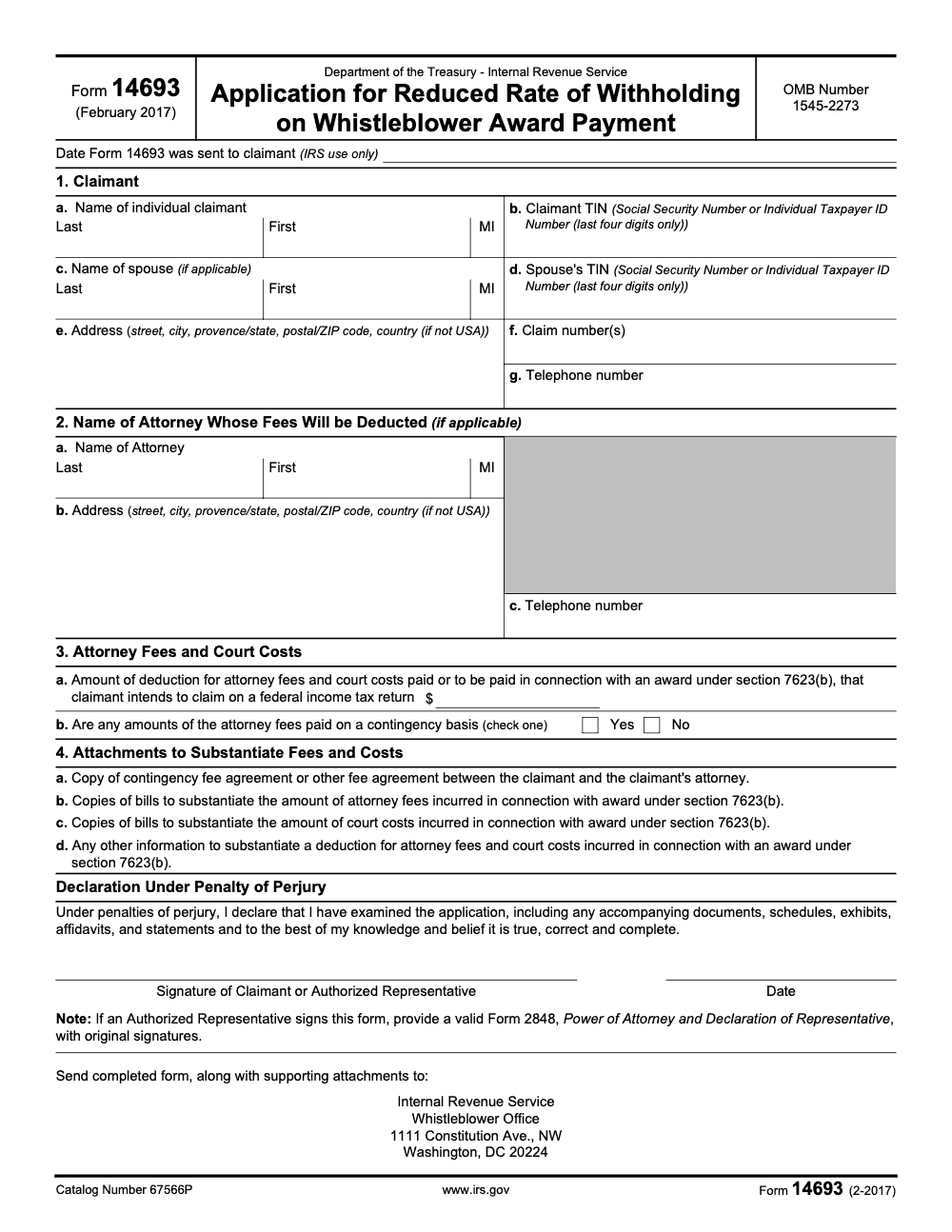
Form 14693 is an IRS Whistleblower Office application that lets you request a reduced rate of federal income tax withholding on your whistleblower award payment. The point is simple: if you can document deductible attorney fees and court costs, the IRS can sometimes reduce withholding so you are not over-withheld on the gross award.
This is not the form you use to become a whistleblower. That is a different process (typically starting with Form 211).
Think of Form 14693 as a “last mile” administrative step that comes into play after the Whistleblower Office has already notified you that an award is due.
Who Form 14693 is for (and who it isn’t)
You should use Form 14693 only if:
- You have been notified that you are due to receive a whistleblower award under IRC § 7623(b) – the mandatory tier; discretionary § 7623(a) awards are not within the scope of this form, and
- You want to reduce the rate of withholding on that award, and
- You can substantiate attorney fees and court costs tied to the award.
You should not use Form 14693 if you are still in the “submitting the claim” stage. The IRS’s whistleblower claim process starts elsewhere.
Why Withholding Happens on Whistleblower Awards (and why it can feel so high)
The IRS treats whistleblower awards as income, and IRS internal guidance explains they are subject to federal reporting and withholding requirements.
Here is the practical impact, in plain English:
- If you are a U.S. citizen or resident alien and the award is over $10,000, IRS guidance says withholding is generally 24%.
- If you are a foreign person, the same IRS guidance notes withholding is generally 30%, subject to possible reductions under an exception or treaty.
On top of that, the IRS may apply award amounts to certain outstanding debts before payment, based on IRS internal guidance.
The “cash flow” problem most people do not plan for
Even if withholding is ultimately credited on your tax return, the timing can hurt. You might be:
- paying attorneys on a contingency,
- reimbursing litigation expenses,
- rebuilding your life after a long reporting process,
- trying to keep your financial situation private and stable.
That is why Form 14693 matters. It is one of the few tools that exists specifically to help reduce over-withholding before the money moves.
How Form 14693 Works (What you’re really asking the IRS to do)
When you submit Form 14693, you are basically saying:
- “I have been notified I’m due an IRS whistleblower award under § 7623(b).”
- “I want a reduced withholding rate.”
- “Here is documentation showing attorney fees and court costs connected to the award.”
- “Please use this substantiation to calculate a reduced rate of withholding on my award payment.”
The IRS Whistleblower Office reviews what you send and, if approved, calculates a reduced withholding rate.
The rule that trips people up (the 30-day receipt requirement)
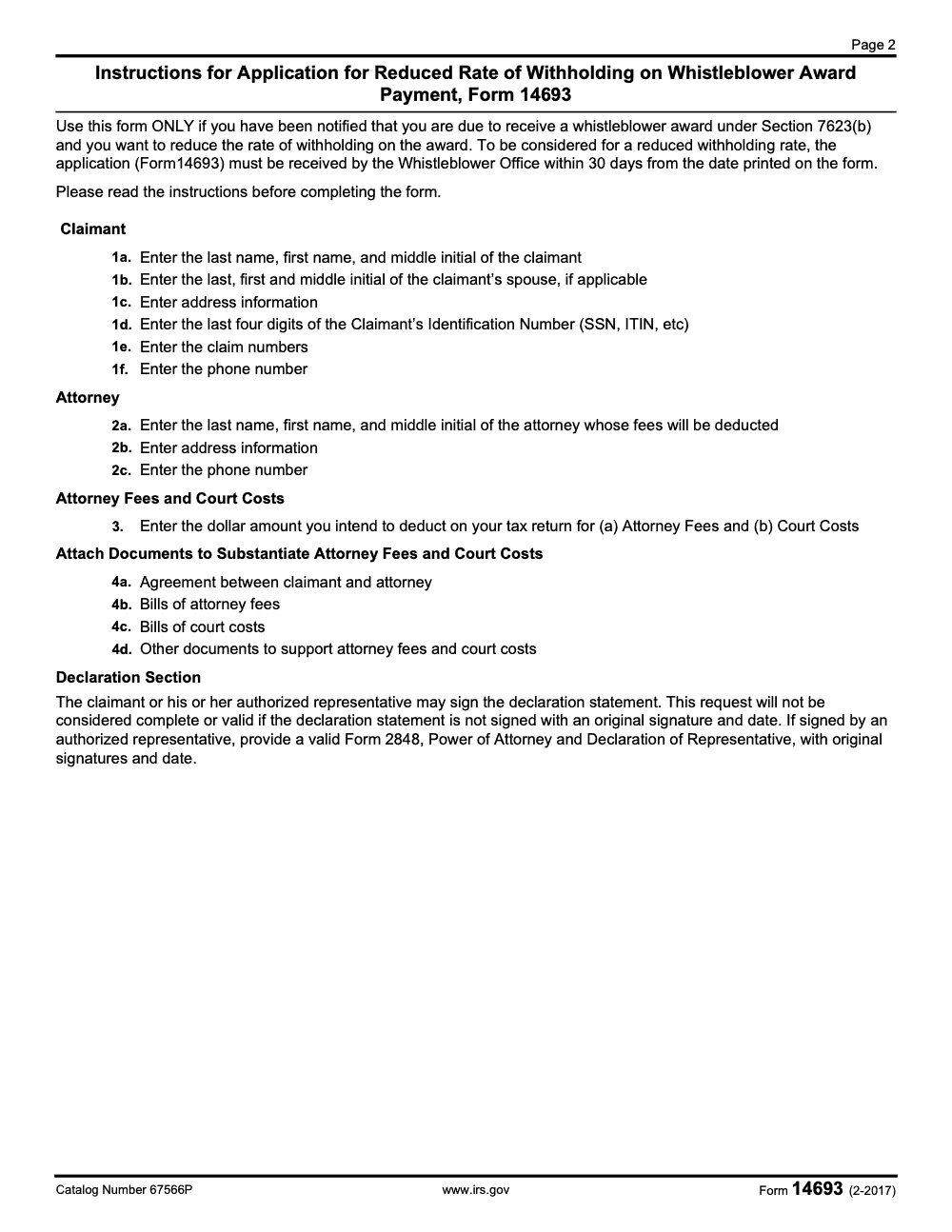
The instructions on the PDF are not vague here. They say Form 14693 must be received by the Whistleblower Office within 30 days from the date printed on the form (the date the IRS sent the form to you, not the date you signed it or the date of the award determination notice).
That means “I mailed it on day 30” might still be too late if it arrives after the window. If you are serious about the reduced rate, you want proof of delivery and a buffer.
Where to Send Form 14693
The form itself provides the mailing address. Send the completed form and attachments only to the Whistleblower Office in Washington, DC – not to a regular IRS service center or your usual Form 1040 filing address:
Internal Revenue Service Whistleblower Office 1111 Constitution Ave., NW Washington, DC 20224
If an authorized representative signs the form, the IRS notes you must provide a valid Form 2848 with original signatures.
What You Need Before You Start (a realistic checklist)
If you want this to go smoothly, your best move is to build your packet like you are preparing it for a skeptical reviewer who has never met you and has limited time.
Here is what the IRS explicitly calls out as attachments to substantiate fees and costs:
- A copy of your contingency fee agreement or other fee agreement
- Copies of bills supporting attorney fees
- Copies of bills supporting court costs
- Any other information that substantiates the deduction
Documentation table you can literally use as your cover page
| Document | What it proves | Tips to avoid delays |
| Fee agreement (contingency or hourly) | The legal basis for fees | Highlight the % or rate, and any reimbursable costs section |
| Attorney invoices or billing statements | The amount of fees incurred | Include detail, dates, and totals that tie to your claimed amount |
| Court cost bills and receipts | Out-of-pocket litigation expenses | Group by category (filings, transcripts, experts) and total them |
| Supporting explanation (1–2 pages) | How the numbers tie together | Add a simple summary schedule so the IRS doesn’t have to guess |
How to Complete Form 14693 (Line by Line, With “Real Life” Notes)
Form 14693 is only two pages, but don’t let that fool you. The IRS is not asking for a long story here, it’s asking for clean identifiers plus proof that your attorney fees and court costs are real and connected to your whistleblower award under IRC § 7623(b).
Line 1, Claimant information
1a. Name of individual claimant Use your legal name, exactly as it appears on IRS records. If your award letter uses a slightly different name format, match the IRS version.
1b. Claimant TIN (last four digits only) This is an easy mistake. The form asks for only the last four digits of your SSN or ITIN. Do not write your full number.
1c–1e. Spouse name and spouse TIN (last four digits only) Only complete these if applicable to your situation. Again, last four digits only.
1e. Address Use the address where you can reliably receive IRS correspondence.
1f. Claim number(s) This is how the Whistleblower Office matches your withholding request to your award file. Copy the claim number(s) exactly as shown on IRS correspondence.
1g. Telephone number Use a number where you actually answer, or where voicemail is secure and checked regularly.
Line 2, Attorney information
Complete this section if you are deducting attorney fees.
2a. Attorney name Enter the attorney “whose fees will be deducted.”
2b–2c. Address and phone Make it easy for the Whistleblower Office to verify details quickly.
Line 3, Attorney fees and court costs
3a. Dollar amount of deduction for attorney fees and court costs This is the number you intend to claim as a deduction on your federal income tax return, tied to the whistleblower award.
Practical tip: attach a one-page schedule showing how you got to that number. The form itself gives only a single dollar line, so your schedule is where your clarity lives.
3b. Contingency fee question Check “Yes” if any attorney fees are contingency-based.
Line 4, Attachments (this is where approvals are won or lost)
The IRS lists the attachment categories right on the form. At a minimum, you should include:
- your contingency fee agreement or other fee agreement,
- bills supporting attorney fees,
- bills supporting court costs,
- and any other substantiation that supports the deduction.
Declaration and signature
You must sign and date the declaration. The IRS instructions say the request is not complete if it is not signed with an original signature and date (electronic, scanned, or photocopied signatures will not qualify).
If an authorized representative signs, the form says you must include a valid Form 2848 with original signatures (a generic power of attorney or non-IRS POA form will not be accepted).
When to File Form 14693 (Timing rules you should not ignore)
This part is non-negotiable.
The instructions state that, to be considered for a reduced withholding rate, Form 14693 must be received by the Whistleblower Office within 30 days from the date printed on the form.
That “received by” language matters. If you are close to the deadline, use a shipping method with tracking and delivery confirmation, and keep proof.
Where to Mail Form 14693
Send the completed form and your attachments to the address printed on the form:
Internal Revenue Service Whistleblower Office 1111 Constitution Ave., NW Washington, DC 20224
A Documentation Packet That Reviewers Can Understand Fast
If you want to make this easy for the reviewer, build your package in a simple order:
- Cover letter (1 page) State that you are requesting a reduced withholding rate on a whistleblower award, and list what’s included.
- Form 14693 (signed and dated)
- Fee agreement Highlight the fee percentage, reimbursable expenses section, and who pays what.
- Fee and cost summary schedule (1 page) A table that totals attorney fees and court costs, with references to invoices and receipts.
- Invoices and receipts Label them so your totals are easy to trace.
Your goal is not to overwhelm the IRS with paper. Your goal is to make your numbers easy to verify.
How the IRS Looks at Withholding on Whistleblower Awards (So you know what you’re up against)
If you are reading this because you’re expecting an award, you’re probably thinking about the payout as a finish line. The IRS looks at it differently. It treats the award as income and applies federal reporting and withholding rules.
According to the IRS Internal Revenue Manual section on whistleblower awards:
- Awards paid under IRC § 7623 are includible in gross income and subject to federal reporting and withholding.
- Awards to U.S. citizens or resident aliens over $10,000 are generally subject to 24% federal income tax withholding.
- Payments to foreign persons are generally withheld at 30%, subject to possible reductions under an exception or treaty.
This is why Form 14693 exists. It is a pre-payment chance to prove attorney fees and court costs, so the IRS can reduce withholding and avoid “over-withholding” on the gross amount.
A quick reality check about what “reduced withholding” means
A reduced withholding rate is not the same thing as “no tax.”
It’s simply a way to reduce the amount withheld from your award upfront when you have documented deductions (like attorney fees and court costs) tied to the award. You still need to reconcile everything on your return.
What Happens After You File Form 14693
The IRS describes this process at a high level. The whistleblower uses Form 14693 to apply for a reduction, the Whistleblower Office reviews and evaluates it, then calculates the rate.
Here’s what that usually looks like in practice:
- Receipt and initial completeness check If your packet is missing core items (like the fee agreement or bills), your request is more likely to stall or be denied.
- Substantiation review The reviewer is looking for amounts that are clearly tied to the award and backed by documents.
- Rate calculation and decision If approved, the Office calculates the reduced withholding rate.
- Withholding applied to the award payment The reduced rate applies to the award payment at issue, not as a blanket rule for future years.
The Most Common Pitfalls (and how to avoid them)
Missing the 30-day receipt deadline
The IRS instructions are direct, your application must be received within 30 days from the date printed on the form.
What to do:
- Send it early.
- Use tracking.
- Keep proof of delivery.
Sending “totals” without support
A single number on Line 3a with no invoices, no receipts, and no agreement is not persuasive. The form expects substantiation attachments.
What to do:
- Include the agreement.
- Include bills.
- Add a one-page fee and cost schedule that ties everything together.
Forgetting the original signature and date
The instructions say the request is not complete or valid without an original signature and date.
What to do:
- Sign in ink.
- Date it.
- Keep a complete copy of what you sent.
Representative signs without Form 2848
If an authorized representative signs, the form instructs you to provide a valid Form 2848 with original signatures.
What to do:
- Include Form 2848 in the front of the packet if you are using a representative.
Confusing Form 14693 with the whistleblower claim itself
Form 14693 is not how you file a whistleblower claim. The IRS uses Form 211 for submitting a claim for award in the first place.
What to do:
- Only use Form 14693 after you’ve been notified that an award is due under § 7623(b).
Final Checklist, What to Do the Day You Receive Form 14693
If you want a simple plan you can follow without spiraling, use this:
- Look at the date printed on the form and mark your 30-day “received by” deadline.
- Complete Form 14693 carefully, especially claim number(s) and the “last four digits only” TIN fields.
- Build your substantiation packet
- fee agreement
- bills for attorney fees
- bills for court costs
- one-page summary schedule (your best friend)
- Sign and date with an original signature.
- If a representative signs, include Form 2848 with original signatures.
- Mail to the Whistleblower Office address on the form and keep delivery proof.
Conclusion
Form 14693 is not complicated because it’s long, it’s complicated because it’s time-sensitive and document-driven. If you send a clean packet quickly, with a clear fee and cost trail, you give the Whistleblower Office what it needs to calculate a reduced withholding rate and avoid unnecessary over-withholding.
If you’re about to receive an award, the best mindset is simple: treat Form 14693 like a deadline plus an evidence file. Get it in early, keep your copies, and make every number easy to verify.
Common Mistakes We See Every Season
The Whistleblower Office is small, deadline-driven, and unforgiving on paperwork that does not look like the form's own instructions. These are the patterns we see repeat across reduced-rate requests.
Reusable Checklists
These checklists are copy-paste ready for firm SOPs. Strip the wrapper if your DMS does not render the styled checkbox component, the underlying steps still hold.
Pre-mail substantiation packet
- Confirm the award letter cites IRC §7623(b), not §7623(a) – Form 14693 applies only to mandatory awards.
- Verify line 1a name matches the claimant name on the award letter.
- Enter only the last four digits of the claimant TIN on line 1b (and spouse TIN on line 1d if applicable).
- Complete line 1e address fully, including country if not USA.
- Enter every claim number from the award letter on line 1f.
- Complete Section 2 only when attorney fees will be deducted in connection with the award.
- Reconcile the line 3a deduction total to the 4a fee agreement and the 4b attorney-fee bills.
- Check the line 3b contingency Yes/No box against the actual fee agreement.
- Assemble Section 4 attachments in order: 4a fee agreement, 4b attorney-fee bills, 4c court-cost bills, 4d other supporting documents.
- Sign with original wet-ink signature, date the declaration, and route the wet-ink original to the mailing folder.
30-day receipt-window calendar
- Log the date printed at the top of the form as Day 0 (not the signature date, not the award determination date).
- Target signature collection and substantiation packet assembly by Day 7.
- Target mailing with tracked delivery by Day 15.
- Address the envelope to: Internal Revenue Service, Whistleblower Office, 1111 Constitution Ave., NW, Washington, DC 20224.
- Save the carrier tracking number and delivery confirmation in the client file.
- Flag the receipt-by date (Day 30) in the firm calendar with a hard reminder.
- If delivery confirmation has not posted by Day 25, escalate with the carrier rather than re-mailing a second packet.
Authorized representative signing handoff
- Confirm the claimant has appointed a representative authorized to act on this whistleblower matter.
- Prepare Form 2848 with original signatures from both the claimant and the representative.
- Match the representative's name and address on Form 2848 to the line 1a/1e claimant block on Form 14693.
- Route the Form 14693 declaration to the representative for wet-ink signature, not the claimant.
- Attach the original-signature Form 2848 to the Form 14693 packet, do not staple over signatures.
- Keep a complete copy of both forms and all Section 4 attachments before mailing.
Keep 14693 Season From Stalling
Form 14693 is not a recurring-season filing. It lands on a single claimant's desk with a date printed on it and a 30-day clock for the IRS Whistleblower Office to receive the application (per Form 14693, Rev. Feb. 2017). That 30-day receipt window – not a postmark window – is where most reduced-rate requests die before substance is ever reviewed. Awards under IRC §7623(b) run 15% to 30% of collected proceeds, capped at 10% when the tip is based principally on public-source information (per IRC §7623(b)), so the withholding question is rarely small.
The fix is not faster mailing. It is a pre-built substantiation packet that travels with the form, original signatures collected on day one, and a calendared receipt-date deadline tracked from the day the IRS sent the form (line printed at the top), not the day the claimant signed it.
- Track the receipt deadline from the date printed on the form, not the signature date or the award-determination date. Form 14693 must be received by the Whistleblower Office within 30 days, not postmarked within 30 days.
- Use only the last four digits of the claimant's (and the spouse's, on line 1d, if applicable) Social Security Number or ITIN. The form does not call for the full nine-digit TIN on lines 1b or 1d.
- Complete Section 2 (Name of Attorney) only when attorney fees will be deducted, and tie line 3a (deduction amount) and line 3b (contingency Yes/No) back to the fee agreement attached as 4a.
- Assemble Section 4 attachments before the form is signed: contingency or fee agreement (4a), attorney-fee bills (4b), court-cost bills (4c), and any other substantiating documents (4d). The form lists all four as required, not optional.
- Collect an original wet-ink signature, and a valid Form 2848 with original signatures if an authorized representative signs in place of the claimant. Electronic, typed, or scanned signatures will be treated as incomplete.
That is the kind of one-off, deadline-bound packet that disappears into compliance backlog when a firm is also closing a quarter or running a 1040 spike. Our offshore tax delivery teams build the Section 4 attachment packet upfront, calendar the 30-day receipt window from the printed-on-form date, and route the original-signature original back to the U.S. lead for mailing to the Whistleblower Office at 1111 Constitution Ave., NW, Washington, DC 20224.
FAQs
Form 14693 is used to request a reduced rate of federal income tax withholding on an IRS whistleblower award payment by substantiating attorney fees and court costs connected to the award. This is a pre-payment step, it’s meant to reduce over-withholding at the time of payout.
You should use Form 14693 only if you have been notified that you are due to receive a whistleblower award under IRC § 7623(b) and you want to reduce withholding. If you are still submitting a whistleblower claim, the IRS points you to Form 211 instead.
The IRS instructions say your application must be received by the Whistleblower Office within 30 days from the date printed on the form to be considered. Because it’s “received by,” not “postmarked by,” it’s smart to send early with tracking.
The form lists the required substantiation categories, including your fee agreement, bills supporting attorney fees, and bills supporting court costs, plus any other documents that support the deduction. If you want the review to move faster, include a one-page summary schedule that ties your totals to the documents.
No. Form 14693 asks for the claimant TIN as the last four digits only (SSN or ITIN). The spouse field, if applicable, is also last four digits only.
Mail it to the address printed on the form: Internal Revenue Service, Whistleblower Office, 1111 Constitution Ave., NW, Washington, DC 20224. Always keep a complete copy of what you sent.
If an authorized representative signs Form 14693, the form instructs you to include a valid Form 2848 with original signatures. Without it, your request may be treated as incomplete.
IRS internal guidance says whistleblower awards to U.S. citizens or resident aliens over $10,000 are generally subject to 24% federal income tax withholding, and payments to foreign persons are generally withheld at 30%, subject to possible reductions under exceptions or treaties. Your facts matter, so confirm details with a qualified advisor.
Other forms this guide names
About this guide
Accountably helps US CPA, EA, and accounting firms hire trained accountants and tax preparers in India.
About us Reviewed byJugal Thacker, CPAFounder and CEO at Accountably
A Washington-licensed CPA with 7+ years inside US firms – PwC, a real-estate tax practice, then a full-service firm, rising from reviewer to manager to advisory. This article was reviewed against current IRS guidance for the 2025 tax year and updated for filers preparing late returns, amendments, and 2026 estimates.
View profile →How we research, review, and update this guide
Every Accountably guide is researched against primary IRS sources, reviewed by a U.S. CPA, and refreshed as guidance evolves. Read our Editorial Guidelines to see how we source, fact-check, and update our content.