Summarize this article with AI
In Brief
Form 3468 is the IRS investment credit computation form – it consolidates the section 48 energy credit, the section 48E clean electricity credit (for property placed in service after December 31, 2024), the section 48C advanced energy project credit, the section 48D advanced manufacturing credit (25% for 2025 placed-in-service property, 35% after 2025), and the section 47 rehabilitation credit at 4% per year over 5 years for certified historic structures (per IRS Form 3468 instructions, OMB 1545-0155). All Part totals roll up to Form 3800 Part III with a 1-year carryback and 20-year carryforward on unused general business credits – for delivery support on multi-facility packages, see our U.S. tax outsourcing services.
A partnership finishes a clean energy project, the credit math checks out, and then nobody can find the placed-in-service date or the domestic content statement six months later. That paperwork is what carries the investment credit through review, and Form 3468 is where the section 48 energy credit, the section 48E clean electricity credit, and the section 47 rehabilitation credit all get computed before anything flows out to owners.
Many energy projects run on a base 6 percent credit that climbs to 30 percent when prevailing wage and apprenticeship rules are met, with low-income community bonuses adding 10 or 20 percentage points for qualifying small facilities under 5 MW ac. Partnerships and S corporations compute at the entity level and pass the details to owners, who then apply limits on Form 3800.
Key Takeaways
- You use Form 3468 to compute investment credits across several areas, including the section 48 energy credit, the section 48E clean electricity investment credit for property placed in service after December 31, 2024, the section 48C advanced energy project credit, and the section 47 rehabilitation credit.
- Partnerships and S corporations compute credits at the entity level on Form 3468 and pass the details to owners, who then apply limits on Form 3800.
- Many energy projects follow a base 6 percent investment credit that increases to 30 percent if prevailing wage and apprenticeship requirements are satisfied or if an exception applies, with possible adders for domestic content and energy communities.
- Low‑income communities bonus credits can add 10 or 20 percentage points for qualifying small solar and wind facilities under 5 MW ac that receive an allocation (facilities of 5 MW ac or more are disqualified regardless of location).
- You aggregate credits on Form 3800, apply ordering and limitation rules, and carry unused general business credits back 1 year and forward 20 years.
What Form 3468 Does, in Plain English
Form 3468 converts qualifying capital spending into investment credits under the general business credit. Current instructions reflect Inflation Reduction Act changes and add the clean electricity investment credit under section 48E for property placed in service after 2024. If you are filing for a fiscal year that ends in 2025, section 48E may already appear on your form.
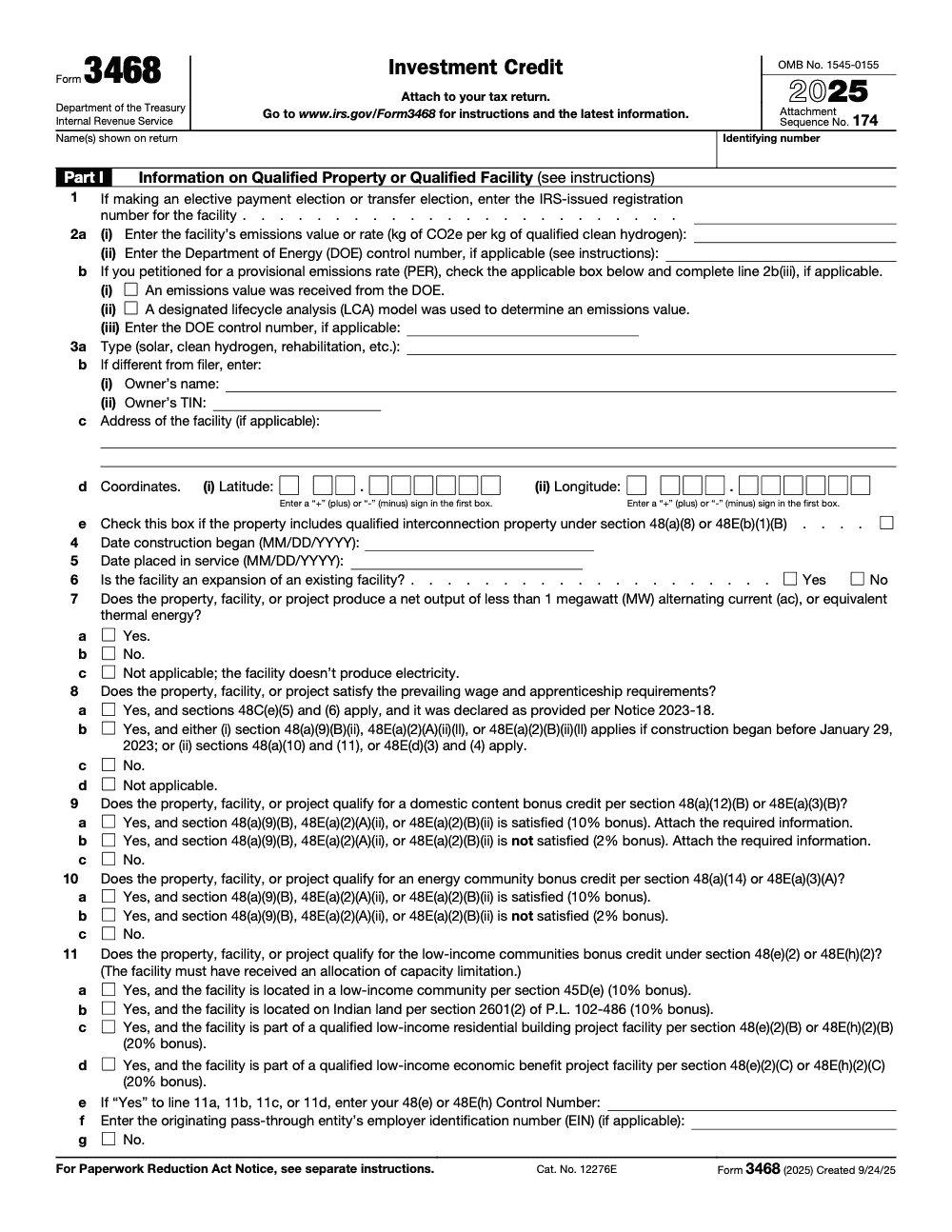
You complete Part I once for each facility or property, then complete the relevant part for the credit you are claiming. For many elections or transfers, you also need a pre‑filing registration number. Keep that number with your workpapers and return attachments.
When your entity is a partnership or S corporation, you still complete Form 3468 to compute credit amounts and provide line‑level information to owners. Owners then apply limits and ordering on Form 3800. This split between computation at the entity and limitation at the owner is where many review notes start, so align your K‑1 statements and activity tags early.
What Changed Recently
- Part V adds the section 48E clean electricity investment credit, which covers qualified clean electricity facilities and qualified energy storage technology placed in service after 2024.
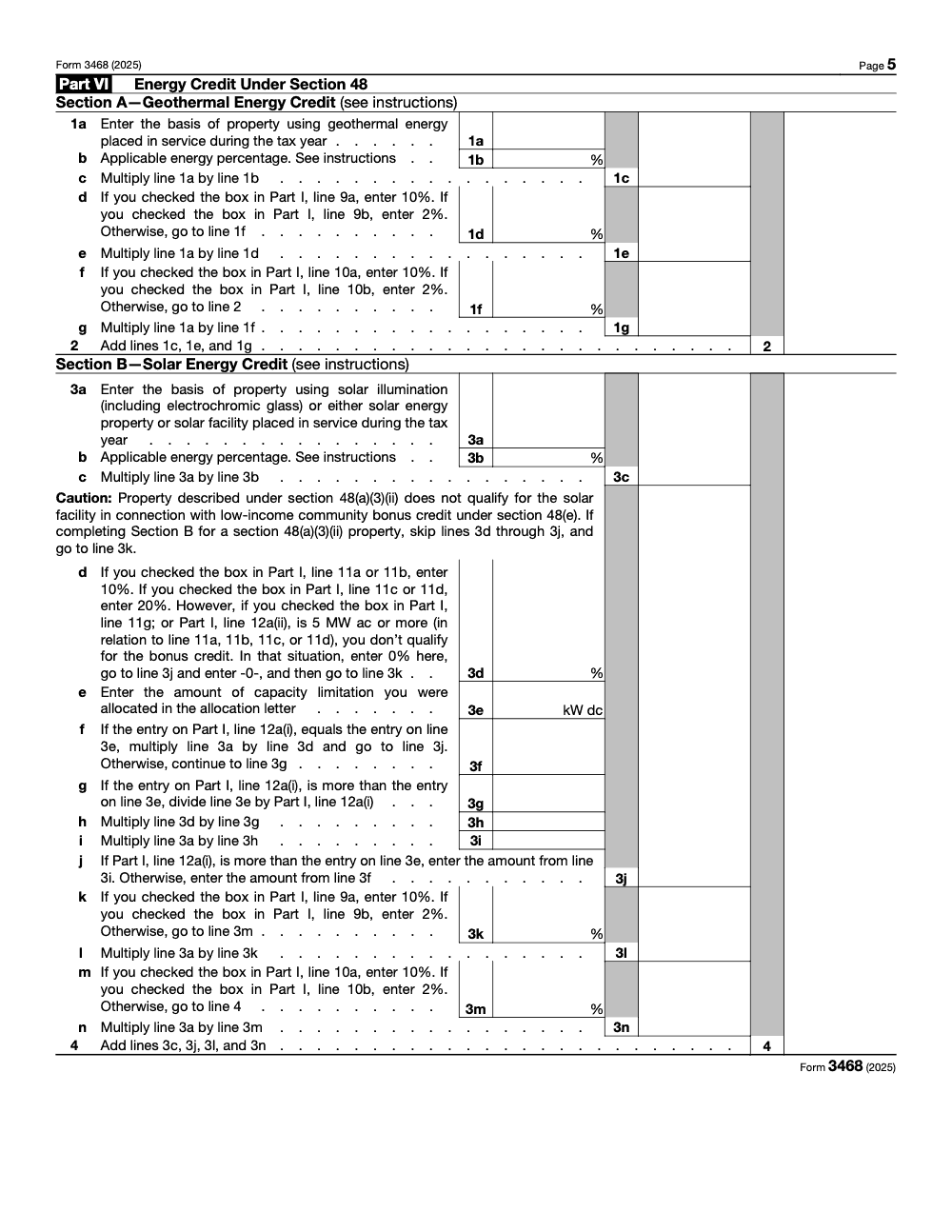
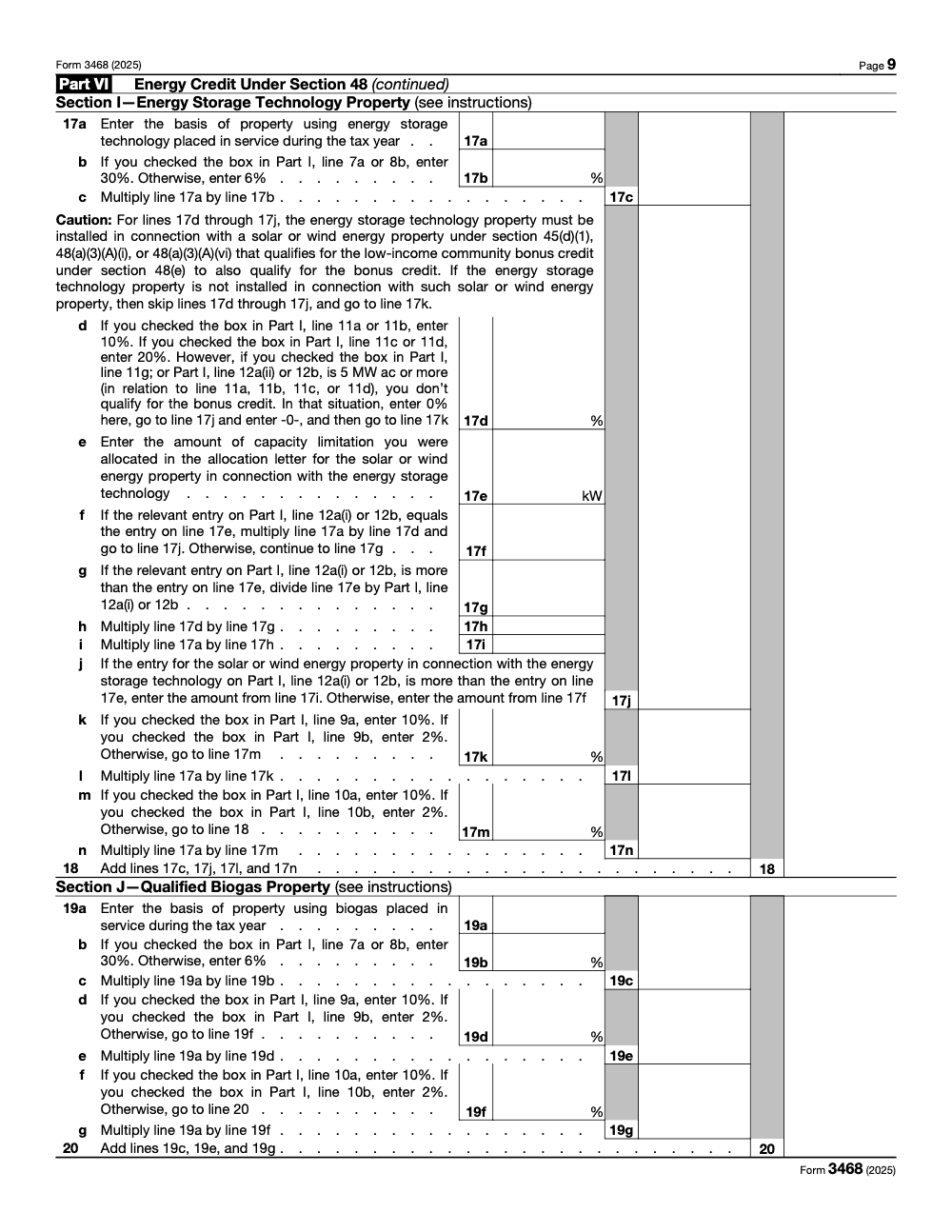
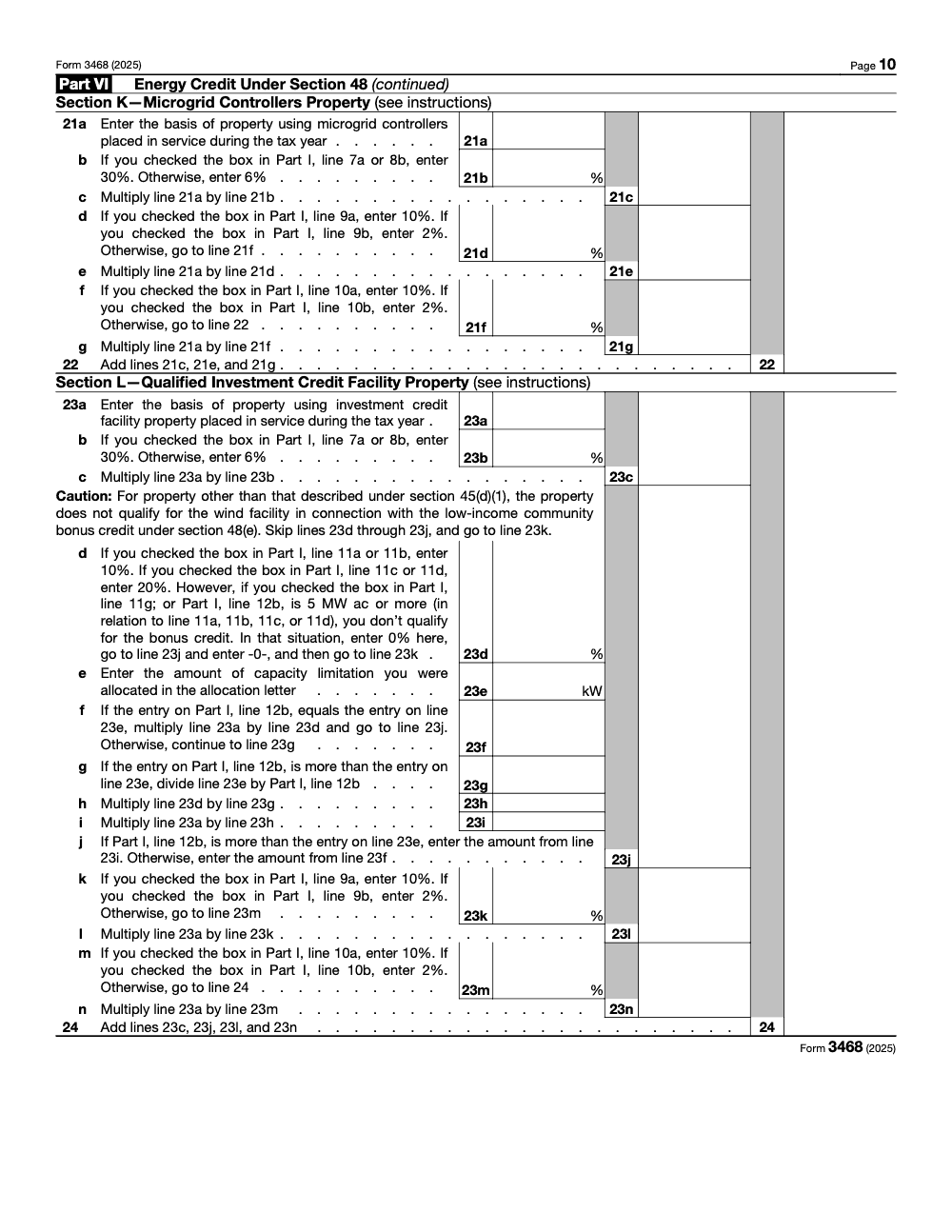
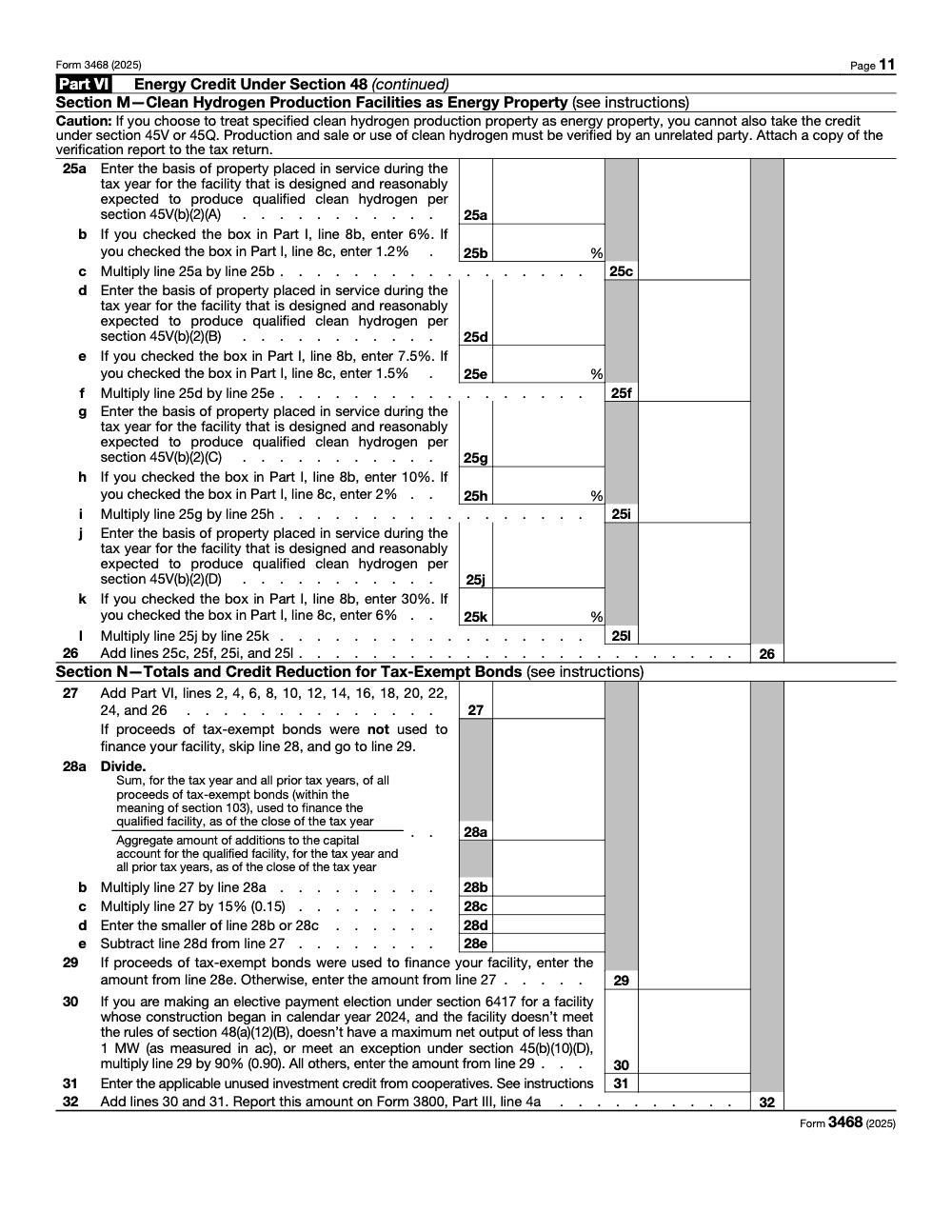
- Part VI, the section 48 energy credit, now explicitly lists technologies like energy storage technology, microgrid controllers, qualified biogas property, and more, along with the domestic content and energy community adders.
- The low‑income communities bonus program for small solar and wind facilities can add 10 or 20 percentage points if you receive an allocation and meet program timelines.
- Domestic content guidance now includes elective safe harbor tables that clarify component classifications and percentages you can rely on when certifying domestic content.
How This Post Is Structured
I will walk you through the parts of Form 3468 you are most likely to touch, what each section expects, and the documentation reviewers look for. I will also cover pass‑through reporting, Form 3800 limits, carryforwards, and practical checklists that cut rework. Where the rules changed for 2025 filings, I call that out so you can update your templates with confidence.
A Quick Word on Workflow
If your firm handles multiple energy projects, treat each facility as its own mini‑engagement. Name files consistently, store certifications and registration numbers in the same subfolder, and tie the asset record, placed‑in‑service date, and the Form 3468 part you used. That simple habit saves hours in review and protects the credit if you are audited.
We have seen firms cut review time by standardizing facility folders with five items, the registration letter, certifications, cost detail by component, placed‑in‑service proof, and a one‑page computation summary. That checklist keeps partners out of email hunts and in client strategy.
Light mention for fit, not a pitch, if you run lean during peak season, a structured offshore team can prepare those files inside your system and templates so your reviewers see a consistent package every time. That is the kind of delivery discipline Accountably, an offshore accounting and tax staffing company built for CPA, EA, and accounting firms, builds into every engagement. Use it only if it helps you hit deadlines without quality drift.
The Parts of Form 3468, What Each One Covers
Here is a simple map you can keep next to your workpapers. You always complete Part I once per facility or property, then add the relevant computation part.
| Part | What it covers | Typical users | Key paperwork |
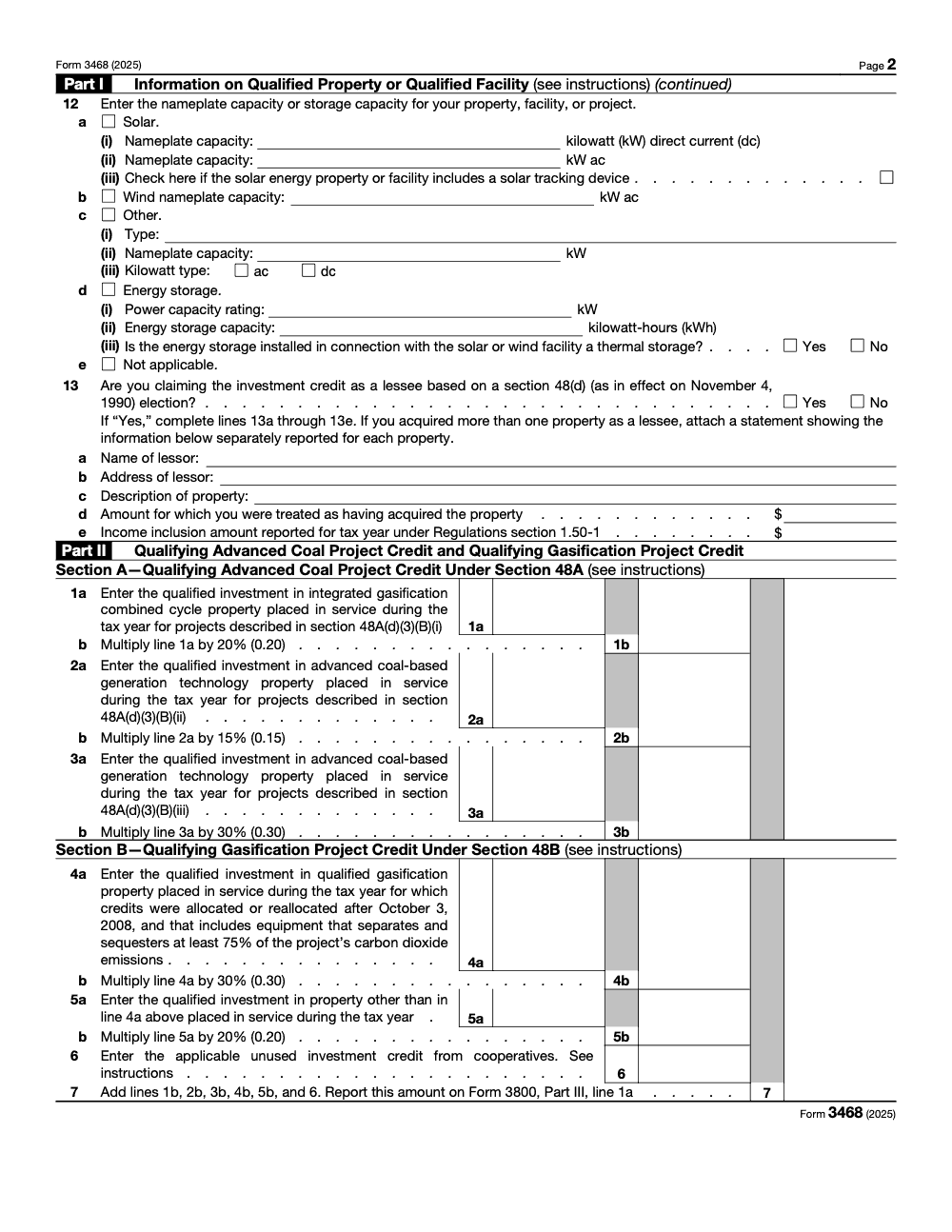
| Part II, Section A | Qualifying Advanced Coal Project Credit, section 48A | Utilities, industrial projects | IRS or DOE‑related certifications, qualified investment basis detail |
| Part II, Section B | Qualifying Gasification Project Credit, section 48B | Industrial gasification projects | Certification letter, CO2 capture details if seeking 30 percent tier |
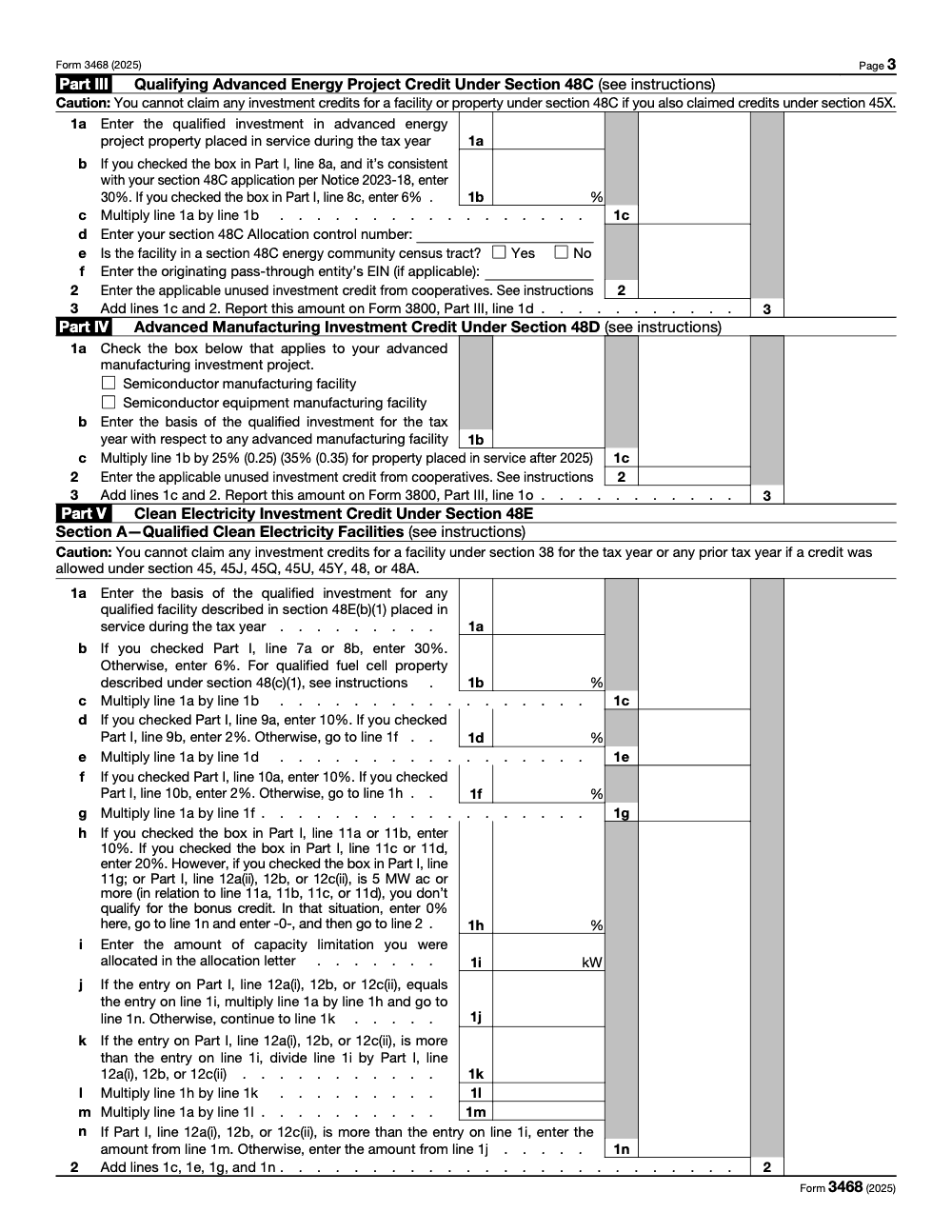
| Part III | Qualifying Advanced Energy Project Credit, section 48C | Manufacturers, recyclers, industrial decarbonization | Allocation letter, certification, placed‑in‑service notices |
| Part IV | Advanced Manufacturing Investment Credit, section 48D | CHIPS facilities | 48D specifics, elective pay where applicable |
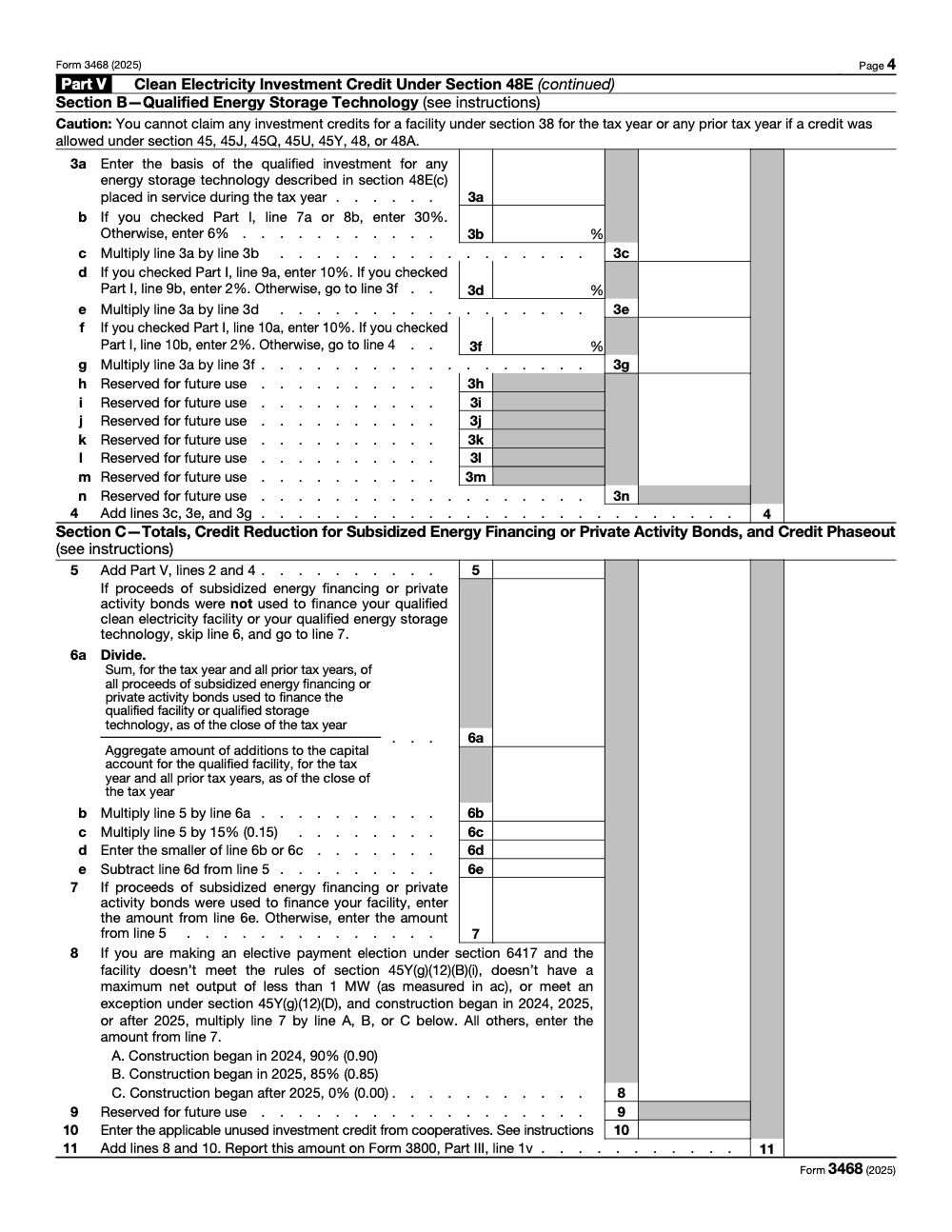
| Part V | Clean Electricity Investment Credit, section 48E | Clean electricity facilities and energy storage after 2024 | Facility details, emissions or model info where required, registration number |
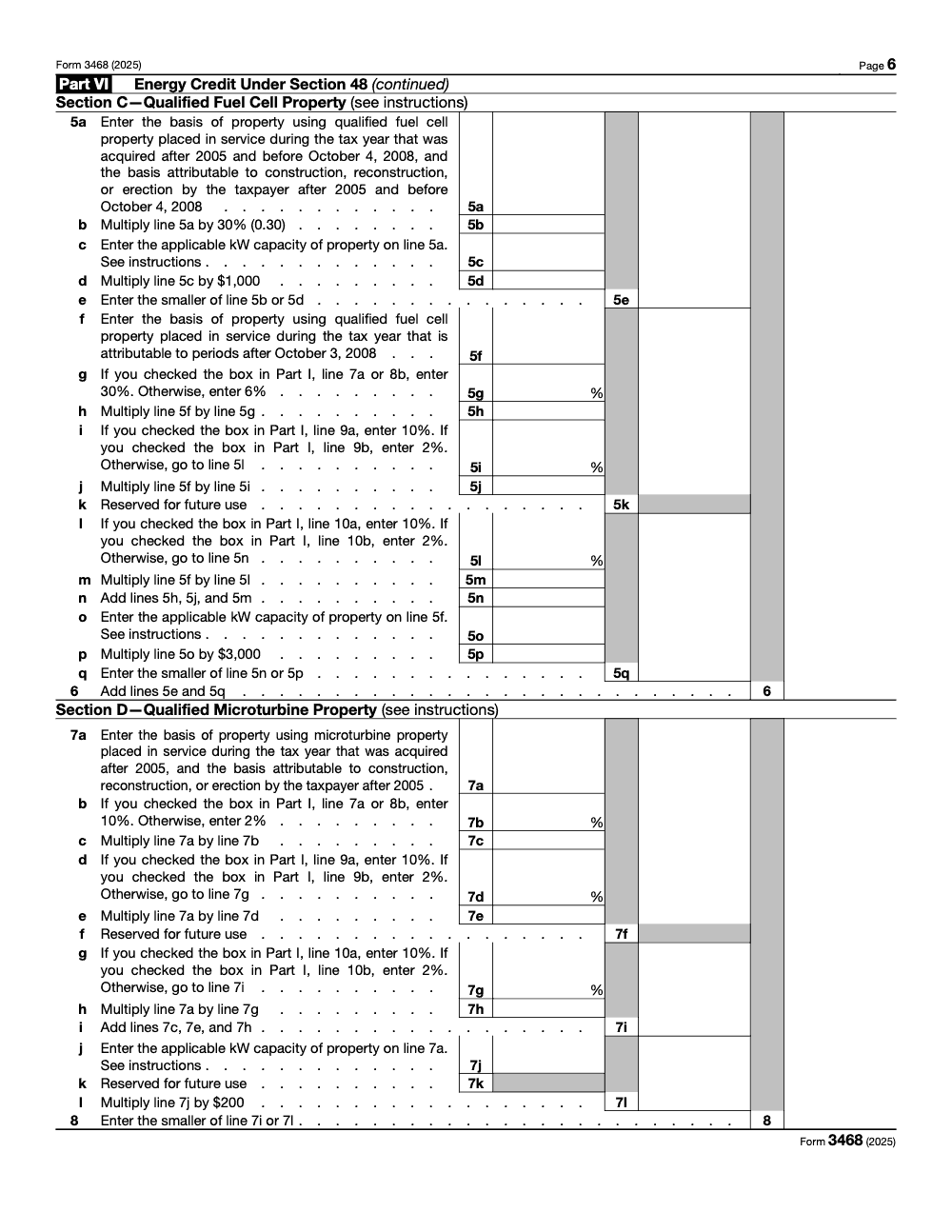
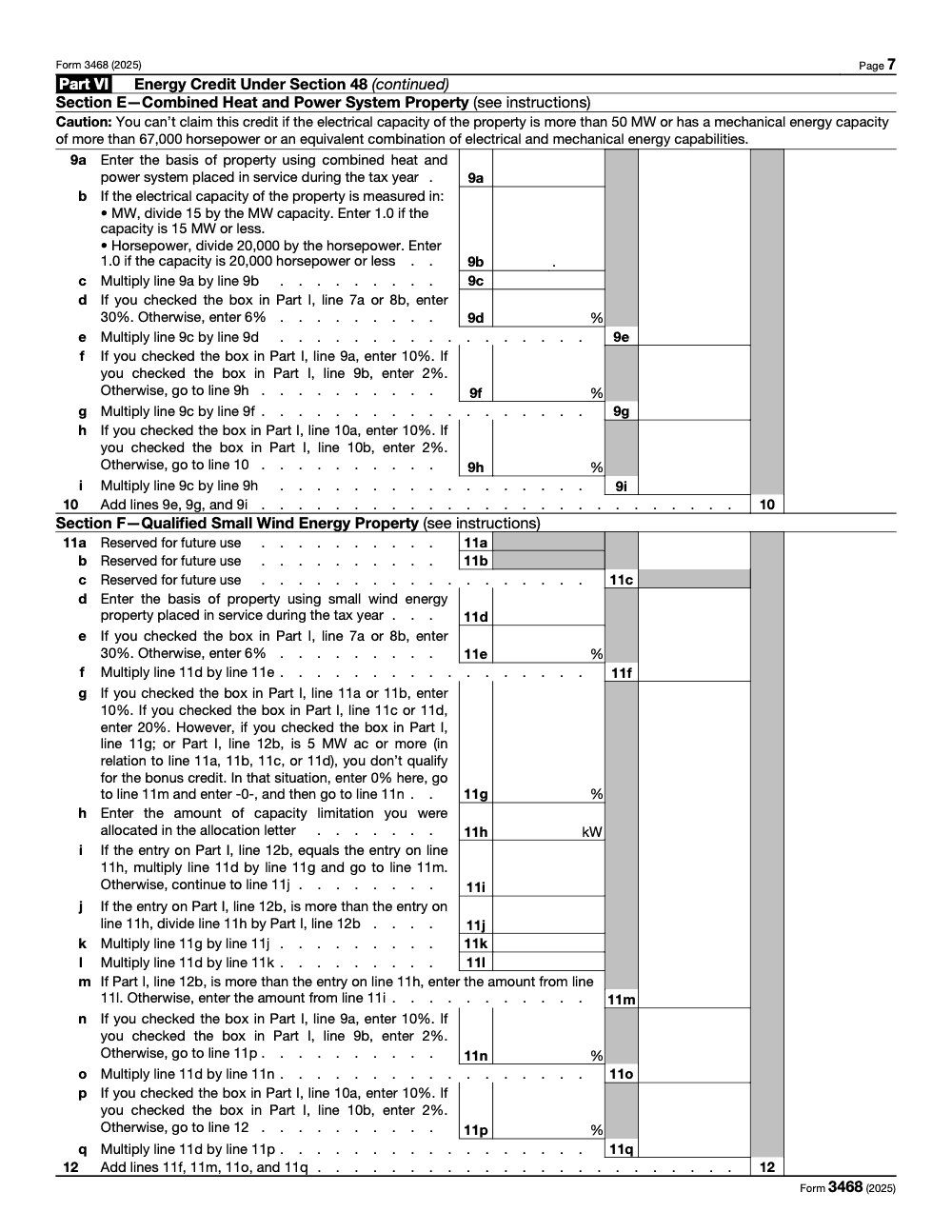
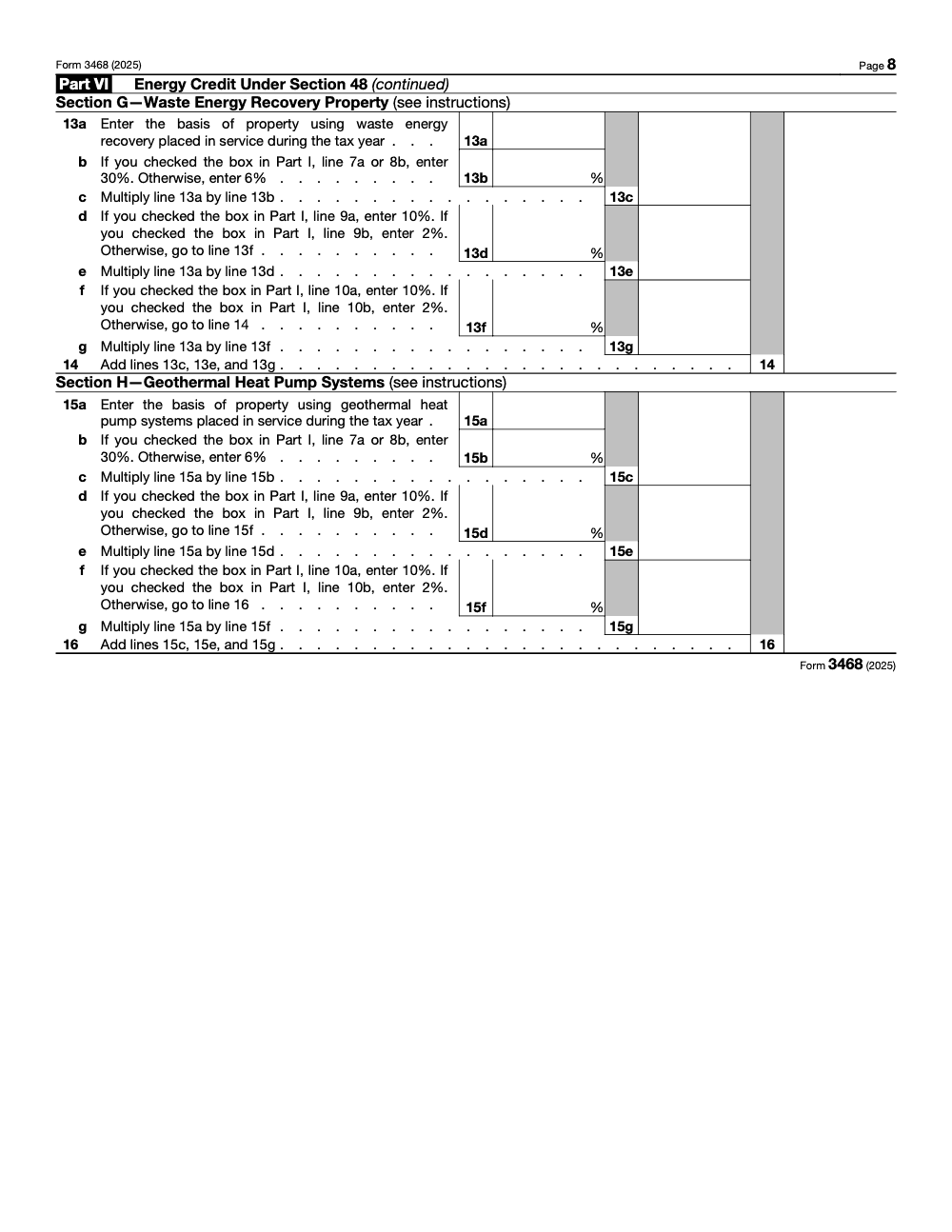
| Part VI | Energy Credit, section 48 | Solar, geothermal, fuel cells, storage, microgrid controllers, biogas, small wind, CHP | Domestic content and energy community statements if claimed |
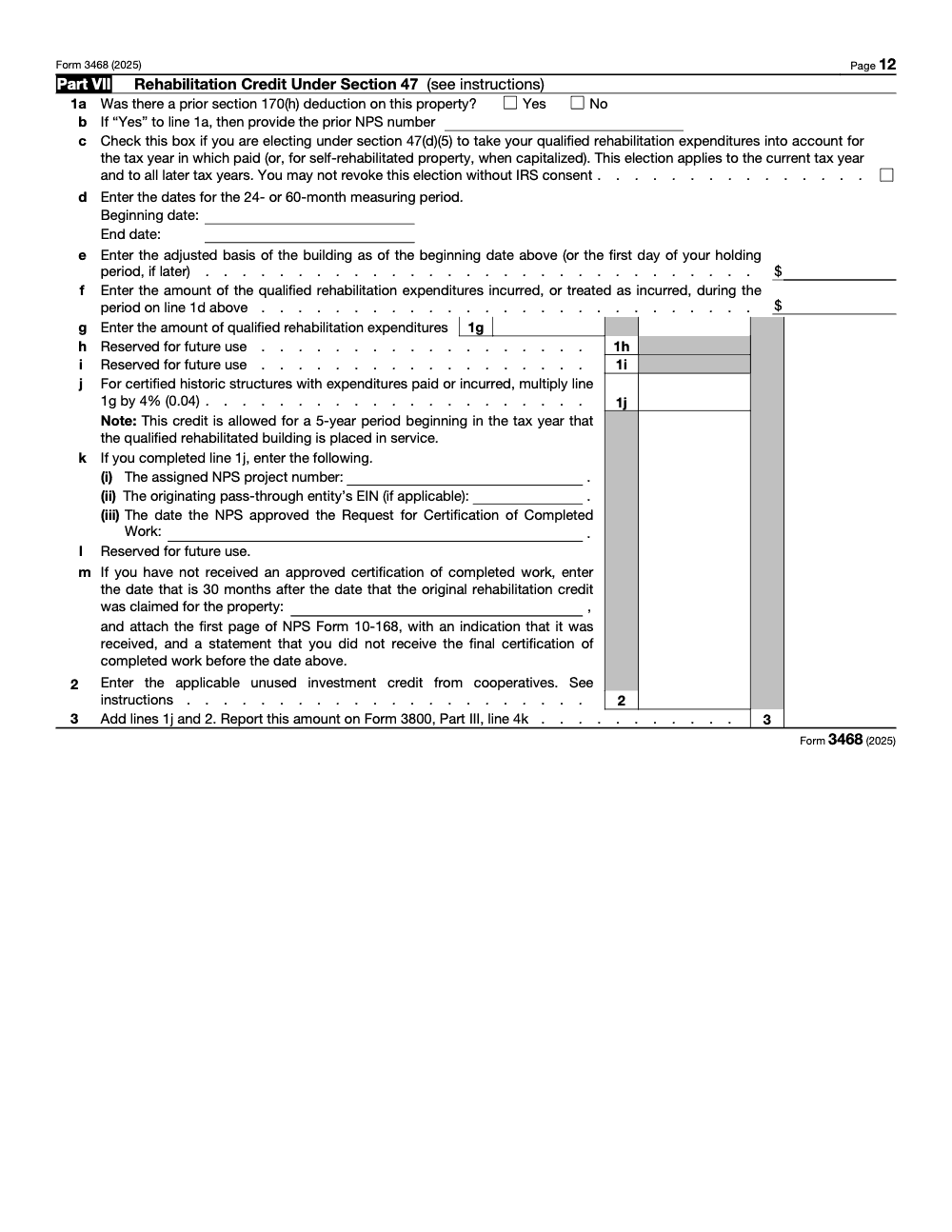
| Part VII | Rehabilitation Credit, section 47 | Certified historic structures and qualified rehab expenditures | NPS approvals, QRE schedules, 5‑year ratable claim tracking |
Part I, The Information You Must Get Right
Part I is where you identify the facility or property and enter the pre‑filing registration number if you intend to transfer a credit or make an elective payment election where allowed. Registration happens before you file, and it is required for transfers and certain elective payments. Save the registration acknowledgment with your form.
You will also indicate whether you are completing Part V or Part VI and whether prevailing wage and apprenticeship rules apply. If you are claiming domestic content or energy community adders, attach the required statements. Build templates for those statements so you do not reinvent them each time.
Pre‑Filing Registration, Transfers, and Elective Pay
- Pre‑file registration is required if you plan to transfer section 48, 48E, or 48C credits, or make elective payment elections where applicable. You receive a registration number that must appear on Form 3468 and Form 3800.
- Section 6418 transfers are available for sections 48, 48E, and 48C. Applicable entities may use section 6417 elective payment for certain credits, following the steps in the instructions (facilities of 1 MW or more that do not meet domestic content rules face a phaseout, 90 percent for 2024 construction, 85 percent for 2025, and 0 percent after 2025 for section 48E facilities).
Who Files and How Pass‑Throughs Handle It
C corporations claim credits directly against income tax. Partnerships and S corporations compute credits on Form 3468, then pass the data owners need on Schedules K and K‑1. The instructions list exactly which lines to complete so owners can compute their share, and they emphasize attaching a statement that provides facility‑level information. Owners then aggregate and limit credits on Form 3800.
Tax‑exempt or governmental applicable entities can treat certain investment credits as a payment of tax, which can generate refunds. When applicable, they file Form 3468, Form 3800, and their return, typically Form 990‑T, and must complete pre‑filing registration before making the election.
Documentation That Protects the Credit
Every number on Form 3468 should tie to a source document. For energy projects, keep invoices by component, interconnection costs, contractor certifications, and placed‑in‑service proof. For domestic content, attach the certification with the required details. For low‑income allocations, keep the control number and placed‑in‑service report. The instructions specify the statements that must be attached when claiming increased credit amounts.
A Reviewer’s Mini‑Checklist
- Registration number, facility name, and location match across Form 3468, Form 3800, and statements.
- Basis reconciles to the fixed asset subledger with in‑service dates.
- If you checked prevailing wage or apprenticeship boxes, attach the increased credit amount statement.
- If you claimed domestic content or energy community, attach the required certification statement and support.
Advanced Coal, Gasification, and Advanced Energy Projects
These parts are specialized, but when they apply, they are high‑value.
Part II, Advanced Coal Project Credit, Section 48A
The advanced coal project credit equals 20 percent, 15 percent, or 30 percent of qualified investment depending on project category under section 48A. Projects in the 30 percent tier generally include specified advanced coal‑based generation categories. These credits require certification and, for certain phases, CO2 separation and sequestration thresholds. Keep the certification letter and cost detail that proves qualified investment.
Part II, Qualifying Gasification Project Credit, Section 48B
The gasification credit is 20 percent of qualified investment, or 30 percent for allocated Phase II projects that capture and sequester at least 75 percent of total CO2 emissions. These credits also require certification and follow allocation rounds. Preserve the certification and engineering documentation with your return file.
Part III, Qualifying Advanced Energy Project Credit, Section 48C
Section 48C was refreshed and funded by the Inflation Reduction Act. It provides an investment credit for projects that re‑equip, expand, or establish facilities that manufacture or recycle clean energy components, reduce industrial emissions, or process critical materials. The base rate is 6 percent, which increases to 30 percent if prevailing wage and apprenticeship conditions are met. Credits are allocated through the IRS with DOE technical review. Do not place property in service before your allocation or you will be ineligible, and note that section 48C and section 45X are mutually exclusive for the same property, you cannot claim both.
The 48C program includes strict timelines, commonly two years to meet certification and two more years to place in service. Track those dates on your close calendar and set reminder tasks so you do not miss a milestone.
Practical filing tips for Parts II and III
- Use a separate facility folder with the allocation or certification letter, capital detail schedules, and a placed‑in‑service memo.
- Tag each asset line with the statute section so it flows to the right part of Form 3468.
- For projects with CO2 capture thresholds, keep the test protocol and results with your cost file, not in a separate engineering drive.
Records and Controls That Survive Review
Whether your claim is under section 48A, 48B, or 48C, reviewers focus on three things, the certification, the basis, and the timing. Certification must match the project. Basis must be depreciable and integral to the project. Timing must align with allocation rules and placed‑in‑service dates. If your team keeps those three proof points in every facility folder, you will clear most review comments in a single pass.
Think in threes, certification, basis, timing. If any one is missing, the credit is at risk.
Light mention where it fits, if high‑volume prep stretches your staff, consider standardizing these facility folders. An offshore team that lives inside your workpapers can build and name them the same way every time so partners spend fewer hours in review and more time in advisory.
Rehabilitation Credit, Energy Credit, and the New Clean Electricity Credit
Part VII, Rehabilitation Credit, Section 47
For certified historic structures, the credit equals 20 percent of qualified rehabilitation expenditures, but you generally claim it ratably over five years for amounts paid or incurred after 2017. The old 10 percent pre‑1936 non-historic building credit was eliminated by TCJA effective 2018. Keep National Park Service certifications, your qualified rehabilitation expenditures schedule, and proof you met the substantial rehabilitation test.
Part VI, Energy Credit, Section 48
Part VI covers a broad set of energy properties, solar, geothermal, qualified fuel cells, small wind, combined heat and power, geothermal heat pumps, energy storage technology, qualified biogas property, microgrid controllers, and more. Section 48 works on a base and bonus model, 6 percent base that increases to 30 percent if you meet prevailing wage and apprenticeship requirements, or if an exception applies. Additional adders may apply for domestic content and energy communities. Track the statements you must attach when you claim increased credit amounts.
Part V, Clean Electricity Investment Credit, Section 48E
For property placed in service after December 31, 2024, section 48E becomes available for qualified clean electricity facilities and qualified energy storage technology, but it is permanently barred for that facility if a credit was allowed under section 45, 45J, 45Q, 45U, 45Y, 48, or 48A in the current or any prior tax year. It follows similar base and bonus mechanics and introduces clean electricity definitions, including emissions concepts and designated lifecycle analysis models for certain technologies. If you are a fiscal‑year filer whose year ends in 2025, you may already see 48E on your form.
Bonuses You Can Stack, With Care
- Domestic content, if you meet the requirement, increases the applicable percentage by 10 percentage points if you meet prevailing wage and apprenticeship or another qualifying condition, otherwise by 2 points. New elective safe harbor tables help classify components and cost shares.
- Energy communities, you can increase the applicable percentage by 10 points when prevailing wage and apprenticeship apply, or by 2 points otherwise, for projects placed in service in an energy community.
- Low‑income communities bonus, for small solar and wind facilities under 5 MW ac with an IRS allocation, add 10 or 20 percentage points depending on category (facilities of 5 MW ac or more are disqualified regardless of location). Keep the control number and placed‑in‑service reporting.
A properly structured solar project can reach a total credit as high as 70 percent when base, domestic content, energy community, and low‑income bonuses apply, subject to program rules and allocations. Your documentation must support each adder and meet placement and certification timing.
Prevailing Wage and Apprenticeship, The Practical Bits
Prevailing wage and apprenticeship rules apply across several clean energy provisions. Use current wage determinations, maintain payroll records, and attach the increased credit amount statement when you check the box for increased rates.
Tip, keep a single PDF with wage determinations, contractor letters, and apprentice ratios for each facility. It travels with the asset file so review does not stall.
Example, Storage + Solar
- You place a 3 MW AC solar facility and a co‑located battery in service in 2025.
- You meet prevailing wage and apprenticeship, you qualify for the 30 percent base rate.
- If the site is in an energy community and you meet domestic content, you may add 10 points for each.
- If you also received a low‑income allocation because the project qualifies and is under 5 MW, you add 10 or 20 points. Document each element before you file.
Reporting on Form 3800, Limits, Ordering, and Carryforwards
After you compute credits on Form 3468, you aggregate them on Form 3800. The general business credit applies ordering rules and limits, including consideration of tentative minimum tax where relevant. Unused general business credits are carried back 1 year and forward 20 years, with special rules for certain credits. Apply carryforwards before current‑year credits, then apply any carryback. Keep a simple tracker so older amounts are used first.
Entity Coordination
If you are a partner or S corporation shareholder, your K‑1 statement should include the facility information your preparer used on Form 3468. You then report those amounts on your own Form 3800 and apply your personal limits and carryforwards. Aligning activity codes and facility names between the entity and owner returns removes a surprising amount of friction in review.
Records and Workflow That Make Audits Boring
- Facility folder, registration letter, certifications, allocation or control numbers, increased credit statements, domestic content statement if claimed, and placed‑in‑service proof.
- Basis support, invoices by component, contractor certifications, and interconnection costs with section 50 basis reduction applied where relevant.
- K‑1 statements that mirror Form 3468 line references for pass‑through owners.
Aim for two to four pages of computation and statements per facility, plus source documents. If your reviewer cannot find the registration number and the control number in 30 seconds, the package is not ready.
Final Notes and a Simple CTA
You already know the hard part is not finding opportunities, it is delivering them cleanly at scale. Build a repeatable facility folder, get pre‑filing registration done early when you plan to transfer or use elective pay, and keep your statements ready for domestic content, energy community, and increased credit amounts.
If you need structured help building those files inside your systems, Accountably integrates disciplined offshore teams who follow your templates, which keeps Form 3468 and Form 3800 packages consistent and your partners out of review loops. Use that only where it helps you protect quality, security, and turnaround.
Small disclaimer, this guide is general information, not tax advice. For specific credits, consult the current IRS instructions and a qualified tax professional.
Common Mistakes We See Every Season
Across multi-facility filings, the same five errors burn senior reviewer time every year. Catching them at the workpaper stage usually clears the package in a single review pass.
Reusable Checklists
These checklists are built to copy-paste straight into a firm SOP library. The line numbers and statement names match the 2025 Form 3468 instructions.
Per-facility pre-filing packet
- Facility name, address, and latitude / longitude with +/- sign in the first box (Part I Line 3d).
- Construction-began date (Part I Line 4) and placed-in-service date (Part I Line 5).
- IRS pre-filing registration acknowledgment letter and registration number (Part I Line 1).
- Facility emissions value or rate documentation (Part I Line 2a(i)) where applicable.
- Prevailing wage and apprenticeship increased credit amount statement attached.
- Domestic content statement under §48(a)(12)(B) or §48E(a)(3)(B) if claimed.
- Energy community statement under §48(a)(14) or §48E(a)(3)(A) if claimed.
- Low-income communities allocation control number and capacity letter if claimed.
- Interconnection property invoices with §50 basis reduction memo.
- Asset register entry tying placed-in-service date to depreciation method.
PWA and bonus stacking verification
- MW capacity confirmed against the Part I Line 7 under-1 MW threshold.
- PWA met or under-1 MW exception documented for the 30% base rate selection.
- Wage determinations on file for all contractors and subcontractors.
- Apprentice hour ratios tracked and contractor attestation signed.
- Domestic content percentage calculation with safe harbor table classification.
- Energy community boundary documentation (Brownfield, Statistical Area, or Coal Closure category).
- Low-income allocation letter on file and facility under 5 MW ac.
- Total credit rate worksheet checked against the base 6% or 30% plus 10% or 2% adders for domestic content and energy community.
- Increased credit amount statement attached for every adder claimed.
- Reviewer sign-off on Part I before any computation Part (II through VII) is started.
Pass-through K-1 handoff
- Facility-level information statement attached to the K-1 per Form 3468 instructions.
- Registration number and §48C allocation control number printed on every K-1.
- Activity codes consistent between entity return and partner or shareholder K-1.
- Line-level credit detail provided so owners can complete Form 3800 Part III.
- Section 50 basis reduction reflected on owner depreciation schedules.
- Domestic content, energy community, and PWA election noted on K-1 statement.
- Owner tax year and entity tax year reconciled for pass-through timing.
- Copy of Form 3468 attached to the K-1 package for owner records.
- 1-year carryback and 20-year carryforward notation for any unused credit.
Keep 3468 Season From Stalling
Form 3468 season does not look like a 1040 season – it stretches across the project life cycle, not just the filing deadline. A clean energy facility placed in service in November can pull in pre-filing registration evidence from August, prevailing wage records from the general contractor, a domestic content safe harbor classification from procurement, and an NPS certification (for §47 rehab projects) from a separate agency entirely. The IRS Form 3468 instructions (OMB 1545-0155) make every one of those statements load-bearing – a missing PWA increased credit amount statement drops a §48 or §48E facility credit from 30% to 6%, and a §48C facility that placed property in service before its IRS-DOE allocation letter loses the credit entirely.
The pattern that survives review is not adding more reviewers – it is moving documentation discipline upstream into a facility folder built the moment construction begins, not the moment the return is due. Once the registration number, certification letter, and bonus-credit statements land in a single folder per facility, Part I of Form 3468 reconciles in minutes, and Parts V, VI, and VII flow through Form 3800 without rework.
- Stand up a per-facility folder the day the construction-began date (Part I Line 4) is set, with pre-built slots for the IRS pre-filing registration acknowledgment, the §48C allocation control number, latitude / longitude coordinates (Part I Line 3d), and NPS Form 10-168 receipt where §47 applies.
- Add a PWA / under-1 MW gating check at the top of every §48 or §48E computation – the difference between 6% and 30% turns on this single answer at Part V Line 1b and the relevant section line in Part VI.
- Maintain one bonus-stacking worksheet per facility – base rate, domestic content (Line 9a or 9b), energy community (Line 10a or 10b), low-income communities (Lines 11a through 11d) – with attached statements indexed in the same order as the form parts.
- Build a 5-year amortization tracker for every §47 rehabilitation credit so the 4%-per-year claim is not missed in year 3 or year 5, and queue an NPS final certification reminder at the 30-month mark.
- Mirror the registration number, allocation control number, and placed-in-service date across Form 3468 Part I, Form 3800 Part III, and every K-1 statement so reviewers see one set of identifying numbers per facility, not three.
For teams running multiple §48, §48E, and §48C projects in parallel, the work is less about credit knowledge than about file discipline – which is exactly what our U.S. tax outsourcing services build into client workflows: SOC-2-aligned facility folders, mirrored line-number references, and review-protection at the workpaper stage so partners spend their time on advisory, not on hunting registration acknowledgments.
FAQs
It is the computation form for several investment credits, including sections 48, 48E, 48C, 48A, 48B, and 47. You attach it to your return, and you carry totals to Form 3800 where the general business credit limits apply.
Section 48 applies to energy property like solar, geothermal, storage, microgrid controllers, and more. Section 48E is the clean electricity investment credit for qualified facilities and qualified energy storage technology placed in service after 2024. Both use base and bonus rates with potential adders.
Yes. Eligible taxpayers may transfer section 48, 48E, and 48C credits under section 6418 after completing pre‑filing registration. Certain applicable entities can make elective payment elections under section 6417 for specified credits. Follow the sequencing in the instructions.
For most projects, you claim 20 percent of qualified rehabilitation expenditures ratably over five years, and the pre‑1936 10 percent non-historic credit was eliminated by TCJA effective 2018. Track certifications and the substantial rehabilitation test.
For small solar and wind facilities under 5 MW, an IRS allocation can add 10 or 20 percentage points if your facility meets one of four categories, low‑income community, Indian land, qualified low‑income residential building, or qualified low‑income economic benefit. Keep the control number and meet placed‑in‑service timelines.
Unused general business credits generally carry back 1 year and forward 20 years. Form 3800 applies ordering rules, carryforwards first, then current‑year credits, then carrybacks. Maintain a schedule with origination year and expiration.
Other forms this guide names
- Form 3800: How to Claim the General Business Credit in 2025
About this guide
Accountably helps US CPA, EA, and accounting firms hire trained accountants and tax preparers in India.
About us Reviewed byJugal Thacker, CPAFounder and CEO at Accountably
A Washington-licensed CPA with 7+ years inside US firms – PwC, a real-estate tax practice, then a full-service firm, rising from reviewer to manager to advisory. This article was reviewed against current IRS guidance for the 2025 tax year and updated for filers preparing late returns, amendments, and 2026 estimates.
View profile →How we research, review, and update this guide
Every Accountably guide is researched against primary IRS sources, reviewed by a U.S. CPA, and refreshed as guidance evolves. Read our Editorial Guidelines to see how we source, fact-check, and update our content.