Summarize this article with AI
In Brief
Form 3921 is the IRS information return that corporations file for each incentive stock option (ISO) exercise under IRC Section 422(b) – one form per stock transfer during the calendar year. For tax year 2025, Copy B is due to the employee by January 31, 2026, and Copy A is due to the IRS by March 31, 2026 for electronic filings (per IRS Form 3921 Instructions, Rev. April 2025, and IRS Publication 1220 for Tax Year 2025).
A company that prepares one Form 3921 per employee comes up short whenever an employee exercised incentive stock options more than once in the year. Corporations file the form for each ISO exercise under IRC Section 422(b), one form per stock transfer, not one per person.
For tax year 2025, Copy B goes to the employee by January 31, 2026, and Copy A goes to the IRS by February 28 if filing on paper or March 31, 2026 if filing electronically. Once you have 10 or more information returns of any type for the year, electronic filing is required, and the Form 3921 data drives AMT calculations on Form 6251 and helps confirm holding periods and basis when the stock is sold.

Key Takeaways
- You must prepare one Form 3921 for each ISO exercise event in the calendar year. It is not one per person, it is one per exercise.
- Furnish Copy B to the employee by January 31 for prior year exercises, then file Copy A with the IRS by February 28 if filing on paper, or by March 31 if filing electronically.
- If you have 10 or more information returns in total for the year, electronic filing is required, and the 10 count is aggregated across return types.
- Penalties for late or incorrect filing are tiered and inflation adjusted. Amounts increase the later you correct, and intentional disregard removes caps.
- Form 3921 data drives AMT calculations on Form 6251 and helps confirm holding periods and basis when the stock is sold.
What Form 3921 is and why it matters
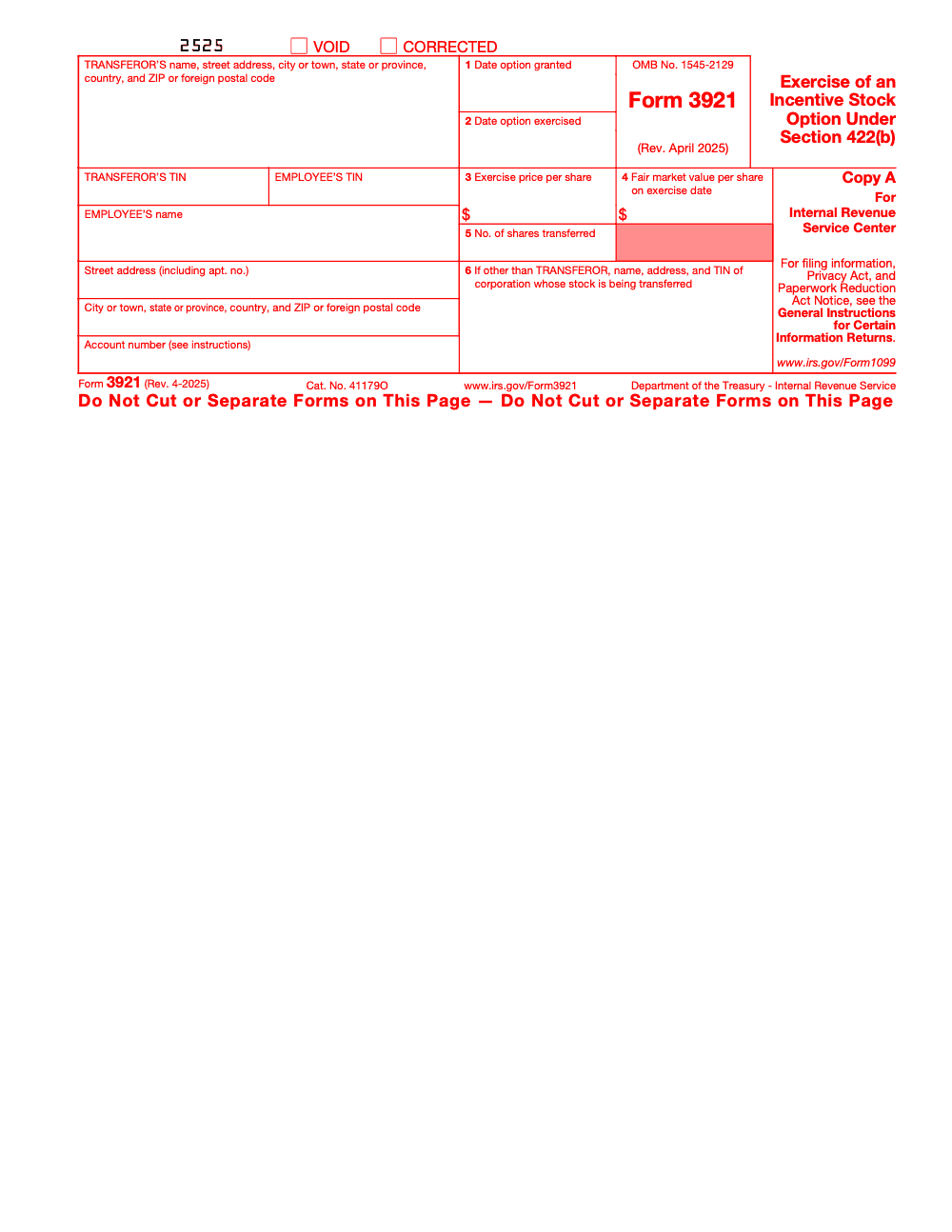
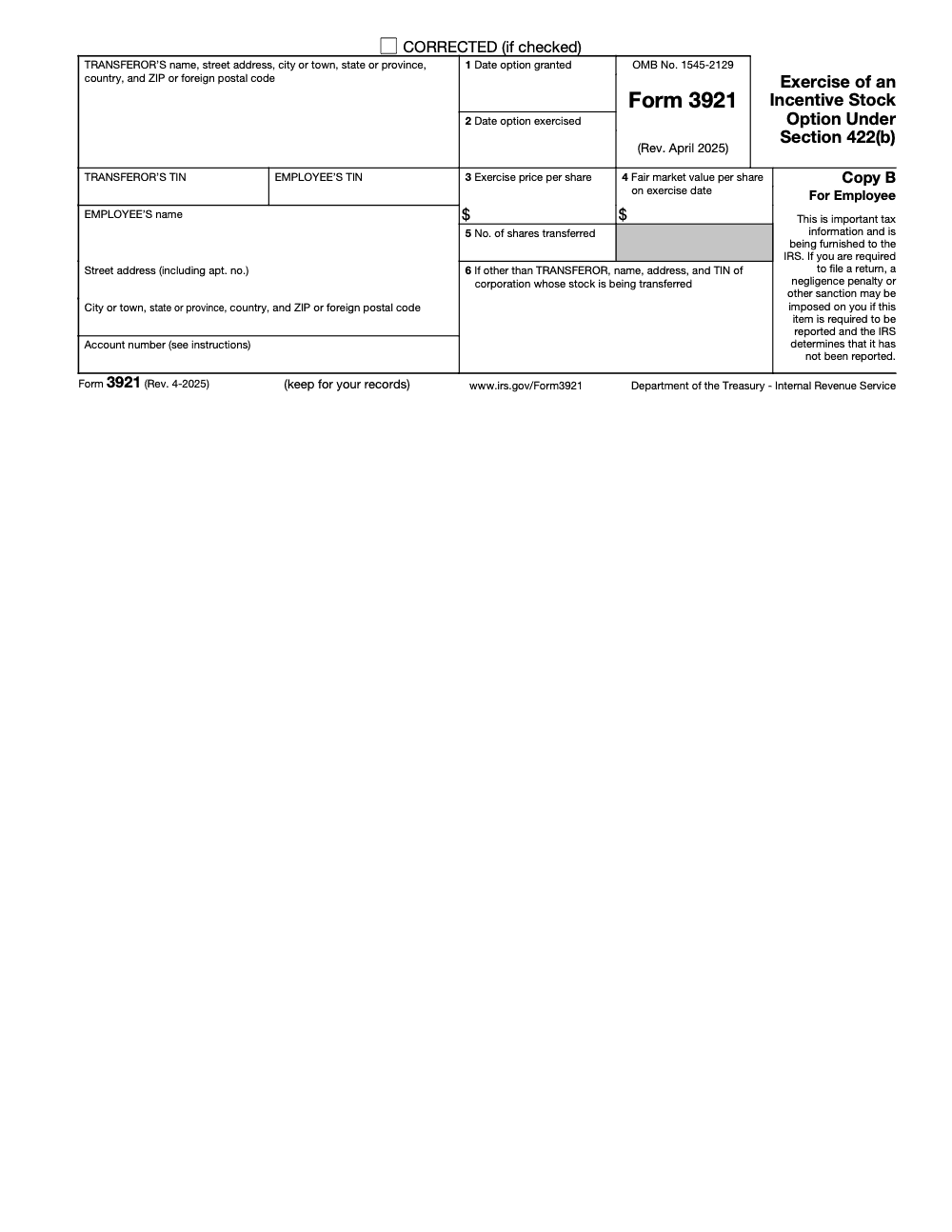
Form 3921 is the IRS information return that reports each transfer of stock to an employee when they exercise an Incentive Stock Option, as defined in section 422(b) (nonqualified stock option exercises do not belong on Form 3921 – NQSO compensation goes on the employee's Form W-2, or Form 1099-NEC for non-employees, and ESPP transfers under §423(c) report on Form 3922, not 3921). It is purely informational for regular tax at exercise, however it is essential for the employee’s AMT computation and for setting the right basis figures later. Expect to complete the grant date, the exercise date, the exercise price per share, the fair market value per share on the exercise date, the number of shares, and both parties’ names, addresses, and TINs.
Why you should care if you are in finance, payroll, or equity admin. The form underpins three jobs. First, employees need the AMT adjustment, which equals fair market value at exercise minus the option price, times the shares. Second, basis for regular tax and AMT can differ, and Form 3921 is your audit‑ready paper trail. Third, accurate and on time filing avoids penalties and late nights in February.
Who must file and who receives the form
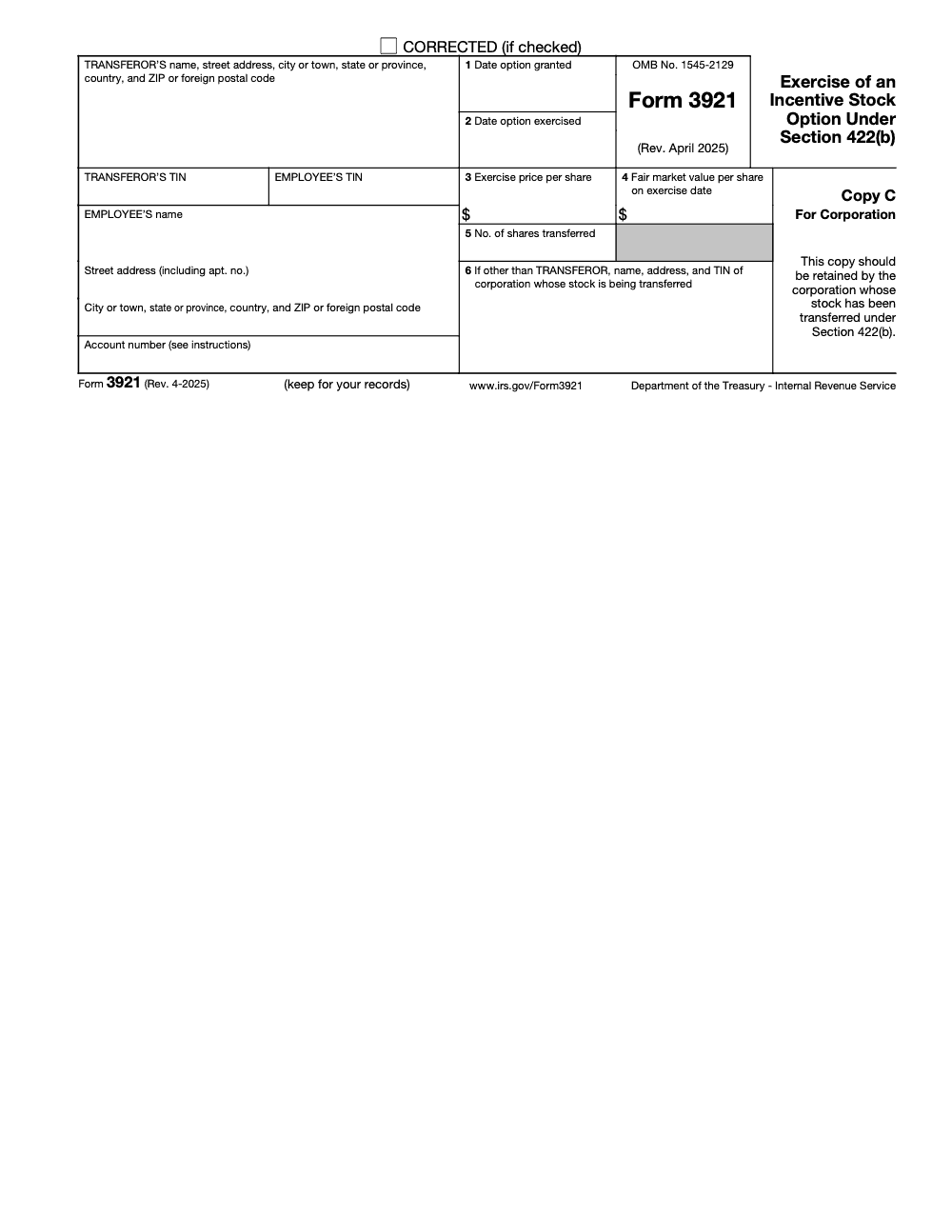
If your company transfers stock to a person because they exercised an ISO, you must file a separate Form 3921 for each exercise in that calendar year. That includes exercises by former employees if the transfer happened while you were their employer. You file Copy A with the IRS and furnish Copy B to the person who exercised. Keep Copy C with your records. There is an exception for some nonresident aliens who were not required to receive a Form W‑2 during the relevant period.
A quick way to confirm responsibility. Check your plan logs for any ISO exercises with share delivery. If the answer is yes, you have a 3921 obligation. Confirm addresses and TINs early, because failed TIN matching is a common reason for rework and penalties. The required data points are specific, so lock them down before you generate any statements.
Information you need to complete Form 3921
Work from reliable source documents. Gather the corporation’s legal name, address, and EIN, the employee’s legal name, address, and TIN, the ISO grant date, the exercise date, the number of shares and their class, the exercise price per share, and the fair market value per share on the exercise date. Cross check share counts and prices against your cap table and brokerage confirmations.
A tip that saves reviews. Tie the fair market value used on Form 3921 to the 409A or other defensible appraisal as of the exercise date. Keep a short note in the file that cites the report date, the valuation firm, and the share class. This small step avoids back and forth during AMT questions later and keeps your basis numbers consistent with what appears on the employee’s return workpapers.
Filing deadlines and furnishing requirements, without surprises
Here is the simple calendar you and your auditors expect to see. Furnish Copy B to each person who exercised an ISO by January 31 of the year after exercise. File Copy A with the IRS by February 28 if paper filing, or by March 31 if e‑filing. For 2024 exercises, those dates were January 31, 2025 and March 31, 2025 for electronic filers. If you need more time to file with the IRS, submit Form 8809 by the original due date to request a 30 day extension for the IRS copy (Form 8809 extends only the IRS filing deadline – to extend the January 31 recipient-statement furnishing deadline you must file a separate Form 15397, and it must be received by the IRS no later than the original recipient due date).
Employee furnishing deadline
Focus first on the January 31 furnishing date. Build a recipient list from your cap table or equity platform, verify addresses, and send Copy B by the deadline. If you furnish late, Section 6722 penalties apply on a per statement basis, with amounts that increase the later you correct.
IRS filing timelines
Treat the IRS deadlines as fixed. Paper filings are due by the last business day in February, electronic filings by March 31. If you cross the electronic filing threshold, you must e‑file. The current rules count almost all information return types together, so if your total is 10 or more, you need to transmit electronically. Plan on this being the norm for most employers once W‑2, 1099, and other returns are included.
Quick reference table
| Item | What to do | Due date |
| Copy B to employee | Furnish statements for prior year ISO exercises | January 31 |
| Copy A to IRS, paper | File if permitted to paper file | February 28 |
| Copy A to IRS, electronic | File via approved IRS e‑file system | March 31 |
| Extension for IRS filing | File Form 8809 for a 30 day extension | By the original due date |
Electronic versus paper filing, what to use in 2025
If you have 10 or more information returns in total, you must e‑file. The 10 count is aggregated across return types, not by form. Many filers easily cross the threshold once W‑2 and 1099 volumes are added to 3921 counts. Register early for the IRS system you will use and confirm technical specs before you transmit.
Where to file electronically. The IRS supports information return e‑filing through its electronic systems. Confirm the system that supports your form, obtain credentials, and test early. If you transmit through FIRE, follow Publication 1220 file layouts and error codes (note: the IRS QuickAlert dated July 2, 2025 confirms FIRE is targeted for retirement after Tax Year 2026 / Filing Season 2027, after which IRIS will be the sole intake system for Form 3921 – existing FIRE users should apply for an IRIS TCC now and plan to migrate). If you use the newer system, follow its user guide and schemas.
When paper still applies. If you are below the 10 return threshold, you may paper file, however Copy A must be machine scannable in the official red dropout ink format or an approved substitute that matches IRS measurements. Order or produce compliant forms to avoid rejections and processing delays.
Penalties for late or incorrect filing, and how to avoid them
The IRS assesses penalties under Sections 6721 and 6722 if you file late, furnish late, or submit incorrect information. The per return amounts are tiered, generally lowest if corrected within 30 days, higher if corrected by August 1, and highest after that. Intentional disregard removes caps and results in steeper amounts per return. Check current year figures before filing season, then build those thresholds into your risk review.
A practical checklist that keeps you out of trouble
- One form per exercise, no combining across events.
- Validate TINs and EINs before you print or transmit.
- Anchor fair market value to a documented appraisal as of the exercise date.
- Use IRS compliant red ink paper if you mail Copy A, or transmit through the approved e‑file system if required to e‑file.
- Calendar the January 31, February 28, and March 31 milestones and file Form 8809 if you need a filing extension for the IRS copy.
AMT implications of ISO exercises, where Form 3921 shows its value
Exercising an ISO usually does not create regular taxable income, however it often creates an AMT adjustment (employees who exercise and hold the shares past year-end can owe substantial cash AMT even though no shares were sold and no cash changed hands). The adjustment equals the fair market value per share on the exercise date minus the exercise price per share, multiplied by the number of shares. You report that adjustment on Form 6251 for the year of exercise. Form 3921 provides the exercise date, exercise price, and exercise day fair market value, so you can compute the adjustment accurately.
When basis differs. For regular tax, basis starts at the exercise price, while AMT basis starts at fair market value on the exercise date if you recognized an AMT adjustment at exercise. Keep both sets of numbers, because the AMT basis can reduce future AMT in a later sale and can affect the AMT credit. This is a common reconciliation during year end reviews, so document it while the exercise details are fresh.
What about disqualifying dispositions. If you sell ISO stock before meeting both holding period tests, part of your gain becomes ordinary income and the AMT adjustment may reverse in that year. If you exercise and sell in the same calendar year, there is no AMT adjustment from the exercise. Track these cases carefully so your W‑2 and 1099‑B tie to the return.
Using Form 3921 data when you sell stock
When the shares are sold, start with facts you already have. Pull the exercise price per share, the exercise date, and the fair market value per share on the exercise date from Form 3921. For regular tax basis, multiply the exercise price by the number of shares. For AMT basis, multiply the fair market value at exercise by the number of shares if you included an AMT adjustment. Reconcile these to the amounts reported on the employee’s 1099‑B and any W‑2 ordinary income for disqualifying dispositions.
Determine the correct cost basis
- Regular basis equals exercise price times shares.
- AMT basis equals fair market value at exercise times shares, if you recognized an AMT adjustment.
- For disqualifying sales, ordinary income is generally the lesser of fair market value minus exercise price, or sales proceeds minus exercise price.
- Keep Copy B with the return workpapers to support Schedule D and Form 8949.
Verify holding period dates
To qualify for ISO long term treatment, you need at least two years from the grant date and at least one year from the exercise date. Use Form 3921 boxes for grant and exercise dates to confirm both tests. If the sale happens in the same calendar year as the exercise, you have a disqualifying disposition, so expect ordinary income reporting on the W‑2 for the appropriate amount.
Recordkeeping and data security, practical controls that stand up in audits
Treat every copy and every data point on Form 3921 as sensitive tax data. Retain Copy C and supporting evidence, including the plan document, grant notice, exercise confirmation, and valuation report. Maintain encryption for storage and transmission, enforce role based access, and preserve audit logs that show who viewed, exported, or changed records. These are table stakes for strong internal controls and they make penalty abatement far more credible if you ever need it.
A note on paper forms. If you mail Copy A, confirm your forms meet the IRS scannable standards, including red dropout ink, exact layouts, and margin specifications. Substitutes must be exact replicas for Copy A. Mismatched measurements and ink are common reasons for processing failures.
Coordinating Form 3921 with 409A valuations
Form 3921 hinges on the fair market value per share on the exercise date, so tie the value to a specific 409A appraisal or other defensible valuation in effect on that date. In your files, note the valuation date, report version, valuation firm, and the share class used, then confirm that the cap table and any post money adjustments line up with what you put on the form. This avoids disputes later and matches the box‑by‑box approach you are expected to follow.
Simple coordination checklist
- Match the FMV per share on Form 3921 to the valuation that covered the exercise date.
- Record the report date, share class, and any preferences that affect price per share.
- Reconcile the AMT adjustment to Form 6251 workpapers.
- Update your filing calendar so valuations are ready before the January 31 furnish date and March 31 e‑file date.
Step by step filing workflow you can reuse every year
Gather required details
Build a complete dataset for each exercise. Capture the corporation’s legal name, address, and EIN, the employee’s name, address, and TIN, the grant date, the exercise date, the number and class of shares, the exercise price per share, and the fair market value per share on the exercise date. Generate one Form 3921 per exercise and label Copies A, B, and C. Keep the source evidence that ties each box to a document.
Choose your filing method
Map form counts and deadlines to the rules. If you have 10 or more information returns in aggregate, e‑file is mandatory. Register early for the IRS e‑file system you will use, then follow the right technical specs. If you are below the threshold and choose paper, use IRS scannable Copy A with the required red ink and measurements. Either way, furnish Copy B by January 31, file Copy A by the correct IRS date, and retain Copy C.
| Criterion | Decision guide |
| Total information returns for the year | 10 or more, e‑file is required |
| System to use | Use the IRS system that supports your forms |
| Setup lead time | Transmitter setup and testing can take several weeks |
| Deadlines | January 31 furnish, February 28 paper, March 31 electronic |
Meet key deadlines
Anchor your calendar to three milestones. Furnish Copy B to each ISO exerciser by January 31. File Copy A with the IRS by February 28 if on paper or by March 31 if electronic. Initiate your transmitter setup well in advance, since credentialing and testing can add time. If needed, file Form 8809 to request a 30 day extension for the IRS filing.
Operating at scale, without burning out your team
If your firm is handling dozens or hundreds of ISO exercises across multiple entities and states, the work can quickly bottleneck, especially in January. The failure pattern is predictable, missing SOPs, unstructured workpapers, unclear review loops, and last minute firefighting. The fix is a disciplined delivery model, clear procedures, standard files, and a layered review that protects partner time. This is where a purpose built offshore delivery system, not resume based staffing, can keep 3921 work on schedule while preserving quality and security.
A light note on how some firms handle it. Accountably integrates trained offshore teams into your workflow, inside your systems and templates, with SOP driven execution, standardized workpapers, and multi layer reviews so reviewers spend time on judgment, not format. Capacity planning and live tracking keep deadlines on target, which matters when January 31 and March 31 arrive at the same moment as W‑2 and 1099 responsibilities. Mentioned here because it is practical, not because you must outsource to do this well.
Common errors and how to avoid them
Small 3921 mistakes tend to snowball, so fix the highest risk steps first.
- Issuing one form per person instead of one per exercise. Always create a separate form for each exercise event.
- Missing or incorrect TINs. Use TIN validation and keep addresses current before you furnish Copy B.
- Using the wrong fair market value. The exercise date FMV is the only value that belongs in Box 4. Tie it to the valuation that covered that date.
- Paper forms that are not scannable. Use red dropout ink and exact measurements for Copy A, or e‑file.
- Missing deadlines. Calendar January 31, February 28, and March 31, and use Form 8809 if you need more time for the IRS copy.
Quick action plan you can use this week
- Build your ISO exerciser list for last year, reconcile shares, and confirm addresses and TINs.
- Tie fair market value per share to the valuation that covered each exercise date and note the report details in your files.
- Decide now whether you must e‑file based on the 10 return aggregation rule, then line up system credentials and test files.
- Order compliant red ink paper forms if you are below the threshold and plan to file on paper, or validate your e‑file test transmissions.
- Calendar January 31 for furnishing and March 31 for e‑file submission, then add a reminder for Form 8809 in case you need a filing extension for the IRS copy.
Templates and checklists you can copy into your SOPs
Across our 3921 desk, the same handful of errors show up year after year, and most surface during a future ISO sale rather than at the moment of exercise. Catching them at filing is faster and cheaper than letting them ride.
Where to check the rules, straight from the IRS
- Instructions for Forms 3921 and 3922, including who must file and box by box details.
- General Instructions for Certain Information Returns, including e‑file options, electronic furnishing, and penalties.
- Current guidance on the 10 return aggregation rule for mandatory e‑file.
- Annual penalty amounts and caps for the current filing year.
- Instructions for Form 6251 showing where the ISO adjustment appears.
Final tip from the trenches
You do not need a hero sprint in late January. You need good files, a repeatable checklist, and early systems setup. If you are short on hands during peak season, consider structured help that works inside your systems, follows your SOPs, and protects review time. That way, Form 3921 becomes a predictable task on your calendar, not a fire drill.
Note: This article is for general information, not tax advice. Always check the current IRS instructions and your facts before filing. Dates in this guide reflect the 2025 calendar as of November 1, 2025.
Common Mistakes We See Every Season
The Form 3921 cycle is short and concentrated. Copy B is due to every ISO-exercising employee by January 31, 2026, and electronic Copy A filings sit on a March 31, 2026 deadline with the IRS, per IRS Publication 1220 (Tax Year 2025). Between those two dates, equity teams have to chase grant-date data, exercise records, Section 409A valuations, and AMT inputs across HR, payroll, and cap-table systems that rarely talk to each other.
The teams that close cleanly treat 3921 like a structured production line, not a year-end scramble. The work is repeatable, but only if the data, the review layers, and the deadlines are mapped to a single SOP before exercise activity begins.
- Pull a January 1 cap-table snapshot of every ISO grant exercised during the calendar year and reconcile Box 1 (grant date), Box 2 (exercise date), Box 3 (exercise price), and Box 5 (shares transferred) against payroll and broker records before drafting any Copy A.
- Build a Box 4 FMV log tied to the most recent Section 409A valuation, with a documented trail for any post-409A adjustments – this is the same FMV that feeds the employee's AMT preference on Form 6251.
- Add a Box 6 review step for any subsidiary-issued exercises where the parent company is the stock issuer; that box is one of the most commonly skipped fields on Form 3921.
- Calendar Form 15397 (recipient extension, by January 31) and Form 8809 (IRS extension, by March 31) as separate workflows, not a single extension request.
- Plan the FIRE-to-IRIS migration now if you e-file – FIRE is targeted for retirement after Tax Year 2026 / Filing Season 2027, and IRIS TCC processing runs about 45 business days.
This is the operational layer Accountably builds for clients running ISO reporting at scale. Our offshore tax delivery teams handle the cap-table reconciliation, Box 4 FMV documentation, Form 6251 AMT inputs, and electronic submission inside a documented SOP, so the January and March deadlines close without a Q1 fire drill.
Keep 3921 Season From Stalling
The 3921 cycle stalls in the same place almost every year – the exercise data lives in cap-table or equity software, the AMT inputs live in payroll, and the deadline math lives with the tax team, and no single workflow owns the handoff. The penalty schedule does not forgive that gap: a Form 3921 filed under the general rule (after August 1, 2026) runs $340 per return, capped at $4,098,500 for large filers and $1,366,000 for small filers, per IRS Publication 1220 (Tax Year 2025), and an intentional-disregard failure carries a $680 per-return floor with no calendar-year cap, per the General Instructions for Certain Information Returns.
The teams that close 3921 cleanly stop treating it as a January-to-March project and start treating it as a year-round intake. The exercise data lands in the tax workflow as each ISO is exercised, with review layers, controls, and extension paths already mapped to the January 31 and March 31 deadlines before peak season begins.
- Build a quarterly intake from the equity platform into the tax workflow so Box 2 (exercise date) and Box 3 (exercise price) are reconciled the same quarter the exercise happens, not reconstructed from year-end emails.
- Run a §422(b) qualification gate before any record lands on a Copy A draft – NQSO exercises belong on the employee's Form W-2 (or Form 1099-NEC for non-employees), not Form 3921, per the Form 3921 Instructions.
- Add a TIN-truncation control on Copy B before furnishing: the employee SSN, ITIN, or ATIN may show only the last four digits, but the TRANSFEROR TIN must appear in full on every copy, per IRS Publication 1220.
- Document the small-filer status test before the season starts – the §6721 calendar-year cap is $1,366,000 if three-year average gross receipts are at or below the $5,000,000 threshold, and rises to $4,098,500 once receipts exceed it, and that classification needs to be locked before any late filing happens.
- Apply for an IRIS TCC alongside any existing FIRE setup and run a Pub 1220 test file before live transmission – the test channel allows up to 125 files per year, which is enough to validate format, payee record, and TCC mapping in the same quarter that live submissions go out.
At volume, this becomes a capacity question, not just an SOP question. Accountably's structured tax delivery teams own the per-quarter exercise log, the §422(b) gate, the AMT preference checks, and the FIRE or IRIS transmission inside a documented review workflow, so March 31 closes as a routine production day rather than an escalation.
FAQs
In general, no. There is an exception for a nonresident alien employee who was not required to receive a Form W‑2 during the time from the grant year through the exercise year. Confirm facts with counsel if uncertain.
Yes, with the employee’s consent that meets IRS rules. Maintain records of consent, deliver on or before January 31, and allow employees to access and print their statements securely. Truncate TINs on payee statements when permitted.
It depends on your total count of information returns. If you file 10 or more in the year, you must e‑file and you must aggregate across return types to test the threshold. Select the IRS system that supports your forms and follow its technical specifications.
Employees compute the ISO adjustment on Form 6251 in the year of exercise. The numbers on Form 3921, mainly exercise date, exercise price, and exercise date fair market value, feed that calculation. Keep both regular basis and AMT basis in your files for the later sale.
Penalty amounts are indexed annually and tiered. The lowest penalty applies if you correct within 30 days, a higher amount applies if you correct by August 1, and the highest tier applies after that. Intentional disregard removes caps and increases the per return amount. Check the current year schedule each filing season.
The IRS offers electronic filing through its systems. Confirm the system that currently supports Form 3921, register, and test early. Many filers continue to use the legacy channel, while others adopt the newer interface as it expands coverage.
No. Copy A must be machine scannable and printed in the required red dropout ink format or an approved substitute that exactly matches layout and measurements. Use approved vendors or IRS supplied forms to avoid rejections.
Other forms this guide names
- Form W‑2: Deadlines, E‑File Rules, Boxes, and W‑2c Corrections
- Form 8809: Information Return Extension Guide
- Form 1099-NEC: Rules, Who Gets One, How to File
- Form 15397: 30-Day Recipient Copy Extension Guide (2025)
- Form 3922: ESPP Basis, Holding Period & 1099‑B Corrections
- Form 1099-B: Report Broker & Barter Proceeds
Summarize this article with AI
About this guide
Accountably helps US CPA, EA, and accounting firms hire trained accountants and tax preparers in India.
About us Reviewed byJugal Thacker, CPAFounder and CEO at Accountably
A Washington-licensed CPA with 7+ years inside US firms – PwC, a real-estate tax practice, then a full-service firm, rising from reviewer to manager to advisory. This article was reviewed against current IRS guidance for the 2025 tax year and updated for filers preparing late returns, amendments, and 2026 estimates.
View profile →How we research, review, and update this guide
Every Accountably guide is researched against primary IRS sources, reviewed by a U.S. CPA, and refreshed as guidance evolves. Read our Editorial Guidelines to see how we source, fact-check, and update our content.