Summarize this article with AI
In Brief
Schedule A (Form 4626) lists each controlled foreign corporation (CFC) in a U.S. shareholder's CAMT calculation, capturing the pro-rata adjusted net income or loss under section 56A(c)(3) (per IRS Form 4626 instructions, December 2024 revision). The aggregate feeds Form 4626 Part I line 2c (or line 11b for foreign-parented multinational group members) and the 3-year AFSI tests at $1 billion and $100 million, with the 15% Corporate Alternative Minimum Tax flowing to Form 1120 Schedule J line 3.
One way a Schedule A goes wrong: the team grabs CFC numbers from Form 5471 Schedule H-1, drops them into Form 4626 columns without locking down the per-year ownership percentages, and then cannot explain why the three-year AFSI test looks off. CAMT is a financial statement story, not a taxable income one, and Schedule A is where the CFC pieces of that story have to line up.
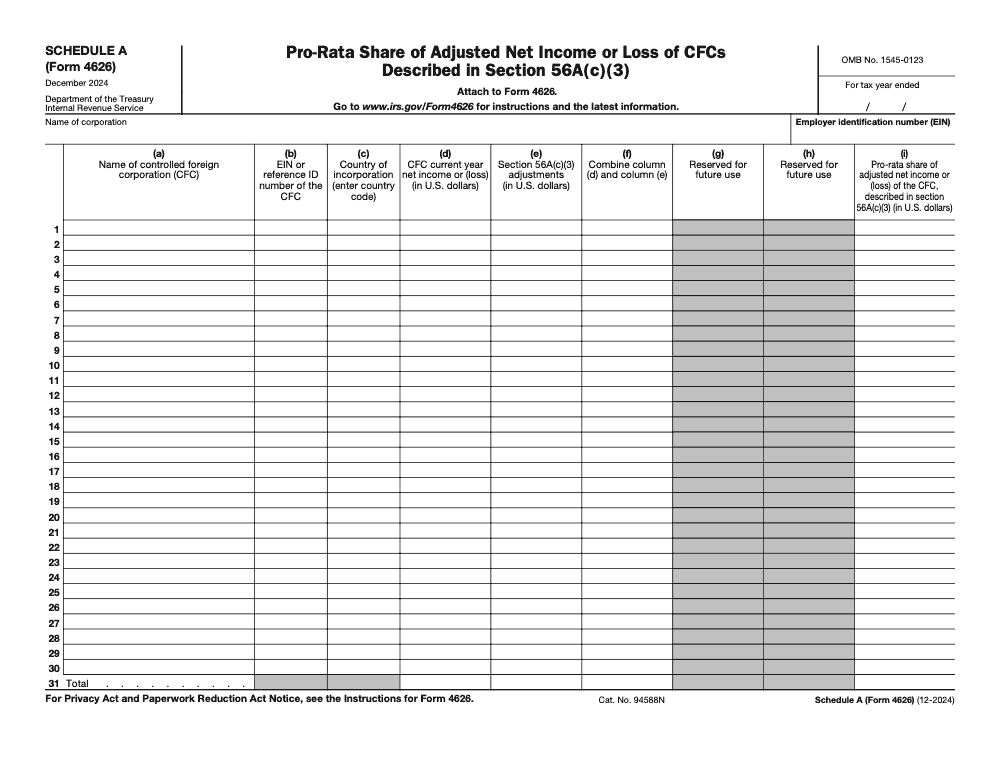
Schedule A lists each controlled foreign corporation in a U.S. shareholder's CAMT calculation, capturing the pro-rata adjusted net income or loss under section 56A(c)(3), with a separate Schedule A attached for each of the three preceding tax years. Convert AFS currency using the weighted average exchange rate. The aggregate feeds Form 4626 Part I line 2c, or line 11b for foreign-parented group members, and the AFSI tests at $1 billion and $100 million. One quick rule for the SOP: one CFC per row, amounts converted to U.S. dollars, and no netting across CFCs on the schedule.
Key Takeaways
- Schedule A is where you list each CFC’s per‑year, pro‑rata adjusted net income or loss described in section 56A(c)(3) for the three preceding tax years. You attach a separate Schedule A for each of those three years. These amounts roll into your AFSI and Part VI on Form 4626.
- Your source is Form 5471 Schedule H‑1, which computes each CFC’s adjusted net income or loss for CAMT. Use the weighted average exchange rate when converting AFS currency to U.S. dollars, and disregard income taxes included on the CFC’s AFS as required.
- For threshold testing, the general AFSI test is 1 billion, the FPMG additional test is 100 million, and the interim simplified method lets you test against 800 million and 80 million for returns not filed as of June 23, 2025. If you qualify for the simplified method and were not previously applicable, you indicate “Yes” to Form 1120 Schedule K question 29(c), and you do not file Form 4626.
- Do not net CFCs together on Schedule A. Enter each CFC’s positive or negative amount by year. When you aggregate for the applicable corporation determination, negative combined CFC amounts can become zero on the relevant line per instructions.
What Schedule A is and why it matters
Schedule A of Form 4626 captures, on a CFC‑by‑CFC basis, your pro‑rata share of each CFC’s adjusted net income or loss under section 56A(c)(3) for each of the three preceding tax years. If you have multiple CFCs, you list each one, then repeat for each prior year. These per‑CFC figures flow into Adjusted Financial Statement Income, then feed Part VI, which totals the aggregate pro‑rata CFC amounts used elsewhere on Form 4626. In short, Schedule A is the backbone for the CFC pieces of your CAMT scope and liability.
Tip, complete a separate Schedule A for each prior year column, then reference Part I and Part VI as your control totals. The 2024 instructions formalized this, which reduces confusion that existed when this lived on worksheets.
When you must complete Schedule A
If you are a U.S. shareholder of one or more CFCs and you are determining applicable corporation status or computing CAMT, you complete Schedule A for each of the three preceding tax years. If the corporation is a member of a foreign‑parented multinational group, the instructions tell some filers to enter zero on the specific line in Part I for the CFC aggregate, however Schedule A still documents the per‑CFC amounts driving your AFSI analysis and the entries that appear in Part VI.
Schedule A ties directly to the three‑year average AFSI test. For many groups, this is the page that determines if you cross the threshold and become an applicable corporation. Keep ownership periods accurate for each year, especially if percentages changed midstream due to acquisitions or restructurings.
Where the numbers come from
Use Form 5471 Schedule H‑1 as your base
Pull each CFC’s adjusted net income or loss from Schedule H‑1. That schedule starts with net income on the applicable financial statements and applies section 56A(c) adjustments to reach adjusted net income or loss for CAMT. Report the amounts in the AFS currency, then convert to U.S. dollars using the weighted average exchange rate, not a year-end spot rate (the AFSI translation conventions under section 56A govern the method). The H‑1 instructions reference proposed regulations for the exchange rate definition, and they remind you to disregard applicable income taxes taken into account on the AFS when computing the CAMT figure.
- If the CFC owns a disregarded entity, treat them as a single CAMT entity for the adjustment step on H‑1.
- If the CFC has depreciation differences on section 168 property, H‑1 has a specific adjustment line for the delta between book and section 167 depreciation, which then flows into the adjusted net income or loss you bring to Schedule A.
Map H‑1 to Schedule A columns cleanly
The 2024 instructions tell you how to complete each column:
- Column (a) Name, column (b) EIN or reference ID, column (c) country code.
- Column (d) current year net income or loss in U.S. dollars for the relevant year.
- Column (e) section 56A(c)(3) adjustments.
- Column (f) sum of columns (d) and (e).
- Columns (g) and (h) are reserved for future use, leave them blank since they are shaded and accept no entries.
- Column (i) is your pro‑rata share of the CFC’s adjusted net income or loss to carry to Part I and Part VI where applicable.
Confirm that your pro‑rata share reflects the correct ownership for that year. If ownership changed midyear, follow the rules similar to section 951(a)(2) when sizing the pro‑rata amount. Keep your workpapers clear about timing, eliminations, and any translation support you applied on H‑1.
Keep your terminology straight
- AFSI is your adjusted financial statement income, the base for CAMT.
- CFC amounts on Schedule A are section 56A(c)(3) items, not Subpart F or GILTI taxable income measures.
- Part VI is where the CFC aggregate shows up inside Form 4626. You will still rely on Schedule A as the detailed backup for each CFC and each year.
Note, this article is general information, not tax advice. Always confirm positions with your advisors and the latest IRS guidance for the specific years you are filing.
Aggregation, controlled groups, and thresholds you must test
The core thresholds
You test applicable corporation status based on a three‑year average AFSI:
- General AFSI test, 1 billion average annual AFSI.
- FPMG AFSI test, the group must meet the 1 billion global test, and the U.S. member threshold is $100 million average annual AFSI.
If you use the IRS interim simplified method for returns not yet filed as of June 23, 2025, the thresholds drop to 800 million for the general test and 80 million for the FPMG U.S. member test. If you meet this interim safe harbor and were not already an applicable corporation in a prior year, indicate “Yes” to Form 1120 Schedule K question 29(c), and you do not file Form 4626 for that year.
Heads‑up, the IRS updated the simplified method in 2025. If you have older memos that cite 500 million or 50 million, update them to 800 million and 80 million for this interim method.
How aggregation works
For controlled groups under sections 59(k)(1)(D) and 52 and consolidated groups, AFSI is determined on a combined basis before you drop into Schedule A detail. Then you bring the CFC pro‑rata amounts in through Part I and Part VI with support from Schedule A and H‑1. Consolidated groups compute CAMT on a consolidated basis, so make sure the AFS you start from aligns with the consolidated presentation, then layer in the Schedule A CFC amounts correctly.
Terminating applicable corporation status
Once you become an applicable corporation, you generally stay in until you meet a termination rule. Proposed regulations describe two exit paths. First, a qualifying change in ownership can end status. Second, if you do not meet your applicable average AFSI test for five consecutive years, your status can terminate. Keep in mind, these are proposed rules, and the IRS continues to issue interim guidance while final regulations are pending.
Line‑by‑line mindset for Schedule A
Here is a simple way to avoid rework:
- Identify every CFC, legal name, EIN or reference ID, and country code (Schedule A provides 30 entry rows, attach additional statements if you have more than 30 CFCs rather than truncating the list).
- Tie each CFC’s H‑1 adjusted net income or loss for each of the three prior years.
- Apply your ownership percentage for that year to arrive at column (i) per CFC, and do not net across CFCs on this schedule.
- Repeat the process for each of the three prior years, attaching a separate Schedule A for each year as instructed.
Useful table, know your columns
| Schedule A column | What to enter | Source to tie |
| (a), (b), (c) | CFC name, EIN/reference ID, country code | Entity records, 5471 header |
| (d) | Current year net income or loss in USD | H‑1 base, after translation |
| (e) | Section 56A(c)(3) adjustments | H‑1 adjustments detail |
| (f) | Sum of (d) and (e) | Computed |
| (g), (h) | Reserved | n, a |
| (i) | Your pro‑rata share of adjusted net income or loss | Ownership schedule and H‑1 |
ProConnect Tax steps that actually work
You can generate Form 4626 and Schedule A in ProConnect with a few clicks once your workpapers are clean:
- Open Input Return, Taxes, Alternative Minimum Tax, then check Include Form 4626 with return.
- In the left panel, select Form 4626, Schedule A to add the CFC detail.
- Enter each CFC with three years of amounts backed by H‑1.
- Complete other AFSI adjustments in the Alternative Minimum Tax section so amounts flow to Form 4626 Parts I through VI.
- Review the populated totals, then compare to your H‑1 and consolidation workpapers.
If your corporation is a member of an FPMG, follow the instruction that tells you when a specific Part I line should be zero, and then maintain the Schedule A backup with H‑1 references in case an examiner requests it.
Common pitfalls and quick fixes
- Missing the separate Schedule A per year, the 2024 instructions require a separate schedule for each of the three prior years.
- Carrying AFS taxes into H‑1 adjusted net income, the CFC AFS tax is disregarded for CAMT. Reconcile this on H‑1 and document the line used.
- Ownership percentage drift, tie each year’s pro‑rata share to the correct period ownership. The wrong percentage in a prior year will throw off the three‑year average AFSI test.
- Using the old simplified method thresholds, update to 800 million and 80 million for the interim method and document the Schedule K question 29(c) position if out of scope.
Documentation tip, prepare a short “statement of rules” that maps each Form 4626 line you relied on to a notice, instruction, or proposed regulation, and keep it with your return file. It reduces back‑and‑forth if you are asked later.
Putting it all together with a quick example
Imagine you own three CFCs. One has adjusted net income, one has a loss, and one swings year to year. On Schedule A, you enter each CFC separately for each of the three prior years, apply the correct ownership for that year to get your pro‑rata amount, and resist any urge to net them on the page. Then you carry totals to Part I and Part VI as the instructions direct. If an aggregate for the CFCs is negative where the instructions tell you to enter zero, make that adjustment only at the form line, not on the Schedule A detail (the negative combined amount is not lost, it carries to the succeeding year via Part VI Section II line 4 as a section 56A(c)(3)(B) negative adjustment). The result is a clean audit trail for your AFSI testing and any CAMT computation.
Checklist you can use before you file
- Confirm every CFC is listed with name, EIN or reference ID, and country code.
- Tie column (i) per CFC to H‑1 and your ownership by year, no netting across CFCs on the schedule.
- Attach a separate Schedule A for each of the three prior tax years.
- Reconcile Part VI totals to Schedule A and H‑1, then reconcile to the AFSI rollup.
- If using the interim simplified method, document the 800 million or 80 million test and check Form 1120 Schedule K question 29(c) as instructed.
Where an offshore partner helps, only when it truly matters
You might not need outside help. But if your team is drowning in workpaper prep, review cycles, or cross‑entity consolidation while CAMT season hits, a disciplined offshore delivery model keeps H‑1 to Schedule A ties consistent, review notes crisp, and deadlines steady. Accountably integrates trained offshore teams inside your systems and templates, with structured workpapers and layered review that protect reviewer time and reduce rework. Use this kind of help when you need production stability without giving up control.
Final word and resources
You have the framework now. Start with accurate H‑1 schedules, map them to Schedule A by CFC and year, and build a tidy trail into Part VI and the AFSI tests. If thresholds or ownership facts change, update your three‑year view and your safe harbor analysis before you file.
- IRS Instructions for Form 4626, including Schedule A and Part VI.
- IRS Instructions for Form 5471, including Schedule H‑1.
- IRS interim simplified method and filing relief, updated September 17, 2025.
- ProConnect help article on generating Form 4626 and Schedule A.
If you want a second set of eyes on your H‑1 to Schedule A mapping or a production plan that clears review bottlenecks, our team is happy to help.
Note, this guide reflects IRS instructions and notices available through November 21, 2025. Always verify updates before filing.
Common Mistakes We See Every Season
The most expensive Schedule A mistakes are the ones that look harmless on the workpaper and only surface when an examiner reconciles your Form 5471 Schedule H-1 file to your Form 4626 Part VI totals.
Reusable Checklists
These checklists are written so you can paste them directly into your CAMT SOP for the December 2024 revision of Schedule A (Form 4626).
Schedule A pre-file packet
- Confirm one Schedule A per CFC per prior year, with the tax year ended date on each header matching the parent Form 4626.
- Tie column (a) name, column (b) EIN or reference ID, and column (c) country code to the Form 5471 Schedule H-1 inputs for that CFC.
- Verify column (d) holds the CFC current year net income or loss in U.S. dollars, translated from the AFS at the weighted average exchange rate.
- Confirm column (e) carries every section 56A(c)(3) adjustment, with column (f) equal to (d) plus (e) per the IRS Form 4626 instructions.
- Leave columns (g) and (h) blank on every row of the 2025-filed revision.
- Reconcile column (i) per CFC to the pro-rata share supported by ownership for that year under section 951(b).
- Cross-check the row 31 Total to Form 4626 Part I line 2c (or line 11b for FPMG members) and Part VI Section I.
Applicable Corporation threshold test
- Pull AFS net income or loss for the three preceding tax years for every test-group member into Form 4626 Part I line 1f.
- Layer in CAMT adjustments through line 4 and compute AFSI on line 5, then the 3-year average AFSI on line 7.
- Test the $1 billion group-wide 3-year average against the section 59(k)(1) threshold on line 8.
- If the group is a foreign-parented multinational group, run the additional $100 million U.S.-connected test on line 15 under section 59(k)(2)(B).
- If neither standard threshold is met, document the interim simplified method positions ($800 million and $80 million) and check Form 1120 Schedule K question 29(c) where applicable.
- Attach Schedule A whenever any CFC pro-rata share is determined, even when the aggregate is floored at zero on Part I line 2c or line 11b.
CAMT review handoff
- Confirm Schedule A column (i) values flow to Form 4626 Part VI Section I column (d) for the CAMT computation.
- Verify Part VI Section II line 4 captures any prior-year section 56A(c)(3)(B) negative-adjustment carryover.
- Tie Part II line 7 to 15% of AFSI per section 55(b)(2)(A)(i).
- Apply the CFC CAMT foreign tax credit limitation at 15% on Part IV Section I line 3g and take the lesser of allowable taxes on line 3h.
- Track unused CFC CAMT FTC in the 5-year section 59(l) carryover columns, not the section 904 10-year window.
- Confirm the final CAMT liability on Part II line 13 lands on Form 1120 Schedule J line 3.
- Lock the workpaper-to-form crosswalk before reviewer sign-off, with H-1 references stored alongside the return.
Keep Schedule A (Form 4626) Season From Stalling
Schedule A pressure does not arrive in March the way individual return work does. It builds quietly through the consolidation cycle, then lands as a wall when the CAMT review window opens, the CFC count is north of 20, and someone realizes the Form 5471 Schedule H-1 packets have not been translated into U.S. dollars yet. The Inflation Reduction Act of 2022 brought the Corporate Alternative Minimum Tax online for tax years beginning after December 31, 2022 (per Public Law 117-169), and Schedule A is the choke point where three years of CFC adjusted net income data have to reconcile cleanly to Form 4626 Part I and Part VI.
The fix is not more hours. It is a tighter chain between the H-1 prep team and the Form 4626 reviewer, so every CFC entry is workpaper-supported the first time and no row gets reopened in week three.
- Standardize H-1 to Schedule A mapping templates so column (d) net income, column (e) section 56A(c)(3) adjustments, and column (f) sum are tied to named tabs in the workpaper, not free-form notes.
- Lock the weighted average exchange rate per CFC at the start of the cycle and keep the translation memo in the file, so a reviewer never has to recompute the U.S. dollar figure under audit pressure.
- Track per-year ownership percentages in a single source so the pro-rata share in column (i) is consistent across every year's Schedule A and matches the section 951(b) 10% U.S. shareholder thresholds.
- Run the 3-year AFSI test ($1 billion group-wide, plus $100 million U.S.-connected for FPMG members) once CFC totals are signed off, not in parallel with data entry.
- Carry the section 56A(c)(3)(B) negative-adjustment trail to Part VI Section II line 4 every cycle, so prior-year carryovers are not lost when reviewers turn over.
Disciplined CAMT execution is what we build inside our taxation delivery model: structured workpapers, multi-layer review, and SLA-backed turnaround so your seniors review positions, not translation rates.
FAQs
You complete Schedule A if you are a U.S. shareholder of one or more CFCs and you are determining applicable corporation status or computing CAMT. You attach a separate Schedule A for each of the three preceding tax years and then use Part VI for the aggregate CFC amounts inside Form 4626.
Use Form 5471 Schedule H‑1. It starts from AFS net income or loss, applies section 56A(c) adjustments, and then you convert to U.S. dollars using the weighted average exchange rate when needed. Disregard applicable income taxes included on the CFC’s AFS when computing the CAMT figure.
For original returns not filed as of June 23, 2025, the interim simplified method reduces the general test to 800 million and the FPMG U.S. member test to 80 million. If you are below the applicable thresholds and were not previously an applicable corporation, check “Yes” on Form 1120 Schedule K question 29(c) and you do not file Form 4626 for that year. Keep records supporting your safe harbor.
Consolidated groups compute CAMT on a consolidated basis, so start with consolidated AFS and then feed in CFC amounts through Schedule A and Part VI. For FPMG members, follow the instructions that tell you when to enter zero on the specific Part I line and maintain backup.
Under the proposed regulations, status can terminate after a qualifying change in ownership or if you do not meet the applicable average AFSI test for five consecutive years. The IRS continues to update interim guidance while final rules are pending, so document your facts for each test year.
Other forms this guide names
Summarize this article with AI
About this guide
Accountably helps US CPA, EA, and accounting firms hire trained accountants and tax preparers in India.
About us Reviewed byJugal Thacker, CPAFounder and CEO at Accountably
A Washington-licensed CPA with 7+ years inside US firms – PwC, a real-estate tax practice, then a full-service firm, rising from reviewer to manager to advisory. This article was reviewed against current IRS guidance for the 2025 tax year and updated for filers preparing late returns, amendments, and 2026 estimates.
View profile →How we research, review, and update this guide
Every Accountably guide is researched against primary IRS sources, reviewed by a U.S. CPA, and refreshed as guidance evolves. Read our Editorial Guidelines to see how we source, fact-check, and update our content.