Summarize this article with AI
In Brief
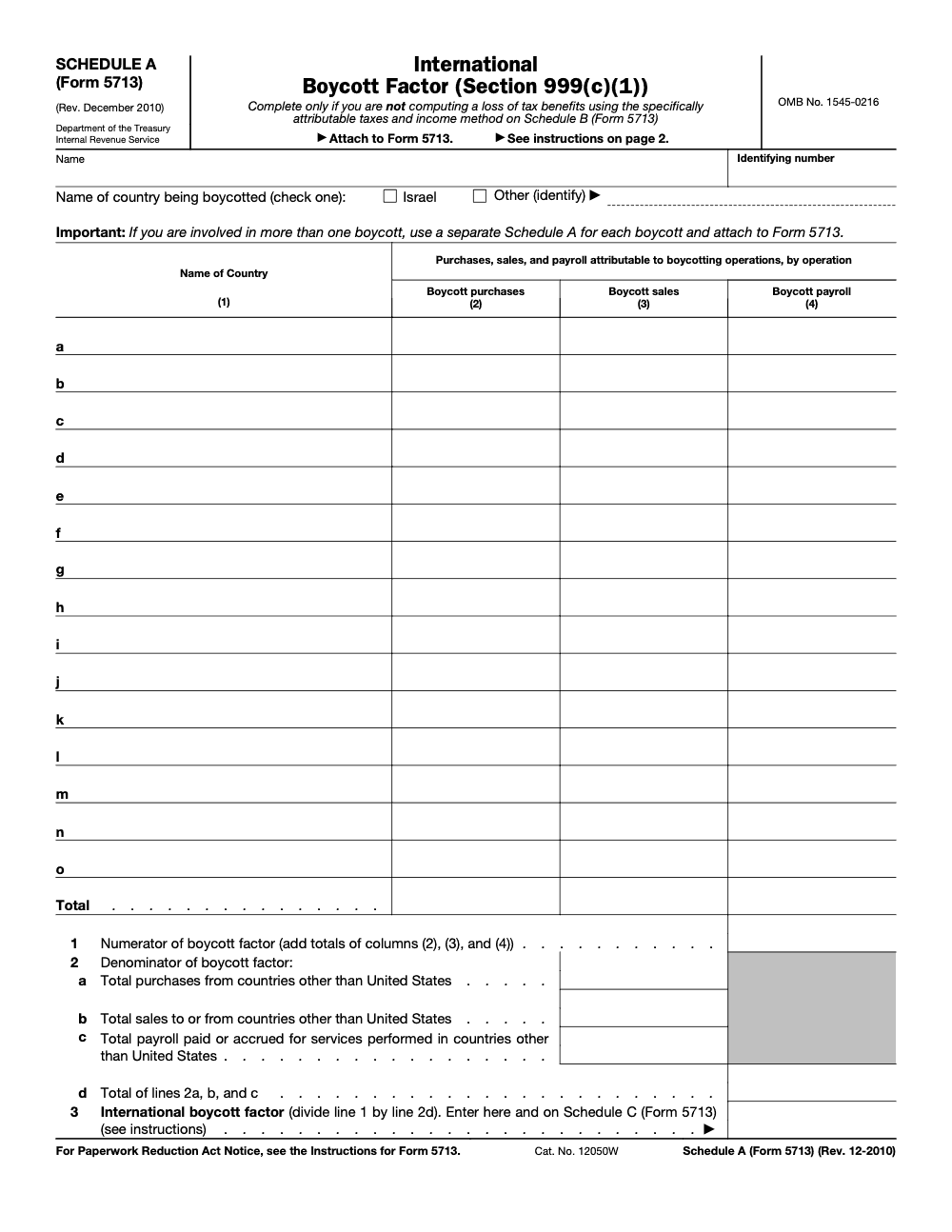
Schedule A (Form 5713) computes the International Boycott Factor under IRC §999(c)(1) – Line 1 (boycott purchases, sales, and payroll) divided by Line 2d (non-U.S. purchases, sales, and payroll). The Line 3 result carries to Schedule C (Form 5713) at Line 2a(2) for the foreign tax credit, 3a(4) for subpart F, 4a(2) for IC-DISC, 5a(2) for FSC, or 6b for the extraterritorial income exclusion (which is the one benefit where the factor method is mandatory rather than optional). The IRS continues to use the Rev. December 2010 edition for tax year 2025 filings, per the Instructions for Form 5713.
Some people read Schedule A as the harder of the two boycott methods and reach for specific attribution instead. For most filers it is the simpler path. Schedule A (Form 5713) computes the International Boycott Factor under IRC §999(c)(1): Line 1, covering boycott purchases, sales, and payroll, divided by Line 2d, the non-U.S. totals. The Line 3 result is a single percentage.
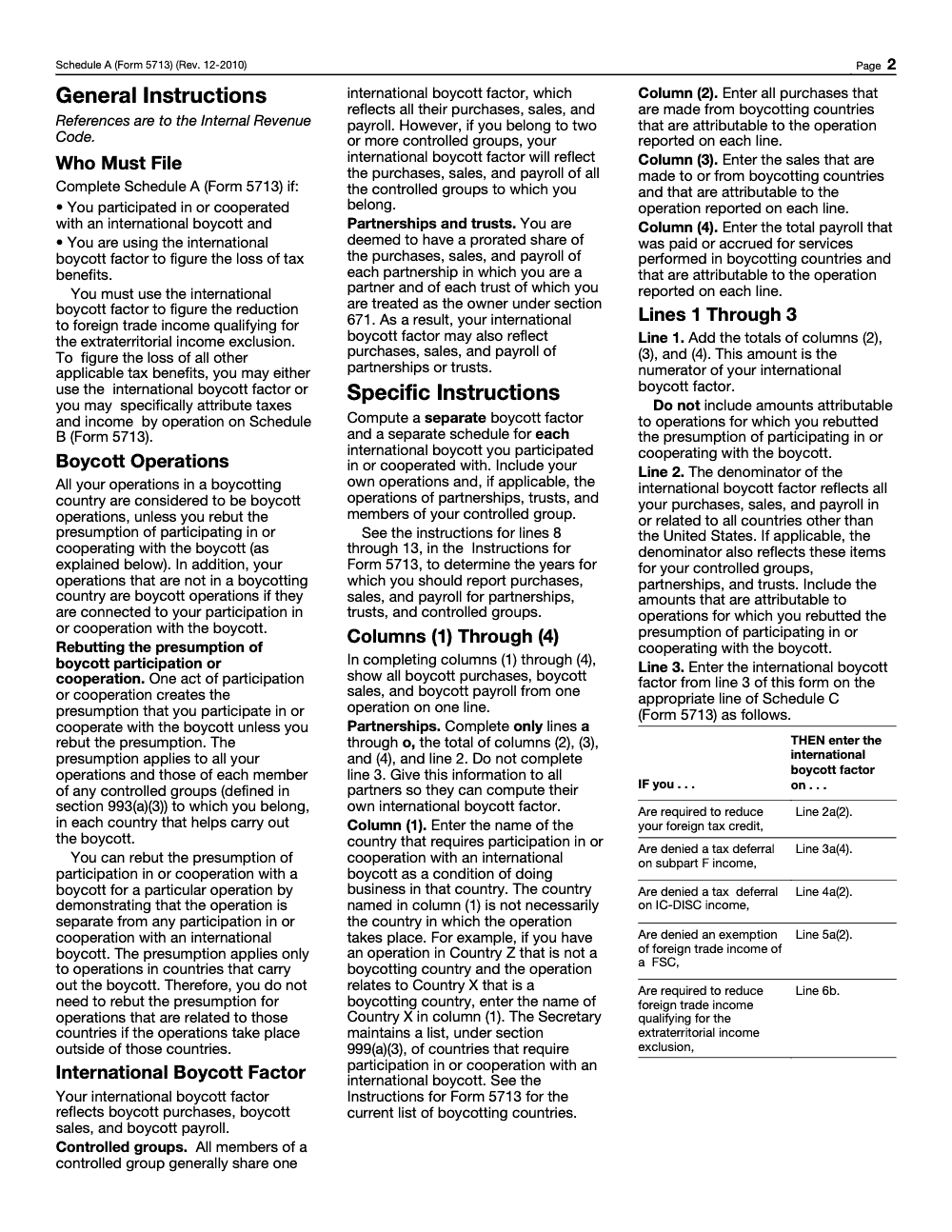
That percentage is not the end, it is the handoff. The Line 3 figure carries to Schedule C at Line 2a(2) for the foreign tax credit, 3a(4) for subpart F, 4a(2) for IC-DISC, 5a(2) for FSC, or 6b for the extraterritorial income exclusion, the one benefit where the factor method is mandatory rather than optional. Check your filing year against the current Treasury list, which removed the UAE in 2021, and confirm the IRS About Form 5713 page for the latest review date.
Key Takeaways
- Schedule A is the International Boycott Factor method under IRC §999(c)(1). It produces a percentage that you must carry to Schedule C to compute dollar disallowances.
- You use Schedule A when you elect the factor method instead of specific attribution on Schedule B. Partnerships complete parts of A or B, while partners complete Schedule C.
- For each boycotting or qualifying nonlisted country, enter total receipts, boycott‑related receipts, then compute the factor that flows through to Schedule C and ultimately to Forms 1116 or 1118.
- File Form 5713 with your income tax return for any year you participated in or cooperated with an international boycott, including attachments and representative requests if applicable.
- The Treasury boycott list is updated in the Federal Register. As of 2025 notices, the list includes Iraq, Kuwait, Lebanon, Libya, Qatar, Saudi Arabia, Syria, and Yemen. The UAE was removed in 2021. Verify your filing year.
What Is Form 5713 Schedule A
Schedule A, titled International Boycott Factor, calculates the percentage reduction to specific foreign tax benefits when you participated in or cooperated with an international boycott. The factor comes from a ratio, Line 1 (boycott purchases, sales, and payroll) divided by Line 2d (non‑U.S. purchases, sales, and payroll). You then apply the percentage on Schedule C to translate it into actual dollar disallowances that affect your foreign tax credit and other items described under IRC §999.
In practice, Schedule A is a measurement tool. Schedule C is where that measurement hits your return.
Use Schedule A if you elect the factor method under §999(c)(1) – with one exception: the factor method is mandatory for reducing foreign trade income qualifying for the extraterritorial income exclusion, where Schedule B is not allowed. If you choose to specifically attribute taxes and income to boycott operations under §999(c)(2), use Schedule B with Schedule C instead. The IRS “About” page and the instructions make this split clear, and both tie back to the same Form 5713 filing package.
The IRS instructions also outline which tax benefits can be reduced, including the foreign tax credit under section 908, and items related to historic export regimes. Even though some regimes were repealed, the instructions keep them for reference, and they explain how Schedule C postings ultimately flow to Forms 1116 and 1118.
Why This Matters For Firm Operations
Most firms do not miss here because they lack clients. They miss because delivery breaks under pressure. Schedule A exposes weak file discipline fast. If receipts do not reconcile to your ledgers or your Form 1116 or 1118 categories, reviews stall, partners get pulled back into line‑by‑line proofing, and deadlines slip. The fix is structure, not heroics. You will see that theme woven through the steps, the example, and the checklists in this guide.
When You Must Use Schedule A
You must complete Schedule A for the tax year in which you participated in or cooperated with an international boycott and you elect the factor method (and if you are involved in more than one international boycott, you must file a separate Schedule A for each boycott and compute a separate factor – do not combine boycotts on one schedule). Attach Schedule C to compute the loss of tax benefits. The instructions confirm filing with the income tax return, including extensions, and outline electronic filing mechanics.
For avoidance of doubt, the IRS “About Form 5713” page lists each schedule’s purpose and links to the current PDFs. Use that page to grab the latest forms package before you start your workpapers.
Quick Orientation To The Current Boycott List
Treasury publishes a quarterly list in the Federal Register. For 2025 notices, the list includes Iraq, Kuwait, Lebanon, Libya, Qatar, Saudi Arabia, Syria, and Yemen. The United Arab Emirates was removed in 2021 after it ended participation in the Arab League boycott, which Commerce and Treasury acknowledged in public releases. Always confirm the list that applies to your tax year because you must classify operations and receipts by country accordingly.
How This Guide Is Organized
- What, who, and when, including key definitions and the current list.
- A step‑by‑step checklist to build airtight workpapers that reviewers can clear quickly.
- A worked example that shows the factor, then how it moves into Schedule C.
- Common mistakes and fixes, so you can prevent rework and questions.
- Practical workflow tips for busy firms, including light process ideas.
- FAQs that mirror the questions we hear during reviews.
You will see a steady focus on clarity, review protection, and audit‑ready documentation. That is how you keep production moving without burning out your team.
Author And Process Transparency
This article was developed by Accountably’s Tax Ops team, reviewed by a U.S. CPA for technical accuracy, and produced with editorial support that may include automation. We cite primary sources and reference the filing year where rules are time‑sensitive.
Who Must File, And When
If you are a U.S. person under §7701(a)(30) and you participated in or cooperated with an international boycott, you file Form 5713 and, when electing the factor method, you complete Schedule A and Schedule C. Members of a controlled group align methods, and partners complete Schedule C on their own returns while the partnership completes the relevant parts of A or B (specifically, a partnership filing Schedule A completes only lines a through o, the column totals, and Line 2 – it does NOT complete Line 3, because the boycott factor is computed at the partner level using each partner's own combined data). File with your income tax return, including extensions.
Penalties And E‑File Notes
Willful failure to file Form 5713 can trigger a fine up to 25,000 dollars, imprisonment up to one year, or both. The instructions also explain that if you attach Form 5713 to an e‑filed return, you do not file a duplicate paper copy. Build this into your compliance calendar and e‑file packaging.
Confirm The Boycott List For Your Year
Treasury’s quarterly notices keep repeating the same list through 2024 and 2025, namely Iraq, Kuwait, Lebanon, Libya, Qatar, Saudi Arabia, Syria, and Yemen. Cite the exact notice date in your workpapers to reduce exam friction. We often reference the January 3, 2025 and July 31, 2025 notices when preparing 2025‑year returns.
If your facts touch a nonlisted jurisdiction that you have reason to believe requires cooperation, you still report. The instructions explain that “boycotting country” also includes those cases when you know or have reason to know a country requires cooperation. Document your basis.
Schedule A Versus Schedule B, Which Method Should You Use
Schedule A gives you a proportionate reduction, a percentage you apply to affected items. Schedule B uses specific attribution by tracing taxes and income to boycott operations. Many firms default to Schedule A because it is operationally simpler when documentation is uneven across entities. Use a quick decision lens.
Decision Lens
- Use Schedule A when you can confidently segment receipts by country and you want predictable review cycles.
- Use Schedule B when you have clean tracing of taxes and income to boycott operations and expect a lower reduction than a broad factor (with one exception: you must use the Schedule A boycott factor to compute the reduction to foreign trade income qualifying for the extraterritorial income exclusion – Schedule B is not allowed for that specific benefit).
- Coordinate across controlled groups so you do not mix methods accidentally.
Side‑By‑Side Reference
| Method | What You Prove | Strengths | Watchouts |
| Schedule A, Factor | Country receipts split into total and boycott‑related, plus any specified items | Faster to build at scale, easier cross‑entity alignment, predictable | Requires strict definitions for numerator and denominator, documentation discipline |
| Schedule B, Specific | Direct tracing of taxes and income to boycott operations | Potentially lower disallowance if tracing is strong | Heavy documentation lift, higher review load |
| Schedule C | Applies either method to compute dollar disallowances and posts to FTC forms | One place to translate factor into dollars | Garbage in, garbage out, if Schedules A or B are weak |
Both methods end on Schedule C, which then flows to your foreign tax credit forms. The IRS pages and instructions confirm these roles.
Step‑By‑Step, Build Audit‑Ready Workpapers For Schedule A
This is the workflow our team uses when we stand up boycott factor files for busy firms. Adjust names to your taxonomy.
Step 1, Set The Year And The List
- Lock the tax year that matches Form 5713.
- Pull the Federal Register notice for that year and drop the PDF in the binder. Note the date. We often use the January or mid‑year notice for the same tax year.
- If your facts involve the UAE, remember it was removed in 2021. Add a short note to avoid unnecessary listings.
Step 2, Map Books To Country Lines
- Create a country ledger that ties gross receipts to each boycotting or relevant nonlisted country, and remember: operations that take place OUTSIDE a boycotting country are still boycott operations if they are connected to your participation in or cooperation with the boycott – physical location is not the test.
- Reconcile the total to your trial balance and to the FTC category mapping used on Forms 1116 or 1118. The instructions expect this cross‑tie.
- Document allocation methods where a transaction touches multiple jurisdictions.
Step 3, Capture Boycott Requests And Agreements
- Log each request or clause, identify the requester, the country, dates, and whether accepted.
- Attach representative samples if the volume is large.
- Note agreements and periods if cooperation continued. The instructions describe requests and agreements and the need for attachments.
Step 4, Populate Schedule A Columns
- Column (1), the name of the boycotting country – the country that requires participation in or cooperation with the boycott, not necessarily where the operation physically takes place.
- Columns (2), (3), and (4), boycott purchases, boycott sales, and boycott payroll attributable to each operation.
- Compute the factor by line, then aggregate as required for the percentage.
- Retain a reconciliation statement that shows how you derived each figure. Use the IRS instructions language to keep reviewers aligned.
Step 5, Carry The Percentage To Schedule C
- Move the computed percentage to Schedule C.
- Apply it to the affected tax benefits, including the foreign tax credit. The IRS materials explain that Schedule C is the translation into dollars and that postings then flow to Forms 1116 or 1118.
Worked Example, From Receipts To Dollar Disallowance
Assume your calendar‑year corporation operated in two boycotting countries.
- Country A receipts total 10,000,000 dollars, with 2,000,000 dollars boycott‑related.
- Country B receipts total 6,000,000 dollars, with 900,000 dollars boycott‑related.
- Total receipts across A and B equal 16,000,000 dollars. Boycott‑related receipts equal 2,900,000 dollars.
International Boycott Factor equals 2,900,000 divided by 16,000,000, which is 18.125 percent. (This stylized example treats receipts as a proxy for the underlying amounts; the actual Line 2d denominator is the sum of all non‑U.S. purchases, sales, and payroll – Lines 2a, 2b, and 2c – not just receipts from boycotting countries.) You list A and B on separate lines, compute the factor per line if needed, then derive your combined factor for Schedule C consistent with the instructions. One trap worth flagging: if you successfully rebutted the presumption of participation for any operation, exclude those amounts from the Line 1 numerator – but you still include them in the Line 2 denominator. Pulling rebutted amounts out of both sides overstates the factor and the loss of tax benefits.
On Schedule C, apply 18.125 percent to the base relevant to your facts. For example, if your foreign tax credit pool for the year is 3,000,000 dollars of creditable taxes in the general category, your potential reduction equals 543,750 dollars, subject to the Schedule C mechanics and any specific instructions for the benefit at issue. The instructions outline which benefits are subject to reduction and where the amounts ultimately post.
Attachments, Documentation, And Recordkeeping
Create a one‑page index at the front of your Schedule A folder. Examiners and reviewers clear faster when they can see the spine of your file.
| Requirement | What To Include | Why It Matters |
| Boycott requests and clauses | Copies or representative samples, dates, requester, acceptance status | Substantiates boycott‑related receipts and agreements |
| Country ledger | Country‑level receipts, method notes, reconciliations to TB and FTC categories | Bridges books to Schedule A and onward to Schedule C |
| Federal Register notice | The exact quarterly notice for your tax year | Confirms your country list by date, reduces questions |
| Controlled group alignment | Memo on method selection and alignment across members | Prevents mixed methods and inconsistent factors |
| Workpaper integrity | Versioned files, standardized names, reviewer checklists | Cuts review time and rework risk |
| E‑file package | PDFs of Form 5713 and schedules, file naming, sign‑off trail | Keeps filing complete and consistent |
If you e‑file, attach Form 5713 and schedules with the return and avoid duplicate paper filings. The IRS instructions confirm both timing and e‑file treatment.
Common Mistakes And Clean Fixes
- Pulling companywide revenue into the denominator. The Line 2 denominator is limited to non‑U.S. purchases (Line 2a), sales (Line 2b), and payroll (Line 2c) – U.S. amounts are excluded. Reconcile to books.
- Aggregating multiple countries on one line. Use one line per country, and, if needed, one line per person within a country with an attached summary.
- Weak documentation of requests. Keep samples, note acceptance, and list agreement periods.
- Forgetting Schedule C. The factor does not affect any dollar until you apply it on Schedule C. The IRS materials make this explicit.
Quick QA Pass Before You File
- Do country totals tie to your trial balance and your Form 1116 or 1118 category mapping.
- Does your boycott list match the Federal Register for your filing year.
- Is the Schedule C math consistent with your chosen method, factor or specific attribution.
How The Boycott List Impacts Your Facts
For 2025 notices, the Treasury list includes Iraq, Kuwait, Lebanon, Libya, Qatar, Saudi Arabia, Syria, and Yemen. If you see transactions in the UAE after April 8, 2021, document why you are not listing UAE for those periods. Add a short note citing the Commerce statement that Treasury removed the UAE from the list in April 2021.
Using the right list is one of the fastest ways to reduce review questions. Include the notice date in your cover memo and move on.
Workflow Tips That Keep Reviews Moving
You can file a perfect Schedule A with a small team if the process is tight. Here are practices we use with firms during busy season.
- Create a standard country ledger template with columns for total receipts, boycott‑related receipts, allocation notes, and cross‑ties to ledger accounts.
- Name files consistently, for example YY‑Entity‑5713‑Country‑Ledger.xlsx, and lock a version on manager sign‑off.
- Use a short reviewer checklist that mirrors the IRS instruction headings. That way, comments stay aligned with rules.
- Build a binder tab for Federal Register notices and paste the exact text of the current list into your memo with the citation.
If your internal capacity is stretched, consider structured help, not resumes. Accountably integrates trained offshore teams into your workflow, uses standardized workpapers, and sets review checkpoints so partners are not stuck in loops. This is useful when your team needs to clear Schedule A files quickly and consistently without resetting your process every week.
Final Filing Checklist
- Form 5713 attached to the income tax return for the correct tax year.
- Schedule A completed for each relevant country line with reconciliations to books.
- Schedule C completed and posted to the right FTC forms.
- Federal Register notice for your year saved in the binder and cited by date.
- Controlled group memo confirming method selection.
- Reviewer sign‑offs and final e‑file package staged.
Common Mistakes We See Every Season
These are the recurring miss patterns we see on Schedule A files during review. Most do not surface in the math – they show up at Column (1), at the method election, or at the controlled group aggregation step.
Reusable Checklists
Drop these into your firm's SOP library and tick them off as you go. Each list maps to a phase of the Schedule A workflow.
Pre-File Data Gather
- Pull the current Federal Register §999(a)(3) boycotting country notice for the return year and save it to the engagement binder with the publication date.
- Confirm whether the filer participated in or cooperated with one boycott or more than one (separate Schedule A per boycott).
- Tag every operation row as boycott, rebutted, or non-boycott in the source workbook.
- Identify the boycotting country for each operation in Column (1) terms, separate from where the operation physically sits.
- List the affected tax benefits in scope (foreign tax credit, subpart F, IC-DISC, FSC, ETI exclusion) and note which is forced-factor.
- Capture any representative boycott requests received and a sample of agreements.
Boycott Factor Computation QC
- Line 1 numerator equals the sum of column (2), (3), and (4) totals – rebutted operations excluded.
- Line 2a (purchases), 2b (sales), and 2c (payroll) cover all non-U.S. amounts, rebutted operations included.
- Line 2d equals Line 2a plus 2b plus 2c.
- Line 3 equals Line 1 divided by Line 2d, carried to the right places on Schedule C.
- If filer belongs to a controlled group under IRC §993(a)(3), Lines 2a–2c aggregate every member's non-U.S. amounts – one factor per group, not one per member.
- Partner-level files pick up prorated shares from each partnership K-1 and each grantor trust under IRC §671 before computing Line 3.
Schedule C Carry-Through Review
- Schedule C Line 2a(2) populated for the foreign tax credit reduction (if elected method is factor).
- Schedule C Line 3a(4) populated for subpart F deferral denial.
- Schedule C Line 4a(2) populated for IC-DISC deferral denial.
- Schedule C Line 5a(2) populated for FSC exemption denial.
- Schedule C Line 6b populated for the extraterritorial income exclusion reduction (factor method is mandatory here).
- Dollar disallowances on Schedule C trace to Forms 1116 or 1118 by category.
- Method election memo signed off and stapled to the file before partner review.
Keep Schedule A (Form 5713) Season From Stalling
Schedule A files do not break under volume – they break under exception handling. Treasury republishes the boycotting country list under IRC §999(a)(3) on a roughly quarterly cadence in the Federal Register, and the form still rides on the Rev. December 2010 edition for tax year 2025 (per the Instructions for Form 5713). Every filing year carries a fresh diligence step that does not sit on a standard tax calendar, and that step is exactly where reviewer comments stack up.
The fix is not more senior hours. It is a tighter cradle around four moving pieces: the current country list, the method election, the controlled group aggregation, and the carry to Schedule C.
- Pin the current Federal Register §999(a)(3) notice to the engagement binder before any data pull, and date-stamp it against the return year.
- Lock the method election (Schedule A factor versus Schedule B specific attribution) in writing before workpapers start – the factor method is forced only for the ETI exclusion reduction, so the choice still matters for the foreign tax credit, subpart F, IC-DISC, and FSC.
- Build one Line 2 denominator across the full controlled group under IRC §993(a)(3) – members share a single boycott factor, not one factor each.
- Tie each Column (1) entry to the boycotting country, not the operation's location. Column (1) confusion is the most common rework prompt on this form.
- Map each Line 3 result to the exact Schedule C line (2a(2), 3a(4), 4a(2), 5a(2), or 6b) for the affected benefit, then trace through to Forms 1116 or 1118 in the same review pass.
When the in-house bench cannot carry exception-heavy returns like Schedule A on top of the regular calendar, structured offshore execution closes the gap. Accountably runs U.S. tax outsourcing with documented workpapers, multi-layer review, and standardized country ledgers, so reviewers spend their time on judgment calls instead of chasing Federal Register attachments.
FAQs
A boycott request is any request to enter into an agreement that would constitute cooperation with or participation in an international boycott. Document the requester, country, dates, acceptance, and attach representative samples.
Yes. Consolidate similar requests by the same person within a country on a single line and attach a summary, then flag agreements with periods if cooperation continued. Keep enough samples to demonstrate the pattern.
Follow your standard return retention policy and keep boycott support through the assessment window for the return. Maintain secure storage, access logs, and a clear index so you can retrieve items quickly during an exam. The IRS instructions highlight filing requirements and potential penalties, which reinforce strong recordkeeping.
Schedule C applies the factor to compute the loss of tax benefits. Those results flow to Forms 1116 or 1118 for the foreign tax credit, and to other forms if relevant per the instructions.
Treasury’s 2025 notices list Iraq, Kuwait, Lebanon, Libya, Qatar, Saudi Arabia, Syria, and Yemen. Confirm the most recent notice for your tax year and attach it to your file.
The United Arab Emirates ended participation in the Arab League boycott in 2020, and Treasury removed the UAE from its boycott list in April 2021. Commerce issued a public statement acknowledging the change.
Other forms this guide names
Summarize this article with AI
About this guide
Accountably helps US CPA, EA, and accounting firms hire trained accountants and tax preparers in India.
About us Reviewed byJugal Thacker, CPAFounder and CEO at Accountably
A Washington-licensed CPA with 7+ years inside US firms – PwC, a real-estate tax practice, then a full-service firm, rising from reviewer to manager to advisory. This article was reviewed against current IRS guidance for the 2025 tax year and updated for filers preparing late returns, amendments, and 2026 estimates.
View profile →How we research, review, and update this guide
Every Accountably guide is researched against primary IRS sources, reviewed by a U.S. CPA, and refreshed as guidance evolves. Read our Editorial Guidelines to see how we source, fact-check, and update our content.