Summarize this article with AI
In Brief
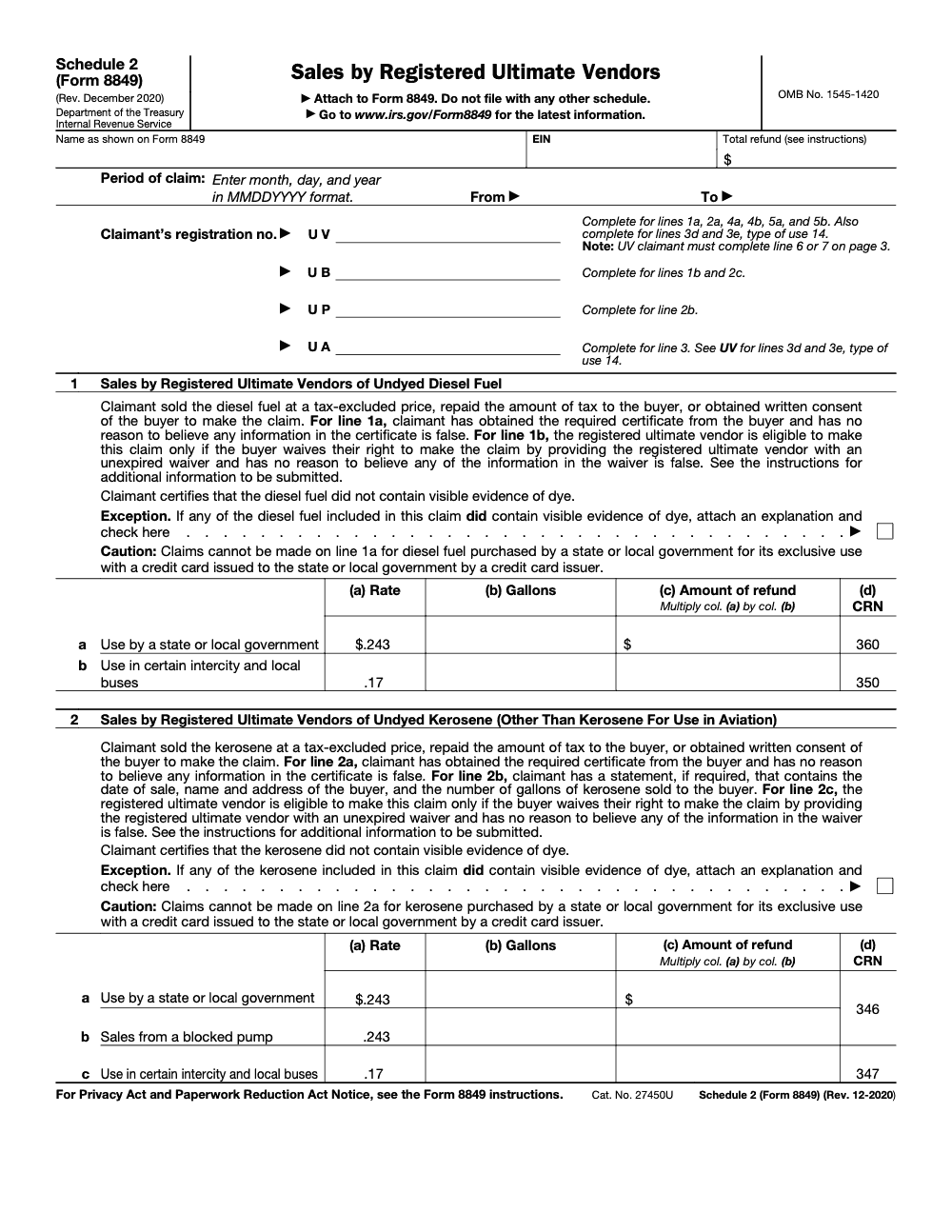
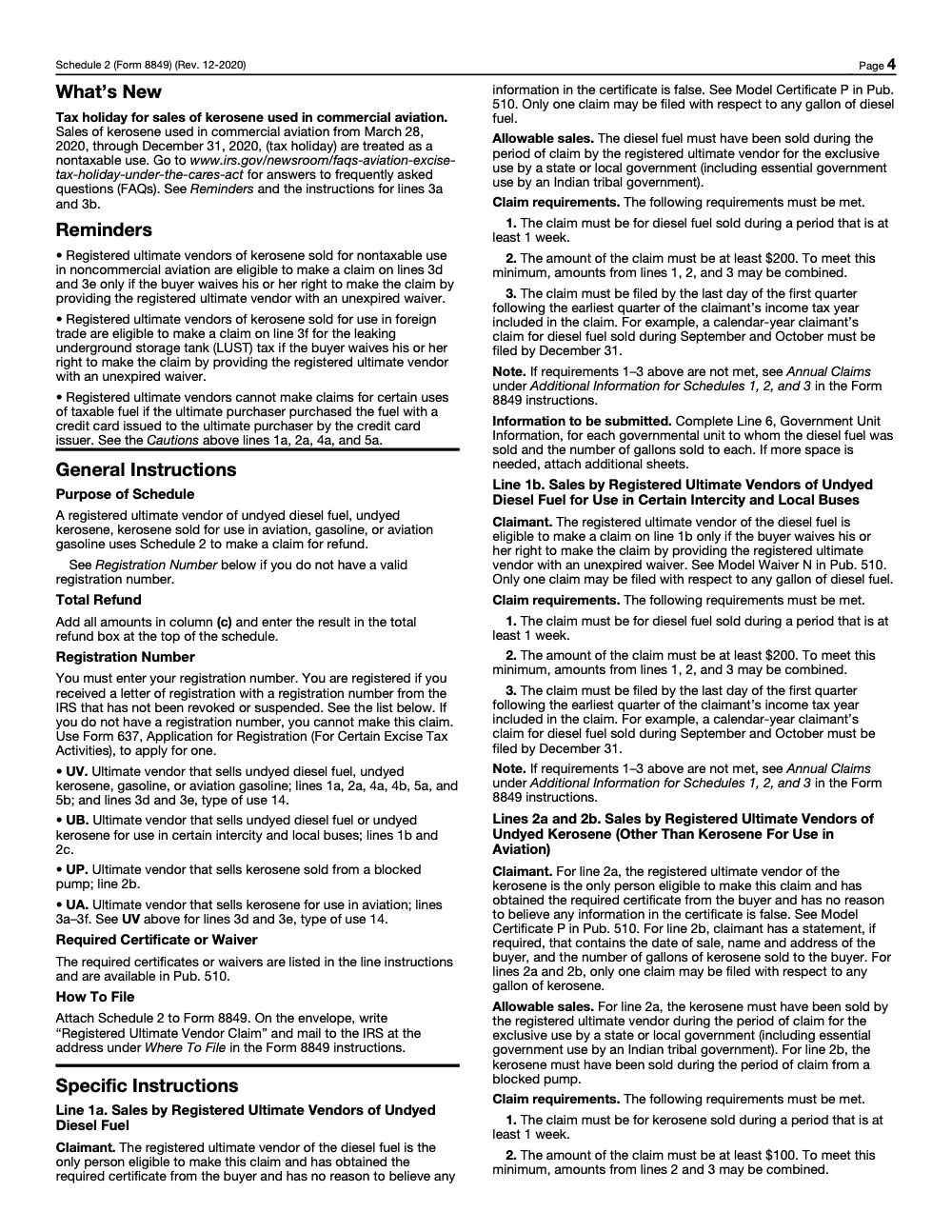
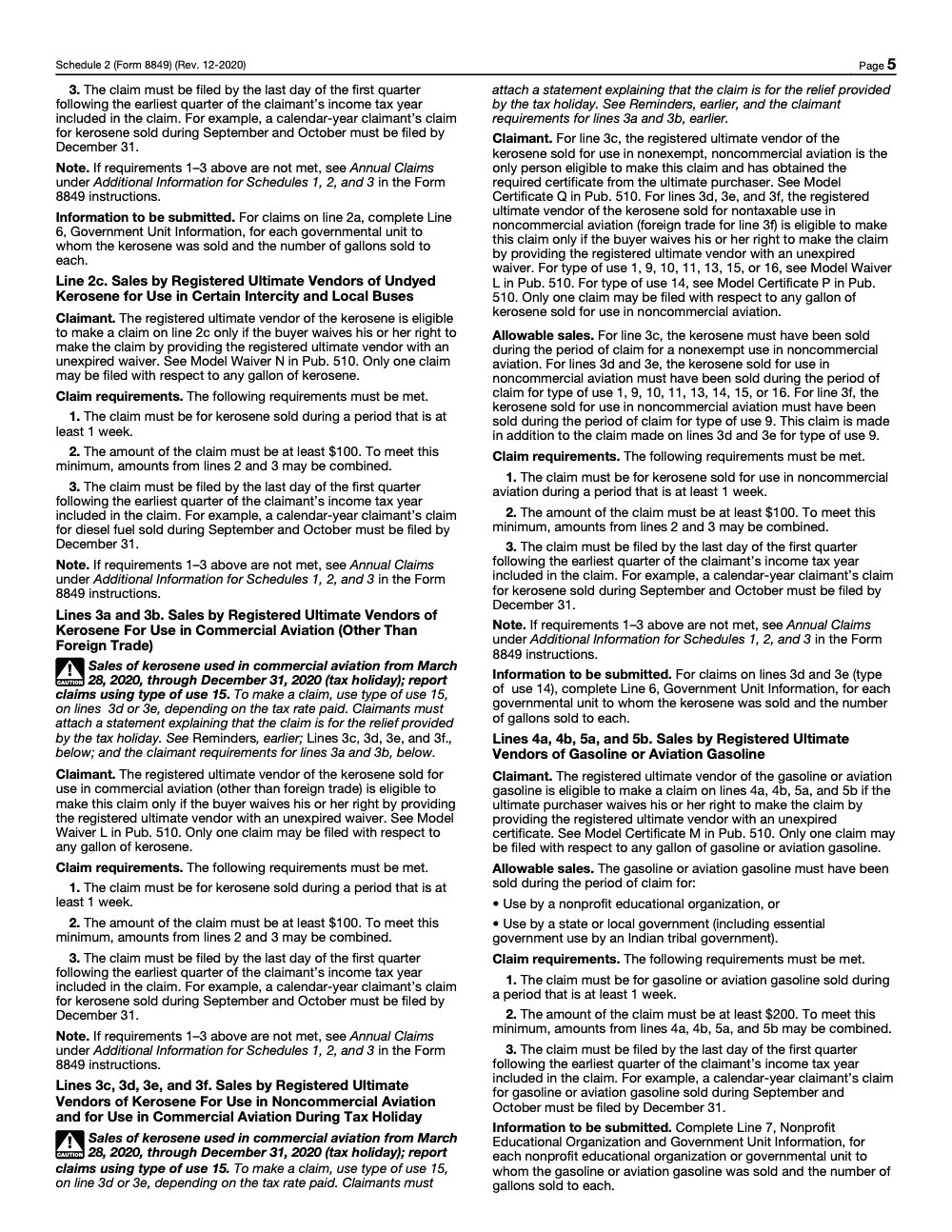
Schedule 2 (Form 8849) is the federal fuel excise tax refund claim filed by registered ultimate vendors of undyed diesel, undyed kerosene, kerosene for use in aviation, gasoline, and aviation gasoline (per the Schedule 2 (Rev. December 2020) instructions). Every claim must cover at least 1 week of qualifying sales, meet the $200 quarterly minimum on diesel and gasoline lines (or $100 on kerosene), and reach the IRS by the last day of the first quarter following the earliest quarter included in the claim.
Schedule 2 is the lane for registered ultimate vendors, not buyers, claiming back federal excise tax on eligible sales of undyed diesel, undyed kerosene, gasoline, and the aviation versions of each. The line you choose and the certificate you hold behind it decide whether the claim survives review.
The thresholds and the clock are where vendors slip. Most diesel and gasoline claims need at least $200 in refundable tax over a period of at least 1 week, kerosene categories use a $100 minimum, and the claim is generally due by the last day of the first quarter after the earliest quarter included. E-file pays faster, usually about 20 days after acceptance, and this all tracks the Rev. December 2020 version.
Key Takeaways
- Schedule 2 of Form 8849 is for registered ultimate vendors to claim refunds of federal excise tax on eligible sales of gasoline, undyed diesel, kerosene, aviation gasoline, and aviation kerosene. The IRS still publishes Schedule 2 as a December 2020 revision, and the rates and line rules in that version remain the reference as of 2025.
- Weekly minimums apply. Most diesel and gasoline claims require at least 200 in refundable tax for a period of at least one week, kerosene categories use 100 minimum. Combine lines where allowed to reach the threshold.
- Quarterly timing matters. Claims generally must be filed by the last day of the first calendar quarter after the earliest quarter included in the claim, for a calendar-year taxpayer that means Q1 due June 30, Q2 due September 30, Q3 due December 31, Q4 due March 31.
- E-file is optional but faster, the IRS says electronically filed Schedule 2 refunds are typically processed within about 20 days after acceptance.
- Certificates and waivers rule the day. Use the IRS model certificate or waiver for each category and keep them on hand when you claim, and match the document to the specific line and type-of-use code – for example, on lines 3d and 3e, type of use 14 requires Model Certificate P while types of use 1, 9, 10, 11, 13, 15, and 16 require Model Waiver L, and using the wrong template disqualifies the claim. The models live in Publication 510.
What Schedule 2 Is, And Who It Is For
Schedule 2, Sales by Registered Ultimate Vendors, is the IRS schedule a vendor uses to claim back federal excise tax that was embedded in fuel sold to certain exempt users, and only registered ultimate vendors can file it – ultimate purchasers must use a different path such as Form 4136 or Schedule 1. Think undyed diesel sold to a city for its exclusive use, kerosene sold from a blocked pump, gasoline sold to a nonprofit educational organization, or aviation kerosene in specific aviation use cases. You attach Schedule 2 to Form 8849 to request the refund, and Schedule 2 must travel on its own Form 8849, not bundled with Schedule 1, 3, 5, 6, or 8 – the schedule header itself says "Do not file with any other schedule."
You must be registered for the correct activity letters under Form 637. The schedule lists them, for example UV for gasoline and diesel vendor claims, UB for certain intercity and local bus sales, UP for blocked pump kerosene, and UA for kerosene for use in aviation. If you do not have the right registration letter, you cannot claim under that line – a pending Form 637 application does not count, and a suspended or revoked registration number does not either; the IRS must have issued an active, unrevoked registration before you file.
Just as important, you need the buyer’s documentation at the time you file. Publication 510 provides the exact templates, Model Certificate M for gasoline sold to governments or nonprofit educational organizations, Model Certificate P for certain aviation kerosene to governments, Model Waiver L for aviation kerosene commercial or other specified uses, and Model Waiver N for intercity and local bus use. Use unexpired forms that match the sale period.
The Credit Card Trap You Must Spot
If gasoline, aviation gasoline, undyed diesel, kerosene, or kerosene for use in aviation is purchased with a credit card issued to the government or nonprofit, the registered credit card issuer is generally the only party that can claim the refund. Schedule 2 even flags this with “Caution” notes on the gasoline and kerosene lines. Do not file a vendor claim if the transaction was on the buyer’s government or nonprofit card.
Covered Fuels And The Big Picture On Transactions
Here is the broad landscape of what you can claim on Schedule 2 as a registered ultimate vendor, plus the documentation you need in hand when you file:
- Undyed diesel fuel sold to a state or local government for its exclusive use, certificate required, vendor must certify the fuel was not dyed.
- Undyed diesel or undyed kerosene sold for use in certain intercity and local buses, buyer waiver required.
- Undyed kerosene sold from a blocked pump, specific pump controls and sales records required.
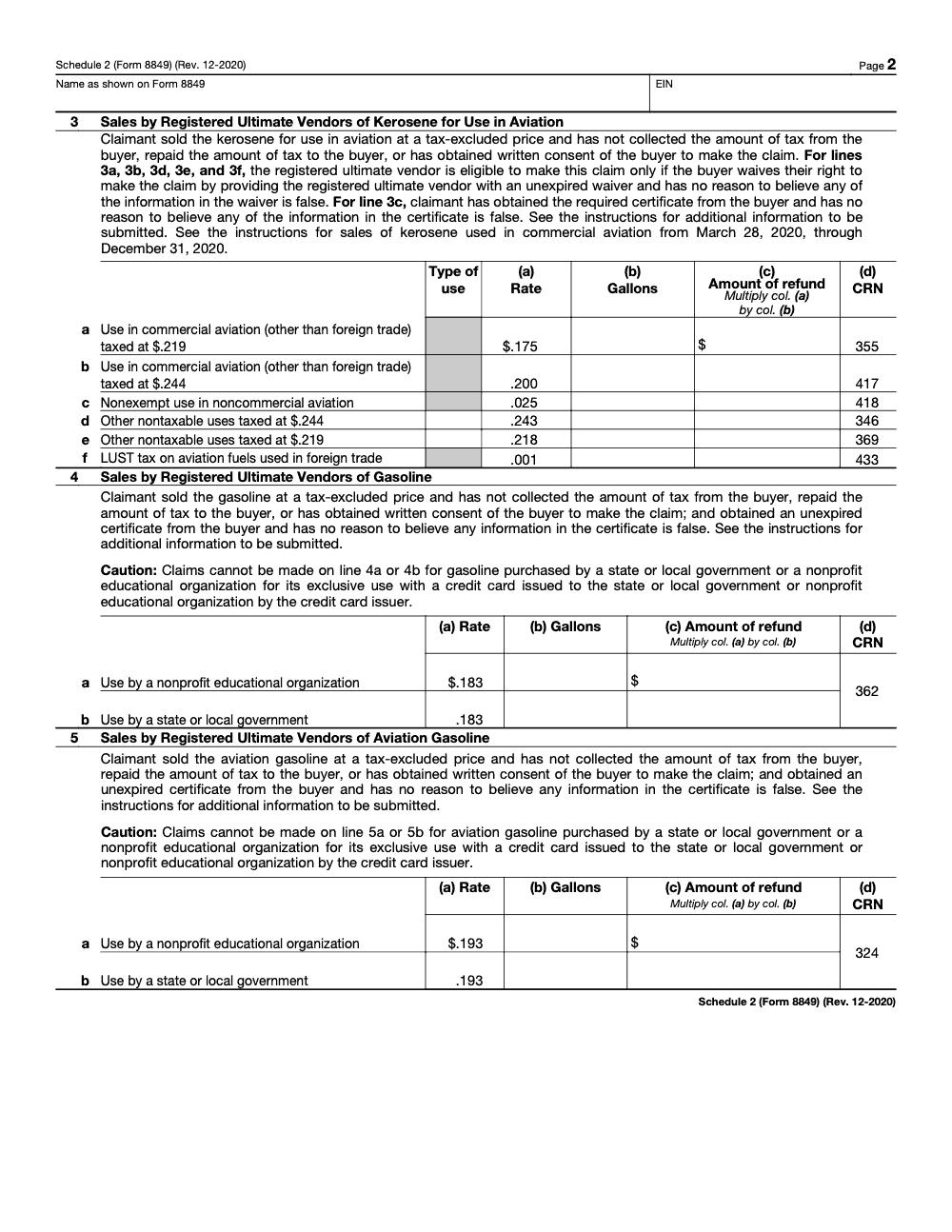
- Kerosene for use in aviation, which branches into commercial aviation, noncommercial aviation, and government aviation use, each with its own certificate or waiver.
- Gasoline or aviation gasoline sold to state or local governments or nonprofit educational organizations for exclusive use, certificate required and no credit card use.
When in doubt, look at the line instructions inside the Schedule 2 PDF itself, then cross-check the matching certificate or waiver in Publication 510’s appendix. That pairing prevents most rework during IRS review.
Eligibility, Thresholds, And Timing You Cannot Miss
You are eligible to use Schedule 2 if you are a registered ultimate vendor and you made sales that fit one of the specific line categories on the schedule. The claim period for each line must span at least one week, and there are minimum refundable tax thresholds per category. The IRS sets different minimums for diesel or gasoline lines versus kerosene lines.
Minimums And Period Rules
- Diesel and gasoline categories generally have a minimum refundable tax amount of 200 for a claim period of at least one week. You can combine related lines, as the instructions permit, to meet the minimum.
- Kerosene categories, including aviation kerosene lines, generally use a 100 minimum, again over at least one week, and you may combine the listed kerosene lines as allowed.
These numbers are on the face of the Schedule 2 instructions. Keep in mind that the schedule also lists the per‑gallon refund rates used for each line, for example 0.243 per gallon for certain government purchases of diesel or kerosene, 0.183 per gallon for gasoline to state or local governments or nonprofit educational organizations, and special rates for aviation kerosene depending on the tax paid at purchase. Always take your rates from the current Schedule 2 PDF.
Quarterly Due Dates For Schedule 2 Claims
Your claim is due by the last day of the first calendar quarter after the earliest quarter included in your claim. For calendar-year filers, that is:
- Q1 sales, due June 30
- Q2 sales, due September 30
- Q3 sales, due December 31
- Q4 sales, due March 31
This timing comes directly from the IRS claim rules applied to these excise refund claims. If you do not meet the weekly period or minimum amount for a quarterly claim, review the annual claim options described in IRS guidance – missing the quarterly window or the dollar minimum redirects the claim to an annual filing (Schedule 3 of Form 8849, Form 720 Schedule C, or Form 4136), it does not forfeit the refund.
Practical tip, build a simple calendar reminder for June 30, September 30, December 31, and March 31 so your team batches and files claims on time.
What To Gather Before You Touch The Form
You can save hours of rework if you assemble your substantiation first. At a minimum, have these on hand:
- Your legal name and EIN, exactly as used on Form 8849.
- Your Form 637 registration letter with the correct activity code, UV, UB, UP, or UA, for the line you are claiming.
- Buyer documentation, the right certificate or waiver for the line and use type, using Publication 510’s model language.
- Invoices and bills of lading that tie directly to the gallons and dates on the line, plus any blocked pump records if you are claiming line 2b.
- A clean gallons worksheet by fuel type and line, applying the per‑gallon rate shown on the schedule.
Simple Prep Table You Can Copy
| Item | What to verify before filing |
| Business ID | Legal name and EIN exactly match Form 8849 header and IRS records |
| Registration | Correct activity letter for the line being claimed, UV, UB, UP, UA |
| Fuel records | Invoice dates, fuel type, gallons, and whether fuel is undyed where required |
| Buyer proof | Right certificate or waiver, unexpired, signed by an authorized person |
| Calculations | Per‑gallon rate, gallons, and math reconcile to source documents |
The Schedule 2 PDF itself lists the rates and the information you must include, and it reminds you to attach the schedule to Form 8849 when you file.
How To Fill Out And File, Step By Step
- Download the current Form 8849 and Schedule 2 from IRS.gov. The live link for Schedule 2 points to the December 2020 revision and is still the operative version as of late 2025.
- Complete the Form 8849 header with your legal name and EIN, then attach Schedule 2.
- Work Schedule 2 line by line. Enter gallons, the applicable rate shown on the schedule, compute the refund amount, and include the required buyer identifiers where the line asks for them.
- Confirm you meet the one‑week period and minimum refundable tax for the set of lines you are filing this quarter. If you do not meet the minimum, consider combining allowable lines or waiting to meet the threshold.
- File by the quarterly deadline. If you miss it, review whether an annual claim route applies under IRS guidance.
E‑File Options, Speed, And Choosing A Transmitter
You can file Form 8849 with Schedules 1, 2, 3, 5, 6, and 8 electronically. The IRS states that refunds tied to electronically filed Schedules 2, 3, or 8 are processed within about 20 days after acceptance, while other schedules may take about 45 days. Paper is still accepted, but it is slower.
- Use an IRS‑approved transmitter or software provider for Form 8849. The IRS maintains technical pages and the MeF program documentation for tax year 2025 that show accepted forms and schedules, return due date references, and when production windows open. This is mainly for developers and vendors, but it helps you confirm that your provider supports Schedule 2 right now.
- Keep your submission receipts and the IRS acceptance acknowledgment. They are part of the refund trail if questions come up.
Accuracy Checks That Prevent Denials
Pin these checks to your prep checklist and run them before you transmit.
- Match the claim quarter to the invoice dates, especially when sales straddle quarter end.
- Validate that your buyer documentation matches the use type and is unexpired, for example Model Certificate M for gasoline to governments or nonprofit educational organizations, Model Waiver L for specified aviation kerosene uses, or Model Waiver N for intercity or local bus use.
- Recalculate gallons times the line rate shown on the Schedule 2 PDF, then tie the total refund to your header amount.
- Confirm you met the weekly period and the minimum refundable tax for your set of lines. If you did not, you may need to regroup and file later in the year rather than push a nonqualifying claim.
- Check the credit card rule for government and nonprofit purchases, if a card was used, the registered credit card issuer generally files, not you.
Documentation And Recordkeeping, What To Keep
The IRS expects you to keep the records that prove you are entitled to the claim and that the amount is correct. Keep invoices, delivery tickets or bills of lading, gallons workpapers by line, and all required buyer certificates or waivers at your principal place of business. Publication 510 explains which certificates and waivers apply and what must be in your files.
For timing, organize your folders by quarter so you can show the one‑week period test and the correct quarterly due date. If you miss the quarterly route or need to fix something later, remember that general refund claim limitations in IRS instructions require filing within 3 years of the filing of the relevant return or 2 years from when the tax was paid, whichever is later. That rule appears in the 8849 Schedule 6 instructions and is a helpful backstop for other excise refund contexts, although your goal is to meet the specific quarterly rule for Schedule 2.
Common Scenarios And How To Handle Them
- A city uses a credit card at the pump for undyed diesel. Do not file a Schedule 2 vendor claim. This is usually a Schedule 8 claim by the registered credit card issuer.
- A nonprofit educational organization buys gasoline for its exclusive use and pays on account, no card, with a valid certificate on file. That is a Schedule 2 line 4 claim, at the rate shown on the schedule.
- Aviation kerosene sold for commercial aviation. You need the buyer waiver and must select the proper line that matches the tax paid at purchase, since aviation kerosene has line items tied to whether tax was paid at 0.219 or 0.244 per gallon.
Example Walkthrough, From Gallons To Refund
Say you sold 85,000 gallons of undyed diesel to a county for its exclusive use over two weeks in March, all tax included at purchase. You have the certificate and undyed fuel statements on file. On Schedule 2, line 1a uses 0.243 per gallon. Your claim amount is 85,000 times 0.243, which equals 20,655. You meet the one‑week period and the 200 minimum easily, and your due date for a calendar-year filer is June 30. The documentation you attach stays the same whether you file electronically or on paper, but with e‑file you should see funds in about 20 days after IRS acceptance. Always pull the current rate from the actual Schedule 2 PDF before you calculate.
Where An Operationally Disciplined Partner Helps
You can absolutely run this in house. That said, many firms run into the classic delivery snags, rushed workpapers, missing waivers, and quarter‑end bottlenecks. If you maintain structured SOPs for collecting certificates, naming workpapers, versioning, and running a two or three‑layer review before filing, your reject rate drops and refunds arrive faster. This is exactly the type of workflow discipline Accountably focuses on as an offshore accounting and tax staffing company built for CPA, EA, and accounting firms, standardized workpapers, clear review steps, escalation rules, and visibility that protect review time while keeping filings clean. Use a partner only where it adds control, speed, and audit readiness, not as a shortcut around documentation.
Quick Compliance Checklist
- I am registered under Form 637 for the lines I am claiming.
- I have unexpired buyer certificates or waivers that match the use.
- My claim covers at least one week and meets the 100 or 200 minimum, as applicable.
- My quarter and invoices match the return period and deadline.
- I am filing electronically with an approved transmitter and saving acknowledgments, or I am mailing a complete paper package.
Closing Thought And Next Step
You do not need to memorize every line of the excise rules to win with Schedule 2. You need clean documentation, the right buyer paperwork, a one‑week period that meets the minimum, and a steady quarterly cadence. Use the live Schedule 2 PDF for rates and lines, Publication 510 for the certificate or waiver language, and e‑file if you want to speed the refund. If you want an extra set of hands to standardize workpapers and reviews so these claims stop clogging your quarter end, our team can help you build that structure without sacrificing control.
Common Mistakes We See Every Season
Across the engagements my team has reviewed, the same handful of Schedule 2 errors keep recurring. Every one is preventable with one or two pre-file controls baked into the vendor's close routine.
Reusable Checklists
Three checklists my team runs before, during, and after every Schedule 2 claim. Copy them into your firm's SOP library and rename the IDs to match your case-management tool.
Pre-claim registration and document scan
- Confirm an active, unrevoked Form 637 registration number on file; pending or suspended numbers cannot support a Schedule 2 claim.
- Match the registration category to every line in the claim (UV, UB, UP, or UA per the Schedule 2 instructions).
- Collect the matching model certificate or waiver from each buyer (P, Q, M, N, or L) and verify each is unexpired.
- For every delivery, certify the diesel or kerosene showed no visible dye; if any did, attach an explanation and check the exception box.
- Confirm each gallon is being claimed only once across vendor and buyer.
- Verify no claimed gallons were purchased by the buyer with a credit card issued to that buyer by the card issuer.
Quarterly close packet
- Identify the earliest quarter included in the claim and set the filing deadline as the last day of the next quarter.
- Confirm the claim period spans at least 1 week of qualifying sales.
- Hit the $200 minimum on diesel-side (lines 1, 2, 3 combined where allowed) and on gasoline/aviation gasoline (lines 4a, 4b, 5a, 5b combined); hit $100 on kerosene-only claims.
- For each line, compute column (c) as column (a) gallons multiplied by column (b) rate and sum to the Total Refund box.
- Reconcile each refund rate and Credit Reference Number against the Rev. December 2020 instructions before sign-off.
- If the thresholds are not met, route the gallons to the annual claim queue (Schedule 3 (Form 8849), Form 720 Schedule C, or Form 4136) rather than forcing the quarterly file.
Filing and mailing controls
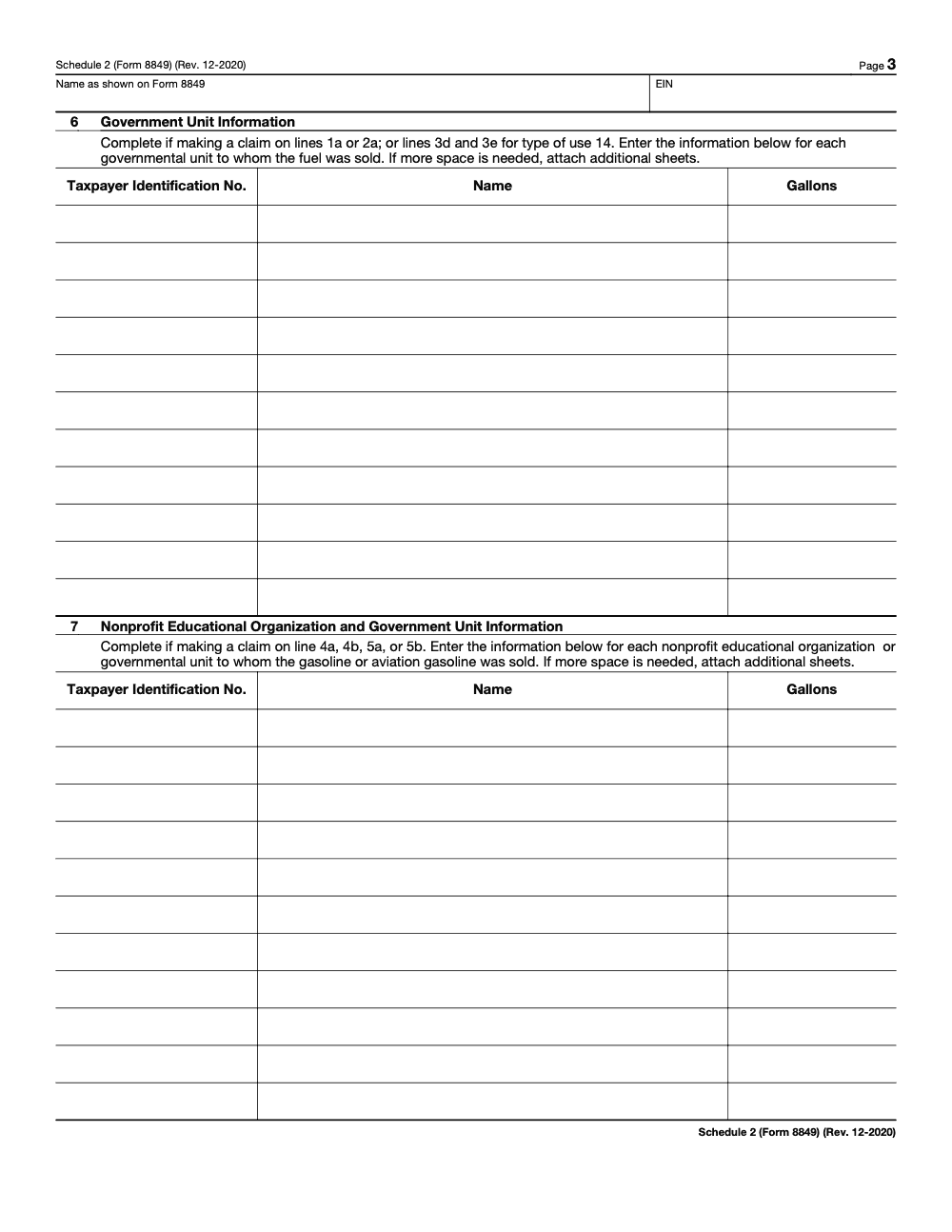
- Complete Section 6 (Government Unit Information) for any claim on lines 1a, 2a, or 3d/3e at type-of-use 14, listing each unit's TIN, name, and gallons.
- Complete Section 7 for any claim on lines 4a, 4b, 5a, or 5b, listing each nonprofit educational organization or governmental unit.
- Attach Schedule 2 to its own Form 8849; do not bundle with Schedule 1, 3, 6, or 8.
- Mark the mailing envelope 'Registered Ultimate Vendor Claim' as the instructions require.
- Send to the address listed in the Form 8849 instructions.
- File a copy of the claim, supporting certificates, and the signed envelope label into the engagement workpapers.
Keep 8849 Schedule 2 Season From Stalling
Schedule 2 claims do not move with the spring busy season; they move with the vendor's gallon-flow calendar. A registered ultimate vendor pushing even a modest book of undyed diesel or kerosene through state-government and nonprofit buyers can build $200 of refundable rate in days, and the quarterly clock starts with the earliest quarter that has those gallons (per the Schedule 2 (Rev. December 2020) instructions). Miss the last day of the next quarter and the refund rolls into an annual claim instead of paying inside the cycle.
The fix is process, not heroics. A vendor that runs Schedule 2 as a recurring close exercise rather than a project closes the door on the most common failure modes: wrong certificate for the line, gallons missing from a Section 6 or 7 schedule, and quarters slipping past the deadline because nobody read the rule on which quarter starts the clock.
- Match every line to its required model certificate or waiver from IRS Publication 510 before the gallon enters the claim, and refuse the gallon if the document is expired or missing.
- Tag each delivery at invoice entry with its registration category (UV, UB, UP, or UA), the Credit Reference Number, and any credit-card-issued-to-buyer exclusion so the close team does not re-derive it.
- Run a deadline-and-minimum check at quarter end: 1-week period, $200 diesel and gasoline minimum or $100 kerosene minimum, and the earliest-quarter rule for the filing date.
- For nontaxable kerosene in aviation, force the line 3d versus 3e selection on the underlying tax rate paid ($0.244 versus $0.219) and verify the type-of-use code before column (c) is computed.
- Bundle each Schedule 2 in its own Form 8849, mark the envelope 'Registered Ultimate Vendor Claim,' and route copies into the engagement workpaper file.
Accountably teams sit inside this process for vendors and the accounting groups that support them. We run the buyer-document matrix, the quarterly threshold check, and the Section 6 and 7 schedules as a standing review item so the refund files inside the quarter. See our taxation service for the full delivery structure.
FAQs
Schedule 2 is for registered ultimate vendors, for example, vendors with UV, UB, UP, or UA activity letters under Form 637. Ultimate purchasers use other paths such as Form 4136 or Schedule 1 when applicable.
Your claim period must be at least one week. Diesel and gasoline categories generally require a minimum refundable tax amount of 200, kerosene categories generally use 100. The instructions allow combining certain lines to reach the minimum.
For calendar-year filers, Q1 is due June 30, Q2 due September 30, Q3 due December 31, and Q4 due March 31, since the rule is the last day of the first calendar quarter after the earliest quarter included.
E‑file is optional, paper is still accepted. The IRS says refunds for electronically filed 8849 Schedule 2 returns are processed within about 20 days after acceptance.
If a government or nonprofit buyer uses a credit card, the registered credit card issuer is usually the party that makes the claim, not the vendor. Schedule 2 and Publication 510 call out this rule.
Keep the records needed to prove entitlement to the claim, including invoices, bills of lading, gallons worksheets, and certificates or waivers. Publication 510 explains certificate and waiver requirements. For other excise refund contexts, IRS instructions cite general claim limitation periods, often 3 years from filing or 2 years from payment, whichever is later, but aim to file timely quarterly Schedule 2 claims.
Other forms this guide names
About this guide
Accountably helps US CPA, EA, and accounting firms hire trained accountants and tax preparers in India.
About us Reviewed byJugal Thacker, CPAFounder and CEO at Accountably
A Washington-licensed CPA with 7+ years inside US firms – PwC, a real-estate tax practice, then a full-service firm, rising from reviewer to manager to advisory. This article was reviewed against current IRS guidance for the 2025 tax year and updated for filers preparing late returns, amendments, and 2026 estimates.
View profile →How we research, review, and update this guide
Every Accountably guide is researched against primary IRS sources, reviewed by a U.S. CPA, and refreshed as guidance evolves. Read our Editorial Guidelines to see how we source, fact-check, and update our content.