Summarize this article with AI
In Brief
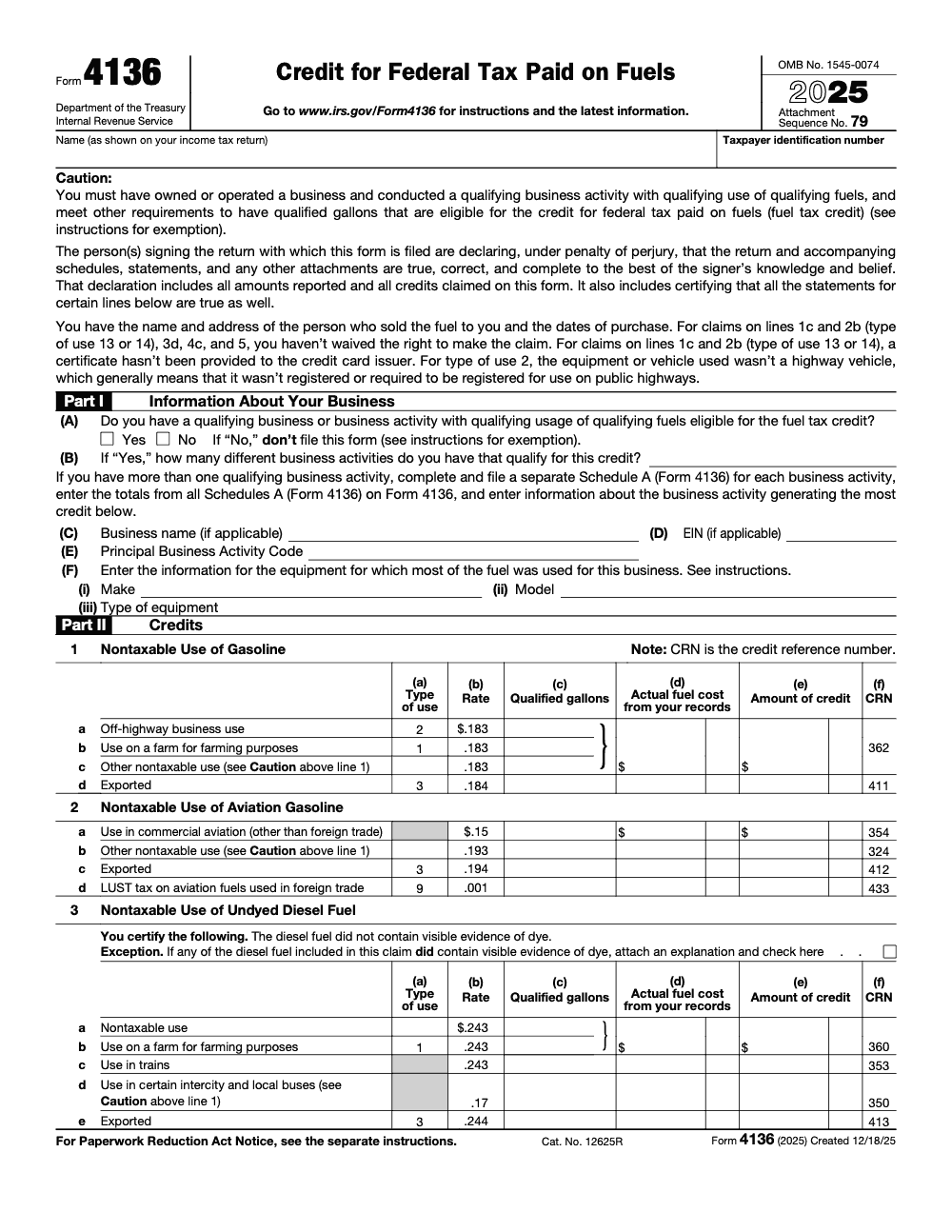
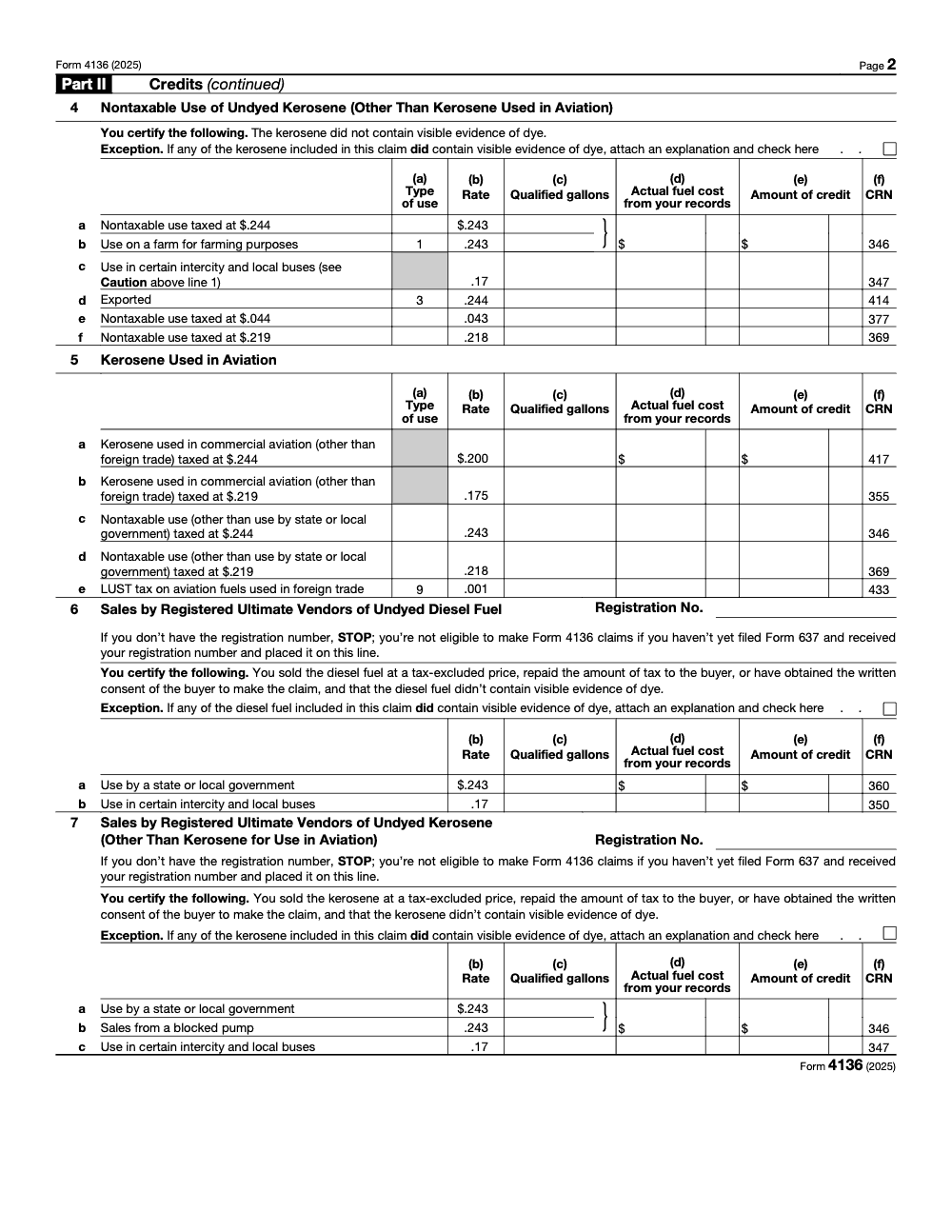
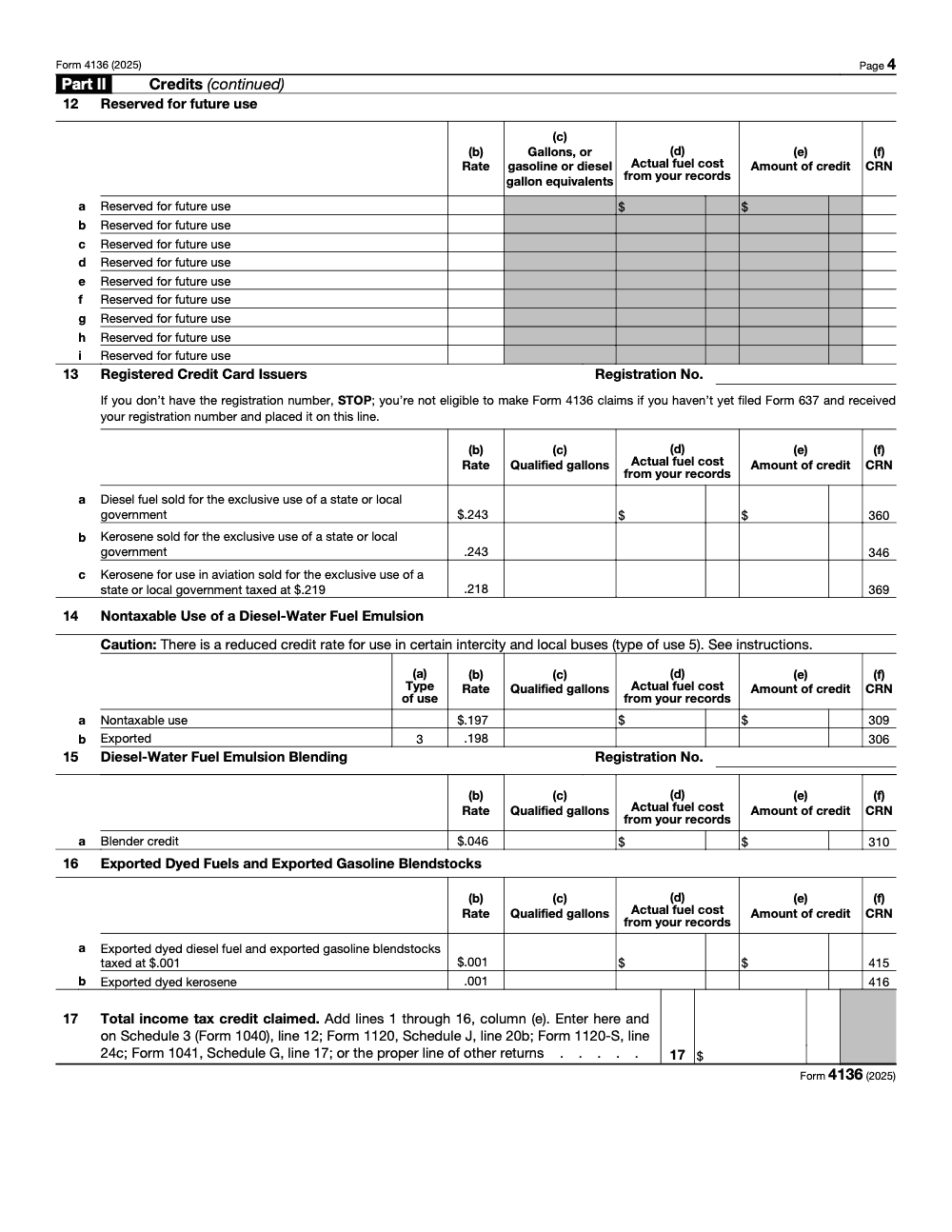
Form 4136 is the IRS Credit for Federal Tax Paid on Fuels – you list qualifying business gallons by fuel type and use, multiply by the per-gallon rate (for 2025: $0.183 on nontaxable gasoline, $0.243 on undyed diesel and kerosene, $0.17 on certain intercity and local bus fuel), and carry the Line 17 total to Schedule 3 (Form 1040) line 12, Form 1120 Schedule J line 20b, Form 1120-S line 24c, or Form 1041 Schedule G line 17 (per the 2025 Form 4136 instructions on IRS.gov). The claim needs a qualifying business activity – personal off-road fuel use does not qualify. For multi-activity filers, attach a separate Schedule A (Form 4136) per business activity.
A diesel generator runs all season on a job site, a forklift never touches a public road, and the fuel that powers them carries federal excise tax that was never meant for off-highway use. Form 4136 is how the ultimate user gets that money back, listing qualifying business gallons by fuel type and use, multiplying by the per-gallon rate, and attaching the credit to the annual return.
Where this trips people up is timing and documentation. If you need the cash sooner than year-end, Form 8849 handles refunds during the year. The IRS keeps false fuel credit claims on its annual Dirty Dozen list, so eligibility and records matter; match gallons to equipment and use categories, and always use the per-gallon rate printed on the current year form.
Key Takeaways
- Form 4136 lets the ultimate user recover fuel excise tax on gallons later used in qualifying nontaxable ways, and you attach the form to the annual return. If timing matters, use Form 8849 for refunds during the year, or Form 720 to first offset excise liability. Do not double claim the same gallons.
- For 2024 Form 1040 filers claiming nontaxable use of gasoline, aviation gasoline, undyed diesel, or undyed kerosene, the IRS requires an attachment called Statement Supporting Fuel Tax Credit Computation‑1. Build it with your workpapers and include it with the return.
- The IRS continues to warn about false Form 4136 claims in its annual Dirty Dozen notices, so eligibility and documentation matter more than ever.
- Keep records tight, match gallons to equipment and use categories, and always use the per‑gallon rate printed on the current year Form 4136.
What Form 4136 Is, In Plain English
Form 4136, Credit for Federal Tax Paid on Fuels, gives you a dollar‑for‑dollar credit when fuel you bought with federal excise tax is later used in qualifying nontaxable ways. You enter gallons by category, apply the IRS per‑gallon rate shown on the form for that tax year, total the credit, and attach it to the annual return. For faster cash, you can file Form 8849 to request a refund during the year, or use Form 720 to claim a credit against excise liability first. Never claim the same gallons in more than one place.
Who Can Claim
Generally, the ultimate user, the person or business that actually burns the fuel, claims the nontaxable use credit (the user must have owned or operated a qualifying business activity; personal off-road fuel use, like a personal ATV or lawn mower, does not qualify). Blenders, exporters, and alternative‑fuel claimants have separate lines, rules, and in some cases registration requirements, so check the current instructions before you file.
Why This Matters More Now
The IRS added a new attachment for 2024 Form 1040 claims called Statement Supporting Fuel Tax Credit Computation‑1. It requires basic business details, a list of equipment or vehicles, and a comparison of your claimed gallons to an IRS estimated cost table. Keep your receipts and logs in your records, and attach the statement with your return when required.
Attach the Statement Supporting Fuel Tax Credit Computation‑1 when you claim nontaxable use of gasoline, aviation gasoline, undyed diesel, or undyed kerosene on a 2024 Form 1040, and keep all source records for later verification.
The Uses That Usually Qualify
- Off‑highway business use, for example construction equipment that is not operated on public roads (the equipment or vehicle must not be registered or required to be registered for public highway use under type of use 2).
- Farming, including tractors, combines, and other farm machinery.
- Certain bus and aviation activities, subject to line‑specific rules (intercity and local bus use under type of use 5 is credited at the reduced $0.17 rate on diesel and kerosene lines, not the standard nontaxable use rate).
- Exports and specialized situations, including exported dyed fuels and gasoline blendstocks, when the exporter is the claimant (exported fuels carry their own line-specific rates – typically $0.001 higher than the matching nontaxable use rate – because they include the LUST recovery).
Each gallon must tie to a qualifying category on the form, and your records must show that you are the ultimate user for that credit.
Where Firms Get Stuck, And The Simple Fix
Common choke points look familiar across firms: invoices live in email, logs do not reconcile to gallons, categories get mixed, and last year’s rates creep into this year’s workpapers. The fix is a repeatable process, not heroics. Use standardized workpapers, simple file naming, and a two‑step checklist so reviewers see the exact trail from invoice to gallons to form line. If you need outside help, treat it like operations. At Accountably, our role with firms is to build SOPs, structured workpapers, and a layered review path so your managers are protected and partner review time drops. We keep brand mentions light on purpose here, because your process is the star.
The Three Buckets You Will See On Form 4136
Form 4136 covers several credit types. Most firms work inside three broad areas. Each has specific claimants, documents, and lines.
1) Nontaxable Use Credit
This is the everyday credit for many clients. You paid excise tax at purchase, then used the fuel in a qualifying nontaxable way. On the form, list gallons by category and multiply by the per‑gallon rate shown for that year. Your file should include invoices, equipment identifiers, usage logs, and any allocations for split uses. If cash timing matters, consider Form 8849 during the year, but never claim the same gallons again on the annual return.
- Reclaim dollars you should not have lost.
- Protect margins with disciplined documentation.
- Make reviewer sign‑off faster.
2) Biodiesel or Renewable Diesel Mixture Credit
This credit belongs to the blender, the party that combines qualifying biodiesel or renewable diesel with petroleum diesel and then sells or uses the mixture as fuel. You will need supplier certificates, and you must follow the registration and line‑item rules in the instructions. Some credits may be claimed first on Form 720, Schedule C, before any excess is refunded, so check your filing sequence.
- Keep blend ratios, inventory reconciliations, and ASTM or EPA documentation where applicable.
- Tie every gallon to a sale or use record.
- Verify you meet the minimum claim thresholds for the line.
3) Alternative Fuel And SAF Items
Alternative fuel items and sustainable aviation fuel have specific lines and often require registration under Form 637 (without a Form 637 registration number entered on the line, the instructions tell you to STOP – the claim is not allowed). In some cases, you must first apply the credit on Form 720, Schedule C, up to your taxable fuel liability, then handle excess as allowed by the instructions. Read the current year instructions carefully because Congress and the IRS have updated these areas over time.
The New IRS Supporting Statement, What To Include And Why
For 2024 Form 1040 claims of nontaxable use of gasoline, aviation gasoline, undyed diesel, or undyed kerosene, the IRS requires the Statement Supporting Fuel Tax Credit Computation‑1. It asks for business identifiers, the make, model, and type of equipment or vehicles, plus a comparison of your claimed gallons to an IRS estimated average cost per gallon.
Here is the IRS estimated average cost table used in that statement:
| Fuel type | IRS estimated average cost per gallon |
| Gasoline | $3.14 |
| Aviation gasoline | $6.60 |
| Undyed diesel | $3.55 |
| Undyed kerosene | $4.30 |
Keep receipts and logs in your records. Do not mail them unless the IRS asks. The attachment lives with your return and helps the IRS validate that your claim looks reasonable.
Why This Attachment Actually Helps Your Team
This is not just compliance. It forces a clean reconciliation between gallons, costs, and activities, which your reviewers can scan in minutes. When you standardize this package, you reduce back‑and‑forth and shorten partner review time.
If you want help building that pack, Accountably can set up SOP‑driven workpapers, file naming conventions, and version control so reviewers always see the right file in the right order. Use us for the heavy lift, keep control of your engagements.
4136 vs 8849 vs 720, Choosing The Right Path
| Purpose | Typical use case | Best form | Key point |
| Annual income tax credit | Ultimate user claims nontaxable uses | Form 4136 attached to 1040, 1120, etc. | Attach the FTC Computation‑1 if required for 2024 1040 claims on listed fuels. |
| Periodic cash refund | Faster cash during the year | Form 8849 | Do not duplicate gallons you will also claim on 4136. |
| Offset excise liability first | Blenders and certain alternative fuel items | Form 720, Schedule C | Some credits must be applied here before any excess refund. Registration may apply. |
Step‑By‑Step, Completing Form 4136 Without Rework
- Determine eligible uses. Identify every nontaxable use you can defend, then assign gallons to the correct line. Confirm you are the ultimate user for those lines and that any blender or alternative fuel items meet the registration and certificate rules.
- Compute the credit. Multiply gallons by the per‑gallon rate printed on that line for the filing year. Keep a calculator sheet in your workpapers.
- Attach and file. Enter totals, complete taxpayer information, and attach Form 4136 to the annual return. If timing dictates, use 8849 during the year, or 720 to offset excise liability first.
- Retain records. Keep invoices, logs, equipment IDs, certificates where required, and the FTC Computation‑1 statement if you are filing a 2024 1040 claim for listed fuels.
Your Documentation Packet
- Index sheet listing each claimed line, gallons, and the per‑gallon rate used.
- Purchase invoices showing excise tax charged or reasonably inferred.
- Usage logs, meter reads, telematics reports, or fuel card exports that tie to gallons.
- Allocation memo when gallons are split across uses, with methods that are simple and repeatable.
- Supplier certificates and registrations for blender or alternative fuel lines.
- The completed FTC Computation‑1 attachment when required, kept with your workpapers and included with the return.
Controls That Cut Review Time
- Preparers use a checklist, reviewers sign off with timestamps.
- Workpapers use simple version control so no one reviews stale files.
- A quick variance check, gallons claimed versus gallons purchased, with an explanation for any difference.
Conversions You Will Be Asked About
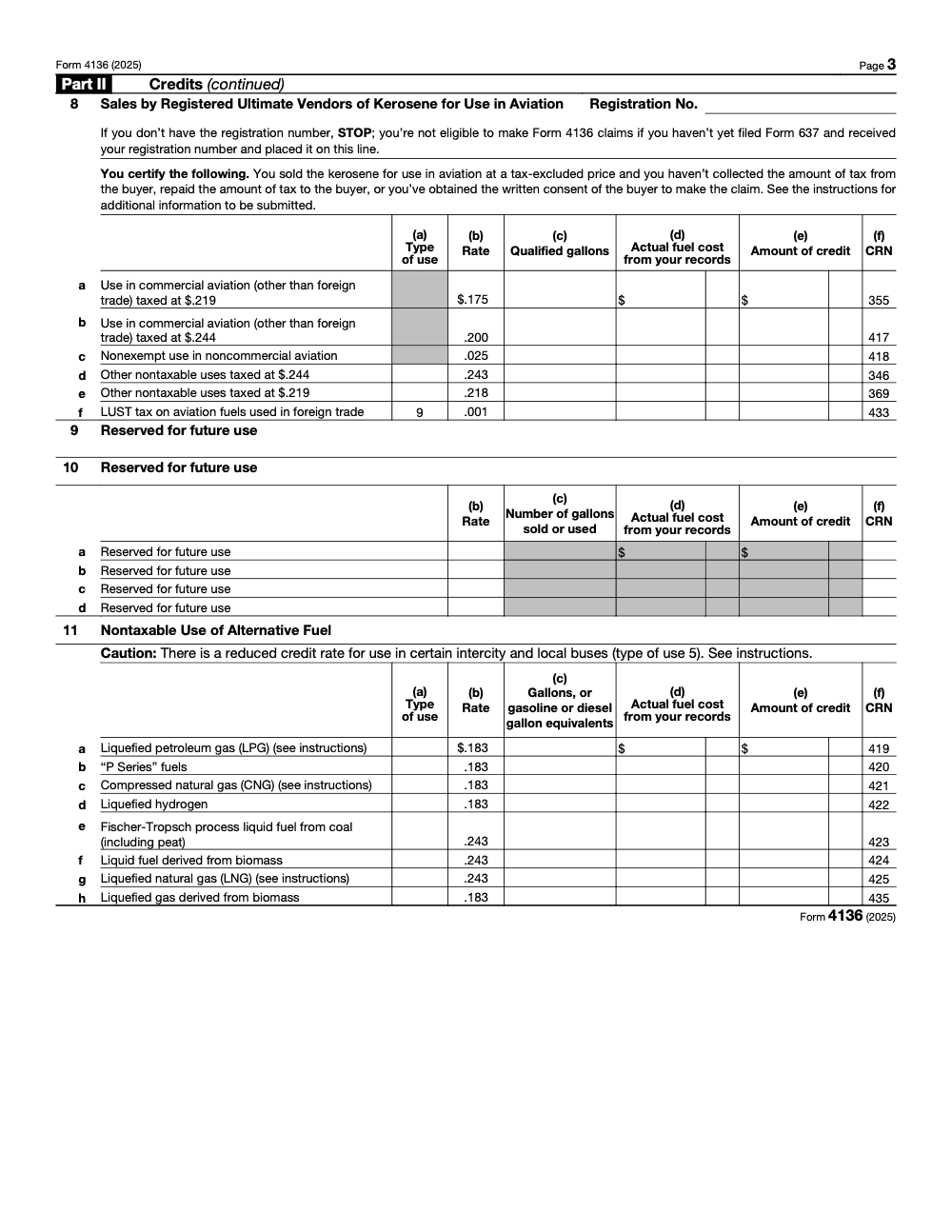
Some fuels use gasoline or diesel gallon equivalents, for example CNG, LPG, or LNG. The instructions specify when to use GGE or DGE and how to apply those conversions before you calculate the credit. Follow the current year instructions, do not rely on memory from a prior year.
Common Pitfalls And How To Avoid Them
- Claiming when you did not burn the fuel, or when you were a reseller rather than the ultimate user.
- Using the wrong year’s per‑gallon rate or mixing categories, which breaks reconciliations.
- Skipping the FTC Computation‑1 on a 2024 1040 claim for the listed fuels.
- Duplicating gallons across 4136 and 8849 or 720.
- Estimating without contemporaneous logs or receipts.
The IRS has repeatedly warned about false fuel tax credit claims, both in formal news releases and in the annual Dirty Dozen campaign. Clean documentation and correct claimants keep your clients out of that risk zone.
A Repeatable Workflow Your Team Can Run
- Intake, confirm ultimate user status, list equipment, map expected use categories.
- Pull 12 months of invoices, fuel card data, and logs.
- Tag each gallon to equipment and to a Form 4136 line.
- Calculate with the current year rates from the form, not last year’s sheet.
- Complete the FTC Computation‑1 if your claim fits the 2024 1040 rule.
- Reviewer checks math, documents, and duplication risk.
- File on the annual return, or use 8849 or 720 to meet timing or liability needs.
Real‑World Tips That Speed Review
- Start with a one‑page summary listing each line, gallons, the per‑gallon rate, and the resulting dollar amount.
- Add a cross‑reference column to the exact invoice, log, or certificate that proves each gallon.
- Write a short allocation memo for any split uses, for example a generator or a mixed‑use asset.
- Run a duplicate check against 8849 and 720 filings before sign‑off.
Micro‑Anecdote From The Field
A multi‑entity contractor had receipts spread across three systems and two inboxes. Credits were real, but reviewers were stuck. We helped standardize file names, workpapers, and a pre‑review checklist. The next cycle, reviewer time dropped and questions disappeared. That is the power of structure over heroics.
Conversion Notes You Will Use
- Certain fuels require GGE or DGE conversions, for example CNG, LPG, and LNG. The instructions explain when and how to convert units before multiplying by the per‑gallon rate. Always use the current year table.
A Simple Workpaper Template You Can Copy
| Tab | What it contains | Why it helps |
| 0‑Index | Lines claimed, gallons, rates, dollars | Reviewer scans this first to see the whole picture |
| Invoices | PDFs or images labeled YYYY‑MM‑Supplier‑Amount | Ties dollars to gallons with no hunting |
| Logs | Fuel card exports, meter reads, telematics | Shows consumption patterns and supports allocations |
| Allocations | Methods, assumptions, calculations | Makes split‑use decisions transparent |
| Statements | FTC Computation‑1 and any required certifications | Completes the audit trail for the year |
If you want us to tailor this pack to your stack, we can. Accountably places trained offshore professionals inside your workflow, with SOPs and a multi‑layer review path, so you get predictable turnaround without giving up control.
Worked Example, From Gallons To Credit
- Assume 1,000 gallons of undyed diesel used in off‑highway equipment during the year.
- Pull the current year per‑gallon rate from the Form 4136 line for undyed diesel nontaxable use.
- Compute the dollar amount and record the math in your worksheet.
- Attach Form 4136 to the annual return. If you are filing a 2024 Form 1040 claim and your lines include undyed diesel, include the FTC Computation‑1. Keep invoices and logs in your file.
Quick Note On The New Statement’s Cost Table
The supporting statement includes an IRS estimated average cost per gallon table, for example gasoline $3.14, aviation gasoline $6.60, undyed diesel $3.55, and undyed kerosene $4.30. Use it to compare estimated versus actual spend, then keep your receipts and logs as proof.
Compliance And Risk, Keep It Clean
- Only claim gallons you actually burned in qualifying nontaxable ways, or that you are otherwise entitled to claim under the line instructions.
- Match gallons to documents, then to form lines.
- Use the current year’s rates.
- Do not duplicate gallons across 4136, 8849, and 720.
- Watch IRS alerts, including the Dirty Dozen, which again calls out improper fuel tax credit claims.
Final Checklist Before You File
- Confirm you are the correct claimant, usually the ultimate user, and verify registration where the line requires it.
- Use the current year Form 4136 instructions and rates.
- If filing a 2024 1040 claim on listed fuels, complete and attach the FTC Computation‑1.
- Keep invoices, logs, certificates, and a cross‑reference index.
- Choose between 4136, 8849, and 720 based on timing and liability, and avoid duplicates.
- Save a reviewer memo that explains any allocations or unusual facts.
When To Loop In Accountably
If your team is drowning in review loops or you are ready to scale this work without losing control, Accountably can help you set SOPs, structure workpapers, and integrate trained offshore capacity that works inside your systems. The goal is workload stability, predictable turnaround, and fewer revision cycles, while you keep quality, security, and process ownership.
Short Disclaimer
This guide is for general information. It is not tax, legal, or accounting advice. Credit availability, rates, and procedures can change. Always confirm the current year Instructions for Form 4136 and related IRS guidance before filing.
Common Mistakes We See Every Season
Form 4136 errors usually trace back to four recurring patterns – wrong claimant, wrong line item, missing certification, or missing Form 637 registration. Each one is fixable with a tighter intake before the worksheet opens.
Reusable Checklists
Three checklists you can paste into your 4136 SOP – one for client intake, one for the worksheet reconciliation before review, and one for exported or LUST-rate fuel claims that follow a different rate table.
Form 4136 client intake packet
- Confirm a qualifying business activity exists and the answer to Part I Question A is Yes.
- Collect supplier name, address, and dates of purchase for every fuel category in the claim.
- Tag each gallon by Type of Use code (1 farming, 2 off-highway business, 3 exported, 5 certain intercity or local buses, 9 foreign-trade LUST).
- Verify a Form 637 registration number is on file for any Line 6, 7, 8, or 13 claim and capture it.
- Flag any dyed-fuel deliveries and isolate those gallons from undyed-fuel Lines 3 and 4.
- List all business activities. If more than one qualifying activity, open a separate Schedule A (Form 4136) per activity at intake.
Pre-review worksheet reconciliation
- Match every line's per-gallon rate to the 2025 Form 4136 table: $0.183 nontaxable gasoline (Line 1), $0.243 undyed diesel and kerosene (Lines 3, 4), $0.17 intercity and local bus fuel (Lines 3d, 4c), $0.001 LUST on aviation fuels in foreign trade (Lines 2d, 5e).
- Confirm Credit Reference Number (CRN) entries match each line (362 off-highway gasoline, 360 undyed diesel nontaxable, 350 bus diesel, 411 exported gasoline, 413 exported undyed diesel, 433 LUST).
- Verify the undyed-fuel certifications on Lines 3 and 4 and attach any dyed-fuel exception explanation.
- Re-add column (e) for Lines 1 through 16 and tie the result to Line 17 (Lines 9, 10, and 12 are reserved for 2025).
- Carry Line 17 to the correct return line: Schedule 3 (Form 1040) line 12, Form 1120 Schedule J line 20b, Form 1120-S line 24c, or Form 1041 Schedule G line 17.
- Save a reviewer memo that documents rate selection, Type of Use codes, and any exceptions.
Exported and LUST claim review
- For exported fuel (Type of Use code 3), confirm export documentation and use the export rate ($0.184 gasoline, $0.194 aviation gasoline, $0.244 undyed diesel and kerosene, $0.198 diesel-water emulsion).
- For aviation fuel used in foreign trade (Type of Use code 9), route the claim to Line 2d or Line 5e at the $0.001 LUST credit rate under CRN 433.
- For Line 15 diesel-water emulsion blender claims, enter the blender Registration Number on the line and confirm the $0.046 blender credit rate (CRN 310).
- Confirm there is no overlap with any Form 8849 or Form 720 Schedule C claim for the same gallons.
- Attach supplier export records, blender registration documentation, and any required certifications to the workpaper file.
Keep 4136 Season From Stalling
Fuel tax credit work hits firms in two waves – the spring 1040 cycle for individual filers who must attach the Statement Supporting Fuel Tax Credit Computation 1, and the year-end rush from trucking, farming, and aviation business clients who gather supplier invoices around the 1120 or 1120-S extension deadline. Both waves arrive with messy fuel logs, missing Form 637 registration numbers, and clients who half-remember whether the credit belongs on Form 4136, Form 8849, or Form 720 Schedule C. The IRS named false fuel tax credit claims on its 2025 Dirty Dozen list (per IRS.gov), so review tolerance for sloppy 4136 workpapers is lower than it used to be.
What slows the cycle is not the math – the per-gallon rates and CRNs are printed on the form. It is the upstream intake. When the intake misses a Type of Use code, a Form 637 number, or a dyed-fuel exception, the preparer pauses, the senior reviewer pauses, and the file sits. A short standardized intake plus a worksheet that mirrors the form's line structure removes almost all of that delay.
- Build a one-page client intake covering qualifying business activity, fuel categories used, Type of Use codes, supplier records, and Form 637 registration status before the worksheet opens.
- Mirror the worksheet to Form 4136's line structure (1a-1d gasoline, 2a-2d aviation gasoline, 3a-3e undyed diesel, 4a-4f undyed kerosene, 5a-5e aviation kerosene, 6-8 registered ultimate vendor, 11 alternative fuel, 13 credit card issuer, 14-15 diesel-water emulsion) so column (e) ties directly to Line 17.
- Pre-build a CRN lookup (362, 360, 350, 411-416, 419-425, 433 among others) so the preparer never guesses a Credit Reference Number on Schedule 3 (Form 1040) line 12 or the equivalent corporate or fiduciary line.
- Route each qualifying activity to its own Schedule A (Form 4136) at intake and identify the largest-credit activity for Part I before the senior reviewer touches the file.
- Document path choice (4136 versus 8849 versus 720 Schedule C) in a single line on the reviewer memo so duplicate gallons never slip through on two filings.
That is the model Accountably's offshore teams run for clients with heavy fuel tax credit volume. We document the intake, mirror the worksheet to the line items, build the CRN and Type of Use lookups, and hand the U.S. reviewer a tied-out file with rate citations and exception memos attached. See our tax delivery services for how the model plugs into an existing review structure.
FAQs
Form 4136 lets you claim a dollar‑for‑dollar credit for federal fuel excise taxes on gallons later used in qualifying nontaxable ways. You list gallons by category, multiply by the per‑gallon rate on the form, and attach it to your annual return.
Usually the ultimate user claims the nontaxable use credit. Blenders, exporters, and certain alternative fuel claimants have separate lines and rules, often with registration or certificates. Check the current year instructions before you file.
For tax year 2024, individuals filing Form 1040 who claim nontaxable use of gasoline, aviation gasoline, undyed diesel, or undyed kerosene on Form 4136 must complete and attach the Statement Supporting Fuel Tax Credit Computation‑1. Keep your source records with your books.
No. In general the alternative fuel mixture credit is handled on Form 720, Schedule C, and limited first by your taxable fuel liability, with excess handled as the instructions allow. Registration rules may apply.
Yes. The IRS has highlighted false fuel tax credit claims in multiple alerts and in its 2025 Dirty Dozen list. Clean eligibility, correct lines, and strong documentation reduce risk and speed processing.
No. You attach required statements, like FTC Computation‑1 when applicable, and you retain receipts and logs in your records. The IRS can ask for proof later.
That is a state program with separate rules. Many claimants use Missouri Form 149 and must follow state documentation and deadlines. Federal Form 4136 does not control state refunds. Always check current state guidance at filing time.
Other forms this guide names
- Form 720: Deadlines, Deposits, and PCORI, 2025 Guide
- Form 1040: Filing Guide for 2025 Returns (AGI, Deductions, Deadlines)
- Form 637: Registration Guide for Fuel Exporters
- Form 1120: Corporation Tax Return Guide
- Form 1120-S: Guide for S‑Corp Filing, K‑1, K‑2/K‑3, Deadlines
- Form 1041: Guide for Estates & Trusts, Deadlines & K-1s
About this guide
Accountably helps US CPA, EA, and accounting firms hire trained accountants and tax preparers in India.
About us Reviewed byJugal Thacker, CPAFounder and CEO at Accountably
A Washington-licensed CPA with 7+ years inside US firms – PwC, a real-estate tax practice, then a full-service firm, rising from reviewer to manager to advisory. This article was reviewed against current IRS guidance for the 2025 tax year and updated for filers preparing late returns, amendments, and 2026 estimates.
View profile →How we research, review, and update this guide
Every Accountably guide is researched against primary IRS sources, reviewed by a U.S. CPA, and refreshed as guidance evolves. Read our Editorial Guidelines to see how we source, fact-check, and update our content.