Summarize this article with AI
In Brief
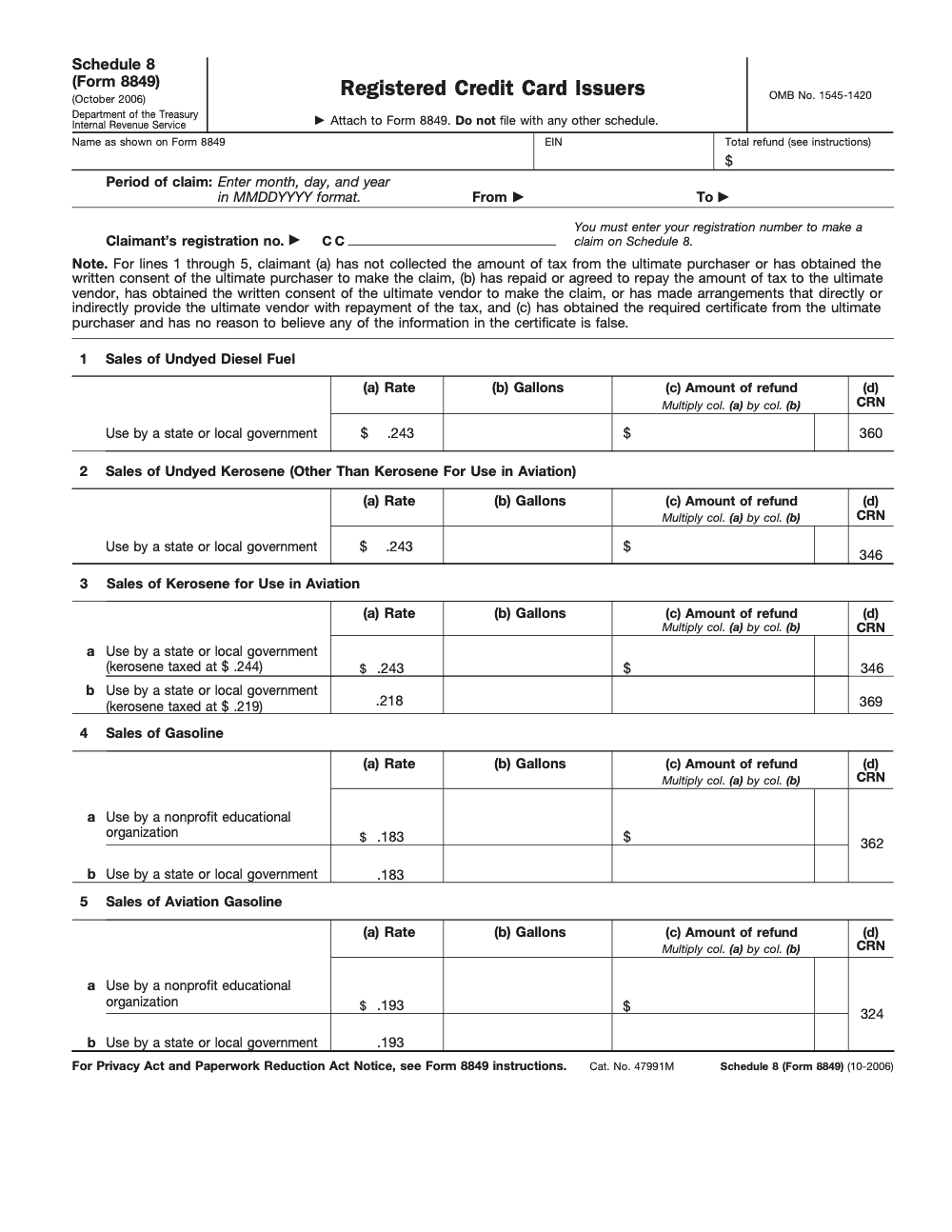
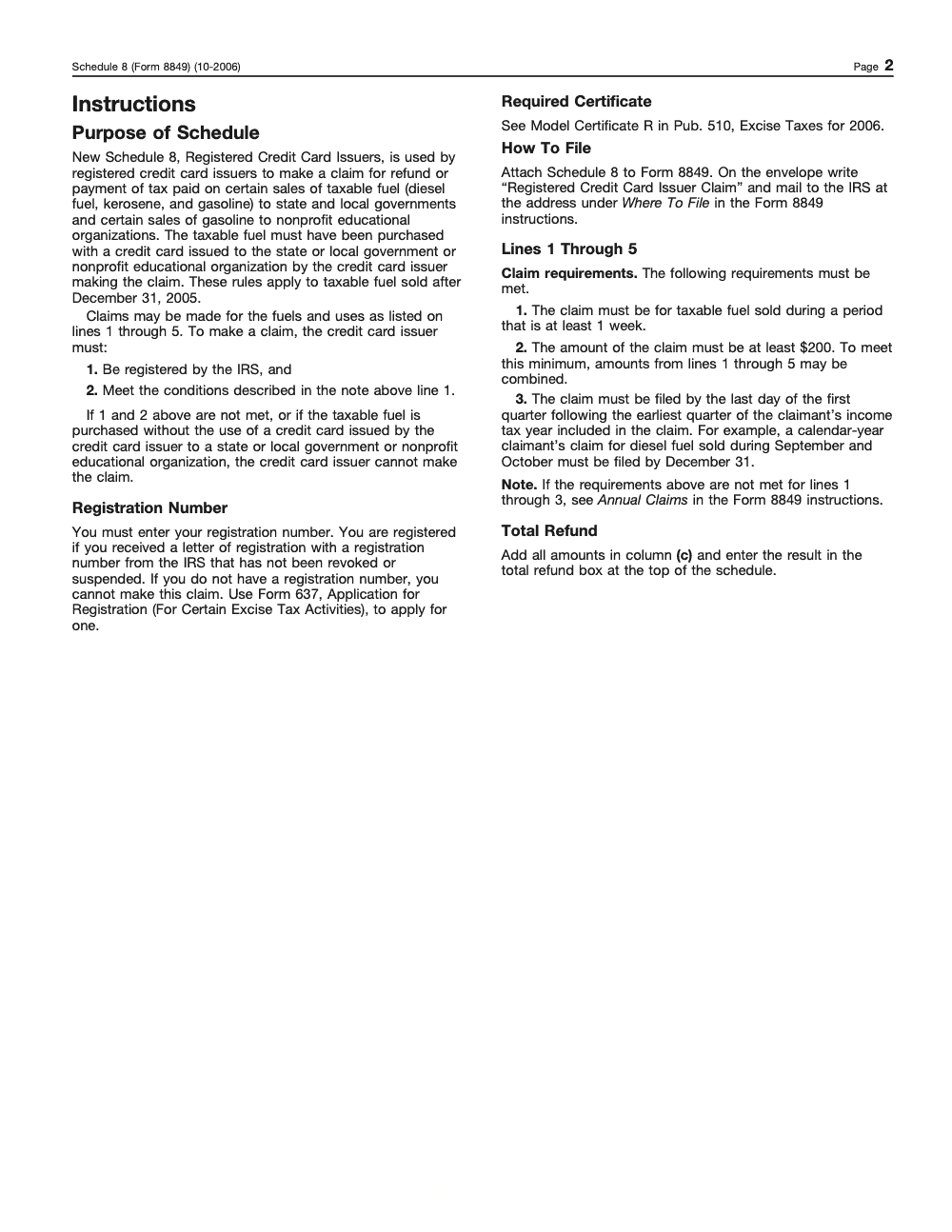
Form 8849 Schedule 8 is the federal excise tax refund claim filed by registered credit card issuers for taxable fuel bought with their cards by state or local governments (diesel, kerosene, and gasoline) and, for gasoline, by nonprofit educational organizations, per the Schedule 8 instructions (Rev. October 2006). Each claim must total at least $200, cover a period of at least one week, and be filed by the last day of the first quarter following the earliest quarter included in the claim. File it on its own Form 8849 with no other schedule attached, and lean on structured tax execution when government fuel volume spikes.
A registered credit card issuer pays for taxable fuel a state or local government buys with one of its cards, and the excise tax sits with the issuer rather than the buyer. Schedule 8 is how that issuer claims the federal excise tax back on diesel, kerosene, and gasoline, plus gasoline sold to nonprofit educational organizations.
The eligibility gate is registration, not gallons. You must be registered under Form 637 with activity letter CC, the fuel must be bought with a card you issued, and each claim has to total at least $200 over a period of at least one week, filed by the last day of the first quarter after the earliest quarter included. E-filed claims typically pay in about 20 days, and this follows the Rev. October 2006 instructions.
Key Takeaways
- Schedule 8 is for you if you are a registered credit card issuer claiming refunds of federal excise tax on certain taxable fuel sold to state or local governments and, for gasoline and in many cases aviation gasoline, to nonprofit educational organizations.
- You must be registered with the IRS under Form 637, activity letter CC, and the fuel must be purchased with a card you issued to the eligible entity. Keep your registration active and on file.
- Minimums matter. Your claim period must cover at least one week and the total claim must be at least 200. File by the last day of the first quarter after the earliest quarter included in the claim.
- E‑file is faster. Electronically filed Schedule 8 refunds are typically processed in about 20 days after IRS acceptance. Paper takes longer.
- Documentation is everything. Hold an unexpired certificate from the purchaser, include required statements, and retain invoices showing gallons and tax paid.
What Schedule 8 Is, and Who Uses It
Schedule 8, attached to Form 8849, lets a registered credit card issuer claim a refund of federal excise tax that was charged on taxable fuel when the purchaser was an eligible state or local government or a qualifying nonprofit educational organization. For governments, the covered fuels include diesel, kerosene, and gasoline. For nonprofit educational organizations, gasoline is covered, and aviation gasoline is recognized in IRS internal guidance as eligible when the other requirements are met.
You must be properly registered. The IRS requires credit card issuers to have a Form 637 registration with activity letter CC. Claims only apply when the card used belongs to the exempt entity and was issued by you, the claimant.
Practical test, if your card did not pay for the fuel, or you are not registered under Form 637 letter CC, you cannot make a Schedule 8 claim.
How Schedule 8 Fits Into the Bigger Picture
Think of Form 8849 as the envelope and Schedule 8 as the page that tells the IRS exactly what you are asking for. The IRS accepts e‑filing for Form 8849 with Schedule 8. E‑filed claims with Schedule 8 often process in about 20 days after acceptance, which is a meaningful speed advantage compared to paper. The IRS still accepts paper if you prefer.
If you handle other excise items, remember that Form 8849 has multiple schedules for different situations, but Schedule 8 cannot be combined with any other schedule. File Schedule 8 on its own separate Form 8849 with no other schedules attached. Schedule 8 is specifically for registered credit card issuers, not for ultimate vendors or nontaxable use claims. The IRS “About Form 8849” page lists all schedules and keeps you grounded in the current revision cycle. Bookmark it for quick checks.
Why Teams Trip Over Schedule 8
Even well‑run finance teams bump into the same bottlenecks:
- Missing or expired purchaser certificates and inconsistent naming on workpapers.
- Receipts without gallons and tax detail, or mismatched merchant records.
- Unclear period setup, which leads to late filings and lost refunds.
- No single source of truth for registrations, item numbers, rates, and timing rules.
If this sounds familiar, you are not doing anything “wrong.” These are process gaps, not math errors, and they are fixable. In my experience, once you standardize documentation and lock in a quarterly cadence, refunds become routine and review time drops.
What, How, Wow
- What, Schedule 8 is your pathway to recover excise taxes on qualifying government and nonprofit educational fuel purchases made with your cards.
- How, Register under Form 637 letter CC, collect the right documents, organize transactions by quarter, then e‑file on time with clean support.
- Wow, Use a simple checklist and a calendar trigger, and you can move from “we hope this is right” to “we file on day 1 and get paid in about 20 days.”
Eligibility, Are You a Qualified Registered Credit Card Issuer?
To claim on Schedule 8, you must meet all of the following:
- You issued the credit card used for the fuel purchase.
- The cardholder is an eligible state or local government, or a nonprofit educational organization.
- You hold a valid Form 637 registration, activity letter CC.
- You meet the timing, period length, and minimum amount rules for Schedule 8 claims.
Purchasers and Fuels at a Glance
| Purchaser type | Fuel types eligible on Schedule 8 | Notes |
| State or local government | Gasoline, diesel, kerosene | Purchases must be on a card you issued to that government entity. |
| Nonprofit educational organization | Gasoline, and in many cases aviation gasoline | Follow the same purchase and documentation rules. Confirm your facts for aviation gasoline before filing. |
Registration Proof You Need
You must be registered under Form 637, and your EIN alone does not satisfy this requirement. Schedule 8 asks for a separate IRS-issued excise tax registration number with activity letter CC, not your EIN. Keep your Letter 3689 showing your approved registration and verify your activity letter is CC. The IRS maintains public guidance on Form 637 and how the registration program works, including where to confirm registration status.
Documents to Gather Before You File
Strong documentation speeds your refund and protects you during any review.
- Purchaser certification, Keep an unexpired certificate similar to Model Certificate R. You must also be able to state that you did not collect the tax from the ultimate purchaser or that you have their written consent to the refund, and that you have repaid or agreed to repay the tax to the ultimate vendor or otherwise arranged to reimburse that vendor. These conditions, together with holding the required certificate, are cumulative, so failing any single one disqualifies the entire claim.
- Evidence of gallons and tax paid, Collect invoices, receipts, or merchant transaction data that clearly show fuel type, gallons, dates, and that federal excise tax was charged. This ties directly to your claim math.
- Registration details, Keep your Form 637 registration details with activity letter CC and your EIN handy for the form.
- Quarter mapping, Decide which transactions belong in each claim and confirm that your earliest quarter in the claim controls the filing deadline.
Quick checklist, certificate on file and unexpired, gallons and tax on each transaction, Form 637 letter CC on hand, transactions grouped by quarter, single claim prepared with the right deadline.
Timing Rules You Cannot Miss
Three rules drive most of the timing questions for Schedule 8:
- Minimum period and amount, Your claim must cover at least one week, so a single-day or single-transaction claim is not permitted, and the total amount claimed must be at least 200. You can combine line items to reach the threshold.
- Filing deadline, File by the last day of the first quarter that follows the earliest quarter included in the claim. This is a strict quarterly deadline, not the general three-year refund window. The three-year rule applies only to certain annual fuel claims on Schedule 1, not to Schedule 8. Example, if your claim includes fuel from September and October, the deadline is December 31 of that same year.
- Statutory basis, These timing rules flow from sections 6427 and 6416. The code cross‑references Schedule 8 timing to the same “first quarter after the earliest quarter included” standard.
Important, there is no separate IRS “Form 8849‑EXT.” Time to file is set by statute and IRS procedure. If you miss the deadline, the claim can be disallowed rather than penalized in cash, which still hurts because you lose the refund.
E‑File vs Paper, Speed and Reliability
- E‑file, If you file Form 8849 with Schedule 8 electronically through an approved transmitter, the IRS generally processes the refund in about 20 days after acceptance. You will also get instant acknowledgment of receipt.
- Paper, The IRS will accept paper, yet processing takes longer due to mailing and manual steps. Use the current mailing address from the latest instructions if you must mail.
Step‑by‑Step, Completing Schedule 8 Accurately
Follow this simple flow so your package is clean the first time.
- Verify eligibility Confirm that the card used belonged to an eligible government or nonprofit educational organization and that you, the issuer, are registered under Form 637 letter CC.
- Organize transactions Group purchases by quarter and by purchaser type. Tag each line with gallons, fuel type, transaction date, and tax rate. Keep the underlying receipts and merchant data in the same folder.
- Prepare the statements and certificate Have an unexpired purchaser certificate similar to Model Certificate R. Include the required statements that you did not collect the tax from the purchaser or you have their written consent, and that you repaid, agreed to repay, or arranged reimbursement to the ultimate vendor.
- Complete Form 8849 and attach Schedule 8 Enter your legal name, EIN, and your Form 637 registration information. Use the correct Schedule 8 item categories, then compute the refund by multiplying gallons by the applicable rate and summing your lines.
- Check timing and totals Confirm the earliest quarter included, calculate the deadline at the last day of the first quarter after that earliest quarter, and verify your claim period spans at least one week and totals at least 200.
- File electronically Transmit through an approved transmitter. Save the acceptance acknowledgment and submission archive in your workpapers. Expect about 20 days for processing on Schedule 8 claims.
Example Timeline
- Your claim includes purchases from September 10 through October 25, 2025.
- Earliest quarter included is Q3 2025. Your deadline is December 31, 2025, the last day of the first quarter following that earliest quarter.
- You file electronically on December 12, 2025, with complete support. You monitor status and expect processing about 20 days after IRS acceptance.
Common Mistakes That Trigger Delays
Across the registered credit card issuer claims my team reviews, the same handful of errors show up every quarter. None are about the refund math; they are about eligibility proof, timing, and how the package is assembled.
Reusable Checklists
These are copy-paste ready for your firm SOP. Drop them into your workpaper template and run them on every Schedule 8 claim.
Eligibility and registration check
- Confirm an active Form 637 registration with the CC activity letter for registered credit card issuers.
- Verify each purchase was made on a card you issued to the eligible entity.
- Confirm the buyer is a state or local government, or a nonprofit educational organization.
- Remember that nonprofit educational organization use only qualifies for gasoline (line 4) and aviation gasoline (line 5), not diesel or kerosene.
- Record the IRS-issued registration number, not the EIN, for the form.
Claim package build
- Group transactions by quarter and by purchaser type.
- Tag each line with gallons, fuel type, date, and the federal excise tax charged.
- Apply the correct Schedule 8 line and CRN: diesel line 1 ($0.243, CRN 360), undyed kerosene line 2 ($0.243, CRN 346), kerosene for aviation line 3a or 3b, gasoline line 4 ($0.183, CRN 362), aviation gasoline line 5 ($0.193, CRN 324).
- Confirm the claim period covers at least one week.
- Confirm the total claim is at least $200, combining lines 1 through 5 if needed.
- Hold Model Certificate R plus the non-collection and vendor-repayment statements.
Pre-transmit review
- Identify the earliest quarter in the claim and set the deadline at the last day of the following quarter.
- Confirm Schedule 8 is on its own Form 8849 with no other schedule attached.
- Check the Schedule 8 box on Form 8849 and tie the Total refund to line 1a.
- Confirm an authorized person signs Form 8849 under penalties of perjury.
- If filing on paper, mail to Internal Revenue Service, P.O. Box 312, Covington, KY 41012-0312 via the U.S. Postal Service, and mark the envelope "Registered Credit Card Issuer Claim."
- Save the transmitter acknowledgment and a copy of the full package in the workpapers.
Keep 8849 Schedule 8 Season From Stalling
Schedule 8 does not have a single annual rush; it has four. Because the deadline is keyed to the earliest quarter in each claim, refund work piles up at every quarter-end, and the IRS itself estimates roughly 5 hours and 15 minutes of recordkeeping per Schedule 8 filing (per the Schedule 8 instructions, Rev. October 2006). For a card program running dozens of government accounts, that recordkeeping load multiplies fast.
The fix is not more hours in the week of the deadline; it is a standing process that keeps documentation current and claims pre-staged. When the certificate trail, the gallon-level support, and the registration details are maintained year-round, the quarter-end filing becomes a review step instead of a scramble.
- Maintain a live register of Form 637 CC registrations and Model Certificate R certificates so eligibility is never reconstructed under deadline.
- Pre-map each transaction to its Schedule 8 line and CRN (line 1 diesel, line 2 kerosene, line 3 kerosene for aviation, line 4 gasoline, line 5 aviation gasoline) as purchases post.
- Track the $200 minimum and one-week period per claim so small claims are batched, not lost.
- Calendar the deadline off the earliest quarter in every open claim, since gasoline and aviation gasoline claims have no annual-claim fallback.
- Keep each Schedule 8 on its own Form 8849 in the workpaper template so packages are never bundled with another schedule.
That standing discipline is exactly what we build into client workflows. Accountably integrates trained, U.S.-led offshore teams into your tax execution process with documented SOPs and multi-layer review, so excise refund claims stay on a quarterly cadence and senior reviewers spend their time on judgment, not assembly.
FAQs
It is the schedule a registered credit card issuer uses to claim a refund of federal excise tax on taxable fuel sold to state or local governments and on gasoline, and often aviation gasoline, sold to nonprofit educational organizations, when bought with a card you issued.
Yes. You must have an active Form 637 registration with activity letter CC as a registered credit card issuer. Keep your Letter 3689 as proof and confirm your status if needed.
Keep an unexpired purchaser certificate similar to Model Certificate R. Include statements that you did not collect the tax from the purchaser and that you repaid or agreed to repay the ultimate vendor, or arranged reimbursement. Keep transaction‑level support showing gallons, fuel type, dates, and tax paid.
File by the last day of the first quarter after the earliest quarter included in the claim. For example, if your claim includes September and October, you are due by December 31. There is no separate extension form for 8849 claims, so plan ahead.
If you e‑file Form 8849 with Schedule 8 through an approved transmitter, the IRS generally processes it in about 20 days after acceptance. Paper claims take longer.
Other forms this guide names
- Form 637: Registration Guide for Fuel Exporters
About this guide
Accountably helps US CPA, EA, and accounting firms hire trained accountants and tax preparers in India.
About us Reviewed byJugal Thacker, CPAFounder and CEO at Accountably
A Washington-licensed CPA with 7+ years inside US firms – PwC, a real-estate tax practice, then a full-service firm, rising from reviewer to manager to advisory. This article was reviewed against current IRS guidance for the 2025 tax year and updated for filers preparing late returns, amendments, and 2026 estimates.
View profile →How we research, review, and update this guide
Every Accountably guide is researched against primary IRS sources, reviewed by a U.S. CPA, and refreshed as guidance evolves. Read our Editorial Guidelines to see how we source, fact-check, and update our content.