Summarize this article with AI
In Brief
Form 8902 is the C corporation election form for the alternative tax on qualifying shipping activities – attached to Form 1120 or Form 1120-F when the corporation operates U.S.-flag vessels of at least 6,000 deadweight tons in U.S. foreign trade and elects the IRC §1354 tonnage tax (per IRC §1355(a)(4) and the Form 8902 instructions, April 2018 revision). Line 30 multiplies total notional shipping income by the flat 21% §11 corporate rate. Calendar-year 2025 returns are due April 15, 2026 for domestic C corps and June 15, 2026 for foreign corporations without a U.S. office; Form 7004 extends the filing deadline by 6 months, but not the payment deadline.
The phrase tonnage tax sounds like a port fee a harbor authority charges by the ton. It is not. Form 8902 is the federal alternative tax election on qualifying shipping activities, and a C corporation files it only when it operates U.S.-flag vessels of at least 6,000 deadweight tons in U.S. foreign trade and elects the IRC §1354 tonnage tax regime.
The election is the part to handle with care, because it does not stop at the current year. Once made on or before the due date of the corporate return, including extensions, the section 1354 election applies to that tax year and all succeeding years until properly revoked or terminated, and an election by one member of a controlled group reaches every qualifying vessel operator in the group. The alternative tax itself is figured at the section 11 corporate rate, which has been 21% since tax years beginning after December 31, 2017.
Key Takeaways
- Form 8902 is the IRS form for the Alternative Tax on Qualifying Shipping Activities under section 1354, often called the tonnage tax regime. It is not for ACE, backup withholding, extensions, or fuel credits.
- Who files: a corporation that is a qualifying vessel operator, including a foreign corporation filing Form 1120‑F. You attach Form 8902 to Form 1120 or 1120‑F.
- When to file: make the election on or before the due date of the corporate return for the election year, including extensions. Once made, the section 1354 election applies to that tax year AND all succeeding tax years until it is revoked or terminated, it is not a year-by-year choice the corporation can opt in and out of. Revocations have specific timing rules, and re-election after a voluntary revocation is generally barred for 5 tax years without IRS consent.
- Controlled groups: an election by one member applies to all qualifying vessel operators in the group. Plan governance and documentation carefully.
- Rates: the alternative tax is figured using the corporate rate under section 11, which has been 21% since tax years beginning after December 31, 2017.
- 2025 freshness: the IRS “About Form 8902” page was last updated January 28, 2025, and the instructions remain the April 2018 revision. Check those pages before filing.
Who Actually Files Form 8902, And Who Should Not
Form 8902 is filed by a C corporation that is a qualifying vessel operator and is either making the section 1354 election, reporting a termination, or reporting information when an election is already in effect, then figuring the alternative tax. Only C corporations qualify, S corporations, partnerships, LLCs taxed as partnerships, and individuals are not eligible to elect under section 1354. You attach it to Form 1120 or Form 1120‑F.
S corporations and partnerships do not file Form 8902 themselves, since the filing attaches to Form 1120 or 1120‑F. However, the instructions explain how partnership operations are treated when a corporate partner is involved, each partner is treated as operating the partnership’s vessels based on its interest. This mirrors the way other pass‑through rules flow to corporate owners.
Key Definitions You Need Handy
- Qualifying vessel operator, any corporation that operates one or more qualifying vessels and meets the shipping activity requirement.
- Qualifying vessel, generally a U.S. flag vessel of at least 6,000 deadweight tons, self‑propelled or a qualifying combination, used exclusively in U.S. foreign trade while the election is in effect.
- Operating a vessel, you are treated as operating a vessel you own, time charter, or operate under an agreement while it is used as a qualifying vessel. Certain bareboat arrangements are carved out and handled separately.
- Shipping activity requirement, on average, at least 25 percent of the aggregate tonnage of qualifying vessels used by the corporation was owned or bareboat chartered to the corporation, tested over prior years with special first‑year rules.
- U.S. foreign trade, movements in the foreign trade of the United States as defined in the instructions. Keep route details to document qualifying days.
These definitions drive eligibility and the notional shipping income you will compute later, so train preparers to tag vessel attributes the same way every time.
Controlled Group Effects
If a member of a controlled group makes the section 1354 election, that election applies to all qualifying vessel operators in the group. Your documentation must be consistent across entities, which is why naming conventions and shared checklists matter. A change for one member flows to the group.
Filing Mechanics At A Glance
- Where it goes, attach Form 8902 to the corporation’s Form 1120 or 1120‑F for the year of the election, termination, or annual information reporting.
- When it is due, by the corporate return deadline for that tax year, including approved extensions.
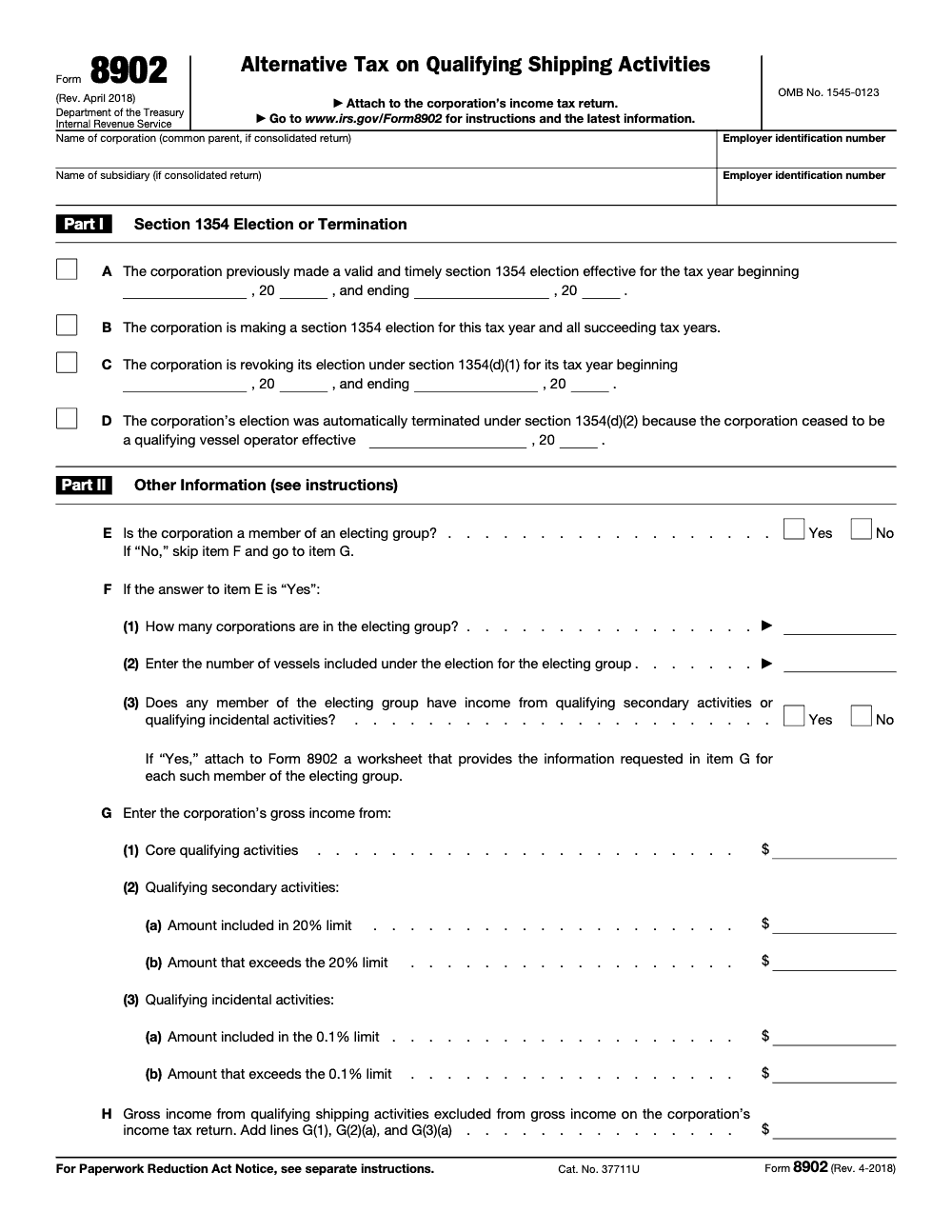
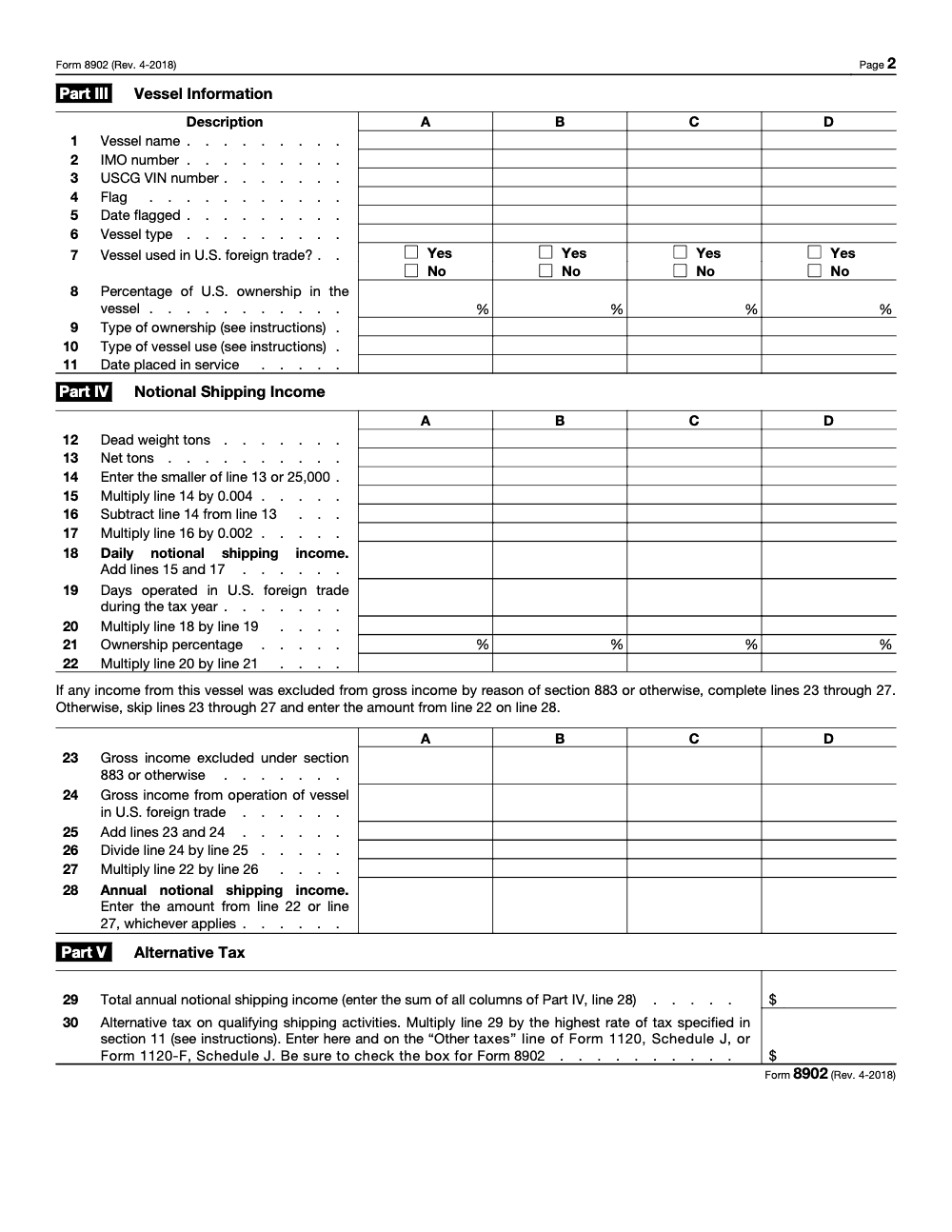
- What you compute: the form includes Parts I through V, culminating in the alternative tax based on notional shipping income and the corporate rate.
- Freshness check, the IRS “About” page shows the most recent update date, currently January 28, 2025, which you should record in your workpapers.
What-How-Wow Summary
- What: Form 8902 is the corporate election and annual reporting for the tonnage tax regime on qualifying shipping income.
- How: prove you are a qualifying vessel operator, complete the vessel and activity sections, compute notional shipping income, then figure the alternative tax and attach to Form 1120 or 1120‑F.
- Wow: the election can simplify taxation of shipping operations and offer planning clarity, but only if your data hygiene is solid and controlled group coordination is tight.
If your team is fighting review backlogs, consider dedicating a “shipping lane” in your workflow tool for 8902s, with structured workpapers and a multi‑layer review. When firms add disciplined offshore capacity that works inside QuickBooks, Thomson Reuters, or CCH environments, these specialized filings stop slipping. Use offshore to execute SOPs, not to improvise process.
Deadlines, Elections, Revocations, And Terminations
Election Timing
You must make the section 1354 election on or before the due date of the corporate return for the election year, including extensions. The election is made on Form 8902, Part I, and you attach the form to Form 1120 or 1120‑F. Calendar this date with your return due date, not a separate midyear deadline.
Revocation Timing
Revoking an election follows specific timing rules. A revocation submitted on or before the 15th day of the 3rd month of the tax year is effective on the first day of that tax year. A revocation made after the 15th day of the 3rd month is effective on the first day of the following tax year, unless you specify a later effective date on or after the day of revocation. Capture the effective date clearly in your memo and client letter.
Terminations And The Five‑Year Lockout
If the corporation ceases to be a qualifying vessel operator, the election terminates as of that date. After a revocation or termination, the operator, and any successor, generally cannot make another section 1354 election until the fifth tax year that begins after the first year for which the termination is effective, unless the IRS consents. This “cool‑off” period is a common exam point, so document the facts.
Controlled Groups
An election by one controlled group member applies to all qualifying vessel operators in the group. Coordinate entity‑level facts, vessel rosters, and notional income across the group to avoid inconsistent filings. Use a shared tracker that ties each vessel to the owning or chartering entity and shows charter type, tonnage, days, and ownership percentages.
How To File, E‑File, And Attachments
Form 8902 is not a stand‑alone filing. You attach it to Form 1120 or 1120‑F for the relevant tax year. If you e‑file the corporate return, include Form 8902 in the e‑file package per your software’s attachment procedures and keep the vessel schedules in your workpapers. If you paper file, include the form behind the return and retain proof of mailing. The IRS instructions describe the attachment requirement, not a separate mailing address.
Quick Deadline Table
| Item | Who | Attach To | Due Date Anchor |
| Initial section 1354 election | Qualifying vessel operator corporation | Form 1120 or 1120‑F | Corporate return due date, including extensions |
| Annual information and tax | Electing qualifying vessel operator | Form 1120 or 1120‑F | Corporate return due date, including extensions |
| Revocation | Electing corporation | Form 1120 or 1120‑F with Form 8902 | Effective per 15th day of 3rd month rule |
| Termination after status change | Former qualifying vessel operator | Form 1120 or 1120‑F with Form 8902 | Effective when the corporation ceases to qualify |
Sources for timing and attachments, see IRS Instructions for Form 8902 and About Form 8902.
Recordkeeping That Speeds Review
Keep a vessel‑level binder in your DMS with the following:
- Vessel identification, flag, deadweight tons, ownership or charter type, and qualifying days.
- Contracts supporting time charters, bareboat charters, and operating agreements.
- Route logs or summaries to support U.S. foreign trade use.
- Ownership percentages and any multi‑operator allocation details.
- A controlled group matrix to show where the election applies.
Well‑named, versioned workpapers cut review time and protect the election. This is where disciplined SOPs and checklists pay off for partners and clients.
If delivery is your ceiling, not demand, structure your 8902 process so preparers, seniors, and reviewers know exactly what “complete” looks like before anything hits review. That is how you avoid 10 p.m. scrambles.
Step‑By‑Step, Completing Form 8902
Part I, Section 1354 Election Or Termination
- Indicate whether you are making an election, revoking it, or reporting a termination.
- For elections, confirm controlled group impacts and align entity governance documents.
- For revocations, state the effective date and confirm it matches the statutory timing rule.
Part II, Other Information, Core, Secondary, And Incidental Activities
Part II asks about the nature of your qualifying activities and imposes limits on income from secondary and incidental activities.
- Core qualifying activities are your primary shipping operations. Document the services and routes.
- Secondary activities have a 20 percent cap relative to qualifying shipping income. Track amounts that fall within the cap and those that exceed it, since amounts above the 20 percent cap are not shielded by the tonnage tax, they stay in the corporation's regular gross income and are taxed at the 21 percent corporate rate.
- Incidental activities have a 0.1 percent cap, that is one tenth of a percent, not one percent, a common factor-of-10 misread. Again, split amounts within and above the limit, since amounts above the 0.1 percent cap stay in regular gross income and are taxed at the 21 percent corporate rate.
- Report gross income from qualifying shipping activities that you excluded from gross income on the corporation’s return, and maintain the reconciliation in your workpapers.
Practical tip, build a simple schedule that tags each revenue stream as core, secondary, or incidental, then totals within‑cap and above‑cap amounts so reviewers can see issues at a glance.
Part III, Vessel Information
List each vessel, ownership type, and the type of vessel use. The instructions use short codes, for example “BB” for bareboat charter out, “TC” for time charter out, and “OI” for operating income. Consistent coding helps you reconcile to operating records.
Part IV, Notional Shipping Income
Compute notional shipping income using vessel days and tonnage. You will also show the corporation’s ownership percentage when multiple operators share a vessel, then allocate income based on ownership, charter, or operating agreement interests. Keep the allocation support with the charter files.
Part V, Alternative Tax
Figure the alternative tax using the corporate rate under section 11, which has been 21 percent for tax years beginning after December 31, 2017. This alternative tax replaces the regular corporate tax on qualifying shipping income (which is excluded from gross income under section 1357), it does not stack on top of it. Fiscal year cross‑over filers had a blended rate for the 2017 transition year, see the worksheet in the instructions if you ever amend an old fiscal period.
8902 Parts, Reviewer’s Checklist
| Part | What You Enter | Reviewer Focus |
| Part I | Election, revocation, or termination | Effective date, controlled group impact, client letter |
| Part II | Core, secondary, incidental activity details | 20 percent and 0.1 percent caps, reconciliation to return |
| Part III | Vessel roster and use codes | Ownership type, code accuracy, tie‑out to fleet records |
| Part IV | Notional shipping income and allocations | Vessel days, tonnage, multi‑operator splits |
| Part V | Alternative tax figure | Rate check, math check, software carry‑through |
Micro‑anecdote, once we added the Part II caps to our prep checklist, first pass review notes dropped by about a third. Reviewers saw the cap math instantly and focused on substance, not hunting for numbers.
A Simple Example
Assume one qualifying U.S. flag vessel, 6,500 DWT, used exclusively in U.S. foreign trade for the full year. You compute daily notional shipping income in your workpaper based on tonnage bands, multiply by qualifying days, then apply ownership percentages if needed. You finish Part V by applying the 21 percent rate to that notional shipping income to arrive at the alternative tax. Attach the form to Form 1120 and retain the vessel file and a route summary in your binder.
Common Mistakes And How To Avoid Them
These come up across Form 8902 reviews more than any other patterns. Each one quietly understates or overstates the alternative tax on Line 30, and a few can invalidate the §1354 election for the year.
How Form 8902 Fits With Other Returns
Form 1120 and 1120‑F
Form 8902 is attached to Form 1120 for domestic corporations or Form 1120‑F for foreign corporations with U.S. income. Your tax software should carry the alternative tax figure appropriately. Keep your workpapers that reconcile excluded shipping income and alternative tax in the same folder as your return support.
Partnerships And Other Pass‑Throughs
While partnerships do not file Form 8902, the rules treat a corporate partner as operating the partnership’s vessels based on its interest. Document the look‑through carefully when a corporate partner is part of the structure.
Amending Or Re‑Electing After Termination
If you previously revoked or terminated, you generally cannot elect again until the fifth tax year that begins after the first year for which the termination is effective, unless the IRS consents. Build a short memo to record dates and the lockout period, then add it to your client’s governance file.
Operational Playbook For Firms
- Create a one‑page intake that asks about vessel list, flag, tonnage, charter type, controlled group membership, and qualifying routes.
- Standardize workpapers with the same tab names for Parts I through V.
- Use a traffic light status in your workflow tool so review does not stall behind unrelated returns.
- Add a two‑level review, preparer and senior, before partner.
If you need added hands without losing control, structured offshore delivery can help, but only if it runs on your SOPs, templates, and SLAs. At Accountably, firms plug in trained offshore teams that work inside their systems and follow multi‑layer review, which keeps specialized filings like 8902 on schedule without surprises. Use offshore to enforce discipline, not to replace it.
Final Word
You do not need heroics to get Form 8902 right, you need clean definitions, consistent workpapers, clear deadlines, and a smooth review path. Anchor your work in the official IRS pages, file with the corporate return, and keep vessel records tight. If your team is stretched, add capacity that runs on discipline, not ad‑hoc fixes, so Form 8902 never becomes a midnight fire drill again.
Reusable Checklists
Three checklists tuned to a Form 8902 engagement. Paste them into your SOP folder and adapt the line items to your firm's workpaper template.
Qualifying-vessel eligibility check
- Confirm the taxpayer is a C corporation (S corps, partnerships, and LLCs taxed as partnerships are disqualified under IRC §1354).
- Verify each vessel is U.S.-flag and self-propelled (combinations of self-propelled and non-self-propelled vessels also qualify).
- Pull the tonnage certificate and confirm deadweight tons are at least 6,000 (IRC §1355(a)(4)).
- Document each vessel's days operated in U.S. foreign trade during the tax year (idle and dry-dock days are excluded from Line 19).
- If the corporation is part of a controlled group, identify all sister corporations operating qualifying vessels. The election is made by the electing group, not vessel by vessel.
- For chartered vessels, capture the charter type (bareboat, time, or voyage) for Line 9.
- Flag any vessels operating in U.S. domestic (Jones Act / coastal) trade. Those days do not feed Line 19.
Form 8902 preparation packet
- Pull Line 12 deadweight tons and Line 13 net tons from the tonnage certificate. The two values are not interchangeable.
- Compute Line 14 (smaller of Line 13 or 25,000) and Line 16 (excess over 25,000) before applying the tier multipliers.
- Apply 0.004 on Line 15 (tier 1, up to 25,000 net tons) and 0.002 on Line 17 (tier 2, above 25,000 net tons).
- Multiply Line 18 daily notional shipping income by Line 19 days operated in U.S. foreign trade only.
- Scale Line 22 by Line 21 ownership percentage before any §883 adjustment.
- Skip Lines 23-27 unless vessel income was excluded under §883. Copy Line 22 directly to Line 28 in standard U.S.-flag fact patterns.
- Cross-check Line 29 by summing Line 28 across columns A through D and across any additional Forms 8902 used for vessels beyond four.
- Compute Line 30 as Line 29 × 21% and confirm the §11 flat rate in the workpaper signoff.
- On Form 1120 Schedule J or Form 1120-F Schedule J, enter Line 30 on the 'Other taxes' line AND check the Form 8902 box.
§1354 election decision memo
- Model 5-year and 10-year alternative-tax vs. regular-tax projections for the corporation's shipping income.
- Confirm the election binds the corporation for the election year and every succeeding year until formal revocation or automatic termination under IRC §1354(d).
- Document the 5-year re-election bar following any voluntary revocation and flag the lockout consequence in writing.
- Identify secondary qualifying activities (within the 20% cap under IRC §1356(b)(2)) and incidental qualifying activities (within the 0.1% cap under IRC §1356(c)(2)) for Item G.
- If the corporation is in a controlled group, secure written confirmation that all electing-group members participate.
- For applicable corporations with $1B+ average adjusted financial statement income, model the 15% Corporate Alternative Minimum Tax (CAMT) on the same activity. The §1354 election does not shield from CAMT.
- Route the final memo through the engagement partner before signing Item B on Form 8902.
Keep 8902 Season From Stalling
Form 8902 is not a peak-season grind in the way Form 1040 or Form 941 is. It is a low-volume, high-stakes attachment that lives or dies on the underlying Form 1120 or Form 1120-F deadline. For calendar-year 2025 corporations, that is April 15, 2026 for domestic C corps and June 15, 2026 for foreign corporations without a U.S. office (per the Form 1120-F instructions and IRC §6072). The §1354 election binds for the election year and every succeeding year (IRC §1354(d)), so a single missed attachment or line-item error compounds across the entire holding period.
The recurring failure mode is treating Form 8902 like a one-off worksheet rather than a multi-year compliance system. The vessel facts on Lines 1 through 13 rarely change year over year, but days operated, ownership percentage, and §883 status often do. Without a documented intake protocol, the prep team rebuilds the workpaper from scratch each cycle and reintroduces the same line-level mistakes.
- Maintain a master vessel register with Lines 1 through 13 locked from the prior-year filing. Roll forward only the fields that genuinely change (days operated, ownership share, §883 status).
- Separate the deadweight ton entry (Line 12) from the net ton entry (Line 13) in the workpaper template. Flag any preparer who copies one value into the other.
- Drive Item G income allocation off a single source-of-truth schedule, with the 20% secondary-activities cap and the 0.1% incidental-activities cap pre-computed against the G(1) gross income figure.
- Pair every Form 8902 attachment with a documented decision memo covering §1354 election status, the 5-year revocation bar, and any electing-group implications under controlled-group rules.
- Stage estimated Line 30 payments alongside the Form 7004 extension request when the underlying return goes on extension. The 6-month grace is to file, not to pay.
That is where structured offshore execution earns its keep. Accountably's taxation team integrates Form 8902 vessel registers and Line 30 calculations into the same workpaper template used for the underlying Form 1120 or Form 1120-F, with multi-layer review on every tonnage calculation before the partner signs Item B. The result is a §1354 election that holds up across the multi-year binding period rather than collapsing under the first IRS correspondence.
FAQs
No. Form 8902 is attached to Form 1120 or 1120‑F. S corporations file Form 1120‑S, so the election does not apply to them.
A U.S. flag vessel of at least 6,000 deadweight tons, self‑propelled or a qualifying combination, used exclusively in U.S. foreign trade while the election is in effect.
If one member elects under section 1354, that election applies to all qualifying vessel operators in the group. Plan and document at the group level.
Use the corporate rate under section 11, 21 percent for tax years beginning after December 31, 2017.
Check the IRS “About Form 8902” page and the official instructions. The About page shows its last review date, currently January 28, 2025.
Other forms this guide names
- Form 1120‑F: Guide, Filing, Deadlines, Protective Return
- Form 1120-F: Schedule Q, QDD Filing Guide
- Form 1120: Corporation Tax Return Guide
- Form 7004: Business Tax Extension Guide, Deadlines & E‑File
About this guide
Accountably helps US CPA, EA, and accounting firms hire trained accountants and tax preparers in India.
About us Reviewed byJugal Thacker, CPAFounder and CEO at Accountably
A Washington-licensed CPA with 7+ years inside US firms – PwC, a real-estate tax practice, then a full-service firm, rising from reviewer to manager to advisory. This article was reviewed against current IRS guidance for the 2025 tax year and updated for filers preparing late returns, amendments, and 2026 estimates.
View profile →How we research, review, and update this guide
Every Accountably guide is researched against primary IRS sources, reviewed by a U.S. CPA, and refreshed as guidance evolves. Read our Editorial Guidelines to see how we source, fact-check, and update our content.