Summarize this article with AI
In Brief
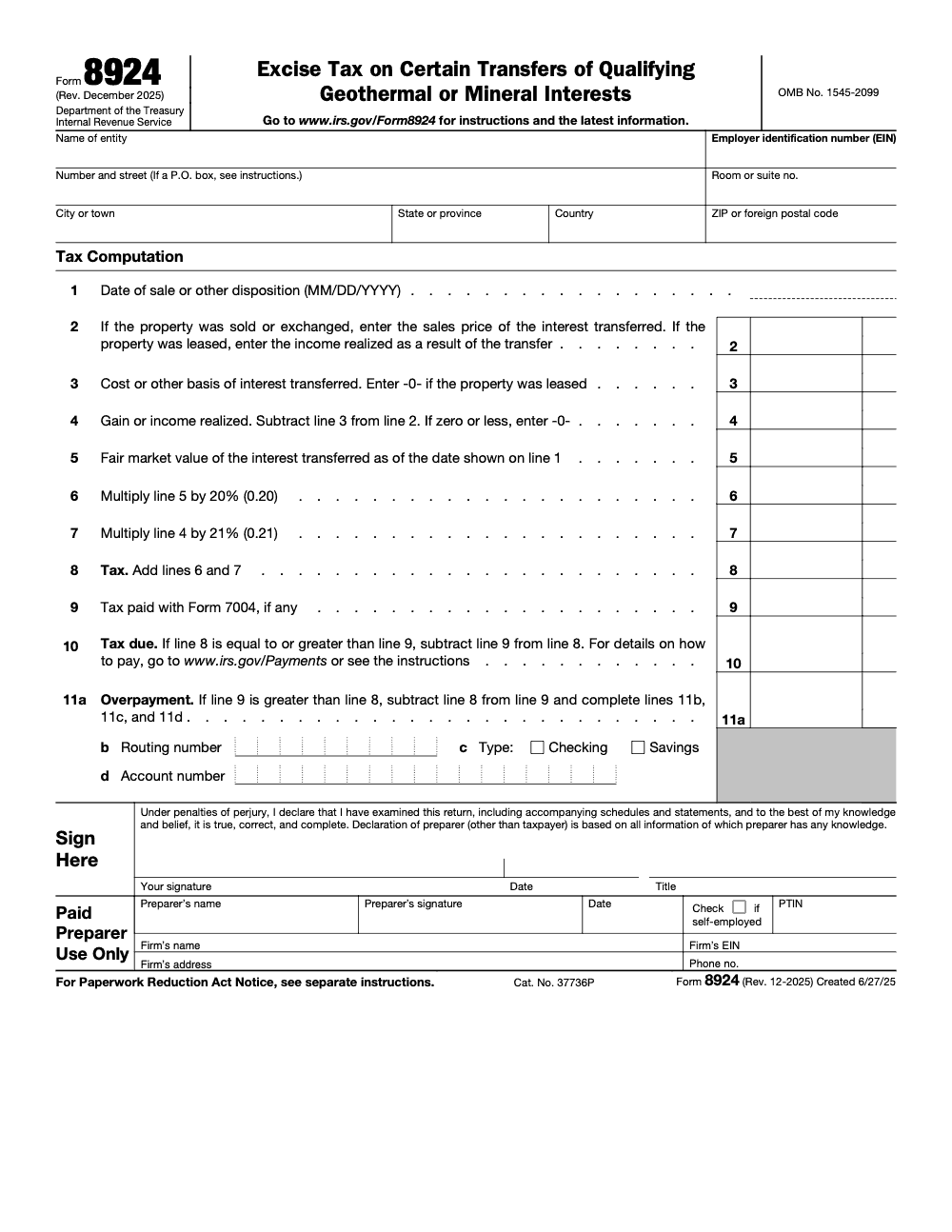
Form 8924 is the entity-level excise return for certain transfers of qualifying geothermal or mineral interests, filed under the filer's EIN rather than an individual SSN, with the tax computed as 20% of fair market value on line 6 plus 21% of the gain or income realized on line 7 and totaled on line 8 (per the Form 8924 instructions, Rev. December 2025). Extend the filing window with Form 7004, not Form 4868, credit any extension payment on line 9, and lean on disciplined tax preparation support to keep the two-rate math correct.
Form 8924 trips people up at the threshold question before any math starts: do we even file this. It is the entity-level excise return for certain later transfers of qualifying geothermal or mineral interests that trace back to a conservation sale with a 25 percent capital-gain exclusion, filed under the entity's EIN rather than a personal SSN.
Once you confirm the filing duty, the tax math is two pieces added together: 20% of fair market value on line 6 plus 21% of the gain or income realized on line 7, totaled on line 8. The clock is tight at the 90th day after the transfer, you extend with Form 7004 rather than Form 4868, and the current revision is December 2025.
Key Takeaways
- Form 8924 reports and pays an excise tax on later transfers of qualifying mineral or geothermal interests that originated in a conservation sale with a 25 percent long‑term capital‑gain exclusion under Section 403 of the Tax Relief and Health Care Act of 2006.
- The form’s tax math uses two components, 20 percent of fair market value on the transfer date, plus 21 percent of gain or income, then adds them together. See the form’s lines 6 and 7.
- Timing matters. File by the 90th day after the taxable transfer. If needed, request an extension with Form 7004, the business-return extension (Form 4868, the individual extension, does not extend Form 8924), but that does not extend time to pay.
- As of December 22, 2025, the current posted form revision is December 2025, and the IRS has a December 2025 draft of updated instructions that adds direct deposit fields for refunds and confirms the 90‑day due date and mailing to Kansas City, MO 64999. Always check the live IRS page before filing.
- The IRS “About Form 8924” page currently shows “Recent developments, None at this time,” last reviewed August 2, 2025. Treat that page as the official status page.
What Form 8924 covers, in plain English
Form 8924 sits on a narrow slice of the Code that encourages conservation. Years back, Congress created a 25 percent exclusion for long‑term capital gain when a taxpayer sold a qualifying mineral or geothermal interest on eligible federal land to an eligible entity, and the conservation purpose was protected. That is the upstream benefit. Later, if that interest changes hands again, the downstream transaction can trigger an excise tax that you report and pay on Form 8924.
Two ideas anchor every decision your team makes:
- Origin, Did this interest come, directly or indirectly, from a post–December 19, 2006 conservation sale that met the 25 percent exclusion rules
- Transfer, Are you handling a sale, exchange, or lease by an eligible entity that now puts you on the hook to file
The form exists to keep the conservation promise intact across later transfers. If a prior transferor was relieved of liability, responsibility can shift to the next eligible entity in the chain. The return is filed per transaction, in the tax year of the transfer, so treat every qualifying assignment, lease, or sale as its own filing event.
Why teams miss this
In my experience working with reviewers, misses usually come from three places:
- The parcel’s “eligible federal land” status was not confirmed at the original conservation sale, so everyone assumes today’s transfer is just a standard mineral assignment.
- Nobody kept the qualifying letter of intent or the conservation sale closing file handy, so tracing the chain takes too long during busy season.
- The team confuses income tax filings with this excise return, which runs on a 90‑day clock and a separate payment.
A simple prep‑review checklist and a short doc set, kept with the client’s workpapers, solves most of it.
Where the rules come from
If you want the primary authority, it lives in Section 403 of the Tax Relief and Health Care Act of 2006. Congress spelled out the 25 percent exclusion, what a conservation sale is, who counts as an eligible entity, and what “qualifying mineral or geothermal interest” means. The statute also ties scope to eligible federal land that the government mapped and recorded for inspection.
The IRS product pages then carry the practical details, the current form, any posted updates, and, for late‑year changes, draft instructions. As of today, the “About Form 8924” page confirms no recent developments, and the form PDF on IRS.gov shows the tax computation that practitioners actually use. The December 2025 draft instructions also highlight a few admin updates, like direct deposit lines for refunds and the Kansas City, MO mailing address.
Definitions that decide your filing position
Build every conclusion on these terms, they are where agents start during exams:
- Qualifying mineral or geothermal interest, The entire interest in a mineral or geothermal deposit located on eligible federal land, as defined in the statute and instructions. Partial interests created to avoid the rules do not qualify.
- Conservation sale, The original sale to an eligible entity, with a qualifying letter of intent, not under condemnation, that allowed the seller to exclude 25 percent of qualifying gain.
- Eligible federal land, The lands referenced in the statute and instructions, mapped as the Rocky Mountain Front Mineral Withdrawal Area and held on file with the Forest Service. Verify with federal maps and ownership records.
Practical tip, Save the original map reference, the letter of intent, and proof of eligible entity status in your permanent file. Those three items settle most scope questions in minutes, not days.
Quick table, do we file or not
| Scenario | Do you file Form 8924 | Why |
| Eligible entity sells a qualifying mineral interest that came from a post‑12‑19‑2006 conservation sale | Yes | Later transfer by an eligible entity after a qualifying conservation sale triggers filing. |
| Prior transferor already paid the Form 8924 excise tax on the same interest | No | Liability already satisfied on a prior transfer. |
| Transferee provides a qualifying letter of intent and is an eligible entity | Often no | Relief rules can apply, document it carefully. |
| Lease of the qualifying interest by an eligible entity | Yes | Leases are listed alongside sales and exchanges as filing triggers. |
Golden rule, treat every qualifying sale, exchange, or lease as its own engagement with its own clock.
Who must file, exactly, and how to confirm it fast
When you strip the jargon out, the filing trigger is simple. If you are an eligible entity and you sell, exchange, or lease a qualifying mineral or geothermal interest that traces back to a post–December 19, 2006 conservation sale with a 25 percent capital‑gain exclusion, you file Form 8924 for that transaction. You file per transfer, in the tax year of the transfer. If a prior transferor was relieved of this excise tax, the obligation can pass to you when you transfer later.
The five‑minute eligibility check
Use this quick pass before you ever open the return:
- Trace the origin, Was the interest originally sold in a conservation sale after December 19, 2006
- Confirm the land, Is or was the interest located on eligible federal land at the original sale
- Confirm the parties, Was the original buyer an eligible entity under the statute
- Confirm today’s event, Are you handling a sale, exchange, or lease by an eligible entity now
- Check prior relief, Did a prior transferor get relief or already satisfy this excise tax
If you clear those five, you likely have a Form 8924 filing. Treat each transfer as its own return with its own support.
Decision flow you can paste into your SOP
- Step 1, Pull the permanent file, find the conservation sale closing set, the qualifying letter of intent, and the map or agency reference for eligible federal land.
- Step 2, Confirm the client’s current capacity in the interest, whole interest or defined fraction, and that the thing being transferred is a qualifying mineral or geothermal interest, not a different right.
- Step 3, Identify the transfer type, sale, exchange, or lease. If no transfer, no Form 8924.
- Step 4, Scan for any prior Form 8924 filings, relief statements, or correspondence that would change who owes the tax now.
- Step 5, Start the return file, name it consistently, attach the proof set, and calendar the 90 day clock.
Who is an eligible entity
The statute points to public and conservation focused buyers. In practice, you will see federal or state agencies, recognized conservation organizations, and similar entities that are allowed to hold and protect the conservation purpose. Your file should include proof of status from the original sale. If you cannot prove eligible buyer status at the original sale, pause, because that puts the entire chain in question.
Common acquisition scenarios and what to do
- You acquired the interest directly in the conservation sale, now you plan to lease it, File Form 8924 for the lease.
- You acquired the interest from an intermediary who was relieved from the excise tax at the time, You are next in line, and your later sale can trigger the filing.
- You hold a royalty carved out after the conservation sale, and now you assign part of it, Check scope carefully. If the carved out royalty is the qualifying interest derived from the original conservation sale on eligible federal land, your assignment can trigger filing.
Table, quick yes or no
| Situation | Likely file | Notes |
| Eligible entity leases qualifying mineral interest that came from a conservation sale | Yes | Leases count as transfers and need their own Form 8924 |
| Eligible entity sells interest, prior owner already paid excise tax on the same interest and transfer type | No | Document the prior payment with proof in your file |
| Assignment of a non‑qualifying right not tied to the conservation sale | No | Confirm it is truly out of scope before you skip the return |
| Later sale where prior transferor was relieved of liability | Yes | The responsibility can pass forward, file per transaction |
Examples from real reviews
- The split estate, A client holds mineral rights under federal surface, the original conservation sale file proves eligible federal land, and last year the client signed a three year lease with a small bonus and royalties. That lease is a transfer. File Form 8924 for the lease.
- The clean sale with relief, A state agency bought the interest in 2010 and was relieved of the excise tax after providing a qualifying letter of intent. Your client later acquired from that agency and now plans to sell. Your client’s sale is in scope. File Form 8924.
- The false alarm, A fee simple ranch sale adjacent to federal land with no mineral or geothermal carve outs. There was no conservation sale and no qualifying interest. No Form 8924.
Field note, Almost every scramble I see starts with a missing permanent file. Build a standing “Form 8924 proof set” in your DMS so the origin story is never lost.
The conservation sale and the 25 percent exclusion, what to keep on file
The conservation sale is the upstream event that created the 25 percent long‑term capital‑gain exclusion. Your job now is not to re‑argue that exclusion. Your job is to verify that today’s transfer is downstream of that sale and still sits within the boundaries that make Form 8924 relevant.
What proves a conservation sale
- The closing file showing a post–December 19, 2006 date and the qualifying mineral or geothermal interest.
- A qualifying letter of intent that shows conservation purpose and eligible buyer intent.
- Evidence the parcel lies on eligible federal land as defined in the statute or the controlling maps.
- The seller’s tax file or representation that the 25 percent exclusion applied to qualifying gain. If you cannot get the seller’s return, keep correspondence, closing statement, or counsel memo that ties the exclusion to the sale.
Protections and covenants your reviewer will look for
Reviewers look for recorded restrictions, covenants, and any agency approvals that preserve the conservation purpose. If the documents are silent, look for attachments to the deed, references to memoranda of understanding with land managers, and any recorded easements that match the conservation intent.
Practical, how I check this in under an hour
- Pull the property description from the earliest instrument you can find in the file.
- Confirm that the legal description matches later transfers, no silent boundary drifts.
- Match the conservation‑related attachments across each recorded document.
- Scan for gaps in years with no recorded activity. If the chain skips, fill it with title work or affidavits.
- Save clean PDFs, name them consistently, and index them. Your senior reviewer should be able to find any document in two clicks.
Pro tip, Build a short index page in the workpapers. It lists the conservation sale date, the eligible entity, the map reference, and links to each supporting document. It pays for itself during review and exam.
Excise tax exposure and how to keep it low
When a qualifying interest changes hands, Form 8924 is your alert system. The excise tax is designed to keep the conservation purpose intact after the original deal. Your job is to show that the new transfer respects those protections or, if it does not, to compute and pay the tax correctly.
The practical sequence for every file
- Identify the interest and the transfer type, sale, exchange, or lease.
- Verify the chain back to the conservation sale and keep proof in one place.
- Confirm whether any prior transferor was relieved of liability.
- Capture valuation and gain data for the current transfer, with support.
- Prepare Form 8924, attach your proof set in the workpapers, and calendar the payment.
Reviewer cue, If you cannot tie the interest back to a post–December 19, 2006 conservation sale on eligible federal land, pause. You may be out of scope, which is good news, but you must be certain.
Valuation and income, what to document
- Fair market value on the transfer date, Keep your methodology memo, comps, and calculations, and measure the value as of the line 1 date of sale or other disposition, not a later appraisal date or the current value.
- Gain or income from the transfer, Show the basis, the proceeds or bonus, and royalty terms for leases. When the interest was leased rather than sold or exchanged, enter the income realized on line 2 and -0- as the basis on line 3, so the full income realized flows through to line 4.
- Allocation schedules, If you are transferring a fraction, document the math and show how you apportioned basis and value.
- Third‑party reports, Save appraisals or valuation letters that support your position.
Keep your write‑ups short, plain, and dated. The goal is to make the reviewer’s job easy and the agent’s questions few.
Avoidable mistakes that create rework
- Treating a lease as “just an agreement,” Leases are listed triggers.
- Missing the permanent file, Without the conservation sale proof, the team wastes hours.
- Inconsistent names and versions, If the workpapers use different labels for the same interest, reviews slow down.
- No calendar, Excise returns have their own clock. Put due dates in your central calendar and assign an owner.
Internal controls that actually help
- Add a “Conservation Sale?” checkbox to your intake for mineral or geothermal work.
- Require a one‑page origin sheet in every transfer file.
- Standardize filenames and folder structures for Form 8924 engagements.
- Use a simple internal QC step before you send the return for signature.
Geographic eligibility and definitions, the simple version
You do not need to be a land office historian to get this right. You just need clean definitions and a repeatable way to verify them.
Eligible federal land, how to confirm
- Start with the earliest recorded instrument in your file and pull the legal description.
- Match the parcel to federal maps or agency references saved from the original conservation sale.
- Keep an image or PDF of the map reference with the workpapers, and label it clearly.
- If you find a boundary dispute, stop and resolve it before you decide coverage.
Qualifying mineral or geothermal interest, what counts
A qualifying interest includes mineral or geothermal rights on or under eligible federal land that were part of the conservation sale. Think whole mineral estates, leasehold interests, or royalty interests that trace back to that sale. Carve‑outs or split interests can qualify, but only if they are derived from the original qualifying interest and still sit inside the statute’s boundaries.
What does not count
- Interests outside the eligible federal land footprint at the time of the conservation sale.
- Property with no link to a qualifying conservation sale after December 19, 2006.
- Rights that are not mineral or geothermal interests.
Field check, If your only “proof” is that the ranch is near federal land, you do not have enough. You need the specific eligible land reference tied to the original sale.
Documentation that closes the loop
- Conservation sale closing file, including the qualifying letter of intent.
- Maps or agency references that identify the eligible federal land.
- Chain‑of‑title from the conservation sale to today’s transfer.
- Any prior Form 8924 filings or relief evidence.
- Valuation and gain workpapers for the current transfer.
Filing requirements and timing, without the guesswork
Here is the cadence you can standardize across your firm for Form 8924 work.
Filing rhythm your team can follow
- File a separate Form 8924 for each qualifying transfer, even if multiple events occur in the same tax year.
- Treat the return as its own engagement, with its own organizer, clock, and sign‑off.
- If the original transferor was relieved of liability, assume the obligation can pass to you when you transfer later.
- Keep proof of filing and payment in the permanent file, not just in the year’s binder.
Packaging the return
- Include a short cover memo that lists the interest, transfer type, transfer date, and the proof set you relied on.
- Double‑check names, EINs, and addresses against your client master record.
- If you e‑file or mail, save confirmations and tracking alongside the return PDF.
Extensions and tight timelines
If the clock looks tight, move two tasks first, valuation and gain support, and return setup with basic ID fields. Assign a one‑hour block to a senior to scrub the proof set so review is smooth. If you need extra time to finish schedules, plan for an extension where allowed and make any required payment on time to avoid penalties.
Tip for managers, Add Form 8924 to your firm’s “short‑fuse” list so resourcing does not get starved during peak season.
Recordkeeping that stands up in review and exam
If you set up the file well, you protect the client, speed the review, and cut down on questions later.
The “proof set” to keep forever
- Conservation sale evidence, closing statement, qualifying letter of intent, and date.
- Eligible federal land proof, maps, agency references, and any correspondence.
- Chain‑of‑title, deeds, assignments, leases, royalty splits, and settlement statements.
- Prior Form 8924 filings, relief letters, and payment proofs.
- Current transfer support, valuation, gain, royalty math, and the signed return.
- A one‑page index that links to each document.
Retention and access
Keep the file for as long as your firm’s policy requires, and mirror it in secure digital storage with version control. Limit access by role, log activity, and avoid local copies. A short audit trail beats a long argument.
Quality signals exam teams respond to
- Consistent naming and dates across all documents.
- Clear explanations without jargon.
- Direct references to the conservation sale and the eligible land proof.
- A simple reconciliation from the valuation memo to the numbers on the return.
Step‑by‑step prep, review, and sign‑off workflow
This is the structure we use with CPA firms that want clean, repeatable Form 8924 work without burning review hours.
Prep, what your staff does first
- Open a dedicated engagement in your workflow system and add the 8924 checklist.
- Pull the permanent file, confirm the conservation sale link, and save copies in this year’s binder.
- Confirm the interest, transfer type, date, and counterparties.
- Draft the valuation and gain schedules, with sources noted.
- Start the return and complete identifying information.
- Create the one‑page index that links to the proof set.
Senior review, how to protect partner time
- Validate scope, is this definitely a qualifying transfer
- Check valuation logic, tie numbers to the memo and supporting docs
- Confirm any prior relief or payment and whether it changes today’s filing
- Reconcile names, IDs, and dates
- Sign off or route back with targeted notes
Manager QC, the last gate
- Run through a short internal checklist, are all attachments present, are versions final, is the index accurate
- Verify the due date is calendared and that the delivery method is chosen
- Prepare the client cover letter or email with a plain‑language explanation
Micro‑anecdote, One firm shaved two days off cycle time just by adding the one‑page index. Reviewers stopped hunting for documents, and partners stopped asking for “one more summary.”
Common traps and how to avoid them
The “near federal land” trap
Being adjacent is not enough. Tie the interest to eligible federal land as defined at the time of the conservation sale, with proof.
The “royalty carve‑out” trap
A carved‑out royalty can still be a qualifying interest if it derives from the original conservation sale interest. Document the derivation, fraction, and basis allocation.
The “we already filed something” trap
Income tax filings do not satisfy this excise return. The excise tax is computed and paid on Form 8924 itself, not carried over to an income tax return such as Form 1040 or 1120. Treat Form 8924 as a separate engagement with its own deadline and payment.
The “missing relief” trap
If a prior transferor was relieved of liability, that can move the obligation forward in the chain. Do not rely on assumptions, find the paper.
Tools and templates you can use today
- Intake add‑on, A two‑question trigger for mineral and geothermal work.
- Origin sheet, A one‑page summary of the conservation sale, eligible land proof, and buyer status.
- File index, Links to every document reviewers need.
- QC checklist, Ten items a senior can review in under fifteen minutes.
- Calendar pack, Standard reminder set for short‑fuse filings.
If you already run a modern workflow platform, add these as templates. If not, a simple shared folder structure with consistent naming and a checklist still pays off.
How disciplined offshore delivery helps, without losing control
When Form 8924 work shows up mid‑busy season, the first instinct is to push it to your busiest reviewers. That is how delays start. What works better is a controlled delivery model where preparers follow SOPs, workpapers are standardized, and reviewers see the same structure every time.
- SOP‑driven execution, Every 8924 file uses the same checklist, naming, and index.
- Structured workpapers, Valuation memo, gain schedule, and proof set in the same order, every time.
- Layered review, Preparer, senior, quality, then final partner review to cut partner time.
- Turnaround SLAs, Predictable windows so filings do not slip.
- Visibility, Live status and early escalation when a map or deed is missing.
If you prefer a partner to help build that discipline with an offshore team that works inside your systems and templates, that is the kind of operational infrastructure Accountably builds for CPA firms. The goal is simple, more on‑time filings, fewer review loops, and no loss of control.
Government links, what to bookmark and why
You do not need a dozen bookmarks, just the authoritative ones and a habit of checking them before you file.
Your short list
- The Form 8924 product page, for the current PDF and official status notes.
- The instructions page, for definitions, who must file, timing, and any process updates.
- The controlling statute, Section 403 of the 2006 Act, for scope and core definitions.
Create a tiny “last‑checked” log in your binder with the date and what you verified. That two‑line note saves time if questions come up later.
How to sanity‑check versions
- Compare the revision date on the form you downloaded to the date on the IRS page.
- If you see “draft” instructions near year‑end, scan for admin changes and watch for the final posting before you file.
- Archive the exact version you used with the return PDF.
A short checklist you can copy into your SOP
- Confirm origin, post–12‑19‑2006 conservation sale
- Confirm land, eligible federal land proof saved
- Confirm parties, eligible entity status on the original sale
- Confirm today’s event, sale, exchange, or lease
- Check prior relief or payment
- Build valuation and gain schedules
- Prepare Form 8924
- Run senior review and QC
- File and pay on time
- Archive return, proof of payment, and index
Example file structure that speeds review
- 00 Index and summary.pdf
- 01 Conservation sale closing set.pdf
- 02 Eligible federal land proof.pdf
- 03 Chain‑of‑title and recorded docs.pdf
- 04 Prior 8924 filings or relief.pdf
- 05 Valuation and gain schedules.xlsx
- 06 Form 8924, final and signed.pdf
- 07 Filing confirmations and payment proof.pdf
Small win, Put the index first so reviewers and partners always know where to start.
Bringing it all together, your action plan for the next transfer
Here is how I would run your next Form 8924 engagement from intake to filing without drama.
Day 1
- Intake the transaction, tag it as “Form 8924 potential.”
- Pull the permanent file and confirm the conservation sale link and eligible land proof.
- Create the engagement in your workflow app and load the checklist and index template.
Day 2
- Draft valuation and gain schedules.
- Start the return and complete identifying fields.
- Request any missing pieces, title gaps, or counterparties’ docs.
Day 3
- Senior review for scope, math, and completeness.
- Manager QC, finalize versions, confirm due date and delivery method.
- Prepare client cover letter with a plain‑language summary and next steps.
Before filing
- Final partner review, limited to decisions and risk notes, not a document hunt.
- Execute signature, file, and pay.
- Save confirmations and update the index.
Where Accountably fits if you want help
If you are swamped with compliance work and want this handled without losing control, Accountably can integrate trained offshore accountants into your workflow and templates so Form 8924 files look and feel exactly like your own.
- Teams work inside your systems and naming standards.
- SOPs and checklists are enforced so proofs are always complete.
- Multi‑layer reviews protect partner time and keep filings on schedule.
- Continuity plans cover vacations or turnover so nothing stalls.
This is not resume farming. It is disciplined delivery that gives you capacity without chaos, so you keep client trust high while your partners stay focused on higher‑value work.
Final word and a friendly reminder
Form 8924 only bites when teams treat it like an edge case. Give it a simple SOP, a tiny proof set, and a tight review flow, and you will file on time with confidence. Your clients get fewer surprises. Your team avoids weekend scrambles. And if an exam comes, your file tells a clean story.
Common Mistakes We See Every Season
Form 8924 trips teams up when they treat it like an income tax return instead of the standalone excise return it is. Here are the misses I see most often, each tied to a specific line on the form.
Reusable Checklists
These checklists are copy-paste ready for your firm SOP, so every Form 8924 engagement runs the same way. Tick each item as you go, your browser saves progress per checklist.
Filer and scope check
- Confirm the filer is an entity identified by EIN, not an individual SSN.
- Confirm the transaction is a sale, exchange, or lease of a qualifying geothermal or mineral interest.
- Confirm Form 8924 is used as an excise return, with tax computed on the form itself, not carried to Form 1040 or 1120.
- Consult the separate instructions before entering a P.O. box on the street-address line.
- Verify you are working from the current revision (Rev. December 2025) on the official IRS Form 8924 page.
Line-by-line tax computation
- Enter the date of sale or other disposition on line 1 in MM/DD/YYYY format.
- Enter the sales price, or for a lease the income realized, on line 2.
- Enter the cost or other basis on line 3, or -0- if the interest was leased.
- Compute line 4 as line 2 minus line 3, entering -0- if the result is zero or less.
- Enter fair market value as of the line 1 date on line 5.
- Multiply line 5 by 20% for line 6.
- Multiply line 4 by 21% for line 7.
- Add lines 6 and 7 for the total tax on line 8.
Extension, payment, and refund
- If extending, file Form 7004 and credit any tax paid with it on line 9.
- If line 8 is equal to or greater than line 9, subtract line 9 from line 8 and report tax due on line 10.
- For payment methods, follow the IRS payment instructions or the separate Form 8924 instructions.
- If line 9 is greater than line 8, report the overpayment on line 11a.
- Complete lines 11b, 11c, and 11d with the routing number, account type (checking or savings), and account number for a direct-deposit refund.
- Sign under penalties of perjury, and have any paid preparer enter their PTIN.
Keep 8924 Season From Stalling
Form 8924 rarely lands on a tidy schedule. It surfaces as a one-off when an entity transfers a qualifying geothermal or mineral interest, often mid-season, and it carries eleven numbered lines plus math most preparers touch only once a year, 20% of fair market value on line 6 plus 21% of the gain or income realized on line 7, totaled on line 8 (per the Form 8924 instructions, Rev. December 2025).
Because the return is transactional and infrequent, the real risk is not volume, it is memory. Without a written routine, teams rebuild the scope logic and the two-rate computation from scratch every time, which is where errors and lost hours creep in. A short, repeatable SOP removes that drag.
- Standardize the line 1 through line 8 computation in one worksheet, with the line 4 floor and the leased-property -0- on line 3 already built in.
- Pin the valuation to the line 1 date of disposition so line 5 is never pulled from a later appraisal.
- Treat extensions as Form 7004 tasks, with the extension payment credited to line 9, so no one defaults to Form 4868.
- Pre-stage the entity and EIN block and the refund lines 11b, 11c, and 11d, so a direct-deposit overpayment never stalls on missing bank details.
- Keep a one-page index of the supporting documents so review starts with the facts, not a file hunt.
That kind of structure, the same worksheet, the same review gates, and the same calendar every time, is what keeps an infrequent filing like Form 8924 from stalling at the worst moment. It is also what disciplined offshore tax delivery is built to provide, with trained teams working inside your templates so transactional returns get filed on time without pulling partners off higher-value work.
FAQs
Form 8924 reports and pays an excise tax on each qualifying sale, exchange, or lease of a mineral or geothermal interest that traces back to a post–December 19, 2006 conservation sale with a 25 percent long‑term capital‑gain exclusion. You file per transaction, in the year of the transfer, and you maintain a proof set in your workpapers.
An eligible entity that transfers a qualifying interest after the conservation sale files the return. If a prior transferor was relieved of liability, the obligation can pass to a subsequent eligible transferor when they later sell, exchange, or lease the interest.
Yes, leases are listed triggers alongside sales and exchanges. Treat a lease like any other transfer, prepare the valuation and gain support, and file a separate return.
Use the original conservation sale file to tie the interest to eligible federal land, then save the map or agency reference in your current file. If you cannot prove it, pause and resolve the gap before you decide coverage.
No. Form 8924 is an excise return related to conservation sale rules. Keep it on its own clock with separate review and payment controls.
Follow your firm’s retention policy, but keep the conservation sale proof set, the eligible land proof, chain‑of‑title, prior filings, and the signed return in the permanent file, with secure digital backups and version control.
Other forms this guide names
About this guide
Accountably helps US CPA, EA, and accounting firms hire trained accountants and tax preparers in India.
About us Reviewed byJugal Thacker, CPAFounder and CEO at Accountably
A Washington-licensed CPA with 7+ years inside US firms – PwC, a real-estate tax practice, then a full-service firm, rising from reviewer to manager to advisory. This article was reviewed against current IRS guidance for the 2025 tax year and updated for filers preparing late returns, amendments, and 2026 estimates.
View profile →How we research, review, and update this guide
Every Accountably guide is researched against primary IRS sources, reviewed by a U.S. CPA, and refreshed as guidance evolves. Read our Editorial Guidelines to see how we source, fact-check, and update our content.