Summarize this article with AI
In Brief
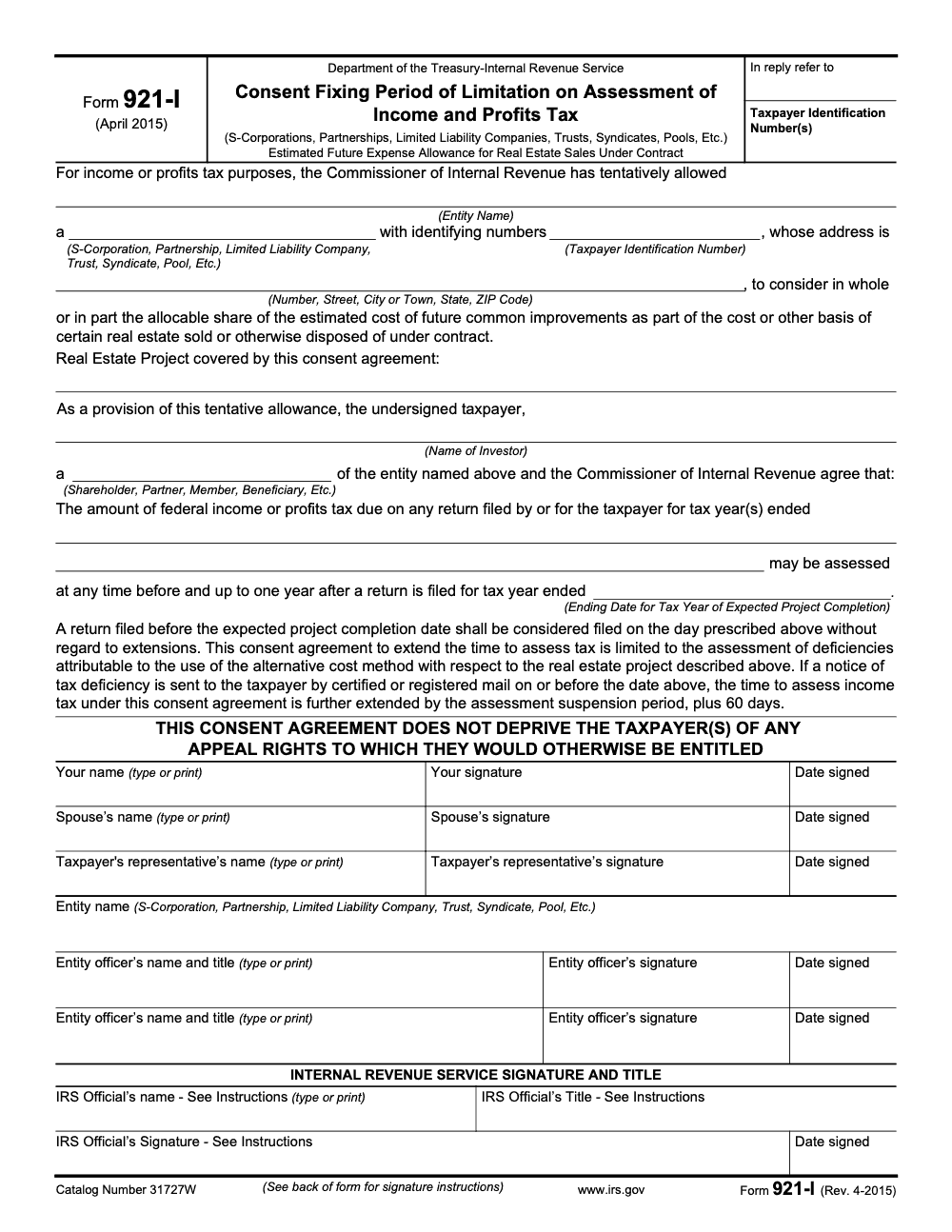
Form 921-I is the IRS consent that fixes the assessment period for federal income or profits tax tied to the alternative cost method under Revenue Procedure 92-29 on an identified real estate project (per the April 2015 IRS Form 921-I instructions, catalog number 31727W). The extended window runs to one year after the return is filed for the tax year ending with expected project completion, and the taxpayer must return original plus one signed copy. Investors in TEFRA-subject electing entities use Form 921-P instead; see our taxation services for full project handling.
Form 921-I tends to arrive in one of two states. Either it is a clean handoff, with each investor's consent collected and the package routed well before the deadline, or it is a controller realizing the project-completion-year return is days from filing and nobody chased signatures. The form is the same. The difference is process.
Form 921-I is not a general audit extension and it does not extend the time to file or pay. It fixes the assessment period for income or profits tax tied to the alternative cost method on one identified real estate project under Revenue Procedure 92-29. The window runs to one year after the return is filed for the tax year of expected project completion, a valid consent must be executed by both sides before the normal statute expires, and the taxpayer returns the original plus one signed copy.
Key Takeaways
- Form 921‑I is not a general audit extension, and it does not extend the time to file or pay tax – only the IRS’s time to assess a deficiency tied to the alternative cost method on a specific real estate project. It is a consent form used with Rev. Proc. 92‑29 for real estate projects, typically for investors in S corporations, partnerships, LLCs, trusts, syndicates, or pools that are not under TEFRA.
- The form fixes the assessment period to run until one year after the return is filed for the tax year when the project is expected to be completed. If the IRS issues a notice of deficiency by certified or registered mail on or before that date, the assessment period is further extended by the assessment suspension period plus 60 days.
- The IRS Internal Revenue Manual confirms the 921 series, explains who uses 921‑I, and distinguishes it from 921‑P and 921‑M for TEFRA and BBA partnership regimes. The section was last revised on August 7, 2025.
- A valid consent must be executed by both the taxpayer and the IRS before the normal statute expires. The IRS also recognizes properly documented faxed signatures on consents as “originals.”
- You can obtain the current two‑page April 2015 PDF directly from the IRS. Review both pages, including the on‑form instructions.
What is IRS Form 921‑I?
Form 921‑I is titled “Consent Fixing Period of Limitation on Assessment of Income and Profits Tax.” It lives in a very specific corner of tax practice, where real estate developers elect the alternative method for estimated future common improvement costs under Revenue Procedure 92‑29. In that setting, investors in the electing entity use 921‑I to agree that the IRS can assess any resulting deficiency up to one year after the return is filed for the tax year in which the project is expected to be completed.
The IRS Internal Revenue Manual spells out the 921 series and clarifies when 921‑I is the right choice. It is used by investors in an electing S corporation, partnership, LLC, trust, syndicate, or pool that are not subject to TEFRA. For TEFRA entities the counterpart is 921‑P, and for entities under the centralized partnership audit regime established by the Bipartisan Budget Act of 2015, the counterpart is 921‑M. Note that TEFRA partnership audit rules were repealed by the BBA effective for tax years beginning after December 31, 2017, so most partnerships today follow the BBA regime – verify the entity’s audit framework before choosing the form.
If you are thinking, “We usually sign Form 872 for statute extensions,” you are right in general, but 872 is the standard fixed‑date consent for assessments outside of the Rev. Proc. 92‑29 world. The Manual is explicit that waivers like Form 870 are not consents and do not extend the statute, and that any consent must be executed by both parties before the statute expires.
Why this form matters for your clients and your workflow
When a client is using Rev. Proc. 92‑29, 921‑I lets the IRS and the investor agree on a tailored assessment window keyed to project completion. That prevents a last‑minute scramble to issue a notice of deficiency and gives both sides time to reconcile the project’s cost treatment. In practice, it reduces risk for the IRS while giving you, the advisor, breathing room to finalize complex schedules and support files without rushing.
From a delivery standpoint, statute dates are unforgiving. One missed signature or an unsigned IRS line can invalidate the consent. Your team needs a crisp checklist, version‑controlled workpapers, and clear ownership. That is especially true if multiple investors need to sign or a power of attorney is involved.
Scope, not a catch‑all
It bears repeating. Form 921‑I is purpose‑built. It is not a blanket tool for exams, refund claims, or general statute management. If your matter has nothing to do with Rev. Proc. 92‑29 common improvements, you probably need a different consent form, usually Form 872. The Manual’s 2025 update continues to position 921‑I within that narrow lane.
Who should use Form 921‑I, and when?
Use 921‑I when all three are true:
- Your matter involves the alternative method for estimated costs of common improvements under Rev. Proc. 92‑29.
- The taxpayer is an investor in an electing S corporation, partnership, LLC, trust, syndicate, or pool that is not under TEFRA.
- You need to fix the assessment period to one year after the return for the year the project is expected to be completed is filed.
A quick real‑world pattern to recognize
- A client invests in a multi‑phase subdivision through an LLC taxed as a partnership.
- The developer elects the Rev. Proc. 92‑29 alternative method for common improvements like roads and utilities.
- Near statute, the IRS requests a 921‑I to ensure it can assess any deficiency tied to that project once the final numbers settle at project completion.
- You coordinate investor signatures and the IRS signature before the normal statute expires.
When 921‑I is not the right tool
- General audit extensions unrelated to Rev. Proc. 92‑29. Use Form 872 or, in some cases, 872‑A if open‑ended terms apply. Waivers such as Form 870 do not extend statutes.
- TEFRA partnerships. Use 921‑P.
- Entities under the BBA centralized partnership audit regime. Use 921‑M.
Form family overview
Comparison guide you can share with staff
| Form | Who typically uses it | What it does | When the extended period ends |
| 872 | Individuals, corporations, partnerships in general exams | Fixed‑date consent to extend time to assess tax | The specific date stated on the consent |
| 921‑I | Investors in electing S corps, partnerships, LLCs, trusts, syndicates, pools not under TEFRA, within Rev. Proc. 92‑29 | Fixes assessment period for deficiencies attributable to the alternative method on the named project | One year after filing the return for the year the project is expected to be completed |
| 921‑P | TEFRA partnerships using Rev. Proc. 92‑29 | TEFRA counterpart to 921‑I | One year after filing the return for the year of expected project completion |
| 921‑M | BBA centralized partnership audit regime using Rev. Proc. 92‑29 | BBA counterpart to 921‑I | One year after filing the return for the year of expected project completion |
The Internal Revenue Manual lists and defines each 921 variant, including the switch points between non‑TEFRA, TEFRA, and BBA. Keep this table in your binder, because misclassifying the entity’s regime is one of the easiest ways to send the wrong form.
Current form version and where to get it
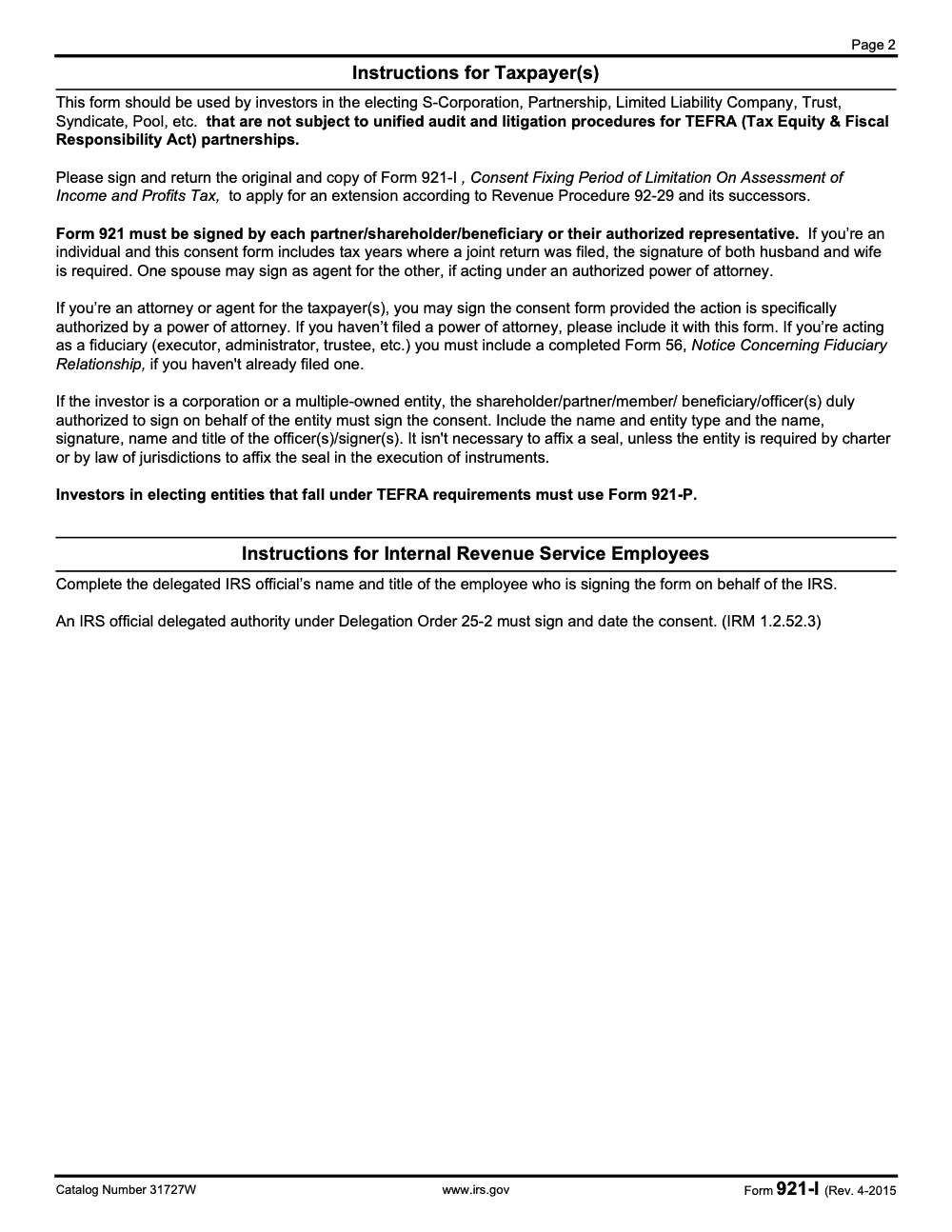
The current IRS PDF for 921‑I is a two‑page April 2015 revision. Page 1 is the consent, and page 2 holds brief instructions for both IRS employees and taxpayers, including signature authority pointers and references to Delegation Order 25‑2. Download the file directly from the IRS and review both pages before you prep signatures.
Tip you can adopt firm‑wide: save a clean copy using a clear name like 921‑I_ProjectName_TaxpayerName_YYYY.pdf, then generate a separate execution set for signature. Keep the clean copy untouched for version control.
Your rights and the IRS’s policy
The IRS policy is to seek consents only when needed, and never longer than necessary to complete the examination and related actions. Each request to extend the assessment period must come with clear notice of the taxpayer’s rights. That includes the right to refuse, to limit the extension to certain issues, and to limit it to a specific date. Signing 921‑I also preserves the taxpayer’s appeal rights – the consent does not waive administrative appeal or Tax Court access. Document these notifications in your file.
How to complete Form 921‑I, step by step
- Identify the project and taxpayer details cleanly
- Enter the investor’s name and capacity, the electing entity’s legal name, TIN, and address.
- Describe the real estate project covered by the consent. Keep it specific enough to match the Rev. Proc. 92‑29 election.
- Set the key dates correctly
- The form fixes the assessment period to any time before and up to one year after the return is filed for the tax year the project is expected to be completed.
- If a return is filed before project completion, it is treated as filed on the prescribed day without regard to extensions. Enter the expected completion year carefully.
- Limit the scope appropriately
- The consent is limited to deficiencies attributable to use of the alternative method for the described project. Do not widen it with extra language. The Manual cautions that restricted consents have specific rules, and that consent wording must reflect the parties’ intent.
- Capture all required signatures
- Investor, spouse when relevant for joint filings, authorized representative if acting under a valid power of attorney, and the delegated IRS official.
- If an attorney or agent signs, include Form 2848. Fiduciaries should include Form 56 if not already filed.
- Execute before the statute expires
- A consent must be signed by both the taxpayer and the IRS while the normal assessment period is still open. Track these dates visibly in your workflow so no one is guessing.
Signature authority and dating protocols
- Use legible names, titles, and actual execution dates in month, day, year format.
- Corporate officers, managing members, or other authorized persons can sign for entities.
- The IRS recognizes properly documented faxed signatures on consents as “originals” if contact and case notes meet Manual requirements. This policy has persisted through the 2025 IRM update.
Practical safeguard: keep a duplicate original signed by both the taxpayer and the delegated IRS official. Attach copies behind the relevant returns and store scans in your DMS with immutable audit logs.
Filing mechanics and retention
- The form itself contains brief instructions on page 2. Follow them, then file in duplicate and ensure both sets carry original signatures or properly documented faxed signatures.
- Maintain a clean, fully executed PDF and a control log with who signed, on what date, and which IRS official executed the consent under Delegation Order 25‑2.
Avoid these common errors
- Using 921‑I for a matter that is not a Rev. Proc. 92‑29 project.
- Missing the IRS signature line or getting it after the statute date.
- Mixing regimes and sending 921‑I when the entity is TEFRA or under BBA.
- Altering a consent after a taxpayer signs. If corrections are needed, prepare a fresh consent.
Privacy and secure communications
Keep all sensitive information off public pages. If you discuss specifics with the IRS, use secure channels. When circulating drafts internally, remove SSNs from filenames, restrict access by role, and log every change. The form’s instructions and the Manual emphasize proper authority and documentation, so your internal controls should match that standard.
Delivery checklists your team can use today
921‑I readiness checklist
- Confirm the matter is a Rev. Proc. 92‑29 project.
- Verify the entity’s regime, then pick the correct form in the 921 family.
- Populate project identification and expected completion year.
- Assemble signature authority: officer titles, Form 2848, or Form 56 if applicable.
- Calendar the statute date and set a seven‑day internal deadline buffer.
- Route for quality review, then secure the delegated IRS official signature.
Workpaper standards that speed reviews
- Standardized file names and version control.
- A single cover sheet summarizing project, investor, expected completion year, and statute date.
- A signature matrix that lists every required signer, their capacity, and the date signed.
- An audit log that captures contact attempts, fax logistics when used, and confirmation that rights notices were provided to the taxpayer.
Where Accountably fits, briefly
If you lead a firm that handles real estate investors across busy seasons, the pain is rarely a lack of clients. It is delivery. Forms like 921‑I expose weak SOPs, inconsistent file naming, unclear review roles, and last‑mile signature chaos. Accountably integrates trained offshore teams into your workflow with structured workpapers, layered reviews, and documented SLAs so deadlines stop being coin flips. Use us when you need capacity without chaos, not as a resume farm. We work inside your systems, follow your templates, and keep statute‑critical steps visible and owned. This keeps partners out of review loops and protects client trust when the calendar turns tight.
Final notes and compliance
- Information here is current as of January 2, 2026. Always confirm the latest IRS Manual section 25.6.22 and the current 921‑I PDF before you act.
- This article is for educational purposes. For your specific facts, consult a qualified tax professional.
- Keep clean copies, track signatures, and never let statute control live in someone’s head. Put it in your system where everyone can see it.
Common Mistakes We See Every Season
After several seasons of 921-I work, the same procedural mistakes repeat. Each one defeats the consent, and each one is fixable with a one-line SOP.
Reusable Checklists
These checklists are copy-paste ready for firm SOPs covering Rev. Proc. 92-29 projects. Each one mirrors a step where 921-I packets stall in practice.
921-I packet pre-flight
- Confirm the electing entity is NOT subject to TEFRA or the BBA centralized audit regime before drafting 921-I.
- Identify the real estate project by name, address, and developer schedule reference.
- List the entity name, entity type, taxpayer identification number, and address on the consent.
- State the ending date of the tax year of expected project completion in plain language.
- Specify the tax year or years for which the extended assessment period applies.
- Attach a current power of attorney for any attorney or agent signer, specifically authorizing consents to extend the assessment period.
- Attach Form 56 for any fiduciary signer not already on file.
- Print the entity name and signer title under every entity-investor signature line.
Signature authority audit
- Match each investor on the consent against the Schedule K-1 or equivalent allocation schedule.
- Identify the investor's relationship (shareholder, partner, member, beneficiary) on the form.
- For joint-return tax years, confirm both spouses signed unless a valid POA authorizes one to sign for the other.
- Verify the IRS countersignature line cites Delegation Order 25-2 authority.
- Hold the engagement open until the countersigned IRS copy is returned.
Statute-clock tracking
- Log the original IRC section 6501 assessment deadline for each covered tax year.
- Log the 921-I extended deadline as one year after the return is filed for the project-completion year.
- Flag any deficiency notice received by certified or registered mail and add the suspension period plus 60 days.
- Reconfirm the project completion date with the developer at each quarter-end.
- Trigger a workpaper review if the completion date slips by more than one quarter.
Keep 921-I Season From Stalling
Form 921-I rarely fails on its own. It fails because the surrounding workflow stalls. A 2015 PDF (catalog number 31727W) routed through email chains, an investor list pulled from outdated Schedule K-1 data, and a Form 56 that nobody knows is missing are the recurring causes of a defective consent. Multiply that across a developer engagement with twenty investors and a project completion date that just slipped two quarters, and the statute exposure becomes real.
The fix is not more hours. It is a tighter process around the few steps that decide whether the consent binds the IRS at all.
- Lock the Rev. Proc. 92-29 election memo, the project schedule, and the investor list into one workpaper folder before any 921-I draft goes out.
- Standardize the consent narrative so the entity name, type, TIN, address, project identification, covered tax years, and expected completion date appear in the same fields every time.
- Track Delegation Order 25-2 countersignatures in your engagement system, not in someone's inbox.
- Run a quarterly Form 56 audit for every fiduciary investor so the consent is not blocked at signature.
- Reconcile the assessment-clock log against the project completion date at every quarter-end review.
Accountably integrates U.S.-led offshore teams into Rev. Proc. 92-29 workpaper preparation, signature tracking, and statute-clock review for developer engagements. See our taxation services for the delivery model.
FAQs
No. 921‑I is tied to Rev. Proc. 92‑29 for real estate projects and fixes the assessment period to one year after filing for the year of expected project completion. Form 872 is the general fixed‑date consent most exam teams use outside of this context.
Use 921‑I for non‑TEFRA investors in an electing entity. Use 921‑P for TEFRA partnerships. Use 921‑M for entities under the BBA centralized partnership audit regime. The IRS Manual lists each form and who uses it.
Yes, when the case file documents proper contact and the taxpayer’s preference to fax, a faxed consent is treated as an “original” for this purpose under the Manual’s fax policy. Keep complete case notes.
From the IRS. The current two‑page PDF is the April 2015 revision and includes concise instructions on page 2. Verify you have the correct file before routing for signatures.
Both the taxpayer and the IRS must execute the consent before the normal statute expires. The consent must clearly reflect the parties’ intent, and alterations after signing are not permitted.
Other forms this guide names
- Form 921-P: 2026 Status, When It Applies, and Form 3115 Guidance
- Form 921‑M: What It Is, Who Signs, How to Complete
- Form 921: Consent to Extend the Time to Assess Tax 2026
- Form 2848: Guide to Line 3, Filing, and Rules
About this guide
Accountably helps US CPA, EA, and accounting firms hire trained accountants and tax preparers in India.
About us Reviewed byJugal Thacker, CPAFounder and CEO at Accountably
A Washington-licensed CPA with 7+ years inside US firms – PwC, a real-estate tax practice, then a full-service firm, rising from reviewer to manager to advisory. This article was reviewed against current IRS guidance for the 2025 tax year and updated for filers preparing late returns, amendments, and 2026 estimates.
View profile →How we research, review, and update this guide
Every Accountably guide is researched against primary IRS sources, reviewed by a U.S. CPA, and refreshed as guidance evolves. Read our Editorial Guidelines to see how we source, fact-check, and update our content.