Summarize this article with AI
In Brief
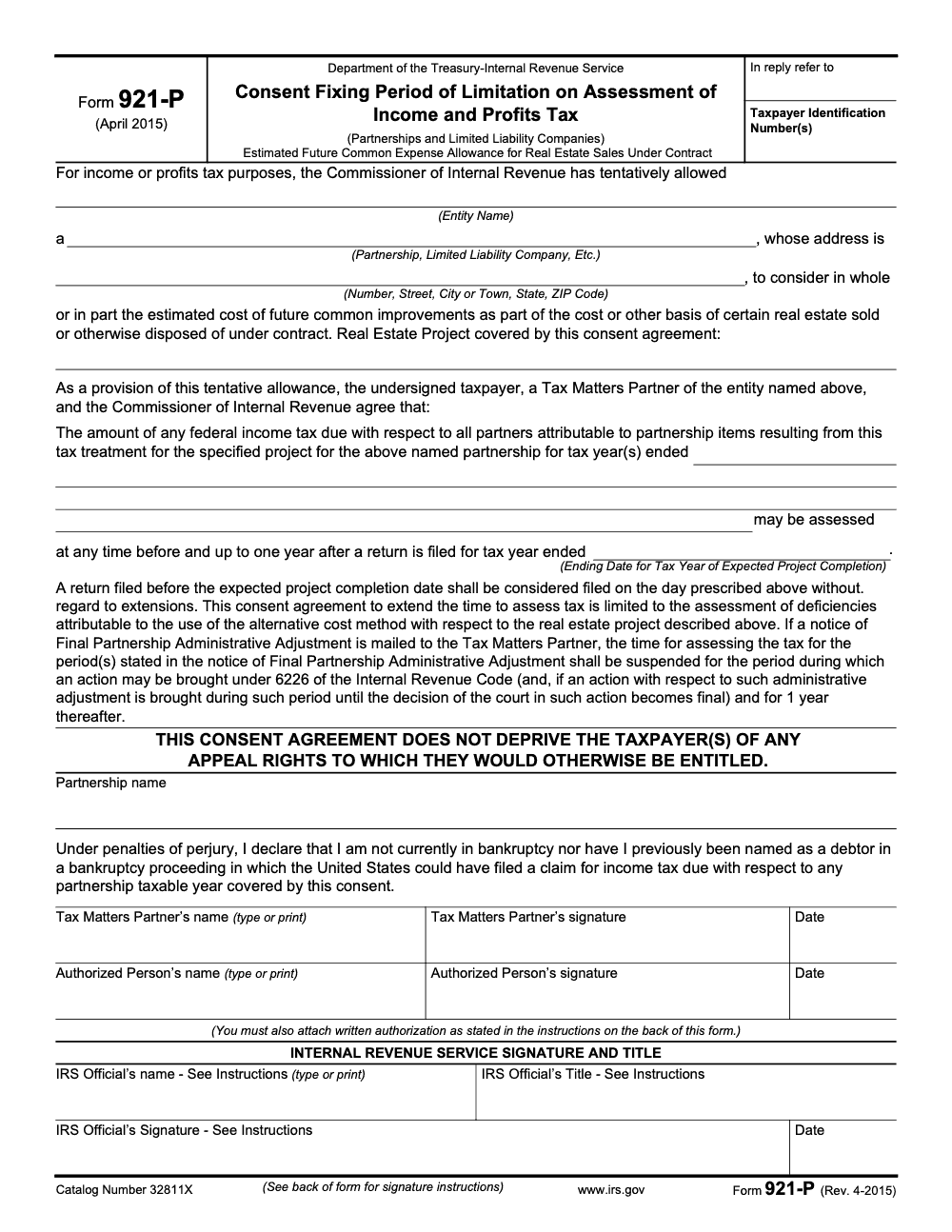
Form 921-P (Rev. 4-2015) is the TEFRA-era IRS consent that extends the assessment statute for partnership deficiencies tied to the alternative cost method under Rev. Proc. 92-29 on a specified real estate project. The extension runs up to one year after the partnership files a return for the tax year of expected project completion (per Form 921-P instructions, catalog number 32811X). For partnership tax years beginning after December 31, 2017, the BBA centralized audit regime replaces TEFRA, so most current projects use Form 3115 under Rev. Proc. 2023-9 instead, as published on IRS.gov. See our U.S. tax execution service for how we handle method-change filings end to end.
Plenty of developers still reach for Form 921-P out of habit, and for current projects that habit is usually wrong. The form is the TEFRA-era consent that extended the assessment statute for partnership deficiencies tied to the alternative cost method under Rev. Proc. 92-29 on a named real estate project, and the IRS still hosts the April 2015 PDF, which is part of why it lingers.
What changed is the framework around it. Rev. Proc. 2023-9 obsoleted Rev. Proc. 92-29 for tax years beginning after December 31, 2022 and now treats the Alternative Cost Method as a method of accounting, generally adopted through Form 3115. So for 2023 and later years you usually do not file Form 921-P at all, you evaluate the Form 3115 path. You still see 921-P in legacy scenarios, like pre-2018 TEFRA years and long-running controversies, where confirming the year and project status comes first.
Key Takeaways
- Form 921-P is a two-page consent that extended the assessment period for projects using the old Rev. Proc. 92-29 alternative cost method, and the IRS still hosts the April 2015 PDF.
- Rev. Proc. 2023-9 obsoleted Rev. Proc. 92-29 for tax years beginning after December 31, 2022, and it treats the Alternative Cost Method as a method of accounting, generally adopted via Form 3115.
- If you are handling 2023 and later years, you usually do not file Form 921-P. You evaluate a Form 3115 path, including streamlined options noted in the revenue procedure.
- TEFRA was repealed for post‑2017 partnership years, so “Tax Matters Partner” language in 921‑P is legacy. Current audits use the BBA centralized partnership audit regime and a “partnership representative.”
- You may still see 921‑P in legacy scenarios, for example, pre‑2018 TEFRA years, older real estate projects, or when finishing long‑running controversies. Confirm the year, the project status, and whether 2023‑9 now governs.
What is IRS Form 921‑P?
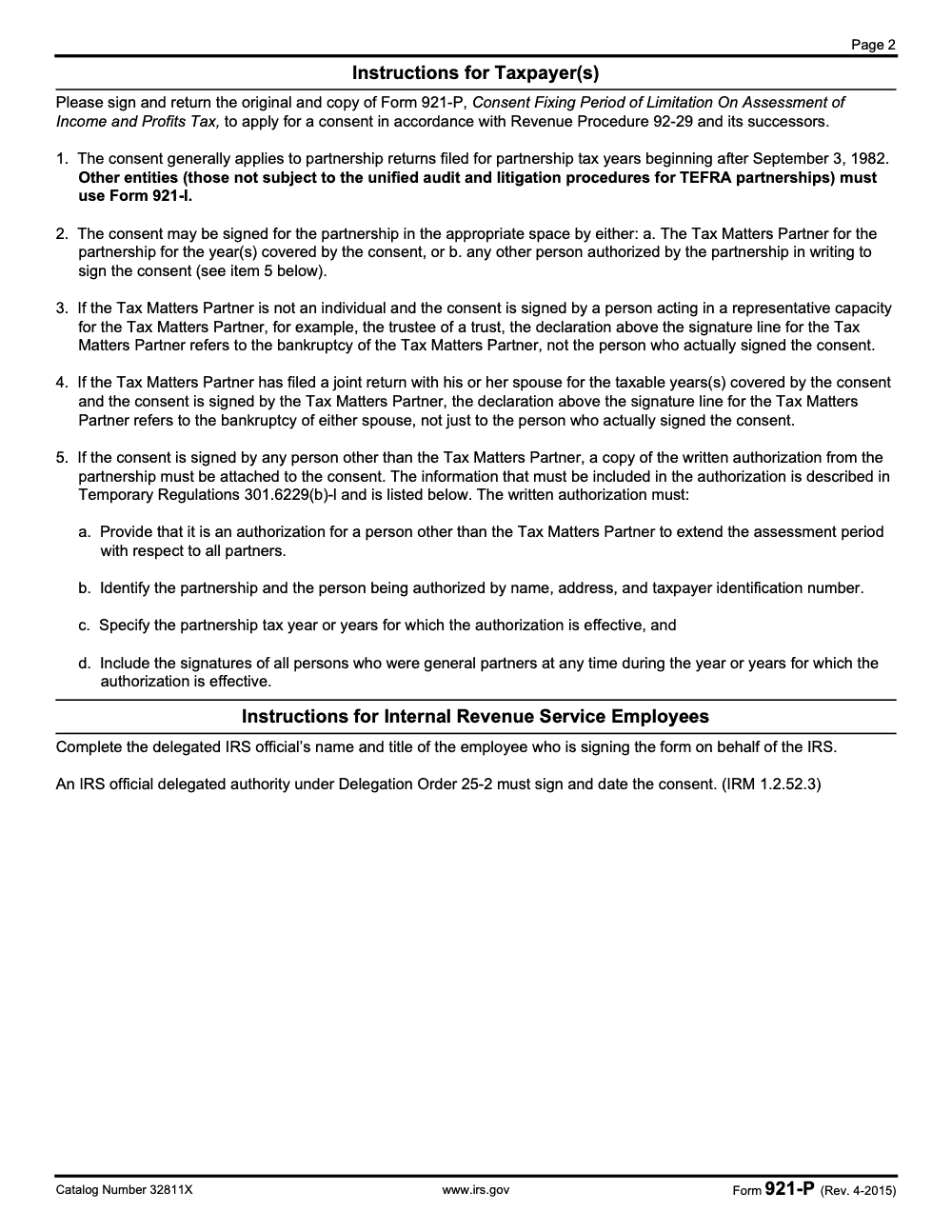
Form 921‑P is titled “Consent Fixing Period of Limitation on Assessment of Income and Profits Tax, Partnerships and Limited Liability Companies.” It was designed for developers using the estimated future common improvement cost approach under Rev. Proc. 92‑29. By signing, the Tax Matters Partner agreed that the IRS could assess tax attributable to that project up to one year after the return for the expected completion year was filed. Page two provides signature rules and cites Delegation Order 25‑2.
The role 921‑P played
When a developer used the 92‑29 method, the Service required an assessment‑statute consent for each affected year. The Internal Revenue Manual’s consent section lists the Form 921 series, including 921‑P for TEFRA partnerships, and explains that the consent was limited to deficiencies tied to the alternative cost method for the named project. That is why lenders and IRS exam teams sometimes still ask for it in older files.
The big change after 2022, Rev. Proc. 2023‑9
In February 2023, the IRS issued Rev. Proc. 2023‑9. It obsoleted Rev. Proc. 92‑29 and reframed the Alternative Cost Method as a method of accounting under sections 446 and 481. For you, that translates to method change mechanics, not a project‑by‑project consent. The revenue procedure also lays out how the method interacts with completed contract method contracts and the alternative cost limitation.
What you file now
For tax years beginning after December 31, 2022, developers generally adopt or change to the Alternative Cost Method through Form 3115, often under automatic procedures. The Internal Revenue Bulletin describes streamlined options for certain situations, including a short Form 3115 when the section 481(a) adjustment is zero. Always verify your facts against the current 3115 instructions before you file.
TEFRA language versus today’s BBA regime
Form 921‑P still says “Tax Matters Partner,” which flags its age. TEFRA unified proceedings do not apply to tax years beginning after 2017. Today’s partnership examinations use the BBA centralized partnership audit regime, and partnerships designate a partnership representative. If you are dealing with a post‑2017 year, confirm that any request for a 921 series consent is not misapplied.
When you might still need Form 921‑P
Even though Rev. Proc. 2023‑9 governs current‑year projects, there are legitimate cases where 921‑P still surfaces.
- Pre‑2018 TEFRA years under exam or appeal, where the original 92‑29 approach was used and the IRS wants a clean consent for assessment timing tied to the project.
- Legacy projects where the first benefitted unit sold years ago and the file includes 92‑29 requests, older consents, and open issues about the project’s completion year.
- Document requests from lenders or buyers during diligence, especially when they see “92‑29” in workpapers and expect a 921‑P on file. In these cases, your job is to confirm which rule applies in each tax year and whether 2023‑9 changed the playbook midstream.
Quick test, 921‑P or 3115?
Ask three questions and you will usually land on the right path:
- What is the tax year at issue, by start date, not by filing date? If it begins after December 31, 2022, look to Rev. Proc. 2023‑9 and Form 3115.
- Was the project using 92‑29 in a TEFRA year that is still open? If yes, a 921‑P may still be relevant for that legacy year.
- Is the partnership under the BBA regime? If yes, be cautious, the TEFRA‑style 921‑P may not be the correct tool for that year.
How to complete Form 921‑P correctly, when it is truly needed
If you determine that a 921‑P is appropriate for an older TEFRA year, treat it like any statute consent, and follow the form’s instructions.
- Use the IRS copy of the April 2015 PDF, confirm the project name, and complete the entity and address lines exactly as reflected on the partnership return for the covered years.
- Identify the tax years and the expected project completion year. The consent allows assessment up to one year after the return for the expected completion year is filed (a return filed before that expected completion date is deemed filed on the day prescribed, without regard to extensions, so an early filing does not shorten the IRS window), which is why the “completion” date matters.
- Verify the signer. The Tax Matters Partner, or a properly authorized person, must sign. If someone other than the TMP signs, attach written authorization that satisfies Temp. Reg. 301.6229(b)‑1 (the authorization must be signed by every person who was a general partner at any time during the covered year(s), not only the current GPs), as the form’s instructions require.
- Coordinate with the IRS official. The form requires an IRS official with delegated authority to sign. The instruction references Delegation Order 25‑2, and IRM consent procedures govern timing and handling.
- Retain originals and certified mail receipts. Statute documents deserve belt‑and‑suspenders recordkeeping, especially if the project spanned multiple filing seasons.
Common pitfalls we see in firm files
- Mixing regimes, using a TEFRA‑era consent for a BBA year, which creates confusion about who can sign and what period is extended.
- Vague project descriptions. If the project name on the consent does not match the workpapers and the lender’s documents, you invite follow‑ups.
- Losing the trail from the original 92‑29 request to the consent years. Link the request, the affected returns, and the completion‑year return in one indexed packet.
What to use for current projects, 2023 and later
For developers adopting or continuing the Alternative Cost Method today, you follow Rev. Proc. 2023‑9. The safe harbor lets you include the allocable share of estimated common improvement costs in the basis of units sold, subject to the alternative cost limitation. You adopt or change the method with Form 3115, typically under automatic procedures. The IRB also describes streamlined filing in certain zero 481(a) cases, which can save time.
Here is a quick comparison you can share with your team.
| Item | Form 921‑P path, legacy 92‑29 | Rev. Proc. 2023‑9 path, current years |
| Authority | Rev. Proc. 92‑29, TEFRA consent mechanics | Rev. Proc. 2023‑9, method of accounting |
| Filing object | Per‑project consent to extend assessment | Form 3115, often automatic |
| Who signs | Tax Matters Partner, IRS official with delegated authority | Taxpayer, no IRS countersignature on 3115 |
| Years covered | Pre‑2018 TEFRA years, legacy projects | Tax years beginning after 12‑31‑2022 |
| Key limiter | Alternative cost limitation under 92‑29 | Alternative cost limitation under 2023‑9 |
Tip, document why you chose the 2023‑9 path in your memo, include the DCN and any 481(a) analysis, and attach your Form 3115 copy to the return per the instructions.
What‑How‑Wow, the quick framework
- What, Form 921‑P is a legacy consent for 92‑29 projects, and the IRS still hosts the 2015 PDF.
- How, for current projects, adopt the Alternative Cost Method with Form 3115 under Rev. Proc. 2023‑9, and document your 481(a), limitation testing, and DCN choice.
- Wow, moving off project‑by‑project consents reduces admin friction. You can often use automatic change procedures, and the revenue procedure even provides streamlined options in defined cases. This is cleaner for your files and faster for your team.
Step‑by‑step, adopting the Alternative Cost Method today
- Confirm scope. Validate that your tax year begins after December 31, 2022 and that your facts meet the 2023‑9 definitions of common improvements and qualifying projects.
- Build the estimate. Use a reasonable, consistently applied allocation method, and test the alternative cost limitation so estimated costs included in basis do not exceed costs incurred under section 461(h).
- Prepare Form 3115. Choose the correct automatic change, follow the instructions for where to file and how to attach the duplicate copy, and document any 481(a) adjustment.
- Draft a client memo. Explain why you are using 2023‑9, outline the method, the limitation, and the expected timing. Attach references to the IRB for the file.
- Update your binders. Replace any “921‑P required” checkboxes in your real estate checklists with “3115 under 2023‑9,” and keep the legacy checklist for pre‑2018 TEFRA clean up only.
Related forms and references
- Form 921 series, including 921‑P, historical consent tools listed in the IRM for 92‑29 projects.
- Form 3115, the current vehicle for adopting the Alternative Cost Method, see the latest instructions.
- BBA centralized partnership audit regime, background and effective dates.
Trust signals and sourcing
- Primary sources, IRS Form 921‑P PDF and its instructions, IRS Internal Revenue Bulletin 2023‑7 for Rev. Proc. 2023‑9, and IRM consent guidance.
- Secondary perspectives for context, respected firm alerts that summarize 2023‑9 and highlight the administrative shift from 92‑29. Use these to sanity‑check your approach, not as the sole authority.
Final checklist
- Identify the tax year and regime, TEFRA legacy or BBA.
- Choose the right path, 921‑P for legacy 92‑29 years, 3115 for 2023‑9 method adoption.
- Document decisions, keep the IRS PDF copies and IRB references in the binder.
- Tighten review, add a QC step for the alternative cost limitation and 481(a).
Disclaimer
Tax rules change, and this topic is time sensitive. All guidance in this article reflects sources available as of January 2, 2026. For high‑risk positions, coordinate with your tax counsel, review the latest Internal Revenue Bulletins, and validate filing mechanics against the current Form 3115 instructions.
Conclusion
You now have a clear playbook. If a lender or examiner asks for Form 921‑P, you can check the year, confirm the regime, and decide whether a legacy consent is appropriate. For current projects, you will use Rev. Proc. 2023‑9 and Form 3115, and you will keep your files tight with a short memo, a limitation test, and a clean 481(a) analysis. This is how you protect your clients, reduce review time, and keep advisory work moving.
Common Mistakes We See Every Season
Form 921-P is a niche consent, but the same handful of mistakes shows up year after year when we review legacy alternative-cost-method projects. These five come up most often, and each one is fixable with a small SOP tweak.
Reusable Checklists
These checklists are copy-paste ready for firm SOPs covering legacy TEFRA 921-P consents and the current BBA-era replacement path. Drop them into a workpaper template, an engagement letter checklist, or a partnership-audit memo.
Pre-signature review packet
- Confirm the partnership tax year falls in the TEFRA window (began on or after September 3, 1982 and before January 1, 2018).
- Identify the specific real estate project covered, with project name, location, and expected completion year.
- Verify the Tax Matters Partner for each covered year and confirm the TMP is the signer, or collect a Temp. Reg. §301.6229(b)-1 written authorization.
- For a non-TMP signer, list every person who served as a general partner at any time during the covered year(s) and collect their signatures on the written authorization.
- Run a bankruptcy check for the partnership, the TMP, and (for joint-return years) both spouses, covering current and prior proceedings.
- Pull the partnership's prior alternative cost method documentation and confirm the scope of deficiencies the consent will cover.
- Print two clean copies of Form 921-P (Rev. 4-2015), confirming catalog number 32811X on the footer.
IRS-side validation before treating consent as effective
- Confirm the IRS signer's printed name and title appear on the IRS signature block.
- Verify the IRS signer holds delegated authority under Delegation Order 25-2 (IRM 1.2.52.3).
- Confirm the IRS signature carries a valid date.
- File the executed consent in the engagement folder with delivery receipts for both the original and the copy.
- Log the new assessment-period end date in the firm's statute tracker.
- Calendar any FPAA suspension trigger and the additional one-year tail under IRC §6226.
BBA-era transition for current real estate projects
- Confirm the partnership tax year began on or after January 1, 2018 (BBA window).
- Switch the method-change documentation path from Form 921-P to Form 3115 under Rev. Proc. 2023-9.
- Document the §481(a) adjustment supporting the alternative cost method election.
- Prepare a short memo distinguishing the legacy 921-P scope from the BBA-era consent path used by the Partnership Representative.
- Update the firm SOP so partnership tax matters for BBA years flow through the Partnership Representative rather than a Tax Matters Partner.
- Notify the client of the new statute mechanics under BBA so timing expectations are aligned.
Keep 921-P Season From Stalling
Form 921-P is not a high-volume seasonal filing the way 941 or 1040 is, but the timing pressure on each one is sharp. The consent has to be executed, attached, and validated before the assessment statute expires for the partnership tax year of expected project completion. According to Form 921-P instructions, the IRS can assess tax tied to the alternative cost method up to one year after the partnership files the completion-year return, and any FPAA action under IRC §6226 adds another one-year tail after a court decision becomes final. Miss the window and the partnership loses the procedural protection that makes the Rev. Proc. 92-29 alternative cost method workable on the named project.
The fix is to treat every 921-P engagement as a small, tightly scoped statute project rather than a one-off signature exercise. The delivery discipline a firm already runs to keep payroll deposits and tax returns on time scales down well to a single legacy consent: assign owners, document the trigger dates, lock the review path, and confirm IRS-side execution before closing the file.
- Log the partnership's expected project completion year and the resulting one-year assessment window in the statute tracker the day the engagement opens.
- Build a dedicated workpaper section for the four-part Temp. Reg. §301.6229(b)-1 authorization when a non-TMP will sign, with a sign-off slot for every general partner who served during the covered year(s).
- Calendar an FPAA watch on every covered tax year so the IRC §6226 court-action window and the additional one-year tail are not missed.
- Lock a review checkpoint that confirms the IRS signer's Delegation Order 25-2 authority before the consent is treated as effective.
- Separate legacy 921-P file work from BBA-era partnerships in the firm's task queue so reviewers do not pick up the wrong instrument for current real estate projects.
This is the kind of layered, owner-assigned review structure we run for clients. When the production discipline lives outside the partner's head and inside a documented SOP, legacy consents stop becoming end-of-quarter fire drills. See how we structure U.S. tax execution and review so statute deadlines, consents, and method-change filings flow through the same controlled path.
FAQs
Yes, the IRS still hosts the April 2015 two‑page PDF. That said, its use is narrow today, primarily for legacy TEFRA‑era projects tied to Rev. Proc. 92‑29. For current projects, look to Rev. Proc. 2023‑9 and Form 3115.
From the IRS, not a third‑party aggregator. The IRS “f921p.pdf” file includes the original instructions on page two and the exact signature language exam teams expect.
Usually no. Rev. Proc. 2023‑9 governs tax years beginning after December 31, 2022. You adopt or change the method via Form 3115 and follow the automatic procedures if eligible.
Rev. Proc. 2023‑9 includes rules for projects already in progress and describes when a taxpayer may use streamlined 3115 procedures or the legacy rule. Read the exact applicability paragraphs in the IRB and document your approach.
For legacy TEFRA years, the Tax Matters Partner or an authorized person signs, and you must attach written authorization if someone other than the TMP signs. The IRS countersigns using delegated authority. Follow the PDF’s page‑two instructions and coordinate with the assigned IRS employee on format.
Because the form is from 2015. TEFRA was repealed for tax years beginning after 2017, and the BBA regime uses a partnership representative. That is another reason not to use 921‑P for post‑2017 partnership years.
921‑P is a federal consent used in a specific federal context. States may request proof of federal positions or consents during audits, but 921‑P itself is tied to federal statute timing around 92‑29. Confirm state rules case by case.
Other forms this guide names
About this guide
Accountably helps US CPA, EA, and accounting firms hire trained accountants and tax preparers in India.
About us Reviewed byJugal Thacker, CPAFounder and CEO at Accountably
A Washington-licensed CPA with 7+ years inside US firms – PwC, a real-estate tax practice, then a full-service firm, rising from reviewer to manager to advisory. This article was reviewed against current IRS guidance for the 2025 tax year and updated for filers preparing late returns, amendments, and 2026 estimates.
View profile →How we research, review, and update this guide
Every Accountably guide is researched against primary IRS sources, reviewed by a U.S. CPA, and refreshed as guidance evolves. Read our Editorial Guidelines to see how we source, fact-check, and update our content.