Summarize this article with AI
In Brief
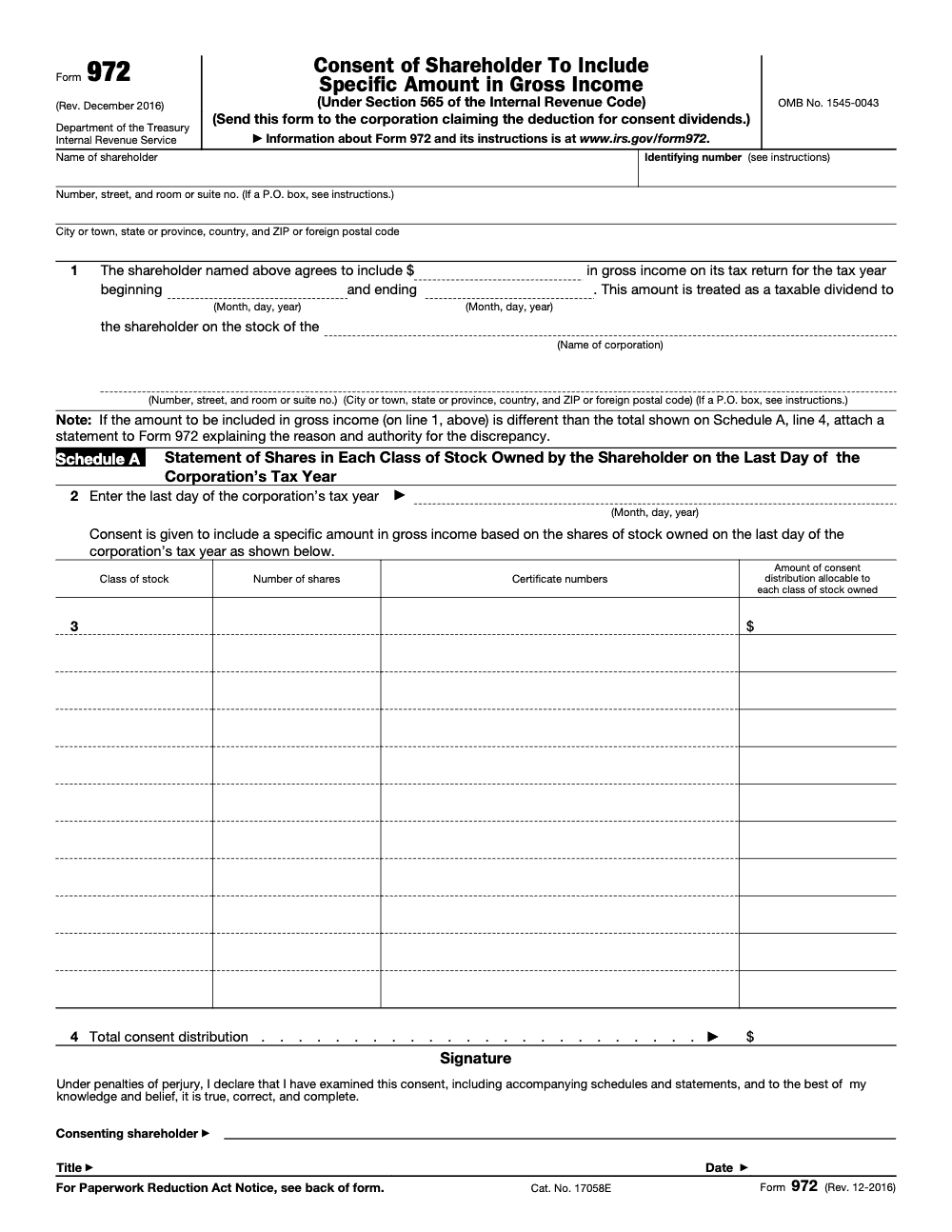
Form 972 is a shareholder’s written consent to include a specific amount in gross income as a consent dividend under IRC §565 (Form 972, Rev. December 2016). The shareholder reports the line 1 amount as a taxable dividend even though no cash is paid, and increases stock basis by that same amount. The signed form goes to the corporation, not the IRS, by the corporation’s return due date; the corporation then attaches a copy to Form 973 to claim the matching deduction.
A consent dividend is a strange thing the first time you meet it: a shareholder reports an amount as a taxable dividend even though no cash ever leaves the corporation, and increases stock basis by that same amount. Form 972 is how the shareholder makes that written consent under IRC section 565.
The signed form goes to the corporation, not to the IRS, and it has to arrive by the corporation's return due date. The corporation then attaches a copy to Form 973 to claim the matching dividends-paid deduction under section 561. Every consenting shareholder files a separate Form 972, and the line 1 amounts have to add up to exactly what the corporation deducts, which is why these two forms have to be built together. The current revision is Rev. December 2016.
Key Takeaways
- Form 972 is filed by shareholders of a corporation to consent to including a specific “consent dividend” amount in their gross income, even though no cash was actually distributed.
- The consent dividend mechanism allows corporations (particularly personal holding companies) to claim a dividends-paid deduction under IRC §561 without making an actual cash distribution.
- Every shareholder who consents must file a separate Form 972 – each shareholder’s proportionate consent amount must match the corporation’s claimed deduction on Form 973.
- Form 972 is sent to the corporation, not filed with the IRS by the shareholder – the corporation then attaches a copy of each completed Form 972 to Form 973 to claim the corresponding deduction on its corporate return.
- Quick rule you can copy into your SOP: for any PHC client, calculate the undistributed PHC income before year-end and determine whether consent dividends are needed – the signed consents must reach the corporation by the due date of its tax return for the year it will claim the deduction.
- The consent must reach the corporation by the due date of its tax return for the year it will claim the consent dividend deduction – this can fall after the tax year closes, but not after that return due date.
What Form 972 Is and When to Use It
Form 972 – Consent of Shareholder to Include Specific Amount in Gross Income – is used in connection with the “consent dividend” provisions of the Internal Revenue Code. A consent dividend is a deemed distribution: shareholders agree to include a specific amount in their taxable income as if it had been distributed, even though no actual payment was made. The corporation then claims a dividends-paid deduction for that same amount under IRC §561.
The primary use of consent dividends is to reduce or eliminate the personal holding company (PHC) tax under IRC §541. A personal holding company is a closely held corporation (generally, more than 50% owned by five or fewer individuals) with at least 60% of its adjusted ordinary gross income from passive sources such as dividends, interest, rents, and royalties. PHC tax is assessed on undistributed PHC income at a 20% rate – a significant penalty on retained earnings that could have been distributed.
Consent dividends also appear in the accumulated earnings tax context (IRC §531). A corporation facing potential accumulated earnings tax liability may use consent dividends to demonstrate that earnings were “distributed” for purposes of the dividends-paid deduction, thereby reducing the accumulated earnings base subject to the 20% tax. The mechanics and forms are the same in both contexts.
Who Files Form 972
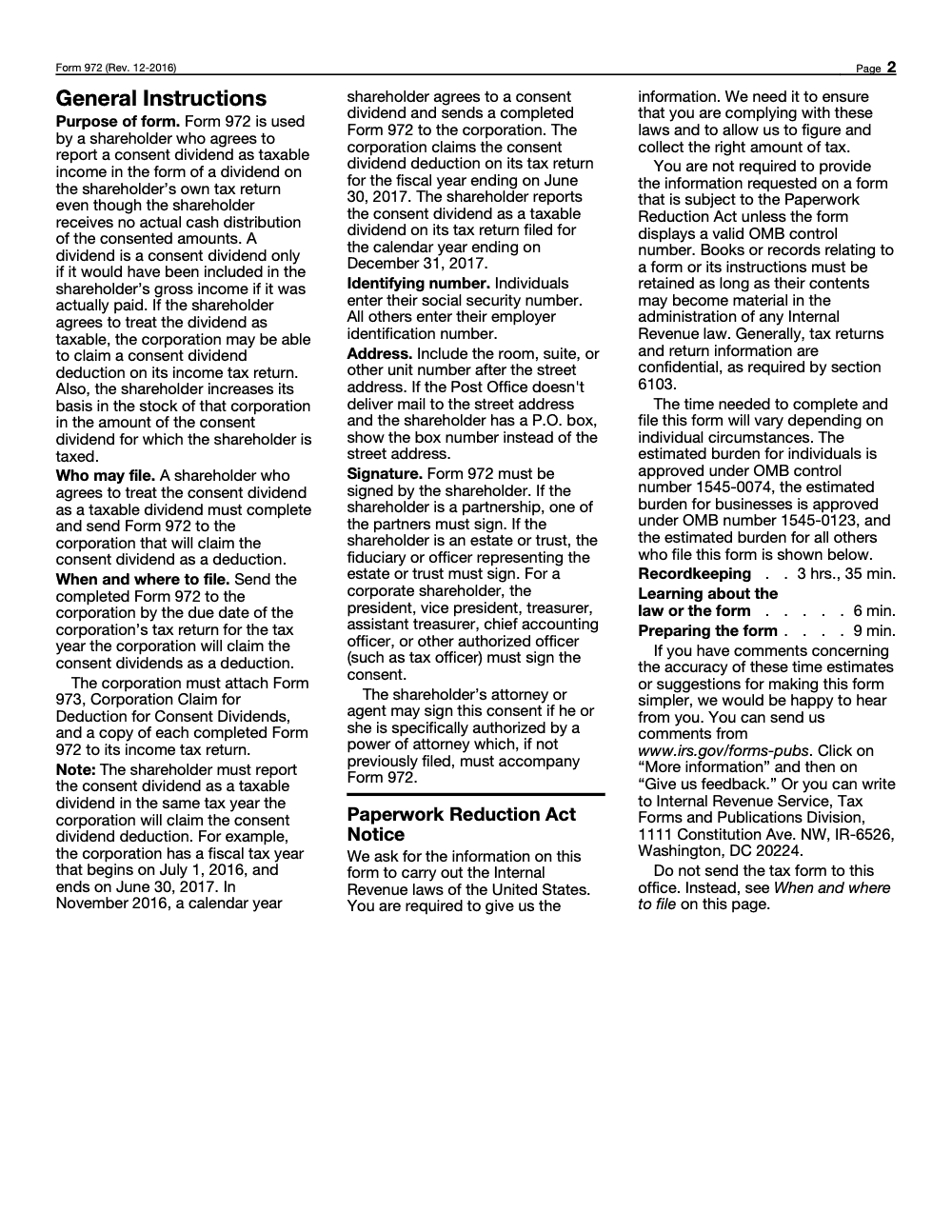
Each shareholder who consents to include a specific amount in their gross income completes Form 972 and sends it to the corporation that will claim the consent dividend deduction – it is not filed with the shareholder’s own income tax return. The consent amount must match the shareholder’s proportionate share of the total consent dividend amount the corporation intends to deduct on Form 973. If even one shareholder fails to file a valid Form 972, the corporation’s deduction for that shareholder’s consent amount is disallowed.
When to Use Consent Dividends vs. Actual Distributions
Consent dividends are most valuable when the corporation wants to avoid PHC tax but cannot or will not distribute cash to shareholders – for example, when the corporation needs to retain liquidity for operations. However, consent dividends carry an important tax cost for shareholders: they include the consent amount in income without receiving any cash to pay the resulting tax (the offsetting benefit, which filers commonly forget, is that each dollar of consent dividend taxed to the shareholder increases that shareholder’s stock basis by an equal dollar – omitting the step-up causes double taxation on a later sale or redemption). This creates a real economic cost that must be factored into the decision. My team always models the after-tax cash impact for each shareholder before recommending the consent dividend approach.
How to Complete Form 972
Form 972 is relatively brief, but precision is critical – the consent amount must reconcile exactly with the corporation’s Form 973. Any discrepancy between what shareholders consent to and what the corporation deducts will result in a partial or complete disallowance of the dividends-paid deduction.
| Field / Section | What to Enter | Practitioner Tip |
|---|---|---|
| Shareholder Name and SSN/EIN | The consenting shareholder’s legal name and taxpayer identification number | Must match exactly to the shareholder’s income tax return; corporate shareholder must use EIN |
| Corporation Name and EIN | The legal name and EIN of the corporation paying the consent dividend | Cross-check against the corporation’s Form 973 – these must match precisely |
| Tax Year of Corporation | The corporation’s tax year for which the consent dividend is being made | The consent must reach the corporation by the due date of its return for the tax year it will claim the consent dividend deduction, which can fall after that tax year has closed |
| Consent Amount | The specific dollar amount the shareholder consents to include in gross income | Calculate as the shareholder’s pro-rata share of total consent dividends – verify against Form 973 before filing |
| Shareholder Signature and Date | The shareholder’s signature under penalties of perjury, with date. For an entity shareholder the authorized signer is specific: a partner signs for a partnership, the fiduciary or officer signs for an estate or trust, and a corporate officer (president, vice president, treasurer, assistant treasurer, or chief accounting officer) signs for a corporate shareholder; an attorney or agent may sign only with a specific power of attorney that accompanies the form | The signed consent must reach the corporation by the due date of its return for the year it will claim the consent dividend deduction – this deadline can fall after the corporation’s tax year has closed |
Calculating the Consent Amount
The consent amount for each shareholder is determined by multiplying the total consent dividend by each shareholder’s ownership percentage, measured by the shares of stock owned on the last day of the corporation’s tax year – not on the date Form 972 is signed and not at the shareholder’s own year-end. For a corporation with 100% consent dividend income of $200,000 and two equal shareholders, each shareholder consents to $100,000. The shareholders then report this $100,000 as dividend income on their individual returns, even though no cash was received. The corporation claims the full $200,000 as a dividends-paid deduction on Form 973.
Timing Requirements for the Consent
Under IRC §565, the completed Form 972 must reach the corporation by the due date of the corporation’s return for the tax year it will claim the consent dividend deduction – the consent can be made after the tax year ends, but not after that return due date. The IRS has provided guidance on the precise timing requirements – including whether consent can be made after year-end but before the return due date – and these rules can be technical. Always review the current IRC §565 regulations and the Form 972 instructions for the applicable tax year before executing consents.
Deadlines, Penalties, and Filing Requirements
Form 972 is sent to the corporation that will claim the consent dividend deduction, not filed with the IRS by the shareholder; the corporation attaches a copy of each Form 972 to its own return. The deadline is therefore the corporation’s return due date for the year it will claim the deduction, including extensions – not the shareholder’s own return due date. The corporation files Form 973 with its corporate return.
| Filer | Form | Filing Deadline |
|---|---|---|
| Each consenting shareholder (individual) | Form 972 sent to the corporation (copy attached to the corporation’s Form 973) | Corporation’s return due date for the year it claims the deduction (or extended) |
| Each consenting shareholder (corporate) | Form 972 sent to the corporation paying the consent dividend (copy attached to its Form 973) | Same as the paying corporation’s return due date (or extended) |
| Consenting corporation | Form 973 attached to Form 1120 | Same as corporate return due date |
Consequence of Missing a Shareholder Consent
If any required shareholder fails to file Form 972, the corporation cannot claim a dividends-paid deduction for that shareholder’s share of the consent dividend. This partial disallowance may still leave the corporation liable for PHC tax on the uncovered portion of undistributed PHC income. Coordinating across all shareholders before filing season is essential – missing one consent is not a small error.
Consent Dividends and Personal Holding Company Tax Planning
The personal holding company tax is one of the lesser-known but potentially significant taxes on closely held C corporations. Understanding how consent dividends interact with PHC planning helps practitioners design year-end strategies that protect clients from this often-overlooked exposure.
What Makes a Corporation a Personal Holding Company
Under IRC §542, a corporation qualifies as a PHC if: (1) at any time during the last half of the tax year, more than 50% in value of its outstanding stock is owned by five or fewer individuals; and (2) at least 60% of its adjusted ordinary gross income (AOGI) consists of personal holding company income (PHCI). PHCI includes dividends, interest, rents (subject to adjustments), royalties, and compensation for the use of corporate property by shareholders. Professional service corporations often trigger PHC status when shareholder compensation is the primary income source.
Calculating Undistributed PHC Income
Undistributed PHC income is the taxable income of the PHC, reduced by the dividends-paid deduction and certain other adjustments. The 20% PHC tax applies to this undistributed amount. Before using consent dividends to eliminate the PHC tax, calculate the precise undistributed PHC income amount – this is the target figure that the consent dividend must offset through the dividends-paid deduction. Over-consenting (more than the undistributed PHC income) creates unnecessary shareholder tax cost without additional corporate benefit.
Form 972 and Form 973 Coordination – Getting the Math Right
Forms 972 and 973 are two sides of the same transaction. Form 972 is the shareholder-side consent; Form 973 is the corporation-side deduction claim. Errors in either form, or mismatches between them, disallow the entire consent dividend strategy.
Form 973 Overview
Form 973 is filed by the corporation and claims the dividends-paid deduction for the total amount consented to by all shareholders. The corporation must attach a copy of each completed, signed Form 972 to Form 973 – a schedule that only summarizes the consents does not substitute for the individual copies, and without each shareholder’s Form 972 the consent dividend deduction cannot be substantiated. The total consent amount on Form 973 must equal the sum of all individual consent amounts reported on the filed Forms 972. Any discrepancy triggers a disallowance.
Reconciliation Before Filing
My standard process is to prepare both Form 972 for each shareholder and Form 973 for the corporation simultaneously, reconcile the totals before anyone files, and distribute the final versions to shareholders for signature well before the return due date. A last-minute coordination process under deadline pressure is where errors occur. Quick rule you can copy into your SOP: complete the consent dividend calculation no later than 60 days before the corporate return due date.
Common Mistakes That Slow Things Down
Form 972 is short, but the consent dividend it documents is unforgiving, and the same handful of errors show up every time my team reviews one. Each one can cost the corporation its deduction.
Practical Checklists You Can Reuse
These are copy-paste ready for a firm SOP. Drop them into your engagement workflow so every consent dividend runs the same way, no matter who on the team handles it.
Consent dividend setup packet
- Confirm the corporation’s tax year and the last day on which stock ownership is measured for the consent.
- List each consenting shareholder with their SSN (individuals) or EIN (entities).
- Capture each class of stock owned, the number of shares, and certificate numbers for Schedule A, line 3.
- Calculate each shareholder’s consent amount as the distribution allocable to their shares.
- Verify the total across all shareholders equals the corporation’s intended deduction.
Form 972 to Form 973 reconciliation
- Enter each shareholder’s consent amount on line 1.
- Total Schedule A, line 4 and confirm it equals the line 1 amount.
- Attach an authority statement for any line 1 versus Schedule A, line 4 discrepancy.
- Match the sum of all Forms 972 to the corporation’s Form 973 total.
- Record the stock basis increase for each shareholder equal to their consent amount.
Signature and attachment review
- Confirm the correct signer by entity type: individual, partner, fiduciary, or corporate officer.
- Attach a specific power of attorney when an attorney or agent signs.
- Route each signed Form 972 to the corporation by the corporation’s return due date.
- Attach a copy of every signed Form 972 to Form 973 with the corporate return.
- Retain the consents and supporting schedules for as long as the position may be examined.
Keep 972 Season From Stalling
Form 972 rarely lands on a calendar the way a quarterly or annual return does. It surfaces once a corporation realizes it has undistributed income to cover, often close to the corporate return due date, and then every consenting shareholder has to sign before that return can be filed. The Paperwork Reduction Act Notice printed on Form 972 (Rev. December 2016) estimates roughly 3 hours and 35 minutes of recordkeeping per filer, and that estimate assumes the consent math is already settled, which it usually is not.
The fix is to treat the consent dividend as a scheduled year-end task, not a filing-season scramble. When the line 1 amount, the Schedule A allocation, and signer authority are locked in early, the corporation’s Form 973 deduction holds up without a last-minute chase for signatures.
- Calculate undistributed income and the target consent amount early, so the signed consents can reach the corporation by the due date of its return for the year it will claim the deduction – under IRC §565 that deadline can fall after the tax year closes, though the math is best locked in before year-end.
- Build each shareholder’s Schedule A allocation, class of stock, shares, and certificate numbers, from the ownership position on the last day of the corporation’s tax year.
- Reconcile every line 1 amount to Schedule A, line 4 and to the Form 973 total in a single pass.
- Confirm signer authority by entity type and collect powers of attorney before circulating consents.
- Route signed forms back to the corporation with enough lead time to attach copies to Form 973 by the return due date.
This is low-volume, high-consequence work that stalls when senior reviewers are buried in peak-season returns. Our tax execution teams run consent dividend coordination on documented SOPs with multi-layer review, so the Form 972 and Form 973 package is reconciled and signed well before the corporate return is due.
FAQs
A consent dividend is a deemed distribution in which shareholders agree to include a specific amount in their gross income as if it had been paid as a dividend, even though no cash changes hands. Corporations use consent dividends to claim a dividends-paid deduction under IRC §561, which reduces or eliminates the personal holding company tax (IRC §541) or accumulated earnings tax (IRC §531) on undistributed income. The strategy avoids the cash outflow of an actual distribution while achieving the tax benefit of one.
Yes. The consent dividend mechanism can also be used to generate a dividends-paid deduction that reduces the accumulated earnings base subject to the IRC §531 accumulated earnings tax. The analysis is more complex in the accumulated earnings tax context, as it also involves the accumulated earnings credit and reasonable business needs arguments. Both Forms 972 and 973 are used in this context in the same way as for PHC tax purposes.
No. The consent dividend provisions of IRC §565 apply to C corporations. S corporations pass through income to shareholders annually regardless of actual distributions, so there is no PHC tax or accumulated earnings tax applicable to S corporations. Form 972 and Form 973 are exclusively C corporation tools. If a client is considering an S election partly to avoid PHC tax, that is a separate planning conversation involving Form 2553 and the full S election analysis.
Other forms this guide names
- Form 973: Corporation Consent Dividends Deduction Guide
Summarize this article with AI
About this guide
Accountably helps US CPA, EA, and accounting firms hire trained accountants and tax preparers in India.
About us Reviewed byJugal Thacker, CPAFounder and CEO at Accountably
A US-licensed CPA with 7+ years inside US firms – PwC, a real-estate tax practice, then a full-service firm, rising from reviewer to manager to advisory. This article was reviewed against current IRS guidance for the 2025 tax year and updated for filers preparing late returns, amendments, and 2026 estimates.
View profile →How we research, review, and update this guide
Every Accountably guide is researched against primary IRS sources, reviewed by a U.S. CPA, and refreshed as guidance evolves. Read our Editorial Guidelines to see how we source, fact-check, and update our content.