Summarize this article with AI
In Brief
Form 1098-C reports contributions of motor vehicles, boats, and airplanes – the donee charity must furnish the form within 30 days when Box 4a (sale), Box 5a (significant intervening use), or Box 5b (transfer to a needy individual) is checked (per Form 1098-C Instructions, Rev. April 2025). When Box 4a is checked, the donor's deduction is generally the smaller of Box 4c gross proceeds or FMV on the date of contribution. Any claimed deduction over $500 requires Copy B attached to the return, plus Form 8283 when total noncash gifts for the year exceed $500 in aggregate.
When a charity sells your donated vehicle instead of using it, the number that controls your deduction is the one the charity got at the sale, not what the car was worth the morning you handed over the keys. That is the gross proceeds figure in Box 4c, and when Box 4a is checked your write-off is generally the smaller of that proceeds amount or fair market value on the date you gave it away. People expect the larger number and are caught off guard by the smaller one.
There are exceptions that flip you back to fair market value, mainly when the charity makes significant intervening use of the vehicle or gives it to a needy individual below market, but the charity has to certify that intended use in writing before any sale. For any donation with a claimed value over $500 you attach Copy B to your return, and the charity owes you that form within 30 days of the sale.
Key Takeaways
- Form 1098-C is issued by charitable organizations to donors who contribute a motor vehicle, boat, or airplane with a claimed value exceeding $500 – it serves as the required contemporaneous written acknowledgment for the deduction.
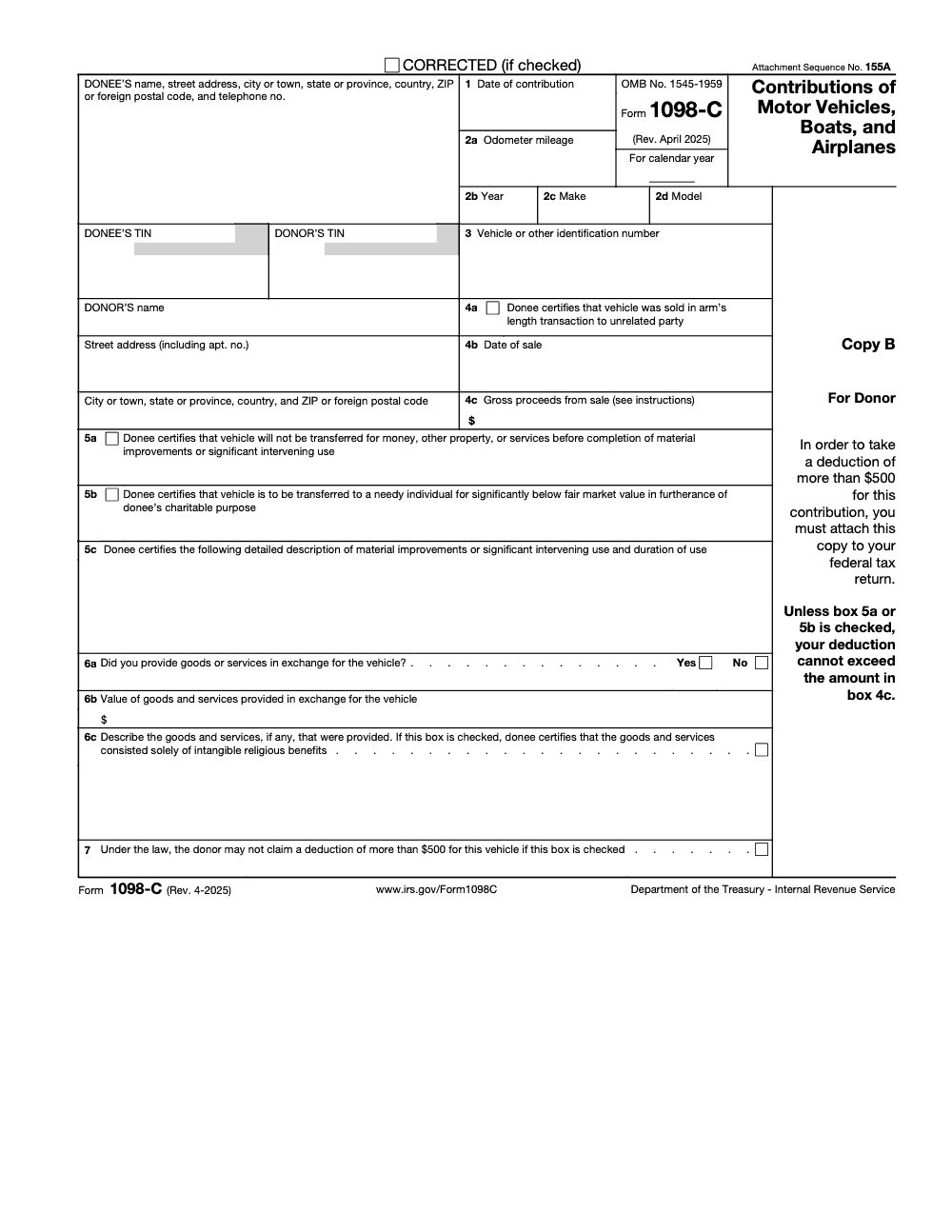
- The donee organization files Form 1098-C with the IRS and provides Copy B to the donor; the donor attaches Copy B to their tax return when claiming the deduction.
- When the charity sells the vehicle without significant intervening use, the donor’s deduction is generally the smaller of the charity’s gross proceeds from the sale (Box 4c) or FMV on the date of contribution – never the full Kelley Blue Book value.
- If the charity makes significant intervening use of the vehicle or gives it to a needy individual at below market value, the donor may deduct FMV – but the charity must certify this intended use in writing before the sale.
- The 1098-C must be provided to the donor within 30 days of the sale (or 30 days of the contribution if the vehicle is retained or given away without a sale).
- Quick rule you can copy into your SOP: if a client mentions donating a vehicle, ask immediately whether they have received the 1098-C and whether the charity has sold the vehicle – the deduction amount depends on which box applies.
What Form 1098-C Is and When to Use It
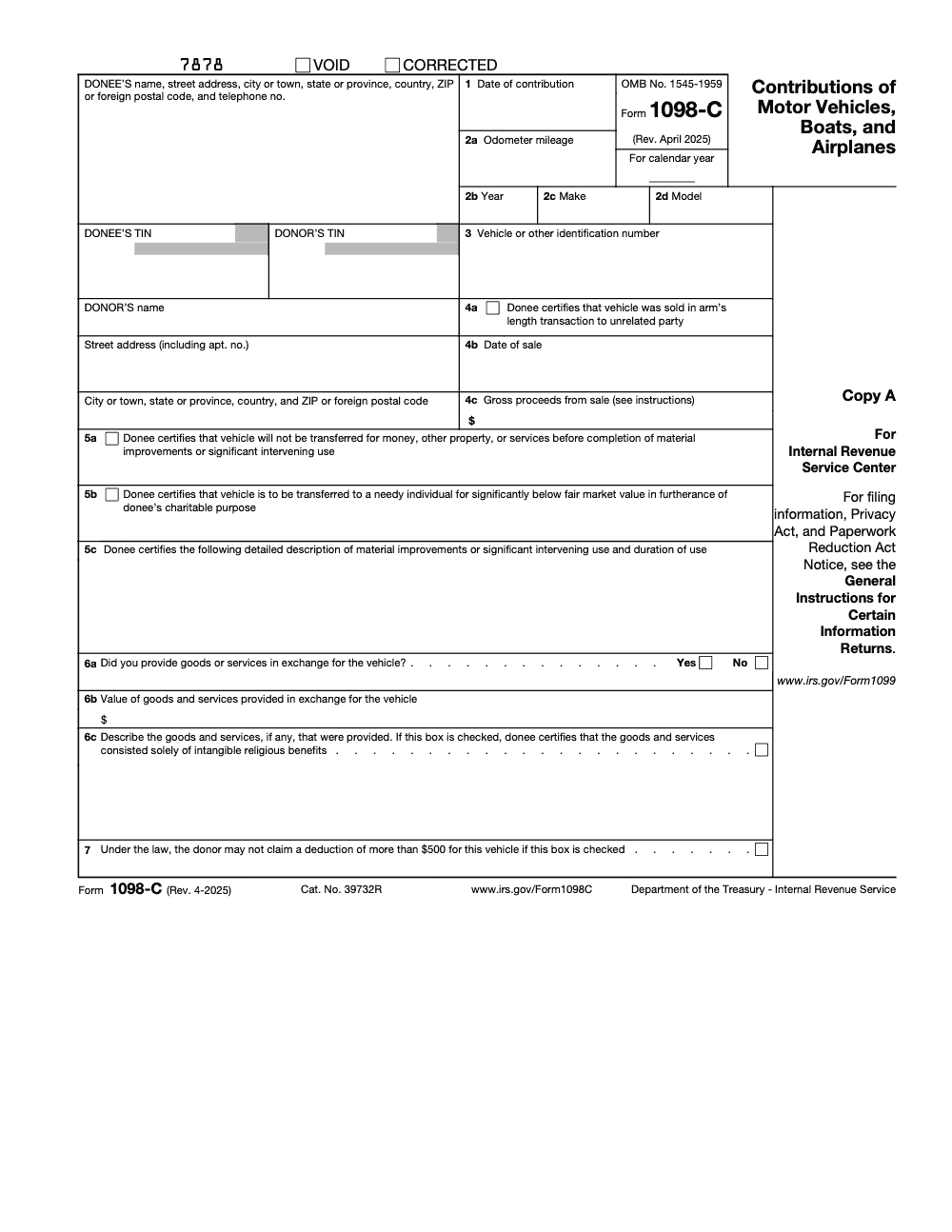
Form 1098-C, Contributions of Motor Vehicles, Boats, and Airplanes, is both an IRS information return and a contemporaneous written acknowledgment required under IRC §170(f)(12). The Pension Protection Act of 2006 tightened the rules for vehicle donations substantially, replacing the FMV-based deduction with a gross proceeds–based regime for most donations and adding the 1098-C filing requirement to enforce compliance.
Prior to 2005, donors could deduct the Kelley Blue Book value of a donated car regardless of what the charity actually realized from the donation. Abuse was rampant – charities were receiving vehicles worth far less than the inflated deductions claimed. The current rules generally limit the deduction to the smaller of what the charity actually receives (Box 4c gross proceeds) or the vehicle's FMV on the date of contribution, unless a specific exception applies (significant intervening use, transfer to a needy individual, or the Box 7 $500 cap). The 1098-C is the mechanism that communicates the deductible amount from the charity to the donor and to the IRS.
Who Files and Who Receives
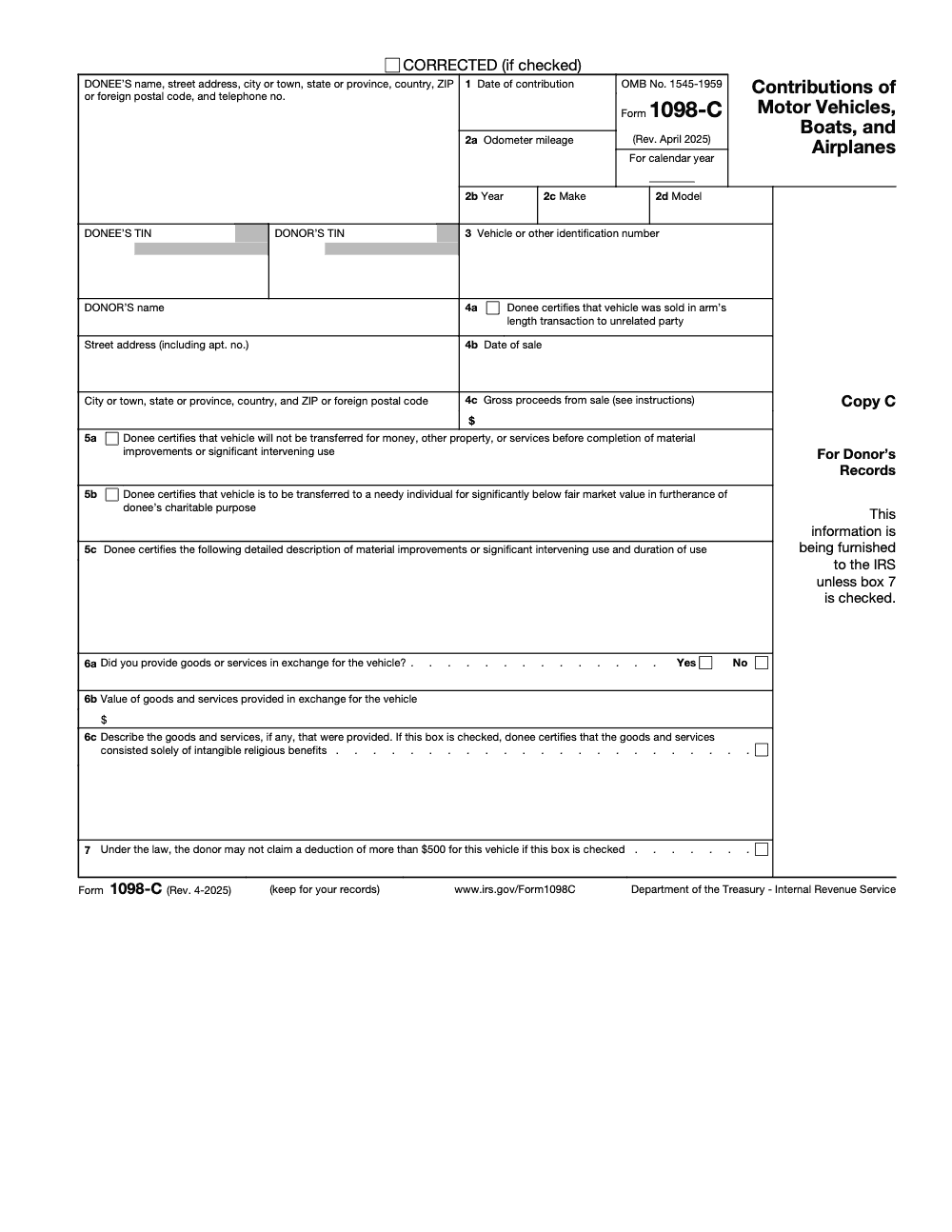
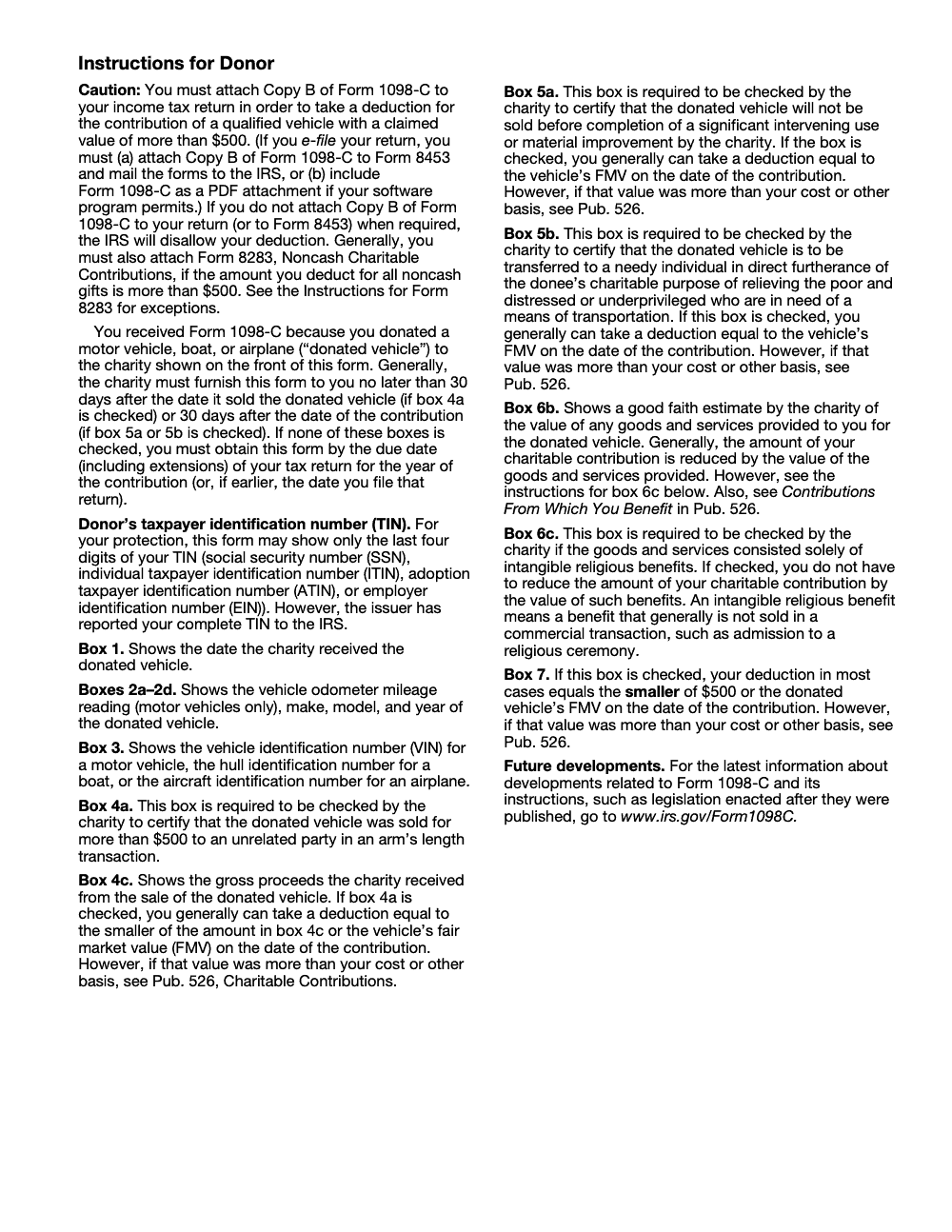
The donee organization (the charity) files Form 1098-C with the IRS and provides Copy B to the donor. When Box 4a is checked, the charity must furnish the form within 30 days of the sale; when Box 5a or 5b is checked, within 30 days of the contribution. If none of those boxes is checked, the donor must obtain the form by the due date (including extensions) of the return for the year of contribution. The donor attaches Copy B to their federal income tax return when claiming the deduction (e-filers must instead attach Copy B to Form 8453 and mail it, or submit Form 1098-C as a PDF attachment if the software allows – keeping Copy C in personal records is not a substitute, and the IRS will disallow the deduction if Copy B never reaches it). If the donor does not receive the 1098-C, or receives it after the return is filed, an amended return may be required to claim the deduction properly. The IRS has ruled that a deduction claimed without the required contemporaneous written acknowledgment is disallowed, full stop – this is one of the areas where documentation before filing is non-negotiable.
What Vehicles Are Covered
The form covers motor vehicles manufactured primarily for use on public roads (cars, trucks, motorcycles), boats, and airplanes. It does not cover off-road vehicles used exclusively on private property, property used in inventory (e.g., dealer trade-ins), or vehicles donated by a business as part of normal business operations – those have separate rules. The $500 threshold applies to the donor’s claimed value, not the charity’s realized proceeds – so if the donor values the car at $600 and the charity sells it for $350, Form 1098-C is still required.
How to Complete Form 1098-C
The charity completes the form based on what it does with the donated vehicle. The key is determining which boxes apply – they are mutually exclusive depending on whether the vehicle is sold versus retained for use or given away. Getting this wrong misstates the donor’s deduction.
| Box | What It Contains | Practitioner Note |
|---|---|---|
| Box 1 – Date of contribution | Date the donor transferred the vehicle to the charity | Must be in the same tax year the deduction is claimed; verify against donor’s records |
| Boxes 2b, 2c, 2d – Year, make, model | Vehicle identification information | Cross-reference VIN if available to confirm identity of donated asset |
| Box 3 – VIN, hull, or aircraft identification number | VIN (vehicles) or hull number (boats) | Required on the form; missing VINs are a common error that delays processing |
| Box 2a – Odometer mileage | Mileage at time of donation (vehicles) | Relevant to substantiating FMV when deducting based on significant use |
| Box 4b – Date of sale | Date the charity sold the vehicle (if sold) | Sale triggers the gross proceeds limit on the donor’s deduction |
| Box 4c – Gross proceeds | Amount realized by the charity from the sale | Unless Box 5a or 5b is also checked, the donor's deduction cannot exceed Box 4c – and is capped at the smaller of Box 4c or FMV on the date of contribution |
| Box 5a – Donee certifies vehicle will not be sold before significant intervening use or material improvement | Checked when charity intends significant use of the vehicle | Allows donor to deduct FMV instead of gross proceeds; charity must certify intended use |
| Box 5c – Detailed description of material improvements or significant intervening use | Specific description of how charity will use the vehicle | Must be detailed enough to support an FMV deduction; vague descriptions may be challenged |
| Box 5b – Donee certifies vehicle will be transferred to a needy individual in furtherance of its charitable purpose | Checked when charity gives vehicle below market to a needy person | Donor may deduct FMV; charity must certify this at time of gift, before any sale |
| Box 6a – Did the donee provide goods or services in exchange for the vehicle? (Yes/No) | Checked if donor received anything in exchange for the contribution | Quid pro quo contributions reduce the deductible amount; must be disclosed |
| Box 6b – Donee's good-faith estimate of the value of goods/services provided | FMV of any goods or services the donor received | Donor deducts contribution minus the value of what they received |
When Donors Can Deduct FMV Instead of Gross Proceeds
Three exceptions allow the donor to deduct FMV rather than gross proceeds. First, if the charity makes “significant intervening use” of the vehicle – defined as substantial use in furtherance of the charity’s exempt purpose for a significant period of time. Second, if the charity sells the vehicle to a needy individual at a price significantly below FMV as part of its charitable mission. Third, if the charity plans to make material improvements to the vehicle before selling it. In all three cases, the charity must provide written certification of the intended use or transfer, and that certification must be provided to the donor before the sale – not after the fact. FMV is the starting point for the deduction, not always the ceiling: if the vehicle’s FMV exceeds the donor’s cost or other basis, IRS Publication 526 may cap the deduction below FMV (for example, under §170(e) for ordinary-income property), so basis matters even when one of these FMV exceptions applies.
Deadlines, Penalties, and Filing Requirements
| Requirement | Deadline | Notes |
|---|---|---|
| Furnish Copy B to donor (vehicle sold) | Within 30 days of the sale | Gross proceeds must be stated; donor uses this amount to determine deduction |
| Furnish Copy B to donor (vehicle retained or given away) | Within 30 days of the contribution | When Box 5a or 5b applies; donor may deduct FMV |
| File Copy A with IRS (paper) | February 28 of the year after the contribution | Paper filers use Form 1096 as transmittal |
| File Copy A with IRS (electronic) | March 31 of the year after the contribution | E-file required if submitting 10 or more information returns aggregate |
| Donor attaches Copy B to tax return | With the tax return for the year of contribution | Required when claiming deduction over $500; failure to attach disallows the deduction |
Deduction Rules by Scenario
| Scenario | Donor’s Deduction |
|---|---|
| Charity sells vehicle, no significant use beforehand | Lesser of gross proceeds or FMV at time of donation |
| Charity makes significant intervening use of vehicle | FMV at time of donation (certified in writing by charity) |
| Charity gives vehicle to needy individual below market value | FMV at time of donation (certified in writing by charity) |
| Claimed value is $500 or less | FMV (no 1098-C required, but contemporaneous acknowledgment still needed) |
Penalties for Non-Compliance
Charities that fail to furnish a timely 1098-C face the same information return penalty structure as other 1099-series filers: $60 per return within 30 days, $130 per return by August 1, and $340 per return thereafter, with intentional disregard penalties at $680 per return with no cap. From the donor side, failing to attach Copy B to the return when claiming a vehicle donation deduction over $500 results in disallowance of the deduction – the IRS is explicit on this point under §170(f)(12).
Vehicle Donation Planning Considerations
Vehicle donation deductions require more planning than most clients realize. The timing of when the charity sells the vehicle affects the deduction amount directly. If a client donates in November and the charity holds the vehicle until January before selling, the sale proceeds flow to the prior-year contribution but are not known until well into the following year. I recommend my clients get written confirmation of the charity’s intended timeline at the time of donation so there are no surprises at tax time.
Quid Pro Quo Considerations
Some vehicle donation programs offer donors services in return – free towing, a vacation voucher, or a small gift. Any goods or services provided by the charity reduce the deductible amount, subject to one narrow exception – if the only benefit the donor received was an intangible religious benefit (such as admission to a religious ceremony, a benefit that generally is not sold in a commercial transaction), the donor does not have to reduce the contribution; the exception does not cover tangible goods or commercial services, even when supplied by a religious organization. Box 6a and 6b of the 1098-C capture this, and the donor’s deduction is the contribution amount minus the Box 6b good-faith value of what was received. Towing is generally considered an incidental service and does not reduce the deduction, but vacation packages and merchandise clearly do. Charities running programs that offer substantive incentives should be careful about how they characterize these in the 1098-C.
Form 8283 Coordination
When the claimed value of a donated vehicle exceeds $500, the donor must also complete Form 8283, Noncash Charitable Contributions, Part A for amounts up to $5,000 (and note the $500 Form 8283 attachment test applies to the donor’s total noncash contributions for the year in aggregate – not to the vehicle gift in isolation – so donors with other noncash gifts must total them all when deciding whether Form 8283 is required; see the Form 8283 instructions for exceptions). If the claimed value exceeds $5,000, a qualified appraisal and Part B of Form 8283 are required. For vehicle donations where the charity checks Box 4a on the 1098-C (and Box 5a, 5b, or 7 does not apply), the deduction is limited to the smaller of Box 4c gross proceeds or FMV on the date of contribution, so the Form 8283 appraisal requirement effectively doesn’t add value – but the form still needs to be filed and Copy B of the 1098-C attached.
State-Specific Rules for Vehicle Donations
Several states follow the federal rules closely but have additional documentation requirements for vehicle donation deductions. California, for example, requires the donor to file a Notice of Transfer when the vehicle title changes hands – failure to do so can result in the donor remaining liable for parking tickets and toll violations incurred by the new owner. This is a non-tax issue but one that trips up clients who thought donating the car ended all obligations.
From a tax perspective, some states cap the deductible amount more aggressively than federal law or require separate state-level substantiation. Always check the client’s state’s conformity to the federal vehicle donation rules before finalizing the state return – the federal deduction amount does not automatically flow through in all jurisdictions.
Common Mistakes That Slow Things Down
The pattern we see with Form 1098-C is treating the donor's deduction as an open fair-market-value question when the form itself locks the answer. Once the donee checks Box 4a, 5a, 5b, or 7, the deduction rule is set – the appraisal does not override it.
Practical Checklists You Can Reuse
These three checklists are written to drop straight into a firm SOP. Each item maps to a specific box, line, or deadline on Form 1098-C so a preparer can work through it without re-reading the instructions.
Donor return packet (claimed deduction over $500)
- Copy B of Form 1098-C in hand (not Copy C).
- Date of contribution in Box 1 matches the client's records.
- VIN, hull ID, or aircraft ID in Box 3 matches the title transfer paperwork.
- Confirm which scenario the donee checked: Box 4a (sale), 5a (significant intervening use), 5b (transfer to a needy individual), or 7.
- FMV evidence at the date of contribution attached (Kelley Blue Book screenshot, NADA pull, or comparable sale).
- Aggregate noncash gifts for the year tallied; Form 8283 Section A or B selected.
- If the donor is e-filing, Form 8453 packet prepared or PDF attachment plan confirmed with the software.
Deduction-rule decision sweep
- Box 4a checked and Box 5a/5b not checked: deduction equals the smaller of Box 4c or FMV on the date of contribution.
- Box 5a checked (significant intervening use or material improvement): deduction equals FMV on the date of contribution, subject to Pub. 526 basis limits.
- Box 5b checked (transfer to a needy individual at significantly below FMV in furtherance of the donee's purpose): deduction equals FMV on the date of contribution, subject to Pub. 526 basis limits.
- Box 7 checked: deduction equals the smaller of $500 or FMV on the date of contribution.
- Box 6b populated and Box 6c not checked: reduce the contribution by the Box 6b value before applying the box rule.
- FMV exceeds the donor's basis: confirm Publication 526 treatment before defaulting to FMV.
E-file Copy B submission
- Software confirmed to accept PDF attachment of Form 1098-C Copy B, or Form 8453 path selected.
- Form 8453 signed by the donor with Copy B physically attached.
- Form 8453 mailing address verified against the current Form 8453 instructions.
- Tracking number captured and stored in the client's workpaper folder.
- Reviewer signs off that Copy B has either been e-attached or mailed before the engagement is closed.
Keep 1098-C Season From Stalling
Vehicle, boat, and airplane donations cluster around year-end, which puts the donee's 30-day clock on a collision course with January 1099 work. Per the Form 1098-C Instructions (Rev. April 2025), the charity must furnish the form within 30 days of sale when Box 4a is checked, or within 30 days of contribution when Box 5a or 5b is checked. The donor's deduction is frozen until that Copy B lands, so a stalled 1098-C can hold up an entire return.
The fix is to treat 1098-C intake as its own tracked workstream rather than bolting it onto general noncash review. A short SOP, a per-donee tracker, and a hard rule on which box drives the deduction will recover most of the time that gets lost in February clean-up.
- Build a per-client donee tracker that captures the Box 1 contribution date, the Box 3 VIN, hull ID, or aircraft ID, and the certified scenario (Box 4a, 5a, 5b, or 7) so the deduction rule is locked before senior review.
- For Box 4a returns, set a default workpaper rule of "smaller of Box 4c or contribution-date FMV" so no preparer carries through full FMV by habit.
- Pair every 1098-C with the Form 8283 aggregate-noncash test before deciding Section A versus Section B.
- For e-filers, route the Form 8453 mailing or PDF attachment through one reviewer, not the preparer, so Copy B reaches the IRS on every return that needs it.
- Document the Box 6b goods-and-services adjustment at intake, not review, so the contribution reduction is netted before the deduction is sized.
Firms with high vehicle-donation volume usually need standing capacity through Q1 review, not a temp surge in March. Accountably's U.S. tax outsourcing and offshoring teams plug into the donee tracker and the Form 8283 aggregation step so the Copy B sync and the Box 4c versus FMV decision are handled before the return reaches the senior reviewer.
FAQs
When the charity sells the vehicle without making significant use of it first, your deduction is generally the smaller of the gross proceeds from the sale (Box 4c) or the vehicle's FMV on the date of contribution – never simply the larger of the two. If you donated a car valued at $8,000 and the charity sold it at auction for $4,500, your deduction is $4,500 (the smaller figure). The 1098-C will show the gross proceeds in Box 4c, and that is the figure you use on your return when no significant intervening use applies. Kelley Blue Book value is not the ceiling once the charity sells the vehicle.
Yes. If the charity makes significant intervening use of the vehicle in furtherance of its charitable purpose before selling it, you may deduct FMV. The charity must provide written certification of the intended use at the time of the donation, not after the sale. “Significant use” means the charity actually employs the vehicle in its charitable activities for a meaningful period – not a brief token use before auction.
Yes, for deductions over $500, you must attach Copy B of Form 1098-C to your paper return. If you e-file, you must either (a) attach Copy B to Form 8453 and mail the forms to the IRS, or (b) include Form 1098-C as a PDF attachment within the e-file submission if your software permits – simply retaining Copy B in your records is not sufficient. Failing to attach the required acknowledgment (or to transmit it via Form 8453 / PDF attachment as an e-filer) disallows the deduction under §170(f)(12). You also need to complete Form 8283 if the amount you deduct for all noncash gifts in the year exceeds $500 in aggregate – the test is on the total, not on each gift.
The 30-day donee furnishing window applies only when Box 4a (sale), 5a, or 5b is checked; if none of those boxes is checked, the donor must obtain the form by the due date (including extensions) of the return for the year of contribution. If the charity fails to provide the 1098-C within the applicable deadline, contact them in writing and document your attempt to obtain it. Without the required contemporaneous written acknowledgment, the deduction is technically disallowed. You cannot substitute your own estimate or a third-party valuation for the 1098-C when one is required. If the charity is unresponsive, you may need to consider whether the deduction can be defended without it – which is a difficult position.
Yes. Motorcycles qualify as motor vehicles manufactured primarily for use on public roads and are covered by Form 1098-C when the claimed value exceeds $500. The same gross proceeds rules apply. Off-road motorcycles or ATVs used exclusively off public roads may not qualify as “motor vehicles” for this purpose – confirm the vehicle type with the charity before claiming the deduction.
Other forms this guide names
Summarize this article with AI
About this guide
Accountably helps US CPA, EA, and accounting firms hire trained accountants and tax preparers in India.
About us Reviewed byJugal Thacker, CPAFounder and CEO at Accountably
A Washington-licensed CPA with 7+ years inside US firms – PwC, a real-estate tax practice, then a full-service firm, rising from reviewer to manager to advisory. This article was reviewed against current IRS guidance for the 2025 tax year and updated for filers preparing late returns, amendments, and 2026 estimates.
View profile →How we research, review, and update this guide
Every Accountably guide is researched against primary IRS sources, reviewed by a U.S. CPA, and refreshed as guidance evolves. Read our Editorial Guidelines to see how we source, fact-check, and update our content.