Summarize this article with AI
In Brief
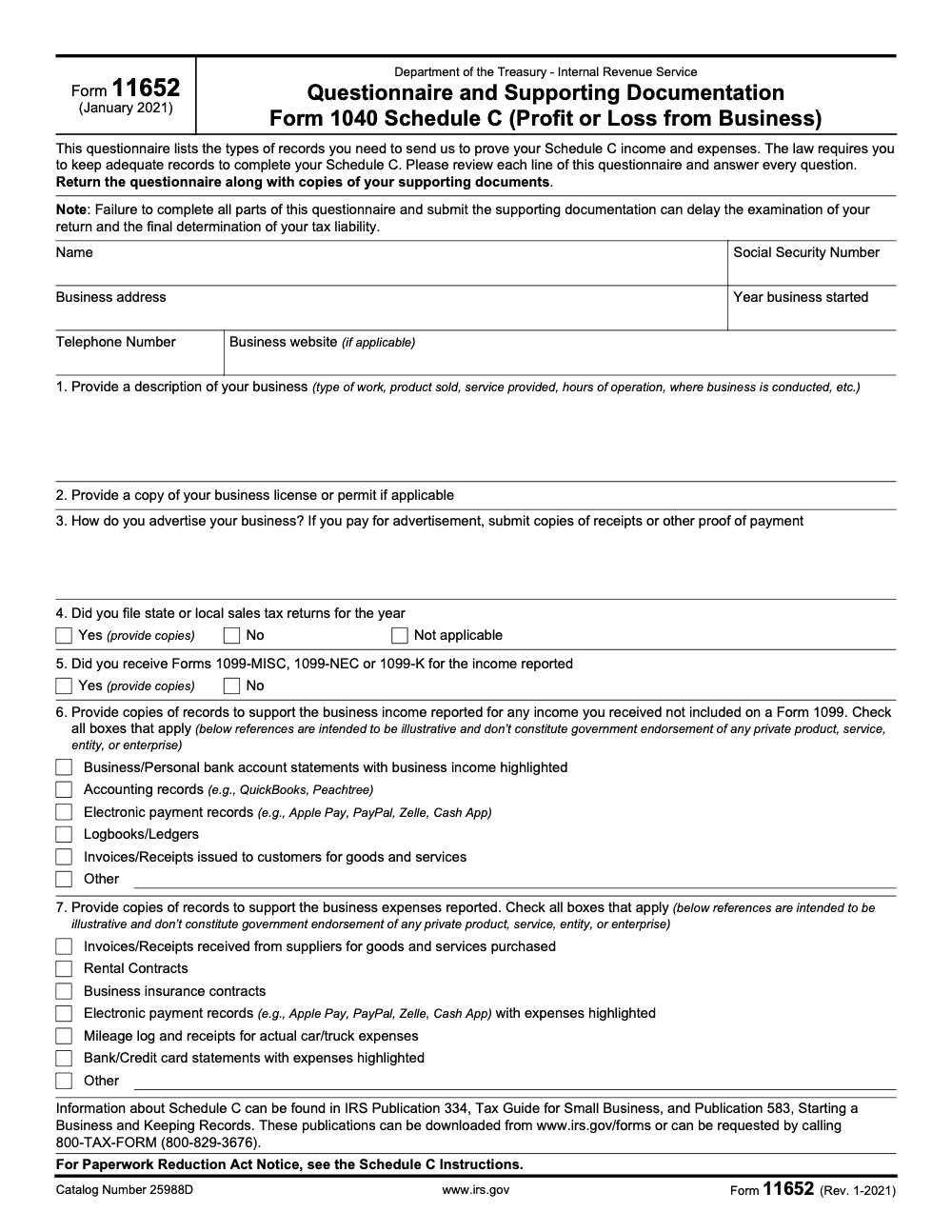
Form 11652 is the IRS Schedule C audit questionnaire (Rev. January 2021) sent during examination of a self-employed taxpayer's Form 1040 Schedule C, with seven numbered questions plus header fields, six income-record categories on Line 6, and seven expense-record categories on Line 7. It carries no statutory due date – respond by the date on the IRS examination letter (typically 30 days), attach copies of supporting records rather than originals, and reconcile Line 5 against the 2025 Form 1099-K threshold of $2,500 (per current IRS guidance on the third-party network transition). Our tax services handle the response packet end-to-end.
A client forwards an examination letter for their Schedule C with a response deadline a couple of weeks out, and tucked inside is Form 11652, the IRS questionnaire that decides how the audit goes. It carries seven numbered questions, six income-record categories on Line 6, and seven expense-record categories on Line 7, and it has no statutory due date of its own. You respond by the date on the letter, which is typically 30 days.
The mistake that costs people is answering the questions without attaching the records that back them up. The IRS expects copies of supporting documents, not just narrative answers, and an incomplete response leads straight to disallowances. Reconcile Line 5 against the 2025 Form 1099-K before you send anything, because a mismatch there invites a wider look. Treated right, the whole exercise is retrieval from a documentation file you already keep, not a reconstruction under pressure.
Key Takeaways
- Form 11652 is a questionnaire the IRS sends to self-employed taxpayers during correspondence examinations and EITC audits to gather information about their Schedule C business income and expenses.
- Who receives it: Taxpayers (or their representatives) whose Schedule C is under examination – most commonly triggered by high expense ratios, EITC claims, or income inconsistencies identified by IRS automated systems.
- Response deadline: Typically 30 days from the date of the notice; extensions are available in writing but must be requested promptly.
- Main pitfall: Answering questions without attached documentation – the IRS expects supporting records, not just answers; incomplete responses lead to disallowances.
- SOP tip: Treat every Schedule C engagement as a potential audit – maintain a documentation file throughout the year so Form 11652 response is a retrieval exercise, not a reconstruction exercise.
What Form 11652 Is and When to Use It
Form 11652, “Questionnaire and Supporting Documentation – Form 1040 Schedule C (Profit or Loss from Business),” is an IRS-issued questionnaire used during correspondence examinations of self-employed taxpayers. The IRS mails it alongside a notice – most often a CP2000 or an examination appointment letter – asking the taxpayer to explain and document their Schedule C business activity, income, and deductions.
The form serves two purposes. First, it gives the IRS examiner structured information about the nature of the business, the taxpayer’s accounting method, and how income and expenses were tracked. Second, it creates a paper record of the taxpayer’s representations, which the examiner will compare against submitted documentation. The IRS uses the answers to identify areas of inquiry and determine which expense categories deserve closer scrutiny.
What Triggers Form 11652
The IRS Discriminant Information Function (DIF) scoring system and automated underreporter (AUR) program flag returns where Schedule C income, expense ratios, or EITC claims fall outside expected ranges. High expense-to-revenue ratios, large home office deductions, significant vehicle expenses without supporting mileage logs, and cash-intensive business income are common triggers. An EITC claim on a return with Schedule C losses is particularly high-risk.
The Role of the Questionnaire in the Examination
The examiner reviews Form 11652 responses before requesting additional records. A well-prepared response – accurate, complete, and consistent with the return – can narrow the scope of the examination. A vague or inconsistent response tends to expand it. From my side of the desk, the questionnaire is the opening statement of your case; treat it accordingly.
How to Complete Form 11652
Form 11652 has header identification fields followed by seven numbered questions covering business description, business license, advertising, state and local sales tax, 1099 receipts, income records, and expense records – the form is a single-page questionnaire, not a multi-part schedule. Answer every question – leaving fields blank signals incomplete records.
| Line | Question on Form 11652 | Documentation to Attach |
|---|---|---|
| Header | Name, Social Security Number, business address, year business started, telephone number, and business website (if applicable) | Identification fields – no separate attachments required |
| Line 1 | Provide a description of your business (type of work, product sold, service provided, hours of operation, where business is conducted, etc.) | Narrative description in the response itself; no attachment required |
| Line 2 | Provide a copy of your business license or permit if applicable | Business license or permit copy; mark “not applicable” if the business does not require one |
| Line 3 | How do you advertise your business? If you pay for advertisement, submit copies of receipts or other proof of payment | Written description of advertising channels; paid-advertising receipts only if money was spent |
| Line 4 | Did you file state or local sales tax returns for the year (Yes / No / Not applicable) | Copies of filed state and local sales tax returns if Yes |
| Line 5 | Did you receive Forms 1099-MISC, 1099-NEC, or 1099-K for the income reported (Yes / No) | Copies of every 1099-MISC, 1099-NEC, and 1099-K received if Yes |
| Line 6 | Records to support business income not included on a Form 1099 – check all six categories that apply | Bank/personal account statements with business income highlighted, accounting records (e.g., QuickBooks, Peachtree), electronic payment records (e.g., Apple Pay, PayPal, Zelle, Cash App), logbooks or ledgers, invoices or receipts issued to customers, other |
| Line 7 | Records to support business expenses reported – check all seven categories that apply | Supplier invoices or receipts, rental contracts, business insurance contracts, electronic payment records (with expenses highlighted), mileage log and receipts for actual car/truck expenses, bank or credit card statements (with expenses highlighted), other |
Consistency with the Filed Return Is Critical
Every answer on Form 11652 must be consistent with the numbers on the filed Schedule C. If the return shows $15,000 in vehicle expenses and you now claim the mileage log shows only 8,000 business miles, the examiner will immediately question the original deduction. Reconcile the return to your documentation before completing the questionnaire.
Deadlines, Penalties, and Filing Requirements
| Action | Deadline | Consequence of Missing |
|---|---|---|
| Respond to Form 11652 questionnaire | 30 days from notice date (stated on the notice) | IRS may issue a default assessment; examination may proceed without taxpayer input |
| Request extension of response time | Before the 30-day deadline, in writing | Extensions typically granted for 30–60 additional days if requested promptly |
| Respond to 30-day letter after proposed changes | 30 days from 30-day letter date | Case moves to Appeals or statutory notice of deficiency (90-day letter) |
| Petition Tax Court (if 90-day letter issued) | 90 days from 90-day letter date (150 days if taxpayer outside U.S.) | Assessment becomes final; taxpayer loses right to pre-payment Tax Court review |
| Pay assessed deficiency (if not protesting) | Per notice demand | Interest accrues from original due date; late payment penalty at 0.5% per month |
Accuracy-Related Penalties
If the examination results in a deficiency, the IRS may impose a 20% accuracy-related penalty under IRC § 6662 for negligence or substantial understatement of income tax. A “substantial understatement” is generally an understatement exceeding the greater of 10% of the correct tax or $5,000. Adequate documentation submitted with Form 11652 is your primary defense against this penalty.
Form 11652 in EITC Examinations
A significant share of Form 11652 examinations are EITC-related. The Earned Income Tax Credit is heavily compliance-tested by the IRS because it is a refundable credit with high improper payment rates. Self-employed taxpayers claiming EITC based on Schedule C income – particularly those showing just enough profit to qualify for maximum credit – face elevated audit risk.
What the IRS Is Looking For in EITC Cases
In EITC examinations, the IRS is testing whether the Schedule C income is real. They want to see that income was actually earned – through bank deposits, 1099s, client records, or contracts – and that expenses claimed were actually paid. A Schedule C with no corresponding bank activity is a significant red flag. The IRS examiner will compare reported income to deposits and look for any gap.
Representing Clients Before EITC Examiners
EITC correspondence examinations are handled by IRS Examination function staff, not Revenue Agents. Quick rule you can copy into your SOP: for EITC correspondence exams, respond directly with documentation using the IRS response cover sheet; do not request an in-person meeting unless the case is complex, because correspondence resolution is faster. If the examiner disallows the credit despite documentation, request a conference with the examiner’s manager before escalating to Appeals.
Documentation Standards for Schedule C Deductions
The strength of a Form 11652 response depends entirely on documentation quality. The IRS applies the Cohan rule – allowing estimates when records are partially lost – but examiners apply it narrowly, especially for categories like vehicle use, meals, and travel where the IRC imposes strict substantiation requirements under § 274.
The § 274 Contemporaneous Record Requirement
Vehicle mileage, meals, and entertainment expenses require contemporaneous records: a log kept at or near the time of the expenditure, not reconstructed from memory months later (and the mileage log itself is required whether the taxpayer claims the standard mileage rate or the actual-expense method – both rely on documented business miles). If your client comes to you without a mileage log, you can sometimes use calendar entries, MapQuest printouts, and client records to approximate – but the IRS examiner knows the difference between a real log and a reconstruction, and so do you.
Bank Statements as Primary Evidence
For cash-method businesses, bank statements are the backbone of the examination record – but they must be highlighted to flag business versus personal transactions, and paired with invoices, accounting records, and electronic payment logs (Form 11652 says “check all boxes that apply” for a reason; raw, unmarked statements alone are commonly treated as inadequate substantiation). Every major expense claim should tie to a bank debit, check, or credit card charge. Where cash was used, there should be receipts. Small errors create big cleanup – if expense totals on the return differ from statement totals by more than a few hundred dollars with no explanation, the examiner will expand their inquiry.
Common Mistakes That Slow Things Down
The same six errors repeat across Schedule C correspondence audits. None of them are technical traps – they are gaps in how the response packet is assembled, and each one delays the case for weeks while the examiner asks the same question twice.
Practical Checklists You Can Reuse
These checklists are written to drop straight into firm SOPs and client packets. They follow the actual flow of a Schedule C correspondence examination from notice receipt to packet mail-out.
Day 1 to Day 3 intake checklist
- Log the notice date and the response deadline stated on the IRS examination letter.
- Calendar the response deadline plus a 7-day internal review buffer.
- Confirm the tax year under examination and pull the as-filed Schedule C plus supporting workpapers.
- Identify which Schedule C lines or items the notice flags (income mismatch, EITC, high expense ratios).
- Send the client a documentation request listing bank statements, 1099s received, supplier invoices, mileage log, and home office measurements.
- Decide whether to engage as representative under Form 2848 and file the POA before contacting the examiner.
- Request a 30- to 60-day extension in writing if the records gather will not complete by the original deadline.
Form 11652 line-by-line response checklist
- Header: name, SSN, business address, year started, telephone, and website (mark "not applicable" if no site).
- Line 1: describe the business – type of work, products, services, hours of operation, and where conducted.
- Line 2: attach a business license or permit copy, or write "not applicable" with a one-line reason.
- Line 3: describe how the business advertises; attach paid-advertising receipts only if money was spent.
- Line 4: select Yes, No, or Not applicable for state and local sales tax; attach return copies if Yes.
- Line 5: select Yes or No for receipt of 1099-MISC, 1099-NEC, or 1099-K; attach every copy if Yes.
- Line 6: check every income-record category that applies (bank statements, accounting records, electronic payment records, logbooks or ledgers, invoices or receipts issued, other) and label each attached exhibit.
- Line 7: check every expense-record category that applies (supplier invoices, rental contracts, business insurance, electronic payment records, mileage log, bank or credit card statements, other) and label each attached exhibit.
Pre-mail final review checklist
- All seven numbered questions answered – no blanks.
- All attachments are copies, not originals; originals retained in the client file.
- Bank statement transactions highlighted with margin notes tying to Schedule C lines.
- 1099 copies attached for every "Yes" on Line 5.
- Cover letter references the case number, tax year, and lists each attached exhibit.
- Mileage log substantiates business miles by date, destination, and purpose.
- Packet delivered by tracked mail or secure upload before the IRS letter deadline.
- Copy of the full packet stored in the client file and the firm document management system.
Keep 11652 Season From Stalling
Schedule C correspondence audits do not follow a calendar like filing season; they hit in waves after IRS Automated Underreporter and EITC pre-refund programs run, which means a single notice can land in May, July, or November and still carry a 30-day response window per the Form 11652 instructions (Rev. January 2021). The bottleneck is rarely the tax position. It is records assembly, with Form 11652 alone requiring decisions across seven numbered questions, six income-record categories on Line 6, and seven expense-record categories on Line 7.
Firms that close these cases without filing extensions or losing deductions treat the response packet as a production workflow, not a one-off scramble. The pattern is the same one structured offshore delivery teams use across the rest of the tax cycle: standardised intake, line-by-line build, and a documented pre-mail review.
- Standardise the intake form so every notice produces the same fields: case number, tax year, deadline, Schedule C lines flagged, and POA status.
- Build the response packet line-by-line against Form 11652 (never as a free-form letter) and label every exhibit with the Line number it answers.
- Run a documentation completeness check before sign-off: every "Yes" on Line 5 carries the 1099 copy, every box checked on Line 6 and Line 7 has a matching exhibit, and every bank statement is highlighted.
- Track the 1099-K threshold year-over-year (the 2025 threshold is $2,500 and the 2026 threshold drops to $600 per current IRS guidance) so Line 5 reconciliation matches the year under examination.
- Calendar a 7-day internal review buffer before the IRS deadline so any missing receipt or unsigned client letter is caught in-house, not by the examiner.
This is where structured offshore execution pays back the most: the records gather, line-by-line packet build, and exhibit labelling fit a documented SOP and a layered review cycle. Our tax services handle the examination response workflow alongside ongoing Schedule C preparation, so the same team that filed the return is the one that defends it.
FAQs
Form 11652 is an IRS questionnaire sent to self-employed taxpayers whose Schedule C is under correspondence examination. You received it because the IRS identified something on your return – income discrepancy, high expense ratios, an EITC claim, or another risk indicator – and wants supporting documentation before making any changes. It is not a bill and it is not a criminal matter; it is an information request with a deadline.
The response deadline is stated on the accompanying notice – typically 30 days from the notice date. You can request a 30–60 day extension in writing before the deadline. Missing the deadline without requesting an extension risks a default assessment, which the IRS issues based on whatever information it already has.
Attach copies (never originals – Form 11652 explicitly asks for copies, and originals risk being lost inside the examination file) that directly support every income and expense line on your Schedule C: bank statements showing deposits and debits, 1099s received, receipts for major expenses, vehicle mileage logs, and home office measurements if applicable. Organize by Schedule C line number or expense category to make the examiner’s review efficient. Well-organized responses tend to resolve faster.
Yes. A CPA, EA, or tax attorney with a valid Form 2848 (Power of Attorney) on file can respond to Form 11652 on your behalf, correspond with the examiner, and represent you at any subsequent conference. If your situation is straightforward and documentation is complete, many practitioners handle correspondence examination responses efficiently without requiring client involvement beyond records gathering.
If the examiner proposes changes after reviewing your response, they will issue a 30-day letter explaining the proposed adjustments. You can agree, disagree and request an Appeals conference, or wait for a statutory notice of deficiency (90-day letter) and petition Tax Court. Most correspondence examinations resolve at the initial response stage or at Appeals without reaching Tax Court.
Other forms this guide names
- Form 1099-K: Rules, Thresholds, and State Triggers
- Form 1099‑MISC: Deadlines, Boxes, Thresholds & Filing Guide
- Form 1099-NEC: Rules, Who Gets One, How to File
- Form 2848: Guide to Line 3, Filing, and Rules
About this guide
Accountably helps US CPA, EA, and accounting firms hire trained accountants and tax preparers in India.
About us Reviewed byJugal Thacker, CPAFounder and CEO at Accountably
A Washington-licensed CPA with 7+ years inside US firms – PwC, a real-estate tax practice, then a full-service firm, rising from reviewer to manager to advisory. This article was reviewed against current IRS guidance for the 2025 tax year and updated for filers preparing late returns, amendments, and 2026 estimates.
View profile →How we research, review, and update this guide
Every Accountably guide is researched against primary IRS sources, reviewed by a U.S. CPA, and refreshed as guidance evolves. Read our Editorial Guidelines to see how we source, fact-check, and update our content.