Summarize this article with AI
In Brief
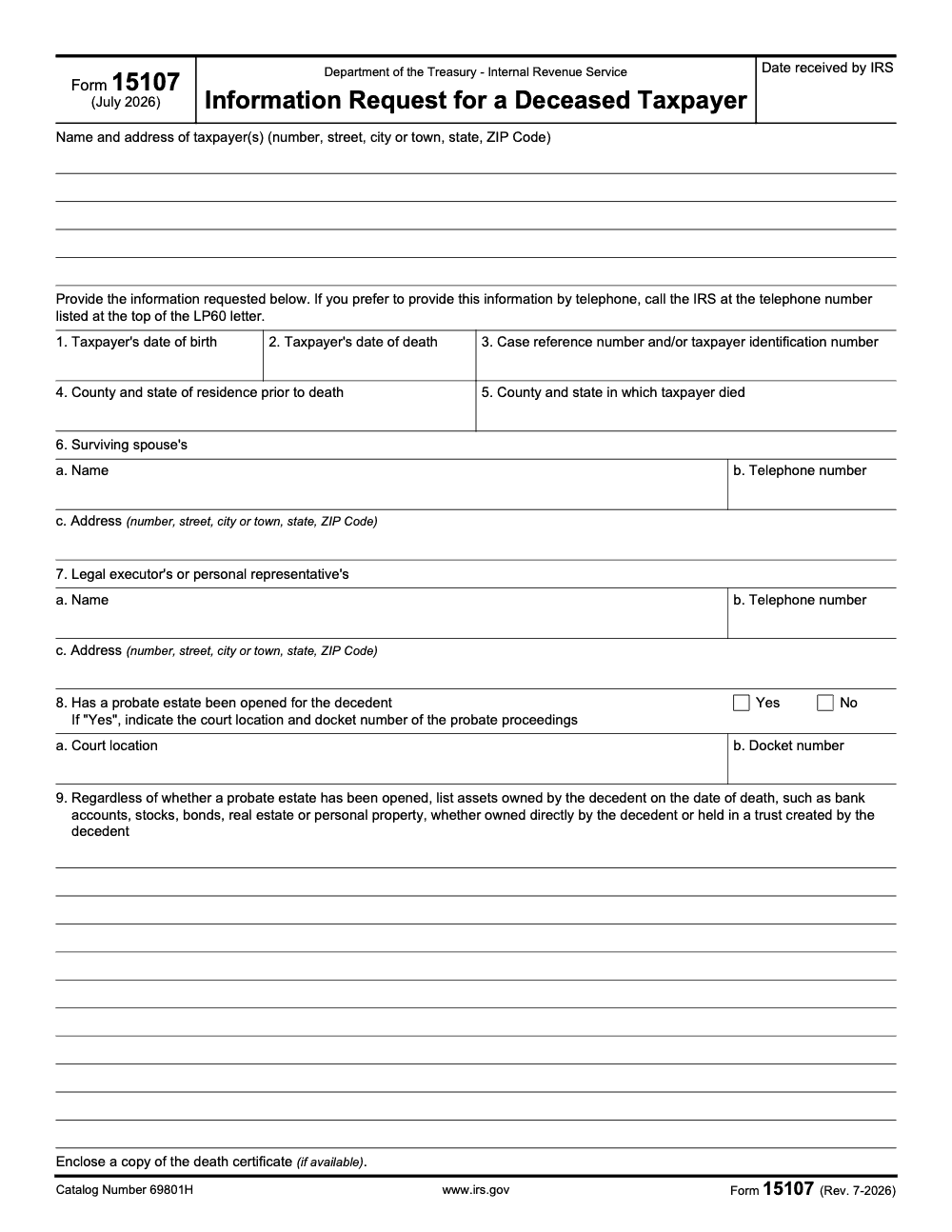
Form 15107, "Information Request for a Deceased Taxpayer," is a one-page IRS form (September 2017 revision, catalog 69801H) the agency attaches to an LP60 letter to confirm a decedent's identity, residence, surviving-spouse or executor contact, probate status, and an asset summary on lines 1 through 8 (per IRS Form 15107). The form itself states no deadline – the response window comes from the LP60 cover letter, and respondents may mail the completed form with a copy of the death certificate (if available) or call the IRS number printed on the letter (see our taxation services if you need help responding).
An LP60 with Form 15107 attached reaches a family at a hard moment, often weeks or months after a funeral, when the surviving spouse or executor is already buried in paperwork. The form is the IRS Information Request for a Deceased Taxpayer, and it confirms the decedent's identity, residence, surviving-spouse or executor contact, probate status, and an asset summary.
It looks simple, one page with eight numbered fields, and that simplicity is where the rework hides. The form itself states no deadline; the response window comes from the LP60 cover letter. Mail the completed form with a copy of the death certificate if you have one, and once it is in, finish the rest of the work, the final Form 1040 or 1040-SR, any refund claim on Form 1310, and transcripts on Form 4506-T.
Key Takeaways
- Form 15107 is the IRS one‑page form used to verify a deceased taxpayer’s identity, estate status, and a summary of assets following an LP60 notice. You respond by mail using the paper form that came with the notice, or by calling the number on the letter. There is no online upload option. Respond within 30 days of the notice date.
- Have ready, and enter exactly as shown on official records, the decedent’s full legal name, last address, date of birth, and date of death, then attach a copy of the death certificate if you have one, the form treats this as conditional on availability rather than as a hard blocker.
- Include county and state of residence and death, surviving spouse details, personal representative information, whether probate is open, and a short asset summary.
- After mailing or calling, finish the rest of the tax work, for example the final Form 1040/1040‑SR, any refund claim on Form 1310 when required, and needed transcripts using Form 4506‑T. For suspected identity theft, file Form 14039.
What Form 15107 Is, and Why You Received an LP60
An LP60 is simply the IRS asking for information about a deceased taxpayer to resolve a federal tax matter. The letter includes Form 15107 and a return envelope. Your two response options are straightforward, mail back the completed form with the detachable stub, or call the number on the notice and provide the same details by phone. The IRS asks you to reply within 30 days of the notice date, so treat the timing as firm and get this off your list quickly.
Quick reminder, the LP60 is an information request, not an assessment. Your goal is clarity, accuracy, and a prompt reply.
If you need a quick lookup, the IRS public page titled “Understanding Your LP60 Notice” confirms these steps, including the 30‑day window and the mail or phone options. Keep the notice in your permanent records after you respond.
What You Need Before You Fill Form 15107
Gather these items first so you can complete the form in one clean pass.
- Decedent’s full legal name, last address on file, date of birth, and date of death.
- County and state of residence immediately before death, plus the county and state where death occurred.
- Surviving spouse information, name, phone, and address.
- Personal representative or executor information, name, phone, and address.
- Probate status, whether opened, court location, and docket or case number if available.
- A simple inventory of assets as of date of death, for example bank accounts, investments, real estate, personal property, business interests, and trust assets, at a summary level (Line 8 asks for this list regardless of whether a probate estate has been opened, and it covers assets held in a trust the decedent created in addition to assets owned directly).
- A copy of the death certificate, do not send the original. These fields align with the IRS description of Form 15107, “Information Request for a Deceased Taxpayer.”
How to Respond to the LP60 on Time
- Complete the paper Form 15107 that arrived with your LP60, include the death certificate copy, and mail it using the envelope shown on the notice. If you prefer, call the phone number at the top of the letter and provide the same information. The IRS asks for your response within 30 days of the notice date.
- There is no upload portal for Form 15107. Treat this as a paper reply by mail, or a phone call, exactly as the notice instructs.
- Keep a copy of everything you send, and save the LP60 in your permanent records.
Form 15107, Line‑by‑Line at a Glance
- Header, enter the decedent’s full name and last known address, match IRS records if possible.
- Line 1, date of birth.
- Line 2, date of death, match the death certificate.
- Lines 3–4, county and state of residence before death, and county and state of death (these may differ, for example when the decedent died while traveling, hospitalized out of state, or in a long‑term care facility, so verify each independently rather than copying Line 3 into Line 4).
- Line 5, surviving spouse, name, phone, and address.
- Line 6, personal representative or executor, name, phone, and address.
- Line 7, probate status, court location, and docket or case number if open.
- Line 8, short asset summary at death (required regardless of whether a probate estate has been opened, and including assets held in a trust the decedent created, not only directly owned assets). This mirrors the IRS listing for Form 15107 and what the LP60 expects you to return.
Step‑by‑Step, Filling Form 15107 Without Rework
Start with exact identity details
Match the name and last address exactly as used on recent filed returns when possible. Precision helps the IRS route the response to the correct account with fewer follow‑ups. Include the date of birth in eight digits, then the date of death as shown on the certificate you attach.
Confirm locations and relationships
List the county and state of residence immediately before death, then the county and state where death occurred. Add the surviving spouse’s information and the personal representative or executor, including a reliable phone number and mailing address where the IRS can reach you.
Probate status and court details
If probate is open, note the court location and case or docket number. If probate is not open, state that clearly. This allows the IRS to understand who has authority to act and what documentation they may request next. If you are acting as fiduciary, consider filing Form 56 to formally notify the IRS of the fiduciary relationship.
Asset summary that speeds reviews
Keep the asset list high level, the goal is a snapshot of what existed on the date of death, not a valuation. Typical categories include bank accounts, brokerage and retirement accounts, real estate, business interests, vehicles, and notable personal property. If there is a trust, identify it at a summary level. Detailed inventory and fair market values are usually handled in estate administration, not on this one‑page request.
Sign, attach, and mail, or call
Attach a copy of the death certificate, include the detachable stub, and mail to the service center address on your notice. Prefer to resolve by phone, you can provide the same information by calling the number at the top of the LP60. Either way, respond within 30 days of the notice date. Save a copy for your files.
Filing Rules for the LP60 Response
- Reply within 30 days of the LP60 date.
- Use the paper Form 15107 that came with the letter, or call the number on the notice.
- Include a copy of the death certificate (if available), not the original.
- Keep the LP60 and what you mailed in your permanent records. These are the IRS’s own instructions for LP60 recipients.
After You Send Form 15107, Finish the IRS To‑Dos
Here is the short list you will likely handle next. Use it like a worksheet.
| Task | What to file | Helpful notes |
| Final individual return | Form 1040 or 1040‑SR | File by the normal due date. Write “Deceased,” the name, and the date of death across the top. See Pub. 559 for details. |
| Refund due to the decedent | Form 1310 | Required when the claimant is not a surviving spouse on a joint return and not a court‑appointed personal representative. |
| Wage, income, or account transcripts | Form 4506‑T | Use to request transcripts needed to prepare the final return or verify filings. |
| Identity theft concerns | Form 14039 | File if you suspect tax identity theft on the decedent’s account. |
| Notice the IRS you are fiduciary | Form 56 | File when you take on or terminate a fiduciary role. |
Tip, if you need more time to file the final Form 1040, request an extension with Form 4868 by the April due date. An extension gives you until October 15 to file, but it does not extend time to pay any tax due.
Who This Guide Helps
- Personal representatives and surviving spouses who must answer an LP60 quickly.
- CPA and EA firms that manage estate‑related filings and want a repeatable process for LP60 responses, transcript pulls, and final return steps. If you run a firm and you are juggling busy‑season capacity, consider building a lightweight SOP for LP60, including a standard Form 15107 workpaper, a death‑certificate intake checklist, and a routing rule for who calls the IRS. If your in‑house team is buried, Accountably can integrate trained staff into your workflow to standardize documentation and hit turnaround windows, while you retain control of review and security. Use this only if it closes a gap in your process.
Deeper Dive, Final Returns, Refunds, Extensions, and Transcripts
Final 1040 or 1040‑SR
File the decedent’s final individual return the same way you normally would, reporting income up to the date of death and claiming eligible deductions and credits. If a prior year was never filed, you may also need to file those missing years. The IRS confirms these steps and points you to Publication 559 for executor guidance.
If a balance is due, pay with the return or use an IRS payment option. If a refund is due and you are neither the surviving spouse filing a joint return nor a court‑appointed personal representative, include Form 1310. The IRS “About Form 1310” page provides the latest details.
Extensions when you need more time
If you cannot file the final return by the April deadline, request an extension by that date using Form 4868 or make an electronic payment and mark it as an extension payment. The extension gives you until October 15 to file, however tax still must be paid by April to avoid penalties and interest. The IRS extension page and About Form 4868 confirm these rules.
For fiduciary returns, for example Form 1041 for the estate, use Form 7004 to request an automatic extension. Estates and trusts generally receive a 5½‑month extension, which the IRS instructions for Form 7004 explain. Always confirm the year‑specific rules in the current instructions.
Transcripts and account checks
Use Form 4506‑T to request tax transcripts, for example wage and income, which help verify what the decedent reported or what information returns exist. The IRS “About Form 4506‑T” page outlines what you can request and how transcripts are masked for privacy.
If you need broader access because you are the fiduciary, file Form 56 to put the IRS on notice that you are authorized to act. Filing when you begin, and again when you terminate the role, is best practice.
Guard against identity theft
If you suspect tax identity theft, for example an unexpected filing on the decedent’s SSN, submit Form 14039, Identity Theft Affidavit. You can complete a paper form or use the online flow described by the IRS. Consider requesting an IP PIN for added protection in future filings tied to the estate.
Practical Checklist, Start to Finish
- Open the LP60, calendar the 30‑day deadline, and assign ownership.
- Gather ID details, spouse and personal representative contacts, probate status, and a summary of assets.
- Make a clean copy of the death certificate.
- Complete Form 15107, attach the death certificate, include the stub, and mail to the address on the LP60. Or, call the number on the notice and provide the same information.
- Prepare the final Form 1040 or 1040‑SR. Include Form 1310 if required. Pull transcripts with Form 4506‑T if you need them for accuracy.
- If timing is tight, file Form 4868 by the April due date to extend filing to October 15, payment still due in April. For estates and trusts, consider Form 7004 for the fiduciary return.
- If you are the fiduciary, file Form 56 to formally notify the IRS that you have authority to act.
- Keep copies of everything, and monitor for follow‑up notices.
One more helpful page, the IRS “Request deceased person’s information” explains the proof you may need, including Letters of Testamentary or Form 56, when you request records. Keep this handy if you are chasing older year transcripts or address changes.
How Firms Can Systematize LP60 Work
If you lead a CPA or EA firm, build a short SOP for LP60 so each case takes minutes, not hours.
- A one‑page Form 15107 worksheet template.
- A standard death‑certificate intake and storage checklist.
- A call script for the IRS number on the LP60.
- A folder structure and naming standard for workpapers.
When capacity is tight, Accountably can supply trained offshore professionals who work inside your systems, use your templates, and follow your review notes, so your partners spend less time in review and more time advising families. Use this to create predictable turnaround and clean documentation, not to replace your standards.
Common Mistakes to Avoid
Form 15107 is short, so the recurring mistakes I see are not about complexity – they are about reading the form too fast. These are the patterns my team flags during review.
Final Checklist and Next Steps
- Confirm your authority, for example Letters of Testamentary or Form 56 if applicable.
- Complete Form 15107, attach the death certificate copy, and mail it with the stub using the return envelope, or call the number on the notice. Expect to respond within 30 days.
- Prepare the final return, attach Form 1310 if required, and request transcripts with Form 4506‑T if you need wage and income data. If time is tight, request an extension with Form 4868, payment still due by April. For fiduciary returns, consider Form 7004.
- Watch for the next IRS response and act promptly when it arrives.
Reusable Checklists
These checklists are built to paste straight into a firm SOP or a personal file. Tick items as you go – the page remembers your state on this device.
LP60 intake packet
- Photocopy the LP60 letter front and back, including the response address and phone number.
- Pull the certified death certificate (or note the order date if one is on the way).
- Confirm the decedent's last permanent address for Line 3 (residence).
- Confirm the place-of-death county and state for Line 4 from the death certificate.
- Gather surviving spouse name, phone, and full address (Lines 5a, 5b, 5c).
- Gather executor or personal representative name, phone, and full address (Lines 6a, 6b, 6c).
- Decide Line 7 Yes or No: has a probate estate been opened? If Yes, capture court location and docket number.
Line 8 asset summary
- List bank and credit union accounts owned by the decedent on the date of death.
- List brokerage accounts, stocks, and bonds held individually or in the decedent's revocable trust.
- List real estate (residence and any rental or investment property) with state.
- List vehicles and other personal property of meaningful value.
- Include trust-held assets when the decedent created the trust – probate status does not limit Line 8.
- Exclude assets the decedent did not own on the date of death.
Post-reply follow-up
- Mail Form 15107 with the death certificate copy using the return envelope from the LP60, or call the number on the letter and log the call.
- File the decedent's final Form 1040 if not yet filed; attach Form 1310 if a refund is due to someone other than the surviving spouse.
- Determine whether Form 1041 (estate income tax) is required and obtain an estate EIN if so.
- Determine whether Form 706 (federal estate tax) is required for the year of death.
- Request wage and income transcripts with Form 4506-T if records are incomplete.
- If time is tight, extend the personal return with Form 4868; remember the tax is still due.
- Log the IRS response date and calendar a 60-day follow-up if no reply arrives.
Keep 15107 Season From Stalling
LP60 letters do not arrive in a season – they arrive on the IRS's calendar, which means a single estate matter can land in the middle of an already full firm week. The form is one page, but the work behind a clean response stretches across the final Form 1040, possible Form 1041, transcript pulls, and family communication. The brief context for this guide notes a 30 day response window from the LP60 cover letter, and firms that miss it spend the next quarter chasing a second IRS letter (per the LP60 cover-letter instructions).
The fix is treating the LP60 like any other IRS correspondence: an intake checklist, a single owner, a documented turnaround target, and a hand-off to the preparer who will handle the related returns. None of this is unique to Form 15107 – it is the same delivery discipline that keeps quarterly payroll and 1040 season from stalling.
- Run a Form 15107 intake the day the LP60 arrives: cover letter copy, death certificate request, residence and place-of-death confirmation, surviving-spouse and executor contact capture.
- Standardize the Line 8 asset listing into a template that prompts for probate and non-probate assets, including decedent-created trust holdings, so reviewers see the same shape every time.
- Pre-decide the mail-or-call routing rule: short, clear asset lists call in; complex estates with trust holdings or out-of-state real estate go by mail with the death certificate copy.
- Link the LP60 file to the decedent's final Form 1040, any Form 1041, Form 706 evaluation, and Form 1310 refund routing so the team works one estate matter, not five disconnected forms.
- Calendar a 60 day follow-up from response date so a missed IRS reply does not sit unworked.
Accountably can drop trained offshore preparers into this workflow – following your intake template, your asset listing standard, and your review notes – so partners stay in the advisory seat and LP60 responses go out on time. See our taxation services for how the engagement works.
FAQs
Form 15107 is a one‑page IRS form titled “Information Request for a Deceased Taxpayer.” It is included with the LP60 notice and is used to confirm identity, estate status, and a brief asset summary. You return the paper form by mail using the envelope that came with your letter, or you call the phone number at the top of the notice and provide the same information. The IRS asks for your response within 30 days.
Yes, include a copy of the death certificate with the Form 15107 reply by mail if you have one (the form itself says "enclose a copy of the death certificate (if available)," so a missing certificate does not block your reply, send it later if requested). If you respond by phone, be prepared to send documentation if the IRS representative requests it. Keep your original certificate, and include only a copy in your mailing.
No. Form 706 is required only when an estate must file an estate tax return or when making certain elections, such as portability. Filing thresholds and elections change over time, so check the Form 706 instructions for the year of death or consult a qualified professional. Publication 559 explains the executor’s role, and it points you to the right estate and gift tax resources.
Form 5498 is issued by IRA custodians to report contributions, rollovers, fair market value, and other IRA information. It helps you confirm retirement account details that may appear on the decedent’s transcripts or in the asset summary, and it can be helpful when preparing the final return. For filing a final return, continue to rely on IRS transcripts and custodian statements as needed.
Other forms this guide names
About this guide
Accountably helps US CPA, EA, and accounting firms hire trained accountants and tax preparers in India.
About us Reviewed byJugal Thacker, CPAFounder and CEO at Accountably
A Washington-licensed CPA with 7+ years inside US firms – PwC, a real-estate tax practice, then a full-service firm, rising from reviewer to manager to advisory. This article was reviewed against current IRS guidance for the 2025 tax year and updated for filers preparing late returns, amendments, and 2026 estimates.
View profile →How we research, review, and update this guide
Every Accountably guide is researched against primary IRS sources, reviewed by a U.S. CPA, and refreshed as guidance evolves. Read our Editorial Guidelines to see how we source, fact-check, and update our content.