Summarize this article with AI
In Brief
Form 15373 (Rev. 8-2022) is the VITA/TCE site-display poster that advertises free over-the-phone interpreter (OPI) services in 350+ languages at no cost to qualifying taxpayers (per IRS Multilingual Services). It is never filed with the IRS; only the host site completes the “Site Name” and “Address” fields before posting it in the waiting area, and the VITA program itself serves taxpayers earning roughly $67,000 or less (per IRS VITA program guidelines).
A taxpayer who spoke almost no English once got a full return prepared in his own language at a community VITA site, with an interpreter on speakerphone the whole way through. What told him that help existed, before he ever sat down, was a poster on the wall. That poster is Form 15373, and signaling that free over-the-phone interpreter services are available is its entire job.
The poster advertises OPI services in 350+ languages at no cost to qualifying taxpayers, and the VITA program it supports serves taxpayers earning roughly $67,000 or less. It is never filed, signed, or transmitted to the IRS. Only the host site coordinator completes the Site Name and Address fields before posting, the current revision is Rev. 8-2022, and the Catalog Number is 92842Y.
Key Takeaways
- Form 15373 is a VITA/TCE site-display poster (Rev. 8-2022) that advertises free over-the-phone interpreter (OPI) services in 350+ languages to limited-English-proficient taxpayers at Volunteer Income Tax Assistance (VITA) and Tax Counseling for the Elderly (TCE) sites.
- It is not a fileable form: Form 15373 is never mailed, e-filed, signed, or transmitted to the IRS. It is a single-page poster (Catalog Number 92842Y) that stays displayed at the site for the filing season, with no deadline.
- Who completes the form: Only the host volunteer site coordinator fills in the “Site Name” and “Address” fields before posting it. Taxpayers do not write on the poster, and no one signs it.
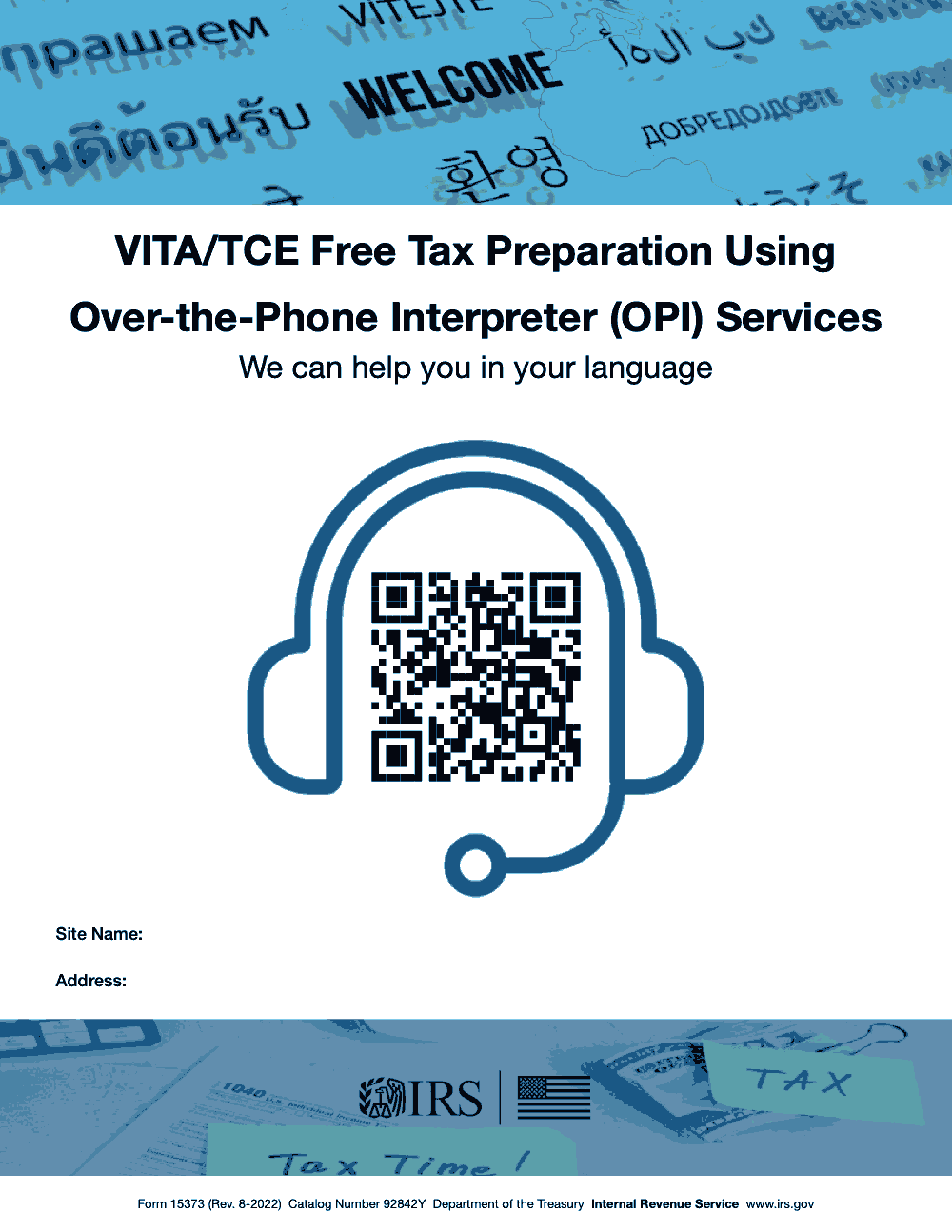
- What it covers: A title (“VITA/TCE Free Tax Preparation Using Over-the-Phone Interpreter (OPI) Services”), the tagline “We can help you in your language,” two fill-in fields for Site Name and Address, and a central QR code linking to IRS multilingual resources.
- Main pitfall: Treating Form 15373 as a fileable tax form or letting taxpayers write on the “Site Name” or “Address” fields. It is never filed, signed, or transmitted to the IRS, and only the site coordinator completes the two fields.
- SOP tip: Pre-fill “Site Name” and “Address” before opening day and post the form at both the intake desk and the waiting area, so limited-English-proficient taxpayers see the OPI service signal on arrival.
What Form 15373 Is and When to Use It
Form 15373, “VITA/TCE Free Tax Preparation Using Over-the-Phone Interpreter (OPI) Services,” is the IRS site-display poster (Rev. 8-2022, Catalog Number 92842Y) used at VITA and TCE sites to tell limited-English-proficient taxpayers that free over-the-phone interpreter services are available during their tax preparation appointment. The poster carries the tagline “We can help you in your language,” two fill-in fields for Site Name and Address, and a central QR code linking to IRS multilingual resources.
VITA (Volunteer Income Tax Assistance) and TCE (Tax Counseling for the Elderly) are among the most high-volume free tax preparation programs in the country. The IRS funds and oversees both through grants to partner organizations – community nonprofits, libraries, universities, AARP Foundation chapters, and similar entities. Form 15373 is one of the outreach products those sites can download from IRS.gov or order in print at no cost, then post where taxpayers can see it.
From my side of the desk, the value of Form 15373 is that it removes a barrier before the prep session even starts. A taxpayer who cannot read the intake signs in English still recognizes the “we can help you in your language” message and the headphones-and-QR-code graphic, and knows to ask for an interpreter. The poster is never filed, signed, mailed, or e-filed; it stays on the wall for the season.
VITA vs. TCE – Same Poster, Different Focus
Form 15373 is posted at both VITA and TCE sites, but the populations served differ. VITA generally serves taxpayers who make $67,000 or less, persons with disabilities, and limited English-speaking taxpayers. TCE offers free tax help to all taxpayers, particularly those age 60 and older, specializing in pension and retirement-related questions unique to seniors (the 60+ focus is a specialization, however – TCE is technically available to taxpayers of all ages, not an absolute eligibility cutoff). The OPI service the poster advertises is available at both program types.
When to Post Form 15373
Form 15373 is not completed per return and has no filing deadline. The host volunteer site coordinator fills in the “Site Name” and “Address” fields once, before the filing season opens, and posts the single poster in the waiting area or at the intake desk for the duration of the season. It has no per-return fields, no signature line, and no taxpayer ID block.
How to Complete Form 15373
Form 15373 is a single-page poster with only two configurable fields: “Site Name” and “Address.” The host volunteer site coordinator fills these in before the poster is displayed. Below the title and tagline, a central QR code (set inside a headphones illustration) links to IRS multilingual help resources and VITA/TCE site locators.
Note: Form 15373 has only two fields (Site Name and Address) and no per-return areas. The table below summarizes the elements that actually appear on the poster and who handles each one.
| Poster Element | What It Is | Who Handles It |
|---|---|---|
| Title | “VITA/TCE Free Tax Preparation Using Over-the-Phone Interpreter (OPI) Services” | Pre-printed by the IRS |
| Tagline | “We can help you in your language” | Pre-printed by the IRS |
| Site Name field | Blank line for the host site to add its location name | Site coordinator |
| Address field | Blank line for the host site to add its street address | Site coordinator |
| QR code | Scannable code centered inside a headphones illustration, linking to IRS multilingual resources | Pre-printed; taxpayers scan it |
| Agency line | “Department of the Treasury, Internal Revenue Service, www.irs.gov” | Pre-printed by the IRS |
| Revision and catalog | Form 15373 (Rev. 8-2022), Catalog Number 92842Y | Pre-printed by the IRS |
What the Site Coordinator Does
Completing Form 15373 takes one step: the site coordinator writes the Site Name and Address on the two blank lines before the poster goes up. Nothing else on the poster is editable, and the taxpayer never writes on it. Print at least two copies, post them where arriving taxpayers will see them, and replace any prior-year copies still on the wall.
How the Over-the-Phone Interpreter Service Works
The whole reason Form 15373 exists is to advertise the IRS Over-the-Phone Interpreter (OPI) service. OPI is a telephone-based service, not in-person interpretation. There is no guarantee of a bilingual staffer in the room; instead, the volunteer preparer connects a remote interpreter by phone during the prep session.
The Connection Steps
In practice, the volunteer preparer dials the OPI line, requests the taxpayer’s language, and a live interpreter joins the conversation by phone. The interpreter relays questions and answers in real time, so the full prep interview can run in the taxpayer’s preferred language rather than relying on partial English fluency.
Free to the Taxpayer
Both the VITA/TCE tax preparation and the OPI interpreter service are free to qualifying taxpayers. The IRS and its partner grantees fund the service, so no taxpayer is charged for using OPI at a VITA or TCE site. The poster reinforces this by pairing “Free Tax Preparation” with the interpreter message.
The QR Code Is Functional
The QR code centered in the headphones illustration is not decorative. Taxpayers can scan it with a smartphone camera to reach IRS multilingual help resources and VITA/TCE site locators, which is useful for anyone who arrives outside open hours or wants language information before visiting.
Who VITA and TCE Serve
Form 15373 is posted at both VITA and TCE sites, so it helps to know which taxpayers each program targets. The OPI service the poster advertises is available across both.
VITA Eligibility
The Volunteer Income Tax Assistance program offers free tax help to people who generally make $67,000 or less, persons with disabilities, and limited English-speaking taxpayers. Income is not the only path in – disability and limited English proficiency are independent eligibility routes, which is exactly the population the poster’s multilingual message reaches.
TCE Eligibility
The Tax Counseling for the Elderly program offers free tax help to all taxpayers, particularly those age 60 and older, specializing in pensions and retirement-related issues unique to seniors. The 60+ focus is a specialization, not an absolute cutoff, so the poster is just as relevant at a TCE site where a senior taxpayer needs a non-English interpreter.
The Common Thread
Across both programs, the taxpayers most likely to need OPI are those who speak little or no English. Posting Form 15373 where they arrive is the front-door signal that an interpreter is available in their language at no cost.
How Many Languages OPI Covers
One of the most common assumptions about the OPI service is that it only supports Spanish or a short list of common languages. That undersells it badly, and it is worth knowing the real reach when you train intake volunteers.
More Than 350 Languages
The IRS provides free interpreter service in over 350 languages through the Over-the-Phone Interpreter service. That includes indigenous and low-incidence languages, not just the high-volume ones. A taxpayer who speaks any of those languages can be connected to a live interpreter during the prep session at a participating VITA or TCE site.
Why It Matters at Intake
Because coverage is so broad, intake volunteers should ask the taxpayer’s preferred language rather than defaulting to Spanish or English. The poster signals the service exists; the volunteer’s question turns that signal into an actual interpreter call in the right language.
Posting Form 15373 at In-Person, Virtual, and Hybrid Sites
Form 15373 is a physical site-display poster, so its role is clearest at in-person sites. Virtual and hybrid sites still serve limited-English-proficient taxpayers, so the same OPI message needs a path to reach them even when there is no waiting-room wall.
In-Person Sites
Post the poster where arriving taxpayers will see it – the intake desk and the waiting area are the two highest-visibility spots. The QR code lets a taxpayer pull up IRS multilingual resources on their own phone while they wait.
Virtual and Hybrid Sites
At a virtual or hybrid site, the same poster image can be shared on the site’s appointment page, in confirmation emails, or on screen during a video intake. The goal is unchanged: make sure a limited-English-proficient taxpayer learns that a free interpreter is available before the prep session starts. The poster content does not change between in-person and virtual delivery.
One Poster, Whole Season
Form 15373 is not posted per appointment. A single copy, with the Site Name and Address filled in, stays up for the duration of the filing season. There is no per-taxpayer version and no per-session step tied to the poster itself.
Getting, Reordering, and Refreshing the Poster
Form 15373 is an IRS outreach asset, which means sites do not pay for it and do not file it. Knowing how to get current copies keeps the front-door message accurate season to season.
No Cost to the Site
VITA and TCE site coordinators can download Form 15373 from IRS.gov or order print copies at no cost through the IRS volunteer-resource ordering system. It is meant for free distribution to host sites, so there is no reason to substitute a homemade flyer.
Rev. 8-2022 Is Still Current
The August 2022 revision is still the current version of Form 15373 for the 2025 filing season. A revision date marks the last content update, not an expiration date, so a 2022-dated poster is not outdated. Confirm the revision with your IRS partner liaison before each season and re-download in case of a quiet update.
No Retention Burden
Because the poster is never filed and carries no per-return data, there is no retention rule attached to it. The poster simply stays displayed while the site operates; when it gets worn or the address changes, reprint a fresh copy.
How Form 15373 Helps Taxpayers
The underlying purpose of Form 15373 is removing a language barrier for taxpayers who are relying on free volunteer assistance for one of the most consequential annual financial transactions in their lives. It is the public-display poster that signals free over-the-phone interpreter services are available, so limited-English-proficient taxpayers know help is at hand before the prep session even starts.
Lowering the First Barrier
For a taxpayer who reads little English, the hardest moment is the front door – not knowing whether anyone can help them in their language. The poster’s “We can help you in your language” tagline and headphones-and-QR-code graphic answer that question on sight, before the taxpayer has to ask.
Connecting Free Help in Any Language
Because OPI covers more than 350 languages at no cost, the poster is a credible promise rather than an empty slogan. A taxpayer who sees it can expect a live interpreter to join their prep session by phone, with both the tax preparation and the interpreter service free of charge.
Building Community Trust in the Program
VITA and TCE programs depend on community trust to attract the taxpayers who most need free assistance. Openly advertising free interpreter services at the front door tells limited-English-proficient communities that the program is built for them. Word travels quickly in those communities, and a clear, consistent multilingual signal helps participation grow season over season.
Common Mistakes That Slow Things Down
The mistakes I see most often with Form 15373 trace back to one root issue: practitioners and volunteer sites treat the poster like a return when it is actually a public-display notice with no filing role. The list below names the recurring errors and the SOP fix for each.
Practical Checklists You Can Reuse
These checklists capture the routine site-display and OPI workflow steps that prevent the recurring problems above. Paste them into your VITA/TCE site SOP and run them every filing season.
Pre-season site display setup
- Download the current Rev. 8-2022 PDF of Form 15373 from IRS volunteer resources.
- Pre-fill the “Site Name” field with the host organization’s name as it appears on IRS partner records.
- Pre-fill the “Address” field with the public intake address taxpayers use to reach the site.
- Print at least two copies: one for the intake desk, one for the waiting area.
- Scan the QR code on the printed copy with a smartphone camera and confirm it resolves to a usable IRS multilingual page.
- Replace any prior-year copies still on display from the previous filing season.
- Note the print date in the site SOP so the next coordinator knows when reprints are due.
OPI session readiness for volunteer preparers
- Ask the taxpayer’s preferred language at intake without assuming Spanish or English.
- Confirm the taxpayer understands the OPI service is free and so is the tax preparation.
- Locate the OPI service phone number provided by the IRS partner liaison and store it at the prep station.
- Dial the OPI line and request the taxpayer’s language before starting the return interview.
- Introduce the remote interpreter to the taxpayer and confirm audio quality on both ends.
- Conduct the full prep interview through the interpreter rather than relying on the taxpayer’s English fluency.
- Log the language used in the site’s intake record for partner reporting.
Annual poster refresh
- Confirm with the IRS partner liaison that Rev. 8-2022 is still the current revision before the season opens.
- Re-download the PDF in case the IRS has issued a quiet update.
- Update the “Site Name” or “Address” field if the host organization moved or rebranded.
- Reprint and replace all displayed copies before the new filing season opens.
- Archive the prior year’s print copy in the site’s records file for audit reference.
Keep 15373 Season From Stalling
VITA and TCE sites run a compressed January-to-April calendar, and the limiting factor is rarely volunteer count. It is multilingual coverage at intake. The IRS Over-the-Phone Interpreter service backs Form 15373 with 350+ languages at no cost to the taxpayer (per IRS Multilingual Services), and VITA itself serves taxpayers earning roughly $67,000 or less plus limited-English-proficient and disabled filers (per IRS VITA program guidelines). When a site cannot signal “we can help you in your language” clearly at the door, throughput drops even though the volunteer hours are available.
The fix is not more volunteers. It is a tighter site-display and intake workflow that surfaces OPI access at every touchpoint and shortens the gap between a walk-in taxpayer and a usable interpreter call.
- Post Form 15373 (Rev. 8-2022) at the intake desk and the waiting area with the “Site Name” and “Address” fields pre-filled by the coordinator, not the taxpayer.
- Add a one-line intake script – “What language do you prefer? The interpreter service is free” – and train every volunteer to ask it before the prep interview starts.
- Pre-load the OPI phone number into the prep station so volunteers do not lose minutes searching for it during a live session.
- Use the QR code on the poster as a backup channel for taxpayers who arrive outside open hours, so they leave with a usable IRS multilingual link rather than a wasted trip.
- Track the languages requested across the filing season so partner reporting reflects real demand and next year’s training matches the population the site actually serves.
For partner organizations and back-office teams supporting community tax programs, the same delivery discipline applies to year-round client work. Accountably runs structured U.S. tax execution with documented SOPs and multi-layer review, so the production side stays predictable while site coordinators keep their attention on the public-facing outreach Form 15373 is built to support.
FAQs
Form 15373 is a public-display poster used at VITA and TCE sites to advertise free over-the-phone interpreter (OPI) services for limited-English-proficient taxpayers. The host volunteer site coordinator fills in the Site Name and Address fields before posting it in the waiting area. It is not a tax return or a fileable form and is never filed with the IRS.
No. Form 15373 is a single-page site-display poster, not a per-return document. One copy is posted at the volunteer site for the duration of the filing season after the coordinator fills in the Site Name and Address fields. It does not document any per-return step and is never filed with the IRS.
The IRS provides free interpreter service in over 350 languages through the Over-the-Phone Interpreter service, including indigenous and low-incidence languages, not just Spanish. A taxpayer who speaks any of those languages can be connected to a live interpreter by phone during their prep session at a participating VITA or TCE site.
No. Both the VITA/TCE tax preparation and the over-the-phone interpreter service are free to qualifying taxpayers. The IRS and its partner grantees fund the OPI service, so no taxpayer is charged for using an interpreter at a VITA or TCE site.
Form 15373 is not a per-return record subject to retention rules. It is a public-display poster that stays posted at the volunteer site for the duration of the filing season. Sites can re-download or reorder the Rev. 8-2022 PDF from IRS volunteer resources at no cost when a new print is needed.
About this guide
Accountably helps US CPA, EA, and accounting firms hire trained accountants and tax preparers in India.
About us Reviewed byJugal Thacker, CPAFounder and CEO at Accountably
A Washington-licensed CPA with 7+ years inside US firms – PwC, a real-estate tax practice, then a full-service firm, rising from reviewer to manager to advisory. This article was reviewed against current IRS guidance for the 2025 tax year and updated for filers preparing late returns, amendments, and 2026 estimates.
View profile →How we research, review, and update this guide
Every Accountably guide is researched against primary IRS sources, reviewed by a U.S. CPA, and refreshed as guidance evolves. Read our Editorial Guidelines to see how we source, fact-check, and update our content.