Summarize this article with AI
In Brief
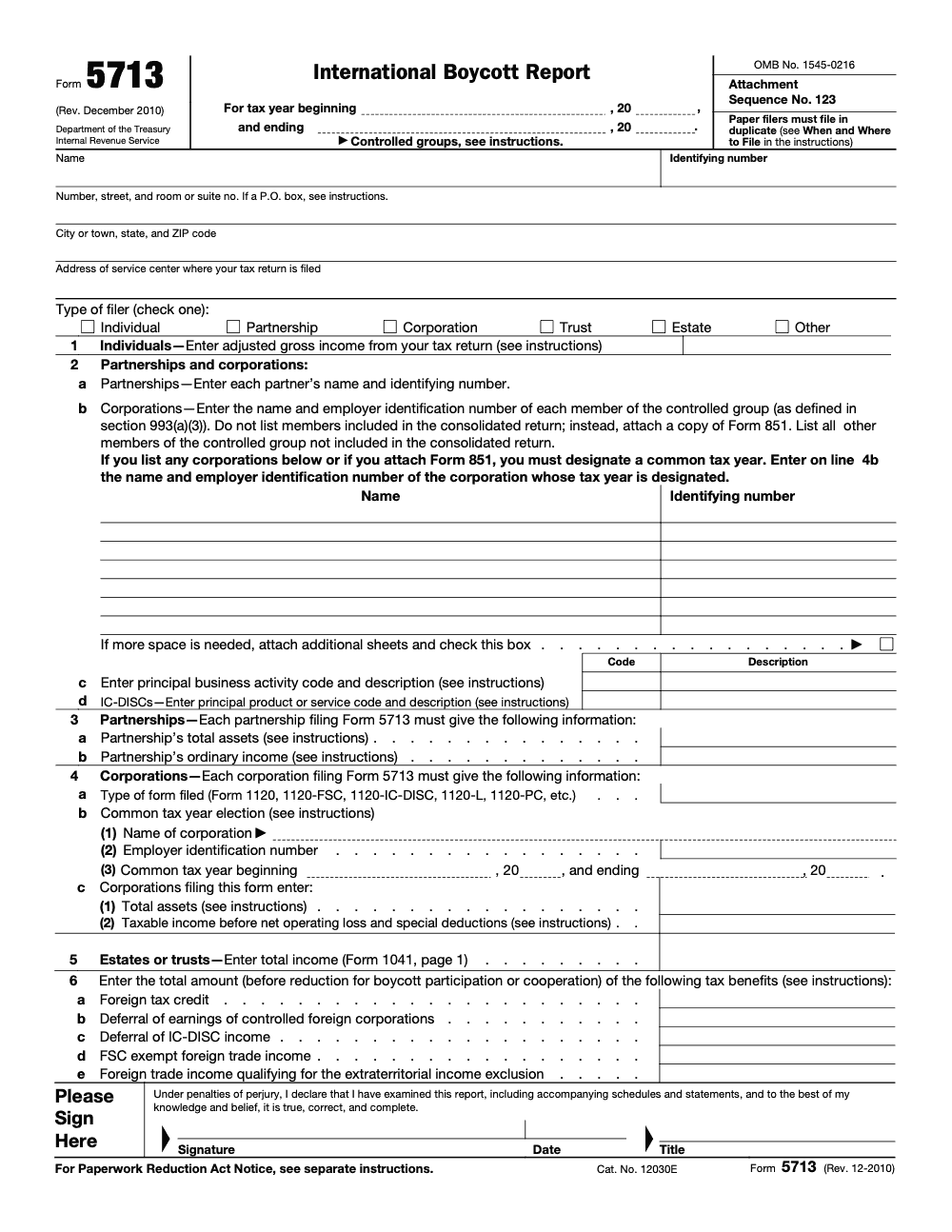
Form 5713 is the IRS International Boycott Report (December 2010 revision, OMB 1545-0216, Attachment Sequence 123) – still the current version for tax year 2025. Any U.S. person with operations in or related to a Treasury §999(a)(3) boycott-listed country, or in any nonlisted country known to require boycott cooperation, attaches it to their U.S. income tax return; a Yes on line 12 triggers either Schedules A+C or B+C, which reduce the foreign tax credit and other tax benefits on lines 6a through 6e under IRC §908.
Form 5713 is the form a controller forgets exists until a reviewer reads a clause in some old distribution agreement asking the other party to refrain from doing business with a listed country. Then a routine contract turns into a boycott-exposure review of every foreign agreement in the file. This is the IRS International Boycott Report, attached by any U.S. person with operations in or related to a Treasury boycott-listed country.
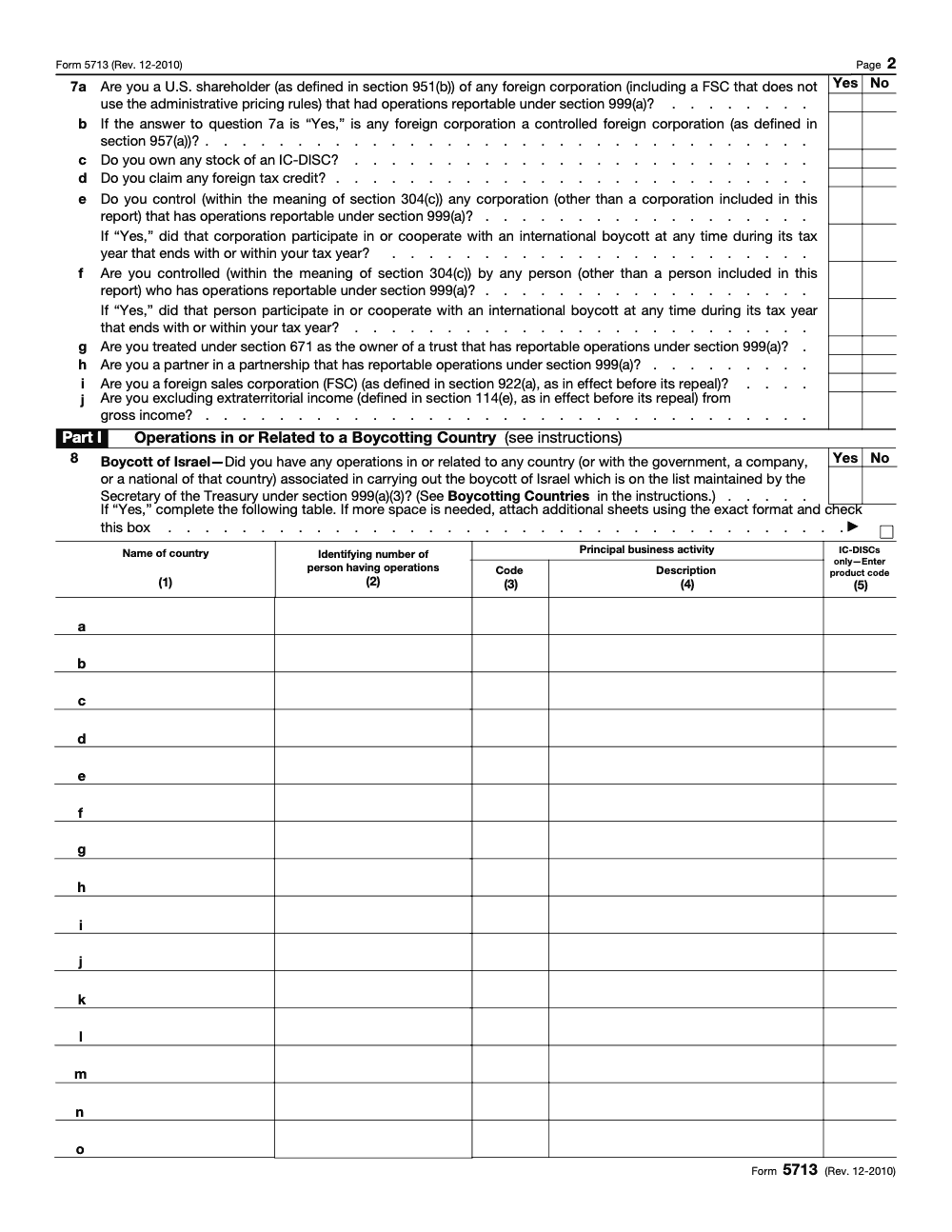
The list itself is published at least quarterly in the Federal Register under IRC §999(a)(3); as of the July 31, 2025 notice it included Iraq, Kuwait, Lebanon, Libya, Qatar, Saudi Arabia, Syria, and Yemen. The form is short and the December 2010 revision is still current for tax year 2025, but the answer on line 12 decides the work: a Yes triggers either Schedules A and C or Schedules B and C, and those reduce the foreign tax credit and other benefits on lines 6a through 6e.
Key Takeaways
- Form 5713 reports two things: (1) operations in or related to certain boycott-listed countries, and (2) boycott requests or agreements you received or responded to.
- The Treasury boycott list is published at least quarterly in the Federal Register under IRC §999(a)(3), so check the most recent notice. As of the most recent Treasury notice (July 31, 2025), the list includes Iraq, Kuwait, Lebanon, Libya, Qatar, Saudi Arabia, Syria, and Yemen.
- You generally attach Form 5713 to your timely filed U.S. income tax return, including extensions.
- If you participated in or cooperated with a boycott (Yes on line 12), you must complete either Schedules A and C or Schedules B and C – the two pairs are alternative computation methods, and at least one full pair is mandatory, not optional.
- The practical win is simple: tight documentation and clean workpapers reduce review cycles and keep this from turning into a deadline emergency.
Form 5713: What It Is (In Plain English)
Form 5713, the International Boycott Report, is how the IRS tracks whether a U.S. taxpayer has:
- Operations in or related to a country on the Treasury list of boycott countries, and/or
- Received a boycott-related request or entered into a boycott-related agreement.
If the rules apply and you participated or cooperated, Form 5713 can also trigger a reduction of certain tax benefits, most notably a reduction to your foreign tax credit, depending on your facts and calculations.
This is why Form 5713 tends to show up in returns where foreign operations exist, even if the business is not “political” and even if boycott language shows up as boilerplate contract terms.
The Boycott Country List (Current as of the Latest Treasury Notice)
The Treasury Department is required to publish a list of countries that “require or may require” participation in, or cooperation with, an international boycott for purposes of IRC §999.
As of the July 31, 2025 Federal Register notice, the list is: Iraq, Kuwait, Lebanon, Libya, Qatar, Saudi Arabia, Syria, and Yemen.
If you’re reading this later and you want the most current list, check Treasury’s most recent publication and the IRS Form 5713 resources page.
Who Must File Form 5713?
Here’s the simplest way to think about it.
You file Form 5713 for a tax year if you are a U.S. person and, during that year, you (or an entity you’re tied to under the rules) had:
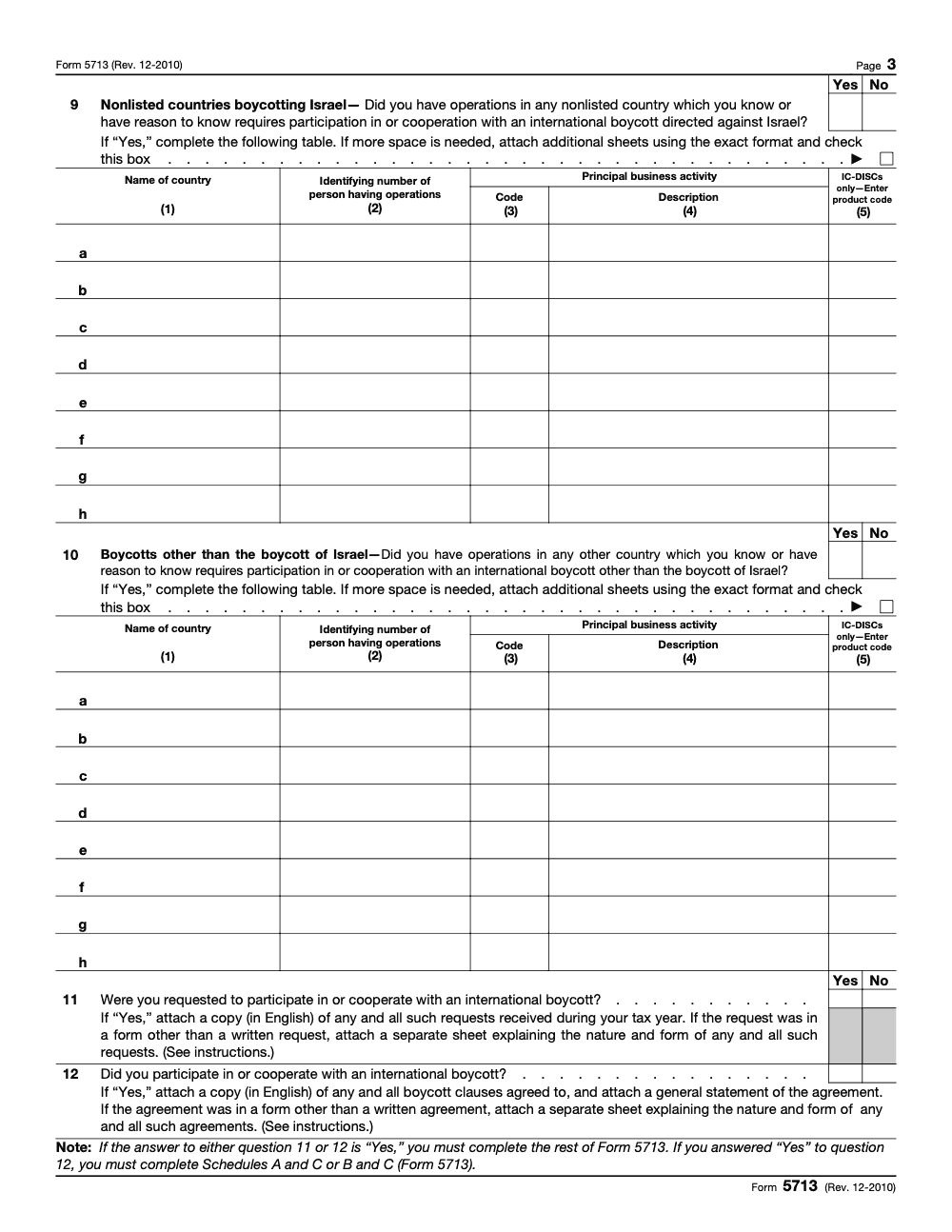
- Operations in or related to a boycott-listed country (or any nonlisted country where you know or have reason to know participation in a boycott is required – lines 9 and 10 sweep these in too), or
- A boycott request, or
- A boycott agreement (including agreements continuing from prior years).
The IRS describes Form 5713 as the form U.S. persons use to report operations in or related to boycotting countries and the receipt of boycott requests and boycott agreements made.
“Operations in or related to” is broader than it sounds
A common surprise is that “operations” is not limited to owning a subsidiary or having boots on the ground. It can include things like:
- buying goods from, selling goods into, or providing services tied to a listed country
- financing, leasing, licensing, shipping, or contracting tied to that country
- contract negotiations where the listed country relationship is part of the deal
If your team is dealing with international vendors, distributors, freight, or multi-entity structures, it’s worth setting a simple internal step: flag any contract clause referencing boycott compliance and route it to tax early.
Quick decision table, are you likely in scope?
| Situation | Form 5713 risk level | What to do next |
| You have sales, purchases, or services tied to a listed country | High | Pull contract files, vendor onboarding docs, and country-level support |
| You received a questionnaire or contract clause about doing business with Israel or “boycott compliance” | High | Save the exact request language, confirm whether you responded or agreed |
| You have foreign subs/partnerships and you’re not sure where they operate | Medium to high | Trace operations by entity, then confirm whether any ties exist to listed countries |
| You have no foreign ops, no foreign vendors, no foreign contracts | Low | Still confirm with procurement and legal if they’ve seen boycott clauses |
When Is Form 5713 Due?
In most cases, you file Form 5713 with your timely filed income tax return, including extensions.
That sounds simple, but the operational reality is where firms get tripped up: the form is only “easy” if you already have the facts, documents, and internal sign-off ready before the return goes to final review.
In my experience, the best time to identify Form 5713 exposure is not in April or September. It’s at the moment a contract, vendor form, or customer requirement introduces boycott language. Catch it then, and the return prep becomes routine.
What You Actually Report on Form 5713 (Parts I and II)
Form 5713 is split into two practical questions:
- Where do you operate (or have ties) that fall under the boycott rules?
- Did anyone ask you to cooperate with a boycott, and what did you do about it?
Part I, report operations in boycott-listed countries
Part I is where you disclose operations “in or related to” the listed boycott countries. The key is clean, consistent reporting by country and by the relevant person or entity.
To make Part I painless, build your support like this:
- Country-level summary (one tab per listed country you touched)
- Activity type (sales, purchases, services, financing, shipping, etc.)
- Counterparty details (who you dealt with and what role they played)
- Source documents (contracts, invoices, shipping docs, onboarding questionnaires)
If you’re a reviewer, this is the moment to push for workpapers that tell a story. A messy stack of PDFs creates slow review loops and rework.
What counts as an “operation”?
Think broad. If your business activity touches the listed country, it can be reportable. In real life, that includes:
- a distributor agreement tied to Saudi Arabia
- a procurement contract with a Kuwaiti vendor
- services provided “in relation to” a Qatari project
- shipping routes and logistics tied to a listed jurisdiction
The form is not asking whether the operation was profitable. It’s asking whether the operation existed and whether it connects to the boycott rules.
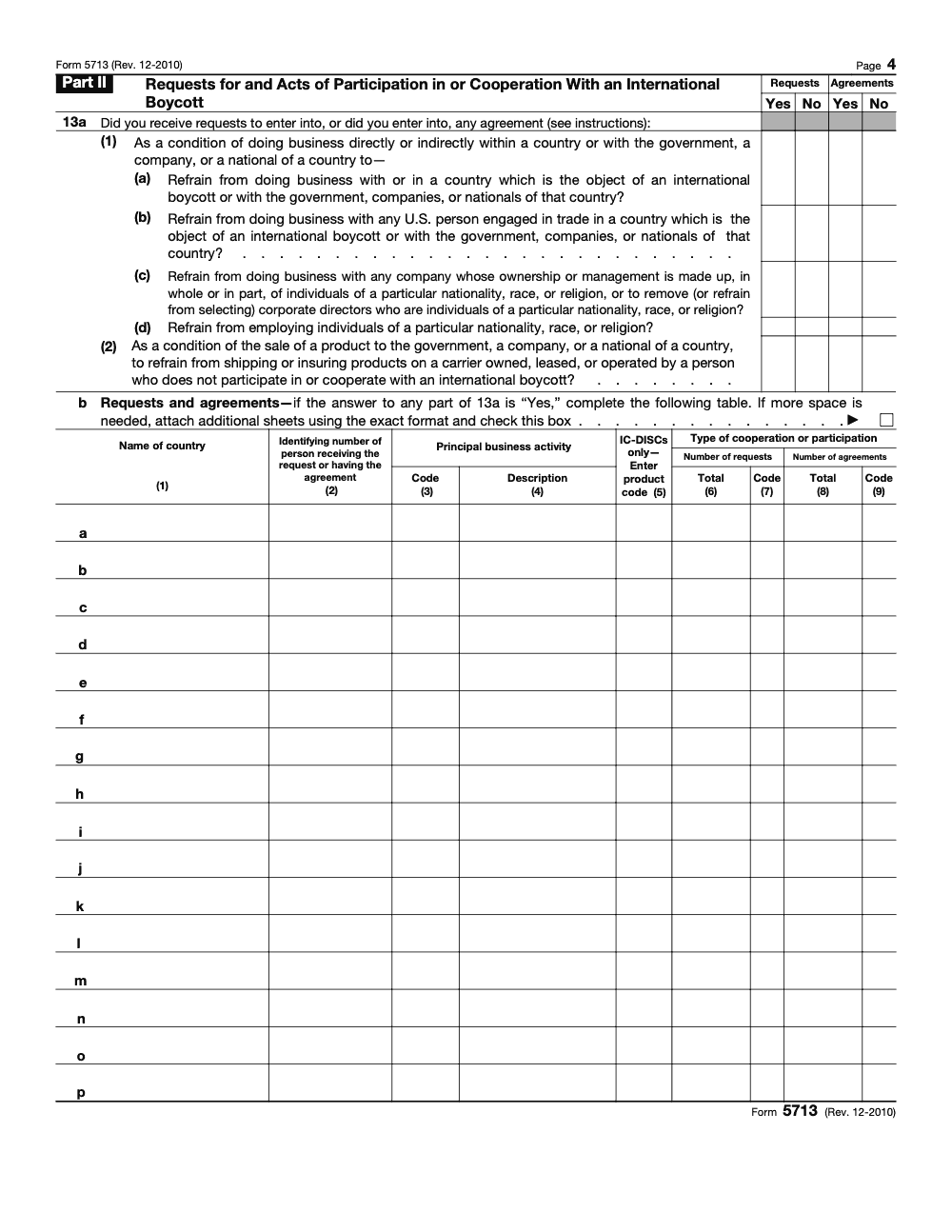
Part II, report boycott requests and your response
Part II is where firms can get uncomfortable, because it forces clarity: Did you receive a boycott request and did you comply, agree, or refuse? Note: a Yes on line 11 alone – simply receiving a request, even if you refused it – still triggers the obligation to complete the rest of Form 5713.
The IRS expects you to disclose boycott requests and boycott agreements made.
Operationally, you want to capture:
- who made the request
- when you received it
- how it was made (contract clause, vendor questionnaire, bid requirement)
- what you did (agreed, complied, partially complied, or refused)
- the evidence (copies of clauses, emails, questionnaires)
Documentation tip that saves partner time
If you only do one thing, do this: create a single PDF packet per request that includes:
- the request language
- your response language
- who approved the response internally
- the related contract page numbers
That packet becomes your audit-ready support and it also speeds review, because the reviewer is not hunting through 60 pages of unrelated contract text.
Schedules A, B, and C (Where the Tax Impact Gets Calculated)
Once Form 5713 moves from “what happened” to “what does it do to our taxes,” you’re typically looking at:
- Schedule A (International Boycott Factor), or
- Schedule B (Specifically Attributable Taxes and Income), plus
- Schedule C, which computes the tax effect and reductions.
The IRS Form 5713 resources page lists Schedule A, Schedule B, and Schedule C and explains their general purpose and when each is used.
Schedule A vs Schedule B, which one fits?
Here’s a practical comparison you can use in planning meetings.
| Schedule | Best when | Upside | Tradeoff |
| Schedule A (IBF method) | You need a standardized method and you can support the factor inputs | More straightforward process | Can feel “blunt,” may reduce benefits based on a broader factor |
| Schedule B (Specific identification) | You can clearly tie taxes/income to boycott operations | More precise when records are strong | More record-heavy, harder review, more time to support allocations |
Schedule C is where reductions show up
Schedule C is used to compute the loss of tax benefits attributable to boycott participation or cooperation.
This is the schedule that, in practice, can flow into the foreign tax credit computation. IRS guidance for Form 1118 specifically calls out that if a corporation participates in or cooperates with an international boycott, the foreign tax credit may be reduced and Form 5713 is used in that process.
Deadlines, Penalties, and the Real Risk
Yes, missing forms can trigger penalties, but the bigger issue most teams feel is this:
- FTC reductions show up late in the process
- partner review time spikes
- you end up doing “rebuild work” under deadline pressure
- the client experiences it as uncertainty, not expertise
So treat Form 5713 like a workflow problem, not like a form problem.
If your process depends on someone remembering a boycott clause at year-end, you don’t have a process, you have hope.
Step-by-Step, How to File Form 5713 Without the Chaos
If you want Form 5713 to run smoothly, you need two tracks running at the same time:
- Tax technical track (what applies, what schedules are needed)
- Ops track (who gathers what, how it’s documented, when it’s reviewed)
Here’s a step-by-step approach that works in the real world.
Step 1, confirm you have a filing trigger
Start with a quick “trigger check” call or checklist:
- Did you have any operations in or related to a listed boycott country?
- Did you receive any boycott-related request or clause in a contract, questionnaire, or bid?
- Do you have foreign entities, partnerships, or group members that might have had those operations?
If the answer is “maybe,” treat it as “yes until proven otherwise” and start gathering support. You can always document that the clause was received but not agreed, or that an operation was not reportable, but you cannot invent documentation at the end.
Step 2, collect support the way a reviewer wants to see it
This is where most teams lose time. The goal is not “collect documents.” The goal is “collect documents that answer reviewer questions quickly.”
Use this support structure:
- Operations workpaper (Part I support)
- country-by-country rollup
- list of counterparties
- description of activity type
- cross-reference to contracts/invoices/shipping docs
- Request workpaper (Part II support)
- a log of each request with date, requester, and action taken
- a PDF packet per request (request language + response + approval + contract pages)
- Method selection memo
- why Schedule A or Schedule B is being used this year
- note consistency requirements if applicable
Step 3, complete Part I (Operations)
Complete Part I using your operations workpaper so the form ties neatly to your support. If you have multiple operations in one listed country, you’ll usually want one clean line item that rolls up the activity, backed by the detail in your workpaper.
Keep your labels consistent. If your workpaper says “KSA Vendor Purchases,” your return package should not label it “Saudi miscellaneous.” Consistency is what reduces review notes.
Step 4, complete Part II (Requests and responses)
For each request:
- describe what the request asked for
- state whether you agreed, complied, or refused
- attach or retain the supporting documents as required
If you have many requests, teams often provide representative samples with a summary. The point is that the IRS wants transparency and you want defensible support if questions come later.
Step 5, pick Schedule A or Schedule B and complete Schedule C
This is where you quantify the impact.
- If you use Schedule A, you’re computing the International Boycott Factor approach.
- If you use Schedule B, you’re doing specific attribution of taxes and income.
- Either way, Schedule C computes the tax effect.
If you’re in a corporate FTC world, keep an eye on how Schedule C amounts tie back to Form 1118. The IRS Form 1118 instructions explicitly connect the boycott reduction to Schedule C (Form 5713).
How Form 5713 Can Reduce Your Foreign Tax Credit (FTC)
This is the consequence most people care about, because it is tangible.
When boycott participation or cooperation exists, IRC §908 can reduce tax benefits. In practice, the FTC reduction is often the headline item, because it changes what you can claim as a credit on the U.S. return.
The IRS notes that Schedule C is used to compute the loss of tax benefits attributable to participation in or cooperation with an international boycott.
FTC impact, what to watch for
From a planning perspective, these are the moments when FTC issues flare up:
- the client expects a full FTC, but the boycott schedules reduce it
- the reduction appears late because the boycott question was not raised early
- the team cannot support the method or calculations cleanly, so review drags
The fix is boring but effective: ask the boycott questions early and build a tight paper trail.
How to Make Form 5713 Easier Next Year (Process Improvements That Actually Stick)
If you run a tax team, you already know this truth: you can’t scale compliance work on memory and heroics.
Here are lightweight operational changes that reduce Form 5713 pain without adding a ton of overhead:
- Add a “boycott clause” flag to contract review If legal or procurement sees boycott language, it gets routed to tax.
- Create a standing “Form 5713 log” One shared tracker beats 40 scattered email threads.
- Standardize file naming for support Example: 5713_Request_YYYY-MM-DD_Requester_Action.pdf
- Build a review-ready packet during the year Don’t wait for year-end. Each time a request shows up, package it immediately.
This is exactly the kind of delivery discipline many accounting firms struggle with during growth. When work expands, review time becomes the bottleneck, and documentation gaps are what turn a manageable filing into a fire drill.
Where Accountably Fits (Only If You’re Trying to Scale Delivery)
If your firm is handling more international work, more entity complexity, and tighter deadlines, Form 5713 is a great example of what breaks first: workpaper quality, documentation consistency, and review bandwidth.
At Accountably, the core focus is not “throw more people at it.” It’s building a delivery system where the prep and support work is standardized, review-friendly, and predictable. That matters for technical forms like 5713, because the form itself is not the hard part, the hard part is getting the right support, in the right structure, on time.
If you’re already staffed and your process is clean, you may not need any outside help. If you’re feeling the strain, support teams that can follow your SOPs, naming conventions, and documentation standards can remove pressure without sacrificing control.
Conclusion
Form 5713 is not a “random extra form.” It’s the IRS’s way of tracking boycott-related operations and requests, and it can carry real tax consequences, including foreign tax credit reductions.
If you want this to feel manageable, focus on two things:
- Spot triggers early (operations tied to listed countries, boycott clauses, and requests).
- Build clean support (country rollups, request packets, and consistent workpapers).
When your documentation is tight, Form 5713 becomes routine. When it’s scattered, it becomes a review bottleneck, and review bottlenecks are where deadlines and margins go to die.
Common Mistakes We See Every Season
Form 5713 reviews fall into the same five or six patterns every season. The form is short enough that filers treat it as boilerplate; the schedule math underneath is what bites.
Reusable Checklists
These checklists are copy-paste ready for firm SOPs. Each step maps to a specific line, schedule, or attachment requirement on Form 5713 so the staff preparer can work them without the senior reviewer having to interpret the form instructions from scratch.
Boycott exposure scan (engagement onboarding)
- Pull every foreign distribution, agency, supply, and licensing contract executed or renewed during the tax year.
- Flag any clause asking the counterparty to refrain from doing business with a specific country, U.S. persons trading there, or persons of a named nationality, race, or religion.
- Map flagged clauses to one of the five line 13a categories: (1)(a) country boycott, (1)(b) U.S. persons trading there, (1)(c) ownership or management nationality, (1)(d) employment by nationality, race, or religion, or (2) carrier restrictions.
- Cross-reference each foreign country in the contract file against the most recent Treasury IRC §999(a)(3) Federal Register notice.
- For nonlisted countries with material operations, document the reason-to-know analysis in a workpaper memo (drives lines 9 and 10).
- Tag every flagged contract with the controlled-group member that signed it and the parent entity for line 2b reporting.
- Confirm whether the filer is a U.S. shareholder of any CFC under IRC §957(a) (drives lines 7a and 7b) and flag any IC-DISC ownership for line 7c.
- Flag any pre-repeal FSC exposure under IRC §922(a) for line 7i and any extraterritorial income exclusion under IRC §114(e) for line 7j.
Schedule method and line 6 baseline lock
- If line 12 is Yes, pick the schedule method BEFORE preparing the workpaper: Schedules A and C (international boycott factor method) or Schedules B and C (specifically attributable taxes and income method).
- Document the method-selection rationale in a one-paragraph memo so the reviewer does not need to re-derive it.
- Pull line 6a (foreign tax credit) from the pre-reduction FTC computation, never from the IRC §908 reduced amount.
- Pull line 6b (CFC deferral of earnings) from the CFC workpaper before applying any boycott-related Subpart F inclusion under IRC §952(a)(3).
- Pull line 6c (IC-DISC income deferral), line 6d (FSC exempt foreign trade income), and line 6e (extraterritorial income exclusion) from their respective pre-reduction baselines.
- Tie Schedule C totals back to the Form 1118 foreign tax credit workpaper for any corporate filer claiming the FTC.
- Confirm the common tax year on line 4b is the tax year used for every controlled-group member listed on line 2b.
Line 11 and 12 attachment packet
- For every line 11 Yes, attach an English-language copy of the actual boycott request received during the tax year.
- For oral requests, attach a separate sheet describing the form and nature of each request, including the date and counterparty.
- For every line 12 Yes, attach English-language copies of every boycott clause agreed to plus a general statement of the agreement.
- For oral agreements, attach a separate sheet describing the form and nature of each agreement.
- Confirm any supplemental sheets used for line 8, 9, 10, or 13b overflow follow the exact column format of the form table and that the relevant box on the printed form is checked.
- For paper filing, prepare two complete copies of Form 5713 with all attachments and confirm the service-center address on the form matches the service center where the related income tax return is filed.
- Confirm the form is signed under penalties of perjury, with date and title, before the related return is mailed or e-filed (an unsigned Form 5713 is treated as not filed).
Keep 5713 Season From Stalling
Form 5713 lives at the seam between the international tax workflow and the boycott-reporting regime, and that seam pulls tight every time Treasury republishes the boycott-country list in the Federal Register (per IRC §999(a)(3), at least quarterly). Recent notices have included Iraq, Kuwait, Lebanon, Libya, Qatar, Saudi Arabia, Syria, and Yemen, but the reason-to-know standard for nonlisted countries (lines 9 and 10) widens the net well past those eight names.
Most delays do not come from the form itself; they come from late-stage discovery. A controller realizes in week 12 of an 1120 review that a foreign distribution agreement carries a boycott clause, or that the line 7c IC-DISC question was answered without anyone reading the underlying ledger. The fix is to push the boycott-exposure check upstream and treat Form 5713 as a workpaper-driven attachment, not a fire-drill afterthought.
- Run a boycott-clause scan on every foreign distribution, agency, or supply contract during onboarding and at each renewal, flagging anything that maps to one of the five line 13a categories before tax season opens.
- Lock the line 6a through 6e baselines (FTC, CFC deferral of earnings, IC-DISC income deferral, FSC exempt foreign trade income, extraterritorial income exclusion) BEFORE any section 908 reduction; reporting post-reduction numbers on line 6 corrupts the schedule math downstream.
- Reconcile line 2b corporation listings against the Form 851 affiliations schedule for any consolidated return so that controlled-group members under section 993(a)(3) are not double-listed and the common tax year on line 4b ties out.
- Pre-decide the schedule path on every line 12 Yes filer: Schedules A and C run the international boycott factor method, Schedules B and C run the specifically attributable taxes and income method, and switching mid-review forces a full rebuild.
- Keep an English-language request file open year-round; for a line 11 Yes the IRS expects either a copy of the actual request or a sheet describing the form and nature of each oral request, not a paraphrased summary.
This is the kind of attachment-level discipline that stops Form 5713 from becoming the last hold on an otherwise-ready return. The structured workflow our U.S. tax delivery teams run on international engagements builds the boycott-exposure check into the standard prep packet, so the form gets staged on day one of the engagement rather than the night before the deadline.
FAQs
Form 5713 is used to report operations in or related to boycott-listed countries, plus the receipt of boycott requests and boycott agreements. If you participated in or cooperated with a boycott, it can also be tied to reductions of certain tax benefits under IRC §908.
As of the most recent Treasury publication in the Federal Register (July 31, 2025), the list includes Iraq, Kuwait, Lebanon, Libya, Qatar, Saudi Arabia, Syria, and Yemen. Because the list is published periodically, confirm the latest list for the year you are filing.
Form 5713 is generally filed with your timely filed U.S. income tax return, including extensions. That means your deadline is usually your return deadline, but your internal documentation work should start earlier.
Schedule A uses the International Boycott Factor method, while Schedule B uses the specifically attributable taxes and income method. Both methods connect to Schedule C, which computes the tax effect.
If boycott participation or cooperation applies, the foreign tax credit can be reduced, and corporations may use amounts computed on Schedule C (Form 5713) in connection with Form 1118 reporting. The practical takeaway is that you want to identify boycott exposure early so you can model the impact before filing.
Form numbers get mixed up all the time, especially in international compliance. For boycott reporting, the relevant form is Form 5713, and the IRS maintains a dedicated page for it, including related schedules and instructions.
Form 5713 Guide family
- Form 5713 Schedule A: International Boycott Factor Guide
- Form 5713 Schedule B: Specific Attribution Guide
- Form 5713 Schedule C: Compute Boycott Tax Effects | Accountably
Other forms this guide names
Summarize this article with AI
About this guide
Accountably helps US CPA, EA, and accounting firms hire trained accountants and tax preparers in India.
About us Reviewed byJugal Thacker, CPAFounder and CEO at Accountably
A US-licensed CPA with 7+ years inside US firms – PwC, a real-estate tax practice, then a full-service firm, rising from reviewer to manager to advisory. This article was reviewed against current IRS guidance for the 2025 tax year and updated for filers preparing late returns, amendments, and 2026 estimates.
View profile →How we research, review, and update this guide
Every Accountably guide is researched against primary IRS sources, reviewed by a U.S. CPA, and refreshed as guidance evolves. Read our Editorial Guidelines to see how we source, fact-check, and update our content.