Summarize this article with AI
In Brief
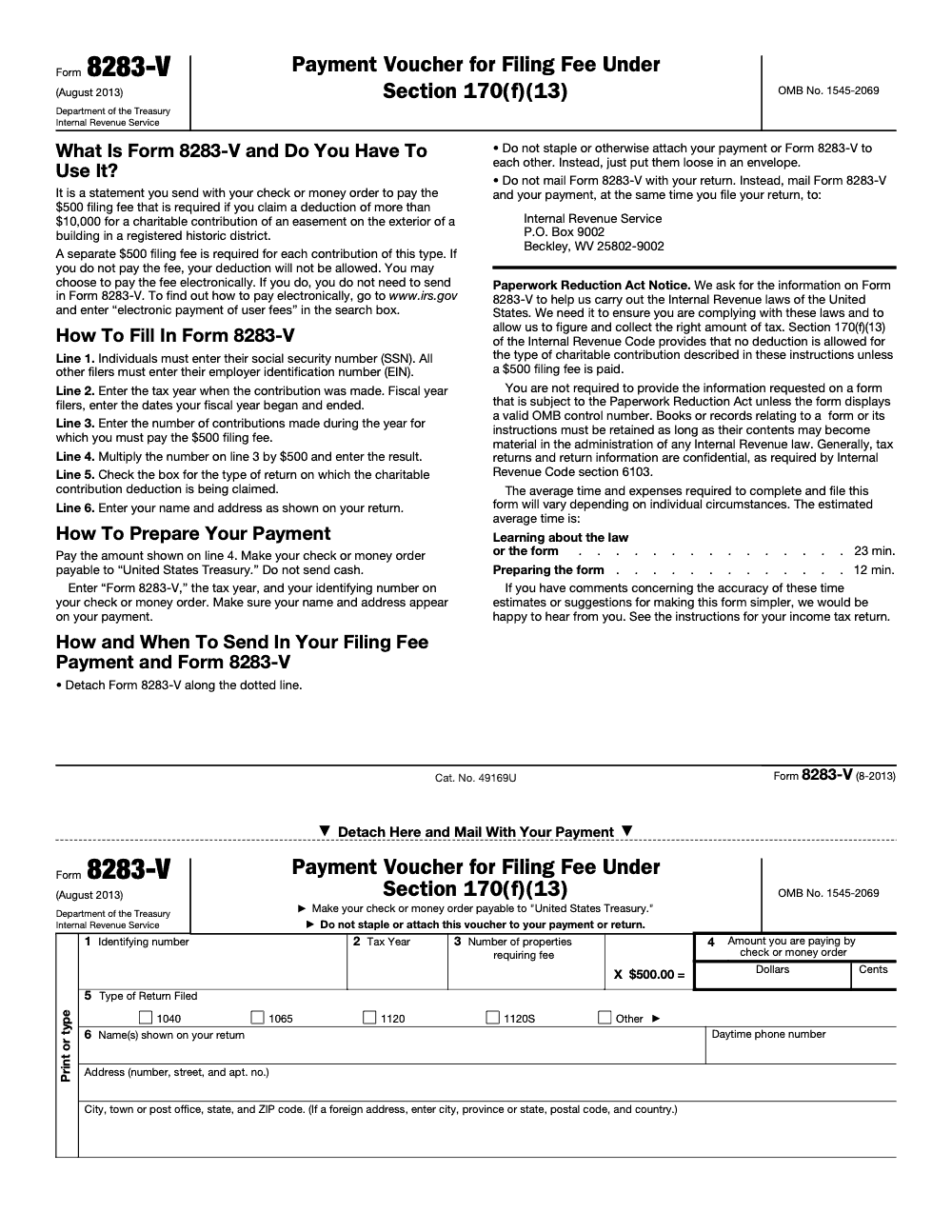
Form 8283-V is the payment voucher for the $500 filing fee under IRC §170(f)(13) – it is required only when you claim a charitable contribution deduction of more than $10,000 for an easement on the exterior of a building in a registered historic district. The fee is $500 per qualifying contribution (Line 3 × $500 on Line 4), payable to United States Treasury, mailed to P.O. Box 9002, Beckley, WV 25802-9002, and it does not replace Form 8283 itself (per IRS Form 8283-V instructions, Rev. August 2013).
A donor hands you a signed easement deed, a qualified appraisal, and the exterior photos, and assumes the deduction is locked in. The piece they almost never mention is the $500 filing fee, and that fee has its own voucher that does not travel inside the same envelope as the return.
Form 8283-V is that voucher. It applies only when the charitable contribution deduction tops $10,000 for an easement on the exterior of a building in a registered historic district, the payment goes to the United States Treasury by check or money order, and it mails to P.O. Box 9002, Beckley, WV 25802-9002 rather than to wherever the return goes. Getting the fee right is what keeps the deduction from being challenged on a technicality.
Key Takeaways
- Form 8283-V is a payment voucher, used to send the $500 filing fee required for certain historic preservation easement deductions under IRC §170(f)(13).
- The voucher applies when you claim a deduction of more than $10,000 for a charitable contribution of an easement on the exterior of a building in a registered historic district.
- It’s $500 per qualifying contribution. Multiple properties mean multiple fees.
- You pay by check or money order payable to “United States Treasury”, and you must include identifying info on the payment.
- You do not mail Form 8283-V with your return. You mail it at the same time you file your return, but to a separate IRS address listed on the voucher.
- For these donations, you also need strong documentation like a qualified appraisal, exterior photos, and a clear description of restrictions.
What Form 8283-V Is (and What It’s Not)
Form 8283-V is the IRS “Payment Voucher for Filing Fee Under Section 170(f)(13)”. In plain terms, it’s the slip you include when you send the mandatory $500 filing fee tied to certain historic preservation easement deductions.
What it is:
- A payment voucher that helps the IRS match your fee to your tax year and identifying number.
- A requirement when you claim a qualifying deduction over $10,000 for an easement contribution described on the voucher.
What it isn’t:
- It is not Form 8283.
- It does not replace appraisals, photos, easement deeds, or signatures.
- It is not something you staple to your return or tuck behind your 1040 and hope for the best.
If you’ve heard, “It’s just a check,” this is the missing piece. The IRS wants the check, and it wants the voucher that tells them what the check is for.
Who Needs to File Form 8283-V?
You use Form 8283-V when you claim a deduction of more than $10,000 for a charitable contribution of an easement on the exterior of a building in a registered historic district.
If you’re reading this because you donated furniture, stock, crypto, or even land, pause. Form 8283-V is not a general “noncash contribution fee.” It’s tied to a specific category of historic preservation easement contributions and the §170(f)(13) filing fee.
The “more than $10,000” trigger
The fee is triggered when the claimed donation exceeds $10,000. A deduction of exactly $10,000 does not trigger the fee – the statutory language is more than $10,000, not $10,000 or more. Publication 561 repeats that requirement and notes that the deduction will generally be disallowed if you don’t comply with the $500 fee and Form 8283-V requirement.
One contribution, one fee
The voucher itself states clearly that a separate $500 filing fee is required for each contribution of this type.
That means if you have two qualifying easement contributions, you’re not sending one $1,000 check and one voucher. You’re treating them as distinct fee events.
How Form 8283-V Relates to Form 8283
Here’s the clean way to think about it:
- Form 8283 is where you report noncash charitable contribution details.
- Form 8283-V is how you transmit the $500 filing fee required for certain historic exterior easements over $10,000.
They work together, but they don’t travel together in the mail.
Quick fee math (so you don’t overthink it)
| Number of qualifying easement contributions | Filing fee per contribution | Total fee |
| 1 | $500 | $500 |
| 2 | $500 | $1,000 |
| 3 | $500 | $1,500 |
And yes, the IRS cares about the mechanics here. The voucher instructs you not to staple or attach the voucher to your payment or return.
Next, we’ll go step-by-step through how to complete Form 8283-V, exactly how to prepare the check or money order, and where to mail everything so it actually lands where it’s supposed to.
How to Complete Form 8283-V (Line by Line)
Form 8283-V is short, but every line is there for a reason. The IRS uses it to match your payment to the correct filer and tax year.
Line 1, Identifying number
- If you’re an individual, enter your SSN.
- If you’re not an individual (corporation, partnership, etc.), enter your EIN. One catch: if you operate as a sole proprietor filing Schedule C, you still use your SSN here, because the donor is the individual filer, not the business.
Line 2, Tax year
Enter the tax year when the contribution was made. If you’re a fiscal year filer, the voucher instructs you to enter your fiscal year begin and end dates.
Line 3, Number of properties requiring fee
This is where people trip. The voucher asks for the number of contributions made during the year that require the $500 fee.
If you’re dealing with multiple qualifying properties, slow down and make sure the count matches the contributions that fall under §170(f)(13).
Line 4, Total amount you are paying
Multiply the number on Line 3 by $500 and enter the result.
Line 5, Type of return filed
Check the box that matches the return where the charitable deduction is being claimed (1040, 1065, 1120, 1120S, or “Other”).
Line 6, Name and address
Enter your name and address exactly as shown on the return.
That’s it for the form. Now the key part, paying correctly.
Paying the $500 Fee (Check or Money Order)
The voucher instructions say to pay the amount shown on Line 4 and make your check or money order payable to “United States Treasury.” The form also says do not send cash. Do not write the check to IRS or Internal Revenue Service either – that wording can cause processing delays or rejection, and United States Treasury is the only valid payee.
What to write on the check or money order
The IRS tells you to include:
- “Form 8283-V”
- the tax year
- your identifying number (SSN/EIN)
on the check or money order.
Also make sure your name and address appear on your payment.
If you want a simple “mailroom-proof” memo line, use something like:
- Form 8283-V, TY2025, SSN xxx-xx-xxxx
(Use the actual tax year you’re filing.)
Do not combine or staple
The voucher is very specific:
- Do not staple or otherwise attach your payment and Form 8283-V to each other.
- Put them loose in the envelope.
That might feel picky, but this is one of those IRS processing details that can save you weeks of confusion later.
Where to Mail Form 8283-V (and When)
This is the part people get wrong because it feels backwards.
The voucher says:
- Do not mail Form 8283-V with your return.
- Instead, mail Form 8283-V and your payment at the same time you file your return to the address on the voucher.
As of the current IRS PDF for Form 8283-V (Rev. August 2013), the mailing address is:
Internal Revenue Service P.O. Box 9002 Beckley, WV 25802-9002
Timing tip that prevents panic
Mail it early enough that it’s moving through the system when you file. If you’re a tax preparer, build this into your client checklist so it doesn’t become a last-day scramble.
Use tracking, keep proof
The IRS doesn’t require certified mail here, but in real life, having proof of mailing is a stress reducer. Keep:
- a copy of the completed voucher
- a copy of the front of the check (or the money order receipt)
- your shipping receipt and tracking number
Can You Pay Electronically Instead?
Yes, the voucher notes that you may choose to pay the fee electronically and that if you pay electronically, you do not need to send in Form 8283-V. It directs you to IRS.gov and to search for “electronic payment of user fees.”
If you go this route, print the confirmation and keep it with your tax file.
Next, we’ll get into the documentation that supports the deduction, including appraisal timing, required attachments for historic district buildings, and the “public access” expectations that come up with certified historic structures and historic land areas.
Documents and Appraisals You Need (So the Deduction Holds Up)
Form 8283-V is only the fee voucher. The bigger risk is the deduction itself. Historic easement contributions are heavily documented, and the IRS expects a complete package.
Publication 561 lays out specific items you must include with your return for an easement donation tied to a historic building, including a signed qualified appraisal, photographs of the entire exterior, and a description of restrictions such as zoning laws and restrictive covenants. It also notes that if the claimed donation exceeds $10,000, you must include the $500 filing fee and Form 8283-V.
Qualified appraisal timing (the 60-day rule)
A qualified appraisal must be signed and dated no earlier than 60 days before the date of the contribution and no later than the due date (including extensions) of the return where the deduction is first claimed.
That 60-day window is one of those rules that sounds simple until you’re juggling closing dates, deed recording, and appraiser schedules. Put it on your calendar early.
What you typically attach for historic district buildings
The IRS instructions for Form 8283 say you cannot claim a deduction for an exterior restriction on a historic district building unless the restriction preserves the entire exterior including front, sides, rear, and height. The instructions also say you must include with your return:
- a signed copy of a qualified appraisal
- photographs of the entire exterior
- a description of all restrictions on the development of the building, and you can do this by attaching a copy of the easement deed
Publication 561 adds that the National Park Service project number (NPS #) may apply in certain certified historic structure situations.
Do not forget the Form 8283 signatures
For many deductions above $5,000, you’re in Form 8283, Section B territory, which generally means:
- the donor statement
- the appraiser declaration
- the donee acknowledgment
The IRS instructions emphasize that the donee organization must complete and sign the Donee Acknowledgment in Part V, with limited exceptions.
Proof of Public Benefit and Visual Access (Why Photos Matter)
If your contribution is a qualified conservation contribution tied to preserving a historically important land area or a certified historic structure, public benefit is part of the story.
Treasury regulations explain that some visual public access is required for a conservation contribution of this type to be deductible. If the property is not visible from a public way (for example, it’s hidden behind a wall or it’s too far back), the easement terms must provide the public a regular opportunity to view the preserved features, consistent with the nature and condition of the property.
That’s why your documentation file often includes:
- time-stamped exterior photos from multiple angles
- the recorded easement deed (showing what’s restricted)
- local historic district or National Register documentation, if relevant
- any public access plan or schedule if visibility from a public way is limited
This is not busywork. It’s how you show the IRS that the “preservation” claim is real and supported by the terms of the easement.
Filing Multiple Properties (How to Stay Organized)
If you have multiple qualifying contributions in one year, your risk isn’t just math. It’s mismatching documents.
Here’s a practical way to keep things clean:
- Assign each property an internal label (Property A, Property B).
- Build one folder per property with:
- appraisal
- photos
- deed and restriction description
- Form 8283 support
- Cut one check (or money order) per contribution as required.
- Prepare the Form 8283-V voucher count carefully, or use separate voucher packages if that’s how your tax team manages it.
Even if you’re a taxpayer handling your own filing, treat this like a mini audit file. Future you will be grateful.
Top 7 Errors That Delay Processing (or Put the Deduction at Risk)
You can avoid most problems by watching for these:
- Mailing Form 8283-V with the tax return instead of separately, the voucher says not to do that.
- Forgetting the payee, the check must be payable to “United States Treasury.”
- Sending cash, the voucher explicitly says not to.
- Not writing identifying info on the payment, the IRS asks for Form 8283-V, tax year, and identifying number on the check or money order.
- Missing appraisal timing, especially violating the 60-day rule.
- Incomplete photo set, the IRS expects photos of the entire exterior for historic district building exterior restrictions.
- Weak restriction description, the IRS expects a description of restrictions and notes you can attach the easement deed.
Where to Get Form 8283-V (and Why “Current Instructions” Still Matters)
Even though the IRS Form 8283-V PDF currently available is labeled “(August 2013)”, it’s still hosted on IRS.gov and includes the mailing address and handling instructions you’re expected to follow.
To get it, use the IRS forms library and download Form 8283-V, Payment Voucher for Filing Fee Under Section 170(f)(13).
Why you should check before you mail
IRS addresses and processing instructions can change over time. The safest habit is checking the IRS-hosted PDF the same day you mail the payment, then saving that PDF to your workpapers.
If you’re a tax pro, build that into your firm SOP, “download fresh, save to file, then mail.”
A Practical Workflow Note for Tax Teams (and Why Delivery Breaks Here)
This is the unsexy part of compliance work, and it’s also where teams lose hours.
A Form 8283-V package isn’t hard, but it’s easy to mishandle because it sits between roles:
- the person assembling the return
- the person chasing the appraisal and donee signature
- the person handling payments
- the reviewer signing off
When those handoffs are informal, you see missed steps like “voucher mailed with return” or “check sent, but memo line blank,” and now you’re stuck doing cleanup when everyone is already overloaded.
This is exactly the kind of repeatable, checklist-driven delivery work that we care about at Accountably, especially for firms trying to scale compliance without turning partner review into a bottleneck. The goal is simple, your team should be able to run a “historic easement package” the same way every time, with the same naming, the same evidence, and the same mailing steps.
Final Checklist: Before You File (and Before You Mail the Fee)
If you want the simplest way to avoid mistakes, use this checklist. It’s written so a taxpayer can follow it, and it’s also clean enough to drop into a firm SOP.
Form 8283-V and payment checklist
- Confirm your contribution is the type that triggers the voucher requirement, generally a deduction of more than $10,000 for an easement on the exterior of a building in a registered historic district.
- Complete Form 8283-V with:
- SSN/EIN, tax year, number of contributions requiring the fee, and total fee calculation.
- Prepare a check or money order payable to United States Treasury.
- Write on the payment:
- “Form 8283-V,” tax year, and your identifying number.
- Do not staple or attach the voucher to the payment, keep them loose in the envelope.
- Do not mail Form 8283-V with your return, mail it separately at the same time you file your return.
- Mail to the address shown on the IRS voucher:
- Internal Revenue Service, P.O. Box 9002, Beckley, WV 25802-9002.
- Save proof:
- copy of voucher, copy of check, and mailing proof.
Documentation checklist (the deduction support file)
For historic district building exterior restrictions, the IRS instructions require you to include:
- A signed copy of a qualified appraisal.
- Photographs of the entire exterior of the building.
- A description of restrictions on development, often satisfied by attaching the easement deed.
And for conservation contributions related to historically important land areas or certified historic structures, be mindful that Treasury regulations discuss visual public access expectations.
Conclusion
Form 8283-V is simple on paper, but it’s not optional when it applies.
If you’re claiming a deduction of more than $10,000 for the type of historic exterior easement contribution described on the voucher, the IRS expects two things to happen correctly:
- Your return includes the right documentation (Form 8283, appraisal, photos, restriction description), and
- Your $500 fee is paid and submitted the way the voucher requires.
Treat this like a process, not a one-off task. When you do, you protect the deduction, reduce IRS follow-up risk, and save your team from last-minute cleanup.
Common Mistakes We See Every Season
Most Form 8283-V problems are not deduction mistakes, they are procedural mistakes that turn a valid contribution into a denied one. The patterns below repeat every season on returns I review.
Reusable Checklists
These checklists are written to be copy-pasted into your firm SOPs. They cover the three places Form 8283-V engagements break: intake, payment, and the final mail packet.
Historic easement intake packet
- Confirm the easement is on the exterior of a building in a registered historic district under §170(h)(4)(C)(ii).
- Confirm the claimed deduction exceeds $10,000 (exactly $10,000 does not trigger the fee).
- Collect the signed easement deed and recorded deed of conveyance.
- Collect the qualified appraisal that supports Form 8283 Section B.
- Collect baseline documentation and current photographs of the building exterior.
- Count the qualifying contributions made during the tax year to populate Line 3.
- Capture the donor's identifying number for Line 1 (SSN for individuals, EIN for partnerships, corporations, and trusts).
- Identify which return type (1040, 1065, 1120, 1120S, or Other) will carry the deduction for the Line 5 checkbox.
$500 fee payment preparation
- Compute Line 4 as Line 3 multiplied by $500 and confirm the check or money order matches.
- Write the payee as "United States Treasury" exactly, never "IRS" or "Internal Revenue Service."
- Write "Form 8283-V," the tax year, and the SSN or EIN on the check or money order.
- Print the donor's name and address on the payment instrument.
- If the donor prefers electronic payment, document the IRS payment confirmation in the workpapers and skip the paper voucher entirely.
- Confirm the form revision in use is Form 8283-V (Rev. August 2013), which remains the current version for 2025 returns.
- Do not accept cash for the §170(f)(13) filing fee under any circumstance.
Mail packet review
- Detach Form 8283-V along the dotted line from the instructions sheet.
- Place Form 8283-V and the payment loose in the envelope with no staples, paperclips, or adhesive.
- Address the envelope to Internal Revenue Service, P.O. Box 9002, Beckley, WV 25802-9002.
- Mail Form 8283-V and the payment in a separate envelope from the income tax return, not inside it.
- Mail both envelopes the same day the income tax return is filed, not before, not after.
- Retain copies of Form 8283, Form 8283-V, the qualified appraisal, the easement deed, and the payment confirmation in the workpaper file.
Keep 8283-V Season From Stalling
The Form 8283-V workflow looks small on paper – the voucher itself is six lines and the IRS estimates 23 minutes to learn the form and another 12 minutes to prepare it, per the Paperwork Reduction Act notice on the Form 8283-V instructions (Rev. August 2013). The friction is not the voucher, it is the surrounding orchestration: pairing each qualifying easement with the $500 fee, confirming the appraisal, separating the envelopes, and getting the payment to Beckley on the same day the return is filed. When one preparer is juggling multiple historic-district easement engagements, that orchestration is where deductions get lost.
The fix is to treat Form 8283-V as a downstream artifact of a documented historic-easement workflow, not a one-off form that pops up at print time. Every step that touches the $500 fee should have an owner and a checkpoint before the envelope is sealed.
- Map every qualifying easement to a Line 3 count at intake so Line 4 is never recalculated under print deadline.
- Standardize the payee, memo line, and identifying-number convention so the check matches the Form 8283-V instructions on the first pass.
- Use a two-envelope rule on the engagement letter: one envelope for the return, one envelope for the Beckley, WV voucher and payment, mailed concurrently.
- Confirm whether the donor wants to pay electronically before printing the voucher, since electronic payment removes Form 8283-V from the mail packet entirely.
- Keep Form 8283 Section B, the qualified appraisal, the easement deed, and the Form 8283-V copy together in a single workpaper folder so any future IRS review pulls from one location.
That is the kind of structured execution our offshore tax delivery teams plug into for U.S. firms running multiple high-value charitable contribution engagements at once, so the $500 voucher never becomes the reason a six-figure deduction is denied.
FAQs
You generally file Form 8283 when the total deduction for each noncash contribution is more than $500, and which section you complete depends on the type of property and the amount. If you’re claiming a historic easement deduction and it falls into the specific historic district exterior restriction rules, you’ll also have additional attachment requirements like photos and an appraisal.
You use Form 8283-V when you claim a deduction of more than $10,000 for a charitable contribution of an easement on the exterior of a building in a registered historic district, and you need to pay the required $500 filing fee. If you pay the fee electronically, the voucher says you do not need to send Form 8283-V.
No. The voucher instructions say do not mail Form 8283-V with your return. Instead, mail the voucher and payment at the same time you file your return, to the IRS address shown on the voucher.
As shown on the current IRS-hosted Form 8283-V PDF, mail it to: Internal Revenue Service, P.O. Box 9002, Beckley, WV 25802-9002. Confirm the address on the IRS PDF before mailing, and keep a copy in your records.
It can be, but only if you itemize and your total itemized deductions exceed your standard deduction. If you claim noncash donations above certain thresholds, you may need Form 8283 and possibly a qualified appraisal, depending on the type of property and value. For anything complex or high-value, treat documentation as part of the “cost” of the deduction.
Usually, no. Charitable contribution deductions are subject to different percentage limits depending on the type of donation and the donee organization, and unused amounts may carry forward. Publication 561 also notes special rules and documentation requirements depending on what you donated and how it’s valued. Talk with a tax pro before assuming you can deduct the full amount in one year.
Form 8233 is generally used to claim an exemption from withholding on compensation for independent personal services of a nonresident alien under an applicable tax treaty. It’s not related to Form 8283-V, but it’s a common point of confusion because the form numbers look similar.
Next, we’ll wrap up with a clean checklist you can use before filing, plus a short closing summary you can publish as-is.
Other forms this guide names
- Form 8283: Noncash Charitable Contributions Guide 2025
- Form 1040: Filing Guide for 2025 Returns (AGI, Deductions, Deadlines)
- Form 1065: Guide, Deadlines, K‑1, K‑2/K‑3, E‑File
- Form 1065: Schedule K-2 and K-3 Guide 2025, one month date rules
- Form 1120: Corporation Tax Return Guide
- Form 8233: How to Reduce 30% U.S. Withholding With a Tax Treaty
Summarize this article with AI
About this guide
Accountably helps US CPA, EA, and accounting firms hire trained accountants and tax preparers in India.
About us Reviewed byJugal Thacker, CPAFounder and CEO at Accountably
A US-licensed CPA with 7+ years inside US firms – PwC, a real-estate tax practice, then a full-service firm, rising from reviewer to manager to advisory. This article was reviewed against current IRS guidance for the 2025 tax year and updated for filers preparing late returns, amendments, and 2026 estimates.
View profile →How we research, review, and update this guide
Every Accountably guide is researched against primary IRS sources, reviewed by a U.S. CPA, and refreshed as guidance evolves. Read our Editorial Guidelines to see how we source, fact-check, and update our content.