Summarize this article with AI
In Brief
Form 1099-SA reports HSA, Archer MSA, and Medicare Advantage MSA distributions – Box 1 carries the gross distribution and Box 3 shows one of six distribution codes (per the IRS Instructions for Forms 1099-SA and 5498-SA, Rev. April 2025). Recipients reconcile the amount on Form 8889 (HSA) or Form 8853 (Archer/MA MSA) attached to Form 1040, and non-qualified HSA distributions before age 65, death, or disability also carry a 20% additional tax under IRC §223(f)(4).
A withdrawal from an HSA to cover a medical bill is usually tax-free, but the 1099-SA that follows still has to be reconciled, and that step is where returns stall. The form confirms money left an HSA, Archer MSA, or Medicare Advantage MSA and hands you the numbers to finish Form 8889 for an HSA or Form 8853 for the MSAs, which is required even when nothing is taxable.
Box 1 shows the total distribution and Box 3 carries one of six codes that signal how the IRS reads it. Spend that did not go to a qualified medical expense becomes taxable, and for HSAs and Archer MSAs an extra 20% tax under IRC §223(f)(4) can hit when the distribution comes before age 65, death, or disability, with the rate running to 50% for the Medicare Advantage MSA. Trustee-to-trustee transfers are a separate matter and do not show up here as distributions.
Key Takeaways
- Form 1099-SA reports distributions from HSAs, Archer MSAs, or Medicare Advantage MSAs for the tax year, and you use it to complete Form 8889 or Form 8853 (required even if the distribution isn't taxable).
- Box 1 shows your total distribution, Box 3 shows a code that signals tax treatment, for example normal, excess contribution, disability, or death-related distribution.
- If you used HSA money for qualified medical expenses, the amount is generally not taxable. Amounts not used for qualified medical expenses are taxable and can trigger an additional 20% tax for HSAs and Archer MSAs (50% for Medicare Advantage MSAs) unless an exception applies.
- Trustees must furnish recipient copies by about January 31, and file with the IRS by February 28 if on paper or March 31 if e-filed, see the current IRS schedule.
- Trustee-to-trustee transfers are not reported as distributions on 1099-SA, while rollovers follow specific rules.
What Form 1099-SA reports and when it applies
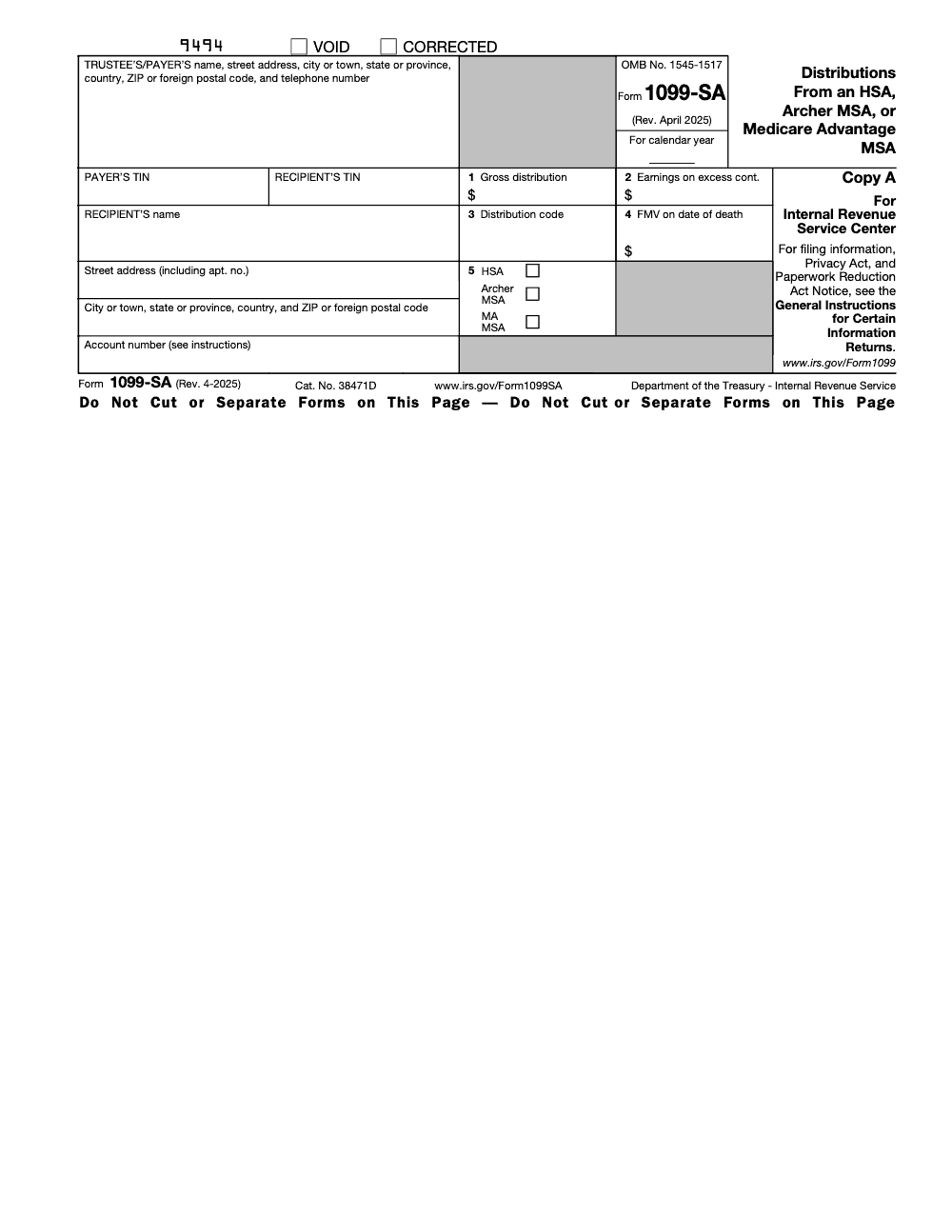
When Form 1099-SA lands in your inbox or mailbox, it means you took a distribution from one of three accounts, an HSA, an Archer MSA, or a Medicare Advantage MSA, during the year. Box 1 lists the total that left the account. Box 3 lists a distribution code that tells you and the IRS what kind of distribution it was. You will carry these details into your tax return, usually on Form 8889 for HSAs or Form 8853 for Archer MSAs.
The trustee is responsible for issuing the form and for filing with the IRS. The IRS allows electronic furnishing of recipient statements with proper consent, and it requires most filers that issue 10 or more information returns to e-file. If a trustee uses electronic delivery, they must meet the IRS timing and access rules so recipients can retrieve statements through October.
A quick highlight on due dates
For information returns like 1099-SA, the IRS schedule most taxpayers rely on is copies to recipients by January 31, paper filing by February 28, and e-filing by March 31. The IRS posts a running table and seasonal notices each year, so if a date falls on a weekend or holiday, the due date usually shifts to the next business day. Use those official tables to confirm the exact year’s dates you care about.
Who issues the form and how it is delivered
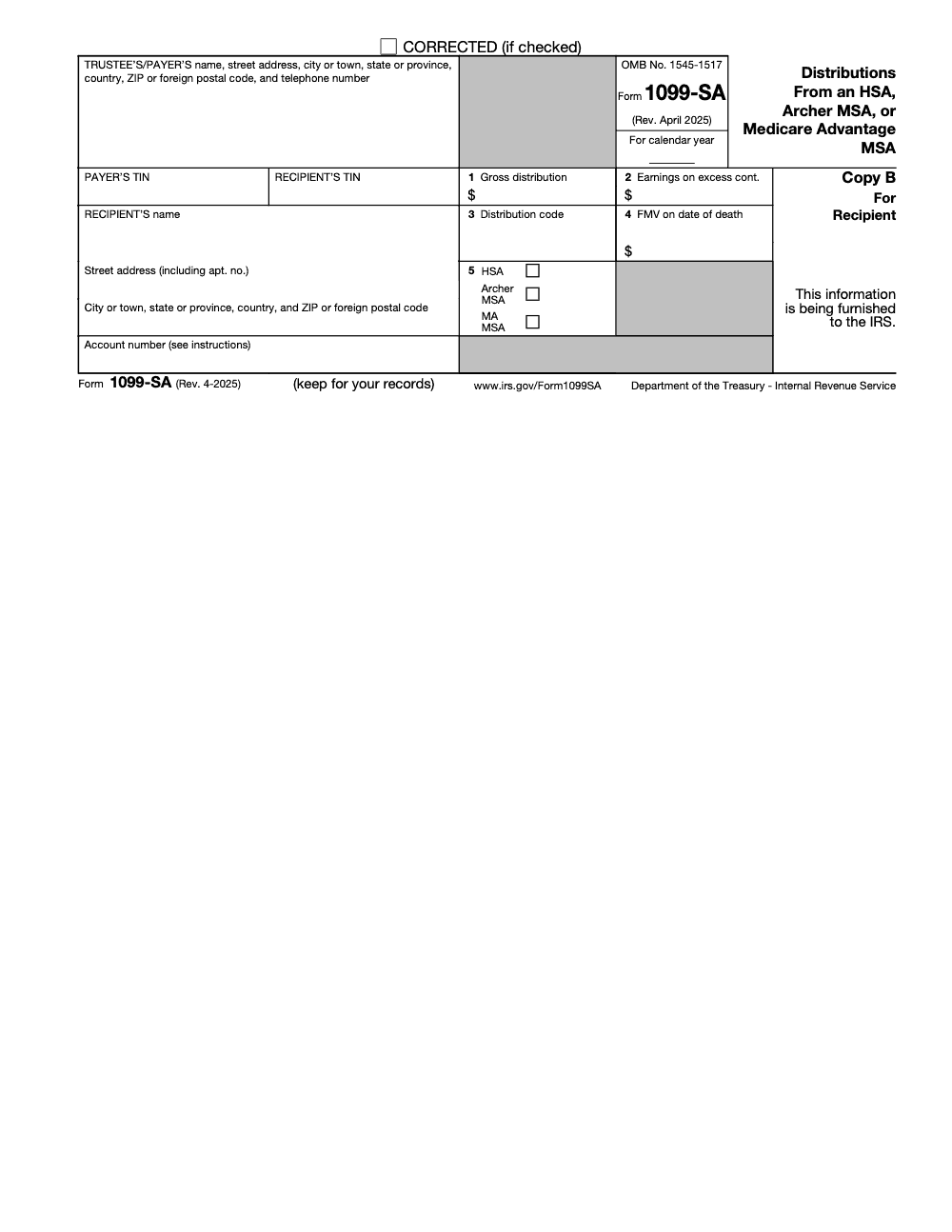
Your HSA or MSA trustee, think bank, credit union, or insurer, prepares the form. They include their name, their TIN, your TIN, your address, and the account number. You receive Copy B for your records and for completing your return, while Copy A goes to the IRS. Electronic delivery is permitted if the trustee follows the IRS rules for consent and online access.
Why you might not receive a 1099-SA
If you did not withdraw any money, there is nothing to report, so no 1099-SA arrives. Trustee-to-trustee transfers are not reportable distributions either, so they will not generate a 1099-SA. If you expected a form and it is missing by early February, contact your trustee to request a copy or a correction.
The boxes that matter
Here is how to read the key fields on your 1099-SA and what they mean for your return.
Box 1, gross distribution
This is the total amount that left your account during the year. You will start with Box 1 to reconcile on Form 8889 for HSAs, or Form 8853 for Archer MSAs.
Box 3, distribution code
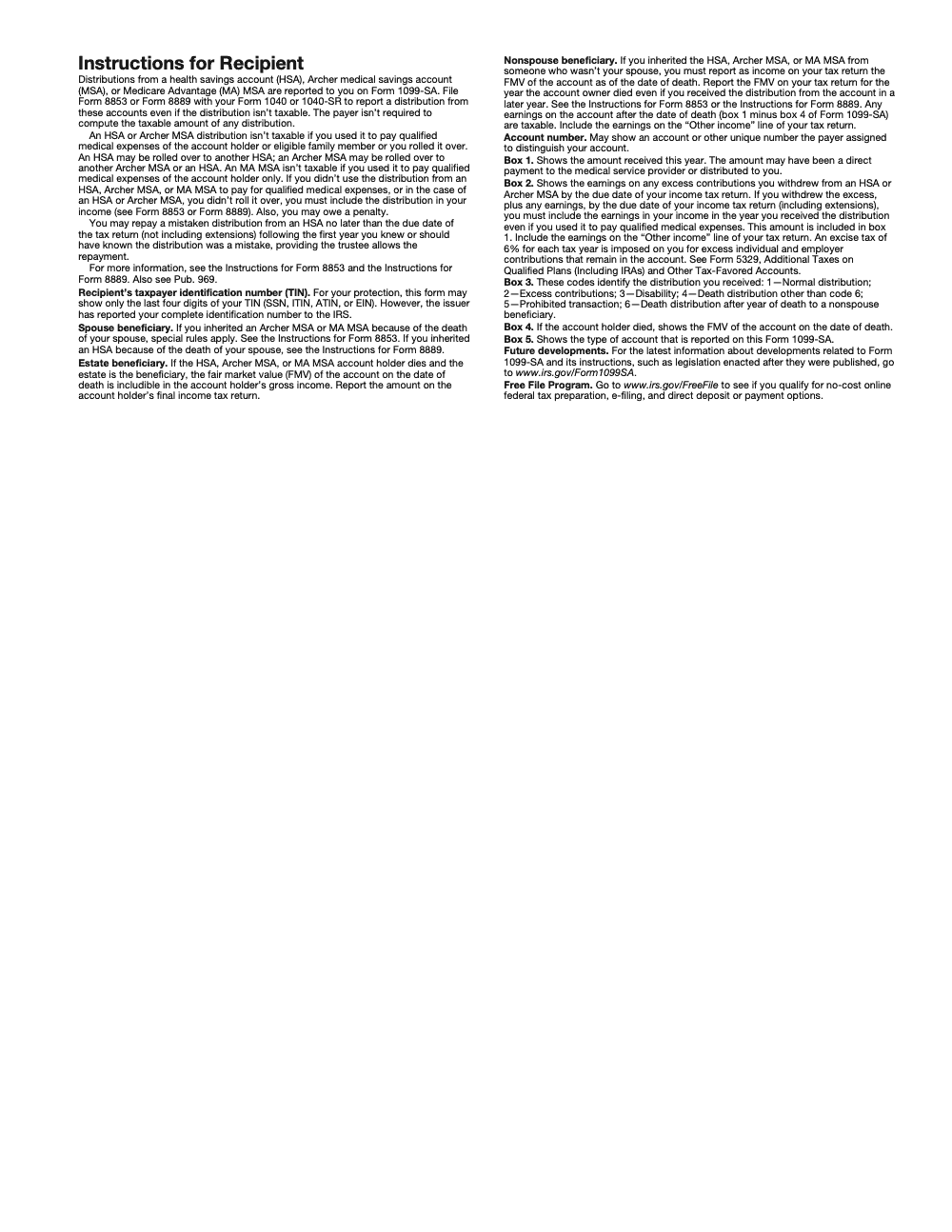
Box 3 tells you the type of distribution, which drives tax treatment – for example, normal distributions, excess contributions, disability, prohibited transactions, and death-related codes. You will reference these when deciding if any part is taxable or subject to the 20% additional tax.
Box 4, fair market value on date of death
If the account holder died, Box 4 may show the account’s value on the date of death. This helps determine how beneficiaries report distributions, and it changes how the additional tax applies.
Tax free versus taxable, and how the 20% additional tax really works
If you used HSA money for qualified medical expenses for you, your spouse, or your dependents, distributions are generally not taxable (this family-member rule applies to HSAs and Archer MSAs only – Medicare Advantage MSA distributions are tax free only when used for the account holder's own qualified medical expenses). If any part was not for qualified medical expenses, that portion is taxable. For HSAs and Archer MSAs, a taxable amount can also trigger an additional 20% tax unless an exception applies (Medicare Advantage MSA non-qualified distributions are subject to a higher 50% additional tax under IRC §138). You claim the exceptions if the distribution occurred after you reached age 65, after you became disabled, or after death of the account holder.
Box 3 distribution codes at a glance
Use your code from Box 3 to understand what you are reporting.
| Code | What it means | Typical notes |
| 1 | Normal distribution | Default code for regular withdrawals or payments to providers |
| 2 | Excess contributions | Used when returning excess HSA or Archer MSA contributions, earnings on excesses appear in Box 2 |
| 3 | Disability | Distribution after the account holder is disabled under section 72(m)(7) |
| 4 | Death distribution, not code 6 | Payments to an estate in the year of death, or to an estate after the year of death |
| 5 | Prohibited transaction | See sections 220(e)(2) and 223(e)(2) |
| 6 | Death distribution after year of death to a nonspouse beneficiary | Use only for nonspouse beneficiaries, not estates, after the year of death |
| Source, IRS Instructions for Forms 1099‑SA and 5498‑SA. |
Transfers, rollovers, and mistaken distributions
- Trustee-to-trustee transfers are not reported as distributions and do not create tax. For example, moving funds from one HSA custodian to another via direct transfer does not generate a 1099-SA.
- Rollovers are different from transfers. Archer MSA rollovers to another Archer MSA or to an HSA are generally tax free if completed within 60 days, and you will track them on Form 8853 or Form 8889 (note the one-way direction – Archer MSA to HSA is permitted, but HSA to Archer MSA rollovers are not). HSAs can only accept one rollover per 1 year period.
- If you took an HSA distribution by mistake, the IRS allows repayment by the due date of the return (not including extensions) for the year you knew, or should have known, of the mistake, and only if your trustee allows the repayment. Ask your trustee about their mistaken distribution process, then keep proof with your records.
How to use the codes when you file
For HSAs, report distributions on Form 8889. If your Box 3 code is 1 and you used the funds for qualified medical expenses, the taxable amount is generally zero. If any portion was not for qualified medical expenses, include that amount in income and compute the 20% additional tax unless an exception applies. For Archer MSAs, report on Form 8853 and follow the same qualified versus nonqualified logic.
The 20% additional tax exceptions, made simple
The additional 20% tax does not apply to amounts included in income if the distribution occurred after you turned age 65, after you became disabled, or after the account beneficiary died. When you complete Form 8889, you will check the exception box if it applies, then only apply 20% to the portion not covered by an exception. Keep dates with your receipts, for example the date you turned 65, so you can support the exception if asked.
Beneficiaries and Box 4
If a spouse is the designated beneficiary of an HSA, the HSA becomes the spouse’s HSA and is treated as if the spouse were the original account holder. If a nonspouse beneficiary inherits, the account stops being an HSA, and the fair market value on the date of death is generally taxable to the beneficiary, reduced by qualified medical expenses the decedent incurred and were paid within 1 year after death (the FMV is reported on the beneficiary's tax return for the year the account owner died, even if the distribution is received in a later year). The 1099-SA codes differ for payments in the year of death versus after the year of death, which is why Box 3 and Box 4 matter here.
Step by step, how to use Form 1099-SA on your return
- Match the basics Check your name, TIN, and account number, then confirm Box 1 and the Box 3 code. If anything looks off, ask the trustee for a corrected form before you file.
- Map the form
- HSAs go to Form 8889, Archer MSAs go to Form 8853. Medicare Advantage MSA distributions are handled under the same 1099-SA framework, but follow the instructions that apply to your account type.
- Prove the purpose Line up receipts for qualified medical expenses. If all distributions were qualified, your taxable amount is generally zero. If not, calculate the taxable portion and the additional 20% tax (50% for Medicare Advantage MSA non-qualified distributions) if you do not meet an exception.
- Watch the exceptions If you reached age 65 during the year, split pre‑65 and post‑65 distributions, then apply the exception only to the post‑65 amounts that were not for qualified medical expenses. The instructions show examples, and the lines on Form 8889 walk you through the math.
Timelines, missing forms, and corrections
Deadlines you should know
- Recipient copies, usually due by about January 31 for the prior tax year.
- IRS filing, February 28 if paper, March 31 if e-filed, unless the IRS posts a special date.
- If a date falls on a weekend or holiday, it typically moves to the next business day. Trustees must also follow IRS rules if they furnish statements electronically, including posting by January 31 and keeping access available through October 15.
Missing or incorrect 1099-SA
If you expected a 1099-SA and it has not arrived by early February, contact your trustee and ask for a copy or a correction. You usually do not mail the form with your return, you keep Copy B and use the numbers to complete your filing. The trustee files Copy A with the IRS.
Common real world scenarios
- You withdrew 2,200 for an ER visit, and Box 3 shows code 1. You keep the hospital and pharmacy receipts, enter the numbers on Form 8889, and you owe no income tax or additional tax.
- You spent 500 on a nonmedical purchase. That portion is taxable, and if no exception applies, you also compute 20% of 500 as additional tax on Form 8889.
- You moved an HSA from Bank A to Bank B through a trustee-to-trustee transfer. There is no 1099-SA, and there is no tax.
- You returned an HSA withdrawal that was clearly a mistake, for example the provider reversed a charge and you immediately sent the funds back. Ask your trustee about their mistaken distribution process, then document the repayment by the deadline in the IRS rules.
Quick reference tables
How 1099-SA flows to your return
| Step | What you do | Where it goes |
| 1 | Confirm name, TIN, account number | Keep Copy B, fix errors with trustee |
| 2 | Read Box 1 total distribution | Form 8889 for HSAs, Form 8853 for Archer MSAs |
| 3 | Use Box 3 code to set tax treatment | Form 8889 or 8853 instructions |
| 4 | Calculate taxable amount, if any | Form 8889 Part II or Form 8853 Part II |
| 5 | Apply 20% additional tax or exceptions | Form 8889 exception checkbox, then line for additional tax |
| Sources, IRS Instructions for Form 8889 and Form 8853. |
Filing due dates, big picture
| What | Recipient copy due | IRS paper due | IRS e-file due |
| Most 1099s, including 1099‑SA | Around Jan 31 | Feb 28 | Mar 31 |
| Source, IRS guide to information returns and seasonal reminders. |
A brief note for firm leaders
If you run an accounting firm and need consistent, on-time HSA and MSA reporting support at scale, structure beats staffing every time. Accountably integrates trained offshore teams inside your workflow with SOP-driven execution, standardized workpapers, and defined SLAs, so partner review time drops and deadlines stop slipping. Use it when you need capacity without chaos, and keep control of quality and security. (Mentioned sparingly since this page is educational first.)
Sources and year checks
- IRS Instructions for Forms 1099‑SA and 5498‑SA, updated for 2025, including distribution codes, death rules, transfers, and mistaken distributions.
- IRS Instructions for Form 8889, 2024 revision, for HSA taxability and the 20% additional tax exceptions.
- IRS Instructions for Form 8853, 2024 revision, for Archer MSA distributions and rollovers.
- IRS Guide to Information Returns and seasonal due date reminders for recipient and IRS filing deadlines.
Note, this content is educational, not tax advice. If your situation involves unique facts, file with a qualified tax professional, and always confirm live-year dates on IRS.gov before you submit.
Common Mistakes We See Every Season
Most 1099-SA filing errors trace back to the same handful of misreads, often from filers who got the form for the first time. Here are the five we flag most often on year-round HSA and MSA review work.
Reusable Checklists
Copy these into the firm's HSA and MSA review SOP. They are written so a senior preparer can paste them straight into TaxDome, Karbon, or Suralink without rewriting.
Pre-return 1099-SA verification packet
- Confirm the recipient name, TIN, and account number on Copy B match the client file.
- Note which Box 5 checkbox is selected (HSA, Archer MSA, or MA MSA) and open the matching attached form (8889 for HSA, 8853 for Archer or MA MSA).
- Read the Box 3 code (1 through 6) and route the engagement to the right workflow lane: normal, excess return, disability, death, prohibited transaction.
- Pull the qualified medical expense ledger for the year and tag receipts to each distribution.
- Flag any case where Box 1 exceeds documented qualified medical expenses, for taxable-portion analysis.
- Check Box 2 (earnings on excess contributions). If non-zero, plan to report on the Other income line of Schedule 1, not on wages or interest.
- If Box 4 carries a date-of-death FMV, pull the death certificate date and confirm the filing year.
20% additional tax exception verification
- Confirm the account holder's date of birth and the date of each distribution. Split pre-65 and post-65 amounts if the 65th birthday falls mid-year.
- If the account holder is under 65 and a disability exception is claimed, verify the IRC §72(m)(7) standard and document supporting medical evidence in the file.
- For death-related distributions, capture the date of death and confirm whether the recipient is a spouse, a nonspouse beneficiary, or the estate.
- For each non-qualified distribution that fails an exception, compute the 20% additional tax on Form 8889 Part II (or 50% on Form 8853 for MA MSA).
- Document the exception election in the workpaper note, not just on the return, so the next reviewer can trace the position without re-deriving it.
Excess contribution wind-down (Box 3 code 2)
- Identify the contribution year that produced the excess. The 2025 HSA limits are $4,300 self-only and $8,550 family, plus a $1,000 catch-up for account holders age 55 or older (per Rev. Proc. 2024-25 and IRC §223(b)(3)).
- Confirm the trustee withdrew both the excess and the earnings on the excess by the income tax return due date, including extensions.
- Report the earnings amount (Box 2) on the Other income line of Schedule 1 in the year of the corrective distribution, regardless of how the funds were spent.
- If the excess was not removed in time, prepare Form 5329 for the 6% recurring excise tax for each tax year the excess remains in the account.
- Note the corrective process in the client engagement file so the same trap does not repeat next contribution year.
Keep 1099-SA Season From Stalling
Form 1099-SA work is not a quarterly avalanche the way Form 941 is, but the January 31, 2026 recipient-furnishing deadline lands at the same moment trustees are racing to push 1099-NEC, 1099-MISC, 1099-INT, and 5498-SA out the door. Add the 10-return aggregate e-filing threshold that took effect under T.D. 9972 for returns filed beginning calendar year 2024, and the per-return penalty ladder of $60, $130, and $340 published in the IRS General Instructions for Certain Information Returns, and a back office that touches even modest HSA and MSA volume now has a measurable late-filing exposure.
The fix is process discipline, not extra people. Most issues that surface on these forms are catchable upstream of furnish-and-file, in the trustee data pull or the workpaper tie-out, if the firm runs a defined review sequence.
- Standardize the trustee data extract format so the Box 5 selection (HSA, Archer MSA, or MA MSA) routes the record to the correct downstream form (8889 vs 8853) before any reviewer touches it.
- Build a Box 3 code routing rule. Code 2 (excess) feeds the Box 2 earnings reconciliation, codes 4 and 6 (death) open the date-of-death FMV worksheet, code 5 (prohibited) escalates to the senior reviewer.
- Track the recipient-furnishing window (January 31) and the IRS filing window (February 28 paper, March 31 e-file) on the firm production board with a hard internal cut-off two days before each date.
- Add a Copy A check to the SOP. Paper filers must use the official red-ink form ordered from the IRS, not the downloaded PDF, or the submission is rejected by IRS imaging.
- For any back office above the 10-return aggregate threshold, default to IRIS or FIRE e-filing and retire paper Copy A from the workflow entirely.
This is where a structured offshore team carries the weight without burning senior-reviewer hours. Accountably's tax delivery service handles trustee data normalization, Box 3 code routing, Form 8889 and 8853 prep, and the January-to-March furnish-and-file cycle inside the firm's existing software, with documented SOPs and turnaround SLAs on every engagement.
FAQs
It reports withdrawals from HSAs, Archer MSAs, and Medicare Advantage MSAs. You use it to complete Form 8889 for HSAs or Form 8853 for Archer MSAs, then carry any taxable amount to your Form 1040.
Yes. HSAs reconcile on Form 8889, MSAs on Form 8853. If all distributions were for qualified medical expenses, your taxable amount is usually zero. If not, include the nonqualified portion in income, and compute any additional 20% tax if no exception applies.
If you did not take a distribution, none is due. If you did and it is missing by early February, ask your trustee for a copy. Transfers between trustees do not produce a 1099-SA.
Direct trustee-to-trustee transfers are not reported as distributions. Rollovers have their own timing and once-per-year limits for HSAs and Archer MSAs, so follow Form 8853 and 8889 instructions and keep proof.
Codes run from 1 to 6 and cover normal, excess contribution returns, disability, death-related distributions, and prohibited transactions. The code you see drives how you report the amount and whether the additional 20% tax can apply.
Other forms this guide names
- Form 8889: HSA Instructions, Limits & Filing Guide
- Form 8853: Archer MSA, Medicare Advantage MSA & Long‑Term Care Reporting Guide
- Form 5498-SA: HSA & Archer MSA Contribution Reporting
- Form 1040: Filing Guide for 2025 Returns (AGI, Deductions, Deadlines)
Summarize this article with AI
About this guide
Accountably helps US CPA, EA, and accounting firms hire trained accountants and tax preparers in India.
About us Reviewed byJugal Thacker, CPAFounder and CEO at Accountably
A Washington-licensed CPA with 7+ years inside US firms – PwC, a real-estate tax practice, then a full-service firm, rising from reviewer to manager to advisory. This article was reviewed against current IRS guidance for the 2025 tax year and updated for filers preparing late returns, amendments, and 2026 estimates.
View profile →How we research, review, and update this guide
Every Accountably guide is researched against primary IRS sources, reviewed by a U.S. CPA, and refreshed as guidance evolves. Read our Editorial Guidelines to see how we source, fact-check, and update our content.