Summarize this article with AI
In Brief
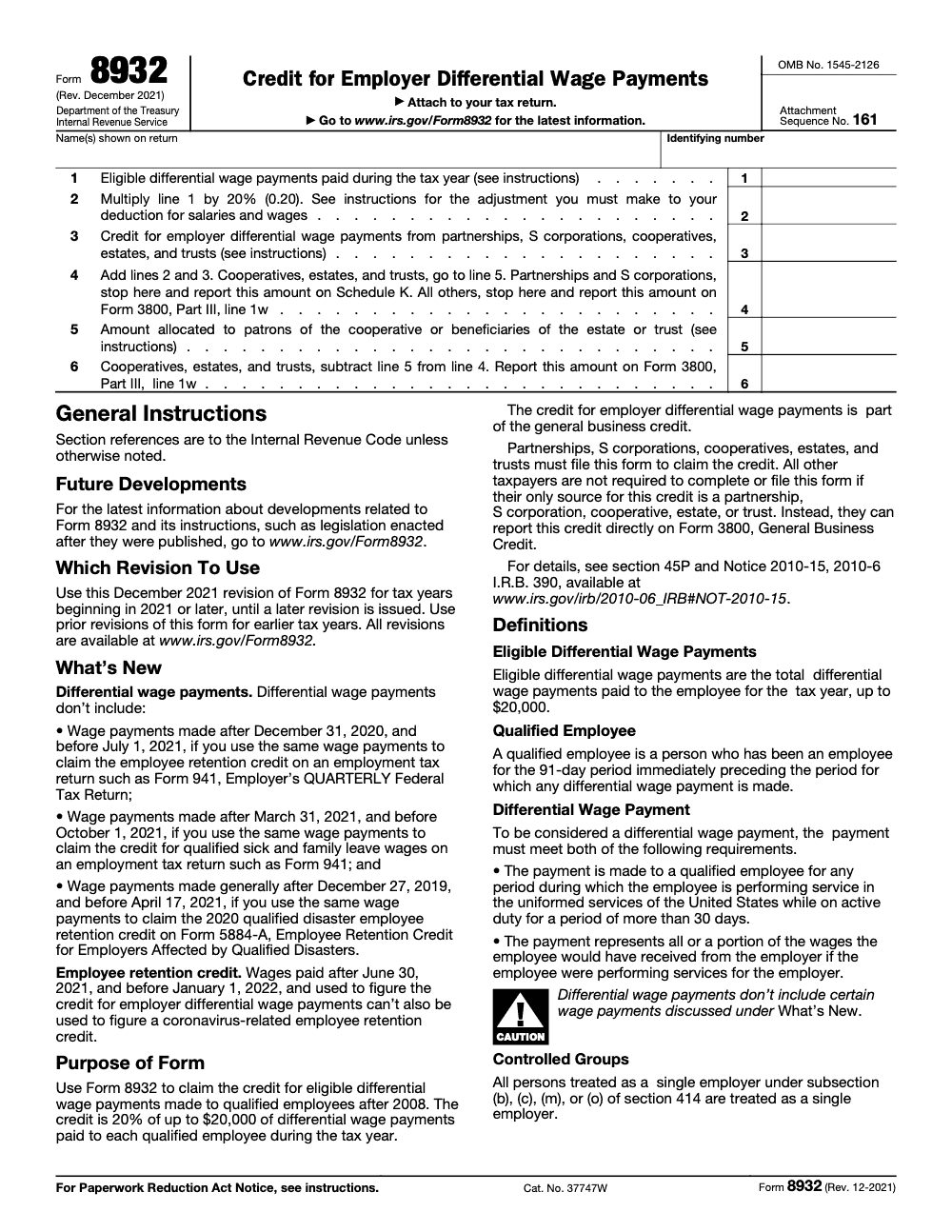
Form 8932 claims the IRC §45P credit for employer differential wage payments – 20% of up to $20,000 of qualifying differential wages per qualified employee per year, so the maximum credit is $4,000 per employee (per IRS Form 8932 instructions, Rev. December 2021). The credit flows to Form 3800, Part III, line 1w; only partnerships, S corporations, cooperatives, estates, and trusts have to file Form 8932 itself, and the December 2021 revision is still current for tax year 2025 returns.
An employer keeps paying part of a reservist's civilian salary while they are on active duty and assumes that generosity is just a cost. It is, but it can also be a credit. Form 8932 claims the IRC §45P credit for those differential wage payments, and as of 2025 the credit is permanent and open to employers of any size.
The math is 20% of up to $20,000 of qualifying differential wages per employee each year, so the maximum is $4,000 per person. You carry it to Form 3800 and reduce your wage deduction by the credit amount, and only partnerships, S corporations, cooperatives, estates, and trusts file Form 8932 itself. The December 2021 revision still controls tax year 2025 returns.
Key Takeaways
- You claim the Credit for Employer Differential Wage Payments on Form 8932, then carry it to Form 3800 as part of the general business credit.
- The credit is 20% of eligible differential wage payments, up to 20,000 per employee each tax year, so up to 4,000 per person.
- Since late 2015, there is no “fewer than 50 employees” limit. Congress removed the small‑employer restriction and made the credit permanent.
- You must reduce your wage deduction by the credit, and you cannot double count the same wages for other credits.
- Partnerships and S corps report the credit on Schedule K, and most other filers route it to Form 3800, Part III, line 1w.
What Form 8932 Covers, in Plain English
Form 8932 is how you, as an employer, claim a credit for paying employees a wage “differential” while they serve on active duty for more than 30 days. Differential wage payments are amounts you pay that replace all or part of what an employee would have earned if they were still working for you. The statute, IRC §45P, sets the rate at 20% and caps the eligible payments at 20,000 per employee per year. The credit itself is one component of the general business credit, so it eventually lands on Form 3800.
Here is the headline change many firms miss. In 2015, Congress struck the old sunset date and removed the “eligible small business employer” definition, which used to tie the credit to employers with fewer than 50 employees and a written plan. Today, §45P applies without a size cap, and controlled‑group rules under §414 still apply. That shift is why you often see outdated articles online that mention a 2010 or 2014 cutoff, or a 50‑employee limit. Those are no longer the law.
Quick Definition Check
- Qualified employee, the person worked for you during the 91 days before the active‑duty period.
- Differential wage payment, a payment you make while the person is on active duty for more than 30 days, intended to replace all or part of the regular wages.
- Eligible amount per employee, up to 20,000 per year counts toward the credit base.
- Credit rate, 20% of the eligible base, maximum 4,000 per employee.
The What, How, Wow Framework
- What, claim a 20% credit on up to 20,000 in differential wages per employee, report on Form 8932, flow to Form 3800, and reduce your wage deduction by the credit.
- How, align policy, payroll, and proof. Track military orders and dates, tag differential pay in payroll, cap at 20,000 per person, avoid overlapping with other credits, then complete lines 1 through 6.
- Wow, in practice I have seen mid‑market employers turn thoughtful military‑support policies into five‑figure credits without adding headcount, simply by standardizing documentation and putting a light review process in place.
Who Qualifies in 2025?
The statute sets very specific conditions, and they are easier than many expect.
Employer Eligibility
- All employers may qualify. The old “fewer than 50 employees” requirement was removed by the PATH Act changes in December 2015.
- Aggregation still matters. Entities under common control are treated as a single employer under §414(b), (c), (m), or (o) for §45P purposes, so the 20,000-per-employee cap applies once across the whole group, not separately per entity.
Employee and Payment Tests
- The employee served on active duty for more than 30 days, and was your employee during the 91 days before that service.
- Payments were made during the active‑duty period, and they represent all or part of the wages the employee would have earned if still working for you.
- Count no more than 20,000 per employee per year toward the credit base.
No Double Counting With Other Credits
Wages you use for this credit cannot also be used for certain other credits. During the pandemic, the IRS clarified that wages used for the employee retention credit or the sick and family leave credits could not be counted here. The 2021 revision of Form 8932 reflects that rule. If you already used a set of wages for ERC, do not include them in the §45P base.
Key Numbers At A Glance
| Item | Amount or Rule |
| Per‑employee cap on eligible payments | 20,000 per tax year |
| Credit rate | 20% of eligible payments |
| Maximum credit per employee | 4,000 |
| Reporting | Form 8932, then Form 3800, Part III, line 1w |
| Wage deduction | Reduce by the credit amount |
| USERRA compliance | No credit for any year you are under a final order for a USERRA violation, plus the next two years |
AI assistance note, this article was drafted with the help of AI for speed, and then reviewed and edited by a human tax professional for accuracy. This content is educational, not tax advice. Work with a qualified advisor on your facts.
How To Calculate and Claim the §45P Credit
You complete Form 8932 and, unless you are a pass‑through entity reporting to owners, you route the result to Form 3800. Here is the step‑by‑step workflow I use with clients.
Step 1, Identify Eligible Differential Wage Payments
- Pull active‑duty orders with start and end dates for each affected employee.
- Extract payroll by check date that falls inside the active‑duty window.
- Isolate payments you labeled as military differential pay or a similar code.
- Cap each employee’s annual total at 20,000.
Step 2, Guard Against Overlaps
- Remove any wages you already used for ERC, sick and family leave credits in 2021, or disaster ERC on Form 5884‑A. The IRS made this exclusion explicit.
Step 3, Complete Form 8932, Lines 1–6
- Line 1, enter the total eligible differential wage payments after applying the per‑employee cap.
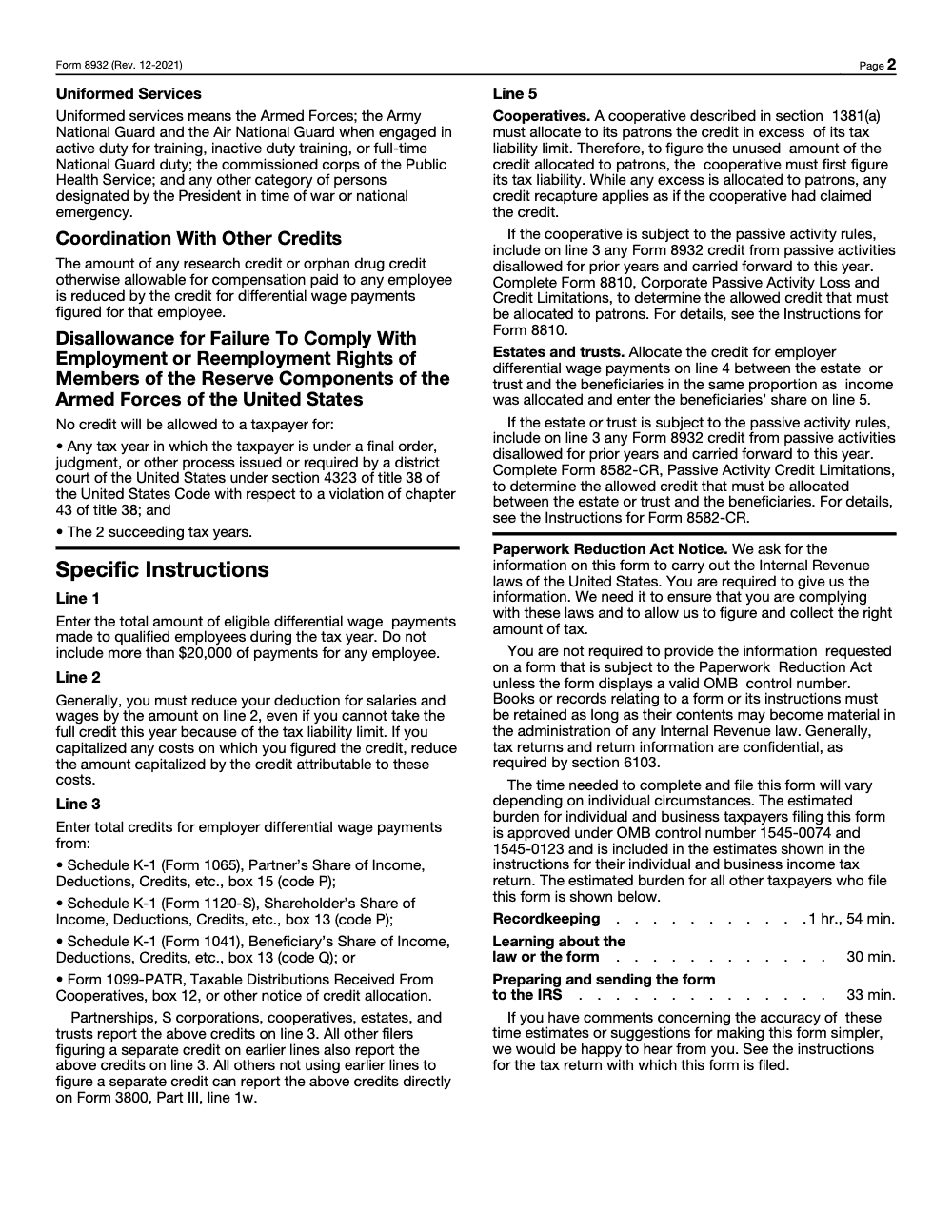
- Line 2, multiply Line 1 by 20%, and remember to reduce your salaries and wages deduction by that amount, even if you cannot take the full credit this year because of the tax liability limit or you carry part of it forward.
- Line 3, add any pass‑through credits from K‑1s or Form 1099‑PATR.
- Line 4, add Lines 2 and 3, then stop if you are a partnership or S corp and report on Schedule K. All other filers carry Line 4 to Form 3800, Part III, line 1w.
- Lines 5–6, cooperatives, estates, and trusts allocate and then carry the remainder to Form 3800, Part III, line 1w.
K‑1 Codes You Will See
- Form 1065 Schedule K‑1, box 15, code P
- Form 1120‑S Schedule K‑1, box 13, code P
- Form 1041 Schedule K‑1, box 13, code Q
- Form 1099‑PATR, box 12
A Simple Example You Can Copy
Say you paid three employees differential wages while each served for more than 30 days during the year.
- Employee A, 14,000
- Employee B, 22,500, cap at 20,000
- Employee C, 6,000
Total eligible differential wages on Line 1, 40,000. Line 2, 20% of 40,000, credit of 8,000. You reduce your wage deduction by 8,000. If you have no pass‑through amounts, Line 4 is also 8,000, which flows to Form 3800.
Pro tip, if you capitalized any costs that include differential wage payments, you must reduce the amount capitalized by the credit attributable to those costs. That detail often gets missed in year‑end close and then pops up during a review.
Documentation That Makes Reviews Easy
You do not need a formal written plan to claim the credit anymore, but a simple policy and tidy records make life easier if questions come up.
What I Ask Clients To Keep
- Copy of active‑duty orders for each service period.
- Payroll reports showing pay dates, codes, and amounts tagged as differential wage payments.
- An annual worksheet that totals eligible differential pay per employee and flags the 20,000 cap.
- A reconciliation tying Form 8932 Line 1 to payroll detail.
- A memo in the tax workpapers noting any wages excluded due to ERC or other credits.
USERRA Compliance Reminder
If your company is under a final order or judgment for violating USERRA employment or reemployment rights, you cannot claim this credit for that tax year and the next two tax years. Confirm HR and legal are in sync before you file.
Line‑By‑Line Summary Table
| Line | What to enter | Where it goes |
| 1 | Total eligible differential wage payments, capped at 20,000 per employee | Basis for credit |
| 2 | 20% of Line 1 | Reduce wage deduction by this amount |
| 3 | Pass‑through credits from K‑1s or 1099‑PATR | Included in total credit |
| 4 | Lines 2 + 3 | To Form 3800 Part III line 1w, or to Schedule K for partnerships/S corps |
| 5–6 | Allocations for co‑ops, estates, trusts | Remainder to Form 3800 Part III line 1w |
Common Mistakes And How To Avoid Them
The §45P credit is small in dollar terms next to most general business credits, but the eligibility tests and routing rules are where preparers slip year after year. The same handful of mistakes show up across our review queue, and almost all of them get caught before sign-off when the checklist runs on the workpaper.
A Lightweight Policy You Can Adopt
You do not have to file this policy anywhere, but having one makes communication and record‑keeping simple.
- Purpose, to support employees on active duty with differential pay and to comply with tax reporting rules.
- Eligibility, employees called to active duty for more than 30 days, with at least 91 days of employment before the service period.
- Payment method, differential pay equals X percent of base pay or a flat amount per pay period, paid on your normal payroll cycle.
- Documentation, HR collects orders, payroll tags payments with a dedicated code, accounting keeps a per‑employee cap tracker.
- Year‑end, accounting prepares a Form 8932 worksheet, tax reduces wages by the credit, and the return team coordinates Form 3800 and owner K‑1s as needed.
Calculator Walkthrough
Try this quick worksheet when you prep Form 8932.
- Gather payroll detail in the active‑duty period, exclude any amounts already used for ERC or sick and family leave credits.
- Cap each employee’s year‑to‑date eligible total at 20,000.
- Sum all employees for Line 1.
- Take 20% for Line 2 and record the wage‑deduction reduction.
- Add any pass‑through amounts on Line 3.
- Carry the result to Schedule K or Form 3800, Part III, line 1w.
Example With Timing Nuance
Your controller paid 10,000 of differential wages in December and another 15,000 in January for the same employee, both during active duty. The employee’s cap for the first tax year is 10,000. In the next tax year, only 10,000 of the 15,000 counts toward the cap. Your credit is 20% of 25,000 across the two years, or 5,000 in total, split by year. This is why a per‑employee cap tracker saves headaches.
How This Interacts With The General Business Credit
Form 8932 is a feeder into the general business credit on Form 3800, which applies annual limitations and manages carryforwards. If your current‑year tax liability is too low to use all of the §45P credit, you carry the unused amount forward under the general business credit rules. The form’s instructions state exactly where to post the amounts and list the K‑1 codes that pass through to owners.
In my practice, the most efficient close happens when payroll, HR, and tax each own a small, repeatable part of the process, then tax ties it together on a single worksheet. The heavy lifting is clerical, not technical, once the rules are clear.
Filing Deadlines And Where To Find The Form
- File Form 8932 with your federal income tax return for the year you made the payments.
- Use the current revision of the form and follow the line references to Form 3800, Part III, line 1w.
- Download the form directly from the IRS page “About Form 8932,” which the IRS last reviewed on October 24, 2025.
Compliance Checklist You Can Drop Into Your Workpapers
- Confirm active‑duty start and end dates, attach orders.
- Verify the 91‑day pre‑service employment requirement.
- Extract and tag differential wage payments, cap at 20,000 per employee.
- Exclude wages used for ERC or sick and family leave credits.
- Prepare the Form 8932 worksheet and post the wage‑deduction reduction entry.
- Complete Form 8932 Lines 1–6, tie out to Form 3800, and schedule K‑1s where applicable.
- Note any USERRA compliance issues.
How Strong Delivery Helps You Capture This Credit
If your team is buried in peak‑season production, credits like §45P fall through the cracks. That is why documentation discipline matters. Build a light SOP, keep naming consistent in workpapers, and set a quick review step before filing. When outside help is appropriate, choose partners who work inside your systems and keep your workflow standard. On our side, the Accountably team plugs into QuickBooks, Xero, CCH Axcess, UltraTax, and the common tax stacks, then follows your templates and review notes to keep payroll tags, caps, and Line 1 totals clean. It keeps partner review time short and credit capture consistent.
Credits like this are rarely missed because the rules are hard. They are missed because no one had the capacity to chase them at the right moment. Fix the workflow, give the work a trained preparer and a real reviewer, and you claim the benefit without drama.
Sources You Can Rely On
- IRS, About Form 8932, page last reviewed October 24, 2025. Confirms use of the form for payments made after 2008 and links to the current PDF.
- Form 8932, Rev. December 2021. Provides the line instructions, the 20% rate, the 20,000 cap, the wage‑deduction reduction, K‑1 codes, and Form 3800 line references.
- 26 U.S.C. §45P, as currently codified. Shows removal of the small‑employer restriction, deletion of the termination subsection, controlled‑group rules, and coordination with other credits.
- IRS historical notice on differential wage definitions during 2020–2021 credits. Documents non‑overlap with ERC and similar credits.
Final Thoughts And Next Steps
You already support your team members who serve. Turning that commitment into a clean, defensible credit is a straightforward process once policy, payroll tags, and year‑end tie‑outs are in place. Start with an inventory of current‑year service periods, run a per‑employee cap tracker, and set a calendar reminder to compile Form 8932 before you close the return. If you keep the records tidy, the filing routine takes minutes.
Reusable Checklists
These three checklists drop straight into the §45P workpaper as preflight, calculation, and exposure-scan steps. The interactive checkboxes save state in your browser, so a paused review picks up where the preparer left off.
Pre-file eligibility scan
- Confirm every claimed employee was employed for the 91-day period immediately preceding the differential wage payment period.
- Verify active duty exceeded 30 days (31 days or longer) for the period the wages relate to.
- Check the duty falls within the §45P definition of uniformed services: Armed Forces; Army and Air National Guard in qualifying duty categories; the commissioned corps of the Public Health Service; or other categories designated by the President in time of war or national emergency.
- Confirm the wage payment substitutes for civilian wages the employee would otherwise have received – the second prong of the §45P differential wage payment definition.
- For controlled groups under IRC §414(b), (c), (m), or (o), consolidate eligible payments across the group and apply the $20,000 per-employee cap once across the group, not once per entity.
- Run the USERRA disallowance check: no claim if the taxpayer is under a final order under 38 U.S.C. §4323 for the current tax year or either of the two succeeding tax years.
Calculation and routing
- Cap each employee's line 1 entry at $20,000, regardless of total differential wages actually paid to that employee.
- Multiply line 1 by 0.20 to land line 2; reduce the salaries and wages deduction by the line 2 amount in the same tax year.
- Reduce any research credit or orphan drug credit otherwise allowable on the same wages by the §45P credit figured on those wages.
- Enter §45P credits flowing in from K-1s or Form 1099-PATR on line 3.
- Sum lines 2 and 3 to land line 4.
- Partnerships and S corporations stop at line 4 and report through Schedule K (Form 1065 K-1 box 15 code P; Form 1120-S K-1 box 13 code P).
- Cooperatives, estates, and trusts allocate to patrons or beneficiaries on line 5, then post line 4 minus line 5 on line 6 and route to Form 3800, Part III, line 1w. Estates and trusts allocate in the same proportion as income.
- All other filers route line 4 to Form 3800, Part III, line 1w.
Double-dip and recapture exposure scan
- For wages paid between December 31, 2020 and July 1, 2021, exclude any dollars also claimed for the employee retention credit on Form 941.
- For wages paid between March 31, 2021 and October 1, 2021, exclude dollars also claimed for the qualified sick and family leave credit on Form 941.
- For wages paid between December 27, 2019 and April 17, 2021, exclude dollars also claimed for the 2020 qualified disaster ERC on Form 5884-A.
- For wages paid between June 30, 2021 and January 1, 2022, exclude dollars also used to figure the coronavirus-related ERC.
- For cooperatives, document that any credit recapture applies to the cooperative as if it had claimed the credit, even where the excess is allocated to patrons.
- For cooperatives, estates, or trusts subject to passive activity rules, complete Form 8810 (cooperative or corporation) or Form 8582-CR (estates and trusts) to determine the allowed credit before allocation.
- Retain records as long as their contents may be material in administering any Internal Revenue law – no fixed three- or seven-year cutoff applies.
Keep 8932 Season From Stalling
Form 8932 is a low-volume return for most preparers, which is exactly why it stalls reviews. The IRS Paperwork Reduction Act estimate on the form budgets roughly 1 hour 54 minutes of recordkeeping, 30 minutes to learn the rules, and 33 minutes to prepare and send the form (per the Form 8932 Paperwork Reduction Act notice), and that assumes the preparer already knows the eligibility tests and routing. In practice the rules sit unused between filings, and the same questions get re-researched every year.
The fix is not more senior time on each return. It is a tight preflight that catches the four or five issues that recur – qualified-employee window, active-duty threshold, per-employee cap, deduction reduction, and double-dip exposure during the COVID-era windows – before the schedule is ever opened.
- Verify the 91-day pre-deployment employment test and the more-than-30-days active-duty threshold on every claimed employee before populating line 1.
- Cap each employee's line 1 entry at $20,000, even when actual differential wages exceeded that figure for that employee.
- Reduce the salaries and wages deduction by the full line 2 amount in the year the credit is figured, regardless of whether the credit is limited or carried forward.
- Flag any wages claimed for the ERC, sick and family leave credit, or 2020 qualified disaster ERC during the listed windows, so the same dollars do not appear on line 1.
- Route line 4 correctly per entity type: partnerships and S corporations stop at Schedule K (Form 1065 K-1 box 15 code P; Form 1120-S K-1 box 13 code P); estates and trusts allocate on line 5 and report to beneficiaries on Form 1041 K-1 box 13 code Q; cooperatives, estates, and trusts post line 4 minus line 5 to Form 3800, Part III, line 1w.
That is the kind of workflow where a structured preparer-plus-reviewer model saves both senior time and accuracy on a return that gets touched only once a year. See how the model runs on the U.S. taxation services page.
FAQs
No. Congress removed the small‑employer limit in December 2015. The code now applies without a size cap, and the credit has no sunset date in current law.
A payment you make to a qualified employee, during an active‑duty period longer than 30 days, that represents all or part of the wages the employee would have earned if still working for you.
You can count up to 20,000 of differential wage payments per employee per year toward the credit base. The credit is 20% of that amount, so up to 4,000 per person.
Complete Form 8932, unless your only source for the credit is a Schedule K-1 or Form 1099-PATR, in which case you do not have to file Form 8932 and can report the credit directly on Form 3800, Part III, line 1w. Partnerships and S corporations report the result on Schedule K, while most other filers carry the amount to Form 3800, Part III, line 1w.
Yes. Reduce your deduction for salaries and wages by the credit you claim, even if you are limited this year under the general business credit rules.
No. Wages used for the employee retention credit or the sick and family leave credits cannot also be treated as differential wage payments for Form 8932 purposes. The IRS highlighted this in a 2021 update and in the current form.
If you are under a final judgment or order for a USERRA violation, you cannot claim the credit for that year, and you are also blocked for the next two tax years.
Yes. Entities under common control are treated as a single employer for §45P. Coordinate caps and reporting across the group.
Other forms this guide names
- Form 3800: How to Claim the General Business Credit in 2025
- Form 1041: Guide for Estates & Trusts, Deadlines & K-1s
- Form 1120-S: Guide for S‑Corp Filing, K‑1, K‑2/K‑3, Deadlines
- Form 1065: Guide, Deadlines, K‑1, K‑2/K‑3, E‑File
- Form 1065: Schedule K-2 and K-3 Guide 2025, one month date rules
- Form 941: Employer's Quarterly Tax Return Guide 2025
About this guide
Accountably helps US CPA, EA, and accounting firms hire trained accountants and tax preparers in India.
About us Reviewed byJugal Thacker, CPAFounder and CEO at Accountably
A Washington-licensed CPA with 7+ years inside US firms – PwC, a real-estate tax practice, then a full-service firm, rising from reviewer to manager to advisory. This article was reviewed against current IRS guidance for the 2025 tax year and updated for filers preparing late returns, amendments, and 2026 estimates.
View profile →How we research, review, and update this guide
Every Accountably guide is researched against primary IRS sources, reviewed by a U.S. CPA, and refreshed as guidance evolves. Read our Editorial Guidelines to see how we source, fact-check, and update our content.