Summarize this article with AI
In Brief
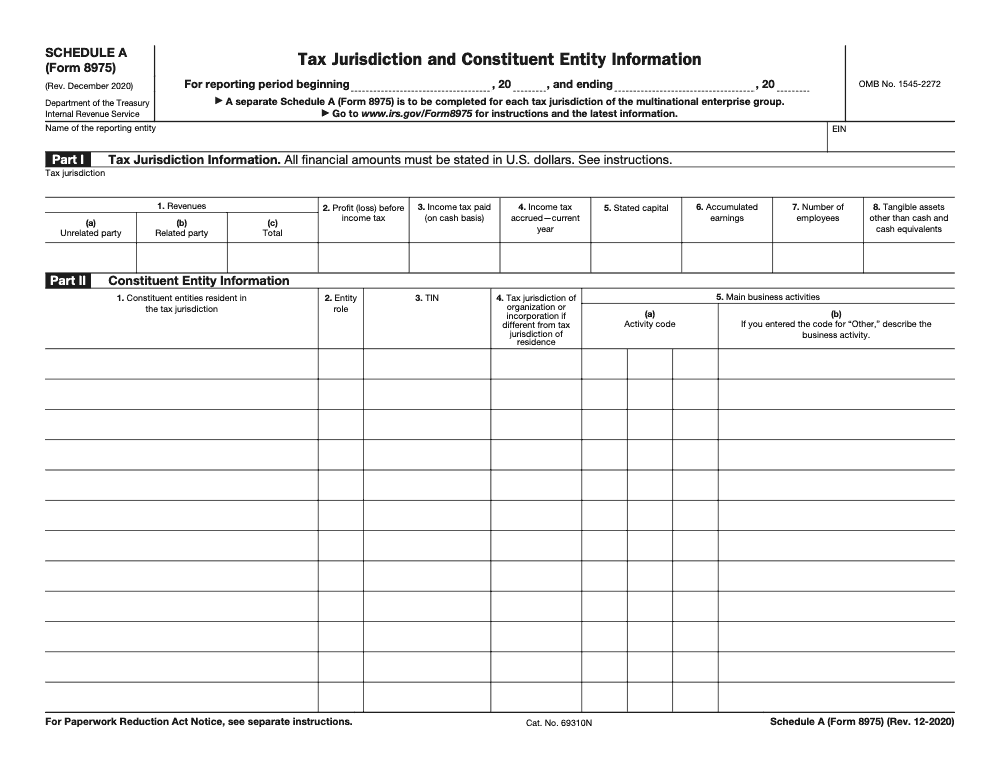
Form 8975 Schedule A is the jurisdiction-level page of the U.S. Country-by-Country report (CbCR). U.S. MNE groups with $850 million or more in preceding-year revenue file one Schedule A per tax jurisdiction (per Treasury Reg. §1.6038-4(h)). Part I, Column 1(c) carries total revenues, Column 3 carries income tax paid on a cash basis, and the package attaches to the U.S. parent's income tax return such as Form 1120 on the parent's due date, including any Form 7004 extension.
On a Form 8975 Schedule A package, two places fall apart every year: the mapping chart and the override column. A first consolidation in ONESOURCE will often surface duplicate constituent entities sitting across two binders, a divisional consolidation that double-counts intercompany revenue, and a Final Form Data column a prior preparer hand-typed because a transfer looked off. The fix is almost always structural, not numeric.
Schedule A is the jurisdiction-level page of the U.S. Country-by-Country report, filed when a U.S. MNE group has $850 million or more in preceding-year revenue. In ONESOURCE, TAS Compute pushes mapped, book-adjusted USD amounts into the From TAS Compute column, and Final Form Data mirrors them unless you override. Column 1(c) carries total revenues, Column 3 carries income tax paid on a cash basis, and Part III is where you explain non-GAAP translations.
Key Takeaways
- Form 8975 Schedule A reports jurisdiction level, GAAP adjusted amounts in U.S. dollars for every place your group has one or more resident constituent entities, including a separate Schedule A for stateless constituents when required.
- In ONESOURCE Income Tax, TAS Compute pushes mapped, book adjusted USD amounts into the From TAS Compute column, and Final Form Data mirrors those values unless you override.
- Avoid Top Consolidation edits. Populate accurate data in each foreign or FTC binder, then use TAS Consolidation to roll up. A consolidated Schedule A workpaper exists for FTC Top Consolidation, but you still fix data in the member binders.
- Mixed federal charts and divisional consolidations are the two most common causes of missing or duplicated amounts. Address chart assignments and properties first, then use overrides only when you cannot correct upstream data.
- Schedule A requires USD reporting and allows you to explain non GAAP translations in Part III. Document translation, mapping sources, and any overrides so the file is audit ready.
What Form 8975 Schedule A actually is
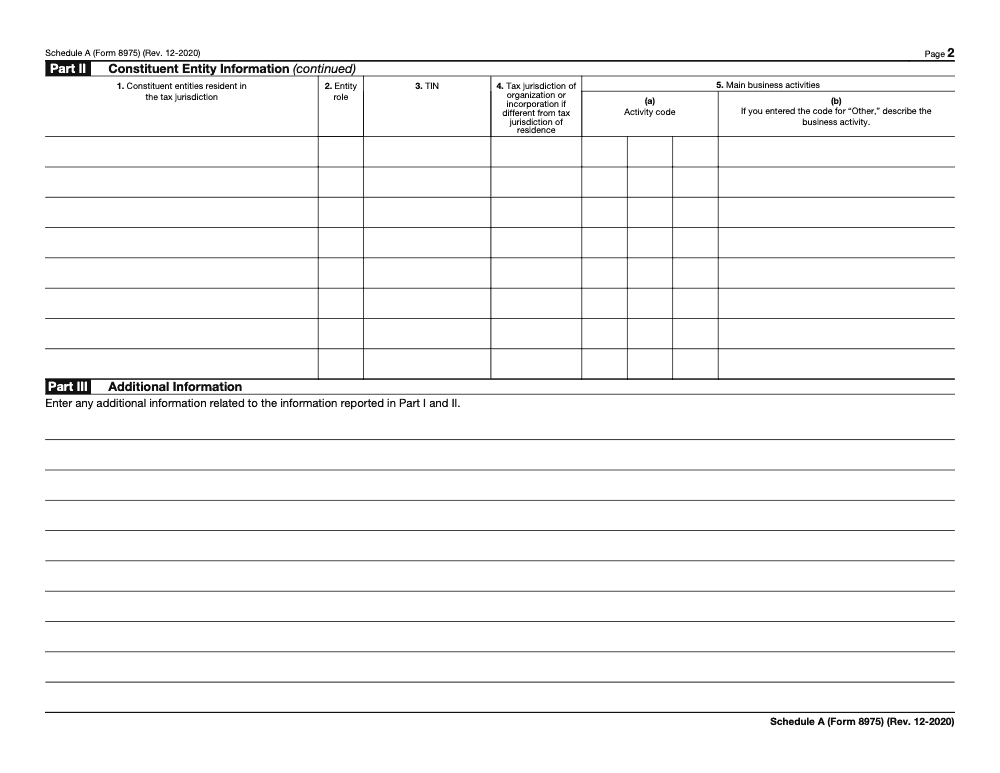
Form 8975 is the IRS country by country report for large U.S. headed groups. Schedule A is the jurisdiction page. You complete one Schedule A for every tax jurisdiction where your group has at least one resident constituent entity, and you also prepare a Schedule A for stateless constituents when applicable (consolidating multiple jurisdictions onto a single Schedule A is not allowed, the requirement is one Schedule A per jurisdiction, every time). All amounts are reported in U.S. dollars and are based on consistent books or applicable financial statements (local-currency reporting for foreign jurisdictions is not permitted, translate to USD first using a consistent method and disclose any non-GAAP rate in Part III). Attach the form set to the ultimate parent’s return and file by that return’s due date (Form 8975 cannot be filed as a standalone return, the parent’s income tax return due date including any Form 7004 extension controls).
If you have ever mixed up this Schedule A with the individual Form 1040 Schedule A, you are not alone. This is not an itemized deduction schedule. It is the CbCR jurisdiction summary with lines for revenue, profit or loss before tax, income tax paid and accrued, stated capital, accumulated earnings, number of employees, and tangible assets other than cash.
Why teams struggle, and why it is not a “sales” problem
If your firm is like most, client demand is not the bottleneck. Delivery is. The work jams in review loops, mapping differs by preparer, and turnover forces you to retrain the same tasks again. The result is late nights, missed handoffs, and too many overrides to explain later. You do not need more spreadsheets. You need a simple, shared way to get clean data into Schedule A, then let TAS Compute do the heavy lifting.
In our experience, the firms that scale CbCR reporting do three things well, they standardize mapping, they document translation and adjustments in one place, and they keep overrides rare and fully explained.
How Schedule A populates in ONESOURCE, the short version
When you run TAS Compute in a foreign or FTC binder, ONESOURCE pulls entity and binder properties, then pushes mapped, book adjusted USD amounts into the Schedule A workpaper. You will see those values in the From TAS Compute column. The Final Form Data column either mirrors TAS or shows your override. If you use the U.S. Dollar Book Balances Override, ONESOURCE sources the amounts from that override screen, not the standard adjusted book balance. Only accounts with balances move.
A consolidated Schedule A workpaper exists in FTC Top Consolidation. It shows combined Final Form Data from member binders and transfers to the Organizer during International Computes. Review at the top is fine, but make changes down in the member binders, then re run consolidation.
The three columns that matter
- From TAS Compute, the system’s mapped pull of book adjusted USD based on your chart assignments and properties.
- Final Form Data, what ultimately transfers. It mirrors TAS unless you override.
- Adjusted Book Balance or U.S. Dollar Book Balances Override, the source of truth you should fix before you touch Final Form Data.
Source to target, at a glance
| Step | Where you work | What happens | Tip |
| 1 | Working Trial Balance, USD | Post book adjustments are finalized | Lock this before computes |
| 2 | Mapping chart | Map federal accounts to Schedule A, Part I lines | One account, one line |
| 3 | TAS Compute | System populates From TAS Compute | Only non zero accounts move |
| 4 | Workpaper | Final Form Data mirrors TAS or your overrides | Document every override |
| 5 | FTC Top Consolidation | Consolidated workpaper rolls up Final Form Data | Edit at member binders, not here |
A quick compliance note
As of December 22, 2025, the latest IRS instructions for Form 8975 and Schedule A are dated December 2020 (use the Rev. 12-2020 version for tax year 2025 filings, older revisions can cause processing issues). The IRS directs filers to monitor the Form 8975 page for future developments. Always confirm the current instructions before you file.
This guide is for information only, not tax advice. Confirm positions with your advisors and the current IRS instructions.
U.S. dollar reporting and post GAAP adjustments
Schedule A requires U.S. dollar reporting. Translate first, then apply book adjustments that align with GAAP and your reporting policy. If you use a non GAAP exchange rate, you can disclose it in Schedule A Part III. The key is consistency, document the source data, the translation approach, and any reclassifications that affect the Part I lines.
The order of operations that prevents rework
| Order | Data source | Action | Why it matters |
| 1 | Reporting currency WTB | Translate to USD | Schedule A requires USD |
| 2 | USD WTB | Apply post book GAAP adjustments | Aligns to financials |
| 3 | TAS Compute | Map to Part I lines via chart | Systemized transfers |
| 4 | Workpaper | Review From TAS Compute vs Final Form Data | Prove or fix |
| 5 | Part III | Add narratives or rate notes if needed | Keeps audit context |
If something looks off in Final Form Data, look left, not down. Compare to From TAS Compute. If TAS is wrong, fix the mapping chart or binder properties so the next compute is right. Use overrides only when timing or system limits prevent a clean fix.
Mapping driven transfers, where accuracy is won or lost
Your mapping chart ties federal accounts to Schedule A, Part I. Each account should feed a single line. Empty accounts do not populate, and that is fine. The right question is whether every balance that should flow has a mapping, not whether every account is mapped. For many teams, a quarterly mapping review saves hours during compliance.
Creating the Schedule A mapping chart, a simple workflow
- Go to Charts, then Federal, Accounts and Adjustments, and Add Chart.
- For each federal account, pick the Schedule A Part I line, then Map.
- Export the mapping to double check with reviewers.
- Re import edits if needed, then Save.
- Assign the chart in binder properties so TAS can use it.
Lines that typically map
- 1a Revenues, unrelated party
- 1b Revenues, related party
- 3 Income tax paid, cash basis
- 4 Income tax accrued, current year
- 5 Stated capital
- 6 Accumulated earnings
- 8 Tangible assets, other than cash and cash equivalents Only mapped accounts with balances will appear in the workpaper.
Divisional consolidations and mixed charts, the two traps
Two patterns drive most headaches. First, in divisional consolidations, TAS does not automatically reduce amounts for member divisions that are also reported on the form. If you see duplicates, you either correct properties so only the right members transfer, or you enter targeted Final Form Data overrides to remove the duplicates. Second, if members use different federal charts, TAS does not transfer cross chart amounts at all, which leaves gaps until you fix the chart alignment or enter precise overrides.
A fast triage for problem binders
- Confirm the jurisdiction of residence and country fields in binder properties.
- Verify that the correct Schedule A mapping chart is assigned.
- Check whether Use U.S. Dollar Book Balances Override is toggled by anyone.
- If values are missing, look for mixed charts inside the consolidation.
- If values are doubled, review which members are set to transfer to Form 8975 Schedule A.
Documentation that protects your file
Use Part III to disclose your data sources, currency approach, and any assumption that affects totals. This is also the right place to explain why a non GAAP exchange rate was used or to call out a one time change in sources. The IRS instructions expect a clear description that ties each item in Parts I and II back to a source.
A clear Part III narrative reduces reviewer time and cuts follow up questions. Think of it as your future self’s cheat sheet.
Minimize overrides with a simple governance checklist
You can cut overrides to near zero with a few habits. Build them into your close checklist so the compute runs clean the first time.
Pre compute checks
- Working Trial Balance in USD is final and locked.
- All post book GAAP adjustments are posted in the USD WTB.
- Mapping chart is current and assigned in binder properties.
- Business activity codes and identification numbers are complete.
- For stateless entities, required fields are populated and correctly coded.
Compute and review
- Run TAS Compute at the binder level.
- Compare From TAS Compute to Final Form Data line by line.
- If a number is wrong, fix mapping or properties, then recompute.
- If you must override, note the source, date, and reason in the workpaper, then mirror that explanation in Part III.
Consolidation
- Run TAS Consolidation when member binders are clean.
- Review the FTC Top Consolidation consolidated Schedule A workpaper as a final check, but do not edit it. Make changes back in member binders, then recompute.
Common scenarios that still need manual adjustments
Even with tight discipline, a few cases call for overrides.
- Different federal charts across divisions stop TAS transfers. You either harmonize charts or enter Final Form Data amounts to complete the jurisdiction totals.
- Divisional consolidations that report members separately can double counts. Reduce in Final Form Data or adjust transfer settings so only the intended members flow.
- Jurisdiction or organization fields are wrong and cannot be corrected before filing. Enter Final Form Data to fix the totals, then correct properties after filing to prevent a repeat.
- You elected U.S. Dollar Book Balances Override at the binder level. In that case, Final Form Data sources from the override workpaper, and you still retain the ability to enter line overrides.
Quality, review, and evidence, what auditors look for
Auditors and tax authorities care less about how fancy your template is and more about whether you can show a straight line from data to filing.
- Keep a saved export of your mapping chart with reviewer initials and date.
- Save a WTB snapshot for each compute.
- Use Part III to list data sources, changes from prior year, and any exchange rate that does not follow GAAP.
- Retain a short log of overrides with who, what, why, and the evidence file name.
- Confirm e file validation rules, for example required business activities and character limits, before you transmit.
Quick resource guide
- IRS Instructions for Form 8975 and Schedule A, purpose, who files, per jurisdiction requirement, stateless reporting, USD translation, and Part III narrative guidance.
- ONESOURCE Income Tax help, how the Schedule A workpaper is populated, when TAS values transfer, and how overrides work.
- ONESOURCE, creating and maintaining the Schedule A mapping chart.
- ONESOURCE binder properties that drive jurisdiction, IDs, and transfer settings.
If you cannot access an article, check Thomson Reuters’ support page for current contact options and hours.
A note on common CbCR errors
OECD materials and professional summaries highlight recurring CbCR mistakes, for example incorrect TINs, multiple currencies across tables, and inconsistent jurisdiction lists. Build a pre file validation step that checks those high risk items before you e file.
A short, practical workflow you can copy today
- Freeze the USD Working Trial Balance and post all book adjustments.
- Confirm the Schedule A mapping chart is assigned and up to date.
- Verify binder properties, jurisdiction fields, IDs, and business activities.
- Run TAS Compute in each foreign or FTC binder, review From TAS Compute, then confirm Final Form Data.
- Use overrides only if a clean upstream fix is not possible, and record the reason in Part III.
- Run TAS Consolidation and review the consolidated FTC Schedule A workpaper.
- Validate e file rules and transmit.
When capacity becomes the blocker
If your team spends more time chasing mappings and review notes than serving clients, consider a disciplined delivery model. Some firms ask us to embed trained offshore accountants inside their ONESOURCE workflow, not as resume staffing, but as a controlled delivery unit that follows your SOPs, your mapping charts, and your SLAs. Done well, this gives you predictable turnaround without sacrificing review protection or data security. Use it when you need stable production so your partners can focus on advisory work.
Final word and compliance reminder
You can make Form 8975 Schedule A boring, fast, and right when you commit to clean mapping and property driven data. Fix sources, trust the compute, and reserve overrides for the exceptions you can explain in one sentence.
Common Mistakes We See Every Season
From the work my team does on CbCR engagements, the same patterns recur every year. Each one shows up in review because the underlying mapping or framing was off, not because the preparer mishandled a single number.
Reusable Checklists
These three checklists are copy-paste ready for your firm's CbCR binder template. The data-checklist ids drive the per-page localStorage state, so each checklist remembers its checked items across visits.
Pre-file CbCR packet
- Confirm preceding-year consolidated revenue meets or exceeds $850 million (Treasury Reg. §1.6038-4(h)).
- Identify the U.S. ultimate parent and confirm the reporting role code for Form 8975 Line 1b.
- Build the jurisdiction list and lock the Schedules A count for Form 8975's open-numeric field.
- Identify any stateless constituent entities requiring a separate Schedule A.
- Confirm the parent's income tax return (e.g., Form 1120) and due date, including any Form 7004 extension.
- Document the GAAP-to-USD translation method per jurisdiction.
- Confirm whether the filing is original or amended, and check the amended-report box on Form 8975 if applicable.
- Verify the December 2020 revision of Form 8975 and Schedule A is the version in use for the 2025 reporting period.
Mapping and override governance
- Lock the chart of accounts mapping for revenues, profit before tax, taxes paid, taxes accrued, capital, earnings, employees, and tangible assets.
- Separate Column 1(a) unrelated-party revenues from Column 1(b) related-party revenues at source.
- Strip cash and cash equivalents from Column 8 tangible assets before TAS Compute runs.
- Verify Part II Column 2 entity role codes for every constituent entity.
- Confirm TINs in Column 3 and tax jurisdiction of organization in Column 4 where it differs from residence.
- Provide a Column 5(b) narrative whenever the 'Other' main business activity code is used in Column 5(a).
- Reserve Final Form Data overrides for documented exceptions only (mixed chart, divisional duplicates, late-cycle timing) and log each override with a one-sentence reason.
- Surface any non-GAAP translation rate in Part III for the affected jurisdictions.
Post-consolidation review
- Run TAS Consolidation and tie the consolidated Schedule A workpaper to From TAS Compute.
- Reconcile Part I Column 1(c) totals to consolidated revenue per the audited financials.
- Reconcile Column 3 cash taxes paid to the consolidated cash tax schedule, and Column 4 accrual to the current-year provision.
- Verify the Schedules A count on Form 8975 matches the number of attached pages.
- Resolve every Final Form Data override against the override log before transmittal.
- Validate e-file rules and confirm the package transmits with the parent's income tax return.
- Archive the override log and any Part III narratives for the next-year cleanup workpaper.
Keep Form 8975 Schedule A Season From Stalling
Country-by-country reporting is a once-a-year event with enterprise-grade data demands. For U.S. MNE groups at the $850 million revenue threshold set by Treasury Reg. §1.6038-4(h), the Form 8975 package rides on the U.S. parent's income tax return cycle, including any Form 7004 extension, which compresses Schedule A production into the same window that already carries the corporate close, return preparation, and provision rollforward.
When delivery stalls on Schedule A, the culprit is rarely the numbers. It is the chart of jurisdictions, the GAAP-to-USD translation method, the divisional consolidations that duplicate entities across binders, and the Final Form Data overrides that quietly cover up a broken transfer. Tightening the production layer around these specific failure points is what gets the filing out cleanly.
- Lock the jurisdiction list and entity role codes before TAS Compute runs, so Part II Column 2 reconciles to the Part I jurisdiction set.
- Standardize the GAAP-to-USD translation method per jurisdiction, and disclose any non-GAAP exchange rate in Part III rather than back-solving inside Final Form Data.
- Source Column 3 cash taxes paid from the cash tax schedule, and Column 4 current-year accrual from the provision rollforward, never the other way around.
- Strip cash and cash equivalents from the Part I Column 8 tangible asset figure during binder rollforward and tie-out.
- Reserve Final Form Data overrides for documented exceptions only (mixed chart, divisional duplicates, late-cycle timing), and log each override for next-year cleanup so the structural issue is fixed at source.
This is the production discipline our taxation services team builds with clients running CbCR cycles. Trained, U.S.-led offshore preparers work inside your ONESOURCE binders, follow your mapping chart, and produce the Schedule A workpaper with the override log auditors look for, so review time goes to judgment calls instead of chasing duplicates.
FAQs
It is the country by country jurisdiction page. You complete one Schedule A for each tax jurisdiction where your group has a resident constituent entity, and one for stateless constituents when applicable. You report aggregate, GAAP adjusted amounts in U.S. dollars and include a short narrative in Part III if needed.
Work in each foreign or FTC binder. Run TAS Compute to populate From TAS Compute in the binder’s Schedule A workpaper. Final Form Data is what flows forward. Review at FTC Top Consolidation if needed, but make changes in the member binders and then consolidate again.
Yes, though they should be rare and documented. Use Final Form Data overrides when a mixed chart blocks transfers, when divisional consolidations create duplicates you cannot prevent in properties, or when timing prevents a clean fix before filing. Reconcile overrides after filing so next year computes clean.
They are unrelated. 1040 Schedule A is for individual itemized deductions. Form 8975 Schedule A is part of CbCR, it reports jurisdiction level revenue, profit or loss, cash taxes paid, taxes accrued, capital, earnings, employees, and tangible assets for MNE groups in scope.
If you translate using a rate that is not in accordance with U.S. GAAP, disclose the exchange rate in Part III for the jurisdictions affected. Keep that note brief and clear.
Other forms this guide names
About this guide
Accountably helps US CPA, EA, and accounting firms hire trained accountants and tax preparers in India.
About us Reviewed byJugal Thacker, CPAFounder and CEO at Accountably
A Washington-licensed CPA with 7+ years inside US firms – PwC, a real-estate tax practice, then a full-service firm, rising from reviewer to manager to advisory. This article was reviewed against current IRS guidance for the 2025 tax year and updated for filers preparing late returns, amendments, and 2026 estimates.
View profile →How we research, review, and update this guide
Every Accountably guide is researched against primary IRS sources, reviewed by a U.S. CPA, and refreshed as guidance evolves. Read our Editorial Guidelines to see how we source, fact-check, and update our content.