Summarize this article with AI
In Brief
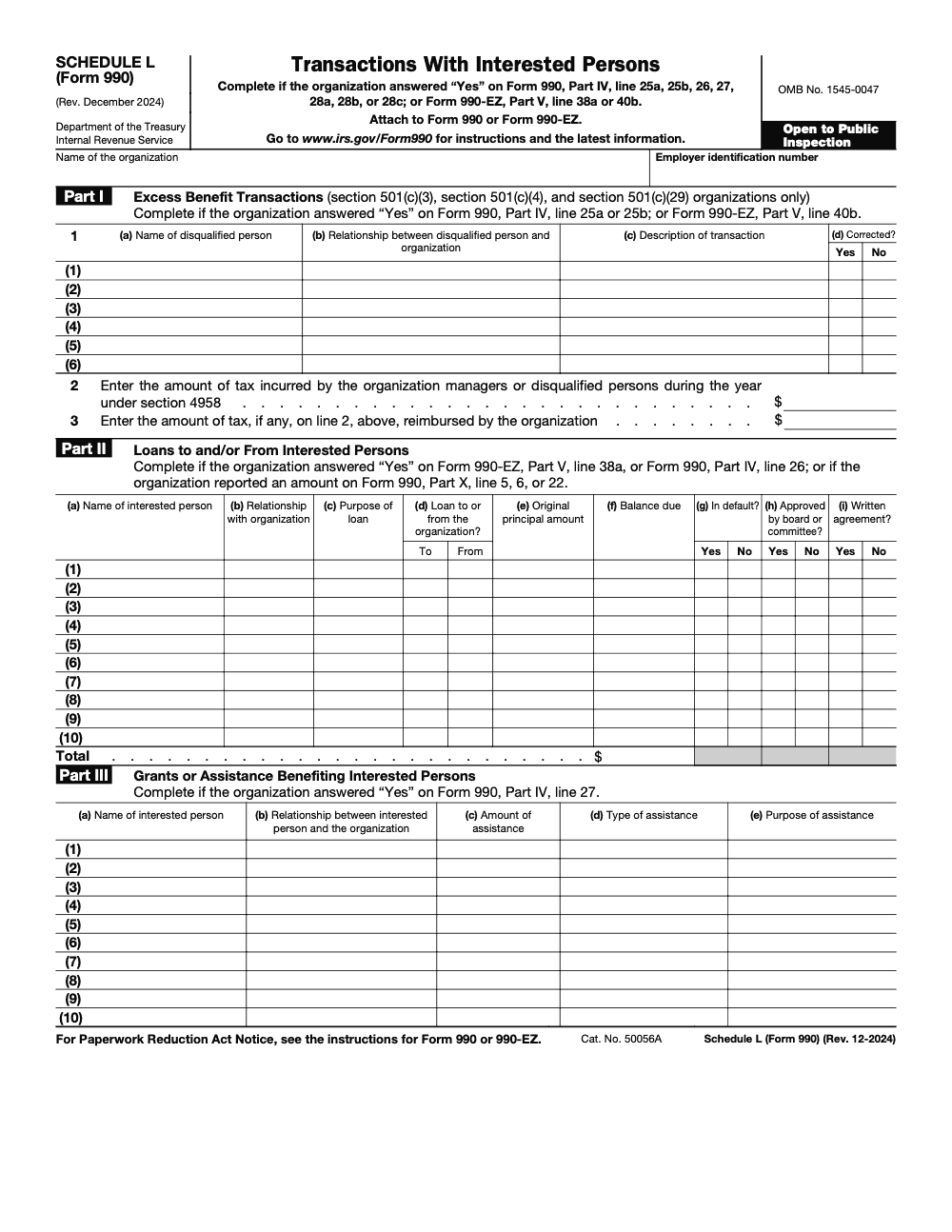
Schedule L (Form 990) is the IRS schedule for reporting transactions with interested persons – attached to Form 990 or Form 990-EZ, never filed standalone (per Schedule L instructions, Rev. December 2024). Calendar-year filers attach it by May 15, and Part IV business transactions trigger at $10,000 for individuals or the greater of $10,000 or 1% of total revenues for 35%-controlled entities.
The mistake we see most on Schedule L is assuming a dollar floor exists everywhere. It does not. Parts I, II, and III have no threshold at all, so an excess benefit transaction, a year-end loan, or a grant to an interested person gets reported no matter how small, while only Part IV business transactions carry bright lines. That single misread leaves real items off the schedule and invites the exact questions the form is meant to head off.
Schedule L never files standalone; it attaches to Form 990 or Form 990-EZ, and calendar-year filers attach it by May 15. Part I runs the section 4958 disqualified-person test with a five year lookback, Parts II through IV use the broader interested-person list, and a Part IV business transaction trips at $10,000 for an individual or the greater of $10,000 or 1% of total revenues for a 35%-controlled entity.
Key Takeaways
- Schedule L has four buckets, excess benefit transactions, year end loans, grants or assistance, and business transactions that cross IRS thresholds. Each bucket has its own rules and definitions.
- You attach Schedule L when your answers on Form 990 Part IV or Form 990‑EZ show that a reportable insider transaction occurred. The instructions map each “Yes” to the part you must complete.
- Part I uses the section 4958 “disqualified person” test with a five year lookback, plus family and 35 percent controlled entities. Parts II through IV use the broader “interested person” list.
- For Parts I, II, and III there is no dollar threshold, report all that apply. Part IV has bright lines, including totals over 100,000, a single transaction over the greater of 10,000 or 1 percent of revenue, compensation to a family member over 10,000, and joint ventures that meet specific levels.
- Part V is your narrative hub. Cross reference the exact Part and line, name the parties and relationships, give dates, amounts, approvals, and any corrections or excise taxes.
What Schedule L Covers, The Short Version
Schedule L, Transactions With Interested Persons, is where you report insider dealings tied to Form 990 or 990‑EZ. It doubles as an independence check for Form 990, Part VI, line 1b. You report the who, what, when, amounts, terms, approvals, and, if needed, corrections or excise taxes, all in one place.
- Part I, Excess benefit transactions with section 4958 disqualified persons, reported regardless of amount, including any corrections and taxes.
- Part II, Loans to or from interested persons that are still outstanding at year end, with terms, approval, and written agreement status.
- Part III, Grants or assistance to interested persons, cash or noncash, including scholarships, prizes, discounts, or use of facilities, subject to narrow exceptions.
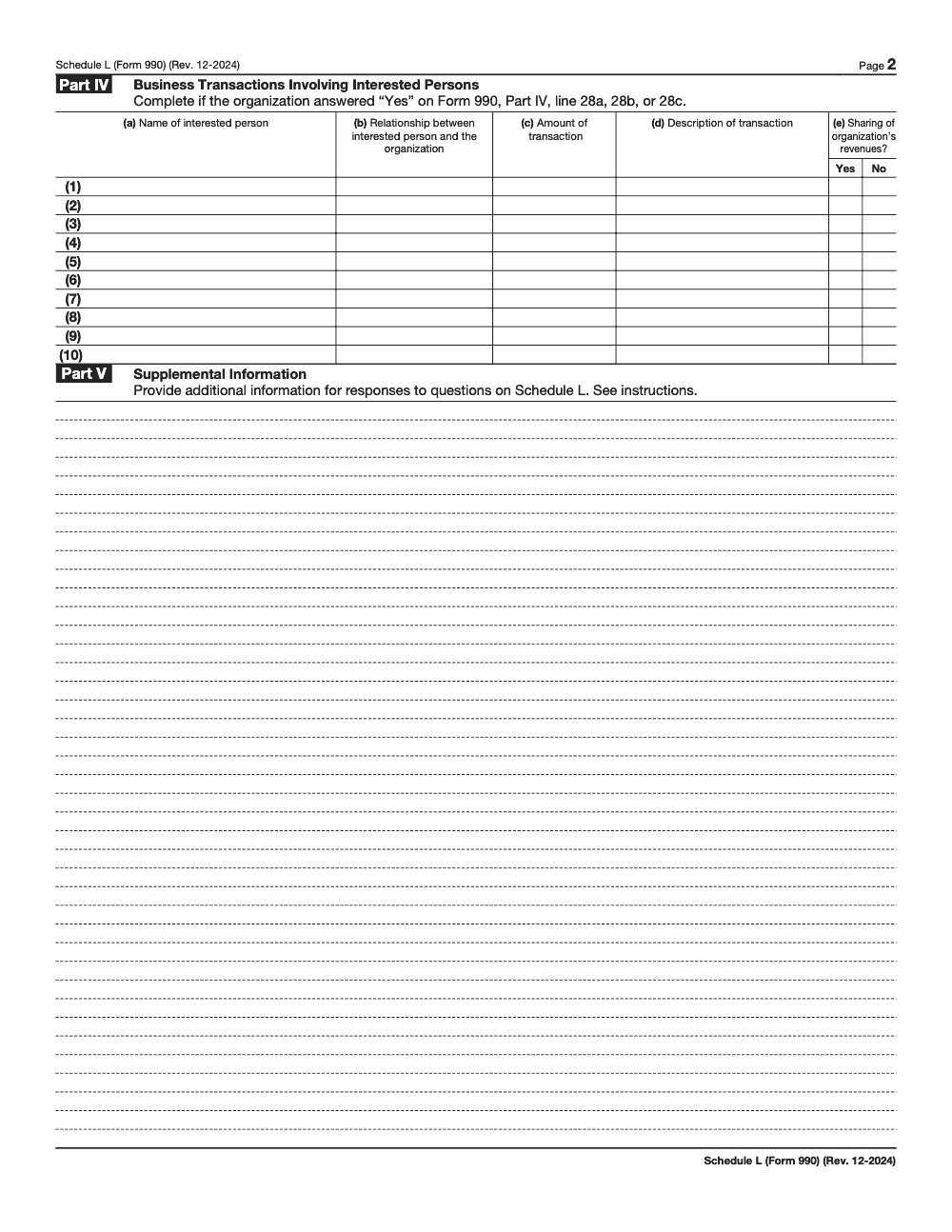
- Part IV, Business transactions with interested persons that meet the IRS thresholds, including service contracts, leases, asset transfers, and certain management company relationships with former insiders.
Who Must File Schedule L
You must attach Schedule L if your Form 990 Part IV lines 25 through 28, or related 990‑EZ questions, come up “Yes.” The instructions show exactly which answer triggers each part. If payments with an interested person exist but stay below Part IV thresholds, you answer “No” on line 28 and do not file that part. The IRS confirms this in a public FAQ updated in 2025.
Quick Trigger Map You Can Trust
- Excess benefit transactions, Form 990 Part IV 25a–25b or 990‑EZ Part V 40b, complete Schedule L Part I.
- Loans with interested persons, Form 990 Part IV 26 or 990‑EZ Part V 38a, complete Part II (Part II is also independently triggered if Form 990 Part X line 5, 6, or 22 reports any amount, even when Part IV line 26 is answered No).
- Grants or assistance to interested persons, Form 990 Part IV 27, complete Part III.
- Business transactions with interested persons, Form 990 Part IV 28a–28c, complete Part IV.
If you have a relationship with a bank because a director works there, the IRS has examples that show when ordinary deposits are not reported and when a bank counts as an interested person. Use those examples to avoid over or under reporting.
“Interested Person” vs “Disqualified Person,” Use the Right Lens
These terms are close, but they do different jobs.
- Part I, use the section 4958 disqualified person test, anyone with substantial influence in the five year lookback, plus family and 35 percent controlled entities by statute and regulation.
- Parts II through IV, use the broader interested person list from the Schedule L instructions, current or former officers, directors, trustees, and key employees listed on the return, founders, substantial contributors from Schedule B, their family, 35 percent controlled entities, and in Part III, certain grant committee and donor related situations.
If you are on the fence, decide first which part applies to the transaction. That choice tells you which definition to use. Then document your reasoning and keep it with the return.
Part I, Excess Benefit Transactions, What to Report and How to Prove It
Part I reports every excess benefit transaction with a section 4958 disqualified person, no minimum amount. An excess benefit happens when the person receives more economic value than the organization receives in return, for example, compensation above fair market value or a bargain sale. For each item, identify the disqualified person, describe the relationship and substantial influence within the past five years, list the date and terms, and state whether you corrected the transaction. If excise taxes apply, note them and remember that managers who knowingly approved can also be taxed on Form 4720 (the disqualified person pays the 25 percent first-tier tax on the excess benefit; the manager-level tax is 10 percent of the excess benefit, capped at $20,000 per transaction in the aggregate). Keep your comparability data, job descriptions, and minutes with the return.
Practical pattern you can copy:
- Build a one page summary, person, relationship, facts, values, conclusion, correction, approvals.
- File the supporting studies and bids behind that sheet.
- Mirror that summary in a clean Part V narrative that cites the Part and line.
Part II, Loans To or From Interested Persons, Year End Is The Gate
Part II asks for loans to or from interested persons that are still outstanding at year end. That includes demand loans, salary advances treated as loans, split dollar amounts treated as loans, and third party debts that became loans between your organization and an interested person. For each loan, list the name and relationship, purpose, direction of the loan, original principal, year end balance including accrued interest and fees, whether there was a default, whether the governing body approved it, and whether a signed agreement exists. Report each loan separately.
Common exclusions, do not report accountable plan advances, normal trade receivables on public terms, pledges that would be charitable when paid, accrued but unpaid compensation, and certain ordinary bank deposit situations noted by the IRS. The instructions list the full set of exclusions with cross references to other parts of Form 990 for tie outs.
Loan Documentation, A Simple Four Point Check
- Approval and conflict disclosures before funds move.
- A signed note with principal, interest, repayment schedule, and collateral if applicable.
- Year end balance that ties to Part X, lines 5, 6, or 22 as applicable.
- Default monitoring and minutes if you modify terms.
Part III, Grants or Assistance to Interested Persons, No Dollar Floor
Part III covers every grant or assistance to an interested person during the year, cash or noncash. You list the recipient, relationship, amount, type of assistance, and purpose. Think scholarships, fellowships, internships, prizes, awards, tuition discounts, or use of facilities. The IRS provides narrow exceptions for objective, nondiscriminatory programs funded by a substantial contributor or a 35 percent controlled entity, and special aggregation rules for schools. Keep selection criteria, committee rosters, award letters, and recusal notes ready to summarize in Part V if asked.
Who Counts as “Interested” in Part III
Add to the usual list, grant selection committee members and, in certain donor directed scenarios, employees or a child of an employee of a substantial contributor when the grant is intended to benefit them. When in doubt, document the objective process, show the committee was independent, and explain the criteria in your files.
Part IV, Business Transactions With Interested Persons, Know the Lines
Part IV has bright line thresholds. Report if, during the year, either all payments between your organization and the interested person are more than 100,000, or a single transaction exceeds the greater of 10,000 or 1 percent of your total revenue. Also report compensation to a family member of a current or former officer, director, trustee, or key employee when it exceeds 10,000, and report joint ventures when you have invested 10,000 or more and both you and the interested person each had over a 10 percent profits or capital interest at some point during the year. The ordinary course exception from Part VI does not apply here, but there is a limited exception for publicly traded companies if your terms match or beat public terms.
Management Companies Linked to Former Insiders
If you hire a management company, and a former officer, director, trustee, or key employee within the last five tax years owns at least 35 percent or serves as an officer, director, or trustee of that company, treat it as an interested person for Part IV testing. The five year look matters even if the person is no longer listed in Part VII.
Part IV Thresholds at a Glance
| Threshold type | When it applies | What to measure |
| Aggregate payments | Total paid between you and the interested person during the year is more than 100,000 | Add all payments between the same parties for the year |
| Single transaction | One transaction is over the greater of 10,000 or 1% of total revenue | Measure the individual payment stream for that transaction |
| Family compensation | You paid a family member of a listed current or former officer, director, trustee, or key employee more than 10,000 | Compensation to that family member during the year |
| Joint venture | You invested 10,000 or more and both parties each held more than 10% profits or capital during the year | Your investment and both ownership percentages |
These lines come straight from the current IRS instructions for Schedule L, Part IV, along with examples you can mirror for edge cases.
How to Use Part V, Your Narrative Hub
Part V is where you make the record clear. Identify the exact Part and line, name the interested or disqualified person, list dates, amounts, terms, approvals, and any corrections or section 4958 excise taxes. Use this space to show how you determined fair value, why a payment falls into Part I instead of Part IV, or how a grant program meets the objective selection exception. Duplicate Part V if you need more space.
A Clean Cross‑Reference Pattern
- Start with the cross reference, for example, “Part II, line 1.”
- Name the parties and relationships that make the person “interested.”
- List dates, dollar amounts, terms, approvals, and minutes citations.
- For excess benefits, describe the correction and who paid section 4958 tax, if any.
Practical Examples You Can Model
Family member on payroll
You paid 15,000 to the spouse of a current officer for seasonal work. That is a Part IV business transaction due to the 10,000 family compensation check. Answer the written agreement and approval questions accurately and be ready to summarize your procurement in Part V.
Year end loan balance
You advanced 8,000 for moving expenses to a key employee in May. A signed note shows a 2,500 balance at year end. Report it in Part II because loans are reported if outstanding at year end, regardless of amount. If it was a proper accountable plan advance and not a loan, it would be excluded.
Scholarship linked to a donor
A substantial contributor funds scholarships reviewed by an independent committee using preset criteria. Those awards can be excluded if the program meets the objective, nondiscriminatory rules described by the IRS. Keep the criteria and committee records in case you need to explain them in Part V.
Management company with a former executive
You hired a management company in 2025. Your former COO, who left in 2023, owns 35 percent and sits on its board. That is an interested person relationship for Part IV testing due to the five year rule for management companies. Apply the thresholds and report if met.
Documentation You Should Have Ready
- Annual and event driven conflict of interest disclosures.
- Board and committee minutes showing approvals and recusals.
- Independent valuation or comparable bids for pay and contracts.
- Loan agreements, schedules, and default monitoring.
- Grant criteria, committee rosters, award letters, and recusals.
- Joint venture agreements and proof of ownership percentages.
These are the exact items the IRS expects you to summarize in Part V when questions arise.
A Simple Pre‑Filing Checklist
- Map every “Yes” on Form 990 Part IV to the correct Schedule L section.
- Confirm all year end loans to or from interested persons and tie balances to Part X.
- Test payments against Part IV thresholds, including the 10,000 family compensation check.
- Draft Part V narratives now, not at midnight, and include approvals, agreements, valuations, and any corrections or Form 4720 filings.
Keep your Schedule L workpapers in a standing folder with a one page index. Your future self will be grateful next season.
Where Accountably Fits, Briefly and Only If You Need It
When teams miss Schedule L details, it is rarely a knowledge gap. It is reviewers stuck in long loops because files are inconsistent, or time lost chasing names, minutes, and loan terms. Accountably places trained offshore preparers and accountants inside your systems with standardized workpapers, named files, and multi-layer review, so the work is proven before your name is on the return. You start with one to three people and scale as trust builds, and if a placement is not a fit in 45 days, we replace them free. If capacity strain is putting filings at risk, the answer is not to outsource judgment, it is to test the work. Don't trust us. Test us.
Final Guidance and Next Steps
If this stirred a memory or two, you are not alone. Most Schedule L issues fade when you build an early list of interested persons, test payments and loans against thresholds, and write clean narratives while details are fresh. Use the current Schedule L instructions for 2024 and later years until the IRS publishes a new version, and file Form 4720 if section 4958 taxes apply. Keep your documentation simple, current, and easy to retrieve. You will file faster and sleep better.
Compliance note
This article is general information for U.S. nonprofits and reflects IRS guidance current through November 27, 2025. It is not legal or tax advice. For your facts, consult your tax advisor and the latest IRS pages linked in the citations.
Common Mistakes We See Every Season
The same Schedule L missteps surface every 990 season. Most stem from skimming Part IV triggers or treating §4958 like a generic disclosure rather than a tax with real correction rules.
Reusable Checklists
These checklists are copy-paste ready for firm SOPs and the tick boxes save locally in the browser. Use them as the trigger gate, the roster build, and the Part II documentation sweep before Schedule L draft.
Schedule L trigger check
- Confirm Form 990 Part IV line 25a (current-year excess benefit transactions) is answered.
- Confirm Form 990 Part IV line 25b (prior-year unreported excess benefit transactions) is answered.
- Confirm Form 990 Part IV line 26 (loans to or from interested persons) is answered.
- Confirm Form 990 Part IV line 27 (grants or assistance benefiting interested persons) is answered.
- Confirm Form 990 Part IV lines 28a, 28b, and 28c (business transactions) are each answered.
- Reconcile Form 990 Part X lines 5, 6, and 22; any balance independently triggers Part II.
- For 990-EZ filers, confirm Part V lines 38a and 40b answers.
- If every trigger is No and Part X is zero, omit Schedule L entirely – do not attach a blank schedule.
- If any trigger is Yes, confirm you are using Schedule L (Form 990) Rev. December 2024.
Interested person and disqualified person roster
- List every current officer, director, trustee, and key employee from Form 990 Part VII.
- Add former officers, directors, trustees, and key employees from the 5-year lookback.
- Add founders and substantial contributors (gave more than $5,000 if more than 2% of total contributions; status is permanent).
- Apply the full family scope: spouse, ancestors, brothers and sisters (whole or half blood), children, grandchildren, great-grandchildren, and spouses thereof.
- Identify each interested person's 35%-controlled entities.
- For Part I (501(c)(3), 501(c)(4), and 501(c)(29) organizations only), flag anyone in a position to exercise substantial influence in the 5-year lookback.
- For Part III, add grant selection committee members.
- Save the roster as the master conflict-of-interest list for the year so Parts I-IV all key off the same source.
Part II loan documentation sweep
- For each loan, mark direction in column (d) (to or from the organization).
- Record original principal in column (e).
- Reconcile column (f) ending balance to Form 990 Part X line 5, 6, or 22.
- Record default status in column (g) with explicit Yes or No – no blanks.
- Record board or committee approval in column (h) with explicit Yes or No.
- Record written agreement status in column (i) with explicit Yes or No.
- For any No in columns (g), (h), or (i), add narrative explanation in Part V.
- If pre-printed rows are insufficient, attach duplicate Schedule L pages – do not list overflow on Part V.
Keep Schedule L Season From Stalling
Schedule L work always lands in the back half of 990 season. Calendar-year filers face the May 15 deadline (with a six-month automatic extension to November 15 via Form 8868, per the Form 990 instructions), and Schedule L pulls from the same Part VII insider data, Part X balance sheet, and Part V narratives that the rest of the return depends on. Compress that into a March to May window and small documentation gaps turn into Part V rework cycles.
The fix is mechanical, not creative. Build the interested-person roster before the schedule, run Part IV and Part X triggers as a single gate, and capture column-level answers at input so reviewers are checking, not re-deriving.
- Lock the interested-person roster (officers, key employees, family, 35% entities, substantial contributors) before any Schedule L draft begins – the roster keys every part.
- Run Part IV lines 25a, 25b, 26, 27, 28a, 28b, 28c plus Part X lines 5, 6, and 22 as one trigger gate; do not draft Part II without confirming the Part X tie-out.
- For Part II, capture columns (g) default, (h) board approval, and (i) written agreement at the loan-input step so no row reaches review with blanks.
- For Part I (501(c)(3), 501(c)(4), and 501(c)(29) organizations only), document corrected status as of the filing date rather than year-end so column (d) reflects current status.
- Reserve Part V for narrative explanation; route overflow rows to duplicate Schedule L pages instead.
That structure is what we run inside our taxation engagements for exempt-org clients: an IP roster owned by a senior reviewer, a Part IV / Part X trigger gate before drafting, and column-level documentation at input rather than review. May 15 stops being a scramble when the roster work happens in January.
FAQs
It is the schedule used to disclose specified transactions with interested persons and section 4958 disqualified persons, including excess benefits, year end loans, grants or assistance, and business transactions that meet IRS thresholds. It also supports independence testing on Form 990.
A person with substantial influence in the five year lookback, plus family members and 35 percent controlled entities. The definition and family list are set by statute and regulations.
Current or former officers, directors, trustees, and key employees listed on the return, founders, substantial contributors from Schedule B, their family, 35 percent controlled entities, grant committee members for Part III, and specific donor related cases described by the IRS.
Report if aggregate payments exceed 100,000, a single transaction exceeds the greater of 10,000 or 1 percent of revenue, compensation to a family member exceeds 10,000, or a joint venture meets the 10,000 investment and 10 percent ownership checks.
Not when your terms match public terms. The IRS gives examples on banking, scholarships, and space limits that show what is and is not reportable.
Other forms this guide names
- Form 990: Nonprofit Tax Return Filing Guide 2025
- Form 990‑EZ: Eligibility, Deadlines, E‑File, Schedules
- Form 4720: IRS Excise Tax Guide for Foundations and Managers
About this guide
Accountably helps US CPA, EA, and accounting firms hire trained accountants and tax preparers in India.
About us Reviewed byJugal Thacker, CPAFounder and CEO at Accountably
A Washington-licensed CPA with 7+ years inside US firms – PwC, a real-estate tax practice, then a full-service firm, rising from reviewer to manager to advisory. This article was reviewed against current IRS guidance for the 2025 tax year and updated for filers preparing late returns, amendments, and 2026 estimates.
View profile →How we research, review, and update this guide
Every Accountably guide is researched against primary IRS sources, reviewed by a U.S. CPA, and refreshed as guidance evolves. Read our Editorial Guidelines to see how we source, fact-check, and update our content.