Summarize this article with AI
In Brief
Form W-10 (Dependent Care Provider's Identification and Certification) collects a care provider's name, address, and TIN so the taxpayer can claim the Child and Dependent Care Credit on Form 2441 or substantiate employer dependent care plan benefits. The form is NOT filed with the return – the taxpayer retains it as due-diligence documentation alongside four other acceptable substitutes: a Social Security card copy, a recent letterhead or invoice showing the TIN, an employer dependent care plan statement, or the provider's Form W-4 (per the IRS Form W-10 instructions). Form W-10 has not been revised since October 2020 and remains the current version for 2025 returns.
Parents can pay a daycare provider all year and reach tax time without the provider's TIN, and by then the provider may no longer cooperate. Form W-10, the Dependent Care Provider's Identification and Certification, is how the provider certifies a name, address, and TIN, and the most common pitfall is failing to collect it at the start of the service relationship.
The form is never filed with the IRS. The taxpayer keeps it as documentation for the Child and Dependent Care Credit on Form 2441 or for excluded dependent care benefits, and if the provider refuses to give a TIN, the taxpayer still completes Form 2441 under its refused-TIN instructions and keeps a record of the refusal.
Key Takeaways
- Form W-10 – “Dependent Care Provider’s Identification and Certification” – is completed and signed by a dependent care provider to certify their name, address, and TIN to the taxpayer who paid for dependent care services.
- Taxpayers use the provider’s information from Form W-10 (or equivalent documentation) to complete Form 2441 (Child and Dependent Care Expenses) and claim the Dependent Care Credit or exclude Dependent Care FSA benefits.
- W-10 is not filed with the IRS – it is a private document given by the provider to the taxpayer. The taxpayer retains it as documentation for their own tax return.
- Taxpayers must make a good-faith effort to obtain the provider’s TIN; if the provider refuses, the taxpayer must still complete Form 2441 per the Form 2441 instructions for the refused-TIN scenario and retain documentation of the refusal in the client’s records.
- The most common pitfall is failing to collect W-10 (or equivalent) at the start of the service relationship, then scrambling to obtain it at tax time – and discovering the provider no longer cooperates.
- Quick rule you can copy into your SOP: advise clients to obtain W-10 from every dependent care provider at the first payment, file it with their tax records, and never pay more than nominal amounts without documentation of the provider’s TIN.
What Form W-10 Is and When to Use It
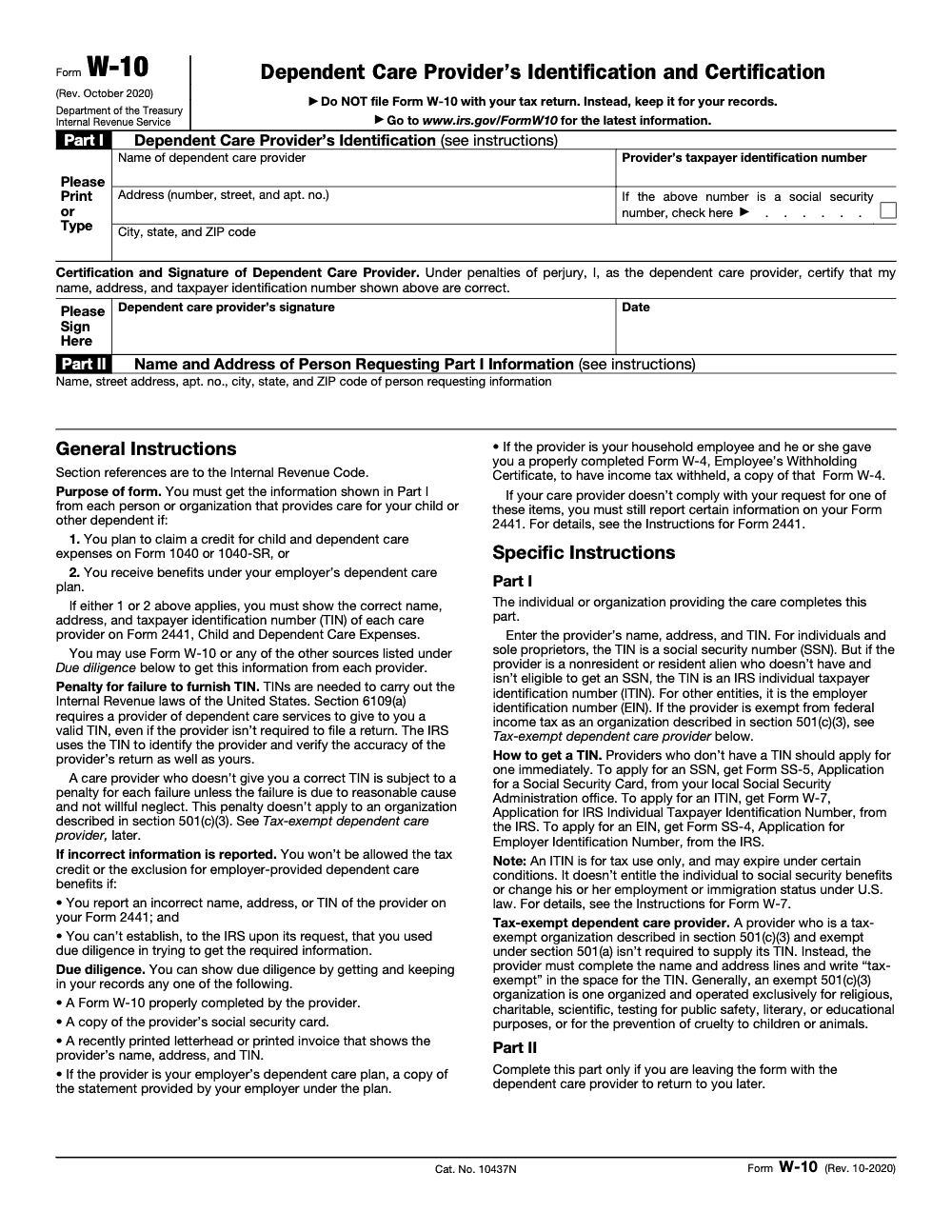
Form W-10 is a one-page identification certification completed by dependent care providers – daycare centers, after-school programs, summer camps, babysitters, nannies, au pairs, and elder care providers. The provider completes and signs the form, certifying their name, address, and Taxpayer Identification Number (TIN), and gives it to the taxpayer who paid for their services.
The taxpayer then uses the TIN provided on W-10 (or another acceptable source document such as a daycare’s W-9 or a letter on business letterhead) to fill out Form 2441 on their individual tax return. Without a valid provider TIN, the IRS may disallow the Dependent Care Credit and deny the exclusion of employer-provided Dependent Care FSA benefits, unless the taxpayer can establish to the IRS that they used due diligence in trying to obtain the required information.
From my side of the desk, Form W-10 is the least-known but most practically impactful form in the individual tax return prep process. Clients routinely pay thousands of dollars in childcare without keeping any record of the provider’s TIN. Building a W-10 request step into their recordkeeping habits is worth more in tax savings than almost any planning strategy I could offer them.
Who Uses Form W-10
The provider completes and signs Form W-10. The taxpayer requests it. Any individual or organization that provides dependent care services for which a taxpayer claims the Dependent Care Credit or excludes FSA benefits should be willing to provide this information (with one carve-out: a 501(c)(3) tax-exempt provider does not have to supply a TIN and instead writes "tax-exempt" in the TIN space). If the provider is a business, the TIN is the business EIN. If the provider is an individual or sole proprietor (nanny, babysitter), the TIN is their Social Security Number; an Individual Taxpayer Identification Number (ITIN) applies only if the provider is a nonresident or resident alien who is not eligible for an SSN.
Form W-10 vs. Form W-9
For business daycare providers (LLC, corporation, licensed center), a Form W-9 is equally acceptable as documentation of the provider’s TIN. Many established daycare centers already have Form W-9 available for parents. Form W-10 is more common when dealing with individual providers who may not be familiar with W-9. Either form accomplishes the same purpose: documenting the provider’s TIN for the taxpayer’s records.
When Is W-10 Relevant
W-10 is relevant whenever a taxpayer paid for qualifying dependent care: children under age 13, or a disabled spouse or other dependent who cannot care for themselves. The care must have been provided to allow the taxpayer (and spouse, if married) to work or look for work. The annual limit for qualifying expenses is $3,000 for one dependent and $6,000 for two or more, though these thresholds interact with the FSA exclusion limit.
How to Complete Form W-10
Form W-10 is straightforward – it is a single page with four boxes and a signature section. The provider completes all of it. The taxpayer should verify the information before filing their return.
| Field | Who Completes | What to Enter |
|---|---|---|
| Box 1 – Care Provider’s name | Provider | Legal name of individual or business name of the care provider |
| Box 2 – Address | Provider | Complete address including street, city, state, and ZIP |
| Box 3 – TIN | Provider | SSN for individuals and sole proprietors, EIN for other entity providers; an ITIN replaces the SSN only for nonresident or resident alien providers not eligible for an SSN |
| SSN designation checkbox | Provider | Check this box if the TIN entered above is a Social Security Number (the form labels this “If the above number is a social security number, check here” per the IRS Form W-10 instructions) |
| Signature and date | Provider | Provider signs and dates under penalty of perjury |
What “Under Penalty of Perjury” Means Here
The provider’s signature certifies the information is correct. If a provider provides a false TIN and the taxpayer relies on it in good faith, the taxpayer is generally protected – but they must be able to document they made a good-faith request. Keep the signed W-10 in the tax file for the year the expenses were paid. The IRS may request it during an examination of the dependent care credit claim.
Acceptable Substitutes for W-10
The IRS accepts other documentation in place of W-10, as long as the document was provided by the care provider and shows their name, address, and TIN. Per the IRS Form W-10 instructions, the four acceptable alternatives are: a copy of the provider’s Social Security card; a recent letterhead or printed invoice showing the provider’s name, address, and TIN; a statement from the taxpayer’s employer’s dependent care plan (when the provider is the plan itself); or a copy of the household employee’s Form W-4 (when the provider is the taxpayer’s household employee). The key is that the provider supplied the TIN – the taxpayer cannot simply look it up on their own.
What to Do If the Provider Will Not Give Their TIN
If a provider refuses to provide their TIN or complete Form W-10, the taxpayer must still report the expenses on Form 2441 with as much information as available (name and address) and write “See attached” in the TIN space. The IRS instructs taxpayers to attach a statement explaining their efforts to obtain the TIN. The credit may still be claimed in good-faith situations where the provider refuses, but the taxpayer’s documentation of the refusal is critical.
Deadlines, Penalties, and Consequences
Form W-10 has no filing deadline with the IRS because it is not filed with the IRS. It is an internal documentation form. However, the consequences of not having a completed W-10 (or equivalent) are tax-specific.
| Situation | Consequence | Resolution |
|---|---|---|
| No provider TIN available on Form 2441 | IRS may disallow the Dependent Care Credit | Document good-faith efforts to obtain TIN; request W-10 or W-9 retroactively |
| Provider provides incorrect TIN | IRS may send notice; the provider may be subject to a TIN-failure penalty unless the failure was due to reasonable cause and not willful neglect (501(c)(3) organizations are carved out) | Good-faith reliance doctrine protects taxpayer; document that provider signed W-10 |
| Provider refuses to provide TIN | Taxpayer must note refusal on Form 2441; credit may still be claimed | Attach written documentation of refusal attempts to tax return |
Retention Requirements
Retain the completed Form W-10 for at least three years from the date the related tax return was filed (the standard statute of limitations for individual returns). If a credit was claimed, retain it as long as the return could potentially be examined. I typically advise clients to keep dependent care documentation for five years to be safe.
Form W-10 and the Dependent Care Tax Credit
The Dependent Care Credit under IRC §21 allows eligible taxpayers to claim a non-refundable credit on Form 2441 for qualifying dependent care expenses. Understanding how W-10 fits into this credit claim helps practitioners guide clients toward proper documentation practices before tax season.
Who Qualifies for the Credit
The credit is available to taxpayers who paid for qualifying care for: (1) a child under age 13 whom the taxpayer can claim as a dependent; (2) a spouse who is physically or mentally incapable of self-care; or (3) any other person incapable of self-care whom the taxpayer can claim as a dependent. The taxpayer (and spouse, if married filing jointly) must have earned income – the credit is tied to the ability to work.
Credit Amount and Phase-Out
The credit percentage ranges from 20% to 35% of qualifying expenses, depending on AGI. The expense limit is $3,000 for one qualifying person and $6,000 for two or more. However, any employer-provided Dependent Care FSA benefits (excluded from income under IRC §129) reduce the qualifying expense limit dollar-for-dollar. If an employee excluded $5,000 in FSA benefits, only $1,000 more qualifies for the credit under the $6,000 limit (for two dependents).
How Provider TIN Documentation Supports Form 2441
Line 1 of Form 2441 requires the care provider’s name, address, and TIN for each provider. The IRS cross-references these TINs to verify that the provider reported the income on their own tax return. A missing or incorrect TIN triggers an IRS notice and potential disallowance of the credit. Form W-10 is the documentation that supports what the taxpayer enters on Form 2441 Line 1.
When Providers Refuse to Provide Form W-10
One of the most common practical difficulties with Form W-10 is providers who refuse to provide their TIN – typically individual babysitters or nannies who do not want their income on the tax radar. Here is how to handle it.
The Taxpayer’s Legal Position
The IRS acknowledges that providers may refuse to provide their TIN, even though IRC §6109(a) requires a dependent care provider to furnish a valid TIN to the customer regardless of whether the provider has a return-filing requirement. Under these circumstances, the taxpayer is still required to report the provider’s name and address on Form 2441 and must note that the TIN was requested and refused. The good-faith standard protects taxpayers who genuinely tried to obtain the TIN – the credit is not automatically denied because the provider refused.
Documenting the Refusal
When a provider refuses to complete Form W-10 or provide any TIN documentation, create a dated written record of the request and the refusal. Include: date of the request, how the request was made (in person, via email, etc.), the provider’s response, and the provider’s name and address. Attach this documentation to the client’s tax return or retain it in the file as backup for the Form 2441 credit claim.
What Happens If the Credit Is Disallowed
If the IRS disallows the dependent care credit because of a missing or incorrect TIN, the taxpayer can respond to the IRS notice with documentation of good-faith efforts to obtain the TIN. This is why having the written refusal record is so important. Without it, the disallowance stands and the credit is lost.
Practical Advice for Clients
Advise clients to request W-10 or equivalent documentation at the start of the service relationship, not at the end of the year. For individual providers who balk at providing an SSN, explain that the information goes only to the taxpayer for their records – it is not separately reported to the IRS as a 1099. Many individual providers who resist the initial request will cooperate when the process is explained clearly.
Common Mistakes That Slow Things Down
Most W-10 mistakes I see come down to one root error: treating the form as a return attachment instead of recordkeeping documentation. Once that frame is wrong, the rest of the workflow drifts.
Practical Checklists You Can Reuse
Three packets I keep in every dependent care file. Copy them into your SOP wiki, share with the engagement team, and the W-10 stops being the bottleneck at Form 2441 review.
W-10 Provider Intake Packet
- Send the blank Form W-10 (Rev. October 2020) to the client as part of the dependent care credit questionnaire.
- Confirm the provider's TIN type: SSN for individuals and sole proprietors, EIN for entities, ITIN for nonresident providers without SSN eligibility.
- If the provider is a 501(c)(3) charitable daycare or religious preschool, write 'tax-exempt' in the TIN field per the IRS Form W-10 instructions.
- Verify the SSN designation checkbox is marked when the TIN is an SSN.
- Leave Part II blank when the provider completes the form in real time.
- Confirm the provider signed and dated the form (the signature is a perjury-jurat certification of the TIN).
- Save the signed W-10 to the client's permanent file, tagged as due-diligence support – not a return attachment.
Acceptable Alternatives When No W-10
- Copy of the provider's Social Security card (for individual providers).
- Recent letterhead or printed invoice showing the provider's name, address, and TIN.
- Statement provided by the client's employer under the dependent care plan (when the provider is the plan itself).
- Copy of the household employee's Form W-4 (when the provider is the client's household employee).
- Date-stamp the substitute on receipt – the IRS treats a recent document as more probative than a stale one.
- Note which substitute applied on the engagement memo so the next-year preparer does not re-request the W-10.
Provider-Refused-TIN Response
- Document the request: dated email or certified mail receipt asking for the W-10 or any acceptable substitute.
- Document the refusal: the provider's reply, or a contemporaneous note if the refusal was verbal.
- Report the provider name and address on Form 2441 per the Form 2441 instructions for the refused-TIN scenario (typically an attached statement).
- Retain the refusal documentation in the client's permanent file – the IRC Section 6109(a) duty is the provider's, not the taxpayer's, and good-faith effort preserves the credit.
- Flag the engagement for next-year follow-up: a fresh W-10 attempt at the start of the next intake cycle.
- If the provider is a 501(c)(3), do not log the refusal as a failure – tax-exempt organizations are not subject to the TIN-furnishing penalty.
Keep W10 Season From Stalling
Form W-10 fails quietly. It is not return-attached, so it does not trigger an e-file rejection when missing. The cost shows up later at Form 2441 review, when the preparer realizes the provider's TIN was never collected and the client now has to chase a daycare director who left for the summer. The IRS processes roughly 161 million individual returns each year (according to IRS Publication 1304, SOI TY2022), and Form 2441 is the kind of credit-supporting form that draws correspondence audits when the supporting records are thin.
The fix is not more diligence at filing time. It is moving the W-10 collection earlier in the engagement cycle, when the provider is still reachable and the client is engaged. Once that shift happens, the W-10 stops being a March emergency and becomes a January task.
- Add a W-10 line item to the annual intake questionnaire alongside the W-2 and 1099 list. Treat it as part of the document checklist, not an afterthought.
- Pre-fill Part II of the form only when the client will be leaving the W-10 with the provider for later return – otherwise leave it blank.
- Build a TIN-type quick-reference card for the preparer team: SSN for individuals and sole proprietors, EIN for entity providers, ITIN for nonresident providers, 'tax-exempt' for 501(c)(3) organizations.
- Set a refusal-response SOP that triggers automatically when a provider does not return the W-10 within ten days: switch to a substitute document request (letterhead invoice, SSN card copy, or W-4 copy for household employees).
- Tag the client file with the substantiation source actually used (W-10, letterhead, SSN card, employer plan statement, or W-4) so the next-year preparer does not re-collect what is already on hand.
Accountably handles dependent care provider intake as part of our individual tax return preparation workflow. The W-10 collection, the substitute-document fallback, and the Form 2441 reporting all happen in one cycle, so the credit holds up if the IRS asks.
FAQs
Form W-10 is used by dependent care providers to certify their name, address, and TIN to taxpayers who paid for their services. Taxpayers use this information to complete Form 2441 and claim the Child and Dependent Care Credit or exclude employer-provided Dependent Care FSA benefits from their income. Form W-10 is not filed with the IRS – it is retained by the taxpayer as supporting documentation.
The dependent care provider completes and signs Form W-10. The taxpayer requests it. Providers include daycare centers, after-school programs, summer camps, individual babysitters, nannies, and other qualifying dependent care service providers. For business providers, the TIN is an EIN. For individuals, it is an SSN, or an ITIN only if the individual is a nonresident or resident alien who is not eligible for an SSN.
If a provider refuses to provide their TIN, the IRS requires the taxpayer to still report the provider on Form 2441 with whatever information is available (name and address), note the TIN was requested and refused, and retain documentation of the refusal attempt in the file (the Form W-10 instructions defer to the Form 2441 instructions for what to enter in the TIN field when a provider refuses). The credit is not automatically denied if a good-faith request was made and refused – but you must document the attempt.
Yes. For business dependent care providers, a completed and signed Form W-9 is an acceptable substitute for Form W-10. Many licensed daycare centers already have W-9s available for parents. Either form documents the provider’s TIN in a format the IRS accepts as substantiation for the dependent care credit claim on Form 2441.
Retain Form W-10 for at least three years from the date you filed the tax return on which you claimed the dependent care credit. If the credit was substantial or there is any question about the provider’s legitimacy, keeping it for five years is prudent. Dependent care credits are an IRS audit focus area for individual returns.
Other forms this guide names
Summarize this article with AI
About this guide
Accountably helps US CPA, EA, and accounting firms hire trained accountants and tax preparers in India.
About us Reviewed byJugal Thacker, CPAFounder and CEO at Accountably
A Washington-licensed CPA with 7+ years inside US firms – PwC, a real-estate tax practice, then a full-service firm, rising from reviewer to manager to advisory. This article was reviewed against current IRS guidance for the 2025 tax year and updated for filers preparing late returns, amendments, and 2026 estimates.
View profile →How we research, review, and update this guide
Every Accountably guide is researched against primary IRS sources, reviewed by a U.S. CPA, and refreshed as guidance evolves. Read our Editorial Guidelines to see how we source, fact-check, and update our content.