Summarize this article with AI
In Brief
Form 973 is a corporation’s claim for the dividends-paid deduction on consent dividends – deemed distributions that shareholders agree to include in income without any cash changing hands, under IRC §565. It is never filed on its own; it attaches to the corporation’s income tax return and must be backed by a Form 972 from each consenting shareholder (per the Form 973 instructions, Rev. November 2016). For a calendar-year 2025 C corporation, that return was due April 15, 2026, with a six-month extension to October 15, 2026 on Form 7004. That extension is to file only, not to pay – interest accrues on any unpaid corporate tax from the original April 15, 2026 due date.
During a return review for a new client, the prior preparer had claimed the dividends-paid deduction for consent dividends on the corporate return without a single shareholder having filed a Form 972. Form 973 is the corporate side of the consent dividend, and the corporate deduction is only valid to the extent each shareholder has executed and filed a corresponding consent.
Form 973 is never filed on its own. It attaches to the corporation's Form 1120, flows through the PHC tax calculation on Schedule PH or the accumulated earnings tax, and the deduction must exactly match the sum of all consent amounts on the Forms 972, or the IRS disallows part or all of it. For a calendar-year 2025 C corporation the return was due April 15, 2026, with a six-month extension to file, not to pay, on Form 7004.
Key Takeaways
- Form 973 is filed by the corporation to claim a deduction for consent dividends paid to shareholders under the dividends-paid deduction provisions of IRC §561.
- Form 973 must be accompanied by Forms 972 from each consenting shareholder – the corporate deduction is only valid to the extent each shareholder has executed and filed a corresponding consent.
- Form 973 is attached to the corporation’s Form 1120 and the dividends-paid deduction flows through the PHC tax calculation on Schedule PH or the accumulated earnings tax calculation.
- The deduction amount on Form 973 must exactly match the sum of all consent amounts reported on the collected Forms 972; any discrepancy results in partial or complete disallowance.
- Quick rule you can copy into your SOP: prepare Form 973 and all shareholders’ Forms 972 simultaneously, reconcile before distribution, and collect signed Forms 972 before filing the corporate return.
- Form 973 alone does not create the deduction – if shareholders have not validly consented on Form 972, the IRS will disallow the deduction regardless of what is claimed on Form 973.
What Form 973 Is and When to Use It
Form 973 – Corporation Claim for Deduction for Consent Dividends – is the corporate-side instrument for claiming the dividends-paid deduction attributable to consent dividends. Under IRC §561, a corporation may deduct dividends paid to shareholders as part of calculating its personal holding company (PHC) tax exposure under IRC §541, or its accumulated earnings tax exposure under IRC §531. Consent dividends – amounts agreed by shareholders to be included in their gross income without an actual cash distribution – qualify as dividends paid for this purpose under IRC §565, but only to the extent the consented amount would constitute a dividend under IRC §316 if actually paid; if the corporation has no current or accumulated earnings and profits, the constructive distribution is a return of capital rather than a dividend and no consent dividend deduction is allowed.
The practical purpose of Form 973 is to allow closely held C corporations with significant passive income to reduce or eliminate their PHC tax liability without distributing actual cash. Instead, shareholders consent to include deemed dividends in their income (Form 972), and the corporation claims the corresponding deduction on Form 973. The net result is that the income is taxed at the shareholder level rather than subjected to the additional 20% PHC tax at the corporate level.
Form 973 is used exclusively by C corporations, and even among C corporations only those that actually face the personal holding company tax or the accumulated earnings tax (along with regulated investment companies and real estate investment trusts under subchapter M) have a statutory basis to file; a regular C corporation that pays its corporate income tax in full has no use for it. S corporations, partnerships, and other pass-through entities do not face PHC or accumulated earnings tax and therefore have no use for this form. For clients operating as closely held C corporations with passive income – particularly professional service corporations, investment holding companies, and family-owned businesses – this form is part of a critical year-end tax planning toolkit.
The Dividends-Paid Deduction Under IRC §561
The dividends-paid deduction under IRC §561 reduces a corporation’s undistributed PHC income (for PHC tax purposes) or the accumulated earnings subject to the accumulated earnings tax. This deduction includes actual cash dividends, property dividends, and consent dividends. Consent dividends are particularly valuable because they achieve the deduction without depleting the corporation’s cash position. The deduction claimed on Form 973 must be supported by valid shareholder consents on Form 972 – without those consents, the Form 973 deduction claim is worthless.
When Form 973 Is Filed
Form 973 is filed as an attachment to the corporation’s Form 1120 for the tax year in which the consent dividends are effective. It is not filed as a standalone document. The corporate return, including Form 973 and the Forms 972 that the corporation attaches to its own income tax return for each consenting shareholder, represents the complete documentation package for the consent dividend strategy.
How to Complete Form 973
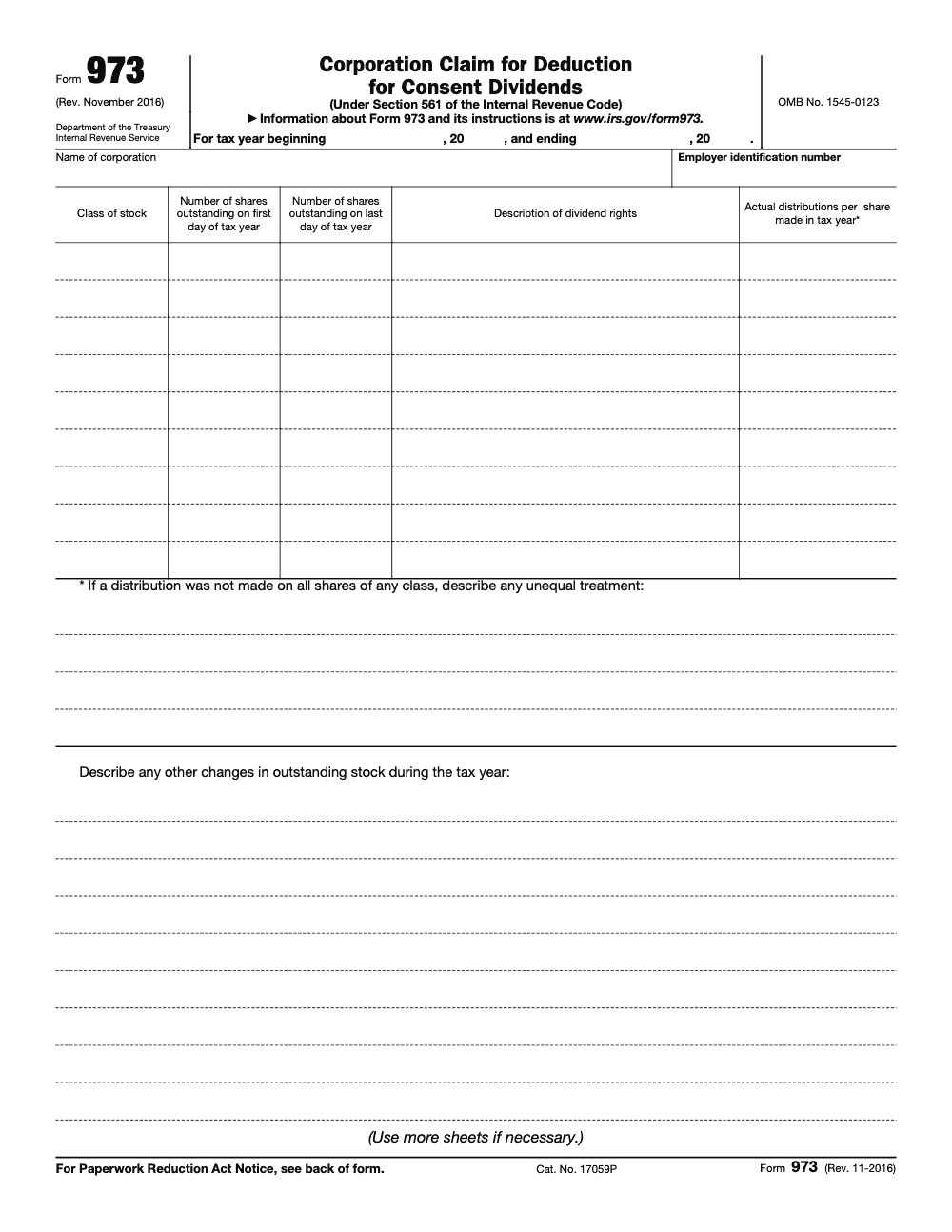
Form 973 captures the corporation’s identifying information and a per-class stock table (class of stock, shares outstanding on the first and last day of the tax year, dividend rights, and actual distributions per share); the consent dividend amount itself is established by each attached Form 972. The accuracy of the shareholder breakdown is critical – it must match the Forms 972 actually executed by shareholders.
| Field / Section | What to Enter | Practitioner Tip |
|---|---|---|
| Corporation Name and EIN | Legal name and employer identification number as on Form 1120 | Must match the Form 1120 header exactly – discrepancies create processing issues |
| Tax Year | The corporation’s fiscal or calendar tax year for which the deduction is claimed | Confirm the consent dividends were executed within this tax year – prior-year consents cannot be applied to the current year |
| Per-Class Stock Table | For each class of consent stock: class of stock, shares outstanding on the first and last day of the tax year, dividend rights, and actual distributions per share; the consent dividend amount itself is established by the attached Forms 972, not by a standalone total field on Form 973 | This figure must equal the sum of all individual consent amounts on the collected Forms 972; verify before filing |
| Stock Detail by Class | For each class of stock: class of stock, shares outstanding on the first and last day of the tax year, dividend rights, and actual distributions per share; consent amounts themselves come from each shareholder’s Form 972 | Cross-reference each line to the corresponding Form 972; each shareholder’s amount must match their Form 972 exactly |
| Attachment of Forms 972 | Copies (or originals) of each shareholder’s signed Form 972 | IRS may request the underlying Forms 972 during examination; maintain originals in the engagement file regardless of what is submitted with the return |
Reconciliation with Schedule PH (Personal Holding Company Tax)
Schedule PH is attached to Form 1120 and calculates the PHC tax. The dividends-paid deduction from Form 973 flows into Schedule PH to reduce undistributed PHC income. Make sure the Form 973 deduction amount is correctly reflected in Schedule PH – an error in this cross-reference leaves PHC tax exposure on the table even when the consent dividend strategy was otherwise correctly executed.
Consent Dividend Timing on Form 973
The tax year shown on Form 973 must be the year in which the consent dividends were made. If the corporation is on a fiscal year and shareholder consents were executed during the fiscal year but before the corporate return is filed, confirm that all consents are dated within the fiscal year period – not after year-end. The timing rule under IRC §565 is strict, and the IRS will disallow a deduction supported only by post-year-end consents unless the specific statutory exception applies.
Deadlines, Penalties, and Filing Requirements
Form 973 is filed with the corporation’s Form 1120 by the corporate return due date. For calendar-year corporations, the standard due date is April 15, with an automatic six-month extension to October 15 available via Form 7004. That extension is for time to file only, not time to pay – interest accrues on any unpaid corporate tax from the original April 15 due date.
| Filer | Form | Due Date |
|---|---|---|
| Corporation (calendar year) | Form 973 attached to Form 1120 | April 15 (extended to October 15 with Form 7004) |
| Corporation (fiscal year) | Form 973 attached to Form 1120 | 15th day of 4th month after fiscal year end |
| Each consenting shareholder | Form 972 attached by the corporation to its own income tax return | Filed with the corporate return – Form 973 and each Form 972 are submitted together |
Consequences of an Unsubstantiated Form 973 Deduction
If the IRS determines on examination that Forms 972 were not validly executed (wrong amounts, post-year-end dates, missing shareholder signatures), the corresponding Form 973 deduction will be disallowed. This disallowance reinstates the undistributed PHC income, triggering the 20% PHC tax plus interest and potentially accuracy-related penalties. The cost of a failed consent dividend strategy can far exceed the cost of properly coordinating the Forms 972 and 973 before the return is filed.
Dividends-Paid Deduction Strategy – When Consent Dividends Outperform Actual Distributions
The choice between consent dividends and actual cash distributions is a planning decision, not just a compliance one. Each approach has distinct tax and economic consequences that must be evaluated in the context of the corporation’s cash position, the shareholders’ tax situations, and the long-term ownership structure.
Cash Flow Comparison
An actual dividend distribution provides shareholders with cash to pay the resulting tax. A consent dividend forces shareholders to report income without receiving cash – they must fund the tax liability from other sources. For shareholders with high other income and available liquidity, this is manageable. For shareholders whose primary asset is the corporation’s stock and who lack liquidity, a consent dividend can create real financial strain. Always model both scenarios and present the after-tax cash flow comparison to your clients before recommending either approach.
Basis Implications of Consent Dividends
When a shareholder includes a consent dividend in gross income under Form 972, their basis in the corporation’s stock is treated as increased by the consent amount (as if they had received the dividend and contributed it back to the corporation). This basis increase can have meaningful long-term consequences on the shareholder’s eventual gain or loss on disposition of the stock. Make sure this basis adjustment is recorded in the shareholder’s stock basis schedule – it is one of the most commonly missed items in PHC planning.
PHC and Accumulated Earnings Tax Planning Context
Form 973 operates at the intersection of two penalty taxes that closely held C corporations must actively manage: the personal holding company tax and the accumulated earnings tax. Understanding both – and how Form 973 addresses them – is essential for any practitioner serving C corporation clients.
Personal Holding Company Tax (IRC §541)
The PHC tax imposes a 20% rate on undistributed PHC income. A corporation subject to PHC status that retains passive income without distributing it faces this additional tax on top of the regular corporate tax. Form 973’s consent dividend deduction reduces the undistributed PHC income base directly. For a corporation with $500,000 of undistributed PHC income, a consent dividend of $500,000 (with all shareholders executing Form 972) eliminates the $100,000 PHC tax entirely – a significant planning result.
Accumulated Earnings Tax (IRC §531)
The accumulated earnings tax applies when a corporation retains earnings beyond the reasonable needs of the business to avoid shareholder-level dividend tax. The 20% accumulated earnings tax applies to accumulated taxable income, which is reduced by the dividends-paid deduction. Consent dividends claimed on Form 973 can reduce accumulated taxable income in the same way as actual distributions. The accumulated earnings tax context often involves a more fact-intensive analysis, including documentation of the corporation’s business needs justifying retention.
Common Mistakes That Slow Things Down
The Form 973 deduction lives or dies on the consents behind it, and the errors I see in review almost always trace back to a corporation treating the form as a standalone claim instead of the visible tip of a documented consent package.
Practical Checklists You Can Reuse
These checklists are copy-paste ready for your engagement SOP, so a preparer can work the consent dividend the same way every year instead of rebuilding the steps from memory.
Consent dividend pre-file packet
- Confirm the corporation is an eligible filer: subject to the accumulated earnings tax, a personal holding company, a regulated investment company, or a real estate investment trust.
- Verify current or accumulated earnings and profits support the planned amount under IRC §316.
- Identify which classes are consent stock under IRC §565(f)(1) and exclude any that are not.
- Collect a signed Form 972 from each consenting shareholder, dated within the tax year.
- Total the Form 972 amounts and carry the exact sum to Form 973.
- Attach Form 973 and each Form 972 to the corporation’s income tax return.
- Retain the signed original Form 972 in the engagement file even when an unsigned copy is filed.
Proportionality and disclosure scan
- Run a per-share proportionality check within each class to rule out a preferential dividend under IRC §562(c).
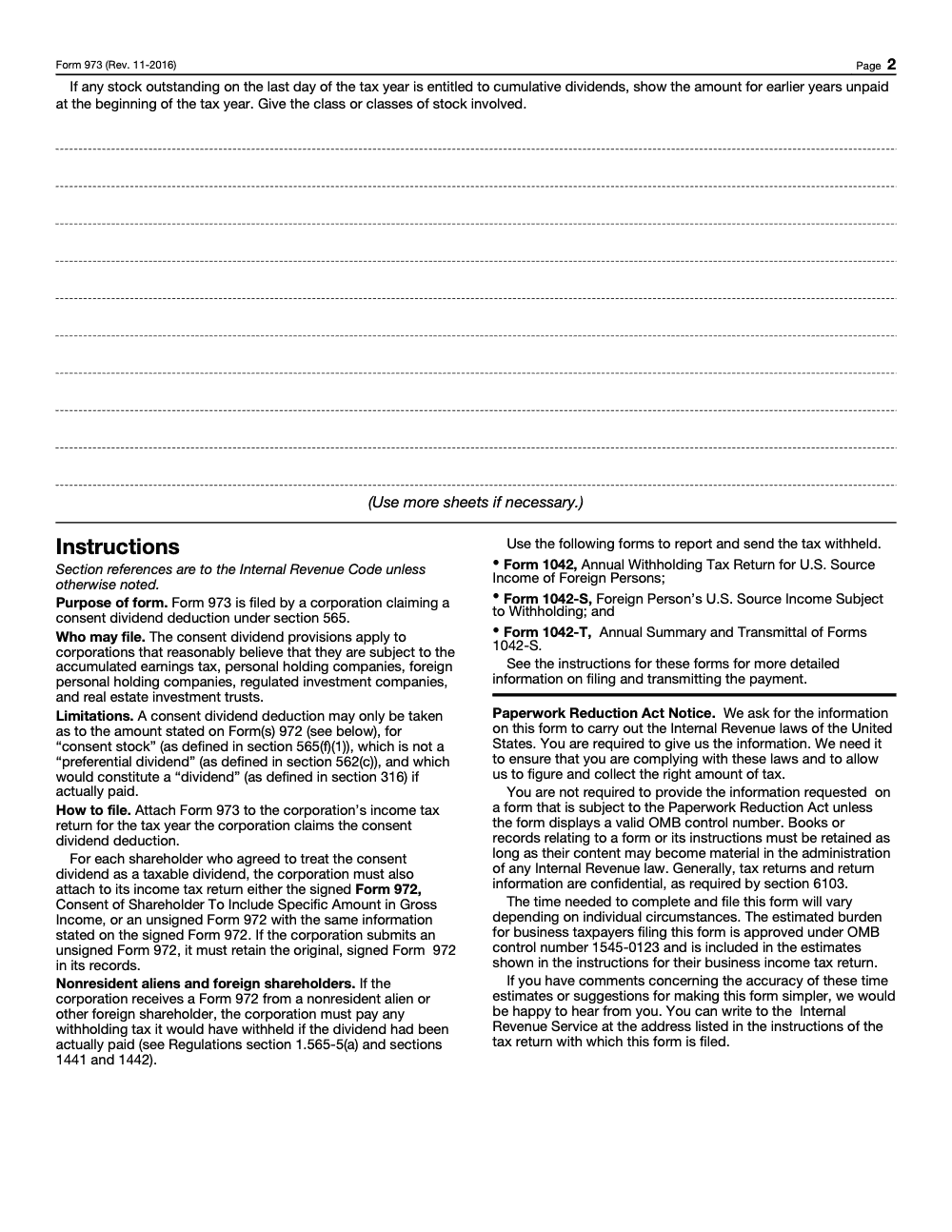
- Describe any unequal treatment within a class on the form.
- Show cumulative dividends unpaid at the beginning of the year for any class entitled to cumulative dividends.
- Describe any changes in outstanding stock during the year, such as issuances, redemptions, or recapitalizations.
- Reconcile the shares outstanding on the first and last day of the tax year.
Foreign shareholder and deadline check
- Flag any nonresident alien or foreign corporate shareholder among the consents.
- Compute withholding, generally 30% under IRC §1441 or §1442 subject to treaty reduction.
- Report the deemed dividend and tax on Forms 1042, 1042-S, and 1042-T.
- Confirm the filing date matches the corporate return due date, April 15, 2026 for calendar-year 2025 filers.
- Calendar the Form 7004 extension to October 15, 2026 if more time is needed to assemble consents.
Keep 973 Season From Stalling
Form 973 rarely shows up in volume, but when it does it lands at the worst possible moment: the back end of the corporate close, when the Form 1120 is almost ready and someone realizes the consent dividend still needs documenting. The stakes are not small, since an unsupported claim reinstates the personal holding company tax under IRC §541 plus interest (per the Form 973 instructions, Rev. November 2016).
The fix is to treat the consent dividend as a documented package built in parallel with the return, not a line item bolted on at signing. When the Forms 972, the per-share table, and the deduction total are reconciled before the return is finalized, the form stops being a fire drill.
- Build Form 973 and every shareholder’s Form 972 in the same workpaper, then reconcile the totals before anything is signed.
- Lock the consent amount to available earnings and profits so the claim survives the IRC §316 dividend test.
- Screen each class against the consent-stock definition in IRC §565(f)(1) and the preferential-dividend rule in IRC §562(c) before drafting.
- Calendar the corporate deadline, April 15, 2026 for calendar-year 2025 filers, and the Form 7004 extension to October 15, 2026 so consents are gathered with time to spare.
- Route any foreign shareholder consent into the Form 1042 withholding workflow rather than discovering it after filing.
That kind of parallel, reconcile-before-signing discipline is what a structured delivery team is built for. Our offshore tax preparation teams assemble the consent package, reconcile Form 973 to the underlying Forms 972, and hand reviewers a clean file, so the corporate close moves without the year-end scramble.
FAQs
The corporation must attach a Form 972 for each consenting shareholder to its own income tax return alongside Form 973; the consents are not filed separately with the shareholders’ individual returns. However, the IRS expects that Form 973 is supported by valid consents. If shareholders ultimately fail to file or file invalid Forms 972, the corporate deduction will be disallowed. Best practice is to collect signed Forms 972 before filing Form 973 to eliminate this risk entirely.
The personal holding company tax under IRC §541 is imposed at a flat 20% rate on undistributed PHC income. For a corporation with $1 million of undistributed PHC income, the potential tax is $200,000. A properly executed consent dividend strategy that generates a full dividends-paid deduction eliminates this liability, at the cost of shareholder-level dividend tax on the consented amount. The net tax savings depends on each shareholder’s individual tax rate.
Yes. The dividends-paid deduction claimed on Form 973 reduces accumulated taxable income for accumulated earnings tax purposes under IRC §531, in addition to reducing undistributed PHC income under IRC §541. The accumulated earnings tax context involves a more complex analysis, including the accumulated earnings credit and reasonable business needs arguments, but Form 973 serves the same mechanical function in both contexts.
A consent dividend reduces the corporation’s current earnings and profits by the consented amount, just as an actual dividend distribution would. This E&P reduction is an important element of the overall planning analysis – it affects the tax character of future actual distributions and the corporation’s E&P history. Maintain a current E&P schedule that reflects all actual and consent dividends for all PHC-status or accumulated earnings risk clients.
Other forms this guide names
- Form 972: Shareholder Consent to Include Dividends in Income
- Form 1120: Corporation Tax Return Guide
- Form 7004: Business Tax Extension Guide, Deadlines & E‑File
- Form 1042: Annual Withholding Tax Return for Foreign Persons 2025
- Form 1042-T: Paper Transmittal for 1042-S, Due March 15
Summarize this article with AI
About this guide
Accountably helps US CPA, EA, and accounting firms hire trained accountants and tax preparers in India.
About us Reviewed byJugal Thacker, CPAFounder and CEO at Accountably
A US-licensed CPA with 7+ years inside US firms – PwC, a real-estate tax practice, then a full-service firm, rising from reviewer to manager to advisory. This article was reviewed against current IRS guidance for the 2025 tax year and updated for filers preparing late returns, amendments, and 2026 estimates.
View profile →How we research, review, and update this guide
Every Accountably guide is researched against primary IRS sources, reviewed by a U.S. CPA, and refreshed as guidance evolves. Read our Editorial Guidelines to see how we source, fact-check, and update our content.