Summarize this article with AI
In Brief
Form 1120-X amends a previously filed Form 1120 (or other 1120-series return) to correct income, deductions, tax, or payments and to claim a refund or report additional tax due (per IRS Form 1120-X instructions, Rev. December 2025). File within the later of 3 years from the original due date including extensions, or 2 years from the date the tax was paid (IRC §6511); explain every change in Part II with the line number plus the computation. If amendment work is eating senior review time, see our tax outsourcing services.
The call that triggers a 1120-X usually sounds the same. A controller realizes the original return missed something material: a §179 election that should have been flagged, a state refund pickup the bookkeeper skipped, or a recaptured credit rolled into the wrong year. The question is rarely whether to amend; it is whether the statute window is still open and how quickly each path gets cash back.
Form 1120-X amends a previously filed 1120-series return and must be filed within the later of 3 years from the original due date including extensions, or 2 years from the date the tax was paid. Explain every change in Part II with the line number and the computation. Paper processing runs about 3 to 4 months, the online amended-return tracker does not show business status, and for corporate amendments you call the Business and Specialty Tax Line at 800-829-4933.

Key Takeaways
- Use Form 1120‑X to amend a previously filed corporate return, and file it only after the original 1120 has posted. The common window to claim a refund is generally 3 years from the original filing date, or 2 years from when you paid the tax, whichever is later. Early‑filed returns are treated as filed on the due date.
- E‑file is possible for many corporate amendments, but not by sending a stand‑alone 1120‑X. In practice, you e‑file an amended Form 1120 with the 1120‑X data attached in XML. If your original was required to be e‑filed, your amended return is usually required to be e‑filed too.
- If you mail, send the signed 1120‑X to the same IRS service center that received the original 1120. The instructions still say, file at the service center where the corporation filed its original return.
- Expect processing to take about 3 to 4 months for paper, complex cases can run longer.
- The IRS “Where’s My Amended Return” tracker does not show business return status. For corporate amendments, call the IRS Business and Specialty Tax Line at 800‑829‑4933.
Who should file Form 1120‑X, and who should not
You should file if you are a C corporation, including an LLC taxed as a C corporation, and you need to correct income, deductions, credits, or other facts on a previously filed Form 1120. Wait until the original 1120 has been filed. If you are seeking a refund, make sure you are still inside the limitation window.
You should not use 1120‑X for items the IRS handles through different channels. For example, quick refunds of estimated tax go on Form 4466, carryback tentative refunds use Form 1139 when within a year of the loss or credit year, and accounting method changes require Form 3115. If your carryback is outside the one‑year tentative window, that is when 1120‑X comes back into play.
Common situations that call for an 1120‑X
- You discovered omitted income or deductions, or need to fix classification of an expense.
- You finalized a credit calculation after filing and must reflect it on the return.
- The IRS examined your return, posted changes, and your state positions now need to match the federal facts.
- You need to make a late election where relief is available under Reg. 301.9100, and the instructions point you to use 1120‑X to make that election (relief is not automatic – the corporation must identify the specific election and meet the regulatory criteria).
Entities that do not use 1120‑X
- S corporations file amended corporate returns using the amended 1120‑S path, not 1120‑X.
- Partnerships amend on Form 1065, estates and trusts on 1041, and individuals on 1040‑X.
- Homeowners associations on 1120‑H follow their own amended filing rules. Consult your software or IRS e‑file program rules if you plan to transmit electronically.
Field note, if your internal review process is tight, most amendments trace back to documentation gaps, naming chaos in workpapers, or unclear reviewer notes, not to tax law. Fix the system, and you cut your amendment rate next season.
Understand your deadlines and refund windows
Timing makes or breaks an amended corporate return. The general refund rule is simple on paper, file within 3 years of when you filed the original 1120, or within 2 years of when you paid the tax, whichever is later. If you filed early, the IRS treats it as filed on the due date, so count from that date.
There are important special rules. A claim based on a net operating loss, capital loss, or general business credit carryback generally must be filed within 3 years after the due date, with extensions, of the year that generated the carryback. Claims tied to bad debts or worthless securities can have a 7‑year window. Always confirm your facts against IRC section 6511 and the current 1120‑X instructions.
Here is a simple way to map your window before you touch the form.
- Step 1, write down the original 1120 filing date and the original due date with extensions. If you filed early, use the due date.
- Step 2, list the dates and amounts of payments, including extension payments and any later assessments you paid.
- Step 3, compute both clocks, 3 years from the treated filing date, and 2 years from the latest payment you want refunded, then use the later date.
- Step 4, if your claim is based on a carryback, check the special rule from the loss or credit year.
- Step 5, if your amendment only reclassifies items without changing tax, you still want it in during the general window to keep the record clean.
Pro tip, include a brief statute timeline in your workpapers. Reviewers bless you for it, and you reduce back‑and‑forth when someone checks timeliness later.
What to file, and how to complete each part
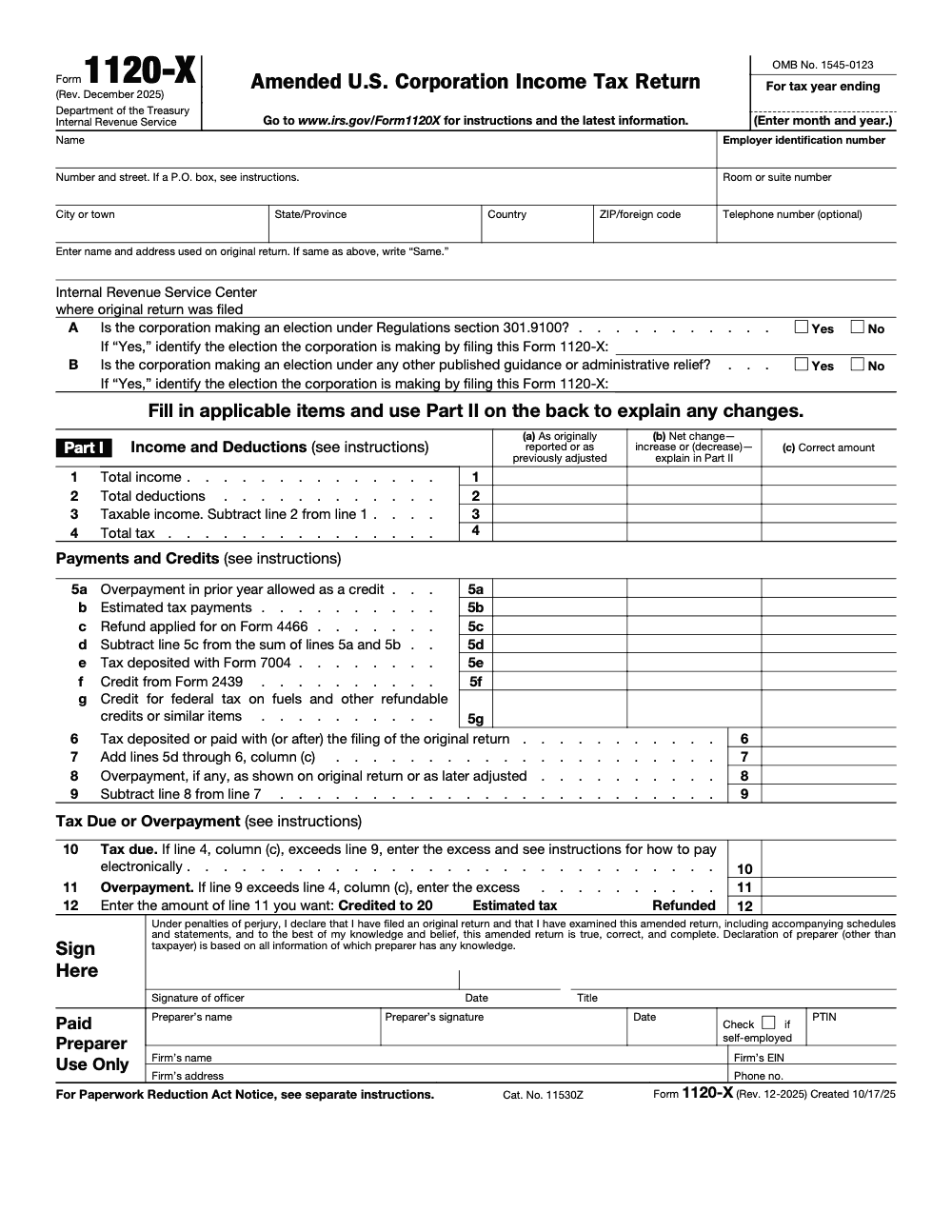
Open Form 1120‑X for the correct tax year and complete the header, including EIN and the amended tax year. In Part I, follow the three‑column method for every affected line, column (a) shows original or IRS‑adjusted amounts, column (b) shows the net increase or decrease for that line, and column (c) shows the corrected amount. Use parentheses for decreases. This mirrors the form and keeps your math audit‑friendly.
Part II is where you win or lose time in review. Give a clear, itemized explanation for each change. Reference line numbers, provide the corrected amounts, and state the why, for example, “To reflect year‑end inventory adjustment identified during cycle count reconciliation.” If law or guidance matters, cite it plainly. Attach the schedules that support each change. Typical attachments include updated M‑1 or M‑2, a revised 1125‑A for cost of goods sold, Form 4255 if investment credit recapture applies, corrected W‑2s or 1099s, and any carryback computations.
Sign the 1120‑X. Officers who can sign include the president, vice president, treasurer, assistant treasurer, or chief accounting officer, or another authorized corporate officer. If a fiduciary is signing for a receiver or trustee in bankruptcy, include the court order authorizing the signature.
Keep the explanation tight, specific, and readable. Reviewers and examiners are humans too. Clear stories get faster approvals.
E‑file or mail, and how to send it to the IRS
If you mail a paper 1120‑X, send it to the IRS service center where you filed the original Form 1120. Check current instructions before you ship in case service center addresses changed. Use a trackable method or a designated private delivery service if timing is tight.
If you e‑file, remember the practical rule, you do not transmit a stand‑alone 1120‑X. You transmit an amended Form 1120 through Modernized e‑File, select the Amended Return indicator in software, and attach the 1120‑X XML explanation and any supporting PDFs the program requires. If the original return was required to be e‑filed, the amended or superseding return is usually required to be e‑filed, unless you hold a waiver or the tax year is no longer supported on MeF.
Processing time varies with workload. The instructions still suggest about 3 to 4 months for a paper 1120‑X, and the IRS’ operations page shows they prioritize refunds and work through paper backlogs by form series. If you need the latest status on general backlogs, check the IRS operations dashboard for Form 1120 series.
To check status, know that the “Where’s My Amended Return” tool does not track business amended returns. For corporate returns, call the Business and Specialty Tax Line at 800‑829‑4933. Have your EIN, the tax year, the date you filed or transmitted, and a copy of the amended package handy. Hours and scope for that line are listed on IRS.gov.
What to attach so your reviewer says “approved”
- The schedules and forms that changed, for example, amended M‑1 or M‑2, a revised Schedule J computation inside the 1120, updated 1125‑A, or Form 4255 if you triggered recapture.
- A clean Part II narrative that lists each changed line, the corrected amount, and the reason.
- Payment proof if you are claiming a refund, and clear carryback calculations if applicable.
- If someone other than an officer is dealing with the IRS, attach a current Form 2848 Power of Attorney for representation.
Keep a simple cross‑reference index. Example, “Change 1 ties to WP‑COGS‑03 and InvRoll‑Q4‑Recount.xlsx.” Future you will thank you during a state piggyback amendment.
Step‑by‑step, from “we found an error” to a clean 1120‑X
When a team pings me with “we need to amend,” I pull up the same short checklist every time. It keeps the work focused and the statute safe.
Prep checklist before you touch the form
- Confirm the original Form 1120 was filed and posted. If it was rejected and later fixed, use the finally accepted version as your baseline.
- Capture the dates that start your clocks, the original filing date or due date if filed early, plus each tax payment date and amount.
- Identify every line that changes, not just the headline item. Adjust downstream lines that flow from the change.
- Export or print the original return, notices, and affected schedules. Pull any late 1099s, K‑1s, inventory counts, and credit computations.
- Decide refund vs no‑refund. If you want money back, you must be inside the statute.
- Pick transmit method, e‑file amended 1120 with attached 1120‑X content if available in your software, or mail a signed 1120‑X to the original service center.
Small habit that pays off, set up a “1120X‑TaxYear‑Client” folder and number your attachments in the order you reference them in Part II. Future you will cheer.
How to complete Part I, the three‑column method
Part I uses three columns for each line you are changing.
- Column (a), the number that was originally filed or later adjusted by the IRS.
- Column (b), the net change for that line, increases as positive, decreases in parentheses.
- Column (c), the corrected amount after applying column (b).
Simple example, your cost of goods sold on line 2 goes from 1,200,000 to 1,260,000 after you found a late vendor invoice batch:
- Column (a) 1,200,000
- Column (b) 60,000
- Column (c) 1,260,000
Make sure your totals reconcile across income, deductions, and tax. If a change increases a credit, reflect that change on the proper line and attach the revised computation.
Part II explanation, the template reviewers love
Use Part II to tell the story in clear, short paragraphs. Reference lines and attachments so a reviewer can verify your math without guessing.
Sample wording you can adapt “Line 2, Cost of goods sold, increased by 60,000 to reflect late‑posted vendor invoices discovered during year‑end AP reconciliation. See Attachment A, AP‑Rollforward‑Q4 and vendor statement confirmations. Line 28, taxable income, decreased by 60,000. Line 30, total tax, decreased accordingly. The corporation requests a refund of overpaid tax for the 20XX tax year. The claim is filed within the period prescribed by IRC 6511.”
Tips for a tight Part II:
- Keep each change in its own paragraph.
- State the amount, the reason, and the evidence.
- Cross‑reference attachments by label and file name.
- If you rely on a specific rule or election, cite it in plain English.
Signatures, POA, and packaging
- An authorized officer must sign. If an outside preparer is involved, they sign in the paid preparer section, but that does not replace the officer’s signature.
- If a representative will talk to the IRS on your behalf, include a current Form 2848 Power of Attorney.
- For mailed filings, print single‑sided, assemble in a logical order, put the 1120‑X on top, payment vouchers behind, then attachments, then the POA. Use a trackable mail method.
- For e‑filed amended 1120 packages, follow your software’s attachment rules for the 1120‑X explanation and supporting PDFs. Validate, clear schema errors, then transmit.
What to attach, by situation
- Income or COGS changes, revised 1125‑A or workpapers that show inventory or purchase rollforwards.
- Deduction corrections, schedules that tie to GL detail and invoices.
- Credit changes, updated credit forms and carryforward or carryback computations.
- Recapture items, Form 4255 or relevant recapture schedules.
- Payroll‑driven changes, corrected W‑2s, W‑3c, or 941‑X tie outs.
- Refund claims, proof of payments you want refunded and a simple statute timeline.
One page to rule them all, add a cover memo titled “Map of Changes.” It lists each changed line, the attachment that proves it, and the net tax impact. You will cut review time in half.
Avoid the top amendment pitfalls
You do not need a long list here, just the ones that cause the most pain.
- Vague Part II narratives, “to correct errors,” with no amounts or evidence.
- Changing one line, then forgetting to update totals or credits that cascade from it.
- Missing proof of payments when asking for a refund, which slows approval.
- Filing outside the 3‑year or 2‑year windows for refunds.
- Treating software exports as workpapers without context, reviewers need a story, not just numbers.
- Not checking state implications, you fix federal, then discover a state deadline passed.
A quick QA pass before you file
- Do totals foot on every page that changed.
- Does Part II reference every attachment and every changed line.
- Are names, EIN, and the tax year correct on each page.
- Is the signature present and dated.
- If mailing, is the address correct and trackable postage selected.
- If e‑filing, did you mark the Amended Return indicator and attach PDFs per schema.
If your amendment reduces tax, add a one‑line interest note in your cover memo, “We understand the IRS will compute any allowable interest on the overpayment.” It shows you know the process and keeps the package tidy.
Timing, statutes, and real‑world examples
The cleanest way to protect your refund rights is to map the statute in writing. Here are simple examples to model.
Example 1, early filer with payments
- Original 1120 due date April 15, 2024, return filed March 20, 2024.
- Extension payment of 50,000 on April 15, 2024, and balance due of 10,000 paid October 15, 2024.
- The 3‑year clock starts April 15, 2024, because early returns are treated as filed on the due date.
- The 2‑year clock for the 10,000 starts October 15, 2024.
- Your latest deadline to claim a refund tied to that 10,000 is October 15, 2026. If you want the April 15 payment back too, your claim also needs to be timely for that amount.
Example 2, carryback claim after the tentative window
- You generated a 2025 NOL, and you are outside the one‑year tentative refund window for Form 1139.
- You can still amend prior years affected by the carryback using Form 1120‑X, attach the NOL computation, and show the carryback year allocations.
- Double‑check the special limitation period for carrybacks in the instructions, then file your 1120‑X for each affected year.
Special windows worth flagging for your file
- Worthless securities and bad debt claims can have a 7‑year window.
- Foreign tax credit timing often requires careful documentation.
- If fraud or non‑filing is involved, different rules may apply, talk to counsel.
If you are on the edge of a deadline, file a protective claim that clearly states the grounds and amounts at issue, then supplement with finalized numbers. It preserves your place in line.
Workpaper standards that cut review time
Great amendments feel boring to review. Everything is labeled, cross‑referenced, and totals foot. That is the goal.
Name files so another human can follow
- Use a short prefix that mirrors your Part II order, A, B, C.
- Add a meaningful name, not “support.xlsx.” Example, “B‑1125A‑COGS‑Rollforward‑2025.xlsx.”
- Put the tax year in every filename.
Build a one‑page index
Create a single page that lists:
- Change number, line reference, amount, and reason.
- Attachment file name that proves it.
- Who prepared the workpaper and who reviewed it, plus dates.
- Net tax effect, increase or decrease.
Tie to the GL and source docs
- Reconcile from the financial statement line or GL account to the tax line you changed.
- If inventory is the issue, show beginning balance, purchases, adjustments, and ending balance with counts to support.
- For credit changes, tie forms to payroll or project accounting where relevant.
A small extra that exam teams love, include a “timeline of events” when the change stemmed from late‑arriving information. It explains why the original was wrong without drama.
What changes trigger state amended returns
Once your federal numbers move, stop and ask, do any states care about this change, and if yes, how soon.
Common triggers
- Any federal change to taxable income.
- Updates to credits that flow to state returns by statute.
- Changes to apportionable items, sales, property, or payroll that drive the state percentage.
- Federal changes finalized by IRS exam, many states require you to report within a fixed period, often 30, 60, or 90 days.
Practical process for state follow‑ons
- Create a list of filing states from the original return.
- For each, mark whether the federal change affects the state base or apportionment.
- Look up each state’s deadline to report federal changes, plus any special attachments like a copy of the 1120‑X or a state‑specific schedule.
- Calendar those due dates and prepare the state packages right after federal is submitted, do not wait.
If you operate in combined or unitary states, verify whether the change affects entities elsewhere in the group. Pull the combined report to confirm.
Processing time, tracking, and what to do if the IRS writes back
You want your refund, or at least confirmation that the record is fixed. Here is how to set expectations and keep things moving.
How long it can take
Plan on several months for paper submissions. Complex amendments, carryback claims, or packages with many attachments can run longer. Electronic submissions generally move faster once accepted, but volume and staffing still matter. If cash flow is tight, set internal expectations with stakeholders early to avoid surprise.
Tracking status
There is no dedicated online tracker for corporate amended returns. Keep your proof of mailing or e‑file acceptance notice. To check status, call the IRS Business and Specialty Tax Line. Have your EIN, the tax year, the date you filed, and a copy of your package ready. Document the call date, the agent’s name or ID, and any next steps they give you.
If you receive an IRS notice
- Respond by the notice deadline, even if you need more time. You can ask for additional time to gather documents.
- Match the notice to your change map. If they question line 2, pull Attachment A that supports line 2.
- Keep your reply organized. Start with a short summary letter, attach the notice, then the proof that addresses each item, labeled to match your summary.
- If you made a math slip, own it, fix it, and, if needed, file a second 1120‑X to correct the correction.
Do not send source documents the IRS did not request, send what answers the question. Over‑sharing can confuse the file.
Limits of Form 1120‑X and better alternatives when they fit
Sometimes 1120‑X is not your best tool. Use the right form for the right job.
Superseding return vs amended return
If you discover an error before the original due date, including extensions, consider filing a superseding return. It replaces the original return in the IRS system for that year. After the due date passes, you are in amended territory.
Quick‑hit alternatives you should know
- Form 1139, Corporation Application for Tentative Refund, often the fastest route to cash for NOL and certain credit carrybacks, if you are inside the one‑year window from the end of the loss or credit year.
- Form 4466, Corporation Application for Quick Refund of Overpayment of Estimated Tax, for overpaid estimates if you meet the threshold and file by the 15th day of the 4th month after year end (a Form 7004 extension does not extend the Form 4466 deadline).
- Form 3115, Application for Change in Accounting Method, when the fix is a method issue, not a one‑time error.
Comparison table
| Scenario | Best form | Why it fits | Timing notes |
| You corrected COGS after year end and want a refund | Form 1120‑X | Amends the filed 1120 with proof | Inside 3‑year or 2‑year window |
| Large NOL carryback within one year of loss year end | Form 1139 | Tentative refund, generally faster cash | One‑year window from end of loss year |
| Big overpayment of estimates, want a quick refund | Form 4466 | Quick refund of overpaid estimates | File by month 4 day 15 after year end |
| Fix requires method change, not a one‑off error | Form 3115 | Formal method change with 481(a) | Follow Rev Proc of the year |
If cash timing matters, start with the table, then pick the path that gets relief fastest while staying compliant.
For firms, how disciplined delivery makes amendments painless
If you run a CPA or EA firm, amendments can clog your pipeline in peak season. That is where structure saves you.
- Standardize your 1120‑X Part II templates and your “Map of Changes” index across the team.
- Train staff on statute mapping and have seniors review the timeline before anyone drafts the form.
- Centralize naming standards for workpapers so reviewers never hunt for files.
- Measure turnaround with simple SLAs, intake to draft, draft to review, review to file.
Accountably can help here in a focused way. We integrate trained offshore teams into your process with SOP‑driven execution, structured workpapers, and multi‑layer review, so partners spend less time fixing drafts and more time on client strategy. Use us when you need stable production capacity for compliance, including corporate amendments, without giving up quality or control.
Light touch, big impact, a clean process turns 1120‑X from a fire drill into a routine ticket.
Common Mistakes We See Every Season
Amendments are where small errors get expensive, fast. The same handful of traps repeat every season, and every one of them has a clean fix if you build it into your SOP.
Reusable Checklists
These are copy-paste ready for your firm SOPs. Tweak the dates and line numbers to your engagement, then run them in order on every 1120-X.
Pre-amendment statute scan
- Confirm the original Form 1120 (or 1120-S, 1120-A) was filed and identify the IRS Service Center where it was sent.
- Pull the original return's due date including any timely Form 7004 extension.
- Pull the actual date the corrected-year tax was paid.
- Compute the later of 3 years from the original due date or 2 years from the payment date (IRC §6511) and document on the workpaper cover sheet.
- Check whether the amendment is driven by an NOL, capital loss, or general business credit carryback; if yes, also note the 1-year Form 1139 window.
- Confirm no S-corp years break the carryover stream (a C corp may not carry capital losses to or from an S-status year).
Form 1120-X assembly packet
- Front page: enter the original name and address used on the prior return, or write "Same" if unchanged; check the §301.9100 election box only if applicable.
- Part I: complete columns (a), (b), and (c) for lines 1 through 12; verify line 3 (taxable income) and line 4 (total tax) reconcile at the 21% flat corporate rate.
- Carryback box: check it in Part II if the change is an NOL, capital loss, or general business credit carryback.
- Part II: for each change, write the line number, the reason, and the corrected computation in detail.
- Attach revised schedules, forms, and supporting workpapers that drove the change in column (c).
- Compute line 10 (tax due) or line 11 (overpayment); on line 12 allocate any overpayment between credit to next year's estimated tax and refund.
- Officer signs under penalties of perjury; preparer block completed; pay any balance due electronically.
Carryback decision: Form 1139 vs Form 1120-X
- Identify the loss year end and count 12 months forward; that is the Form 1139 deadline.
- If within the 12-month window, default to Form 1139 for the tentative refund.
- If beyond 12 months but within the 3-year-from-due-date or 2-year-from-payment window, use Form 1120-X with the carryback box checked.
- For a C corp carrying a capital loss back 3 years, refigure the prior-year tax treating the loss as short-term in the carry year.
- Confirm the capital loss does not create or increase an NOL in the carryback year (it cannot, by rule).
- Remember Form 7004 does not extend the Form 4466 quick-refund deadline; that filing must precede the corporation's income tax return.
Keep 1120-X Season From Stalling
1120-X work runs on a different clock than original filings. Amendments do not arrive in a predictable March-to-April wave. They arrive whenever a client closes the books, finishes a state audit, finalizes a §481(a) accounting method change, or finds a missed §179 election in a prior year. Each one resets the statute math, reopens prior-year schedules, and pulls a senior into review on something that was not on the planned engagement list.
The discipline that keeps these tickets from clogging your pipeline is not more staffing. It is a standard intake-to-file path that anyone on the team can follow.
- A single Part II template that forces the line number, the reason, and the computation into the same three blocks on every amendment.
- A statute cover sheet that lays out the 3-year-from-due-date clock and the 2-year-from-payment clock side by side, with the later date circled before any drafting starts.
- A pre-draft check for whether Form 1139 or Form 4466 is the faster path, so 1120-X is the considered choice, not the default.
- A carryback flag at intake that triggers the Part II carryback box and routes the file through the corresponding IRS processing track.
- Workpaper naming that pairs every changed line in Part I with the revised schedule or form supporting the corrected column (c) amount.
This is the model we run for engagements that treat amendments as a normal production stream rather than a fire drill. Our tax outsourcing teams integrate this intake-to-file path into the existing workflow with SOP-driven execution and multi-layer review, so partners spend less time rebuilding Part II math and more time on the next engagement.
FAQs
Yes, but if you want an additional refund, your claim still has to be within the 3‑year or 2‑year window. If the amendment increases tax, pay with the filing to stop interest from growing.
Often yes, especially if federal facts changed in a way that states must follow, or if you want the permanent record to match the corrected numbers. Keep Part II short and factual.
Yes. Explain each change in its own paragraph in Part II and attach the schedules for each. The form is built for multiple corrections to one year.
If their change is correct, reflect it in states that require reporting of federal changes. If you disagree, follow the exam’s protest or appeals path. You can still file an 1120‑X for separate errors you found.
Mail to the service center where you filed the original 1120 for that year. Check the current instructions right before you send, addresses can move. Use a trackable method.
Follow your transmission method. For paper, an original officer signature is standard. For electronic amended 1120 packages, follow your software’s supported signature options.
Other forms this guide names
- Form 1120: Corporation Tax Return Guide
- Form 7004: Business Tax Extension Guide, Deadlines & E‑File
- Form 4466: Quick Refund Guide 2026 for Corporations
- Form 1125-A: COGS Guide for Corporations & Partnerships
- Form 3115: Accounting Method Change Guide 2025
- Form 4255: ITC Recapture, PWA Penalties, Excess Direct Pay & Transfers
Summarize this article with AI
About this guide
Accountably helps US CPA, EA, and accounting firms hire trained accountants and tax preparers in India.
About us Reviewed byJugal Thacker, CPAFounder and CEO at Accountably
A Washington-licensed CPA with 7+ years inside US firms – PwC, a real-estate tax practice, then a full-service firm, rising from reviewer to manager to advisory. This article was reviewed against current IRS guidance for the 2025 tax year and updated for filers preparing late returns, amendments, and 2026 estimates.
View profile →How we research, review, and update this guide
Every Accountably guide is researched against primary IRS sources, reviewed by a U.S. CPA, and refreshed as guidance evolves. Read our Editorial Guidelines to see how we source, fact-check, and update our content.