Summarize this article with AI
In Brief
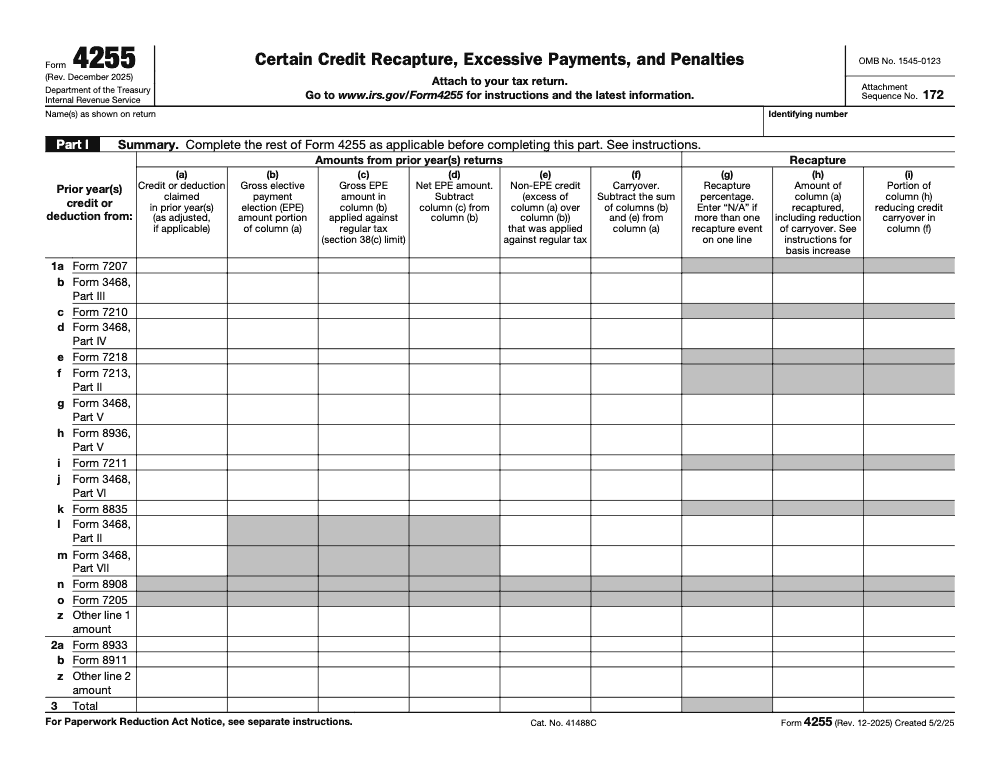
Form 4255 (Rev. December 2025) computes the increase in tax from credit recapture, excessive elective payments, and excessive credit transfers – it covers IRC §50(a) recapture on the five-year sliding scale (100%, 80%, 60%, 40%, 20%, 0%), the 20% statutory additions on excessive §6417 payments and §6418 transfers, and the Inflation Reduction Act prevailing-wage and apprenticeship penalties. Attach Form 4255 to the return (Form 1040, 1120, 1120-S, 1065, or 990-T) for the year in which the recapture event, excessive payment, or penalty arises, with Attachment Sequence Number 172 per the Form 4255 (Rev. December 2025) instructions on IRS.gov. See the U.S. tax preparation hub for filing-cycle context.
You claimed a section 48 credit in 2023 and sell the property in 2025, two full years after it was placed in service, so 60 percent of that credit comes back as an increase in tax. Form 4255 is where that increase gets computed, and the amount depends on how many full years passed: the recapture schedule runs 100%, 80%, 60%, 40%, 20%, then 0%. Get the year count wrong and the whole figure is wrong.
Beyond IRC §50(a) recapture, Form 4255 is also where prevailing wage and apprenticeship penalties and excessive elective payments or credit transfers land. Excess direct pay under §6417 and excess transfers under §6418 trigger an increase equal to the excess, plus a potential 20% additional amount unless you show reasonable cause. Attach the form to the return for the year in which the recapture event occurs.
Key Takeaways
- Form 4255 increases tax for investment and energy credit recapture under IRC section 50(a), and it is also where you report prevailing wage and apprenticeship penalties and excessive direct payments or credit transfers. File it with the return for the year the event is determined.
- The classic recapture schedule is five years. Count full years from placed in service to the event, then apply 100%, 80%, 60%, 40%, 20%, or 0%. Basis and carryovers adjust after recapture.
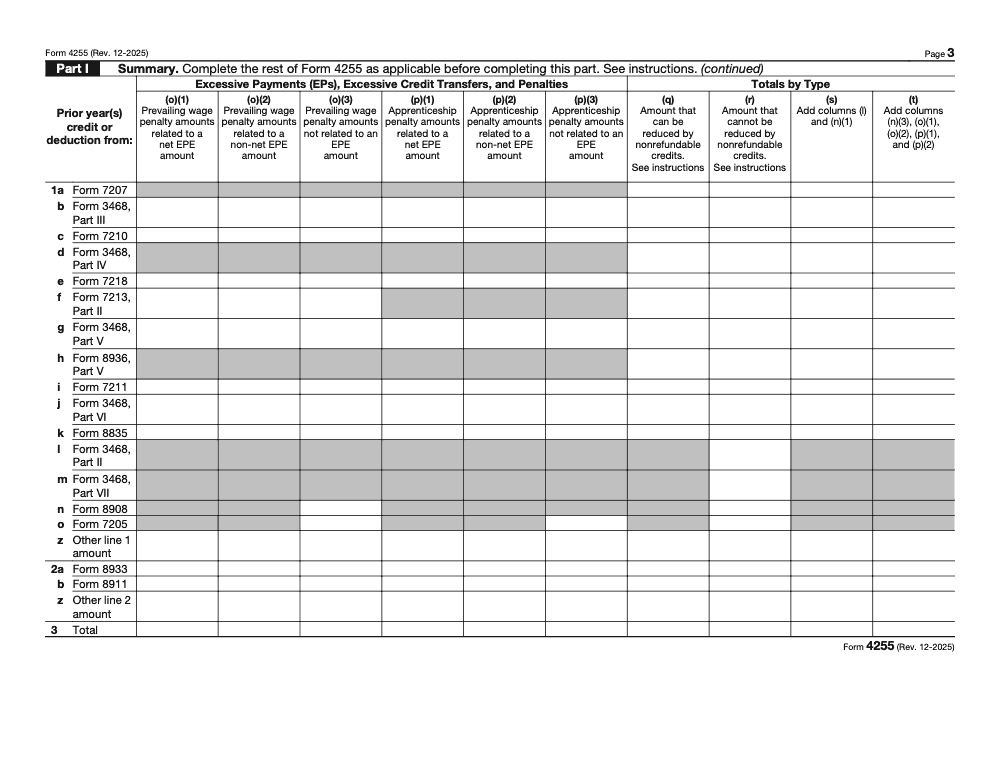
- Columns (o) and (p) on the December 2025 instructions are where you enter prevailing wage and apprenticeship penalties – column (o) series for prevailing wage, column (p) series for apprenticeship – tied to credits or deductions, including amounts that originated on Forms 8908, 7205, or 7213.
- Excess direct pay under section 6417 and excessive credit transfers under section 6418 trigger an increase in tax equal to the excess, plus a potential 20% additional amount unless you show reasonable cause. Report on Form 4255.
- Partnerships and S corporations generally compute these amounts at the entity level and follow the instructions for how to push totals to the entity return rather than through K‑1s.
- Prevailing wage penalties are typically 5,000 per underpaid worker, or 10,000 if intentional disregard. Apprenticeship penalties are 50 per noncompliant labor hour, or 500 for intentional disregard. These rules apply to the credits and deduction the IRS lists under the IRA PWA framework.
What Form 4255 Does
Form 4255 has grown into a hub for three buckets of issues:
- Recapture of investment or energy credits under section 50(a) when qualified property is sold, disposed of, drops below qualified business use, or otherwise ceases to qualify within the recapture window.
- Prevailing Wage and Apprenticeship penalties tied to the IRA’s increased amounts. Starting with tax years that include 2024, you enter these penalty amounts in Part I, columns (o)(1)-(o)(3) for prevailing wage and columns (p)(1)-(p)(3) for apprenticeship.
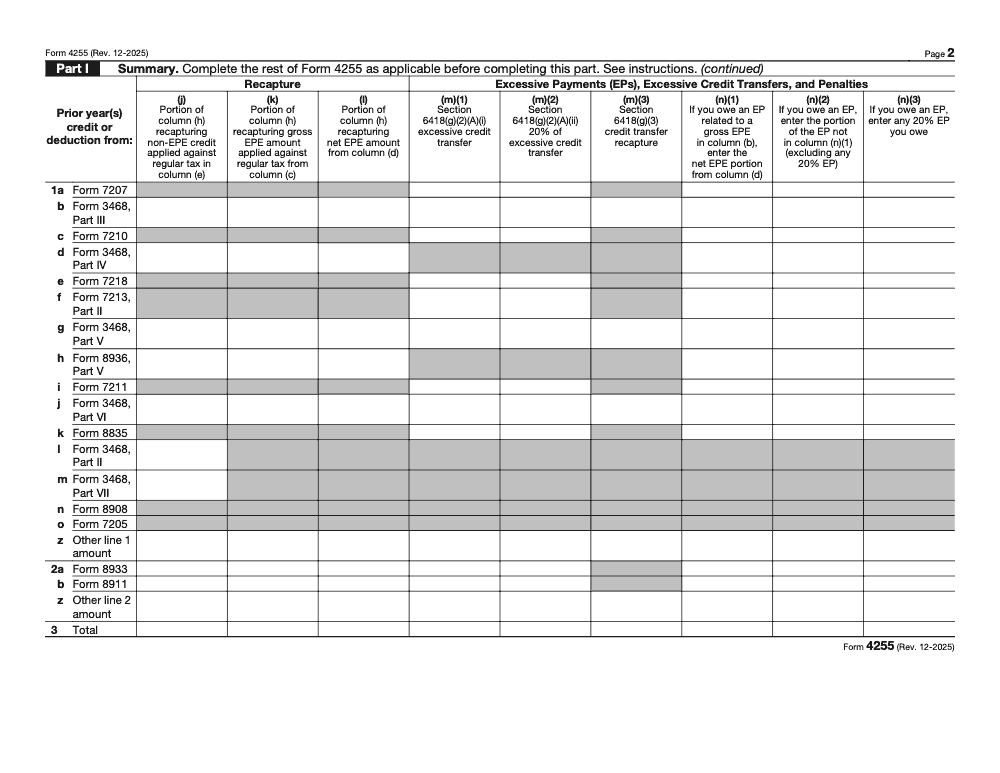
- Excessive elective payments and excessive credit transfers. If the IRS determines you received more than the allowable amount under sections 6417 or 6418, your chapter 1 tax increases by the excess plus a potential 20% add‑on unless you establish reasonable cause. Form 4255 captures these amounts in column (m) for §6418 excessive transfers and column (n) for §6417 excessive payments.
The IRS updated the online “About Form 4255” page in August 2025, confirming the current scope covers recapture, excessive payments and transfers, and PWA penalty amounts.
When You File It
You attach Form 4255 to the annual return for the year the event is determined. That could be the year you sell the asset, the year business use falls below the threshold, or the year the IRS determines an excessive elective payment or transfer. For PWA and apprenticeship failures, you also report the penalty for the tax year that the failure relates to, after making any required make‑whole wage payments with interest.
Who Files
Corporations, partnerships, S corporations, trusts, estates, and in some cases tax‑exempt filers via Form 990‑T attach Form 4255 when there is recapture, excessive elective payment, excessive credit transfer, or a PWA penalty amount. The instructions explain how partnerships and S corporations report totals at the entity level, rather than duplicating amounts on each owner’s K‑1.
Triggers That Put You On Form 4255
Classic Recapture Triggers Under Section 50(a)
- Sale or other disposition of investment credit property within the five‑year recapture period.
- Drop in qualified business use below required thresholds, including rules for dual use property.
- Property returned to a lessor before the recapture period ends.
- Ownership interest drop of more than one‑third in a pass‑through that holds the property.
You report the increased tax in the year of the event, then adjust basis and any remaining carryovers. The instructions provide the basis rules, including the 50% and 100% adjustments depending on the property type.
Excess Elective Payment Or Transfer Determinations
Two IRA mechanics can also send you to Form 4255:
- Excessive elective payment under section 6417. You owe back the excess and, unless you show reasonable cause, an additional 20% of that excess. This applies even if the entity would not otherwise owe chapter 1 tax.
- Excessive credit transfer under section 6418. The transferee’s tax increases by the excess and, absent reasonable cause, 20% of the excess. This is separate from classic section 50(a) recapture events.
PWA And Apprenticeship Penalties
If you claim the 5x increased amounts for applicable credits or deductions, you must pay prevailing wages during construction and, for many incentives, meet apprenticeship labor hour, ratio, and participation requirements. If you miss, you can often keep the 5x amount by making corrective wage payments with interest, then paying the applicable penalty. Those penalty amounts go in Part I, column (o) for prevailing wage and column (p) for apprenticeship.
The IRS maintains a current list of incentives covered by PWA. It includes sections 30C, 45, 45Q, 45V, 45Y, 45Z, 48, 48C, 48E, and 179D. Only the prevailing wage portion, not apprenticeship, applies to 45L and 45U.
Small projects under 1 megawatt and projects that began construction before January 29, 2023 can be exempt from PWA. Always document begin‑construction evidence.
Exceptions That Avoid Immediate Recapture
Not every transfer sets off section 50(a). Statutory exceptions exist for events such as certain transfers at death, some spousal transfers, and specified reorganizations. If an exception applies, document the facts, the relevant code or regulation, and monitor the successor’s later actions that could still trigger recapture. The instructions point you to the exceptions and to section 50 mechanics.
The Five‑Year Recapture Schedule
When a recapture event happens during the five‑year window, use the standard table below. Count full years from the placed‑in‑service date to the event date.
| Years from PIS to event | Recapture percentage |
| 0 | 100% |
| 1 | 80% |
| 2 | 60% |
| 3 | 40% |
| 4 | 20% |
| 5 or more | 0% |
This table appears in the current instructions, and it is the backbone for section 50(a) investment credit recapture. After you compute the increase in tax, adjust remaining carryovers and step up basis per section 50(c) and the instructions.
A Quick Example
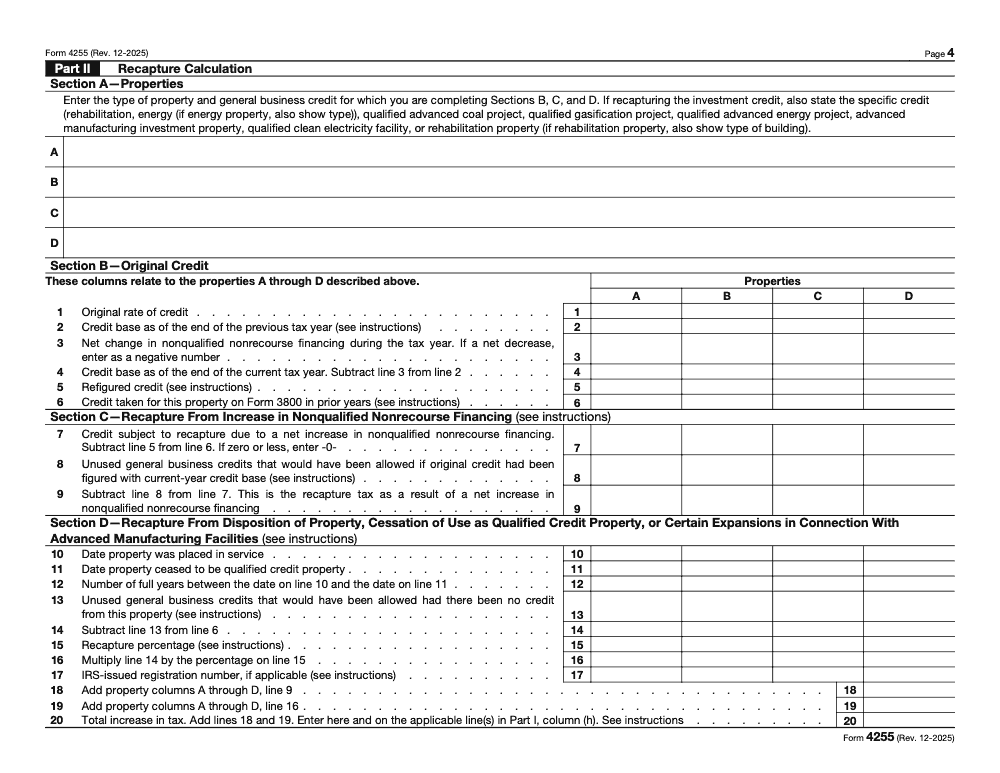
You claimed a 48 credit in 2023. You sell the property in 2025, two full years after placed in service. You refigure prior year credits used, reduce them by available carryovers that could have been used instead, apply the 60% factor, and that amount flows to Part I, column (h). The instructions include detailed examples showing carryover interaction and basis increases.
Prevailing Wage And Apprenticeship, How The Penalties Work
The final PWA regulations explain how to cure failures and how penalties are computed. This is the part many teams miss during close, then end up rebuilding later when an IRS notice arrives.
Prevailing Wage, Correction And Penalty
- Pay each affected laborer or mechanic the wage shortfall plus interest at the federal short‑term rate plus 6 points. Then, pay a penalty of 5,000 per underpaid worker to keep the increased amount. If the IRS finds intentional disregard, triple the wage correction and the penalty increases to 10,000 per worker. Report the penalty amount on Form 4255, column (o).
Apprenticeship, Hours And Penalty
- Track labor hours, required apprentice ratios, and participation. If you miss the requirement and the good‑faith exception does not apply, the penalty is 50 per noncompliant labor hour, or 500 per hour for intentional disregard. Report on Form 4255, column (p).
Which Incentives Have PWA
- Credits and deductions where full PWA applies include 30C, 45, 45Q, 45V, 45Y, 45Z, 48, 48C, 48E, and 179D. 45L and 45U are PW only, no apprenticeship requirement. The IRS maintains this list and updates its PWA page.
Column (p) On The Form
The December 2025 instructions spell out that column (o) is for prevailing wage penalties and column (p) is for apprenticeship penalties, including amounts derived from Form 8908 (45L), Form 7205 (179D), and Form 7213, Part II. If you are preparing partnerships or S corporations, the instructions detail how PWA penalties roll to the entity return.
Practical tip, tie your certified payrolls, timecards, wage determinations, and subcontractor certifications to a project‑level file. When penalties are cured before any IRS exam notice, the regulations provide a presumption against intentional disregard.
Excess Elective Payments And Credit Transfers
The IRA introduced two features that create brand‑new failure modes for compliance teams.
Section 6417 Elective Payment, Excessive Payments
If an elective payment amount is later determined to be excessive, your chapter 1 tax increases by the amount of the excess, plus an additional 20% unless you demonstrate reasonable cause. This applies even if the entity would not otherwise owe income tax for the year. Form 4255 has dedicated columns to track gross and net elective payments and the 20% portion.
Section 6418 Credit Transfers, Excessive Credit Transfers
If a transferred credit is later determined to be excessive, the transferee’s tax increases by the excess and a potential 20% add‑on unless the transferee shows reasonable cause. The final regulations clarify timing, multiple‑transferee mechanics, and that ordinary section 50(a) recapture events are not themselves excessive transfer events (under section 6418(g)(3) the recapture liability from those section 50(a) events still passes to the transferee, not the transferor).
Where These Go On Form 4255
The instructions group excessive transfers in column (m) and elective payment components in column (n). Totals then feed into columns (q) and (r) depending on whether other nonrefundable credits can offset them. Read the partnership and S corporation subsections closely so you do not double count on K‑1s.
Completing Form 4255 In Your Software
Every platform is different, so the safest route is to let the software spawn Form 4255 when you mark the sale or use change, then complete the form’s grids from your project file.
A Simple Checklist
- Identify the triggering event date and placed‑in‑service date for each property.
- Refigure the original credit and compute the aggregate decrease in credits that would have been allowed had the original credit been zero, then apply the five‑year percentage from the instructions.
- If applicable, complete the columns for elective payment, net elective payment, and any 20% additional amount.
- If applicable, enter excessive credit transfer amounts, including the 20% amount if no reasonable cause.
- Enter prevailing wage penalty amounts in column (o) and apprenticeship penalty amounts in column (p), supported by your wage correction worksheets, interest calculations, and apprentice hour reconciliations.
- Follow the partnership and S corporation reporting instructions so totals flow to the entity return rather than through owner K‑1s where required.
Documentation That Saves Reviews
My team keeps a standard audit file for every energy credit engagement. It includes begin‑construction evidence, placed‑in‑service certificates, fixed asset details, Form 3468 support, certified payrolls, wage determinations by craft and county, subcontractor certifications, apprentice requests and responses, monthly timecards, and any cure payments with proof of delivery. If a recapture event or PWA penalty arises, that file lets a reviewer compute and sign off in one sitting. The IRS PWA page lists the covered incentives and points to the final rules you should bookmark.
Recapture Math, A Few Watch‑outs
- Carryovers can offset part of the refigured prior‑year credits used, which reduces the recapture base before you apply the percentage. The instructions include step‑by‑step examples.
- Basis increases differ by property class, so confirm whether you use the 50% or 100% rule under section 50(c).
- Dual use property has special measurement rules. Dropping qualifying energy input below 50% inside the recapture period triggers section 50(a).
Emissions Tier Recapture For Clean Hydrogen Elections
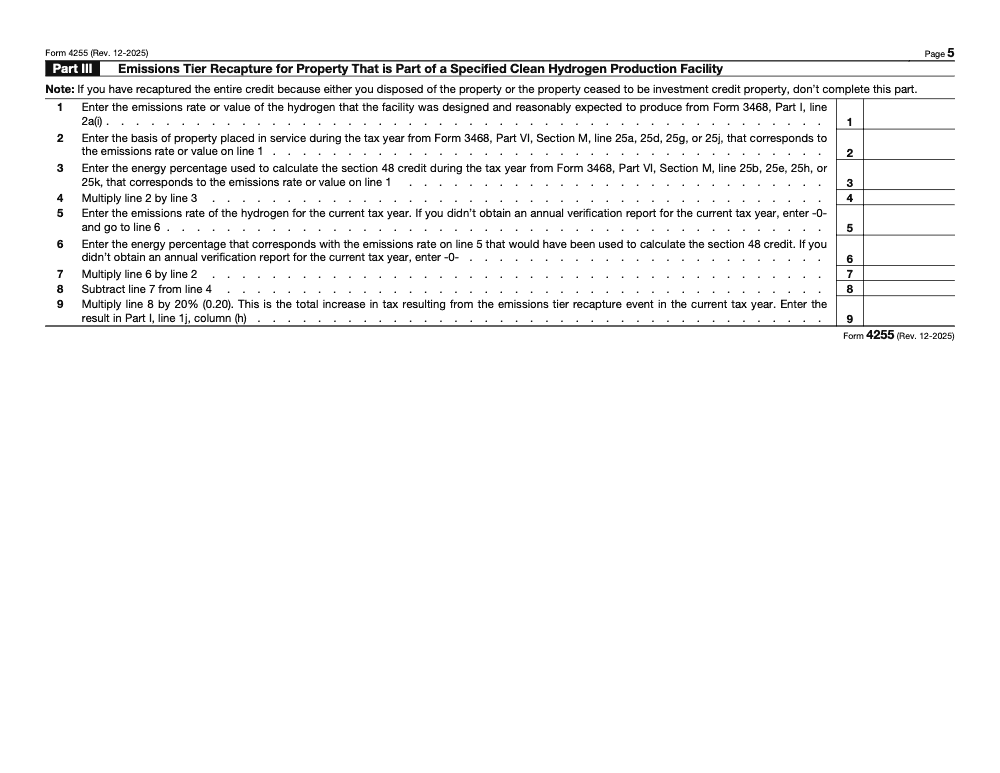
If you elected section 48 for specified clean hydrogen property under section 48(a)(15), there is a separate emissions tier recapture. In short, if actual lifecycle emissions support a lower energy percentage than the one used at placed in service, or if you miss the annual verification, the increase in tax is up to 20% of the excess credit amount, computed annually during the emissions tier recapture period (skipping the verification is not neutral, the instructions require entering -0- on Part III lines 5 and 6, which makes the entire design-tier credit the excess subject to that 20% recapture). The December 2025 instructions add a worksheet and a line reference for this item.
Operating With Discipline, So Form 4255 Is Routine
If your firm struggles during busy season, Form 4255 work can pile up. Create SOPs for naming, version control, and reviewer checklists. Split preparer, senior, and quality review with clear timing SLAs so recapture, PWA, and 6417 or 6418 issues are handled before filing. If you use offshore support, treat it as an operations layer, not resume farming, and require structured workpapers, multi‑layer review, and continuity plans to avoid rework.
When firms need outside capacity and want workflow control, some choose a partner that supplies trained teams who work inside your systems under SOPs, with layered reviews and security controls. Used well, this model reduces revision cycles and shortens partner review time.
Recent Changes And What To Watch In 2025
- The Form 4255 instructions revised in December 2025 added Part I, columns (o) for prevailing wage penalties and (p) for apprenticeship penalties, and expanded columns for elective payment and credit transfer mechanics. The IRS “About Form 4255” page, last updated August 27, 2025, confirms the current scope.
- Final regulations under sections 6417 and 6418 became effective in mid‑2024. They clarify timing, multiple transferees, and how the 20% additional amounts work, along with prefiling registration.
- The final PWA regulations, published June 25, 2024, set correction payments, penalty amounts, and examples of intentional disregard. Keep those citations in your project files. (downloads.regulations.gov)
Note, this article reflects IRS guidance available as of November 22, 2025. Always confirm current instructions and regulations before filing.
Common Mistakes We See Every Season
The same handful of Form 4255 mistakes surface every year, especially since the December 2025 revision expanded the form's scope to credit recapture, excessive §6417 elective payments, excessive §6418 transfers, and Inflation Reduction Act prevailing-wage and apprenticeship penalties. These are the patterns we cure for clients before the return goes out the door.
Reusable Checklists
The checklists below are copy-paste ready for your firm's Form 4255 SOPs. Each one maps to a specific decision point we run before the return is finalized.
Recapture-window scan (pre-return)
- Pull prior-year Form 3800 and Form 3468 detail to identify every credit still inside its IRC §50(a) five-year recapture window.
- For each property, confirm placed-in-service date and current-year status (sold, leased, converted to personal use, ownership change, qualified-use drop).
- Count full years from placed-in-service to the cessation or disposition date for Part II Section D line 12.
- Apply the §50(a)(1)(B) percentage on line 15: 100%, 80%, 60%, 40%, 20%, or 0%.
- Flag any §6418-transferred credits separately so Part I columns (m)(1), (m)(2), and (m)(3) are not missed.
- Flag any §6417 direct-pay credits so the §38(c) split across columns (c) (gross EPE applied against regular tax) and (d) (net EPE refunded) is computed.
- Confirm whether IRC §50(c) basis restoration applies, including the 50% factor for energy and reforestation property.
Prevailing wage and apprenticeship penalty file
- List every IRA bonus-credit project in scope (sections 30C, 45, 45Q, 45V, 45Y, 45Z, 48, 48C, 48E, and 179D).
- Request the project's certified payroll and apprenticeship hour log from the developer or general contractor.
- Confirm whether the deficiency was cured by a timely correction payment (the $5,000-per-worker / $50-per-hour penalty still applies on top of make-whole wages plus interest) or remains open (penalty due, with possible intentional-disregard add-on).
- Compute $5,000 per underpaid laborer or mechanic under IRC §45(b)(7)(B), or $10,000 plus tripled correction for intentional disregard.
- Compute $50 per noncompliant apprenticeship hour under IRC §45(b)(8)(D), or $500 per hour for intentional disregard.
- Allocate penalty amounts across columns (o)(1) through (o)(3) and (p)(1) through (p)(3) based on whether the underlying credit was direct-paid under §6417.
- Document reasonable-cause exhibits if the client intends to assert a defense.
Part I summary tie-out (pre-file)
- Confirm Part II line 20 ties to the Part I column (h) total on each property line.
- Confirm Part III line 9 lands on Part I, line 1j, column (h) for any hydrogen facility.
- Walk columns (q) and (r) to confirm which amounts can be reduced by nonrefundable credits and which cannot.
- Confirm the IRS-issued registration number on Part II Section D line 17 for any §6417 or §6418 election.
- Mark any multi-event line with "N/A" in column (g) and attach the per-event workpaper.
- Reconcile the line 3 grand total to the parent return (Form 1040, 1120, 1120-S, 1065, or 990-T) at Attachment Sequence Number 172.
Keep 4255 Season From Stalling
Form 4255 is not a high-volume return, it is a high-stakes one. The December 2025 revision expanded the form to cover credit recapture under IRC §50(a), excessive elective payments under §6417, excessive credit transfers under §6418, and Inflation Reduction Act prevailing-wage and apprenticeship penalties, per the Form 4255 (Rev. December 2025) instructions on IRS.gov. That means a single 4255 attachment can route through Part I columns (a) through (t), Part II Sections B, C, and D, and a separate Part III for clean-hydrogen facilities, and a partner who only sees one or two of these a year is doing the work cold every time.
The bottleneck is rarely the math itself. It is the workpaper discipline behind it: placed-in-service evidence for every active credit, registration-number trails for §6417 and §6418 elections, certified payroll and apprenticeship-hour logs for IRA projects, and a per-event reconciliation when a single Part I line carries more than one recapture trigger.
- Stand up a recapture-window register that tracks every IRC §50(a) credit's placed-in-service date, so a triggering disposition is caught the quarter it happens, not the week the return is due.
- Build a per-property workpaper that ties Part II Section D line 10 (placed in service) to line 11 (cessation), computes line 12 full years, and supports the line 15 sliding-scale percentage.
- Maintain a separate §6418 transferee file with the IRS-issued registration number on Part II Section D line 17, transferor representations, and reasonable-cause exhibits in case columns (m)(1) through (m)(3) fire.
- Run a Part I tie-out checklist that confirms Part II line 20 and Part III line 9 land on the correct column (h) lines before the parent return is finalized.
- Document the §38(c) split across columns (c) (gross EPE applied against regular tax) and (d) (net EPE refunded) so the §6417 direct-pay portion is auditable on review.
Accountably's U.S. tax outsourcing and offshoring teams staff the recapture-window register, the PWA penalty file, and the Part I tie-out under documented SOPs and layered review, so a Form 4255 attachment lands on a partner's desk already proved out rather than rebuilt from scratch.
FAQs
Form 4255 is where you compute the increase in tax for investment and energy credit recapture under section 50(a), report prevailing wage and apprenticeship penalties, and account for excessive elective payments and credit transfers, including any 20% additional amounts. You attach it to the return for the year the event is determined.
Selling or disposing of investment credit property, an early return of leased property, or a drop in qualified use during the five‑year window. Ownership reductions in entities that hold the property can also trigger it. You compute the increase in tax using the five‑year percentage table.
PWA applies to sections 30C, 45, 45Q, 45V, 45Y, 45Z, 48, 48C, 48E, and 179D. Only prevailing wage applies to 45L and 45U. Penalties are 5,000 per underpaid worker, or 10,000 if intentional disregard. Apprenticeship penalties are 50 per noncompliant hour, or 500 for intentional disregard. Report prevailing wage penalties in column (o) and apprenticeship penalties in column (p).
If the IRS determines an excessive elective payment under 6417 or an excessive credit transfer under 6418, you owe back the excess and may owe an additional 20% unless you show reasonable cause. Form 4255 provides columns for these amounts.
Compute on the entity’s Form 4255. The instructions explain which totals go directly on the entity return, and caution against duplicating through K‑1s.
| Topic | Where to report | Core rule |
| ITC recapture under section 50(a) | Part I, column (h) | Apply five‑year percentages, then adjust basis and carryovers. |
| Excess elective payments, section 6417 | Column (n), totals to (q) or (r) | Excess plus 20% unless reasonable cause. |
| Excess credit transfers, section 6418 | Column (m), totals to (q) or (r) | Excess plus 20% unless reasonable cause. |
| PWA penalties | Columns (o) and (p) | 5,000 or 10,000 per worker for prevailing wage in column (o); 50 or 500 per hour for apprenticeship in column (p). |
You have a clear path now. Tie each project to a clean audit file, set up SOPs for recapture math, and keep PWA cure steps and penalty amounts handy. Before filing, reconcile to Form 3468 support, confirm the five‑year table, and make sure column (p) and the 6417 or 6418 columns reflect any determinations this year.
If your team needs extra hands for structured prep, review, and documentation, consider bringing in help that works inside your systems with standardized workpapers and layered review. That is how you keep Form 4255 work quick, accurate, and drama‑free.
This material is for general information only. Confirm the latest IRS instructions, regulations, and your facts before filing.
Other forms this guide names
- Form 3468: Investment Credit Guide for Energy & Rehab
- Form 990‑T: UBTI Filing Guide, Schedule A, Deadlines, E‑file
- Form 7205: Claim the Section 179D Deduction in 2025
- Form 7213: Claim Nuclear Production Credits (45J & 45U) Guide
- Form 8908: Section 45L Energy Efficient Home Credit Guide
Summarize this article with AI
About this guide
Accountably helps US CPA, EA, and accounting firms hire trained accountants and tax preparers in India.
About us Reviewed byJugal Thacker, CPAFounder and CEO at Accountably
A Washington-licensed CPA with 7+ years inside US firms – PwC, a real-estate tax practice, then a full-service firm, rising from reviewer to manager to advisory. This article was reviewed against current IRS guidance for the 2025 tax year and updated for filers preparing late returns, amendments, and 2026 estimates.
View profile →How we research, review, and update this guide
Every Accountably guide is researched against primary IRS sources, reviewed by a U.S. CPA, and refreshed as guidance evolves. Read our Editorial Guidelines to see how we source, fact-check, and update our content.