Summarize this article with AI
In Brief
Schedule A (Form 8038-CP), titled Specified Tax Credit Bonds Credit Computation, computes the refundable credit a state or local government issuer claims for each interest payment period (per the IRS Form 8038-CP instructions). It applies only to the four specified tax credit bonds: qualified school construction bonds (QSCBs), qualified zone academy bonds (QZABs), new clean renewable energy bonds (NCREBs), and qualified energy conservation bonds (QECBs). Build America Bonds do not use Schedule A. The credit is interest-based, the lesser of the interest payable or the interest computed at the applicable credit rate (multiplied by 70% for NCREBs and QECBs), not a face-amount calculation. Each Form 8038-CP is due 45 days before the interest payment date, the subsidy is reduced annually by sequestration, and a separate return is required for each bond issue. Our tax outsourcing team handles these recurring direct payment filings end to end.
The first Build America Bond client I worked with was a county government that had issued Direct Payment BABs years earlier and had been cashing Treasury subsidy checks without really following the mechanics behind them. When sequestration hit, their bond counsel called in a panic because the payment came up short. That is when it became clear that Schedule A is not a set-it-and-forget-it filing; it has to be worked every interest payment period.
Schedule A (Form 8038-CP) computes the refundable credit an issuer claims for each interest payment period, and it applies only to the four specified tax credit bonds: QSCBs, QZABs, NCREBs, and QECBs. The credit is the lesser of the interest payable on the bond or the interest computed at the applicable credit rate, multiplied by 70% for NCREBs and QECBs, not the credit rate times the face amount. File 45 days before each interest payment date; file late and you forfeit that period's subsidy. Sequestration reduces the payment by a percentage the IRS publishes each year, and one form covers one bond issue per payment period, so multiple issues mean multiple filings.
Key Takeaways
- Schedule A (Form 8038-CP), Specified Tax Credit Bonds Credit Computation, computes the refundable credit an issuer may claim from the U.S. Treasury for each interest payment period – it is not a tax return, it is a credit computation attached to Form 8038-CP and flows to line 19c.
- Who files: State and local government issuers of the four specified tax credit bonds – qualified school construction bonds (QSCBs), qualified zone academy bonds (QZABs), new clean renewable energy bonds (NCREBs), and qualified energy conservation bonds (QECBs). Build America Bonds do not use Schedule A; the BAB 35% subsidy is computed directly on Form 8038-CP.
- Interest-based credit: The credit is the lesser of the interest payable on the bond or the interest computed at the applicable credit rate, multiplied by 70% for NCREBs and QECBs. It is not the credit rate times the face amount.
- Filing deadline: 45 days before each interest payment date. File late and you forfeit that period’s subsidy payment; the IRS will not retroactively honor it.
- Sequestration applies annually and reduces the subsidy payment by a percentage published by the IRS each year. Failing to apply sequestration means your claim overstates the credit – a common error that delays payment processing.
- One form per bond issue per payment period: Multiple outstanding bond issues require separate Form 8038-CP filings. You cannot aggregate multiple CUSIPs on a single return.
- Quick SOP rule: Set a calendar trigger 60 days before each bond’s interest payment date to initiate the Schedule A computation and filing workflow, giving 15 days of buffer before the 45-day deadline.
What Form 8038-CP Schedule A Is and When to Use It
Form 8038-CP, Return for Credit Payments to Issuers of Qualified Bonds, is the mechanism by which state and local government bond issuers claim their direct payment subsidy from the U.S. Treasury. The subsidy was authorized under the American Recovery and Reinvestment Act of 2009 (ARRA) for certain “specified tax credit bonds” where Congress chose to deliver a federal subsidy to the issuer (a direct payment) rather than a tax exclusion to the bondholder.
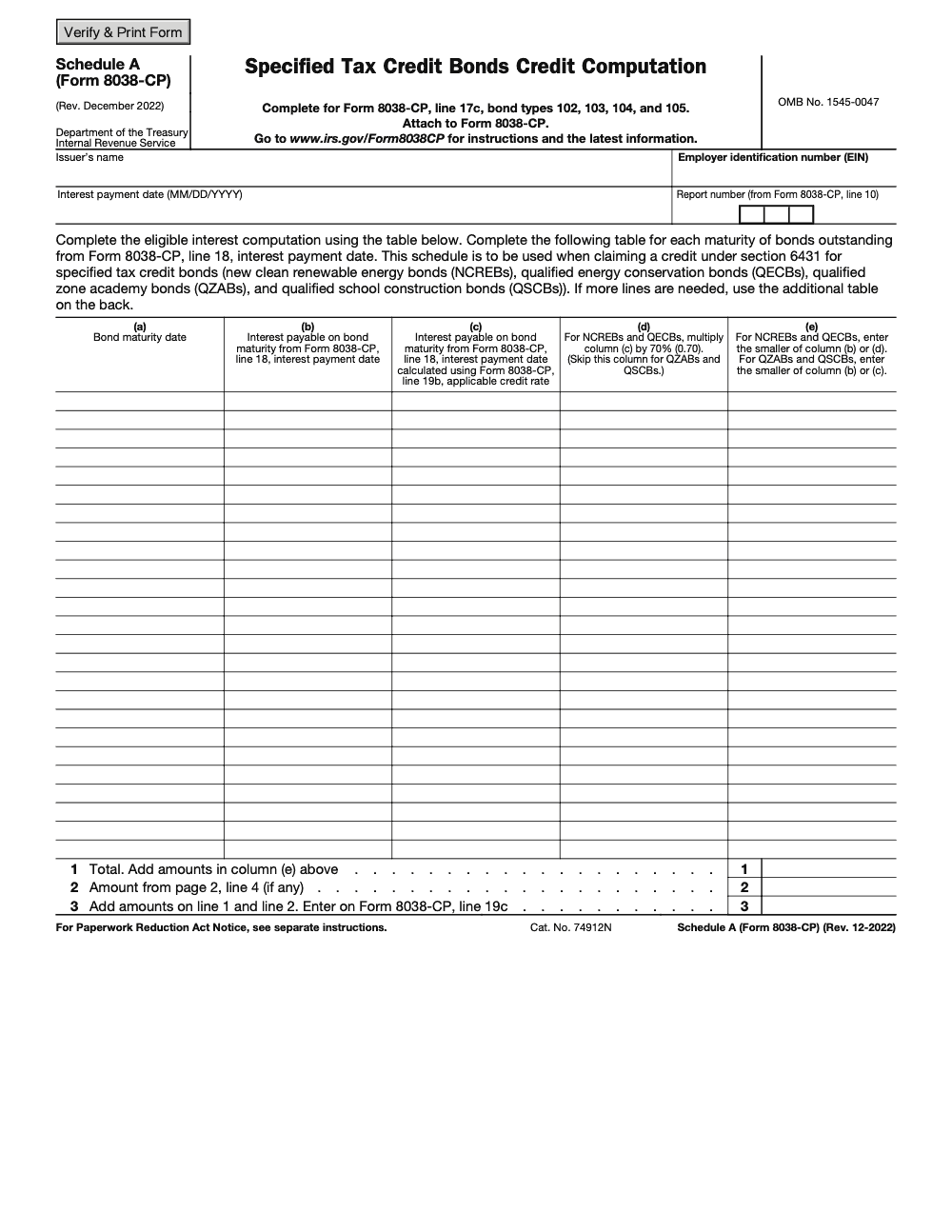
Schedule A (Form 8038-CP) – formally titled Specified Tax Credit Bonds Credit Computation – is attached to Form 8038-CP to compute the refundable credit for each interest payment period. It is used only when claiming a credit under former section 6431 for specified tax credit bonds. For each maturity of bonds outstanding, the schedule compares the interest payable on the bond to the interest that would be payable at the applicable credit rate, then takes the smaller figure (reduced to 70% for NCREBs and QECBs). The total from Schedule A carries to Form 8038-CP, line 19c.
This filing is required for every interest payment period on eligible bonds. If a bond pays interest semiannually, the issuer files twice per year per bond issue. If interest is paid monthly, there are twelve filings per year per issue. The volume of paperwork for an issuer with multiple outstanding eligible bond issues can be significant.
The BAB program authorized new issuances only in 2009 and 2010, but bonds issued then had maturities of 20 to 30 years. Many are still outstanding. State and local governments that issued BABs are in an annual cycle of Form 8038-CP filings that will continue until the bonds mature or are refunded.
Eligible Bond Types and the Direct Payment Election
Not every bond type authorized under ARRA is eligible for the direct payment (Form 8038-CP) mechanism. Some bond types offer only a tax credit to bondholders, not a direct payment to issuers. The distinction matters for determining whether a Form 8038-CP filing is required.
| Bond Type | IRC Section | Direct Payment Available? | Subsidy Rate |
|---|---|---|---|
| Build America Bonds (Direct Payment) | §54AA | Yes – Form 8038-CP, no Schedule A | 35% of interest paid (computed directly on Form 8038-CP) |
| Qualified School Construction Bonds | §54F | Yes – Form 8038-CP with Schedule A | Smaller of interest payable or interest at applicable credit rate |
| Qualified Zone Academy Bonds | §54E | Yes – Form 8038-CP with Schedule A | Smaller of interest payable or interest at applicable credit rate |
| New Clean Renewable Energy Bonds | §54C | Yes – Form 8038-CP with Schedule A | Smaller of interest payable or 70% of interest at applicable credit rate |
| Qualified Energy Conservation Bonds | §54D | Yes – Form 8038-CP with Schedule A | Smaller of interest payable or 70% of interest at applicable credit rate |
| Build America Bonds (Tax Credit) | §54AA (alt) | No – credit goes to bondholder | N/A (issuer does not file 8038-CP) |
The direct payment election for QSCBs, QZABs, New CREBs, and QECBs is made on the initial information return filed when the bonds are issued (Form 8038 or Form 8038-G). Once made, the election is irrevocable. Issuers who are unsure whether they made the direct payment election should review their original bond transcript documents or the initial information return on file.
How to Complete Schedule A, Line by Line
Schedule A is completed on a per-bond-issue basis and attached to the corresponding Form 8038-CP. At the top you enter the issuer’s name, the EIN, the interest payment date, and the report number from Form 8038-CP, line 10. The body is a maturity-by-maturity table, completed for each maturity of bonds outstanding from Form 8038-CP, line 18.
The eligible-interest computation table (columns a–e)
| Column | What it holds | Practitioner Note |
|---|---|---|
| (a) | Bond maturity date | One row per maturity outstanding on the interest payment date |
| (b) | Interest payable on that maturity (from Form 8038-CP, line 18) | Actual interest payable on the interest payment date |
| (c) | Interest payable calculated at the applicable credit rate (Form 8038-CP, line 19b) | The same interest recomputed at the Treasury-set credit rate |
| (d) | For NCREBs and QECBs, column (c) multiplied by 70% (0.70) | Skip this column for QZABs and QSCBs |
| (e) | Credit amount for the maturity | NCREBs/QECBs: smaller of (b) or (d). QZABs/QSCBs: smaller of (b) or (c) |
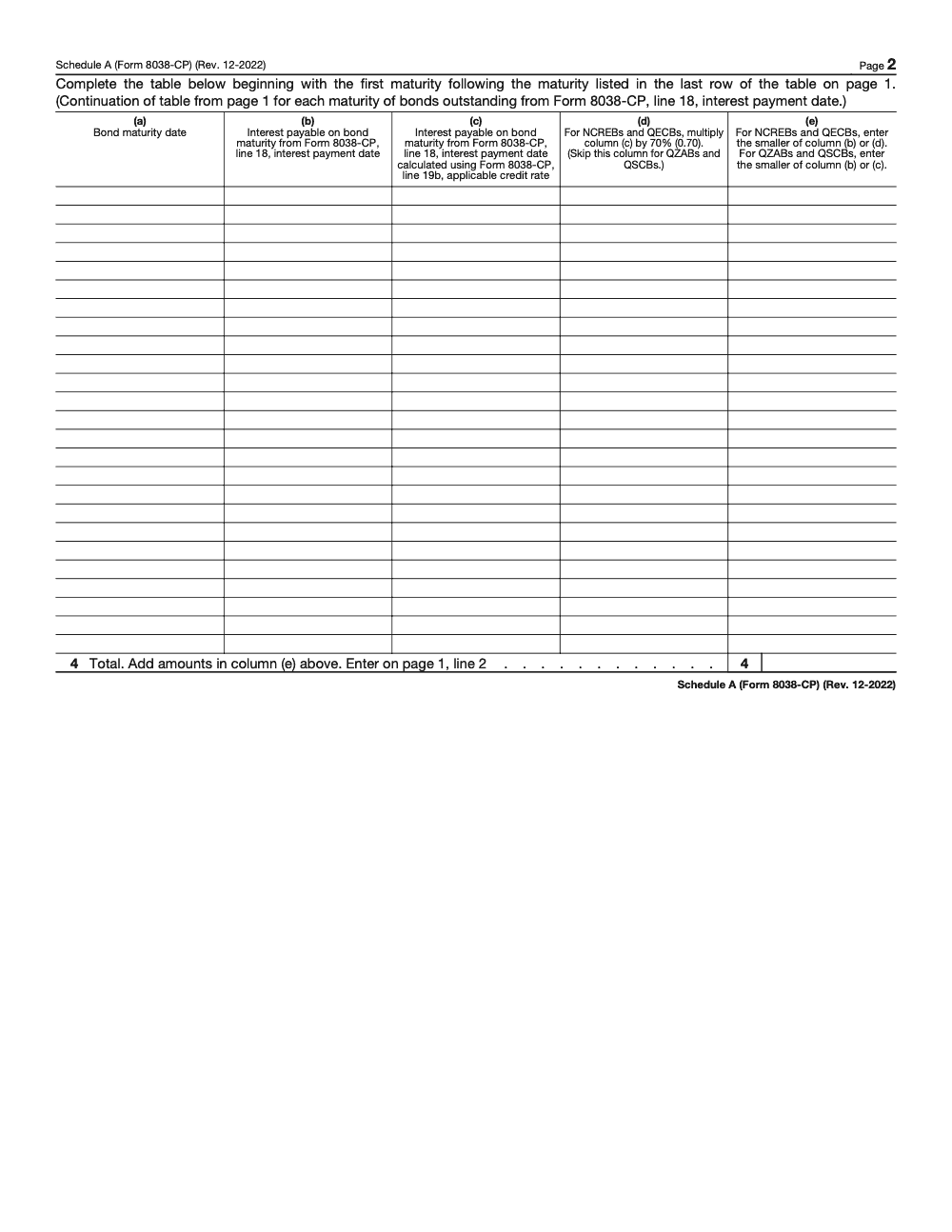
The bottom of the schedule totals column (e) on line 1, adds any continuation amount from page 2 on line 2, and reports the sum on line 3, which carries to Form 8038-CP, line 19c. The computation is interest-based throughout; there is no face-amount or allocation step on Schedule A.
QZABs and QSCBs vs. NCREBs and QECBs
The two bond pairs differ by one factor. For QZABs and QSCBs the credit per maturity is the smaller of the actual interest payable or the interest at the applicable credit rate, full 100%. For NCREBs and QECBs the interest at the applicable credit rate is first reduced to 70%, then compared to the actual interest payable, and the smaller figure is the credit. Routing the wrong pair through the wrong column is the most common Schedule A error.
Sequestration Reduction
Before claiming the credit on Form 8038-CP, the Schedule A amount is reduced by the current year sequestration percentage. This calculation is done on Form 8038-CP itself (not on Schedule A), but the Schedule A amount feeds into it. The sequestration-reduced amount is what Treasury actually pays.
Sequestration: The Annual Reduction Every Issuer Faces
Sequestration under the Budget Control Act of 2011 has reduced Form 8038-CP payments every year since fiscal year 2013. The percentage varies by year based on OMB calculations. The IRS publishes a notice each year specifying the applicable sequestration rate for direct payment bond credits.
| Fiscal Year | Approximate Sequestration Rate |
|---|---|
| FY 2013 | 8.7% |
| FY 2014 | 7.2% |
| FY 2015 | 7.3% |
| FY 2016 | 6.8% |
| FY 2017–2019 | 6.6% |
| FY 2020–2025 | 5.7%–6.2% (verify annually) |
From my side of the desk, the sequestration rate is the first thing I confirm when setting up a new filing period. Using last year’s rate without checking for updates is a common error that produces either an overstated or understated claim. The IRS notice is typically released in January or February for the upcoming fiscal year.
Issuers should incorporate the sequestration impact into their debt service reserve fund modeling. The subsidy payment they originally projected when issuing the bonds has been consistently lower than the original 35% of interest due to sequestration. Municipal finance advisors and bond counsel often underestimate how long sequestration will continue – it has now been in effect for over a decade.
Deadlines, Penalties, and Filing Requirements
| Item | Detail |
|---|---|
| Filing deadline | 45 days before the applicable interest payment date |
| Filing frequency | Once per interest payment period per bond issue (monthly, semiannual, or annual per bond terms) |
| Late filing consequence | Forfeiture of the subsidy payment for that period – IRS does not pay retroactively |
| No extension mechanism | No provision for requesting additional filing time |
| One form per bond issue | Multiple outstanding CUSIPs require multiple Form 8038-CP filings per period |
| Where to file | IRS Center in Ogden, UT (check current instructions for mailing address updates) |
| E-filing | Form 8038-CP is not currently available through standard e-file; paper filing is standard |
| Amended returns | File a corrected Form 8038-CP; note it as “Amended Return” in the header |
The 45-day deadline is firm. I have seen clients miss a semiannual payment cycle because the finance department assumed the bond administrator was tracking the deadline and the bond administrator assumed the issuer’s accountant was. Assign ownership of the filing calendar explicitly in your engagement documentation.
Relationship Between Form 8038-CP and Schedule A
Form 8038-CP is the return that triggers the actual payment from the U.S. Treasury. Schedule A is the attachment that performs the eligible-interest credit computation feeding line 19c of the return. Build America Bonds do not use Schedule A – the BAB 35% subsidy is computed directly on Form 8038-CP. Schedule A must be submitted for all NCREBs, QECBs, QZABs, and QSCBs for which the issuer elected the refundable credit under former section 6431.
Think of it this way: Form 8038-CP is the claim, and Schedule A is the per-maturity computation behind the credit. Filing an 8038-CP for a specified tax credit bond without the required Schedule A will delay processing and may result in a reduced or rejected payment.
IRS Compliance Reviews and Arbitrage Considerations
The IRS Tax-Exempt and Government Entities division (TE/GE) conducts compliance reviews of governmental bond issuers, including issuers of direct payment bonds who file Form 8038-CP. The focus areas include:
- Use of bond proceeds: The financed project must continue to qualify for the applicable bond type throughout the bond’s term. A QSCB that funded a school building faces post-issuance compliance obligations to ensure the building remains used for qualifying educational purposes.
- Arbitrage: Proceeds of specified tax credit bonds are subject to IRC Section 148 arbitrage rules. Investing proceeds at a yield higher than the bond yield (without qualifying for an exception) creates a rebate obligation and may disqualify the bonds. This is separate from the Form 8038-CP filing but affects the subsidy eligibility.
- Credit computation accuracy: For QSCB, QZAB, NCREB, and QECB issues, TE/GE checks that the eligible-interest computation on Schedule A is correct – that the credit per maturity is the smaller of interest payable or interest at the applicable credit rate (reduced to 70% for NCREBs and QECBs), and that sequestration was applied. Overstating the credit relative to the eligible interest delays or reduces the payment.
Post-issuance compliance for these bond types requires an ongoing record-keeping program, not just the annual or semiannual Form 8038-CP filing. If your client is a governmental issuer, their internal finance team needs a written post-issuance compliance policy. Bond counsel typically drafts this at issuance – make sure it was actually implemented, not just drafted.
Common Mistakes That Slow Things Down
Most rejected or delayed Form 8038-CP payments I see trace back to the same handful of errors, and every one of them is preventable with a tight pre-filing review. Here are the patterns that cost issuers their subsidy.
Practical Checklists You Can Reuse
These checklists are copy-paste ready for your firm SOP or a governmental issuer’s post-issuance compliance file. Lift them into your workflow and adapt the line references to each bond issue.
Pre-filing data packet (per bond issue)
- Confirm the bond type: QSCB, QZAB, NCREB, or QECB (Schedule A applies only to these; BABs use Form 8038-CP alone).
- Enter the issuer name, EIN, interest payment date, and the report number from Form 8038-CP, line 10.
- List each maturity outstanding on the interest payment date, one row per maturity (column a).
- Record the interest payable on each maturity from Form 8038-CP, line 18 (column b).
- Record the interest at the applicable credit rate from Form 8038-CP, line 19b (column c).
Credit computation and sequestration
- Confirm the current fiscal year sequestration rate from the IRS notice and note the source date.
- For NCREBs and QECBs, multiply column (c) by 70% to get column (d); skip this step for QZABs and QSCBs.
- Enter the credit per maturity in column (e): smaller of (b) or (d) for NCREBs/QECBs, smaller of (b) or (c) for QZABs/QSCBs.
- Total column (e) on line 1, add any page 2 amount on line 2, and carry line 3 to Form 8038-CP, line 19c.
- Apply the sequestration reduction on Form 8038-CP, fed by the Schedule A total, then reconcile the net payable to the debt service reserve model.
Filing calendar and handoff
- Trigger the workflow 60 days before each interest payment date, 15 days ahead of the 45-day deadline.
- Assign explicit ownership of the filing calendar in the engagement documentation.
- Attach the required Schedule A before the return leaves the desk.
- Mail to the IRS Center in Ogden, UT, after checking the current instructions for address updates.
- Flag any corrected return as an “Amended Return” in the header and log the reason.
Keep 8038-CP Schedule A Season From Stalling
Form 8038-CP work never lands in one tidy season. Bonds authorized under the American Recovery and Reinvestment Act of 2009 carry 20 to 30 year maturities, so a single issuer can be in a perpetual cycle of filings, each one due 45 days before its own interest payment date. When semiannual and monthly schedules overlap across several outstanding issues, the calendar, not the math, is what breaks first.
The fix is to treat each bond issue as a standing, repeating engagement rather than a once-a-year scramble. Sequestration has reduced these subsidy payments every fiscal year since 2013 under the Budget Control Act of 2011, which means the computation changes annually even when nothing about the bond does. Structure absorbs that drift better than memory.
- Maintain a per-CUSIP filing register tied to each issue’s interest payment dates, since one return is required per issue per period.
- Refresh the sequestration rate from the IRS notice at the start of each fiscal year before any eligible-interest computation runs.
- Keep the interest-payable and applicable-credit-rate figures (Form 8038-CP lines 18 and 19b) tied to each QSCB, QZAB, NCREB, and QECB maturity so Schedule A is ready, not reconstructed.
- Route NCREBs and QECBs through the 70% column and QZABs and QSCBs through the full-interest column so the eligible-interest credit lands in the right place.
- Run a two-layer review on every packet so a missed Schedule A or a stale rate gets caught before mailing.
That is the kind of recurring, deadline-bound compliance work our tax outsourcing and offshoring teams are built to carry, with documented SOPs, multi-layer review, and turnaround SLAs that keep every interest payment period on schedule.
FAQs
Schedule A (Form 8038-CP), titled Specified Tax Credit Bonds Credit Computation, is attached to Form 8038-CP to compute the refundable credit for each interest payment period. For each maturity it takes the smaller of the interest payable or the interest at the applicable credit rate (reduced to 70% for NCREBs and QECBs), and the total carries to Form 8038-CP, line 19c. It is required for qualified school construction bonds, qualified zone academy bonds, new clean renewable energy bonds, and qualified energy conservation bonds. Build America Bonds do not use Schedule A.
State and local governmental entities that issued Direct Payment Build America Bonds or other specified tax credit bonds with a direct payment election file Form 8038-CP. The return is due 45 days before each interest payment date. There is no extension, and a late filing forfeits the subsidy for that payment period.
Build America Bonds were taxable governmental bonds authorized under the American Recovery and Reinvestment Act of 2009, issued only in 2009 and 2010. Issuers who elected the Direct Payment option receive a federal subsidy equal to 35% of interest paid (reduced by sequestration). The bonds’ long maturities mean many are still outstanding and require ongoing Form 8038-CP filings.
Sequestration under the Budget Control Act of 2011 reduces all discretionary federal spending, including Form 8038-CP subsidy payments, by a percentage set annually by OMB. The IRS publishes the applicable rate each year. For example, a 6% sequestration rate means an issuer receives 94% of the calculated subsidy instead of the full amount. The sequestration rate has been in effect since fiscal year 2013.
No. The IRS requires a separate Form 8038-CP (and Schedule A where applicable) for each distinct bond issue (each CUSIP) for each interest payment period. An issuer with three outstanding BAB issues paying semiannual interest would file six Form 8038-CP returns per year.
About this guide
Accountably helps US CPA, EA, and accounting firms hire trained accountants and tax preparers in India.
About us Reviewed byJugal Thacker, CPAFounder and CEO at Accountably
A Washington-licensed CPA with 7+ years inside US firms – PwC, a real-estate tax practice, then a full-service firm, rising from reviewer to manager to advisory. This article was reviewed against current IRS guidance for the 2025 tax year and updated for filers preparing late returns, amendments, and 2026 estimates.
View profile →How we research, review, and update this guide
Every Accountably guide is researched against primary IRS sources, reviewed by a U.S. CPA, and refreshed as guidance evolves. Read our Editorial Guidelines to see how we source, fact-check, and update our content.