Summarize this article with AI
In Brief
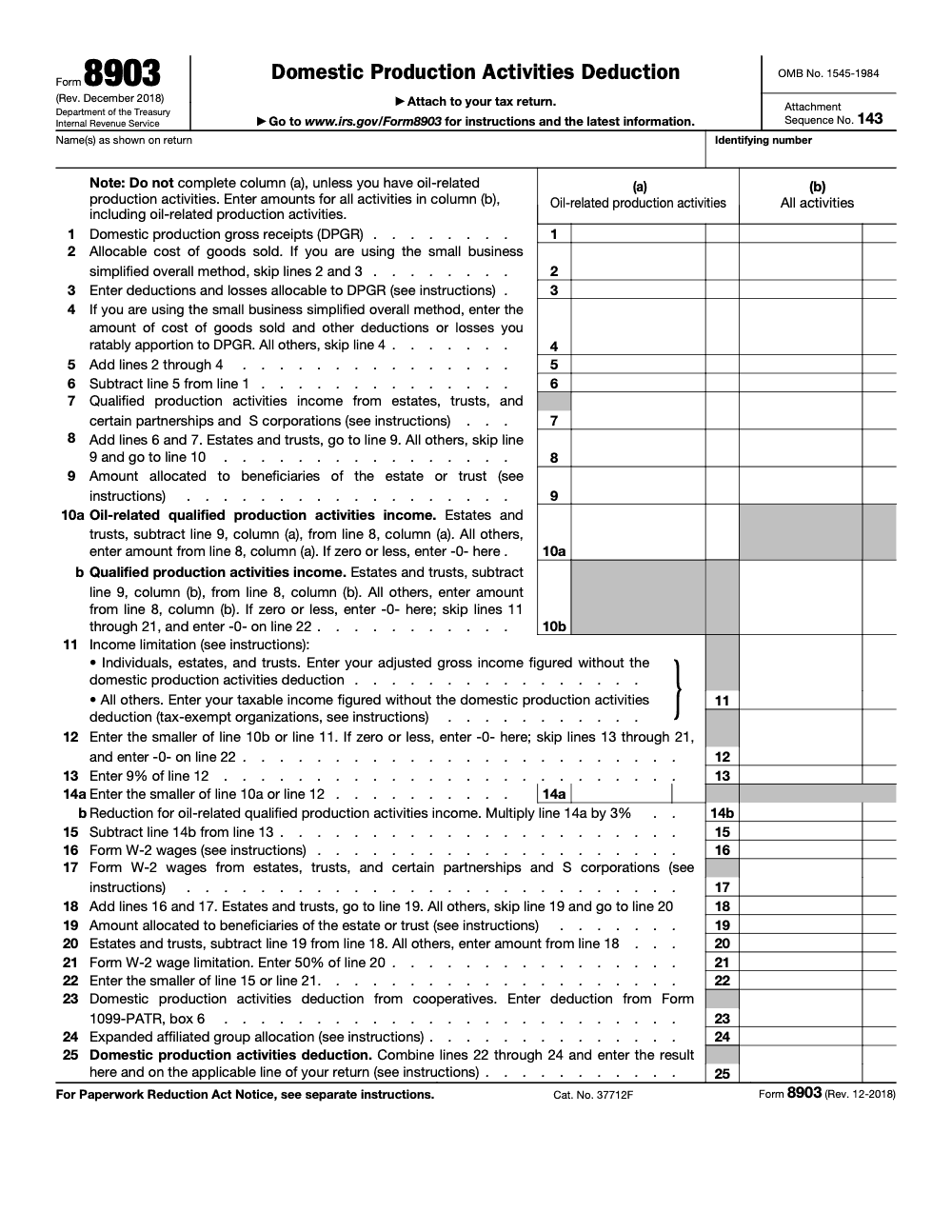
Form 8903 (Rev. December 2018) claims the Domestic Production Activities Deduction (DPAD) under former IRC §199, repealed by the Tax Cuts and Jobs Act (Public Law 115-97) for tax years beginning after December 31, 2017. For 2025 it is filed only with amended pre-2018 returns (1040X, 1120X, 1065X) still open under the §6511 refund window (per IRS Publication 535 and the Form 8903 instructions, Rev. December 2018). The deduction equals 9% of QPAI on line 13, capped at 50% of allocable W-2 wages on line 21; today's §199A qualified business income deduction sits on Form 8995 or 8995-A, not on Form 8903.
Form 8903 keeps surfacing years after a firm thinks it is done with it. A closed manufacturing return gets pulled during M&A diligence, and the wage cap on the deduction turns out to have been computed against total payroll instead of the W-2 wages allocable to domestic production. Rebuild the allocation, refile inside the still-open §6511 refund window, and a quiet legacy form turns into real money back.
The Domestic Production Activities Deduction was claimed for tax years 2005 through 2017 and is gone for years beginning after 2017, repealed by the Tax Cuts and Jobs Act. The deduction generally equaled up to 9% of Qualified Production Activities Income, further capped at 50% of properly allocable W-2 wages, and today it only appears on amended pre-2018 returns. For current years, the closest deduction most pass-through owners reach for is the Section 199A deduction on Form 8995 or 8995-A.
Key Takeaways
- Form 8903 was used to claim the Domestic Production Activities Deduction, DPAD, for tax years 2005 through 2017. It is not available for years beginning after 2017.
- The DPAD amount generally equaled up to 9% of Qualified Production Activities Income, QPAI, limited by taxable income or AGI, and further capped at 50% of properly allocable W‑2 wages.
- You built QPAI from Domestic Production Gross Receipts, DPGR, and then subtracted allocable COGS and deductions using a compliant allocation method, small business simplified overall, simplified deduction, or Section 861.
- Section 199 was repealed for post‑2017 years. Today, the closest current deduction for most pass‑through owners is the Section 199A Qualified Business Income deduction, a separate statute claimed on Form 8995 or 8995‑A and not a rename or continuation of DPAD. Congress made it permanent in July 2025 with modest tweaks that begin for tax years starting after December 31, 2025.
- Use Form 8903 only for pre‑2018 years, and use Forms 8995 or 8995‑A for Section 199A in current years.
What Form 8903 Did And Who Used It
Form 8903 existed to compute and claim the Domestic Production Activities Deduction under former Section 199. For 2005 through 2017, individuals, corporations, estates, trusts, S corporations, partnerships, and certain cooperatives used the form to figure the allowable deduction from qualifying U.S. production activities. The form walked you from DPGR to QPAI to the deduction, then applied the taxable income limit and the W‑2 wage limit.
In practice, you started with receipts tied to qualifying domestic production, then allocated COGS and other expenses that were properly attributable to those receipts. You computed DPAD as up to 9% of QPAI or taxable income, whichever was smaller, and then ensured the amount did not exceed 50% of W‑2 wages allocable to those production receipts. The W‑2 wage cap often became the binding constraint for firms with lean payrolls.
Covered Activities At A Glance
Form 8903 focused on domestic activity. You were in scope if you, in the United States, manufactured or produced tangible personal property, built or substantially renovated real property, produced qualified films, developed certain software, or produced electricity, potable water, or natural gas. For qualified film, at least half of the production costs had to be incurred in the United States.
Who Claimed The Deduction In A Pass‑Through
Pass‑through entities computed QPAI and the W‑2 wages at the entity level and reported DPAD information to owners on Schedule K‑1. Owners then applied their own income limits on their returns. The W‑2 wage calculation itself had prescribed methods, unmodified box, modified box 1, or tracking wages, and had to reflect only wages properly allocable to DPGR.
The Timeline, When DPAD Stopped, And Why It Still Matters
DPAD applied to tax years beginning in 2005 through 2017. The Tax Cuts and Jobs Act ended the deduction for tax years beginning after 2017, so you cannot take DPAD for 2018 or later. That said, you still need Form 8903 if you are amending a pre‑2018 year or closing out legacy audits.
| Year range | What it meant for filers |
| 2005 | First year Form 8903 applied |
| 2006 to 2016 | DPAD fully available, watch wage cap and allocation consistency |
| 2017 | Final effective year, then TCJA repeal applies to years beginning after 2017 |
For 2018 and beyond, Section 199A became the go‑to regime for many owners of pass‑through entities. In July 2025, H.R. 1 made the 199A deduction permanent at 20% and added a new minimum deduction of 400 dollars for active QBI, with higher phase‑in ranges that first apply for tax years beginning after December 31, 2025. The core framework, including wage and property limits at higher incomes and SSTB constraints, remains. Use Form 8995 or 8995‑A to compute the deduction today.
Why Firms Struggle With Legacy DPAD Work
The technical rules are knowable, yet delivery often breaks down through the busy season. In my experience, the bottlenecks are not in sales, they are in production and review. Common culprits include poorly labeled workpapers, inconsistent allocation methods, missing wage computations, and thin documentation that slows reviewer sign‑off. That is why a disciplined workflow matters, especially when you reopen 2015 to 2017 projects that must clear older state filing rules and current documentation standards.
If you are facing a backlog, structure helps. Standard naming, version control, and layered reviews cut rework. Clear escalation keeps deadlines intact. And if you need outside help, focus on accountable delivery, not resumes. That is the difference between capacity and chaos.
If you are amending pre‑2018 returns at scale, set reviewer checklists for DPGR identification, QPAI math, and W‑2 wage support, all tied to Form 8903 line references. Reviewers finish faster when every schedule tees up the answer instead of hiding it.
Qualifying Activities, What Counted As DPGR
Think of DPGR as the top line from which QPAI is built. Receipts qualify when they come from U.S. manufacturing or production of tangible personal property, U.S. construction or substantial renovation of real property, qualified film production with at least half of costs in the United States, certain software development, and production of electricity, potable water, or natural gas in the United States. The receipts must be domestic in substance, not just in billing address.
The Checklist I Give Teams
- Identify DPGR first, sale, lease, license, or disposition of qualifying property produced in the United States, or qualifying domestic services like construction, engineering, or architecture tied to U.S. real property.
- Tie every DPGR line to specific workpapers, so reviewers can trace it to source.
- Choose your allocation method and document why it fits, then stick with it for consistency unless facts change.
What Did Not Count, The Exclusions That Cause Rework
Plenty of revenue looks tempting until you read the rules. Rental income from real property usually does not qualify. Resale of finished goods you did not produce in the United States does not qualify. Services performed outside the United States do not qualify, even if your customer is U.S. based. Non‑qualifying royalties, passive investment income, and dispositions of capital assets also fall out. Film work fails if at least half of the costs are outside the United States or if the content is sexually explicit as defined. Scrub these out before you compute QPAI.
A reliable approach is, “DPGR first, exclusions second, allocation third.” Shortcuts inflate DPGR and waste reviewer time later.
How To Compute QPAI, Step By Step
QPAI is DPGR minus the portion of COGS and minus the portion of deductions, losses, and expenses that are properly allocable to those receipts. Your choice of allocation method drives the mechanics and the level of documentation you need.
Allocation Methods That Appear On Workpapers
- Small business simplified overall method. If you qualified, you allocated COGS and other deductions to DPGR using the DPGR to total receipts ratio. This method was designed for smaller taxpayers under specific gross receipts and cost thresholds. Example, if DPGR is 75% of total receipts, you allocate 75% of COGS and 75% of other deductions to DPGR.
- Simplified deduction method. You allocated only non‑COGS deductions by the DPGR ratio when you met the asset or receipts thresholds. COGS still followed regular rules.
- Section 861 method. When required, you allocated COGS, direct, and indirect costs using the detailed rules, often with more granular support on Form 8903 lines 2 to 4.
Practical tip. Lock a one‑page “method memo” to each engagement that states the method, eligibility thresholds, and the exact ratio used. Put the ratio in the file name of the calculation sheet, for example, “QPAI‑allocations‑ratio‑0.752.xlsx.” It reduces questions during review.
The DPAD Limits In Plain English
Two ceilings capped your DPAD. First, the percentage limit, generally 9% of the smaller of QPAI or the line 11 income limit before the DPAD (AGI for individuals, estates, and trusts; taxable income for corporations and all other filers). Second, the wage cap, your DPAD could not exceed half of the Form W‑2 wages properly allocable to DPGR. If you had no qualifying W‑2 wages, your deduction was often zero, except for special cooperative or expanded affiliated group cases (cooperative pass‑through DPAD on line 23 is not capped by the patron level 50% wage limit because that limitation is applied at the cooperative level).
W‑2 Wages, Methods And Pitfalls
Form 8903 allowed three ways to compute W‑2 wages, unmodified box, modified box 1, and tracking wages. Whichever method you used, only wages properly allocable to DPGR counted. S corporations and partnerships could compute W‑2 wages at the entity level and report each owner’s share on Schedule K‑1 if they met specific requirements. For qualified film, compensation for actors and production personnel performing services in the United States counted as W‑2 wages.
Reviewer flags I see often:
- Using total payroll instead of DPGR‑allocable wages.
- Mixing calendar year W‑2 data with fiscal year tax returns without adjusting.
- Double counting wages across entities in a consolidated context.
Documentation That Makes Reviews Fast
- One source‑of‑truth index for DPGR and exclusions with cross‑references.
- Allocation ratio worksheet with eligibility proof for the chosen method.
- W‑2 wage computation tied to payroll reports and labeled by method.
- A tie‑out from QPAI to the deduction and to the return line, with any oil‑related reductions if applicable.
When you present work this way, partners spend their time on judgment, not on reconciling columns.
If your internal capacity is thin, consider a structured offshore team that works in your templates and adds review protection with checklists and layered QC. The point is not headcount, it is accountable delivery that cuts rework while you keep control of standards.
Filing Mechanics By Entity, And What To Attach
For C corporations, attach Form 8903 to Form 1120. For S corporations, attach it to Form 1120‑S. For partnerships, attach it to Form 1065. Sole proprietors flow results to Form 1040 for the years when DPAD applied. Pass‑throughs compute QPAI and W‑2 wages at the entity level and report the necessary items to owners on Schedule K‑1. Owners then apply their own income limits on their individual returns.
What to include with the return:
- Schedules that show DPGR, exclusions, COGS split, and expense allocations by method.
- The W‑2 wage calculation and method memo.
- Any oil‑related QPAI reduction if applicable.
Do not file Form 8903 for any tax year beginning in 2018 or later. For those years, consider Section 199A.
The Transition To Section 199A, Updated For 2025
Section 199A provides a deduction of up to 20% of qualified business income, plus certain REIT dividends and PTP income, for eligible non‑corporate taxpayers. You calculate it on Form 8995 or 8995‑A. It applies to tax years beginning after December 31, 2017.
In July 2025, Congress enacted H.R. 1, often called the One Big Beautiful Bill Act. The law made Section 199A permanent at 20%, increased the phase‑in ranges for the income‑based limitations, and added a 400 dollar minimum deduction for taxpayers with at least 1,000 dollars of active QBI. These changes generally apply to tax years beginning after December 31, 2025. The existing framework for wage and property limits, and for specified service trades or businesses, continues, with the higher ranges easing the phase‑in for more filers.
If you prepare 2025 returns, the pre‑change rules still apply. If you prepare 2026 returns, plan for the permanent rules and the new minimum deduction. Check the current IRS instructions for Forms 8995 and 8995‑A for thresholds, forms, and schedules, then document your aggregation positions and owner‑level limits for review.
199A vs. Former DPAD, What To Tell Clients
- DPAD was production focused, built on DPGR and QPAI, and capped by W‑2 wages. 199A is broader and keyed to qualified business income at the owner level, although wage and property limits can apply when income is high.
- DPAD ended for years beginning after 2017. 199A applies after 2017 and is now permanent, with statutory tweaks effective after 2025.
- Forms changed too. Use Form 8903 only for pre‑2018, and use Forms 8995 or 8995‑A for current years.
Production Workflow Note For Firms
When you switch between DPAD amendments and 199A work in the same week, context switching drains hours. Park a short “DPAD pack” in your template library, a cover sheet, DPGR index, allocation memo, wage memo, and a reviewer checklist mapped to Form 8903 lines. Do the same for 199A, owner‑level worksheets tied to Forms 8995 or 8995‑A, aggregation notes, and SSTB analysis. Small organization moves reduce review time and help you hit deadlines.
When A Scalable Partner Helps
If your team is buried in production, a controlled offshore unit can absorb standardized work without sacrificing review quality. The key is structure. Accountably integrates trained offshore teams into your own systems with SOPs, standardized workpapers, and layered reviews, so partners spend less time in review and more time on client strategy. Use this selectively for legacy DPAD cleanups or seasonal spikes while you keep control of process, security, and deadlines.
This is not generic, plug‑and‑play outsourcing. It is structured offshore staffing with the operational discipline that protects quality and gives you predictable turnaround on complex, older‑year work.
Common Review Traps And How To Avoid Them
- Counting non‑qualifying receipts as DPGR. Use a one‑page exclusions list in every file, then highlight the tie‑outs that prove what you removed.
- Skipping the W‑2 wage method memo. Reviewers need to see the method, source reports, and the allocation to DPGR.
- Inconsistent allocation methods across years. Explain method choices, eligibility thresholds, and any fact changes that required a switch.
Light Compliance Note
Tax rules change. Where thresholds or limitation ranges are involved, confirm the year‑specific numbers in the official IRS instructions for Form 8903 for the amended year, and for Forms 8995 and 8995‑A for current filings. For 2026 and later returns, reflect the permanent 199A rules enacted in July 2025 and the new minimum deduction where applicable.
If You Need Scalable Help Without Losing Control
When teams are buried in production, you need capacity that comes with discipline. This is where a structured offshore partner can help with standardized workpapers, clear SOPs, and multi‑layer reviews that protect partner time. Accountably integrates trained offshore teams inside your systems and templates, with turnaround SLAs and review protection, so you can clear legacy 8903 work and current 199A cycles without sacrificing quality or security.
Conclusion
Form 8903 is retired for new years, yet it still shows up on your desk when a pre‑2018 year needs attention. Now you have a clear, practical way to finish the work. Identify DPGR with intent, remove exclusions early, select and document your allocation method, compute the wage cap correctly, and package the file so reviewers can say yes fast. For current years, pivot to Section 199A and plan for the permanent rules that begin after 2025. Keep your files clean, your checklists short, and your review loops tight. That is how you protect quality, keep clients’ trust, and give yourself room to grow.
Common Mistakes We See Every Season
Most rework on legacy Form 8903 files comes from the same handful of misses, and they surface again whenever a pre-2018 year is reopened inside the §6511 refund window or an amended K-1 touches a partner's return.
Reusable Checklists
These three checklists are copy-paste ready for your SOP library when you reopen a pre-2018 year, staff a junior preparer on a legacy DPAD file, or pivot a current-year engagement to §199A.
Pre-amendment scoping
- Confirm the underlying tax year began on or before December 31, 2017 (Form 8903 does not apply to later years per TCJA §13305).
- Verify the §6511 refund window is still open: later of three years from filing or two years from payment.
- Pull the original Form 8903 and the return it was attached to (1040, 1120, 1065, or 1041) for the affected year.
- Identify entity type (individual, C corp, S corp, partnership, estate, trust) so the AGI versus taxable income choice on line 11 is locked early.
- Note whether oil-related QPAI is in scope so the 3% reduction on line 14b is on the radar.
- Flag any cooperative pass-through DPAD on Form 1099-PATR box 6 for line 23 handling.
- Confirm the allocation method previously used (small business simplified overall, simplified deduction, or §861) and whether changing methods is appropriate.
- Log the $510 failure-to-file minimum penalty exposure for any late amended return required to be filed in 2026.
QPAI and W-2 wage cap workpaper
- Identify DPGR on line 1 and tie each receipt category to the qualifying activity list in the Form 8903 instructions.
- Allocate COGS on line 2 and other deductions on line 3, or use line 4 if the small business simplified overall method applies (do not fill both).
- Pick up pass-through QPAI from K-1s on line 7 and total QPAI on line 10b.
- Build line 11 using AGI for individuals, estates, and trusts, and taxable income for all others, each figured without the DPAD.
- Multiply line 12 by 9% to land line 13.
- Apply the 3% oil reduction on line 14b only to the oil-related slice that survives the line 12 income limit.
- Compute W-2 wages on line 16 using one of the prescribed methods and limit to wages allocable to DPGR.
- Take 50% of line 20 on line 21 and the smaller of line 15 or line 21 on line 22.
- Add cooperative DPAD from 1099-PATR box 6 on line 23 without re-applying the patron's own wage cap.
- Confirm the total on line 25 ties to the line on the underlying amended return where DPAD is reported.
§199A handoff for current years
- For tax years beginning after December 31, 2017, move QBI work to Form 8995 (simplified) or Form 8995-A (full).
- Confirm whether each activity is a Specified Service Trade or Business (SSTB) under §199A(d).
- Track the W-2 wage and qualified property limits at higher incomes per §199A(b).
- For tax years beginning after December 31, 2025, factor in the permanent 20% deduction, the new $400 minimum for active QBI, and the wider phase-in ranges enacted in July 2025.
- Document the §199 to §199A transition inside the engagement file so future reviewers see the deliberate handoff rather than a missing form.
Keep 8903 Season From Stalling
Form 8903 does not ride a quarterly or annual calendar like 941 or 1040 – it surfaces unpredictably, on a 1120X opened by M&A diligence on a 2015 acquisition, on an IRS notice reaching back into a closed 2016 year, or on a partner-level audit working through the §6511 refund window. The work then collides with current-year §199A engagements on Form 8995 or 8995-A, and the team that can build a clean workpaper for the wage cap on line 21 and the entity-specific income limit on line 11 is often the same team carrying the spring 1040 load (per the Form 8903 instructions, Rev. December 2018, and IRS Publication 535).
The fix is treating legacy DPAD as a separate workstream with its own SOP, not as overflow assigned to whoever has bandwidth that week. The work is too specific (different allocation methods, a different income limit by entity type, a different wage cap structure than §199A) to share a queue with current-year tax prep without slowing both down.
- Name one owner per open pre-2018 year and log the §6511 refund-window date in the engagement file before any computation begins.
- Standardise the workpaper around line 1 (DPGR), line 11 (the entity-specific AGI or taxable income base), and the W-2 wage allocation feeding line 16 – the three places where most rework originates.
- Run a two-pass review: the preparer ties lines 1 through 13, and the reviewer validates the 50% wage cap on line 21 plus any cooperative pass-through carried straight to line 23 from Form 1099-PATR box 6.
- Add a §199 to §199A handoff checklist for any related current-year filing on Form 8995 or 8995-A so the transition is documented rather than inferred from a missing form.
- Track the $510 failure-to-file minimum exposure on any late amended return required to be filed in 2026 so the deadline pressure stays visible to every preparer on the file.
Accountably builds that legacy DPAD workstream beside your current-year cycle, with standardised workpapers, SOC-2-aligned access controls, and a documented two-pass review, so pre-2018 amendments clear on schedule and senior reviewers stay focused on the engagements that move the business. See our taxation services for how the delivery model fits a team clearing legacy 8903 files alongside §199A work.
FAQs
Only for tax years 2005 through 2017, including late or amended returns. Amended returns must also fall inside the IRC §6511 refund window (generally 3 years from filing or 2 years from payment), which has closed for most pre‑2018 years by 2025. For any year beginning after 2017, Section 199 was repealed, so DPAD does not apply.
The DPAD amount was generally up to 9% of the smaller of QPAI or taxable income, AGI for individuals, and it could not exceed 50% of W‑2 wages properly allocable to DPGR. Wages had to be computed using one of the allowed methods and tied to domestic production.
The entity computed QPAI and W‑2 wages, reported the necessary items on Schedule K‑1, and owners applied their own limits on their returns. S corporations and partnerships could compute W‑2 wages at the entity level and allocate to owners if they met the rules.
Section 199A provides a deduction of up to 20% of qualified business income for eligible non‑corporate taxpayers. Congress made the deduction permanent in July 2025 and increased the phase‑in ranges, with a new 400 dollar minimum deduction for active QBI, generally effective for tax years beginning after December 31, 2025. Use Form 8995 or 8995‑A.
DPAD applied to tax years beginning in 2017 and earlier. If your fiscal year begins after 2017, DPAD does not apply. Confirm your fiscal year start date and follow the instructions for Form 8903 or the current 199A rules accordingly.
A cooperative reports the DPAD it passes through to you in box 6 of Form 1099‑PATR. You carry that amount straight to line 23 of Form 8903. It is added to your own computed deduction on line 22 (and any expanded affiliated group allocation on line 24) to reach the final DPAD on line 25.
Line 1 captures domestic production gross receipts, not total gross receipts. Only receipts from qualifying domestic production activities under §199 belong here, and you then subtract allocable cost of goods sold and deductions on lines 2 through 5 to reach net DPGR on line 6. Getting line 1 right is where most legacy 8903 cleanups start.
Use Form 8995 for the simplified computation and Form 8995‑A with its schedules for more complex cases. S corporations and partnerships do not file these forms, they pass the required information to owners on Schedule K‑1 to complete the deduction at the owner level.
Other forms this guide names
- Form W‑2: Deadlines, E‑File Rules, Boxes, and W‑2c Corrections
- Form 8995-A: QBI Deduction Thresholds and Phaseouts
- Form 8995: QBI Deduction Guide for Pass-Through Owners 2025
- Form 1040: Filing Guide for 2025 Returns (AGI, Deductions, Deadlines)
- Form 1065: Guide, Deadlines, K‑1, K‑2/K‑3, E‑File
- Form 1065: Schedule K-2 and K-3 Guide 2025, one month date rules
About this guide
Accountably helps US CPA, EA, and accounting firms hire trained accountants and tax preparers in India.
About us Reviewed byJugal Thacker, CPAFounder and CEO at Accountably
A Washington-licensed CPA with 7+ years inside US firms – PwC, a real-estate tax practice, then a full-service firm, rising from reviewer to manager to advisory. This article was reviewed against current IRS guidance for the 2025 tax year and updated for filers preparing late returns, amendments, and 2026 estimates.
View profile →How we research, review, and update this guide
Every Accountably guide is researched against primary IRS sources, reviewed by a U.S. CPA, and refreshed as guidance evolves. Read our Editorial Guidelines to see how we source, fact-check, and update our content.