Summarize this article with AI
In Brief
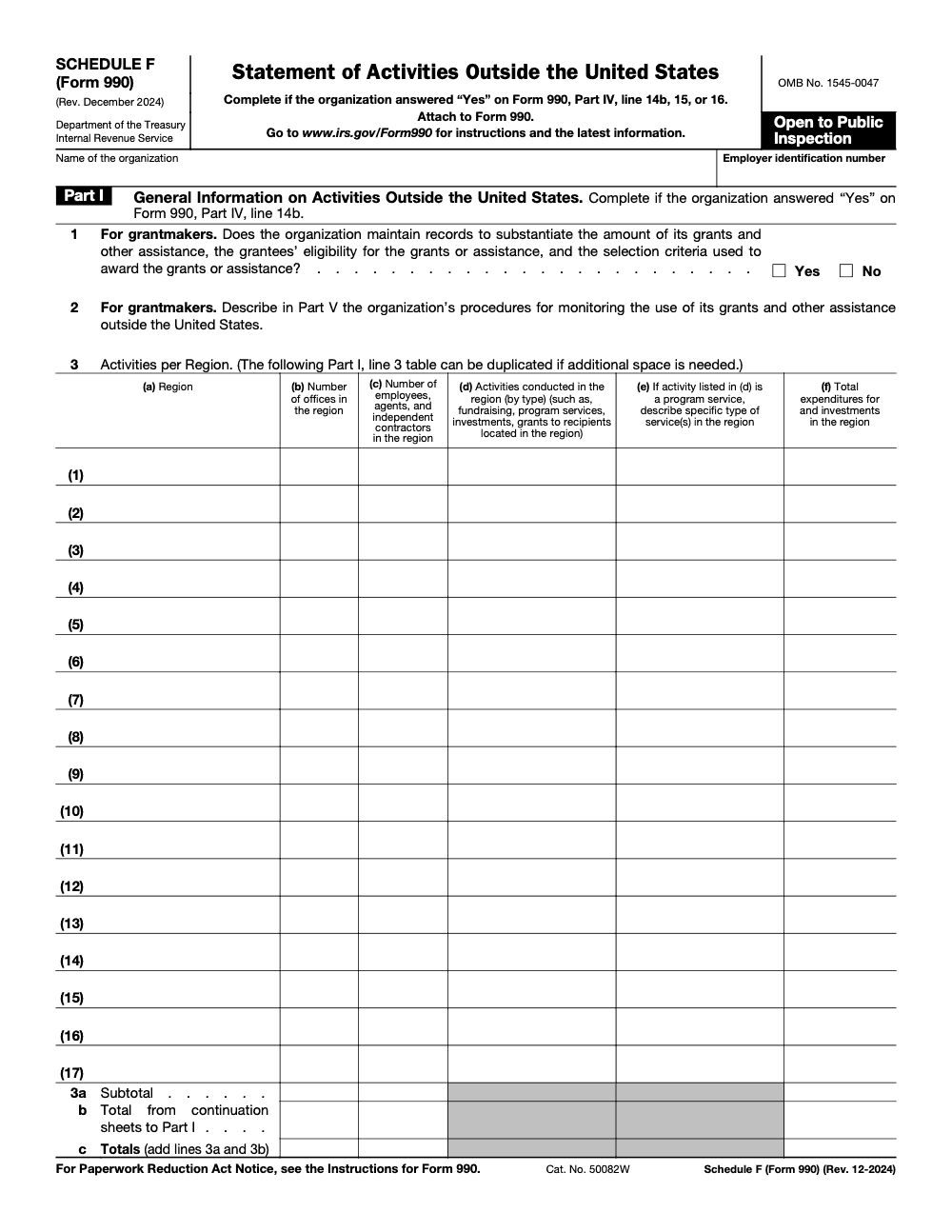
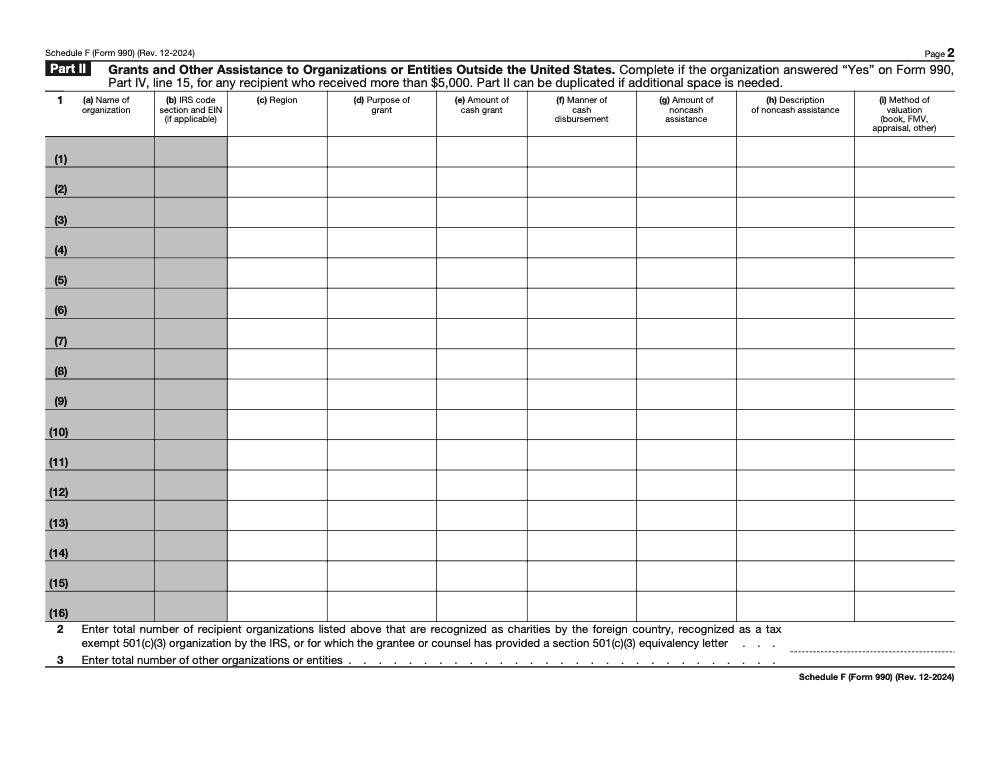
Schedule F (Form 990) is the Statement of Activities Outside the United States – you attach it to Form 990 whenever you answer Yes to Part IV line 14b, 15, or 16, per the Schedule F (Form 990) instructions. Itemize every foreign organization that received more than $5,000 of grants in Part II, then file the schedule with Form 990 by the 15th day of the 5th month after year-end, which is May 15, 2026 for calendar-year 2025 filers; Form 8868 extends that deadline six months.
A growing nonprofit wires a few field grants overseas, sends board members to a conference abroad, and parks some reserves in an offshore fund. None of it feels like foreign activity until it is lined up against Form 990 Part IV, lines 14b, 15, and 16, and Schedule F, the Statement of Activities Outside the United States, comes into scope.
From there the thresholds do the sorting. More than $10,000 in aggregate foreign revenues or expenses, or an aggregate book value of $100,000 or more in foreign investments held at any time during the year, drives which parts you file, and any foreign organization that received more than $5,000 of grants gets itemized in Part II. Map the work by IRS region, pull a clean grant log, and Schedule F becomes a routine tie-out instead of a year-end scramble.
Key Takeaways
- Schedule F is where you disclose activities and dollars outside the United States, summarized by IRS regions and, when required, itemized by recipient.
- Three bright‑line triggers drive which parts you file, more than $10,000 aggregate foreign revenues or expenses or an aggregate book value of $100,000 or more in foreign investments held at any time during the tax year for Part I, more than $5,000 to any single foreign organization for Part II, and any grants or assistance to foreign individuals for Part III, which a Yes on Form 990, Part IV, line 16 turns on with no dollar threshold.
- Investments are reported by the legal domicile of the entity, and they sit on their own lines, separate from operating activity.
- Part V is your narrative proof, explain valuation methods, controls, intermediaries, and monitoring so reviewers can follow your judgment.
What Schedule F covers and why it matters
Schedule F captures your organization’s work outside the United States, including program services, grantmaking, fundraising, unrelated business, and investments, plus whether you maintain offices, employees, or agents abroad. The IRS uses it to confirm that regional activity, grants, and investments are complete and consistently classified, and to route you to other foreign forms when needed. Treat it as a structured story of where you work, who you support, and how you safeguard funds.
Think of Schedule F as your global map. When your ledger, grant log, and narrative all point to the same regions, review becomes a quick tie‑out, not a scramble.
Who must file Schedule F
You must complete one or more parts of Schedule F if you answered Yes to Form 990, Part IV, lines 14b, 15, or 16 (note that a Yes on line 14a alone, which asks about foreign offices or employees, does not by itself require Schedule F; line 14b is the trigger). These correspond to foreign activity totals, grants to foreign organizations, and grants to foreign individuals, respectively. The thresholds are objective and apply across countries, not per country, so a few small projects can still push you over.
Quick threshold table
| Part | Filing trigger | What you disclose | Notes that speed review |
| Part I | More than $10,000 aggregate foreign revenues or expenses during the year, or an aggregate book value of $100,000 or more in foreign investments held at any time during the tax year | Regional lines with revenues, expenses, offices, employees or agents, and activity types; investments listed separately by region | Do not count services performed in the U.S. for foreign audiences as foreign expenses for Part I. |
| Part II | More than $5,000 to any single foreign organization, foreign government, or amounts routed through a domestic intermediary designated for a foreign recipient | One line per qualifying recipient with purpose, region, cash versus noncash, valuation method, and manner of disbursement | Track by recipient, not by country totals. Earmarked pass‑throughs still belong here. |
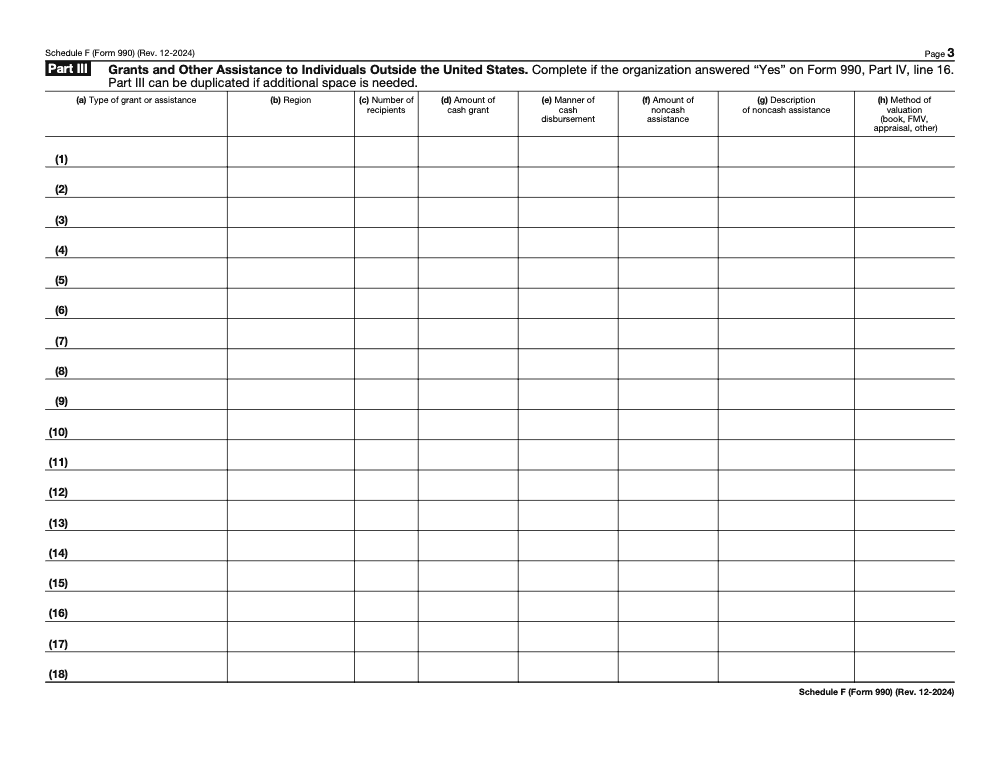
| Part III | A Yes on Form 990, Part IV, line 16 for grants or other assistance to foreign individuals, with no per-individual dollar threshold | Rows aggregated by type of grant or assistance and region, with number of recipients, cash and noncash amounts, manner of disbursement, and valuation method | If aid goes through a foreign organization but is earmarked for named individuals, use Part III. Otherwise, Part II. |
The What‑How‑Wow of Schedule F
- What, a schedule to report non‑U.S. activities and amounts with regional detail and itemized grants when thresholds are met.
- How, code your ledger to IRS regions, separate investments from operations, track grants by recipient, and write a clear Part V narrative that explains methods and controls.
- Wow, you reduce audit risk and speed sign‑off because every number has a home and every judgment is explained in plain language. This turns year‑end into a checklist, not a fire drill.
A short, friendly intro to the parts
- Part I, activities by region, plus foreign investments by legal domicile.
- Part II, grants and other assistance to foreign organizations that cross the $5,000 per recipient threshold.
- Part III, grants and other assistance to foreign individuals, which a Yes on Form 990, Part IV, line 16 turns on, aggregated by type and region with no dollar threshold.
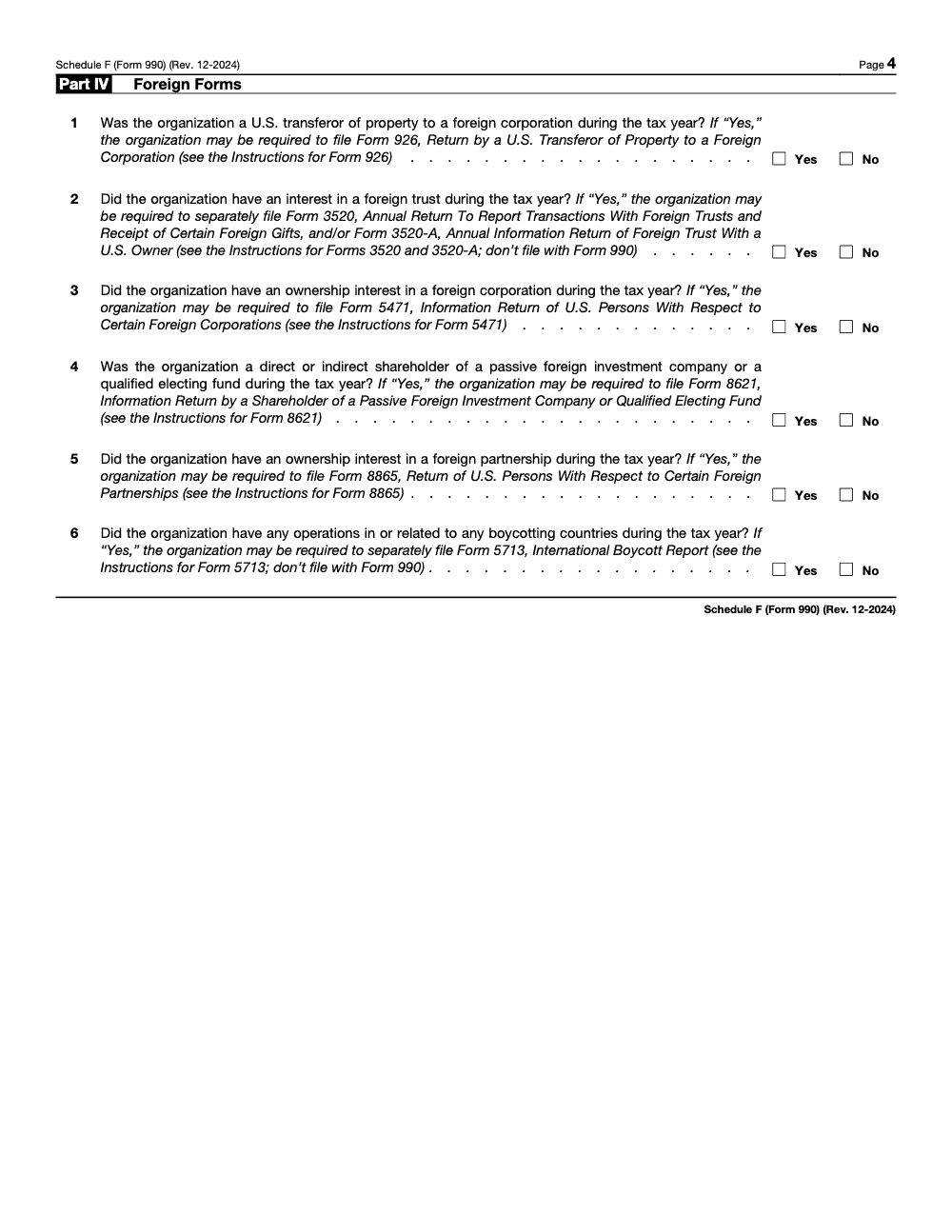
- Part IV, the gateway to separate foreign forms like 926, 3520, 3520‑A, 5471, 5713, 8621, and 8865 when ownership or transfers exist.
- Part V, your narrative for accounting methods, valuation, intermediaries, and monitoring, the place you make your decisions easy to follow.
Use the same region map in your accounting system, travel policy, and 990 workbook. Consistency is what turns raw activity into clean Schedule F reporting.
Part I, reporting activities outside the United States
Once Part I is triggered, list each IRS region where you had foreign activities. If you ran both program services and fundraising in Europe, enter two lines for Europe, one for each activity type. Count offices, employees, and agents accurately. Then tie revenues and expenses to the region where the work happened, not where an invoice was paid.
- Services performed in the United States, even for beneficiaries abroad, are not Part I foreign expenses. Keep them out of Part I to avoid over‑reporting.
- Board travel and speaking at conferences outside the United States belong in Part I when you exceed the threshold. Volunteers are not reported as agents in column c.
Reporting investments correctly
Investments go on their own lines, by region, and you determine the region by the investment entity’s legal domicile, for example, a Cayman fund reports to the Caribbean region even if portfolio companies are elsewhere. You may aggregate all investments within a region and complete only columns a, d, and f for those lines. Do not report foreign investments indirectly held through a domestic pass‑through, those are not foreign for this purpose.
Quick win, create a one‑page investment domicile list at year end, then paste totals by region into Part I. Reviewers love a clean tie‑out.
Column f, what actually belongs there
Part I, column f captures expenditures tied to foreign activity, such as employment costs for staff located abroad, occupancy, grants, banking or agent fees, and similar payments. The IRS allows you to use the same method you apply in your financial statements to track these amounts, which keeps reporting aligned with your books. Some filers will have reportable activity but little or no expenditures in column f, for example, when reporting foreign revenue.
Coding foreign costs so Part I ties out
Your ledger must speak the same language as Schedule F. That means coding travel, events, and on‑site services to the IRS region where the work occurred. If your expense tool defaults to domestic based on airline or origin, override it when the destination or purpose is abroad. A simple monthly review of “international travel” entries catches drift before year‑end.
Steps that work:
- Decide the activity first, program, grantmaking, fundraising, business, or investment.
- Pick the IRS region that matches where the work occurred.
- Code all related costs to that region, including U.S. legs that only exist to support the foreign activity.
- Keep investments separate and report them by legal domicile.
Save a region mapping tab in your 990 workbook and add three examples per region, for example, “Berlin conference, Europe,” “Kampala field work, Sub‑Saharan Africa,” “Luxembourg‑domiciled fund, Europe.” New staff will code correctly on day one.
Common Part I pitfalls and fast fixes
- Mixing investments with operating activity, fix by moving investments to their own lines and citing the domicile rule.
- Reporting U.S.‑performed services as foreign expenses, fix by removing them from Part I and keeping only out‑of‑country costs.
- Ignoring board travel and conference activity abroad, fix by adding the region and activity type and confirming volunteer status for agents.
Part II, grants and other assistance to foreign organizations or governments
Part II activates when you provide more than $5,000 to any single foreign organization or foreign government during the year (the test is more than $5,000, not $5,000 or more, so a recipient that received exactly $5,000 does not have to be itemized). Amounts routed through a domestic intermediary still belong here if they are designated for a particular foreign recipient. Itemize each recipient with region, purpose, cash and noncash amounts, valuation method, and the manner of disbursement such as wire or check. Track by recipient, not by country totals.
What to document so review is painless:
- Award letters or agreements with purpose, restrictions, and milestones
- Payment proofs that tie to the ledger
- Monitoring reports, photos where relevant, and confirmations of receipt
- Due‑diligence notes, for example, vetting and sanctions checks
- Valuation workpapers for noncash aid, plus a one‑sentence method for Part V
Reporting noncash assistance
Describe the asset clearly and state your valuation method. Fair market value on the transfer date is common. If you use another reasonable method, keep a short workpaper and explain it in Part V. This keeps the number defensible without over‑explaining in the body of the return.
Part III, grants and assistance to foreign individuals
Part III applies when you answered Yes on Form 990, Part IV, line 16 for grants or assistance to foreign individuals (you report by type of grant and region, with no per-individual or aggregate dollar threshold like the more-than-$5,000 test in Part II). Include scholarships, fellowships, stipends, prizes, and designated medical or hardship aid. If funds pass through a foreign organization but are earmarked for named individuals, they still belong in Part III. List the type of grant or assistance, region, number of recipients, cash and noncash amounts, valuation method, and manner of disbursement.
Part II or Part III, use the earmark rule
| Scenario | Part II | Part III |
| Wire to a foreign university for its general scholarship fund | ✓ | |
| Payment to a foreign hospital for a named patient’s care | ✓ | |
| Pass‑through via a U.S. charity to a designated foreign clinic | ✓ | |
| Gift cards delivered to identified families after a flood | ✓ |
If you control who the end recipient is, report in the part that matches that end recipient. Then use Part V to describe any intermediary that helped move the funds.
Keep a quarterly “over 5,000” test by recipient. It turns year‑end itemization into copy‑and‑paste instead of a weekend rebuild.
Documentation and oversight that actually helps reviewers
Build a compact file per recipient and per year. Store the agreement, payment support, monitoring, due diligence, and valuation notes together. Add a one‑line summary you can paste into Part V, for example, “FMV from manufacturer price list on 2025‑03‑14, quarterly reports with receipts, wire to verified account.” Reviewers can answer most questions without pinging your team.
Part IV, the foreign forms gateway
Answer Part IV, lines 1 through 6 carefully, then map each Yes to the separate form and deadline. Depending on your facts, this can include Forms 926, 3520, 3520‑A, 5471, 5713, 8621, or 8865. These are filed separately when required, and they address transfers, ownership interests, boycott reporting, PFIC holdings, and foreign partnerships. Keep a one‑page tracker that lists the responsible person and due date for each.
Part V, your narrative that proves control
Parts I to III show the who, where, and how much. Part V explains the why and how. Describe selection criteria for grantees, how you monitor results, how you value noncash items, and how you handle installment or present‑value grants in your books. If you used an intermediary, say so and explain how you kept control. This short narrative is the fastest way to reduce back‑and‑forth during review.
Copy‑ready Part V example
We pay universities directly each term for named scholarship recipients selected by our committee using published criteria. We require term reports that list recipients and amounts applied. For in‑kind equipment, we record fair market value on the transfer date using current catalog pricing or an independent quote and require a signed receipt within 30 days.
Regions and countries, mapping made simple
Use the IRS region list when you code activity. Map where the work happened, not airline zones or internal CRM tags. For investments, use the legal domicile of the entity. Keep a master tab that shows your mapping choices and three examples per region, then reuse it each year so coding stays consistent.
Fast process you can run every year
- Publish your region map and account codes before the year starts.
- Each month, spot check a few international travel or foreign vendor entries and confirm region codes.
- Each quarter, group foreign grants by recipient and test who crossed $5,000.
- In Q4, confirm legal domicile for each foreign investment and draft your Part V blurbs.
- At close, reconcile Part I regional totals to your GL and review Parts II and III with grant owners.
Where Accountably fits, only when you need disciplined delivery
Most firms do not struggle with the rules, they struggle with the work. Review loops expand, files look different across preparers, and seasonal spikes make deadlines stressful. If you want production stability with clean reviews, Accountably can embed trained offshore teams into your workflow, use your templates, follow SOPs, and protect reviewers with clear workpaper standards. You keep control, and delivery stops being the ceiling.
Closing checklist, a 30‑minute pre‑filing pass
- Confirm which parts are triggered and tie Part I to the GL.
- List investments by legal domicile and paste totals by region.
- Rebuild the grant log by recipient, then test $5,000 thresholds.
- Scan noncash items, make sure each has a valuation note and a Part V sentence.
- Assign owners for any Part IV forms and log due dates.
Small habit, big payoff, read your Part V aloud. If a board member can follow your controls in two minutes, you wrote enough.
Note, we verified thresholds and rules against IRS pages last reviewed between January and June 2025. Always check the current IRS instructions before filing, since the Service now uses continuous‑use forms and updates online guidance as needed.
Common Mistakes We See Every Season
The rules trip people up less than the edge cases do. Here are the misreads my team catches most often on Schedule F, and the quick fixes we paste into our review notes.
Reusable Checklists
These are copy-paste ready for your firm SOP folder. Drop them into your 990 workbook and reuse them each season.
Schedule F trigger and scope check
- Confirm the Yes answers on Form 990, Part IV, lines 14b, 15, and 16.
- Complete Part I when line 14b is Yes, listing each IRS region of activity.
- Complete Part II when line 15 is Yes for every foreign organization paid more than $5,000.
- Complete Part III when line 16 is Yes for grants and assistance to foreign individuals.
- Confirm you file the full Form 990, since Form 990-EZ and 990-N filers do not attach Schedule F.
- Record the manner of disbursement and the valuation method (book, FMV, appraisal, or other) for each grant.
Part IV separate-forms tracker
- Line 1, U.S. transfer of property to a foreign corporation, check whether Form 926 is due.
- Line 2, interest in a foreign trust, check whether Form 3520 or 3520-A is due, filed separately.
- Line 3, ownership in a foreign corporation, check whether Form 5471 is due.
- Line 4, PFIC or qualified electing fund holding, check whether Form 8621 is due.
- Line 5, interest in a foreign partnership, check whether Form 8865 is due.
- Line 6, operations in a boycotting country, check whether Form 5713 is due, filed separately.
- Assign an owner and a due date to each separate form you flagged.
Part V narrative and close pass
- Describe how you monitor the use of grants and assistance outside the United States.
- State the accounting method used for Part I region expenditures and for grants in Parts II and III.
- Explain how you estimated any Part III recipient counts.
- Tie Part I regional totals back to the general ledger.
- Confirm Schedule F is e-filed with Form 990 by the 15th day of the 5th month after year-end, or the extended date if you filed Form 8868.
Keep Form 990 Schedule F Season From Stalling
Schedule F work clusters right where capacity is tightest. Calendar-year filers face a May 15 deadline, the 15th day of the 5th month after year-end, and the schedule pulls together a full year of regional coding, recipient-level grant logs, and Part IV form triggers all at once. Per IRS Publication 557, an incomplete or late Form 990 can run $100 per day up to $50,000 for larger organizations, and three consecutive years of non-filing ends exempt status, so a rushed Schedule F is an expensive place to cut corners.
The fix is not more hours in May, it is moving the work upstream so the schedule almost builds itself. When region coding, grant tracking, and valuation notes are captured as the activity happens, the year-end pass becomes a tie-out instead of a rebuild.
- Code every foreign cost to the right IRS region as it posts, so Part I column f ties to the general ledger without a year-end cleanup.
- Run a quarterly over-$5,000 test by recipient, so Part II itemization is copy-and-paste rather than a weekend rebuild.
- Keep a per-grant file with the valuation method and a one-line Part V summary, so noncash assistance is defensible on sight.
- Maintain a live Part IV tracker that assigns an owner and due date to any Form 926, 5471, 8621, or 8865, plus the separately filed 3520, 3520-A, and 5713.
That upstream discipline is exactly what we build into engagements. If your reviewers are buried every close, our tax outsourcing and offshoring teams can run the region coding, grant logs, and Part V drafting inside your workflow, so the schedule is ready before the deadline pressure hits.
FAQs
It is the attachment where you report activities conducted outside the United States, with regional detail plus itemized grants to foreign organizations and individuals when the thresholds are met.
Any filer that crosses one or more triggers, more than $10,000 aggregate foreign revenues or expenses or an aggregate book value of $100,000 or more in foreign investments held at any time during the tax year for Part I, more than $5,000 to any single foreign organization for Part II, and any grants or assistance to foreign individuals for Part III, which a Yes on Form 990, Part IV, line 16 turns on with no dollar threshold.
Yes, if you exceed the threshold, report them in Part I by region. Volunteers are not reported as agents in column c.
On separate lines by region, based on the legal domicile of the investment entity. You can aggregate all investments within a region and complete only columns a, d, and f.
Report expenditures tied to foreign activity, such as employment, occupancy, grants, banking, and agent fees, using the same method you use in your financial statements to track amounts.
Other forms this guide names
- Form 990: Nonprofit Tax Return Filing Guide 2025
- Form 3520: Guide to Foreign Gifts and Trust Reporting
- Form 3520-A: Filing Guide, Deadlines & Penalties
- Form 926: Transfers to Foreign Corporations Filing Guide
- Form 5471: Filing Categories, Schedules, Penalties
- Form 5471: Schedule I‑1, GILTI, Tested Income and QBAI Guide
Summarize this article with AI
About this guide
Accountably helps US CPA, EA, and accounting firms hire trained accountants and tax preparers in India.
About us Reviewed byJugal Thacker, CPAFounder and CEO at Accountably
A Washington-licensed CPA with 7+ years inside US firms – PwC, a real-estate tax practice, then a full-service firm, rising from reviewer to manager to advisory. This article was reviewed against current IRS guidance for the 2025 tax year and updated for filers preparing late returns, amendments, and 2026 estimates.
View profile →How we research, review, and update this guide
Every Accountably guide is researched against primary IRS sources, reviewed by a U.S. CPA, and refreshed as guidance evolves. Read our Editorial Guidelines to see how we source, fact-check, and update our content.