Summarize this article with AI
In Brief
Form 8879-EMP is the IRS e-file signature authorization for the 94x employment tax return family – the employer and the ERO each sign with a five-digit PIN to e-file Form 940, 941, 943, 944, or 945, plus 941-X, 943-X, and 945-X amendments now supported via Modernized e-File (per Form 8879-EMP, Rev. December 2024 instructions). The ERO retains the signed form for four years from the return due date or IRS received date, whichever is later, and does not mail it to the IRS.
Most 8879-EMP problems are not tax math, they are mismatches. The employer and the ERO each sign a 94x return with a five digit PIN to e-file a Form 940, 941, 943, 944, or 945, and the amounts on the form have to match the lines on the return exactly. A zero typed where the e-file shows a blank, or a balance-due figure left over from a last-minute edit, is enough to trigger a reject.
Two other details earn their keep. If you authorize an Electronic Funds Withdrawal, the debit has to match the return and date you approved, and to cancel it you call the Treasury Financial Agent no later than two business days before settlement. And the signed form stays in the ERO's files for four years from the later of the return due date or IRS received date, not with the IRS.
Key Takeaways
- Use Form 8879-EMP when you and your ERO agree to sign the 94x return with a five-digit PIN. If the PIN method is not used, you must use Form 8453-EMP instead. Do not send 8879-EMP to the IRS unless they specifically request it.
- Enter the exact amounts the form asks for, drawn from the specific lines on the return you are filing. Leave a line blank if the return line is blank, do not type “-0-” unless the return shows zero.
- If you authorize Electronic Funds Withdrawal, your debit must match the return and date you approved. To revoke, call the Treasury Financial Agent no later than two business days before the scheduled settlement.
- The ERO must keep the signed 8879-EMP. The current 8879-EMP instructions say retain it for four years from the return due date or IRS received date, whichever is later.
- Get the current PDF from IRS.gov and check the latest revision. As of July 8, 2025, the “About Form 8879-EMP” page confirms current status and links to the form.
What is Form 8879-EMP
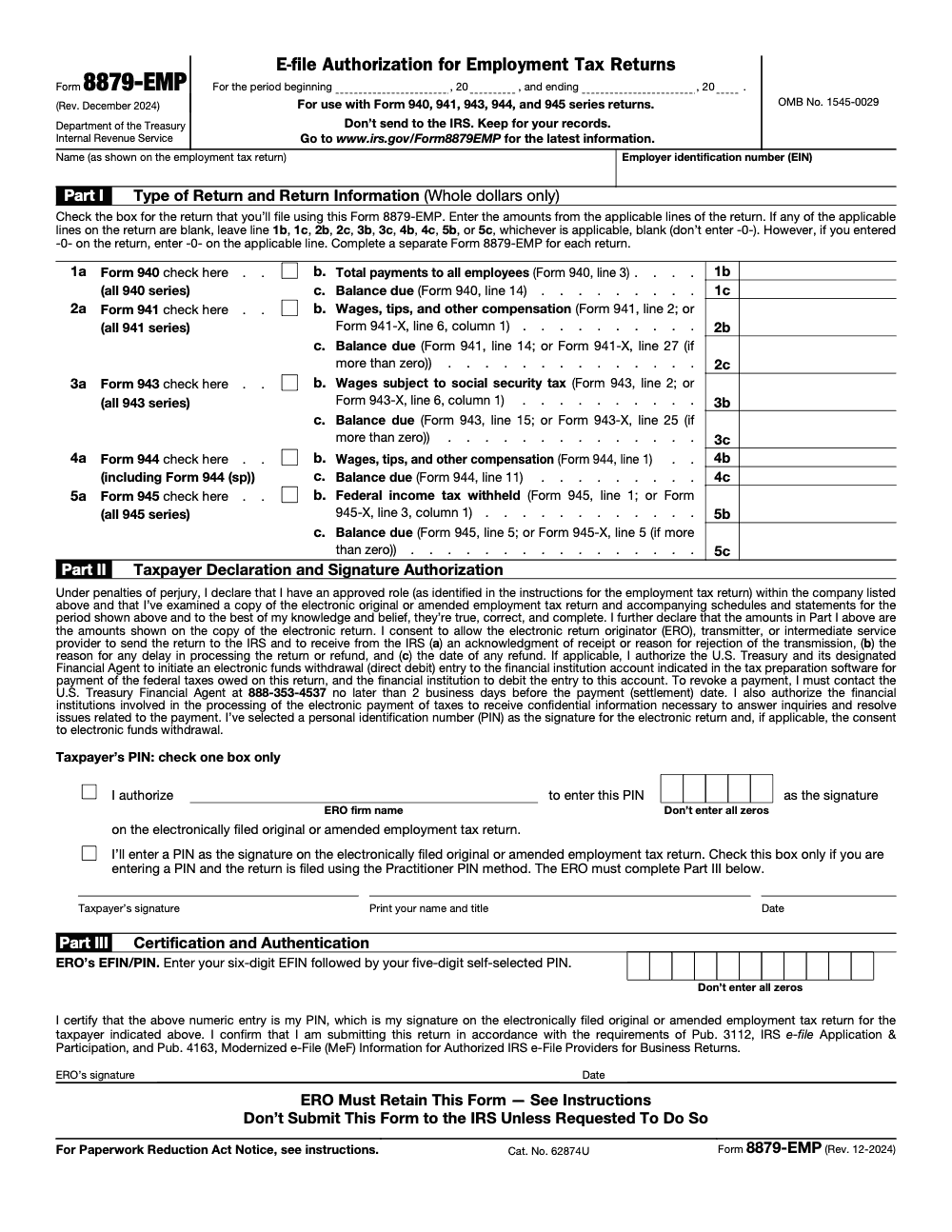
Form 8879-EMP is the IRS e-file Signature Authorization for employment tax returns. It lets you sign an electronic Form 940, 941, 943, 944, or 945 with a five-digit PIN and authorize your ERO to submit the return. If you choose, it also authorizes an electronic funds withdrawal tied to that return.
The form captures your legal name and EIN, the return you are filing, and a couple of specific dollar amounts the IRS uses to validate that the signed authorization matches the transmitted return. You sign Part II, and your ERO signs Part III, which includes their EFIN and ERO PIN.
Who should use this form
Use Form 8879-EMP if you are e-filing a 94x return and you and your ERO agree to use the PIN method. That includes original returns and, when applicable, amended X-series filings covered by the form. If you do not use a PIN, you must use Form 8453-EMP, scan it, and attach it to the e-filed return. Reporting agents that sign using a five-digit reporting agent PIN follow different rules, so 8879-EMP usually does not apply to them.
When to use Form 8879-EMP vs Form 8453-EMP
If you plan to e-sign with a five-digit PIN, use 8879-EMP. If you prefer a paper declaration or your software does not support the PIN method, use 8453-EMP, scan it, and attach it to the electronic return. The IRS’ employment tax e-signature page states this decision clearly.
Quick comparison
| Scenario | Use 8879-EMP | Use 8453-EMP |
| You and your ERO will use a five-digit PIN | Yes | No |
| You want a paper declaration instead of a PIN | No | Yes |
| You will authorize Electronic Funds Withdrawal via the PIN method | Yes | No |
| Your software does not support the PIN method | No | Yes |
| What to do with the signed document | ERO keeps it, do not send to IRS | Scan and attach to the e-filed return |
Source: IRS employment tax Modernized e-File e-signature methods.
Where to get the latest PDF
Always download the current Form 8879-EMP directly from IRS.gov and confirm the revision on the form. The IRS “About Form 8879-EMP” page, last reviewed July 8, 2025, links to the current PDF. The latest version shows “Rev. December 2024,” and includes the exact line references and the four-year retention instruction for EROs.
Tip: Check the revision on the form itself and make sure your software uses the same revision. Mismatched revisions can trigger validation issues during transmission.
Information you need before you start
Before you touch the form, gather the essentials so you only sign once.
- Employer legal name and nine-digit EIN, exactly as they appear on the return.
- The specific return you are authorizing, 940, 941, 943, 944, or 945, including whether it is an amended X-series filing.
- The exact amounts the form requires from the return’s listed lines. Leave a line blank on 8879-EMP if the same line is blank on the return. Only enter “-0-” if the return shows zero.
- Your five-digit PIN, either you enter it or you authorize the ERO to enter it (the PIN must be five numbers and cannot be all zeros, default 00000 values are rejected).
- If authorizing Electronic Funds Withdrawal, routing and account numbers, the payment date, and awareness that revocation must happen at least two business days before the scheduled settlement by calling the Treasury Financial Agent.
Accountably note: our review checklists include a literal side-by-side of each Part I figure and the final e-file numbers. That tiny pause prevents the classic “last edit after signature” problem that causes rejects.
Top-of-form entries and recordkeeping rules
Even if your software pre-fills data, confirm every character in the employer name and EIN, and make sure the return period on 8879-EMP matches the electronic return you are filing. If you are authorizing an X-series amendment, verify the X-form is selected and the correct X-line amounts will be used in Part I.
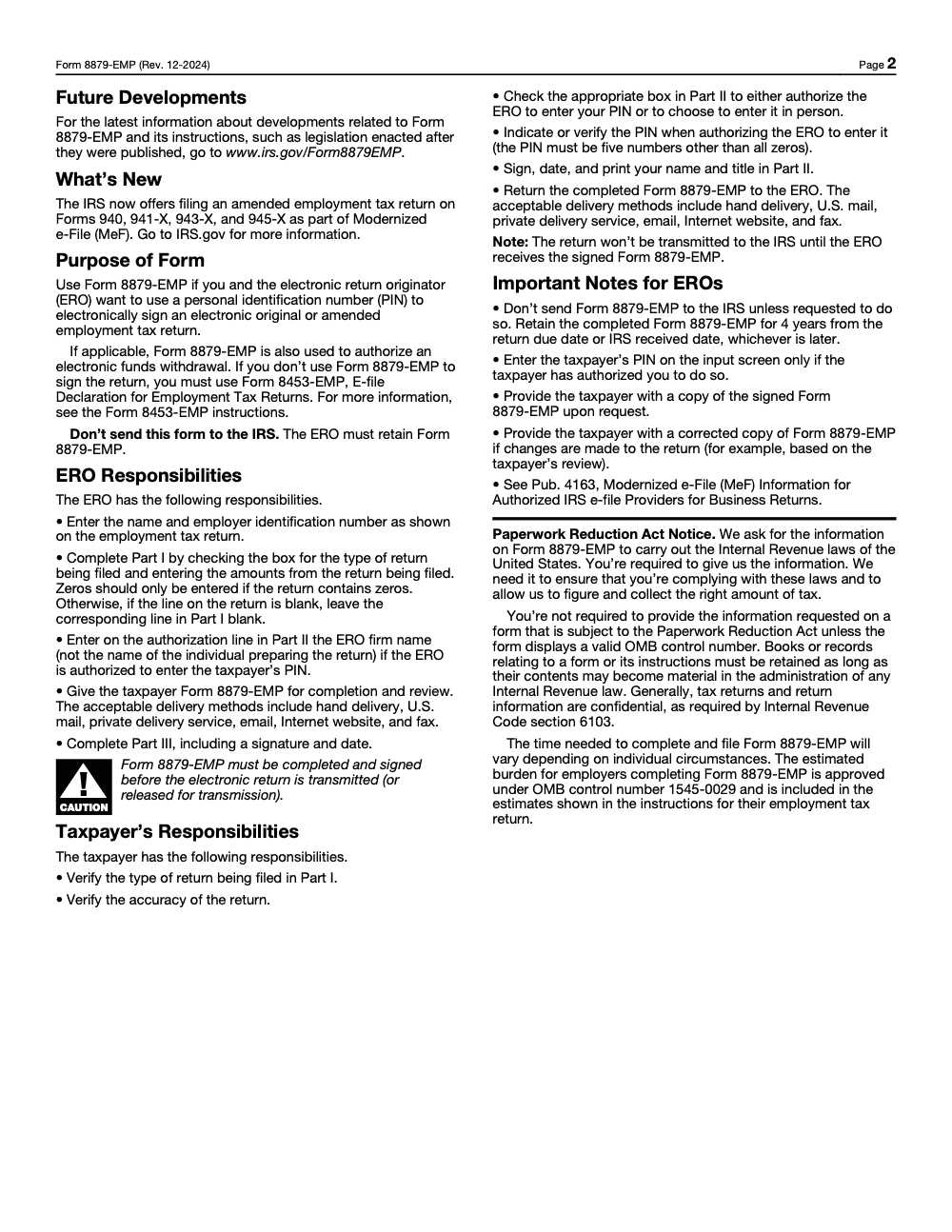
Do not mail Form 8879-EMP. Your ERO must keep it, and per the current 8879-EMP instructions, keep it for four years from the due date or IRS received date, whichever is later.
Why the four-year note matters: some IRS webpages and IRM sections refer to a three-year retention for other 8879-series contexts. The 8879-EMP form instructions are specific and state four years. Follow the form you are using.
Part I, selecting the return and entering the right lines
Part I is where accuracy makes or breaks your submission. First, check the single box for the return you are filing, then enter the exact amounts the form asks for from that return (Part I is labeled whole dollars only, do not carry over cents from the underlying return). If the return line is blank, leave the corresponding 8879-EMP line blank. If the return shows “0,” then enter “-0-” on 8879-EMP.
Return-to-line map you can trust
- Form 941, enter wages, tips, and other compensation from Line 2, and the balance due from Line 14. For 941-X, use Line 6 column 1 and Line 27 if greater than zero.
- Form 940, enter total payments to all employees from Line 3, and balance due from Line 14.
- Form 943, enter wages subject to Social Security from Line 2, and balance due from Line 15, or 943-X Line 25 if greater than zero.
- Form 944, enter wages, tips, and other compensation from Line 1, and balance due from Line 11.
- Form 945, enter federal income tax withheld from Line 1, and balance due from Line 5, or for 945-X, Line 5 if greater than zero.
Quick reference table
| Return | Key wages or tax line | Balance due line |
| 941 | Line 2 | Line 14 |
| 940 | Line 3 | Line 14 |
| 943 | Line 2 | Line 15 |
| 944 | Line 1 | Line 11 |
| 945 | Line 1 | Line 5 |
Source: Form 8879-EMP, Rev. December 2024. Cross-check 941 line labels with the current year instructions. As of March 2025 instructions, 941 wages are on Line 2 and balance due is Line 14.
Match the return period, exactly
After you select the form, enter the same tax period that appears on the electronic return. Mismatched periods or EIN variations are common reject triggers. When you are filing an amended 941-X, 943-X, or 945-X, confirm you are pulling the amounts from the X-form lines noted on 8879-EMP.
Pro move: lock the return, export a PDF, and enter the Part I amounts from that exported copy. That way, if anyone edits the return later, you will catch the change before signing again.
Parts II and III, declarations, signatures, and PINs
Part II is your declaration under penalties of perjury that you reviewed the electronic return and that it is true, correct, and complete. You also choose who enters the five-digit PIN, you or the ERO firm you authorize, then you sign and date. If you are authorizing Electronic Funds Withdrawal, this is where you give consent for the debit, and you accept responsibility for the amount and date.
The form also includes a consumer-friendly payment safeguard. If you need to revoke a scheduled EFW, the taxpayer must contact the Treasury Financial Agent directly at 888-353-4537 no later than two business days before the settlement date (the ERO has no role in revocation and cannot do this on the taxpayer's behalf). After you sign, your ERO keeps the signed form.
Part III is the ERO’s certification. They enter their EFIN and five-digit ERO PIN, sign, and date, and certify they are filing within the rules of Publication 3112 and Publication 4163.
Who actually signs 94x returns with a PIN
- Taxpayer PIN method, use 8879-EMP with your ERO, you sign with a five-digit PIN.
- Reporting agent PIN method, the reporting agent signs the 94x returns using a five-digit reporting agent PIN tied to Form 8655 authorization. This is a different model, and 8879-EMP is not used in that setup.
ERO responsibilities you should expect
The 8879-EMP instructions spell out the ERO’s job. They must complete Part I with the correct return and line amounts, give you the form to review and sign before transmission, complete Part III, and retain the signed form for four years. On request, they must provide you a copy of the signed form, and provide a corrected copy if anything changes.
Accountably’s take: we build these steps into the workflow so they are not optional. In our support for firms, we require two checks before signature capture, one at data entry and one at packaging, and we log retention windows so 8879-EMP never goes missing during an IRS audit window. This is the kind of delivery discipline most firms want but struggle to enforce during peak.
Authorizing Electronic Funds Withdrawal, the right way
If you choose EFW, your authorization on 8879-EMP allows the U.S. Treasury Financial Agent to debit the bank account shown in your software for the exact amount and date tied to the return. The IRS validates those figures against the e-file. If the numbers do not match, you risk a reject or a payment mismatch. If you need to revoke the payment, call 888-353-4537 at least two business days before the settlement date.
EFW checklist: confirm routing and account numbers, confirm the settlement date, double-check the balance-due amount against the return, and save the signed 8879-EMP with the bank authorization details visible.
Common mistakes that cause delays
Across the 8879-EMP work we support, the same patterns generate the bulk of preventable rejects and rework. Most of them surface in the last hour before transmission, which is exactly when nobody has time to fix them cleanly.
Step-by-step, filling Form 8879-EMP without drama
- Pick the right form box in Part I, 940, 941, 943, 944, or 945, and confirm original versus X-series if amended.
- Enter the exact amounts from the specified lines on that return, for example 941 Line 2 and Line 14, leaving the 8879-EMP line blank if the return line is blank, and using “-0-” only if the return shows zero.
- In Part II, choose who enters the five-digit PIN, you or the ERO firm you name, then sign and date.
- If authorizing EFW, verify the bank account and payment date in your software match the return and your intent. Keep in mind the two-business-day revocation window.
- Your ERO completes Part III with their EFIN and ERO PIN, signs, and dates. They transmit only after they have your signed 8879-EMP in hand.
- Your ERO retains the signed form for four years. You may request a copy at any time.
Where line numbers trip people up
Line labels can change over the years, which is why it helps to cross-check the current-year instructions for the underlying return when you are unsure. For example, for 2025 Form 941, wages, tips, and other compensation remain on Line 2, and balance due remains on Line 14. When in doubt, confirm with that year’s Instructions for Form 941.
PIN options at a glance
- Self-select five-digit PIN via 8879-EMP with your ERO.
- Reporting agent five-digit PIN, available only when a reporting agent has a valid Form 8655 on file. Different process, not 8879-EMP.
Getting the current form, and staying current
Use the IRS “About Form 8879-EMP” page to access the latest PDF and confirm the revision. As of July 8, 2025, the page lists the current revision and links directly to the form. The Rev. December 2024 PDF includes the latest line mapping and the four-year retention instruction. Bookmark the page and check it each filing season.
If you operate in software that automatically generates 8879-EMP, verify the software vendor updated to the current revision. If your software cannot support the PIN method for a specific return, use 8453-EMP, scan it, and attach it to the e-filed submission. The IRS e-signature methods page explains this fallback clearly.
Operational best practices we recommend
- Lock the return before pulling Part I figures, then unlock only if edits are required.
- Store the signed 8879-EMP with a consistent file name, for example EIN_ReturnType_Period_8879-EMP_YYYYMMDD.pdf.
- Track retention windows. For 8879-EMP, use a four-year timer from due date or IRS received date.
- If you authorize EFW, include a note with the payment amount and scheduled date in the workpapers for easy review.
Accountably helps firms wire these practices into daily operations, not as “extra work,” but as the standard way the work gets done. That keeps partners out of review loops and keeps filings on schedule without last-minute scrambles.
Final checklist before you sign
- Confirm EIN, legal name, and period match the return.
- Select the single correct return box, 940, 941, 943, 944, or 945.
- Enter the exact line amounts 8879-EMP requests, no placeholders.
- Decide who will enter the five-digit PIN, you or the ERO firm you name.
- If authorizing EFW, verify the amount and date, and remember the two-business-day revocation window.
- Make sure your ERO signs Part III and retains the signed form, four-year rule.
As of November 12, 2025, the IRS pages cited here list 8879-EMP as the PIN signature authorization for 94x returns, and the Rev. December 2024 form PDF includes the four-year retention instruction for EROs. Always confirm the latest revision on IRS.gov before filing.
If you want help turning this into a living SOP your whole team can follow, our Accountably delivery playbooks standardize the review loop, lock in line-accuracy checks, and track retention automatically so you file clean and on time, quarter after quarter.
Reusable Checklists
These checklists are copy-paste ready for engagement SOPs and review workpapers. Each one tracks state in the browser, so a reviewer returning later can see where the team left off.
Pre-signature 8879-EMP packet
- Lock the underlying 94x return (940, 941, 943, 944, or 945) before pulling Part I figures.
- Confirm employer legal name and nine-digit EIN match the return character for character.
- Verify the period beginning and ending dates on 8879-EMP equal the period on the return.
- Pull each Part I amount from the locked return PDF, in whole dollars, leaving blank lines blank.
- Confirm the single correct return box is checked in Part I (line 1a, 2a, 3a, 4a, or 5a).
- If the return is amended, confirm the X-form is selected and X-line amounts are used.
- Decide who enters the five-digit PIN and check the matching Part II authorization box.
- Send the form for taxpayer signature with EFW details, if any, clearly summarized.
ERO Part III completion
- Enter the ERO firm name on the authorization line, not the individual preparer's name.
- Enter the six-digit EFIN followed by the five-digit ERO PIN (eleven characters total).
- Confirm the ERO PIN is not 00000 and contains at least one non-zero digit.
- Date Part III on or after the taxpayer's signature date in Part II, never before.
- Confirm Pub. 3112 and Pub. 4163 compliance is current for the EFIN before transmission.
- Attach the signed 8879-EMP to the engagement record before releasing the return for MeF transmission.
- If the return changed after signature, prepare and route a corrected 8879-EMP for fresh signature.
EFW authorization and retention tracker
- Verify the routing number, account number, and account type on the EFW authorization.
- Confirm the EFW debit amount equals the balance due reported on the underlying return.
- Set the scheduled settlement date and document the two-business-day revocation cutoff.
- Email the taxpayer the Treasury Financial Agent number, 888-353-4537, with the revocation window.
- Log the signed 8879-EMP into the retention calendar with a four-year alarm from due date or received date, whichever is later.
- Store the signed form with a consistent file name: EIN_ReturnType_Period_8879-EMP_YYYYMMDD.pdf.
- Tag the engagement so the form is producible on IRS request without re-keying.
Keep 8879-EMP Season From Stalling
8879-EMP volume hits hardest at the close of each 94x cycle: the January 31 deadline for Form 940 and Q4 941, the quarterly 941 windows in April, July, and October, and the rolling X-series amendments that flow through Modernized e-File for 941-X, 943-X, and 945-X (now supported per the December 2024 revision of Form 8879-EMP). Most teams hold the work until the last forty-eight hours of the cycle, which is exactly when line-mismatch rejects, missing PINs, and forgotten EFW authorizations create the worst kind of rework.
The fix is not faster typing; it is moving the 8879-EMP step earlier in the engagement and treating it as a controlled checkpoint. The fields are short and the rules are explicit (Rev. December 2024 instructions spell out blank-versus-zero, four-year retention, five-digit PIN, and EFW authorization), so almost every reject we see traces back to a step that was skipped under time pressure.
- Sequence the 8879-EMP draft right after the return is locked, not after the cover letter is written, so Part I amounts reflect the final figures.
- Map each Part I line to its source in advance: 941 Line 2 and Line 14, 940 Line 3 and Line 14, 943 Line 2 and Line 15, 944 Line 1 and Line 11, 945 Line 1 and Line 5, plus the corresponding X-form line for amended returns.
- Apply the blank-versus-zero rule mechanically: a blank line on the underlying return stays blank on 8879-EMP, and -0- on the return becomes -0- on the form, in whole dollars only.
- Schedule the EFW authorization conversation before signature: confirm bank details, the settlement date, and the two-business-day revocation cutoff with the Treasury Financial Agent at 888-353-4537.
- Tag the signed form to a four-year retention calendar from the return due date or IRS received date, whichever is later, so it never disappears into a year-by-year archive.
That sequence is exactly what our U.S. accounting and tax outsourcing teams wire into the daily 94x workflow: Part I figures pulled from locked returns, PIN values validated against the IRS five-digit rule before signature, and retention tracked automatically. Teams that adopt the same checkpoint discipline stop discovering 8879-EMP issues at transmission and start clearing the form a day or two before the deadline.
FAQs
It is the IRS e-file signature authorization employers use, with their ERO, to sign electronic 94x employment tax returns with a five-digit PIN, and, if checked, to authorize an electronic funds withdrawal that matches the return.
No. Reporting agents who have a valid Form 8655 on file sign 94x returns using a five-digit reporting agent PIN. That model does not use 8879-EMP.
Per the current 8879-EMP instructions, retain it for four years from the return due date or IRS received date, whichever is later. Do not send it to the IRS unless requested.
Yes. Call the Treasury Financial Agent at 888-353-4537 no later than two business days before the scheduled settlement date to revoke an EFW.
Use the IRS “About Form 8879-EMP” page to access the current PDF and confirm the latest revision date. As of July 8, 2025, that page was current.
Yes. Complete a separate 8879-EMP for each return type and period, and enter only the lines the form specifies for that return.
Your authorization must match the transmitted return. If a figure changes, update the return and reissue 8879-EMP for signature before transmission.
Other forms this guide names
About this guide
Accountably helps US CPA, EA, and accounting firms hire trained accountants and tax preparers in India.
About us Reviewed byJugal Thacker, CPAFounder and CEO at Accountably
A Washington-licensed CPA with 7+ years inside US firms – PwC, a real-estate tax practice, then a full-service firm, rising from reviewer to manager to advisory. This article was reviewed against current IRS guidance for the 2025 tax year and updated for filers preparing late returns, amendments, and 2026 estimates.
View profile →How we research, review, and update this guide
Every Accountably guide is researched against primary IRS sources, reviewed by a U.S. CPA, and refreshed as guidance evolves. Read our Editorial Guidelines to see how we source, fact-check, and update our content.